
Sensory causes of diplopia profound Abnormal Retinal Corrspondence
Sensory causes of diplopia profound Abnormal Retinal Corrspondence ARC LIONEL KOWAL MELBOURNE Financial disclosure: There’s no $ in ARC - stick to cataracts
Introduction • ARC & suppression in strabismus are common & prevent symptomatic diplopia in the presence of frank tropia. • ARC prevents confusion about straight- aheadedness and can allow some binocularity despite strabismus. • When strabismic eyes are straightened, ARC usually resolves quickly. • Unresolved ARC will cause (paradoxical) diplopia despite straight eyes. • If the ARC is profound the diplopia may persist. • Profound ARC can often be predicted pre-operatively
Results n=9 • Retrospective chart study. Ages 18 - 62. • 6 were XT. • All : definite or probable childhood-onset strab • 2: first surgery under age 5 • 7: first surgery 16 or older [16, 20, 24, 25, 38, 43, 62] • Risk of paradoxical diplopia due to profound ARC was appreciated pre-operatively in 3 • 1/3: postop suppression, & no postop diplopia
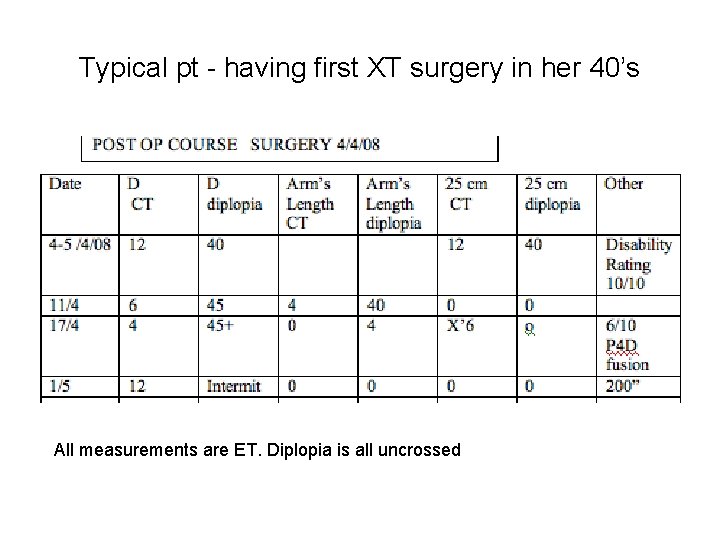
Typical pt - having first XT surgery in her 40’s All measurements are ET. Diplopia is all uncrossed
SH - 1 st ET surgery in her 20’s • LET 20∆, amblyopia 6/30 since childhood. • Early recurrence of ET after Rs+Rc • After 2 nd surgery, straight with ‘new’ visual field in the temporal field of LE • Xed Diplopia on her L in her ‘new’ field ARC only in her new field • Diplopia resolved in 2 mo
Results • Symptoms disappeared in 2 -8 weeks • ARC for near disappeared before distance • Using Fresnel ∆ for diplopia did not hinder resolution of symptoms • 1: diplopia persisting after 8 months • 1: paradoxical ‘ARC’ with the pseudofovea of infantile esotropia acting in exotropia
Conclusion • Most BUT NOT ALL patients with postop paradoxical diplopia due to ARC resolve after surgical alignment. • Deferring alignment surgery to adulthood is a risk factor in this cohort
- Slides: 7