
Sensory and Motor Systems Psychology 2617 Introduction The
- Slides: 14
Sensory and Motor Systems Psychology 2617
Introduction The nervous system basically goes sensory -> inter -> motor neurons l You convert energy from the environment to energy in your nervous system l This is called transduction l Agnosia l
Somatosensory systems Where your body is, what its state is l Proprioception l Mechanical receptors l Chemoreceptors l Thermoreceptors l Nociceptors l Wired contralaterally l
l Ascending spinal thalamic tract l Pain l and temperature Dorsal column medial lemniscal pathway l Goes through medial lemniscus to medula -> pons -> midbrain -> thalamus -> cortex l So again, the thalamus is a sensory clearinghouse or switchboard or whatever
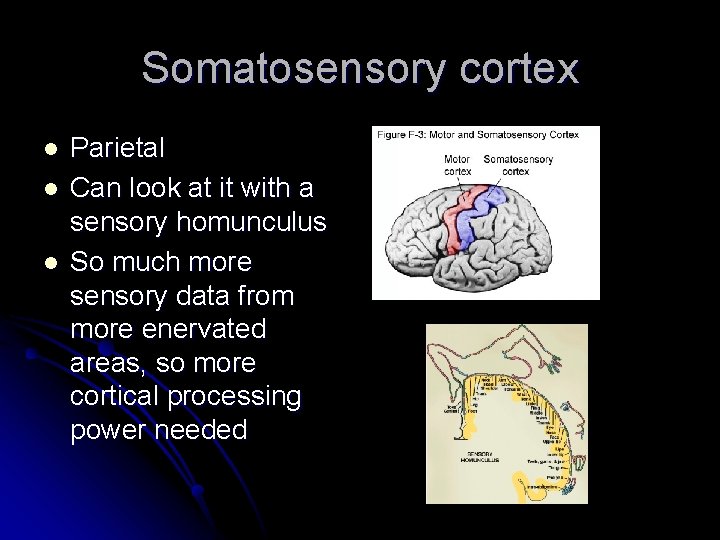
Somatosensory cortex l l l Parietal Can look at it with a sensory homunculus So much more sensory data from more enervated areas, so more cortical processing power needed
Chemical senses Is taste the five types of basic tastes, or is it a pattern? l Fine question…. l Cranial nerves to brainstem (medulla) l Evolutionarily sensible l Smell does not go to the thalamus! l Goes to the olfactory bulb l
Goes to the limbic system, amygdila and Hp l Smell and emotion? l Well many people say this l There is not a whole bunch of data l Smell disorders do happen though l
Vision Basically, it all goes to V 1 – V 5 in occipital lobe l Won’t dwell on this as we did lots last term l Book does a decent job anyway l Blindsight l Neglect l
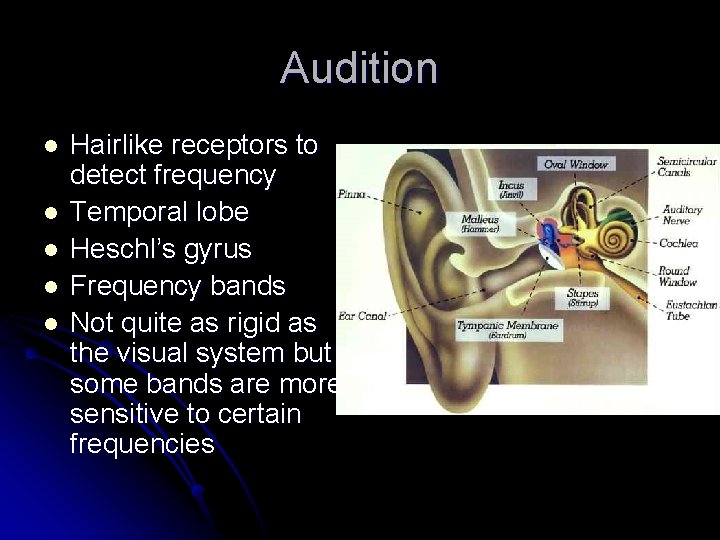
Audition l l l Hairlike receptors to detect frequency Temporal lobe Heschl’s gyrus Frequency bands Not quite as rigid as the visual system but some bands are more sensitive to certain frequencies
Speech and lingo Heschl’s -> Wernicke’s l Makes sense of speech l Now other cortical areas are needed to interpret meaning l Wernicke’s aphasia l l Left meaning l Right, intent l Broca’s for speaking
This is cool People that use ASL as their first language use Broca’s and Wernicke’s as we do! l So they are not necessarily for say auditory processing l They are for language l Only we have ‘em l
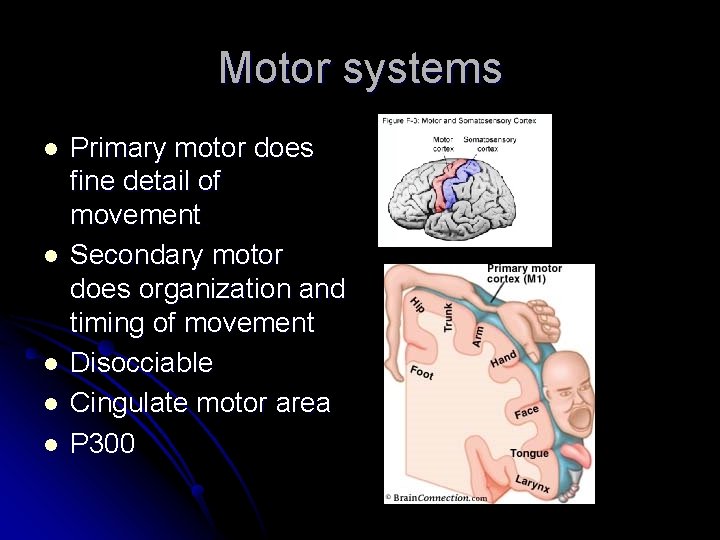
Motor systems l l l Primary motor does fine detail of movement Secondary motor does organization and timing of movement Disocciable Cingulate motor area P 300
Subcortical motor processing Basal ganglia and cerebellum, automatic l Parkinson’s disease and substantia negra of the basal ganglia l Huntington’s affects the cuadate, jerky movement l
conclusions This is just a taste l This stuff is very complex l May be where ‘consciousness’ comes from l Disorders are possible, more on that later l