
Sensors and their characteristics Sensors Devices to record
- Slides: 5
Sensors and their characteristics
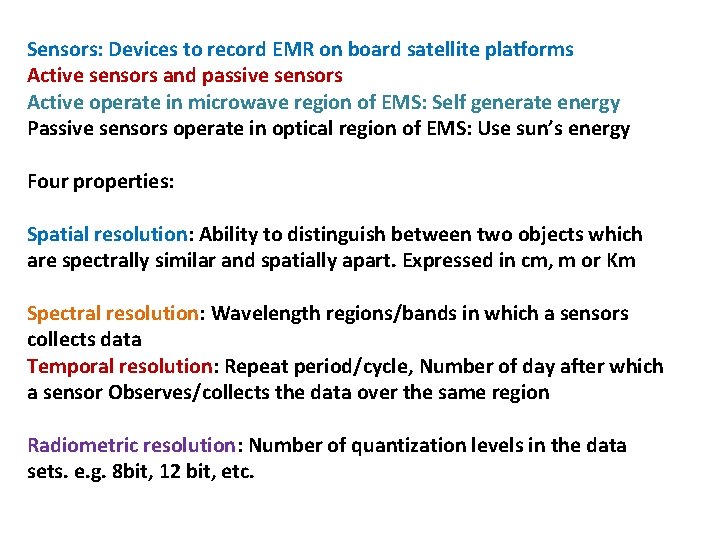
Sensors: Devices to record EMR on board satellite platforms Active sensors and passive sensors Active operate in microwave region of EMS: Self generate energy Passive sensors operate in optical region of EMS: Use sun’s energy Four properties: Spatial resolution: Ability to distinguish between two objects which are spectrally similar and spatially apart. Expressed in cm, m or Km Spectral resolution: Wavelength regions/bands in which a sensors collects data Temporal resolution: Repeat period/cycle, Number of day after which a sensor Observes/collects the data over the same region Radiometric resolution: Number of quantization levels in the data sets. e. g. 8 bit, 12 bit, etc.
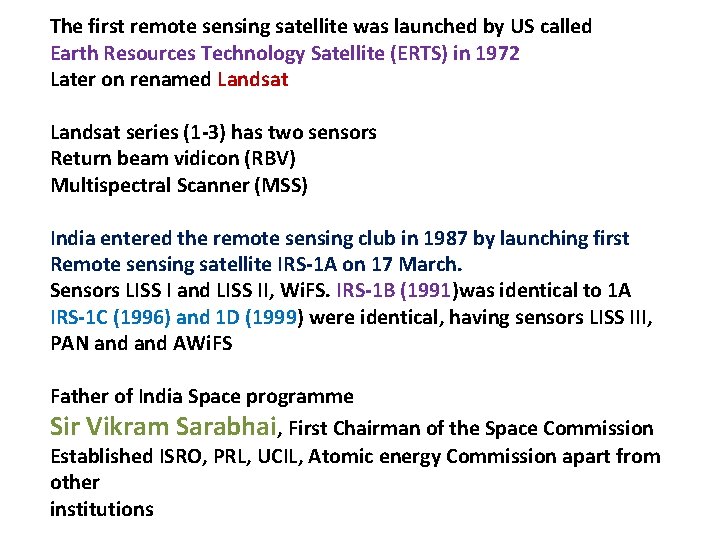
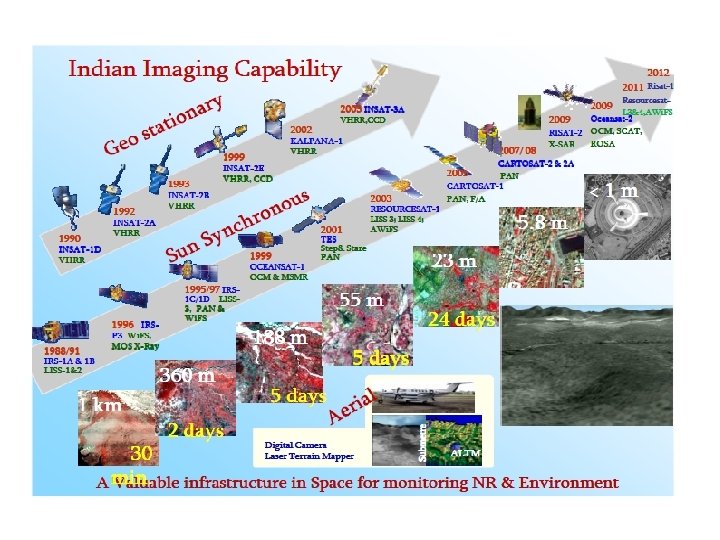
The first remote sensing satellite was launched by US called Earth Resources Technology Satellite (ERTS) in 1972 Later on renamed Landsat series (1 -3) has two sensors Return beam vidicon (RBV) Multispectral Scanner (MSS) India entered the remote sensing club in 1987 by launching first Remote sensing satellite IRS-1 A on 17 March. Sensors LISS I and LISS II, Wi. FS. IRS-1 B (1991)was identical to 1 A IRS-1 C (1996) and 1 D (1999) were identical, having sensors LISS III, PAN and AWi. FS Father of India Space programme Sir Vikram Sarabhai, First Chairman of the Space Commission Established ISRO, PRL, UCIL, Atomic energy Commission apart from other institutions
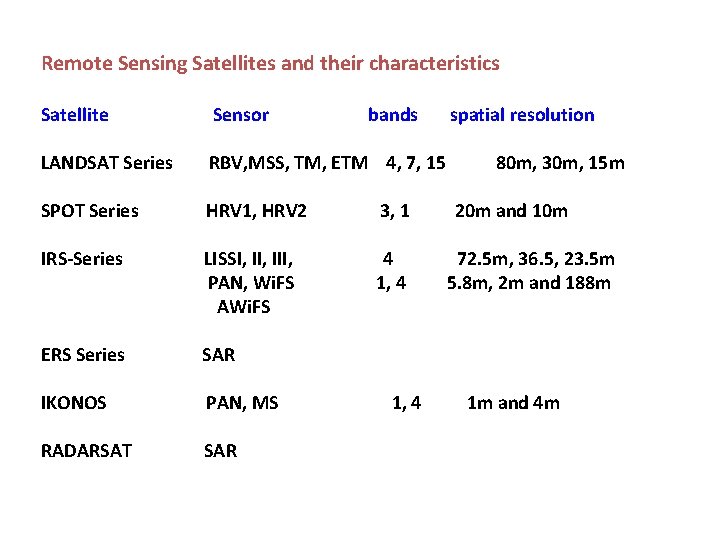
Remote Sensing Satellites and their characteristics Satellite Sensor bands LANDSAT Series RBV, MSS, TM, ETM 4, 7, 15 SPOT Series HRV 1, HRV 2 3, 1 IRS-Series LISSI, III, PAN, Wi. FS AWi. FS 4 1, 4 ERS Series SAR IKONOS PAN, MS RADARSAT SAR 1, 4 spatial resolution 80 m, 30 m, 15 m 20 m and 10 m 72. 5 m, 36. 5, 23. 5 m 5. 8 m, 2 m and 188 m 1 m and 4 m