
Sensori a Fibre Ottiche nellapparato sperimentale CMS al
Sensori a Fibre Ottiche nell'apparato sperimentale CMS al CERN Salvatore Buontempo INFN Napoli on behalf of the FOS 4 CMS Group CERN Ginevra (Svizzera) CNR Napoli, 17 Settembre 2012 Uni Sannio Benevento Uni Federico II Napoli ATOMKI Debrecen (Ungheria) NIKIET Mosca (Russia) Opto. Smart Napoli
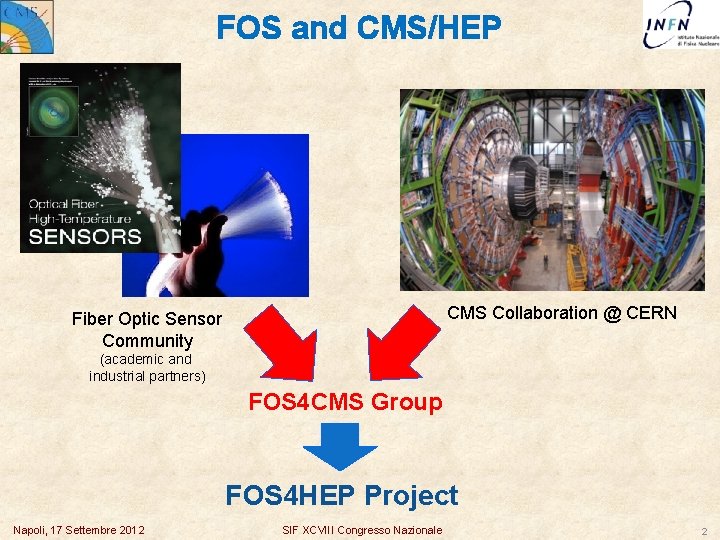
FOS and CMS/HEP CMS Collaboration @ CERN Fiber Optic Sensor Community (academic and industrial partners) FOS 4 CMS Group FOS 4 HEP Project Napoli, 17 Settembre 2012 SIF XCVIII Congresso Nazionale 2
Outline • FBG concept • Overview of FOS sensors in CMS • FOS Infrastructure in CMS • Temperature measurements in CMS with FOS § § Silicon Tracker Bulkheads CMS Underground cavern (UXCsite) Cathod Strip Chamber (CSC-ME 4/1) Pixel Luminosity Telescope (PLT) • Strain measurements in CMS with FOS • Hadron Forward Calorimeter support • Additional CMS T and strain FOS installations planned in 2013 LS 1 • • • T on RPC Forward Strain on YE 4 disk T and Strain on new central Beam Pipe • Development of new sensors for HEP based on FBG technique(FOS 4 HEP) • • Relative Humidity T and Strain Measurement in Cryogenic environment Napoli, 17 Settembre 2012 SIF XCVIII Congresso Nazionale 3
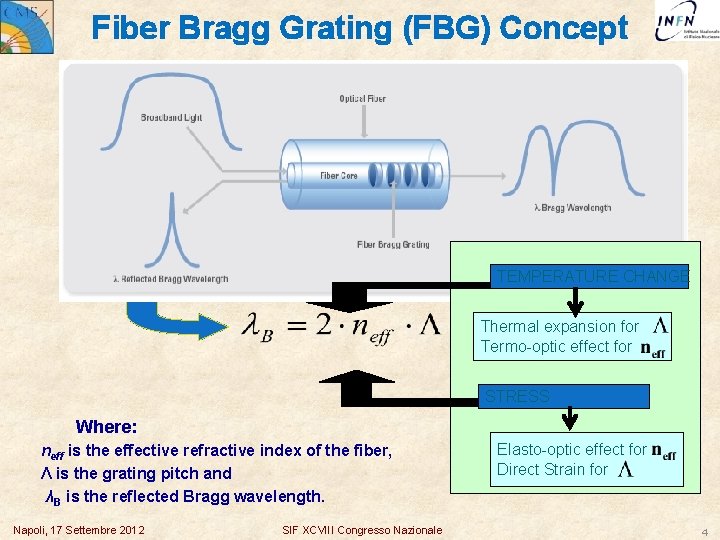
Fiber Bragg Grating (FBG) Concept TEMPERATURE CHANGE Thermal expansion for Termo-optic effect for STRESS Where: neff is the effective refractive index of the fiber, Λ is the grating pitch and λB is the reflected Bragg wavelength. Napoli, 17 Settembre 2012 SIF XCVIII Congresso Nazionale Elasto-optic effect for Direct Strain for 4
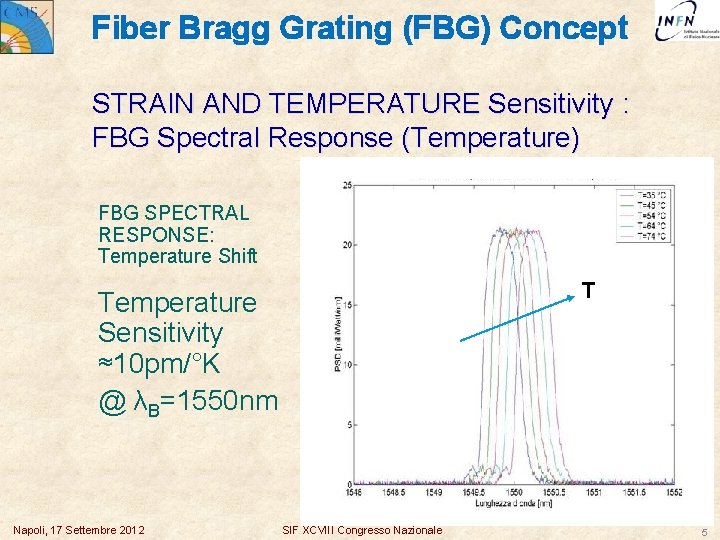
Fiber Bragg Grating (FBG) Concept STRAIN AND TEMPERATURE Sensitivity : FBG Spectral Response (Temperature) FBG SPECTRAL RESPONSE: Temperature Shift T Temperature Sensitivity ≈10 pm/°K @ λB=1550 nm Napoli, 17 Settembre 2012 SIF XCVIII Congresso Nazionale 5
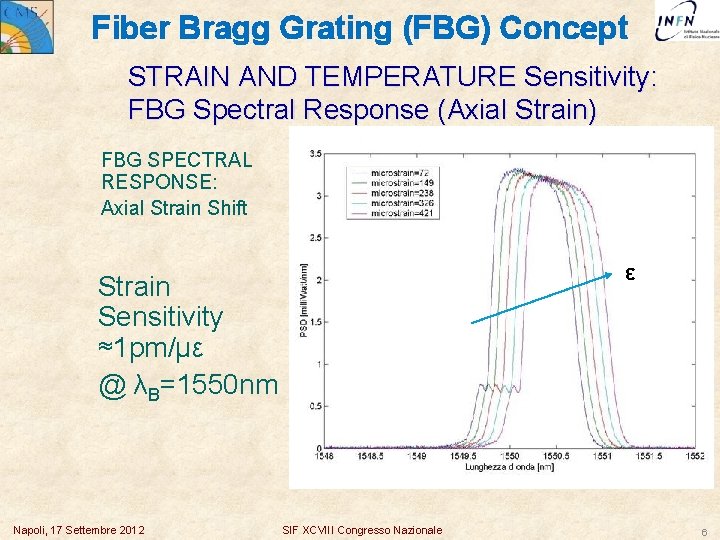
Fiber Bragg Grating (FBG) Concept STRAIN AND TEMPERATURE Sensitivity: FBG Spectral Response (Axial Strain) FBG SPECTRAL RESPONSE: Axial Strain Shift ε Strain Sensitivity ≈1 pm/με @ λB=1550 nm Napoli, 17 Settembre 2012 SIF XCVIII Congresso Nazionale 6
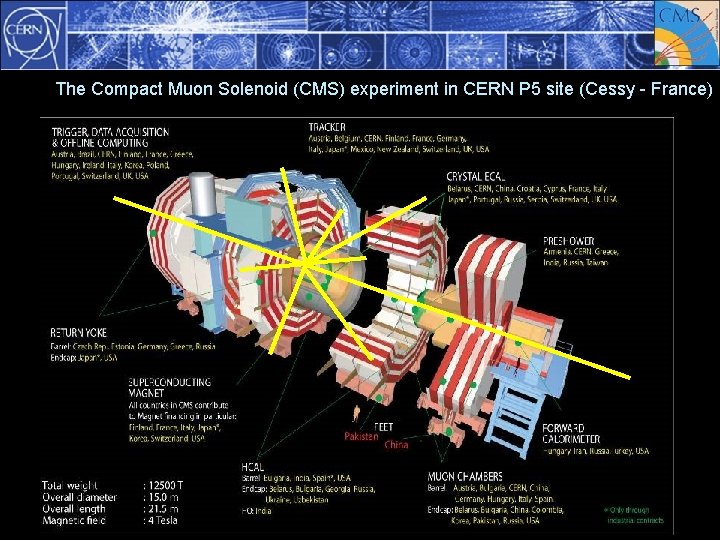
The Compact Muon Solenoid (CMS) experiment in CERN P 5 site (Cessy - France) Napoli, 17 Settembre 2012
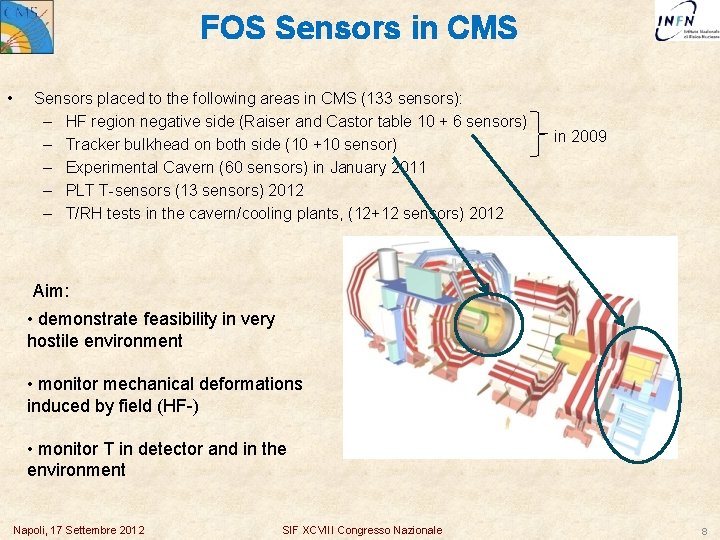
FOS Sensors in CMS • Sensors placed to the following areas in CMS (133 sensors): – HF region negative side (Raiser and Castor table 10 + 6 sensors) – Tracker bulkhead on both side (10 +10 sensor) – Experimental Cavern (60 sensors) in January 2011 – PLT T-sensors (13 sensors) 2012 – T/RH tests in the cavern/cooling plants, (12+12 sensors) 2012 in 2009 Aim: • demonstrate feasibility in very hostile environment • monitor mechanical deformations induced by field (HF-) • monitor T in detector and in the environment Napoli, 17 Settembre 2012 SIF XCVIII Congresso Nazionale 8

FOS infrastructure in CMS site Second interrogator for additional 16 ch being installed in these days CMS today can read up to 2000 FBGs ! • A backbone of 72 fibers was installed between X 1 near and S 2 C 18 • New patchpanel is added to S 2 C 18 • New 1 U 16 channel interrogator in the system Detector Cavern (UXC) 100 m underground Napoli, 17 Settembre 2012 120 m fiber lenght distance SIF XCVIII Congresso Nazionale Service Cavern (USC) 70 m underground 9
Temperature sensors on the Silicon Tracker Bulkheads Napoli, 17 Settembre 2012 SIF XCVIII Congresso Nazionale 10
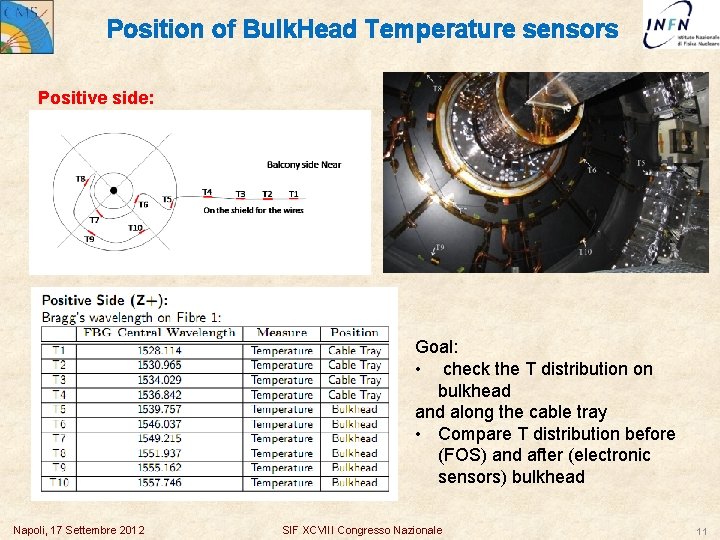
Position of Bulk. Head Temperature sensors Positive side: Goal: • check the T distribution on bulkhead and along the cable tray • Compare T distribution before (FOS) and after (electronic sensors) bulkhead Napoli, 17 Settembre 2012 SIF XCVIII Congresso Nazionale 11
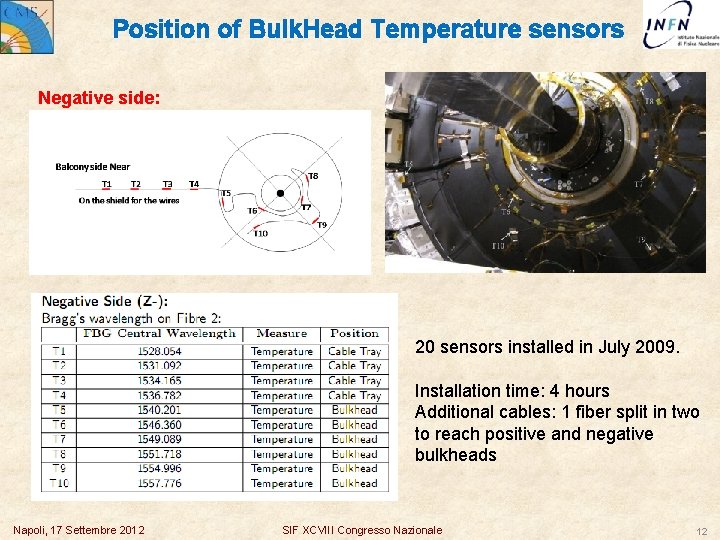
Position of Bulk. Head Temperature sensors Negative side: 20 sensors installed in July 2009. Installation time: 4 hours Additional cables: 1 fiber split in two to reach positive and negative bulkheads Napoli, 17 Settembre 2012 SIF XCVIII Congresso Nazionale 12
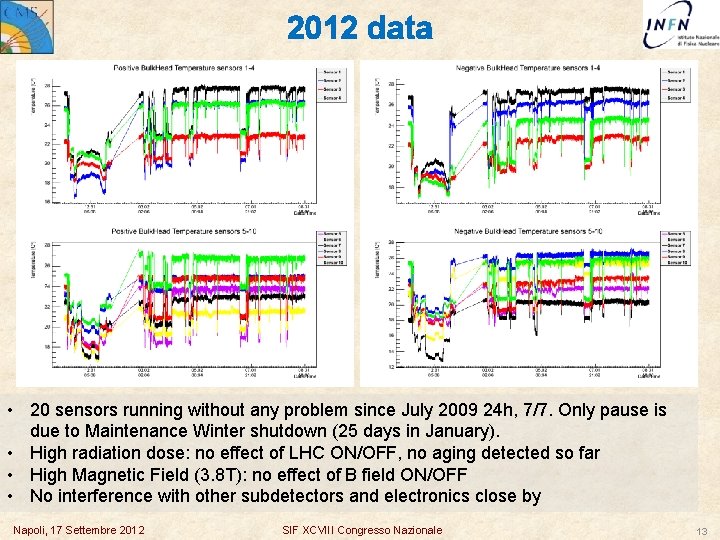
2012 data • 20 sensors running without any problem since July 2009 24 h, 7/7. Only pause is due to Maintenance Winter shutdown (25 days in January). • High radiation dose: no effect of LHC ON/OFF, no aging detected so far • High Magnetic Field (3. 8 T): no effect of B field ON/OFF • No interference with other subdetectors and electronics close by Napoli, 17 Settembre 2012 SIF XCVIII Congresso Nazionale 13
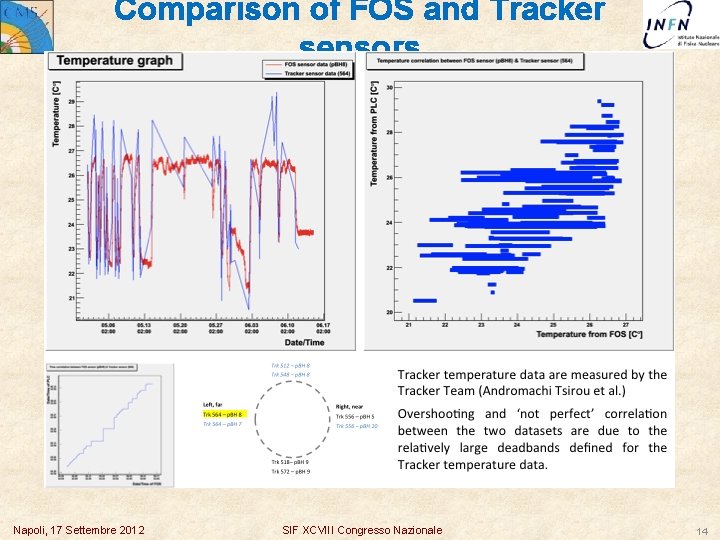
Comparison of FOS and Tracker sensors Napoli, 17 Settembre 2012 SIF XCVIII Congresso Nazionale 14
Temperature sensors in the UXC cavern Napoli, 17 Settembre 2012 SIF XCVIII Congresso Nazionale 15
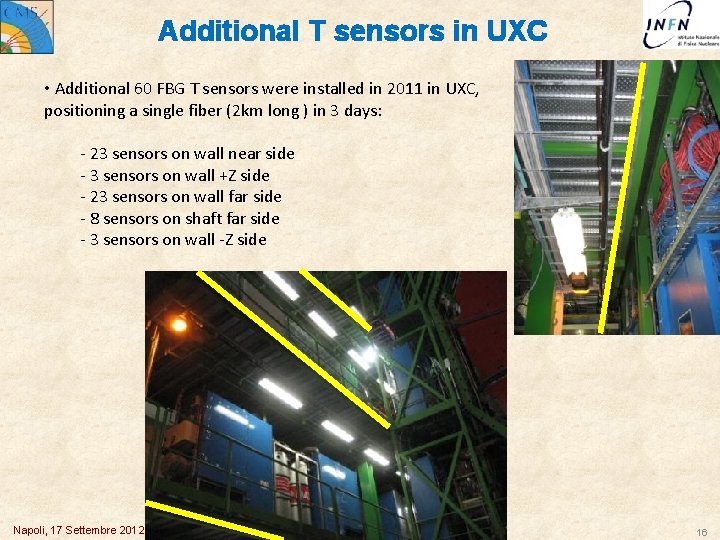
Additional T sensors in UXC • Additional 60 FBG T sensors were installed in 2011 in UXC, positioning a single fiber (2 km long ) in 3 days: - 23 sensors on wall near side - 3 sensors on wall +Z side - 23 sensors on wall far side - 8 sensors on shaft far side - 3 sensors on wall -Z side Napoli, 17 Settembre 2012 FOS operation in CMS 16
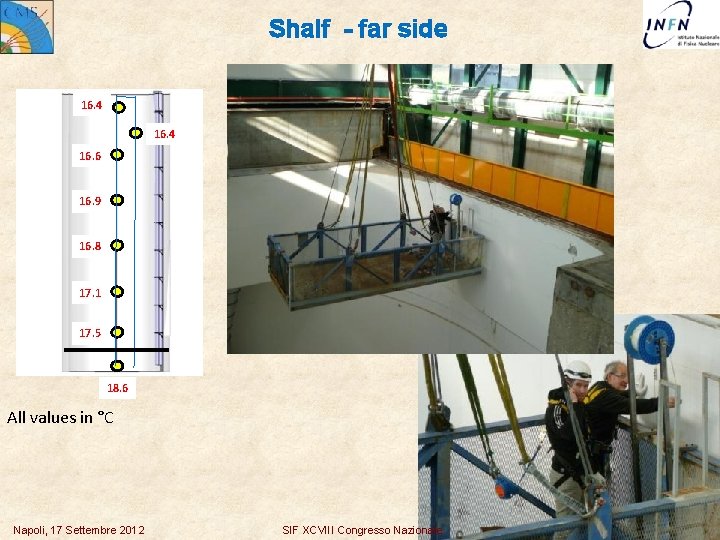
Shalf - far side 16. 4 16. 6 16. 9 16. 8 17. 1 17. 5 18. 6 All values in °C Napoli, 17 Settembre 2012 SIF XCVIII Congresso Nazionale 17
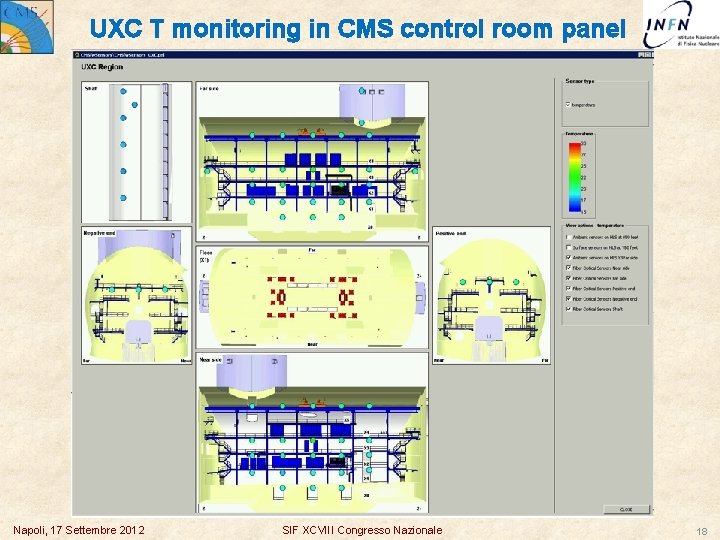
UXC T monitoring in CMS control room panel Napoli, 17 Settembre 2012 SIF XCVIII Congresso Nazionale 18
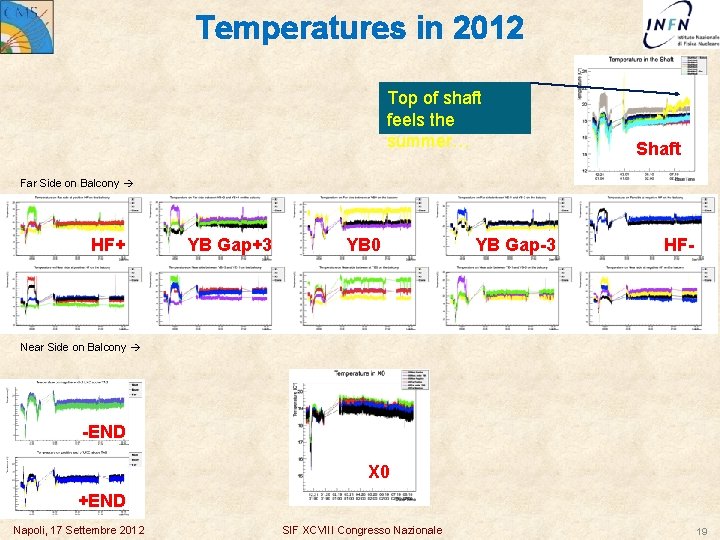
Temperatures in 2012 Top of shaft feels the summer… Shaft Far Side on Balcony HF+ YB Gap+3 YB 0 YB Gap-3 HF- Near Side on Balcony -END X 0 +END Napoli, 17 Settembre 2012 SIF XCVIII Congresso Nazionale 19
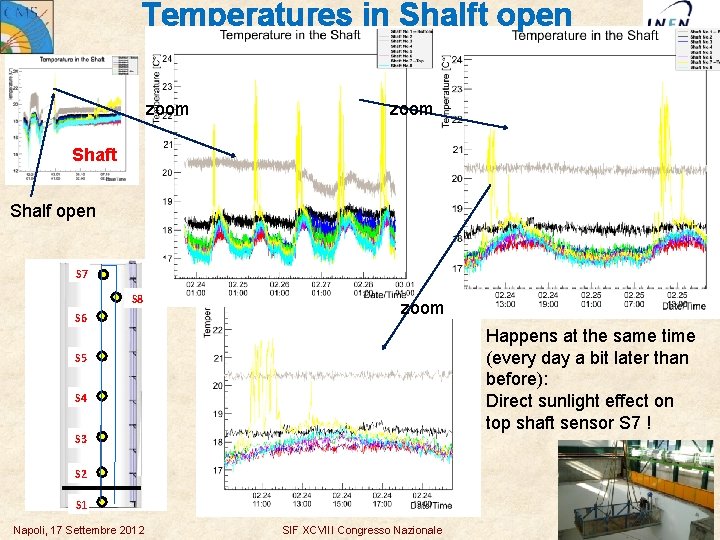
Temperatures in Shalft open zoom Shaft Shalf open S 7 S 8 S 6 zoom Happens at the same time (every day a bit later than before): Direct sunlight effect on top shaft sensor S 7 ! S 5 S 4 S 3 S 2 S 1 Napoli, 17 Settembre 2012 SIF XCVIII Congresso Nazionale 20
Temperature sensors on Cathod Strip Chamber (ME+4/1) Napoli, 17 Settembre 2012 SIF XCVIII Congresso Nazionale 21
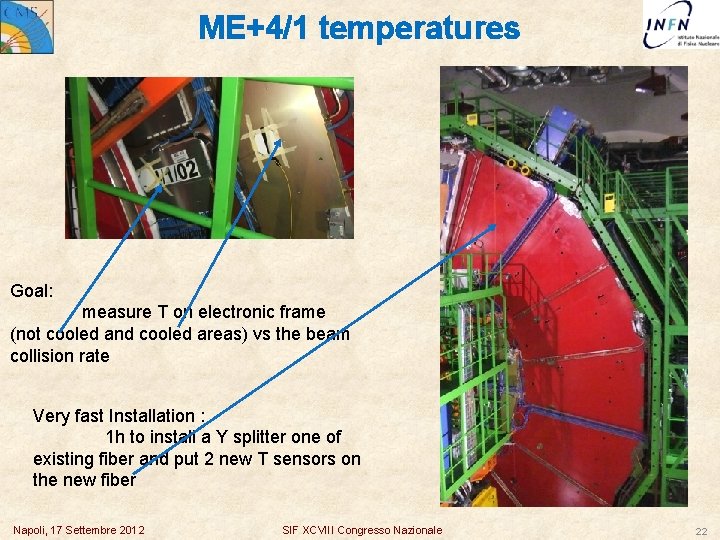
ME+4/1 temperatures Goal: measure T on electronic frame (not cooled and cooled areas) vs the beam collision rate Very fast Installation : 1 h to install a Y splitter one of existing fiber and put 2 new T sensors on the new fiber Napoli, 17 Settembre 2012 SIF XCVIII Congresso Nazionale 22
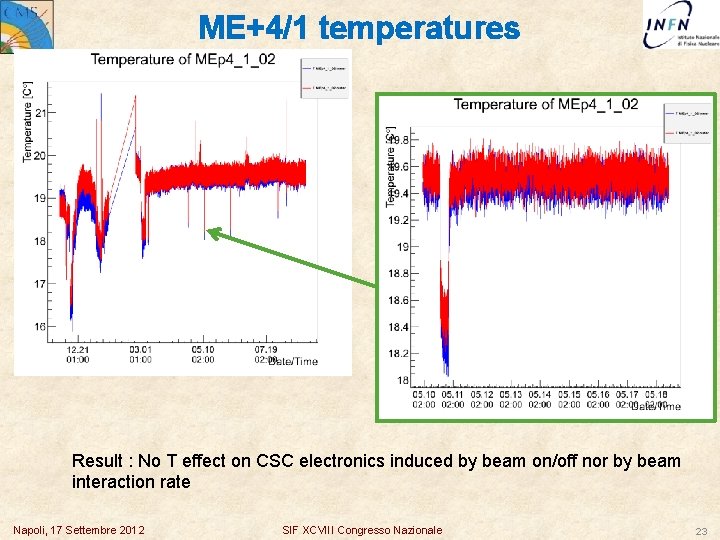
ME+4/1 temperatures Result : No T effect on CSC electronics induced by beam on/off nor by beam interaction rate Napoli, 17 Settembre 2012 SIF XCVIII Congresso Nazionale 23
PLT (Pixel Luminosity Telescope) Temperature measurements Napoli, 17 Settembre 2012 SIF XCVIII Congresso Nazionale 24
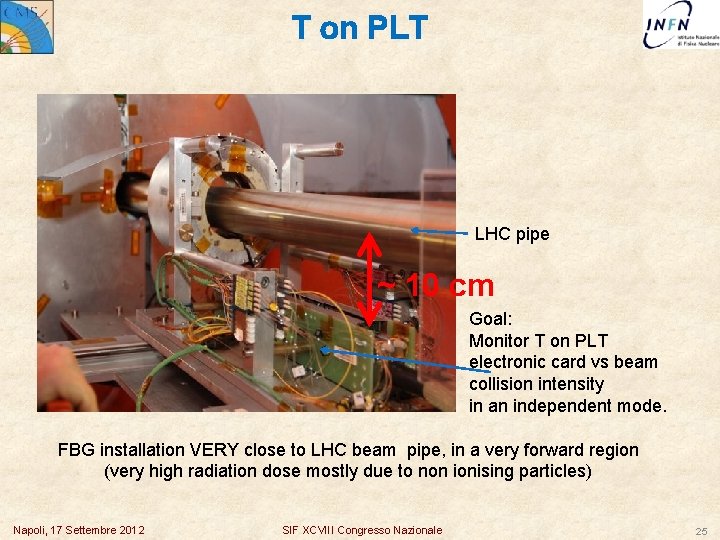
T on PLT LHC pipe ~ 10 cm Goal: Monitor T on PLT electronic card vs beam collision intensity in an independent mode. FBG installation VERY close to LHC beam pipe, in a very forward region (very high radiation dose mostly due to non ionising particles) Napoli, 17 Settembre 2012 SIF XCVIII Congresso Nazionale 25
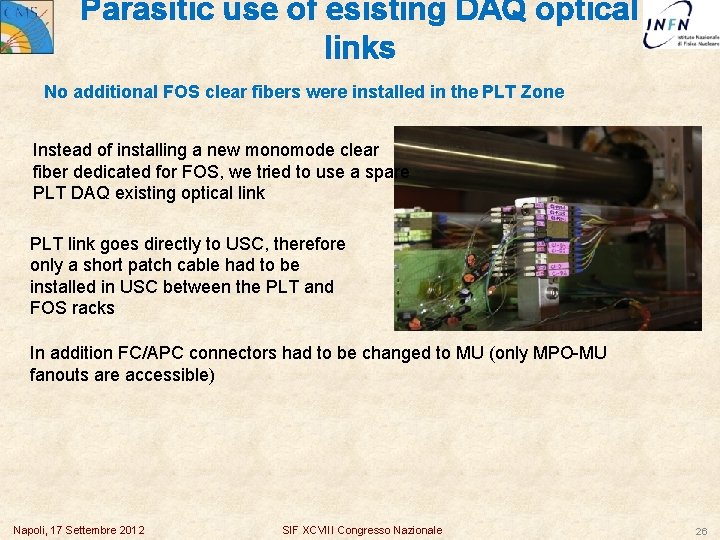
Parasitic use of esisting DAQ optical links No additional FOS clear fibers were installed in the PLT Zone Instead of installing a new monomode clear fiber dedicated for FOS, we tried to use a spare PLT DAQ existing optical link PLT link goes directly to USC, therefore only a short patch cable had to be installed in USC between the PLT and FOS racks In addition FC/APC connectors had to be changed to MU (only MPO-MU fanouts are accessible) Napoli, 17 Settembre 2012 SIF XCVIII Congresso Nazionale 26
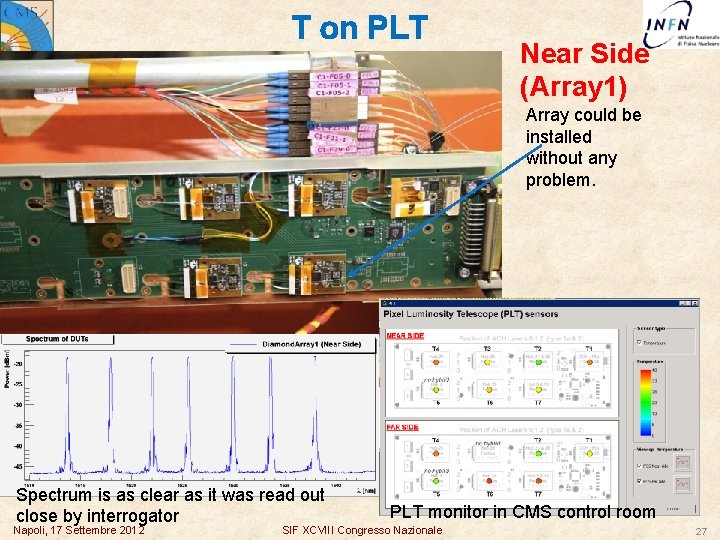
T on PLT Near Side (Array 1) Array could be installed without any problem. Spectrum is as clear as it was read out close by interrogator Napoli, 17 Settembre 2012 PLT monitor in CMS control room SIF XCVIII Congresso Nazionale 27
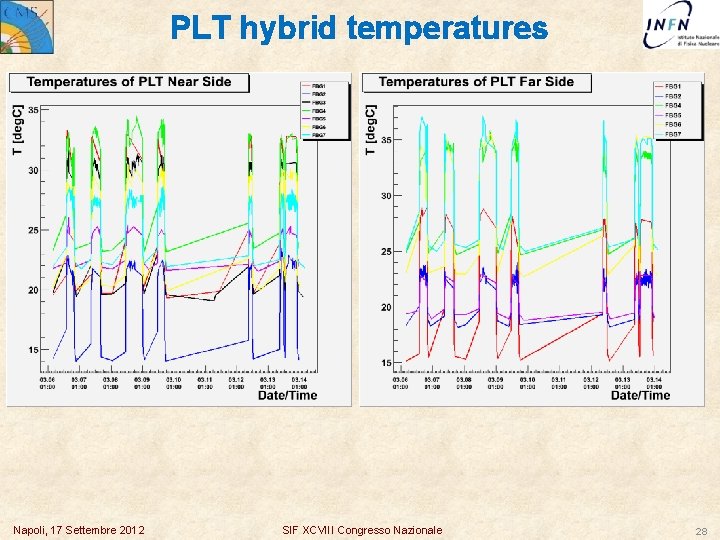
PLT hybrid temperatures Napoli, 17 Settembre 2012 SIF XCVIII Congresso Nazionale 28
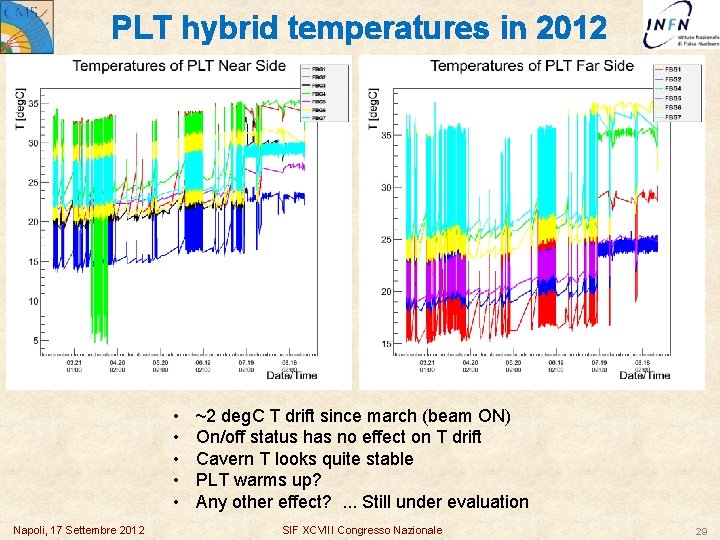
PLT hybrid temperatures in 2012 • • • Napoli, 17 Settembre 2012 ~2 deg. C T drift since march (beam ON) On/off status has no effect on T drift Cavern T looks quite stable PLT warms up? Any other effect? . . . Still under evaluation SIF XCVIII Congresso Nazionale 29
Strain measurements on Forward Hadronic Calorimeter Napoli, 17 Settembre 2012 SIF XCVIII Congresso Nazionale 30
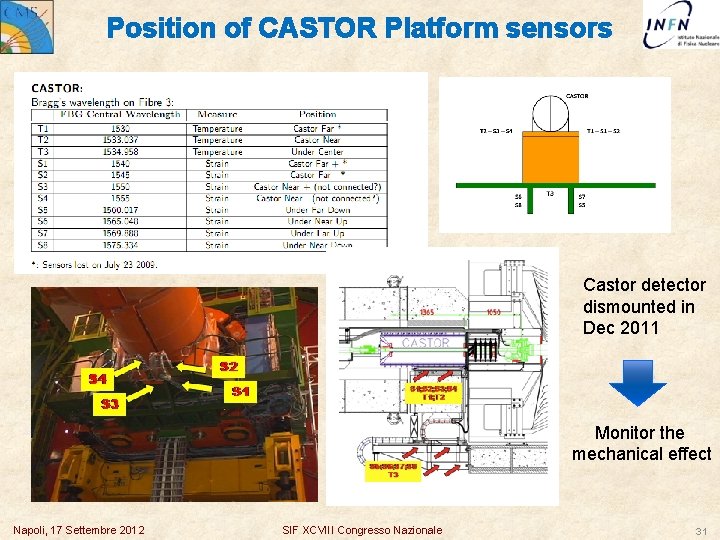
Position of CASTOR Platform sensors Castor detector dismounted in Dec 2011 Monitor the mechanical effect Napoli, 17 Settembre 2012 SIF XCVIII Congresso Nazionale 31
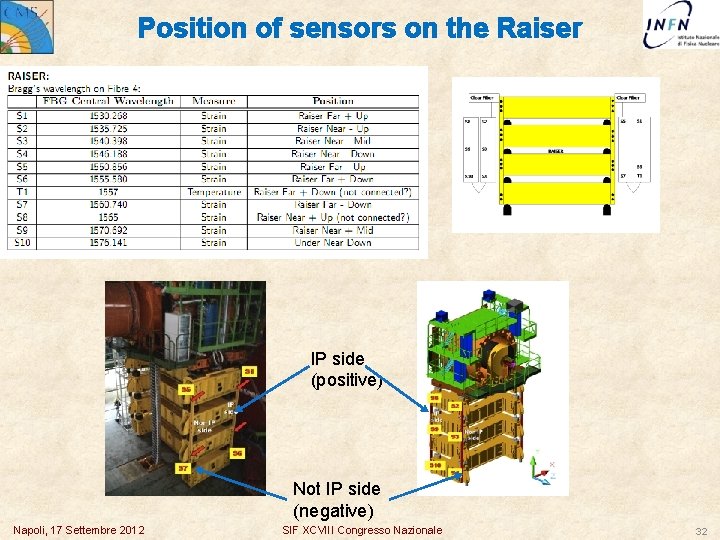
Position of sensors on the Raiser IP side (positive) Not IP side (negative) Napoli, 17 Settembre 2012 SIF XCVIII Congresso Nazionale 32
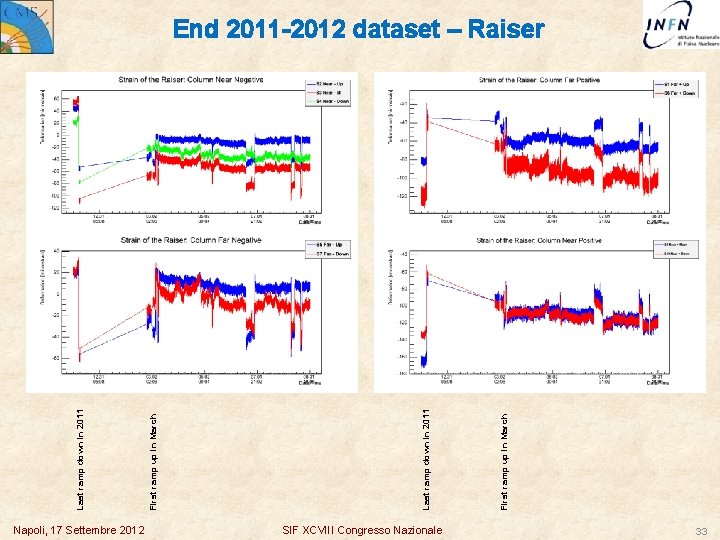
Napoli, 17 Settembre 2012 SIF XCVIII Congresso Nazionale First ramp up in March Last ramp down in 2011 End 2011 -2012 dataset – Raiser 33
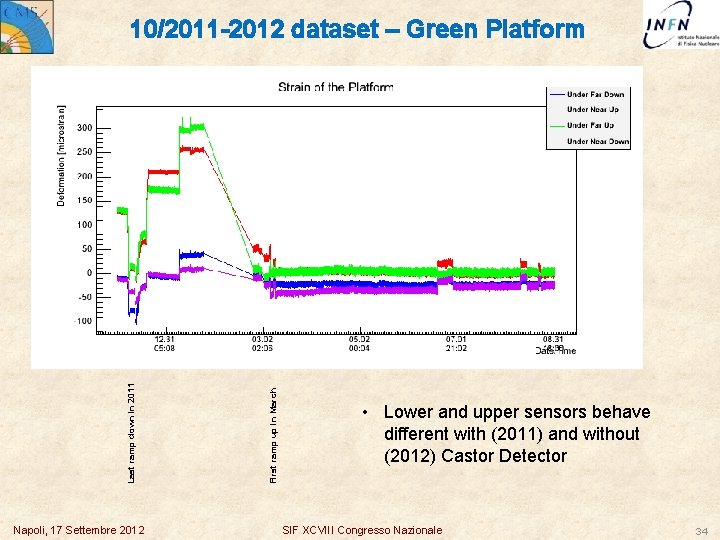
Napoli, 17 Settembre 2012 First ramp up in March Last ramp down in 2011 10/2011 -2012 dataset – Green Platform • Lower and upper sensors behave different with (2011) and without (2012) Castor Detector SIF XCVIII Congresso Nazionale 34
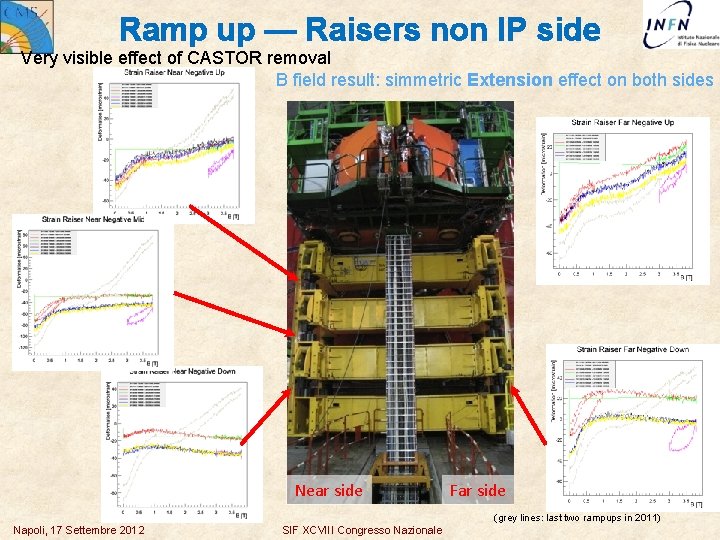
Ramp up — Raisers non IP side Very visible effect of CASTOR removal B field result: simmetric Extension effect on both sides Near side Far side (grey lines: last two rampups in 2011) Napoli, 17 Settembre 2012 SIF XCVIII Congresso Nazionale
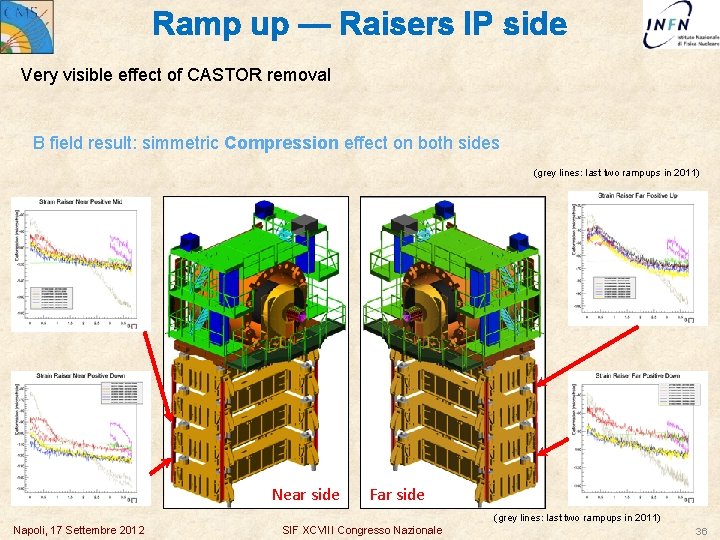
Ramp up — Raisers IP side Very visible effect of CASTOR removal B field result: simmetric Compression effect on both sides (grey lines: last two rampups in 2011) Near side Far side (grey lines: last two rampups in 2011) Napoli, 17 Settembre 2012 SIF XCVIII Congresso Nazionale 36
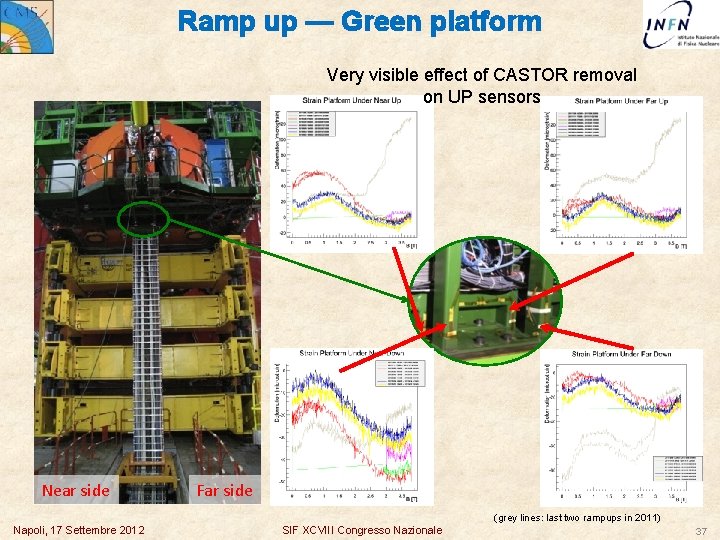
Ramp up — Green platform Very visible effect of CASTOR removal on UP sensors Near side Far side (grey lines: last two rampups in 2011) Napoli, 17 Settembre 2012 SIF XCVIII Congresso Nazionale 37
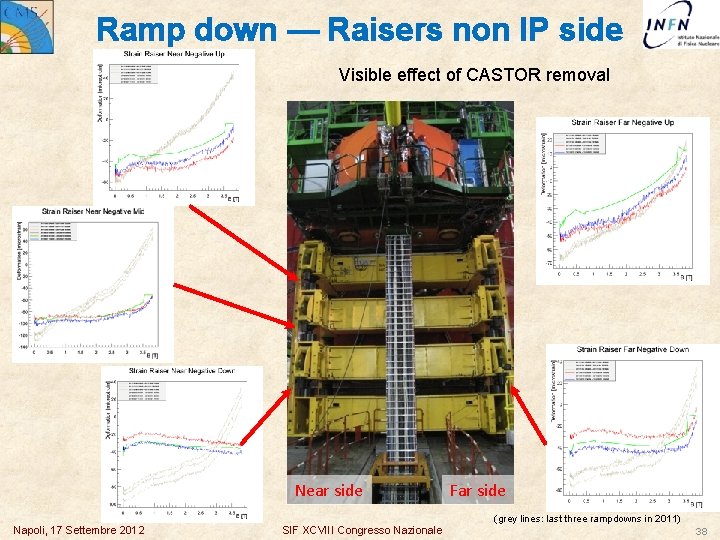
Ramp down — Raisers non IP side Visible effect of CASTOR removal Near side Far side (grey lines: last three rampdowns in 2011) Napoli, 17 Settembre 2012 SIF XCVIII Congresso Nazionale 38
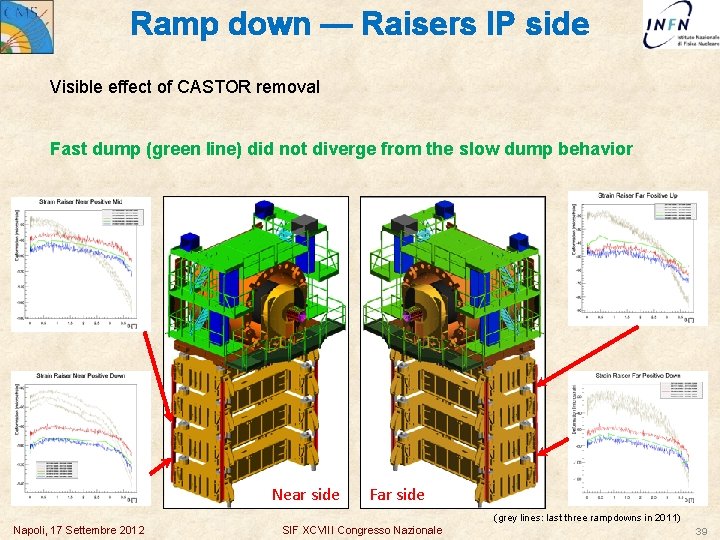
Ramp down — Raisers IP side Visible effect of CASTOR removal Fast dump (green line) did not diverge from the slow dump behavior Near side Far side (grey lines: last three rampdowns in 2011) Napoli, 17 Settembre 2012 SIF XCVIII Congresso Nazionale 39
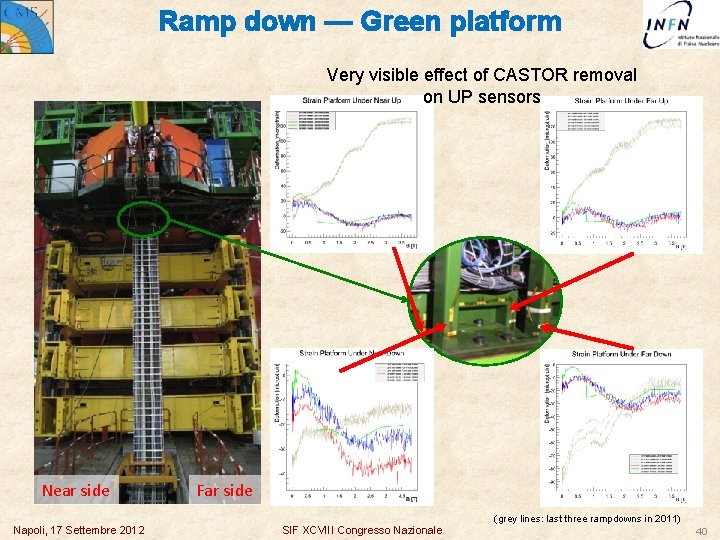
Ramp down — Green platform Very visible effect of CASTOR removal on UP sensors Near side Far side (grey lines: last three rampdowns in 2011) Napoli, 17 Settembre 2012 SIF XCVIII Congresso Nazionale 40
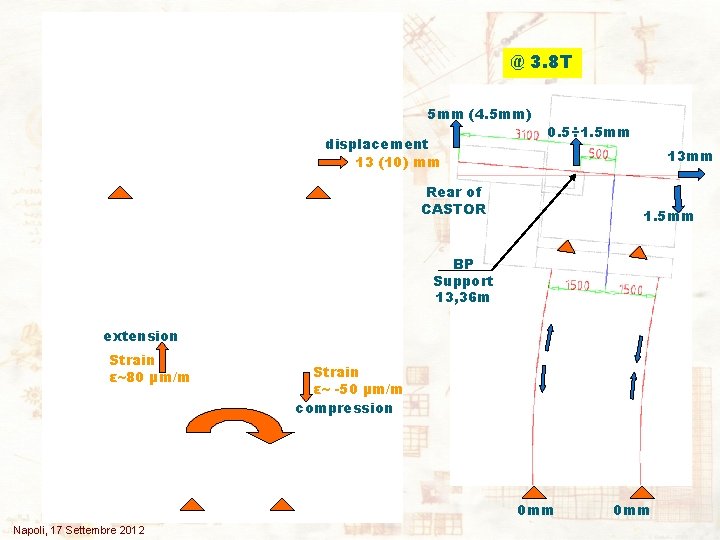
@ 3. 8 T 5 mm (4. 5 mm) displacement 13 (10) mm 0. 5÷ 1. 5 mm 13 mm Rear of CASTOR 1. 5 mm BP Support 13, 36 m extension Strain ε~80 µm/m Strain ε~ -50 µm/m compression 0 mm Napoli, 17 Settembre 2012 0 mm
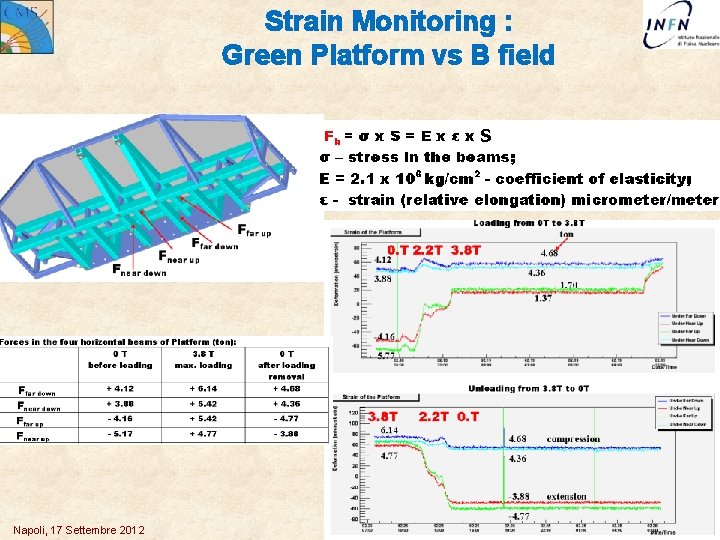
Strain Monitoring : Green Platform vs B field S Napoli, 17 Settembre 2012
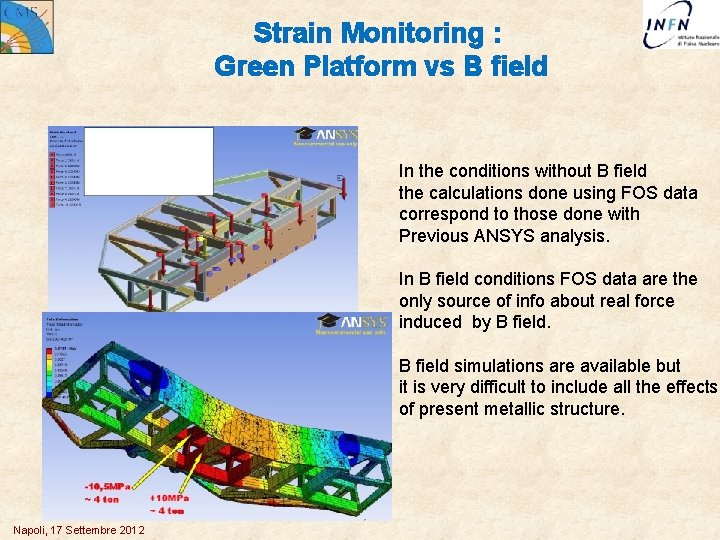
Strain Monitoring : Green Platform vs B field In the conditions without B field the calculations done using FOS data correspond to those done with Previous ANSYS analysis. In B field conditions FOS data are the only source of info about real force induced by B field simulations are available but it is very difficult to include all the effects of present metallic structure. Napoli, 17 Settembre 2012
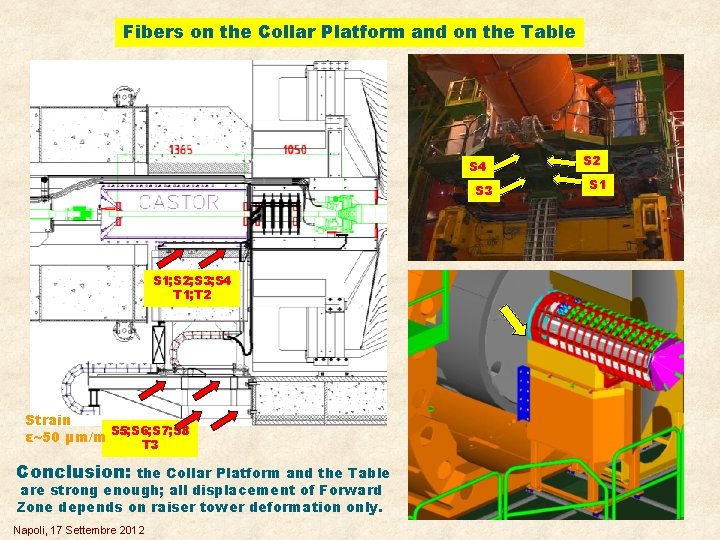
Fibers on the Collar Platform and on the Table S 4 S 3 S 1; S 2; S 3; S 4 T 1; T 2 Strain ε~50 µm/m S 5; S 6; S 7; S 8 T 3 Conclusion: the Collar Platform and the Table are strong enough; all displacement of Forward Zone depends on raiser tower deformation only. Napoli, 17 Settembre 2012 S 1
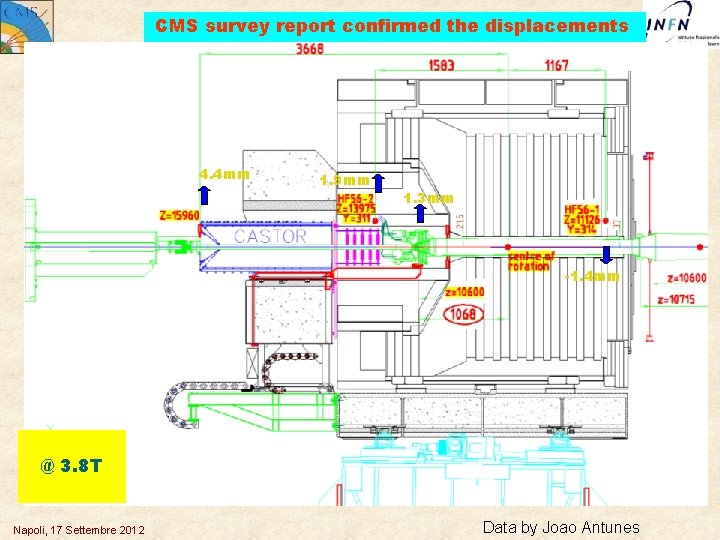
CMS survey report confirmed the displacements 4. 4 mm 1. 9 mm 1. 3 mm -1. 4 mm @ 3. 8 T Napoli, 17 Settembre 2012 Data by Joao Antunes
Additional CMS T and strain FOS installations planned in 2013 LS 1 Napoli, 17 Settembre 2012 SIF XCVIII Congresso Nazionale 46
Temperature sensors on RE 4 Napoli, 17 Settembre 2012 SIF XCVIII Congresso Nazionale 47
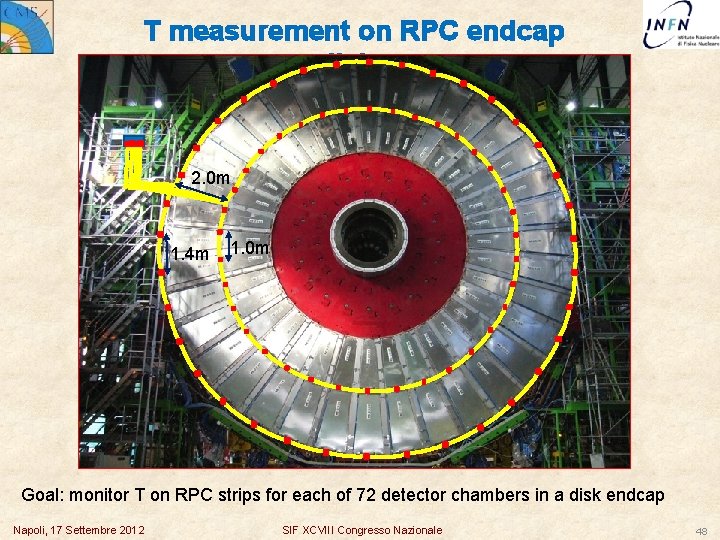
T measurement on RPC endcap disks 2. 0 m 1. 4 m 1. 0 m Goal: monitor T on RPC strips for each of 72 detector chambers in a disk endcap Napoli, 17 Settembre 2012 SIF XCVIII Congresso Nazionale 48
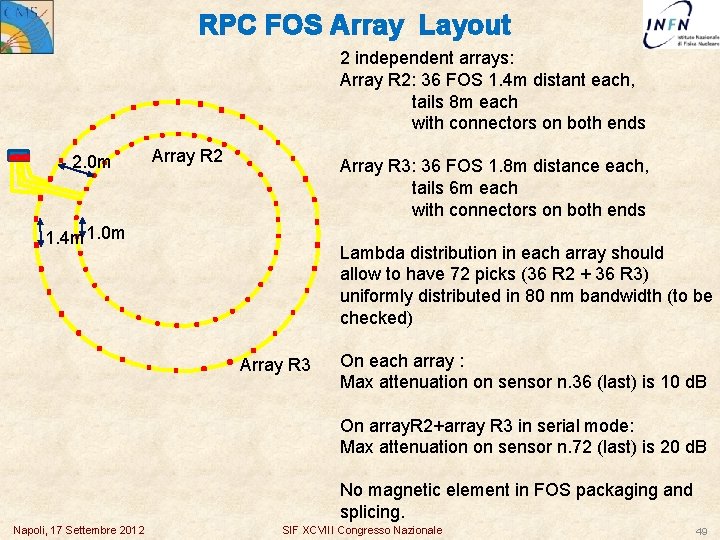
RPC FOS Array Layout 2 independent arrays: Array R 2: 36 FOS 1. 4 m distant each, tails 8 m each with connectors on both ends 2. 0 m Array R 2 Array R 3: 36 FOS 1. 8 m distance each, tails 6 m each with connectors on both ends 1. 4 m 1. 0 m Lambda distribution in each array should allow to have 72 picks (36 R 2 + 36 R 3) uniformly distributed in 80 nm bandwidth (to be checked) Array R 3 On each array : Max attenuation on sensor n. 36 (last) is 10 d. B On array. R 2+array R 3 in serial mode: Max attenuation on sensor n. 72 (last) is 20 d. B No magnetic element in FOS packaging and splicing. Napoli, 17 Settembre 2012 SIF XCVIII Congresso Nazionale 49
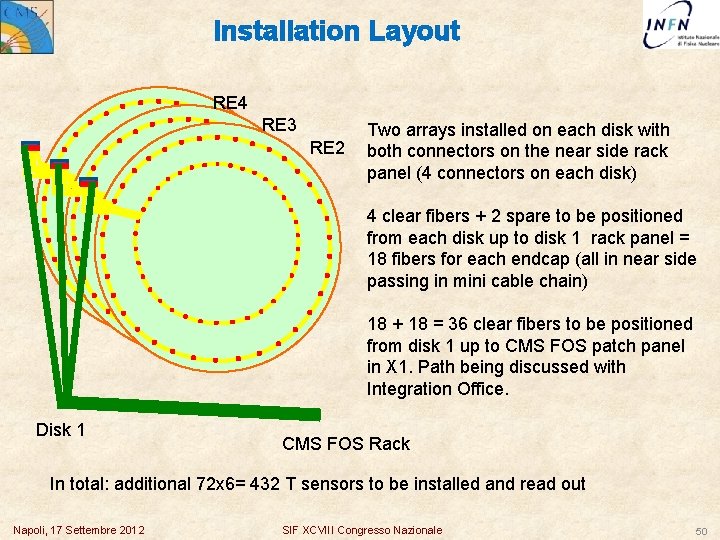
Installation Layout RE 4 RE 3 RE 2 Two arrays installed on each disk with both connectors on the near side rack panel (4 connectors on each disk) 4 clear fibers + 2 spare to be positioned from each disk up to disk 1 rack panel = 18 fibers for each endcap (all in near side passing in mini cable chain) 18 + 18 = 36 clear fibers to be positioned from disk 1 up to CMS FOS patch panel in X 1. Path being discussed with Integration Office. Disk 1 CMS FOS Rack In total: additional 72 x 6= 432 T sensors to be installed and read out Napoli, 17 Settembre 2012 SIF XCVIII Congresso Nazionale 50
Strain on YE 4 disk Napoli, 17 Settembre 2012 SIF XCVIII Congresso Nazionale 51
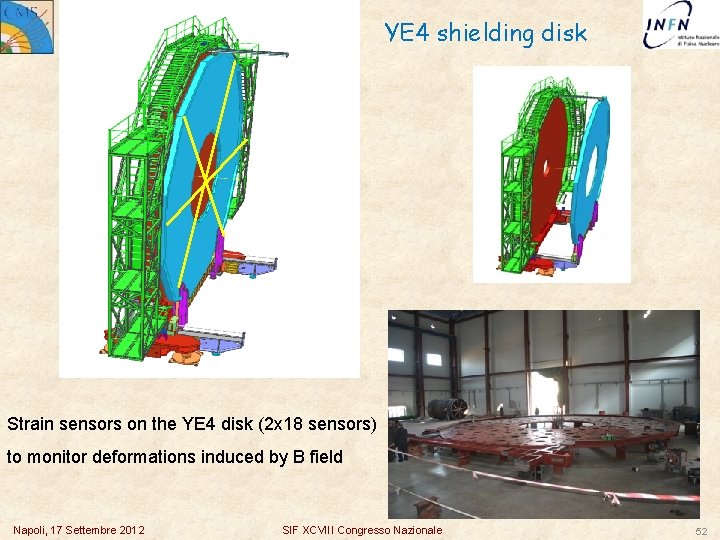
YE 4 shielding disk Strain sensors on the YE 4 disk (2 x 18 sensors) to monitor deformations induced by B field Napoli, 17 Settembre 2012 SIF XCVIII Congresso Nazionale 52
Strain and T on new CMS central beam pipe Napoli, 17 Settembre 2012 SIF XCVIII Congresso Nazionale 53
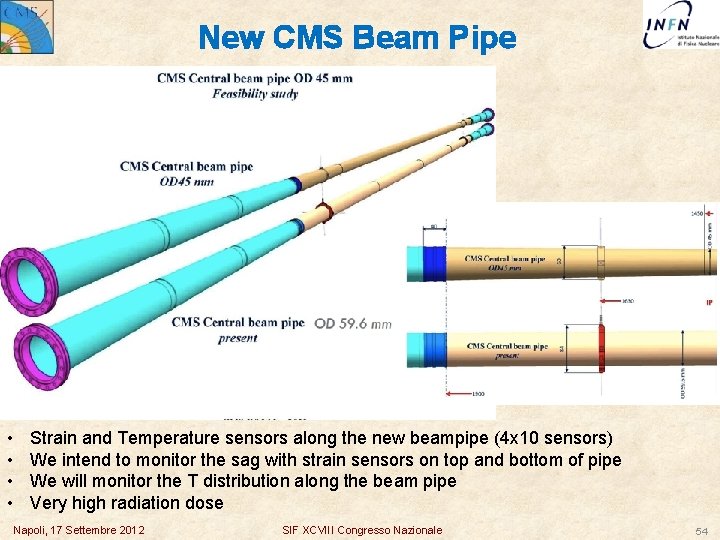
New CMS Beam Pipe • • Strain and Temperature sensors along the new beampipe (4 x 10 sensors) We intend to monitor the sag with strain sensors on top and bottom of pipe We will monitor the T distribution along the beam pipe Very high radiation dose Napoli, 17 Settembre 2012 SIF XCVIII Congresso Nazionale 54
Development of New Sensors for HEP based on FBG technique (FOS 4 HEP) Napoli, 17 Settembre 2012 SIF XCVIII Congresso Nazionale 55
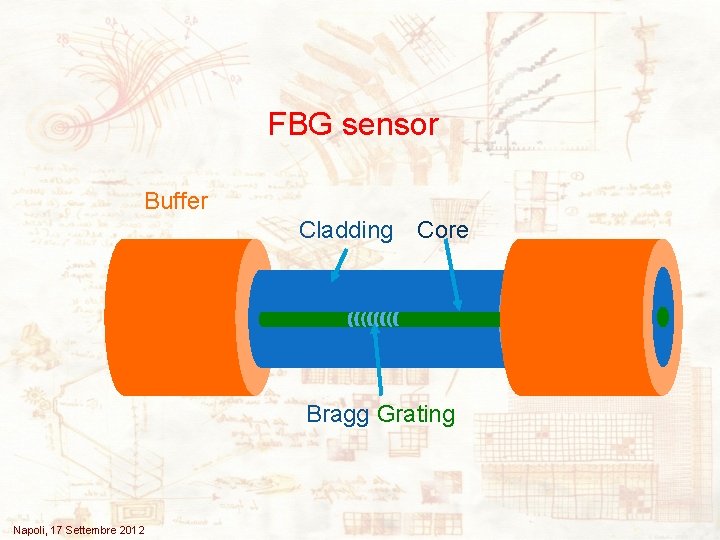
FBG sensor Buffer Cladding Core Bragg Grating Napoli, 17 Settembre 2012
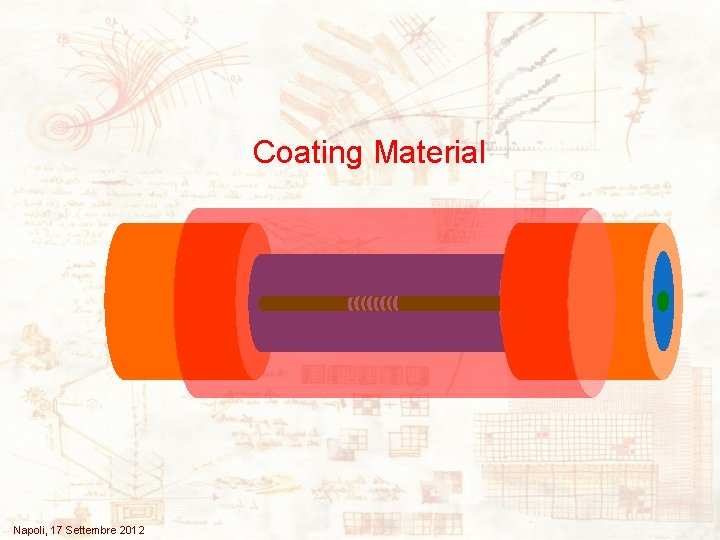
Coating Material Napoli, 17 Settembre 2012
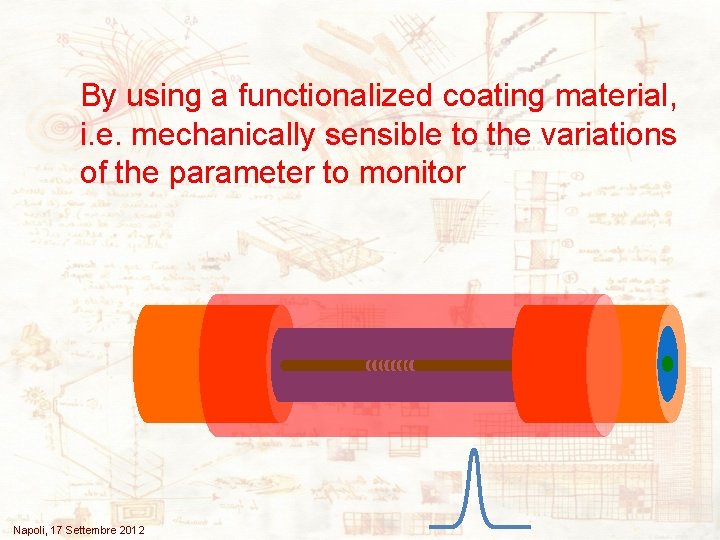
By using a functionalized coating material, i. e. mechanically sensible to the variations of the parameter to monitor Napoli, 17 Settembre 2012
Relative Humidity sensors for CMS Tracker Napoli, 17 Settembre 2012 SIF XCVIII Congresso Nazionale 59
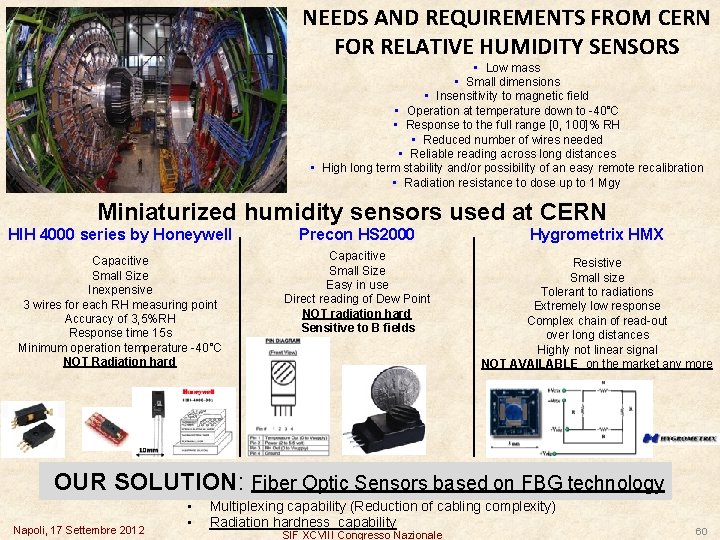
NEEDS AND REQUIREMENTS FROM CERN FOR RELATIVE HUMIDITY SENSORS • Low mass • Small dimensions • Insensitivity to magnetic field • Operation at temperature down to -40˚C • Response to the full range [0, 100]% RH • Reduced number of wires needed • Reliable reading across long distances • High long term stability and/or possibility of an easy remote recalibration • Radiation resistance to dose up to 1 Mgy Miniaturized humidity sensors used at CERN HIH 4000 series by Honeywell Precon HS 2000 Capacitive Small Size Inexpensive 3 wires for each RH measuring point Accuracy of 3, 5%RH Response time 15 s Minimum operation temperature -40°C NOT Radiation hard Capacitive Small Size Easy in use Direct reading of Dew Point NOT radiation hard Sensitive to B fields Hygrometrix HMX Resistive Small size Tolerant to radiations Extremely low response Complex chain of read-out over long distances Highly not linear signal NOT AVAILABLE on the market any more OUR SOLUTION: Fiber Optic Sensors based on FBG technology Napoli, 17 Settembre 2012 • • Multiplexing capability (Reduction of cabling complexity) Radiation hardness capability SIF XCVIII Congresso Nazionale 60
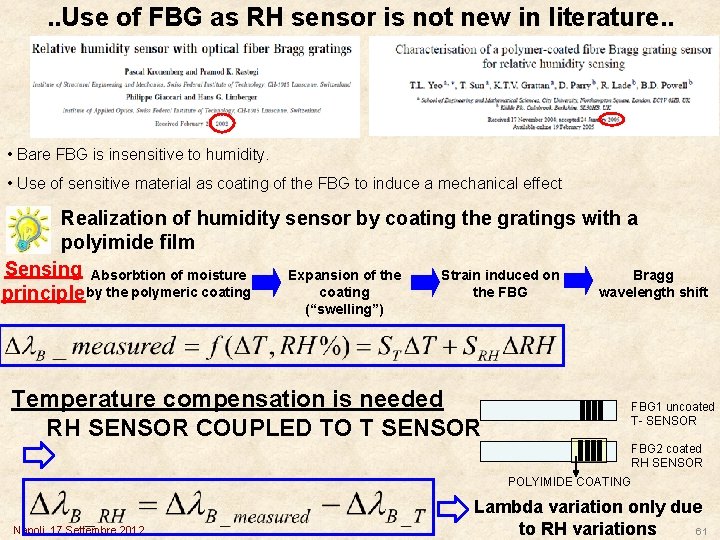
. . Use of FBG as RH sensor is not new in literature. . • Bare FBG is insensitive to humidity. • Use of sensitive material as coating of the FBG to induce a mechanical effect Realization of humidity sensor by coating the gratings with a polyimide film Sensing Absorbtion of moisture Expansion of the Strain induced on Bragg coating the FBG wavelength shift principle by the polymeric coating (“swelling”) Temperature compensation is needed RH SENSOR COUPLED TO T SENSOR FBG 1 uncoated T- SENSOR FBG 2 coated RH SENSOR POLYIMIDE COATING Napoli, 17 Settembre 2012 Lambda variation only due to RH variations 61
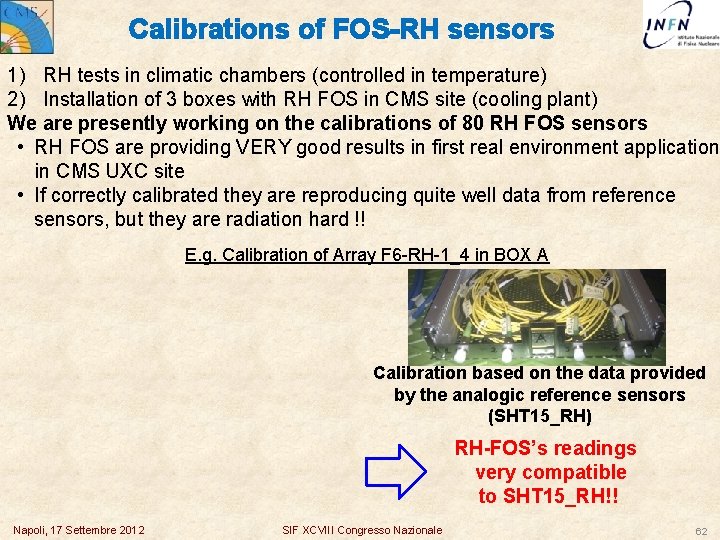
Calibrations of FOS-RH sensors 1) RH tests in climatic chambers (controlled in temperature) 2) Installation of 3 boxes with RH FOS in CMS site (cooling plant) We are presently working on the calibrations of 80 RH FOS sensors • RH FOS are providing VERY good results in first real environment application in CMS UXC site • If correctly calibrated they are reproducing quite well data from reference sensors, but they are radiation hard !! E. g. Calibration of Array F 6 -RH-1_4 in BOX A Calibration based on the data provided by the analogic reference sensors (SHT 15_RH) RH-FOS’s readings very compatible to SHT 15_RH!! Napoli, 17 Settembre 2012 SIF XCVIII Congresso Nazionale 62
Additional CERN FOS projects triggered by FOS 4 CMS group (for more detail see also Prof. L. Rossi talk tomorrow) Napoli, 17 Settembre 2012 SIF XCVIII Congresso Nazionale 63
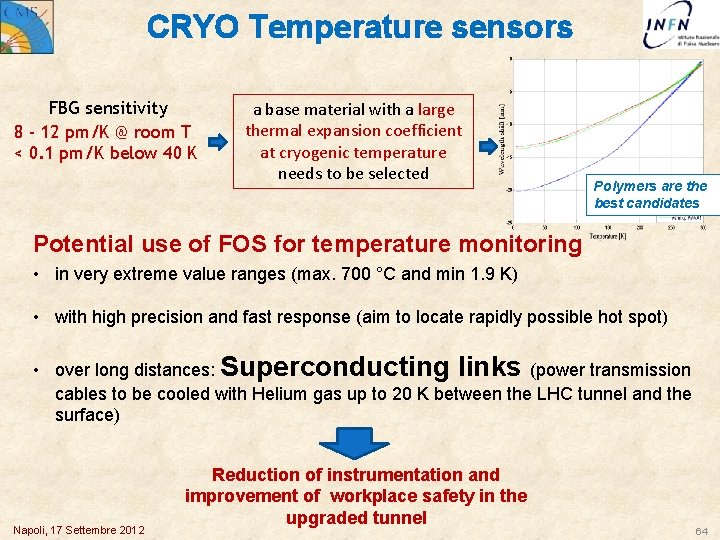
CRYO Temperature sensors FBG sensitivity 8 - 12 pm/K @ room T < 0. 1 pm/K below 40 K a base material with a large thermal expansion coefficient at cryogenic temperature needs to be selected Polymers are the best candidates Potential use of FOS for temperature monitoring • in very extreme value ranges (max. 700 °C and min 1. 9 K) • with high precision and fast response (aim to locate rapidly possible hot spot) • over long distances: Superconducting links (power transmission cables to be cooled with Helium gas up to 20 K between the LHC tunnel and the surface) Napoli, 17 Settembre 2012 Reduction of instrumentation and improvement of workplace safety in the upgraded tunnel 64
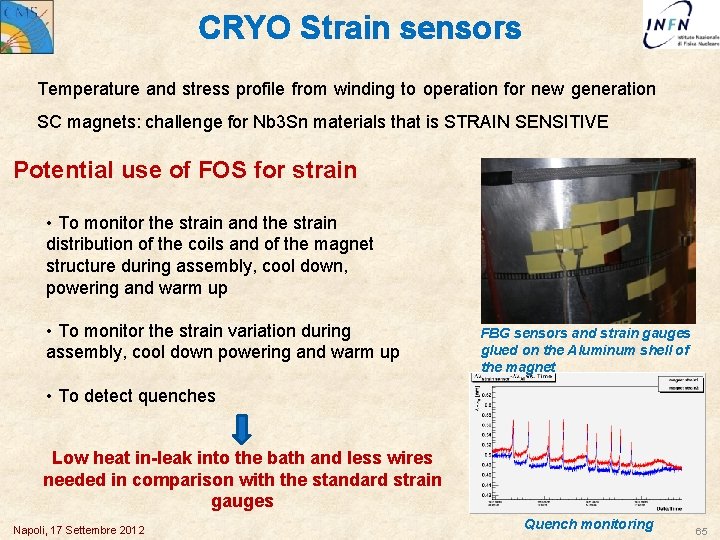
CRYO Strain sensors Temperature and stress profile from winding to operation for new generation SC magnets: challenge for Nb 3 Sn materials that is STRAIN SENSITIVE Potential use of FOS for strain • To monitor the strain and the strain distribution of the coils and of the magnet structure during assembly, cool down, powering and warm up • To monitor the strain variation during assembly, cool down powering and warm up FBG sensors and strain gauges glued on the Aluminum shell of the magnet • To detect quenches Low heat in-leak into the bath and less wires needed in comparison with the standard strain gauges Napoli, 17 Settembre 2012 Quench monitoring 65
Additional fields of interest for FOS technique: We have a clear expression of interest from CMS Collaboration for additional application of fiber sensors for: • Magnetic field measurement • Gas detection • Vibration monitoring • Radiation monitoring / Dosimetry Napoli, 17 Settembre 2012 SIF XCVIII Congresso Nazionale 66
Conclusions • FOS 4 CMS project started in 2009 and is rapidly expanding year by year ü At present we have about 150 sensor running without ANY problem since 3 years 24 h, 7/7, T and strain monitoring in hostile environment without any problem ü We have installed a facility ready to handle 32 fibers (about 2000 sensors) fully compatible with CERN software standard ü We have already received requests for additional 700 sensors to be installed in next year of maintenance/upgrade (RPC, YE 4, new beam pipe, tracker) • R&D on new fields of application of FBG technique with custom coating are giving very positive and interesting results ü Relative Humidity sensors for low range and high precision have been produced in mass scale (100 pieces). Reliability is impressive. Calibration on goin. Intallation in March 2013 in CMS Tracker. ü First prototypes for Cryo T and Cryo Strain are both giving very positive results (see Prof. L. Rossi talk tomorrow on. LHC upgrade) • Additional requests from CMS and HEP for new fields of application of FOS technique Napoli, 17 Settembre 2012 SIF XCVIII Congresso Nazionale 67
Conclusions Optical Fiber Sensor Technology is becoming a new reference standard in CMS and in HEP Great example of interdisciplinary collaboration between academic and industrial partners FOS validation and impressive stable/reliable results in very hostile environment (high radiation and high electromagnetic field) will open more field of application for technology transfer Napoli, 17 Settembre 2012 SIF XCVIII Congresso Nazionale 68
- Slides: 68