
Sensitization and Agglutination AntigenAntibody reaction Red cell AgAb

Sensitization and Agglutination
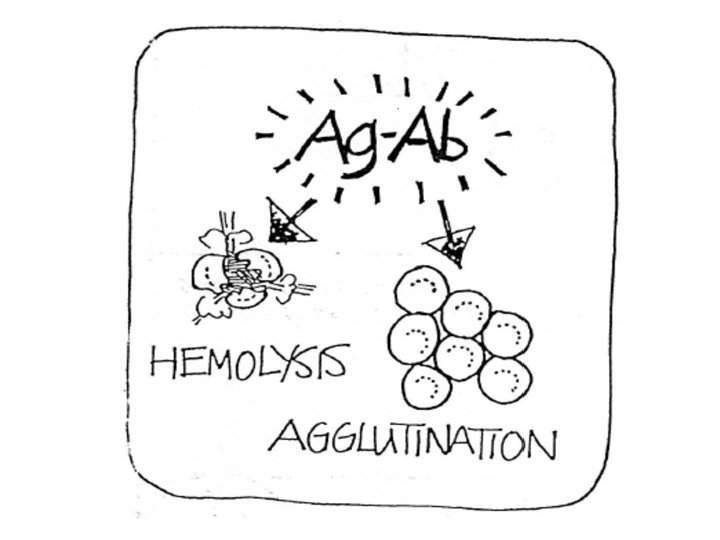
Antigen-Antibody reaction • Red cell Ag-Ab reaction can be detected by a number of techniques • Most frequently used – Hemolysis • Occurs if the entire complement sequence is activated following Ag-Ab interaction • Frequently stops at C 3 – no lysis • In vitro, lysis of RBC’s rarely occurs. – Agglutination • Used as indicator of Ag-Ab reaction
Sensitization • Sensitization is whereby the Ab binds to Ag on the surface of the cell. • Sensitization does not always result in visible agglutination. • Ig. G is too small to span the distance between two red cells. • So Ig. G does not always result in visible agglutination.
Agglutination • Agglutination occurs when bound Ab links adacent red cells forming clumps. • Red cells must be close enough for the Fab portion of Ab to bind and make bridges between cells. • Ig. M can easily induce agglutination.
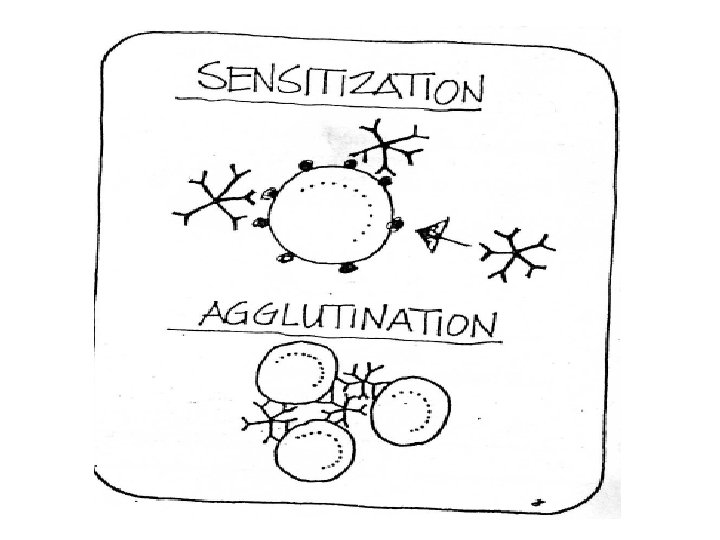
Agglutination Reactions • Two Stage Process: – Stage 1 Sensitization: • attachment of Antibody to Antigen on the RBC membrane. – Stage 2 Lattice formation (agglutination): • formation of bridges between the sensitized red cells to form the lattice that constitutes agglutination.
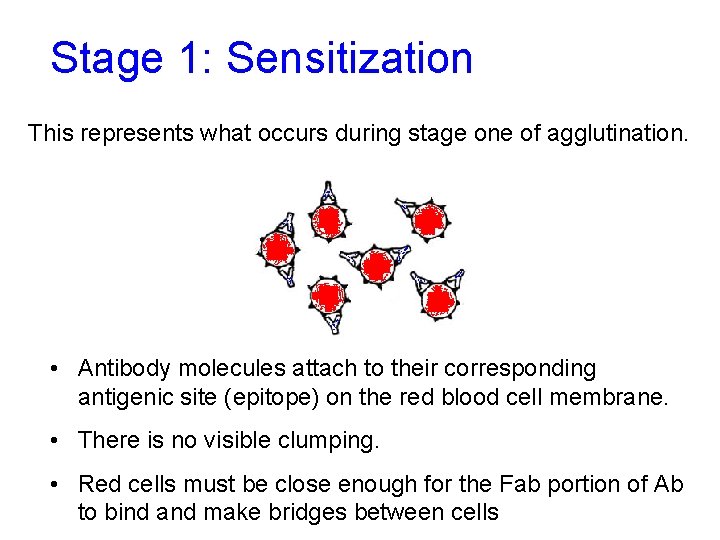
Stage 1: Sensitization This represents what occurs during stage one of agglutination. • Antibody molecules attach to their corresponding antigenic site (epitope) on the red blood cell membrane. • There is no visible clumping. • Red cells must be close enough for the Fab portion of Ab to bind and make bridges between cells
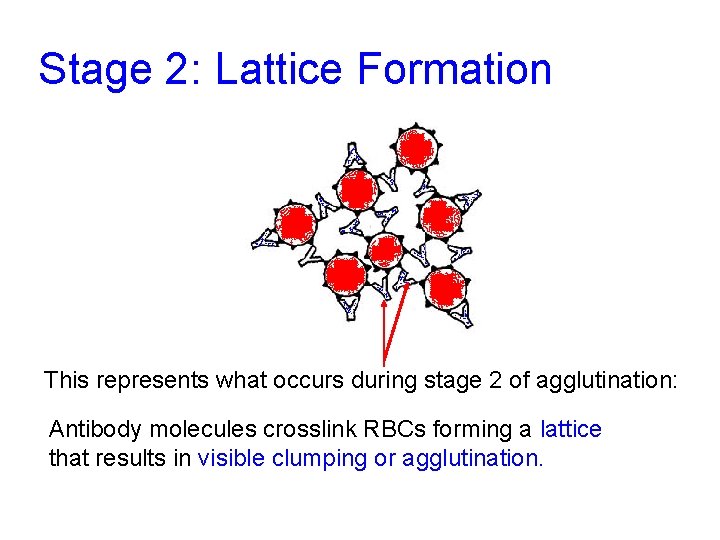
Stage 2: Lattice Formation This represents what occurs during stage 2 of agglutination: Antibody molecules crosslink RBCs forming a lattice that results in visible clumping or agglutination.
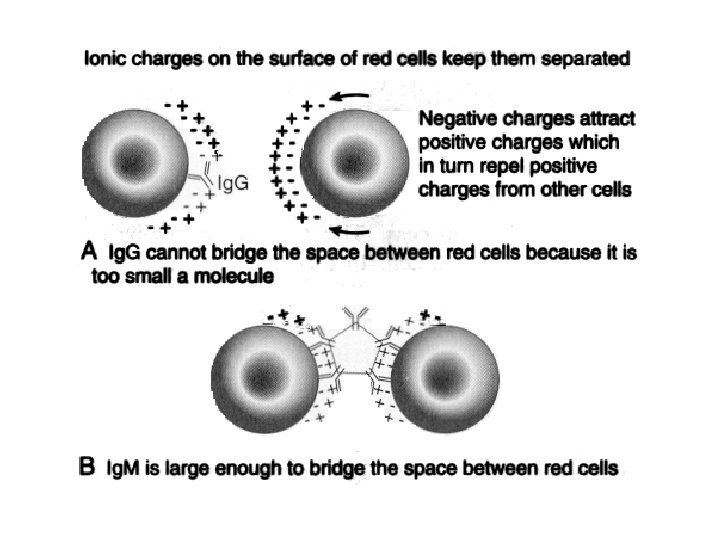
The Zeta Potential • The electric repulsion between cells • This explains why cells do not agglutinate • Red cells have negative charge due to sialic acid molecules

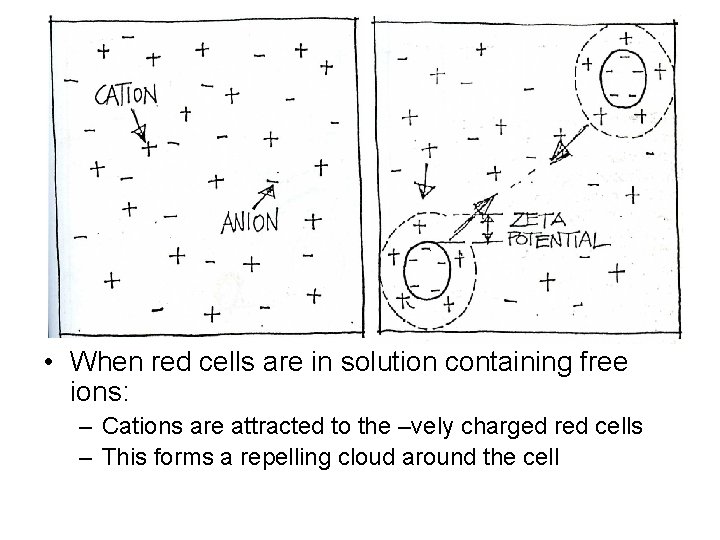
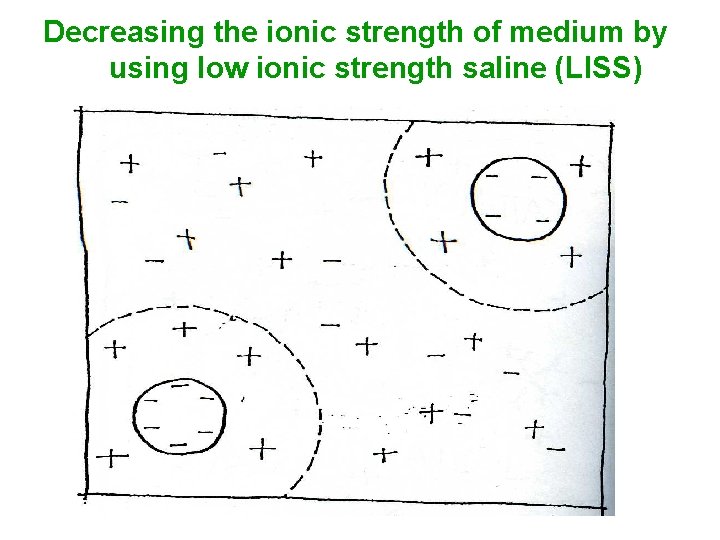
• When red cells are in solution containing free ions: – Cations are attracted to the –vely charged red cells – This forms a repelling cloud around the cell
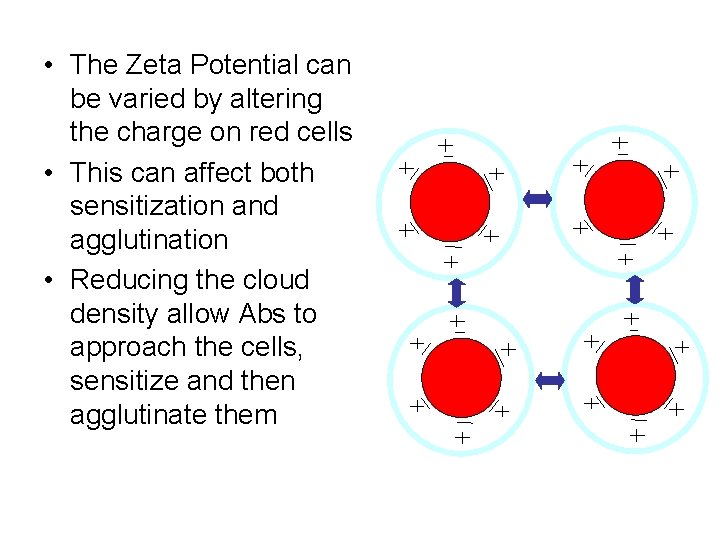
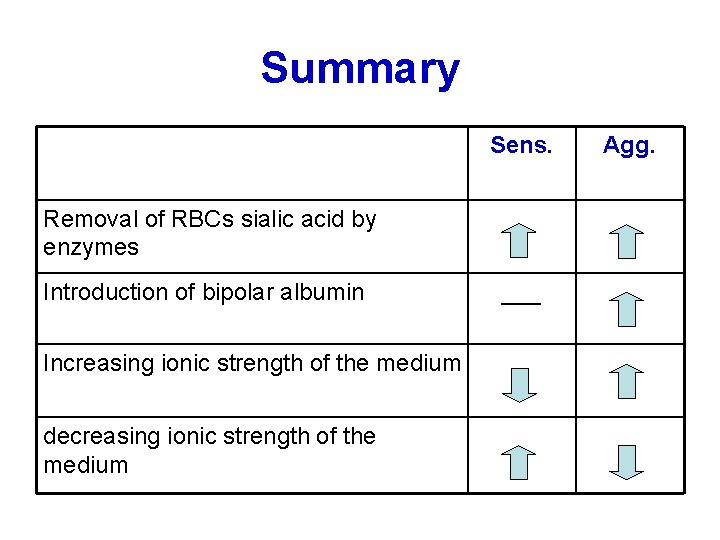
• The Zeta Potential can be varied by altering the charge on red cells • This can affect both sensitization and agglutination • Reducing the cloud density allow Abs to approach the cells, sensitize and then agglutinate them

Factors affecting the Zeta Potential
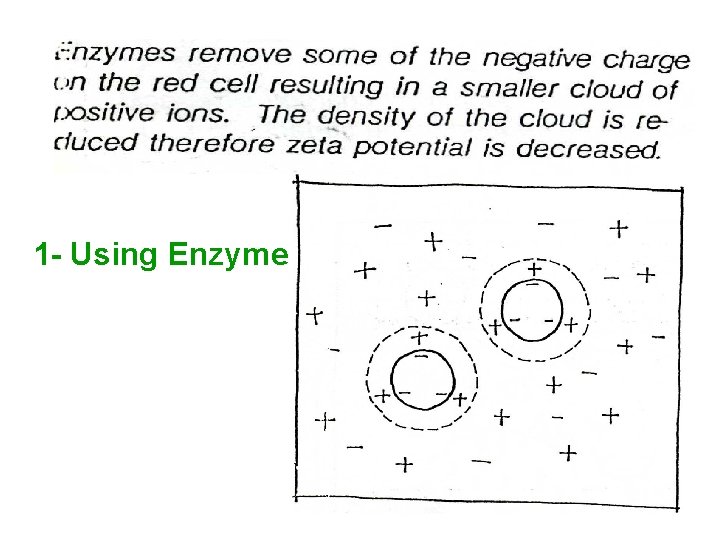
1 - Using Enzyme
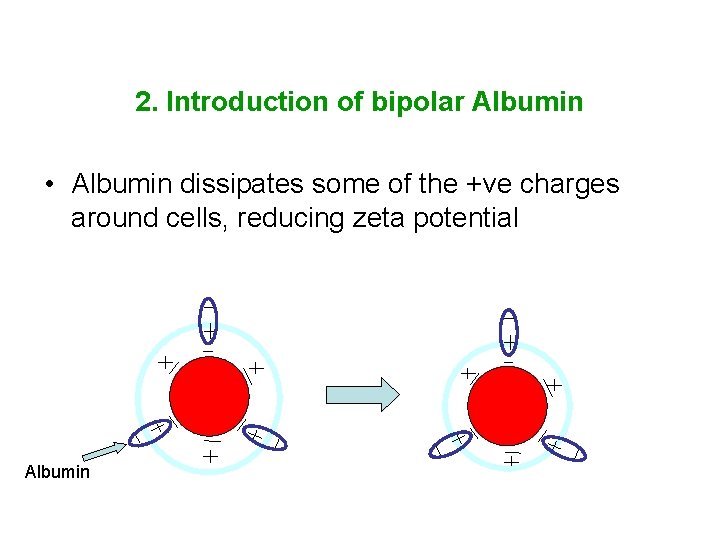
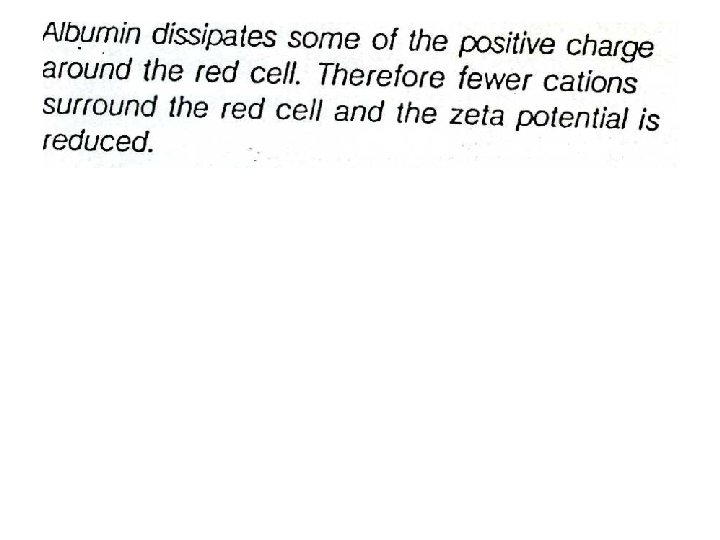
2. Introduction of bipolar Albumin • Albumin dissipates some of the +ve charges around cells, reducing zeta potential Albumin
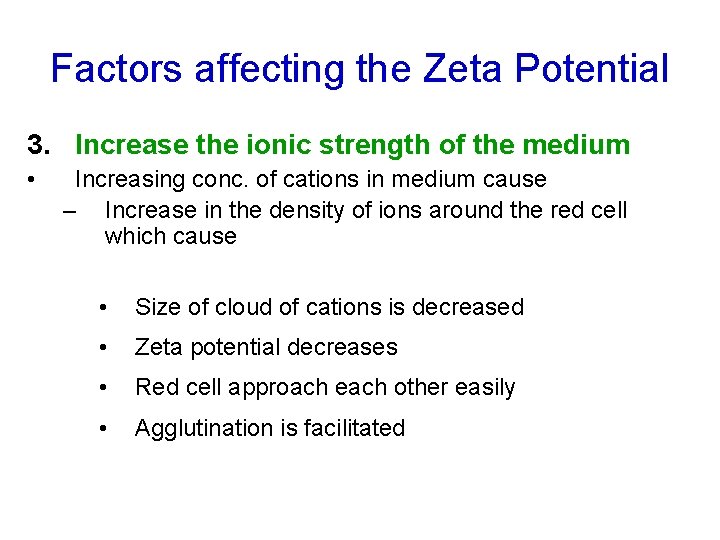
Factors affecting the Zeta Potential 3. Increase the ionic strength of the medium • Increasing conc. of cations in medium cause – Increase in the density of ions around the red cell which cause • Size of cloud of cations is decreased • Zeta potential decreases • Red cell approach each other easily • Agglutination is facilitated
Increase the ionic strength of the medium
Factors affecting the Zeta Potential 4. Decreasing the ionic strength of medium by using low ionic strength saline (LISS) – Decreasing conc. of cations in medium – Leads to decrease in density of ions around red cells – This increases sensitization – But decreases agglutination
Decreasing the ionic strength of medium by using low ionic strength saline (LISS)
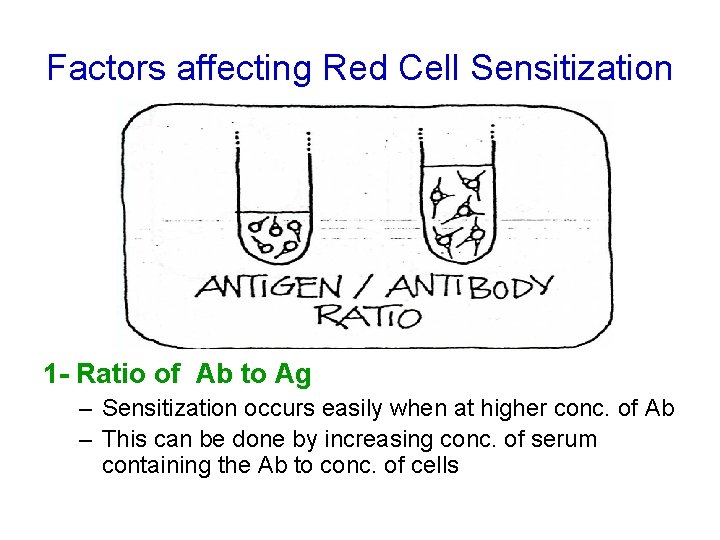
Factors affecting Red Cell Sensitization 1 - Ratio of Ab to Ag – Sensitization occurs easily when at higher conc. of Ab – This can be done by increasing conc. of serum containing the Ab to conc. of cells
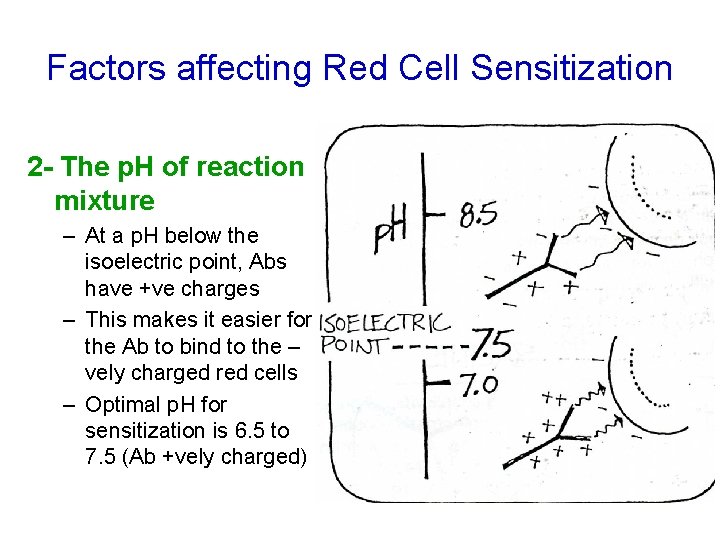
Factors affecting Red Cell Sensitization 2 - The p. H of reaction mixture – At a p. H below the isoelectric point, Abs have +ve charges – This makes it easier for the Ab to bind to the – vely charged red cells – Optimal p. H for sensitization is 6. 5 to 7. 5 (Ab +vely charged)
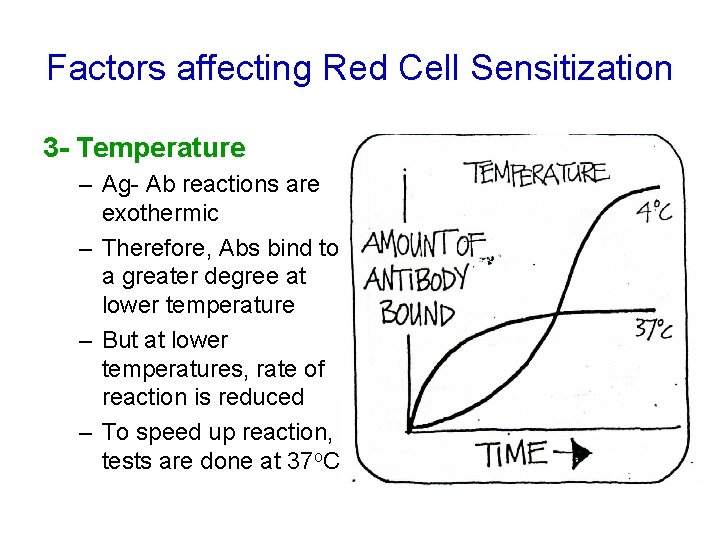
Factors affecting Red Cell Sensitization 3 - Temperature – Ag- Ab reactions are exothermic – Therefore, Abs bind to a greater degree at lower temperature – But at lower temperatures, rate of reaction is reduced – To speed up reaction, tests are done at 37 o. C
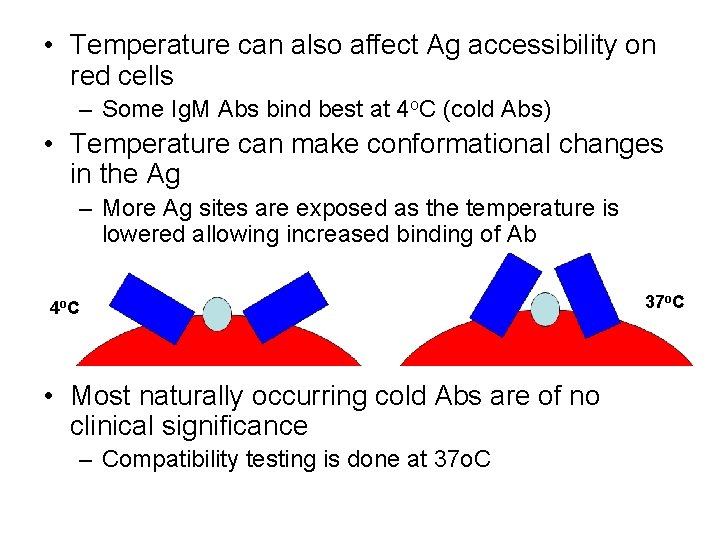
• Temperature can also affect Ag accessibility on red cells – Some Ig. M Abs bind best at 4 o. C (cold Abs) • Temperature can make conformational changes in the Ag – More Ag sites are exposed as the temperature is lowered allowing increased binding of Ab 4 o. C • Most naturally occurring cold Abs are of no clinical significance – Compatibility testing is done at 37 o. C
Factors affecting Red Cell Sensitization 4 - Ionic strength of the medium – When RBCs are suspended in LISS the cloud of ions around the cell is less dense than in isotonic saline – Reduced conc. of cations surrounding RBCs allow +vely charged Abs easier to access Ag sites – Rate of sensitization increases

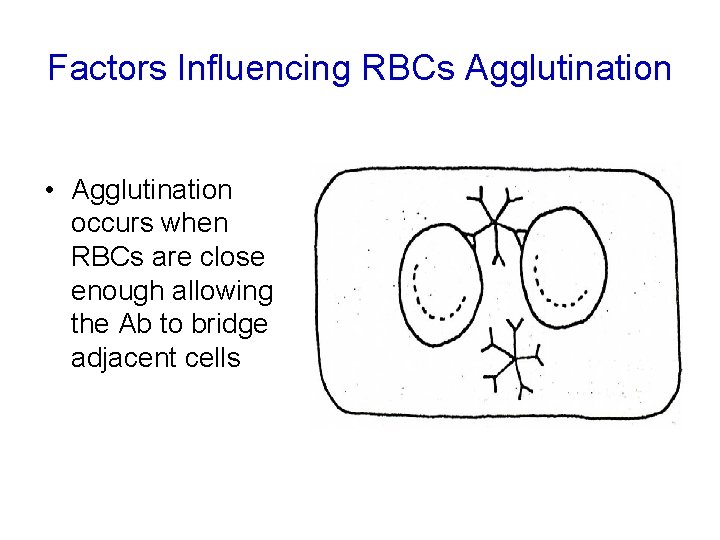
Factors Influencing RBCs Agglutination • Agglutination occurs when RBCs are close enough allowing the Ab to bridge adjacent cells
Factors Influencing RBCs Agglutination 1 - Ionic strength of Medium – Rate of sensitization increases in LISS BUT: – Agglutination is impaired because of increase in zeta potential • (Rule: reduced zeta potential facilitate agglutination)
Factors Influencing RBCs Agglutination 2 - Presence of Albumin in medium 3 - Enzyme treatment of red cells • • Remove –vely charged sialic acid & therefore reduce the zeta potential This make cells come closer & agglutinate But, certain Ags can be destroyed by enzymes (M, N, S, Fya, Fyb) 4 - Temperature (previously discussed)
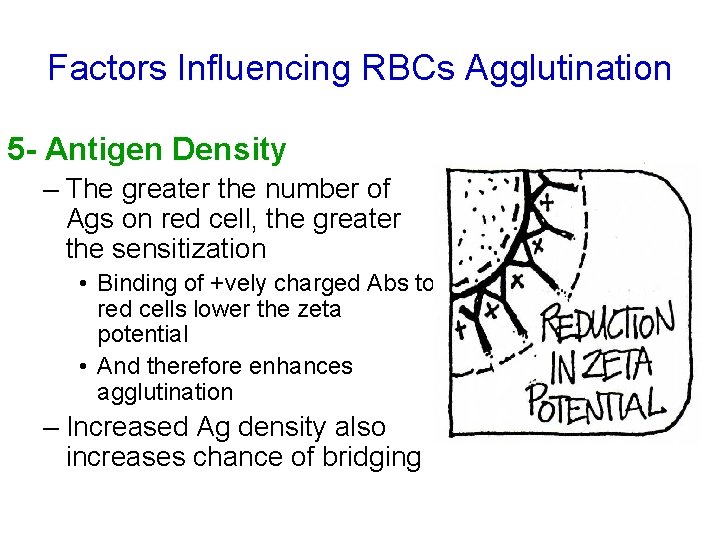
Factors Influencing RBCs Agglutination 5 - Antigen Density – The greater the number of Ags on red cell, the greater the sensitization • Binding of +vely charged Abs to red cells lower the zeta potential • And therefore enhances agglutination – Increased Ag density also increases chance of bridging
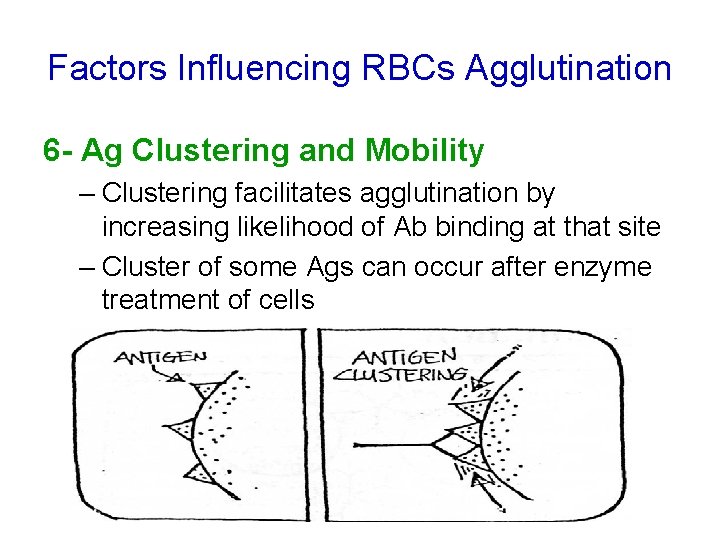
Factors Influencing RBCs Agglutination 6 - Ag Clustering and Mobility – Clustering facilitates agglutination by increasing likelihood of Ab binding at that site – Cluster of some Ags can occur after enzyme treatment of cells Clustering of Ags
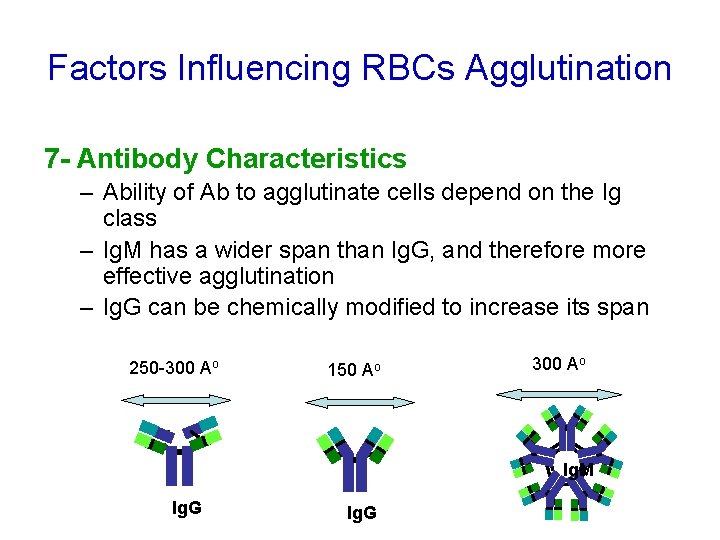
Factors Influencing RBCs Agglutination 7 - Antibody Characteristics – Ability of Ab to agglutinate cells depend on the Ig class – Ig. M has a wider span than Ig. G, and therefore more effective agglutination – Ig. G can be chemically modified to increase its span 250 -300 Ao 150 Ao A g Ig. G Ig. M
7 - Antibody Characteristics
Summary Sens. Removal of RBCs sialic acid by enzymes Introduction of bipolar albumin Increasing ionic strength of the medium decreasing ionic strength of the medium ___ Agg.
- Slides: 36