
Sensitivity Analysis Introduction to Sensitivity Analysis n Graphical




- Slides: 20
Sensitivity Analysis Introduction to Sensitivity Analysis n Graphical Sensitivity Analysis n Sensitivity Analysis: Computer Solution n Simultaneous Changes n 1
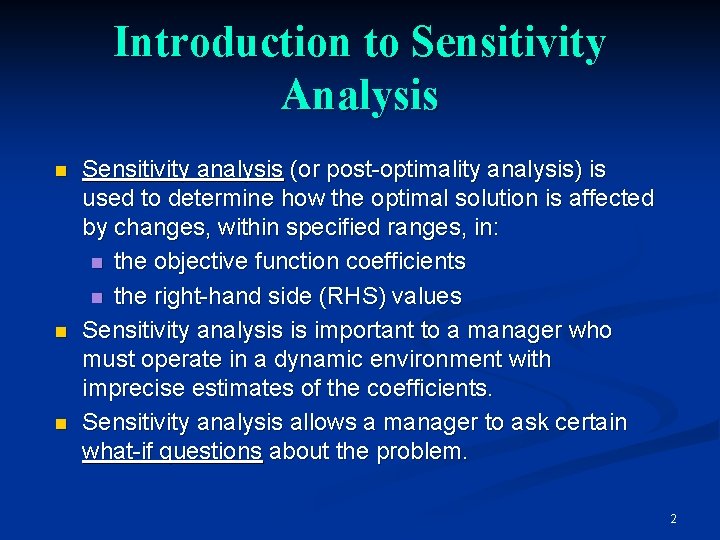
Introduction to Sensitivity Analysis n n n Sensitivity analysis (or post-optimality analysis) is used to determine how the optimal solution is affected by changes, within specified ranges, in: n the objective function coefficients n the right-hand side (RHS) values Sensitivity analysis is important to a manager who must operate in a dynamic environment with imprecise estimates of the coefficients. Sensitivity analysis allows a manager to ask certain what-if questions about the problem. 2
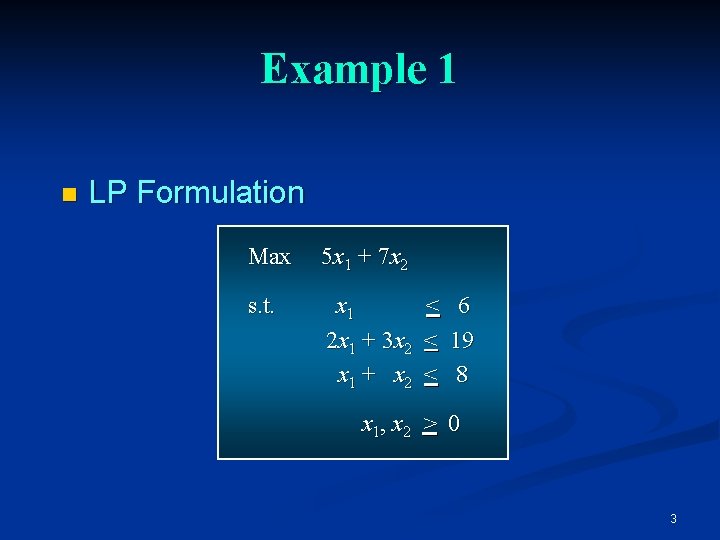
Example 1 n LP Formulation Max 5 x 1 + 7 x 2 s. t. x 1 2 x 1 + 3 x 2 x 1 + x 2 < < < 6 19 8 x 1, x 2 > 0 3
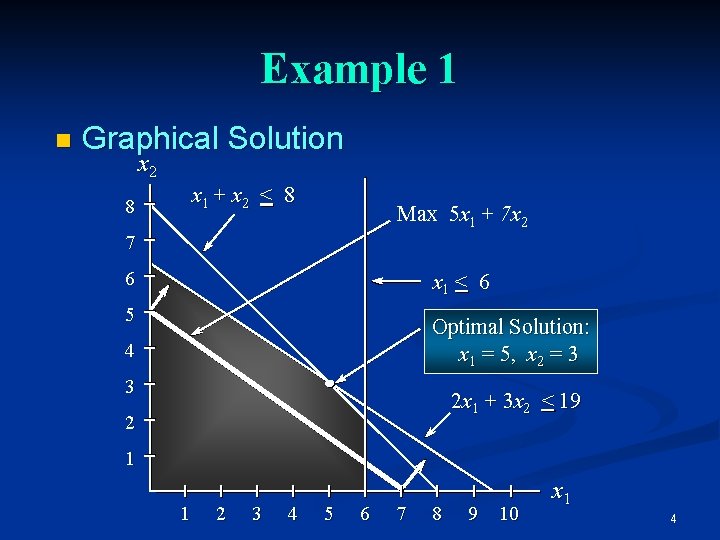
Example 1 n Graphical Solution x 2 x 1 + x 2 < 8 8 Max 5 x 1 + 7 x 2 7 6 x 1 < 6 5 Optimal Solution: x 1 = 5, x 2 = 3 4 3 2 x 1 + 3 x 2 < 19 2 1 1 2 3 4 5 6 7 8 9 10 x 1 4
Objective Function Coefficients Let us consider how changes in the objective function coefficients might affect the optimal solution. n The range of optimality for each coefficient provides the range of values over which the current solution will remain optimal. n Managers should focus on those objective coefficients that have a narrow range of optimality and coefficients near the endpoints of the range. n 5
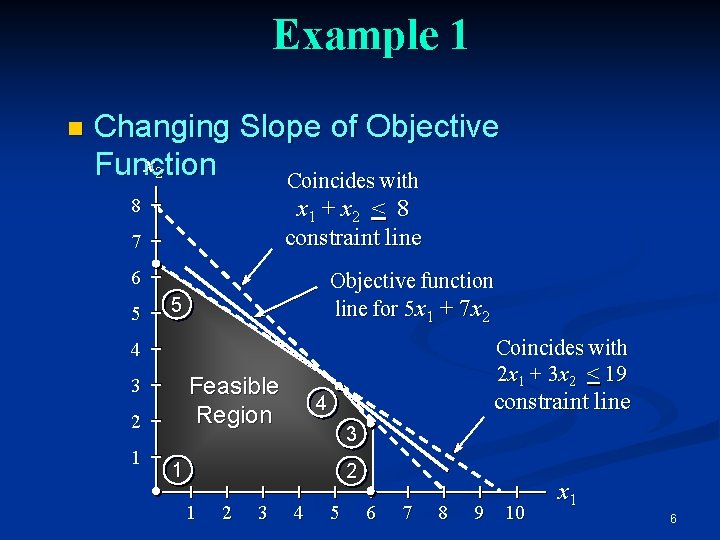
Example 1 n Changing Slope of Objective x 2 Function Coincides with 8 x 1 + x 2 < 8 constraint line 7 6 5 Objective function line for 5 x 1 + 7 x 2 5 Coincides with 2 x 1 + 3 x 2 < 19 4 Feasible Region 3 2 1 constraint line 4 3 1 2 3 4 5 6 7 8 9 10 x 1 6
Range of Optimality Graphically, the limits of a range of optimality are found by changing the slope of the objective function line within the limits of the slopes of the binding constraint lines. n Slope of an objective function line, Max c 1 x 1 + c 2 x 2, is -c 1/c 2, and the slope of a constraint, a 1 x 1 + a 2 x 2 = b, is -a 1/a 2. n 7
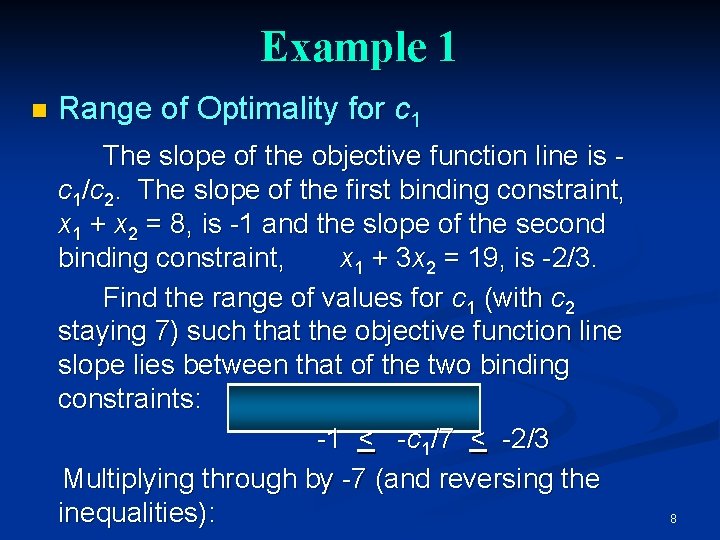
Example 1 n Range of Optimality for c 1 The slope of the objective function line is c 1/c 2. The slope of the first binding constraint, x 1 + x 2 = 8, is -1 and the slope of the second binding constraint, x 1 + 3 x 2 = 19, is -2/3. Find the range of values for c 1 (with c 2 staying 7) such that the objective function line slope lies between that of the two binding constraints: -1 < -c 1/7 < -2/3 Multiplying through by -7 (and reversing the inequalities): 8
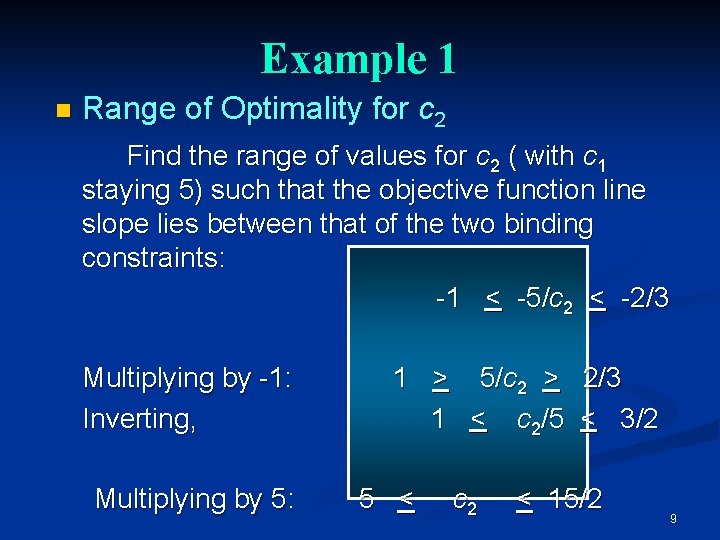
Example 1 n Range of Optimality for c 2 Find the range of values for c 2 ( with c 1 staying 5) such that the objective function line slope lies between that of the two binding constraints: -1 < -5/c 2 < -2/3 Multiplying by -1: Inverting, Multiplying by 5: 1 > 5/c 2 > 1 < c 2/5 5 < c 2 2/3 < 3/2 < 15/2 9
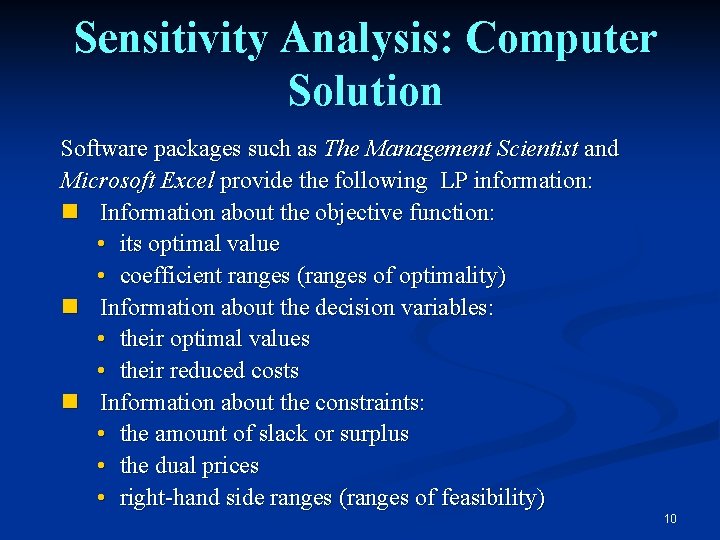
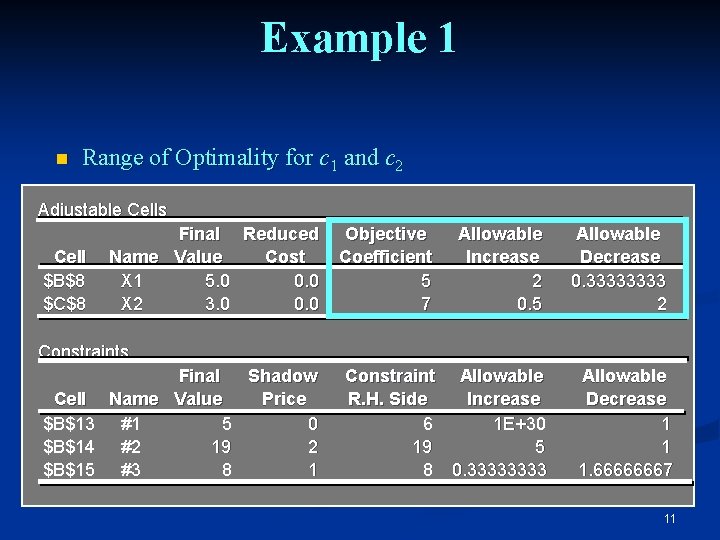
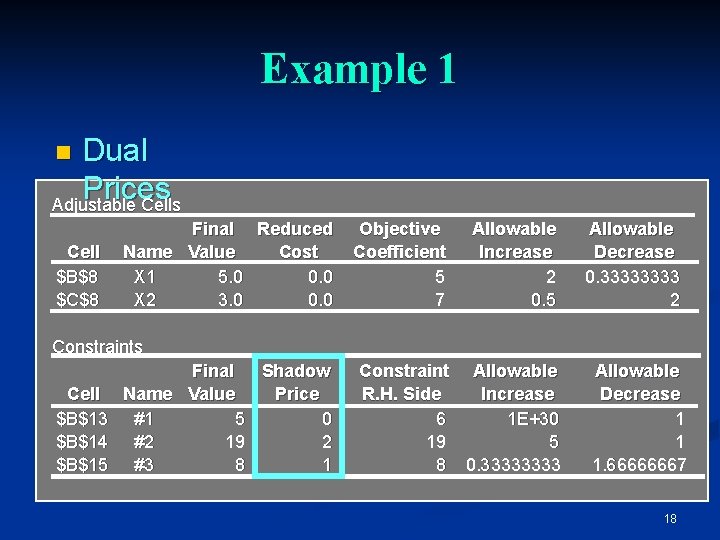
Sensitivity Analysis: Computer Solution Software packages such as The Management Scientist and Microsoft Excel provide the following LP information: n Information about the objective function: • its optimal value • coefficient ranges (ranges of optimality) n Information about the decision variables: • their optimal values • their reduced costs n Information about the constraints: • the amount of slack or surplus • the dual prices • right-hand side ranges (ranges of feasibility) 10
Example 1 n Range of Optimality for c 1 and c 2 Adjustable Cells Cell $B$8 $C$8 Final Reduced Name Value Cost X 1 5. 0 0. 0 X 2 3. 0 0. 0 Objective Coefficient 5 7 Allowable Increase 2 0. 5 Allowable Decrease 0. 3333 2 Constraints Final Shadow Cell Name Value Price $B$13 #1 5 0 $B$14 #2 19 2 $B$15 #3 8 1 Constraint Allowable R. H. Side Increase 6 1 E+30 19 5 8 0. 3333 Allowable Decrease 1 1 1. 66666667 11
Right-Hand Sides n n Let us consider how a change in the righthand side for a constraint might affect the feasible region and perhaps cause a change in the optimal solution. The improvement in the value of the optimal solution per unit increase in the right-hand side is called the dual price. The range of feasibility is the range over which the dual price is applicable. As the RHS increases, other constraints will become binding and limit the change in the 12
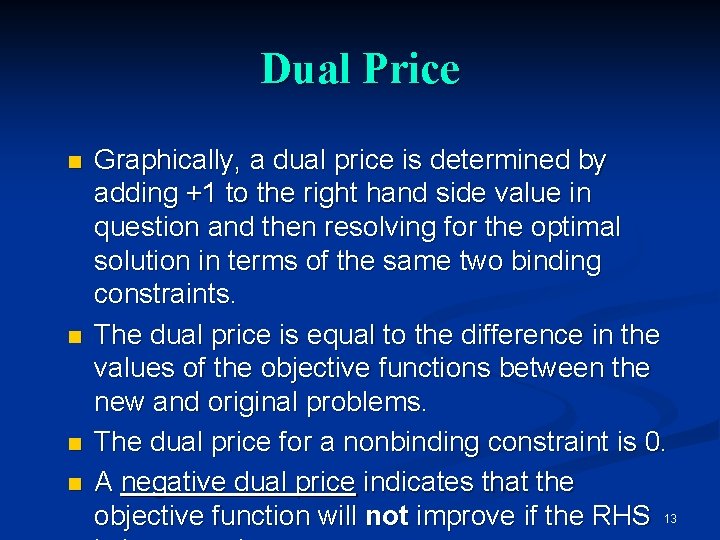
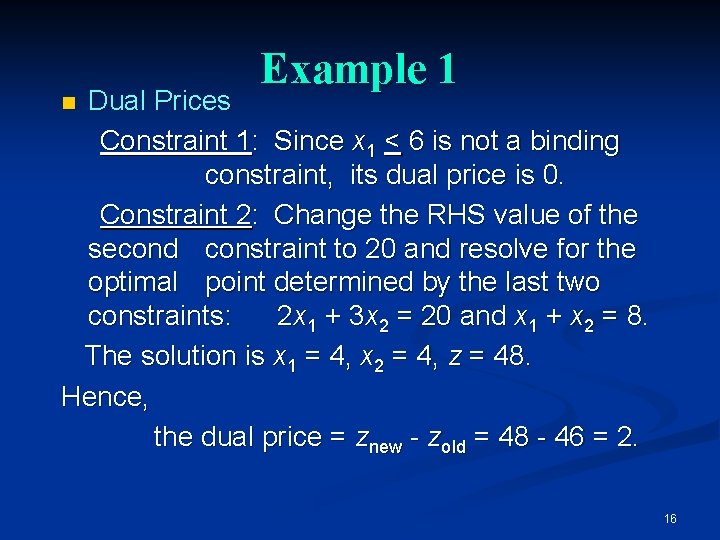
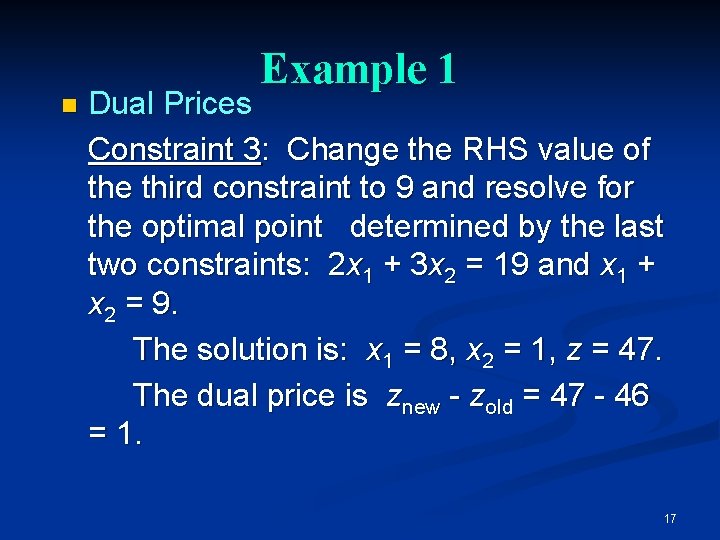
Dual Price n n Graphically, a dual price is determined by adding +1 to the right hand side value in question and then resolving for the optimal solution in terms of the same two binding constraints. The dual price is equal to the difference in the values of the objective functions between the new and original problems. The dual price for a nonbinding constraint is 0. A negative dual price indicates that the objective function will not improve if the RHS 13
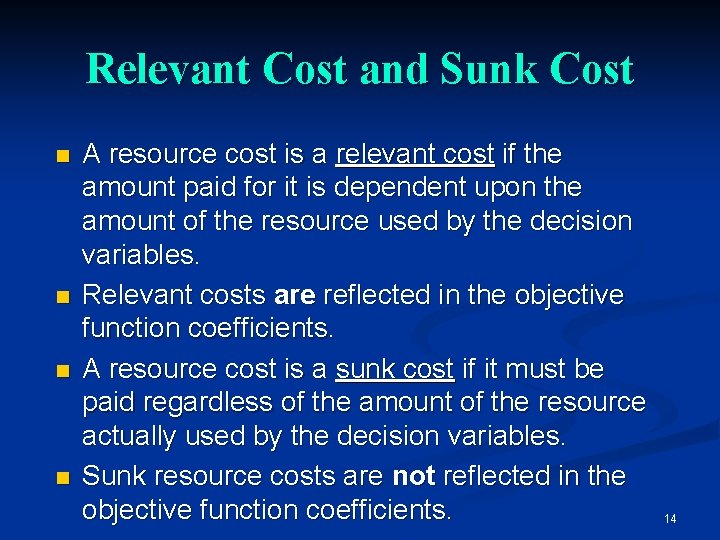
Relevant Cost and Sunk Cost n n A resource cost is a relevant cost if the amount paid for it is dependent upon the amount of the resource used by the decision variables. Relevant costs are reflected in the objective function coefficients. A resource cost is a sunk cost if it must be paid regardless of the amount of the resource actually used by the decision variables. Sunk resource costs are not reflected in the objective function coefficients. 14
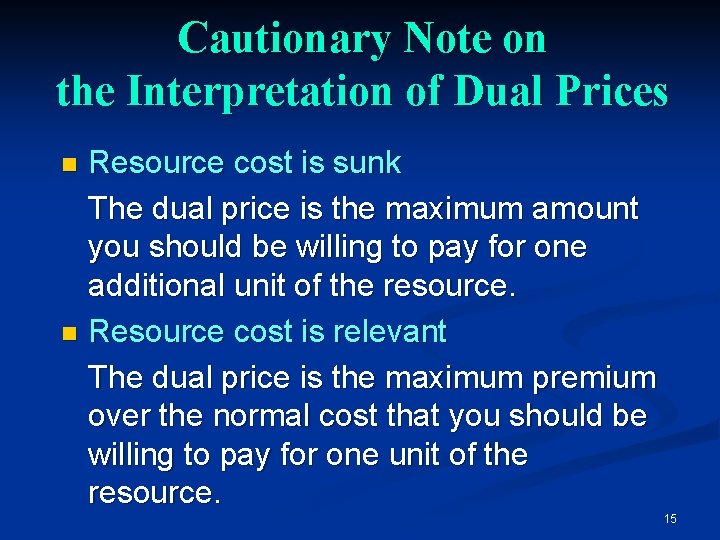
Cautionary Note on the Interpretation of Dual Prices Resource cost is sunk The dual price is the maximum amount you should be willing to pay for one additional unit of the resource. n Resource cost is relevant The dual price is the maximum premium over the normal cost that you should be willing to pay for one unit of the resource. n 15
Example 1 Dual Prices Constraint 1: Since x 1 < 6 is not a binding constraint, its dual price is 0. Constraint 2: Change the RHS value of the second constraint to 20 and resolve for the optimal point determined by the last two constraints: 2 x 1 + 3 x 2 = 20 and x 1 + x 2 = 8. The solution is x 1 = 4, x 2 = 4, z = 48. Hence, the dual price = znew - zold = 48 - 46 = 2. n 16
n Example 1 Dual Prices Constraint 3: Change the RHS value of the third constraint to 9 and resolve for the optimal point determined by the last two constraints: 2 x 1 + 3 x 2 = 19 and x 1 + x 2 = 9. The solution is: x 1 = 8, x 2 = 1, z = 47. The dual price is znew - zold = 47 - 46 = 1. 17
Example 1 Dual Prices Adjustable Cells n Cell $B$8 $C$8 Final Reduced Name Value Cost X 1 5. 0 0. 0 X 2 3. 0 0. 0 Objective Coefficient 5 7 Allowable Increase 2 0. 5 Allowable Decrease 0. 3333 2 Constraints Final Shadow Cell Name Value Price $B$13 #1 5 0 $B$14 #2 19 2 $B$15 #3 8 1 Constraint Allowable R. H. Side Increase 6 1 E+30 19 5 8 0. 3333 Allowable Decrease 1 1 1. 66666667 18
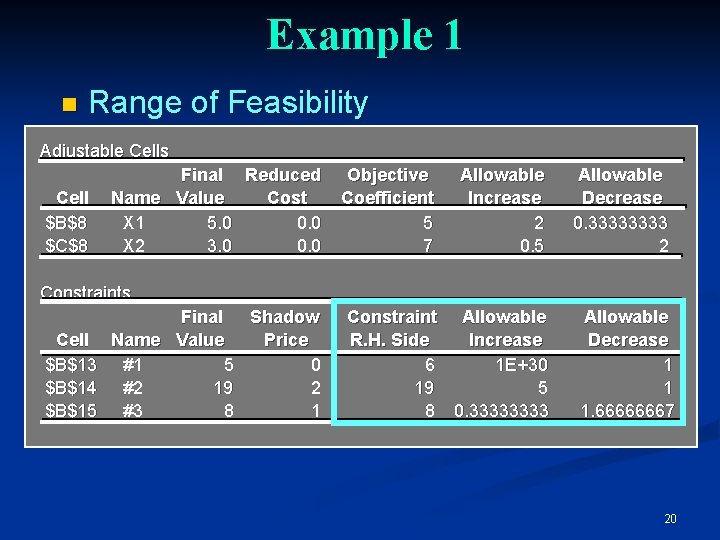
Range of Feasibility The range of feasibility for a change in the right hand side value is the range of values for this coefficient in which the original dual price remains constant. n Graphically, the range of feasibility is determined by finding the values of a right hand side coefficient such that the same two lines that determined the original optimal solution continue to determine the optimal solution for the n 19
Example 1 n Range of Feasibility Adjustable Cells Cell $B$8 $C$8 Final Reduced Name Value Cost X 1 5. 0 0. 0 X 2 3. 0 0. 0 Objective Coefficient 5 7 Allowable Increase 2 0. 5 Allowable Decrease 0. 3333 2 Constraints Final Shadow Cell Name Value Price $B$13 #1 5 0 $B$14 #2 19 2 $B$15 #3 8 1 Constraint Allowable R. H. Side Increase 6 1 E+30 19 5 8 0. 3333 Allowable Decrease 1 1 1. 66666667 20