
Senses and Sensory Processing Aims of today Understand
- Slides: 32
Senses and Sensory Processing
Aims of today: • Understand the sensory systems, where they are located and what they do. • Understand what happens when sensory processing isn’t working as it should. • Understand what we can do to support children and young people with sensory processing difficulties.
How many senses do we have?
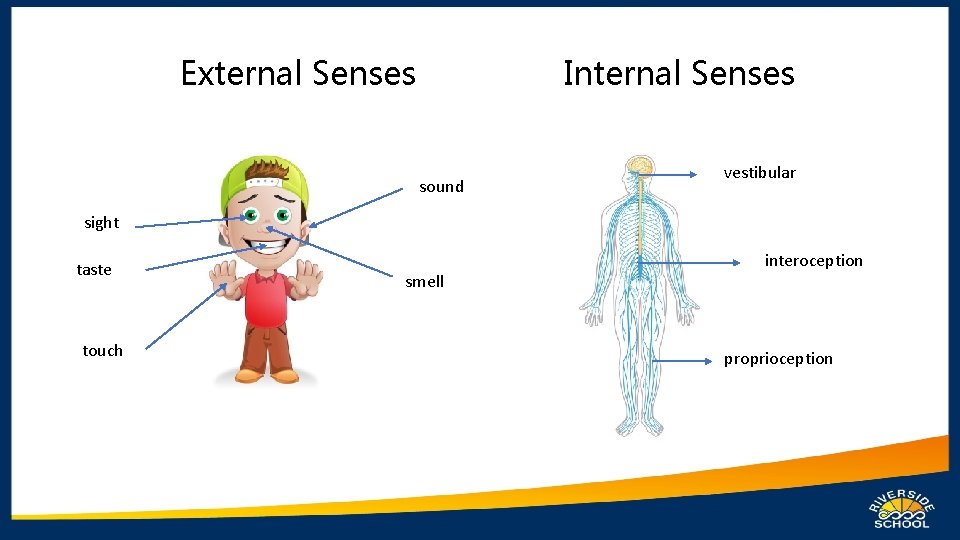
External Senses Internal Senses sound vestibular sight taste touch smell interoception proprioception
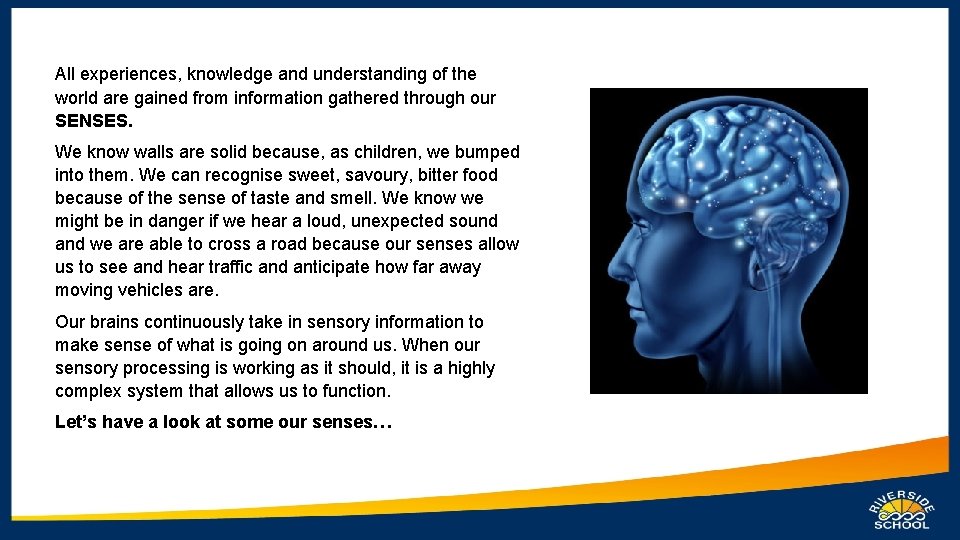
All experiences, knowledge and understanding of the world are gained from information gathered through our SENSES. We know walls are solid because, as children, we bumped into them. We can recognise sweet, savoury, bitter food because of the sense of taste and smell. We know we might be in danger if we hear a loud, unexpected sound and we are able to cross a road because our senses allow us to see and hear traffic and anticipate how far away moving vehicles are. Our brains continuously take in sensory information to make sense of what is going on around us. When our sensory processing is working as it should, it is a highly complex system that allows us to function. Let’s have a look at some our senses…
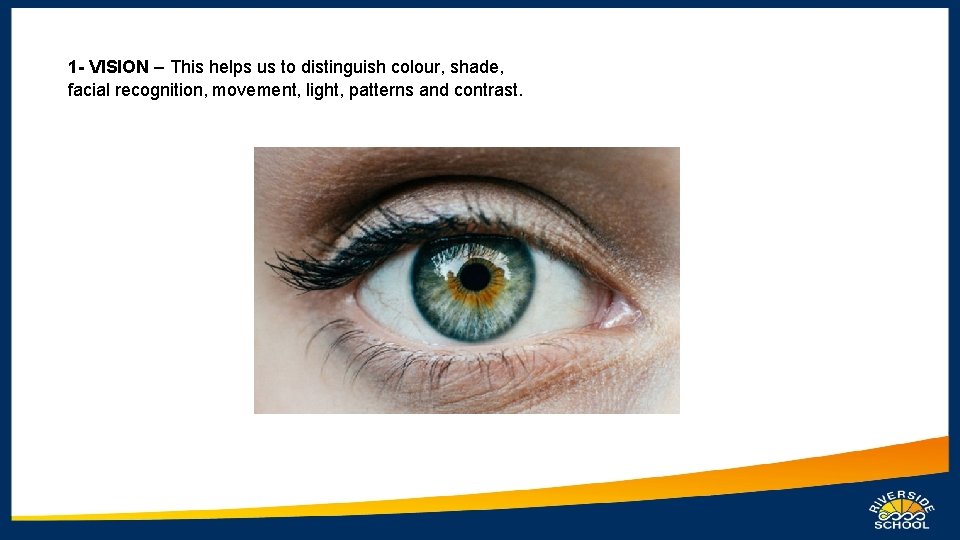
1 - VISION – This helps us to distinguish colour, shade, facial recognition, movement, light, patterns and contrast.
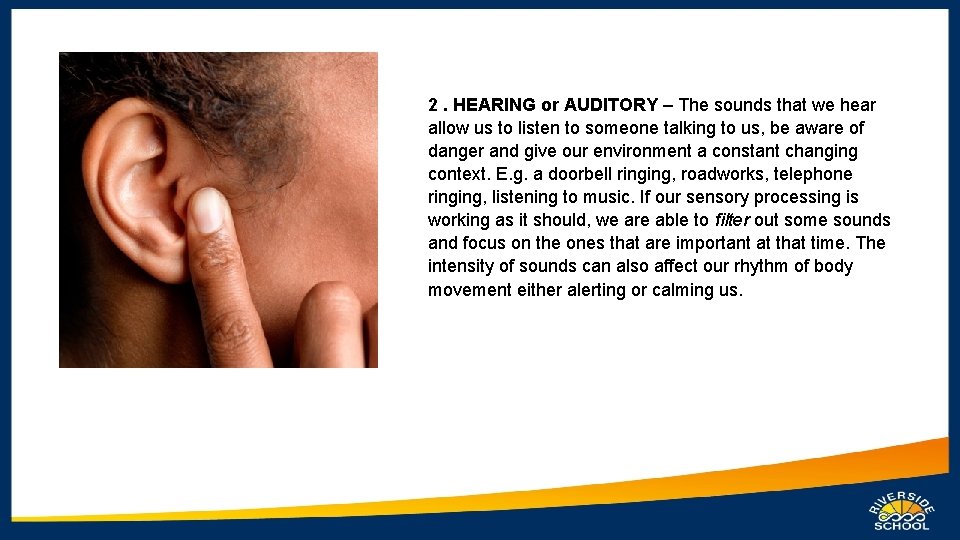
2. HEARING or AUDITORY – The sounds that we hear allow us to listen to someone talking to us, be aware of danger and give our environment a constant changing context. E. g. a doorbell ringing, roadworks, telephone ringing, listening to music. If our sensory processing is working as it should, we are able to filter out some sounds and focus on the ones that are important at that time. The intensity of sounds can also affect our rhythm of body movement either alerting or calming us.
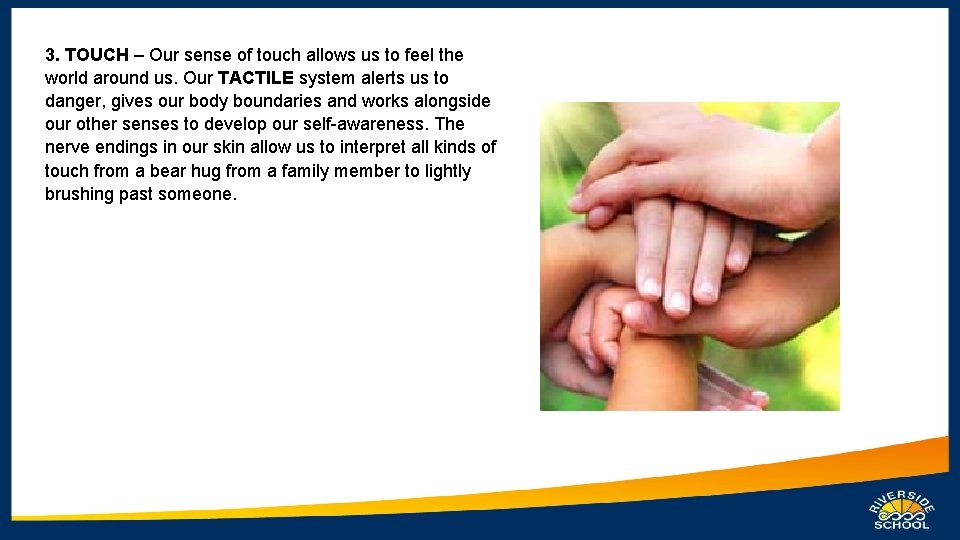
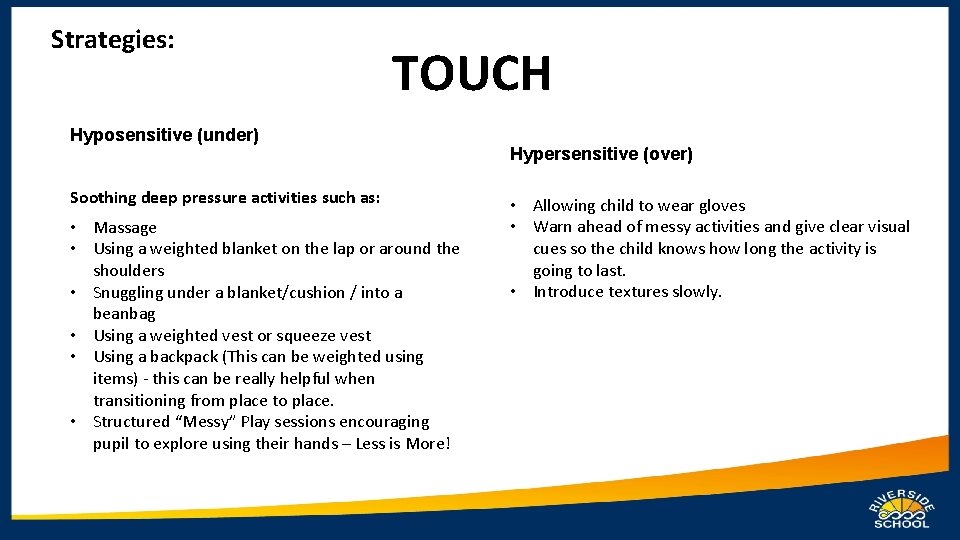
3. TOUCH – Our sense of touch allows us to feel the world around us. Our TACTILE system alerts us to danger, gives our body boundaries and works alongside our other senses to develop our self-awareness. The nerve endings in our skin allow us to interpret all kinds of touch from a bear hug from a family member to lightly brushing past someone.
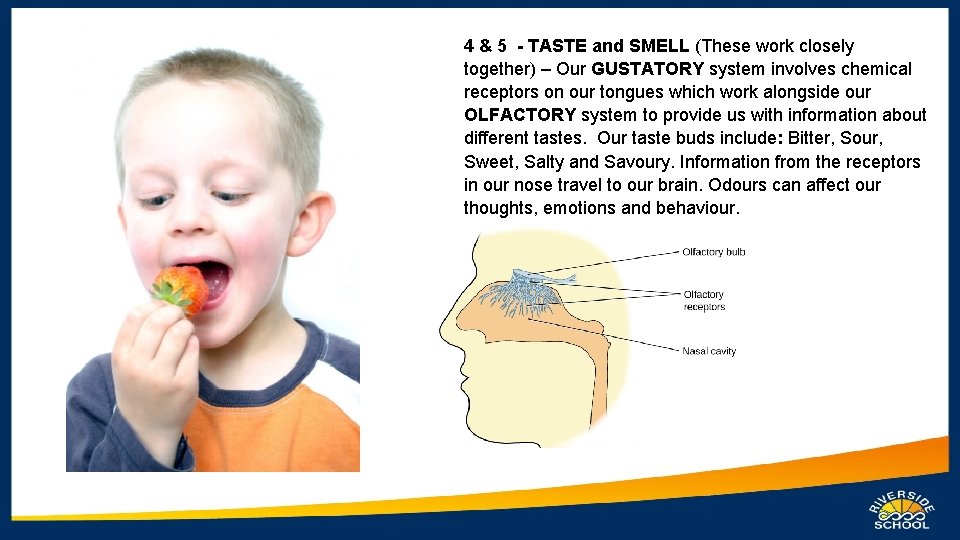
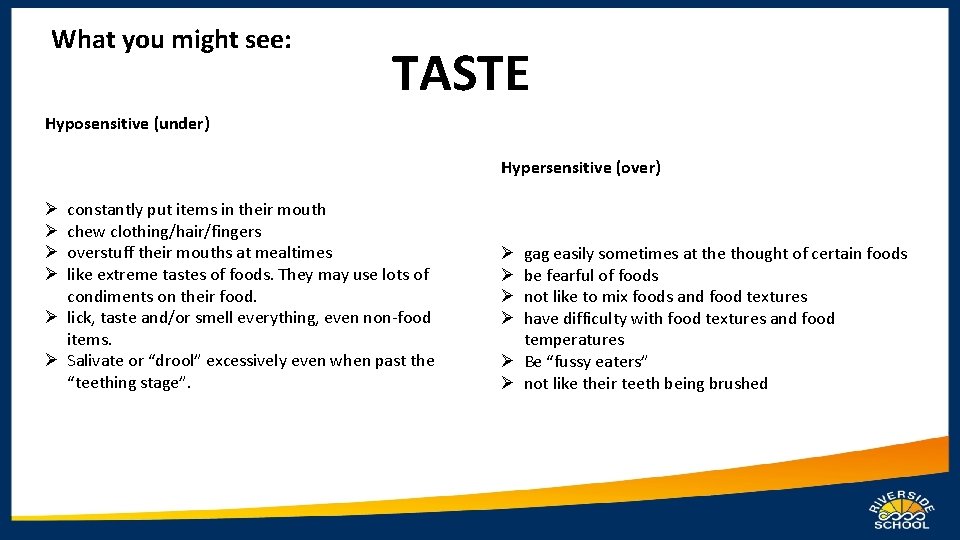
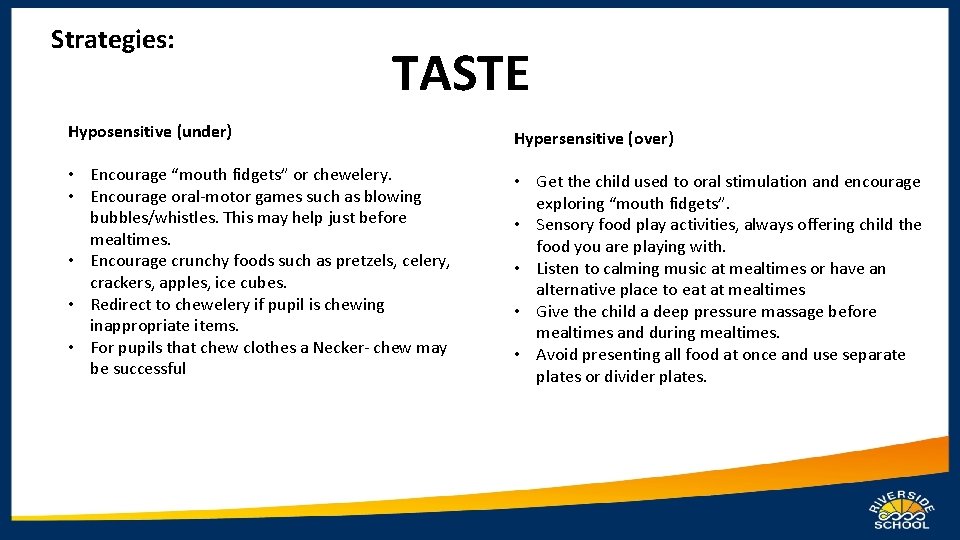
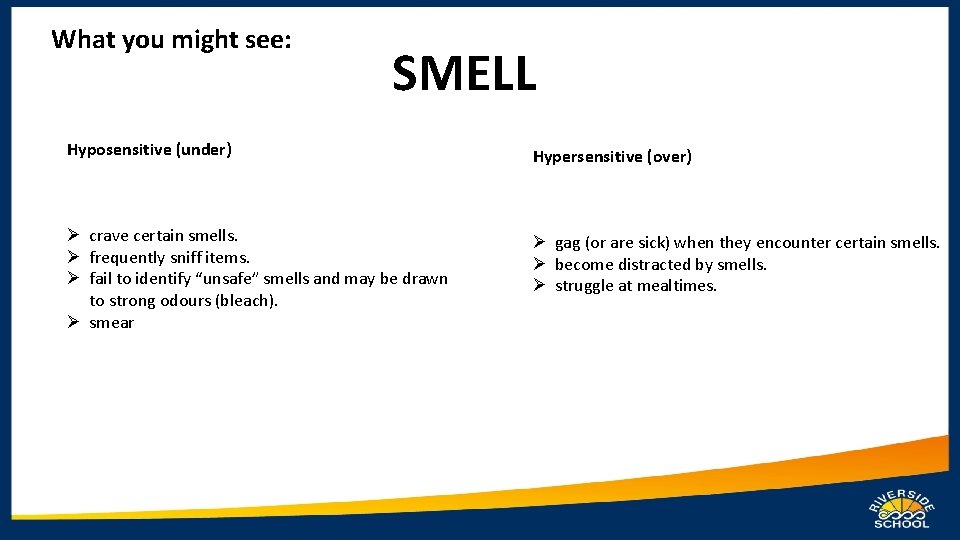
4 & 5 - TASTE and SMELL (These work closely together) – Our GUSTATORY system involves chemical receptors on our tongues which work alongside our OLFACTORY system to provide us with information about different tastes. Our taste buds include: Bitter, Sour, Sweet, Salty and Savoury. Information from the receptors in our nose travel to our brain. Odours can affect our thoughts, emotions and behaviour.
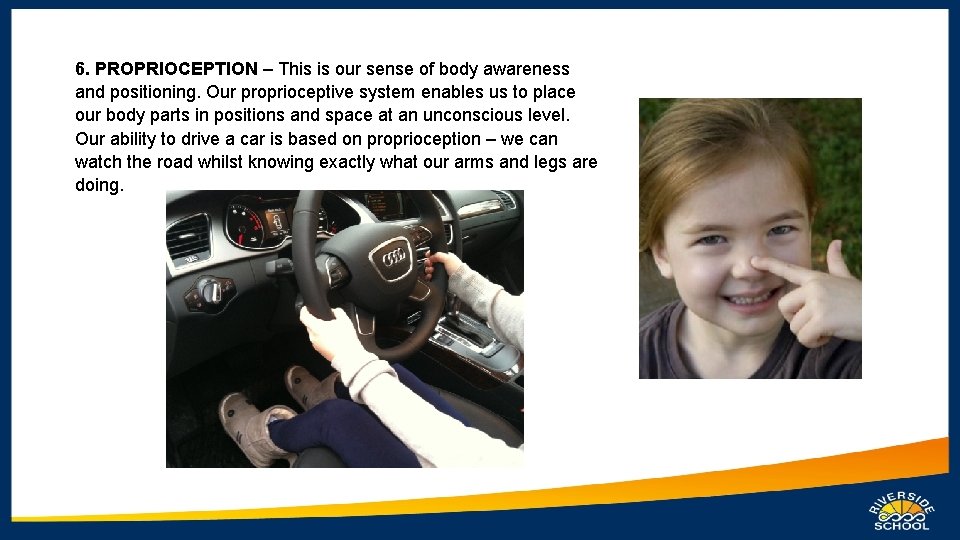
6. PROPRIOCEPTION – This is our sense of body awareness and positioning. Our proprioceptive system enables us to place our body parts in positions and space at an unconscious level. Our ability to drive a car is based on proprioception – we can watch the road whilst knowing exactly what our arms and legs are doing.
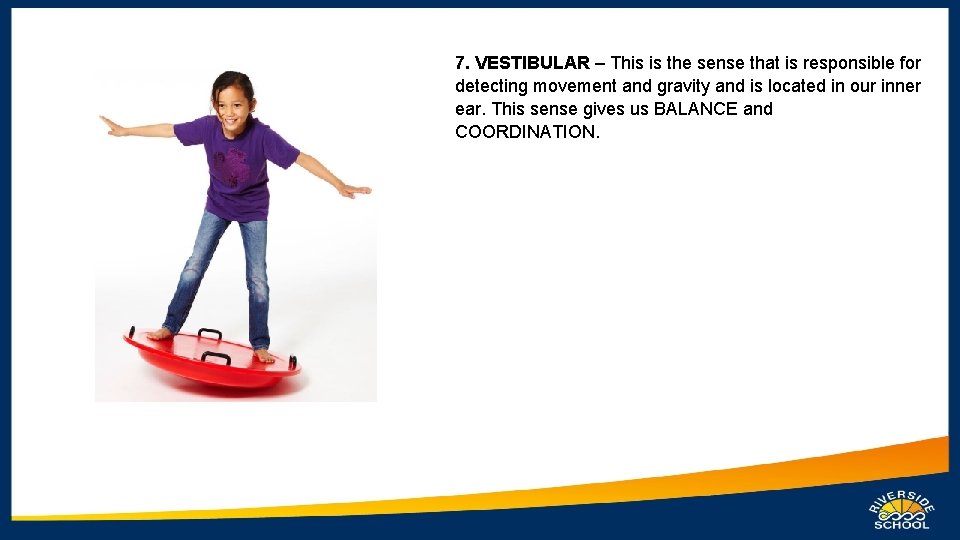
7. VESTIBULAR – This is the sense that is responsible for detecting movement and gravity and is located in our inner ear. This sense gives us BALANCE and COORDINATION.
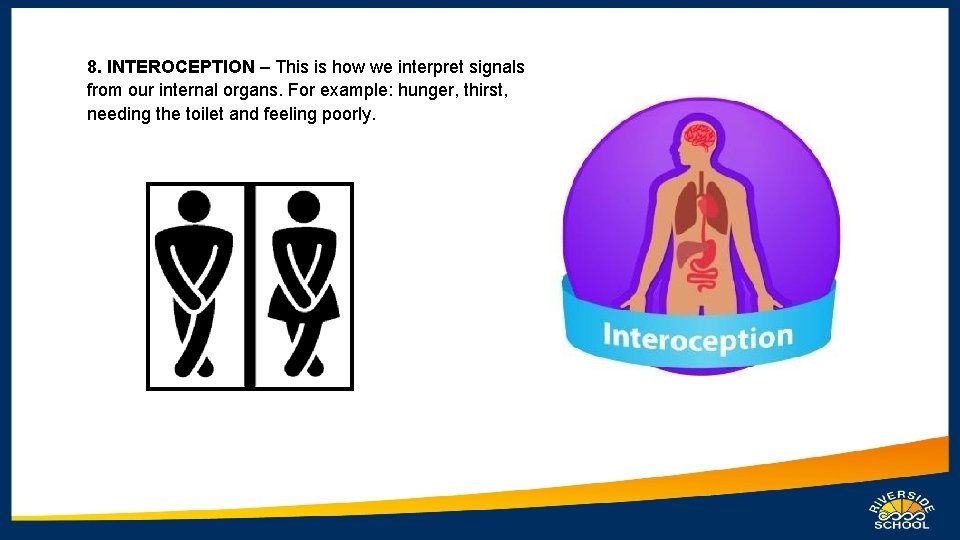
8. INTEROCEPTION – This is how we interpret signals from our internal organs. For example: hunger, thirst, needing the toilet and feeling poorly.
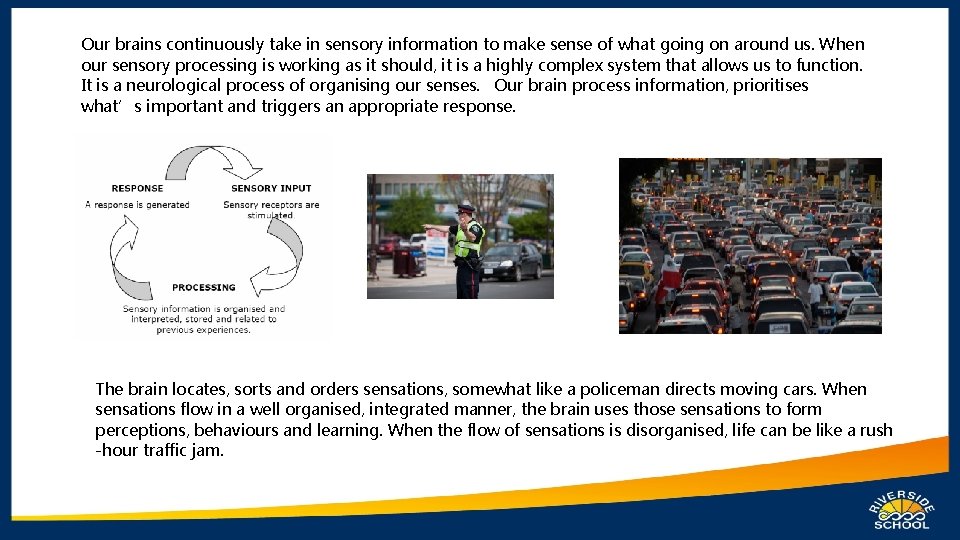
Our brains continuously take in sensory information to make sense of what going on around us. When our sensory processing is working as it should, it is a highly complex system that allows us to function. It is a neurological process of organising our senses. Our brain process information, prioritises what’s important and triggers an appropriate response. The brain locates, sorts and orders sensations, somewhat like a policeman directs moving cars. When sensations flow in a well organised, integrated manner, the brain uses those sensations to form perceptions, behaviours and learning. When the flow of sensations is disorganised, life can be like a rush -hour traffic jam.
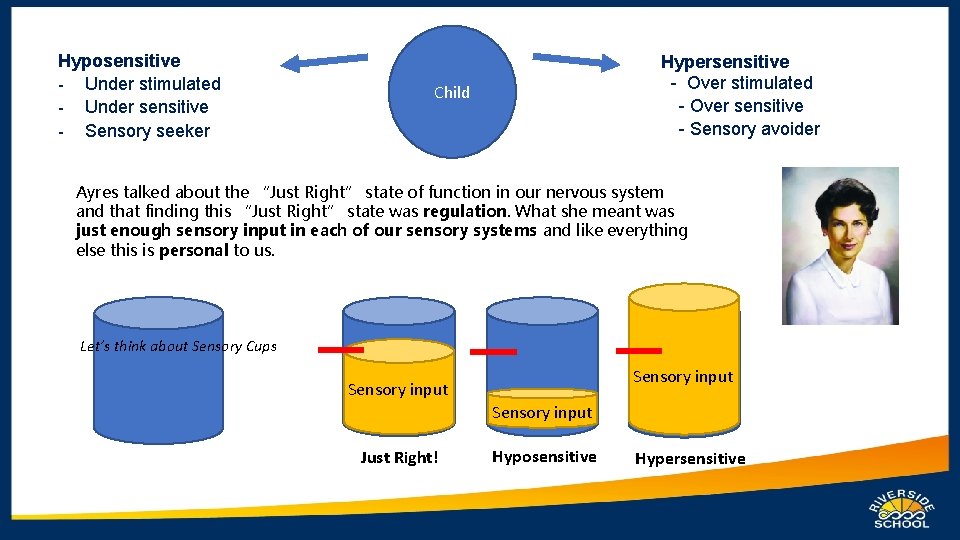
Hyposensitive - Under stimulated - Under sensitive - Sensory seeker Hypersensitive - Over stimulated - Over sensitive - Sensory avoider Child Ayres talked about the “Just Right” state of function in our nervous system and that finding this “Just Right” state was regulation. What she meant was just enough sensory input in each of our sensory systems and like everything else this is personal to us. Let’s think about Sensory Cups Sensory input Just Right! Hyposensitive Hypersensitive
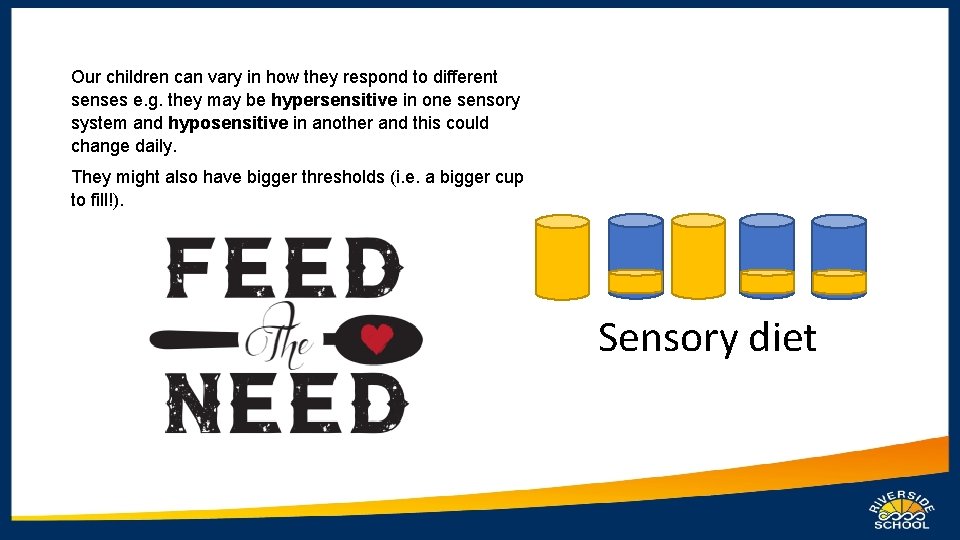
Our children can vary in how they respond to different senses e. g. they may be hypersensitive in one sensory system and hyposensitive in another and this could change daily. They might also have bigger thresholds (i. e. a bigger cup to fill!). Sensory diet
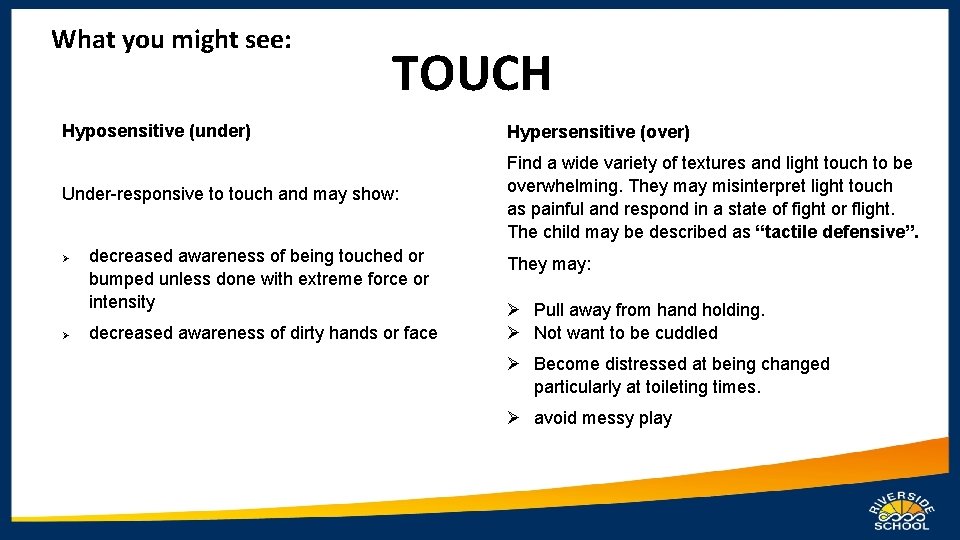
What you might see: TOUCH Hyposensitive (under) Hypersensitive (over) Find a wide variety of textures and light touch to be overwhelming. They may misinterpret light touch as painful and respond in a state of fight or flight. The child may be described as “tactile defensive”. Under-responsive to touch and may show: decreased awareness of being touched or bumped unless done with extreme force or intensity decreased awareness of dirty hands or face They may: Pull away from hand holding. Not want to be cuddled Become distressed at being changed particularly at toileting times. avoid messy play
Strategies: TOUCH Hyposensitive (under) Soothing deep pressure activities such as: • Massage • Using a weighted blanket on the lap or around the shoulders • Snuggling under a blanket/cushion / into a beanbag • Using a weighted vest or squeeze vest • Using a backpack (This can be weighted using items) - this can be really helpful when transitioning from place to place. • Structured “Messy” Play sessions encouraging pupil to explore using their hands – Less is More! Hypersensitive (over) • Allowing child to wear gloves • Warn ahead of messy activities and give clear visual cues so the child knows how long the activity is going to last. • Introduce textures slowly.
What you might see: TASTE Hyposensitive (under) Hypersensitive (over) constantly put items in their mouth chew clothing/hair/fingers overstuff their mouths at mealtimes like extreme tastes of foods. They may use lots of condiments on their food. lick, taste and/or smell everything, even non-food items. Salivate or “drool” excessively even when past the “teething stage”. gag easily sometimes at the thought of certain foods be fearful of foods not like to mix foods and food textures have difficulty with food textures and food temperatures Be “fussy eaters” not like their teeth being brushed
Strategies: TASTE Hyposensitive (under) Hypersensitive (over) • Encourage “mouth fidgets” or chewelery. • Encourage oral-motor games such as blowing bubbles/whistles. This may help just before mealtimes. • Encourage crunchy foods such as pretzels, celery, crackers, apples, ice cubes. • Redirect to chewelery if pupil is chewing inappropriate items. • For pupils that chew clothes a Necker- chew may be successful • Get the child used to oral stimulation and encourage exploring “mouth fidgets”. • Sensory food play activities, always offering child the food you are playing with. • Listen to calming music at mealtimes or have an alternative place to eat at mealtimes • Give the child a deep pressure massage before mealtimes and during mealtimes. • Avoid presenting all food at once and use separate plates or divider plates.
What you might see: SMELL Hyposensitive (under) Hypersensitive (over) crave certain smells. frequently sniff items. fail to identify “unsafe” smells and may be drawn to strong odours (bleach). smear gag (or are sick) when they encounter certain smells. become distracted by smells. struggle at mealtimes.
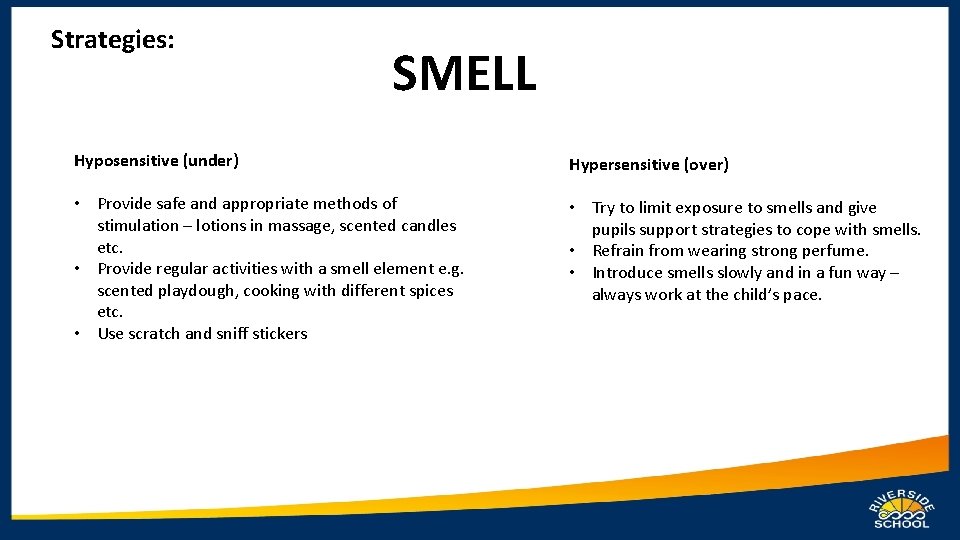
Strategies: SMELL Hyposensitive (under) Hypersensitive (over) • Provide safe and appropriate methods of stimulation – lotions in massage, scented candles etc. • Provide regular activities with a smell element e. g. scented playdough, cooking with different spices etc. • Use scratch and sniff stickers • Try to limit exposure to smells and give pupils support strategies to cope with smells. • Refrain from wearing strong perfume. • Introduce smells slowly and in a fun way – always work at the child’s pace.
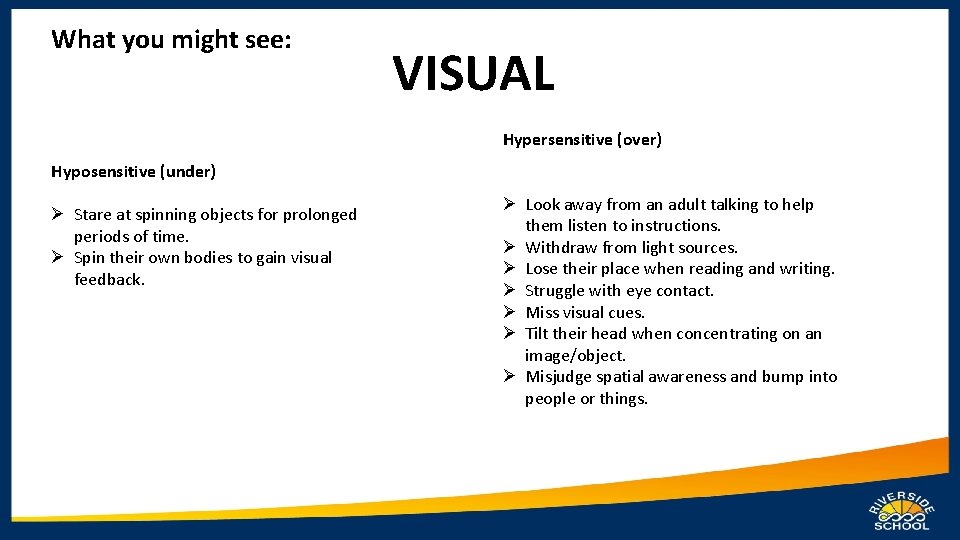
What you might see: VISUAL Hypersensitive (over) Hyposensitive (under) Stare at spinning objects for prolonged periods of time. Spin their own bodies to gain visual feedback. Look away from an adult talking to help them listen to instructions. Withdraw from light sources. Lose their place when reading and writing. Struggle with eye contact. Miss visual cues. Tilt their head when concentrating on an image/object. Misjudge spatial awareness and bump into people or things.
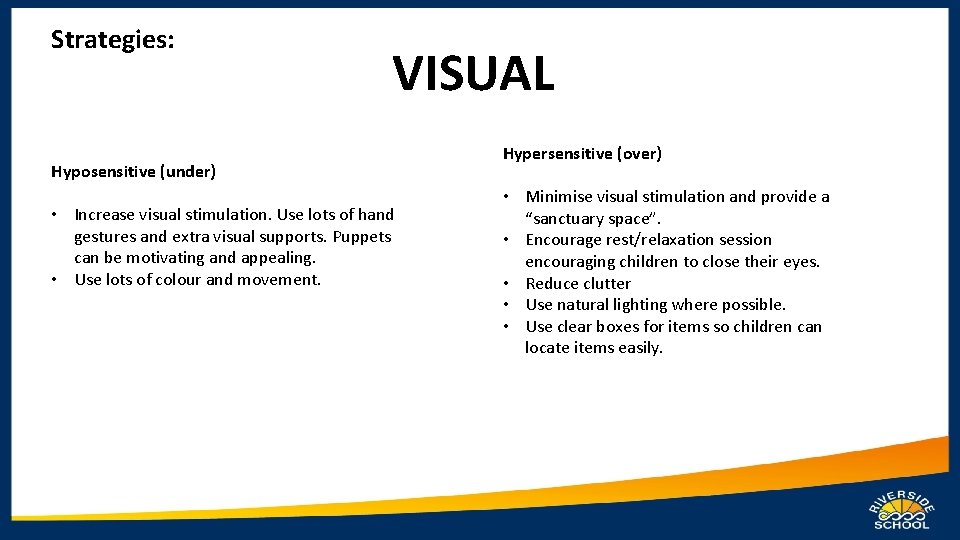
Strategies: VISUAL Hyposensitive (under) • Increase visual stimulation. Use lots of hand gestures and extra visual supports. Puppets can be motivating and appealing. • Use lots of colour and movement. Hypersensitive (over) • Minimise visual stimulation and provide a “sanctuary space”. • Encourage rest/relaxation session encouraging children to close their eyes. • Reduce clutter • Use natural lighting where possible. • Use clear boxes for items so children can locate items easily.
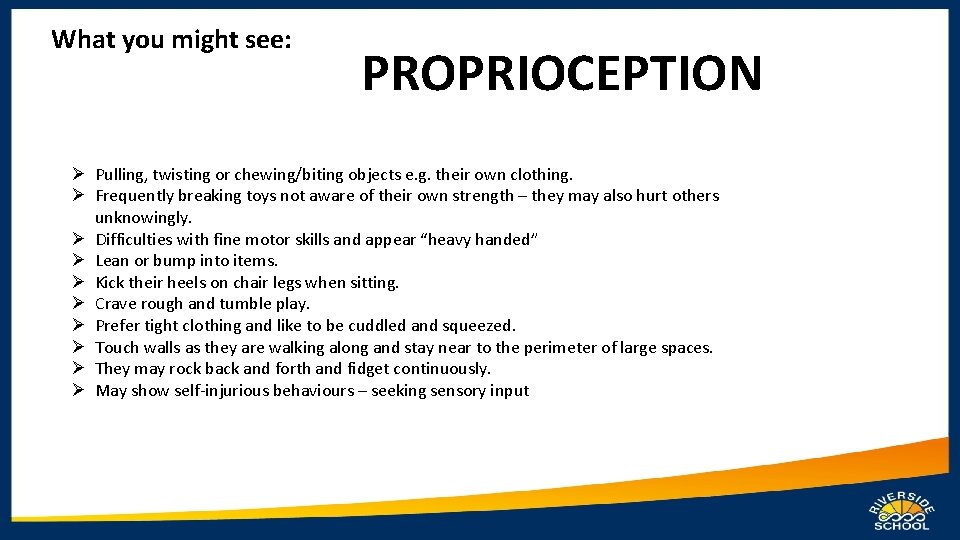
What you might see: PROPRIOCEPTION Pulling, twisting or chewing/biting objects e. g. their own clothing. Frequently breaking toys not aware of their own strength – they may also hurt others unknowingly. Difficulties with fine motor skills and appear “heavy handed” Lean or bump into items. Kick their heels on chair legs when sitting. Crave rough and tumble play. Prefer tight clothing and like to be cuddled and squeezed. Touch walls as they are walking along and stay near to the perimeter of large spaces. They may rock back and forth and fidget continuously. May show self-injurious behaviours – seeking sensory input
Strategies: PROPRIOCEPTION • Regular movement breaks • Access to sensory equipment e. g. swings, Trampolining, IJoy, scooter boards, balance boards, bouncing on a therapy ball. • Use fidget toys • Use malleable material to manipulate e. g. playdough or blu tac. • Use of foot fidgets • Special/alternative seating – therapy balls, wobble cushions. • Regular sips of cold water. • Allow chewing of crunchy foods or ice cubes to support concentration. • Chewelery • Steam roller massage – using a therapy ball, rolling over the body. • Deep pressure, particularly at times the child needs to focus. • Weighted Equipment
What you might see: VESTIBULAR Hyposensitive (under): Hypersensitive (over) : thrill seekers, jumping from high places and climbing high. They seem to have no sense of danger. enjoy spinning and do not appear to become dizzy. They will swing very high and fast at any opportunity. enjoy being upside down. have trouble staying seated. rock or are constantly moving/fidgeting. cautious, hesitant to take risks. avoid movement and may be fearful of heights. They have “gravitational insecurity”. be disorientated and prefer laying down to sitting upright. They may lean their head on their arm. find balancing activities very difficult.
Strategies: VESTIBULAR Hyposensitive (under): • Give regular movement breaks. Perhaps they could complete regular “jobs”. • Provide a sensory diet consisting of physical movement. This can include both indoor and outdoor equipment. E. g. rockers, climbing walls, swings, therapy balls, IJoy, Trampolining, swimming. • Provide alternative “seating” e. g. sitting on a therapy ball or using a wiggle cushion. Hypersensitive (over): • Limit unnecessary movement. • Allow pupils to hold on for support when balancing. • Ensure that pupils have their feet on the ground when seated in class. • Introduce new movements slowly and let the pupil dictate the pace. • Provide self-regulation techniques e. g. using a safe space, weighted blanket, therapy ball rolled over their body, deep pressure etc.
What you might see: Interoception Children with Interoceptive difficulties might display the following: Overeating and not feeling full. Not feeling hungry. Not aware of when they are feeling poorly. Not aware of body temperatures. Not being aware of needing the toilet.
Strategies : Interoception Timers for toileting times/meal times to help routine and predictability. Body awareness and Emotion sessions to help understand what different emotions/bodily functions feel like e. g. When I’m hungry my tummy rumbles, when I’m anxious I get “butterflies” and my hands are sweaty.
Sensory Circuits Sensory circuits are an example of a sensory integration intervention, they can be used to help those who struggle to process and appropriately use sensory information, and consequently Sensory Circuits may facilitate engagement for learning. Sensory circuits can be effective in supporting individuals to improve their levels of attention and focus. They can help to tackle sensory imbalances & support those with lots of energy to enable them to redirect it positively. Sensory circuits should include the following 3 elements in the correct order in order to be effective:
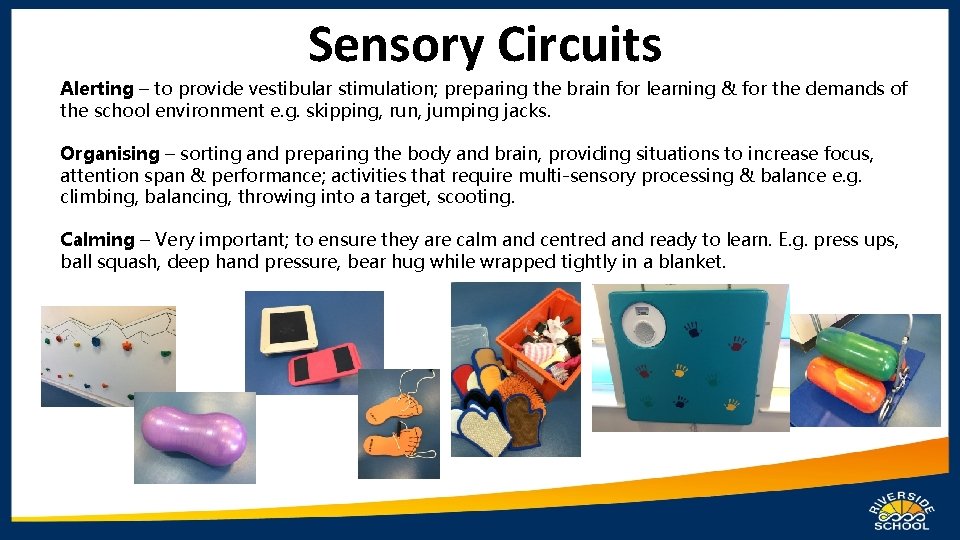
Sensory Circuits Alerting – to provide vestibular stimulation; preparing the brain for learning & for the demands of the school environment e. g. skipping, run, jumping jacks. Organising – sorting and preparing the body and brain, providing situations to increase focus, attention span & performance; activities that require multi‐sensory processing & balance e. g. climbing, balancing, throwing into a target, scooting. Calming – Very important; to ensure they are calm and centred and ready to learn. E. g. press ups, ball squash, deep hand pressure, bear hug while wrapped tightly in a blanket.
Helpful links www. sensoryspectacle. co. uk/ Also on Facebook and Youtube fledglings. org. uk/ www. exploreyoursenses. co. uk/