
Sense and Respond Logistics CoEvolution of an Adaptive

- Slides: 25
Sense and Respond Logistics: Co-Evolution of an Adaptive Enterprise Capability Presented to: Change Management Group 23 October 2003
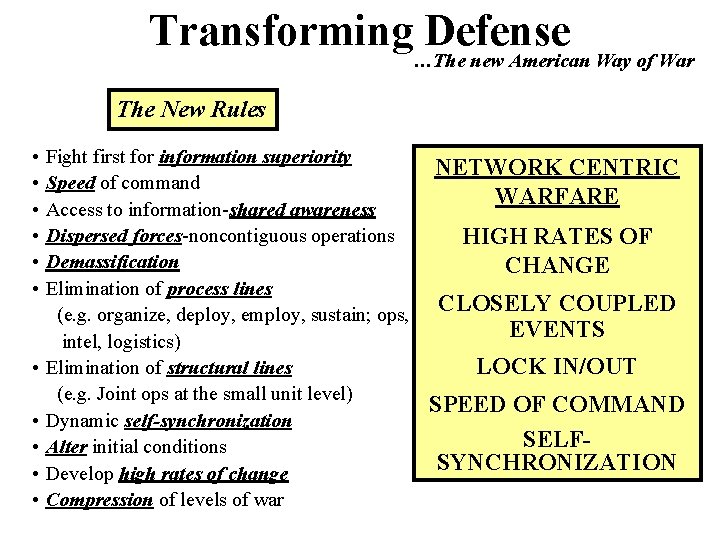
Transforming Defense …The new American Way of War The New Rules • • • Fight first for information superiority Speed of command Access to information-shared awareness Dispersed forces-noncontiguous operations Demassification Elimination of process lines (e. g. organize, deploy, employ, sustain; ops, intel, logistics) Elimination of structural lines (e. g. Joint ops at the small unit level) Dynamic self-synchronization Alter initial conditions Develop high rates of change Compression of levels of war NETWORK CENTRIC WARFARE HIGH RATES OF CHANGE CLOSELY COUPLED EVENTS LOCK IN/OUT SPEED OF COMMAND SELFSYNCHRONIZATION
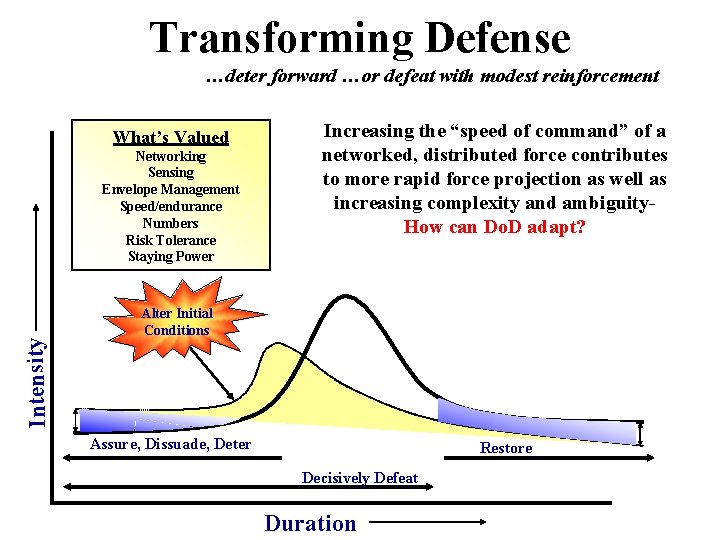
Transforming Defense …deter forward …or defeat with modest reinforcement What’s Valued Intensity Networking Sensing Envelope Management Speed/endurance Numbers Risk Tolerance Staying Power Increasing the “speed of command” of a networked, distributed force contributes to more rapid force projection as well as increasing complexity and ambiguity. How can Do. D adapt? Alter Initial Conditions Assure, Dissuade, Deter Restore Decisively Defeat Duration
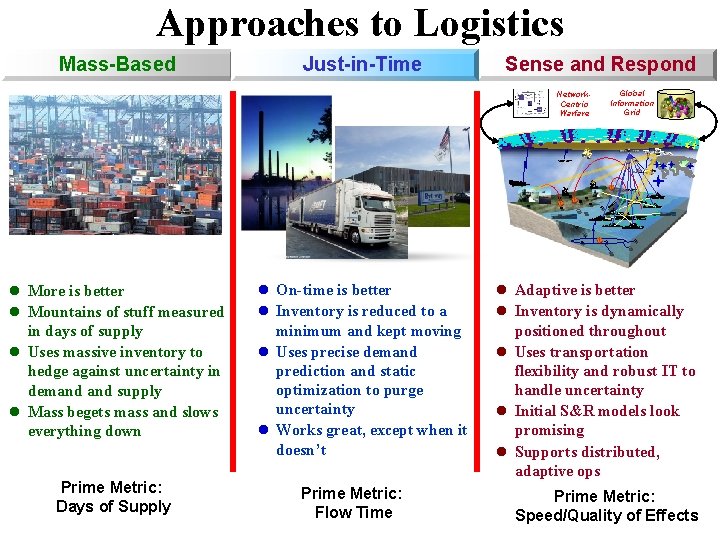
Approaches to Logistics Mass-Based Just-in-Time Sense and Respond Network. Centric Warfare l More is better l Mountains of stuff measured in days of supply l Uses massive inventory to hedge against uncertainty in demand supply l Mass begets mass and slows everything down Prime Metric: Days of Supply l On-time is better l Inventory is reduced to a minimum and kept moving l Uses precise demand prediction and static optimization to purge uncertainty l Works great, except when it doesn’t Prime Metric: Flow Time Global Information Grid l Adaptive is better l Inventory is dynamically positioned throughout l Uses transportation flexibility and robust IT to handle uncertainty l Initial S&R models look promising l Supports distributed, adaptive ops Prime Metric: Speed/Quality of Effects
What’s the Behavior Telling Us? Current Logistics Concepts (Predominant Approach) “Predictive, optimized, linear supply chain” Sense & Respond Logistics (Predominant Approach) “Adaptive, responsive demand networks” Army Stuff Joint Force Capabilities Packages Navy Stuff USAF Stuff USMC Stuff “Traditional C 2” Common Stuff Forward Ops “Context & Coordination” Joint Sea Base Distributed Operations Other Stuff Sources of Stuff (Theater, CONUS, etc) Transition from linear supply chain to adaptive demand network
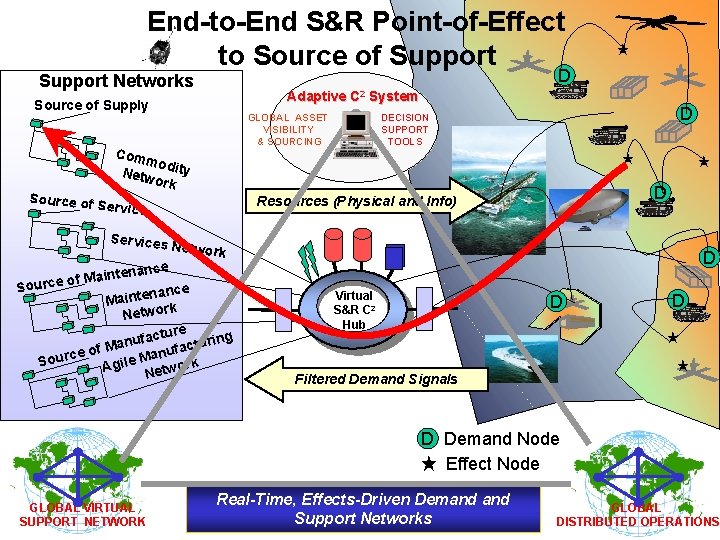
End-to-End S&R Point-of-Effect to Source of Support D Support Networks Adaptive C 2 System Source of Supply Source of GLOBAL ASSET VISIBILITY & SOURCING Com mo Netw dity ork D DECISION SUPPORT TOOLS D Resources (Physical and Info) Services N etwork e intenanc a M f o e Sourc ance Mainten k Networ cture a f u n uring a t c M a f f o ce Manu rk e l Sour i g o A Netw D Virtual S&R C 2 Hub D D Filtered Demand Signals D Demand Node Effect Node GLOBAL VIRTUAL SUPPORT NETWORK Real-Time, Effects-Driven Demand Support Networks GLOBAL DISTRIBUTED OPERATIONS
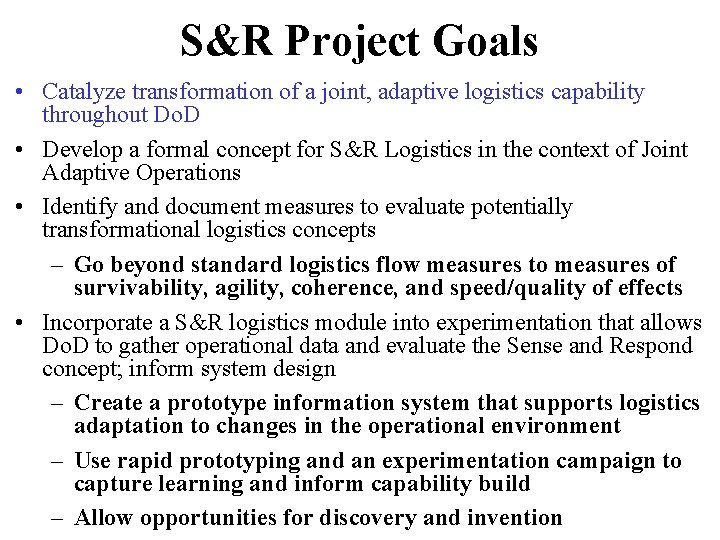
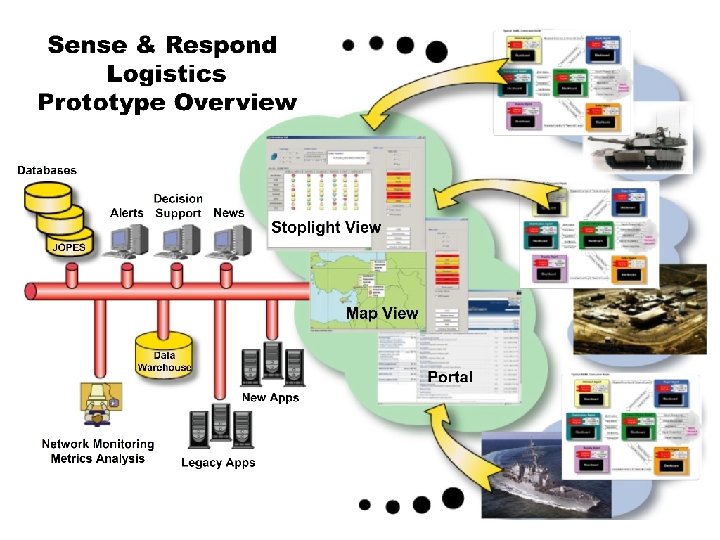
S&R Project Goals • Catalyze transformation of a joint, adaptive logistics capability throughout Do. D • Develop a formal concept for S&R Logistics in the context of Joint Adaptive Operations • Identify and document measures to evaluate potentially transformational logistics concepts – Go beyond standard logistics flow measures to measures of survivability, agility, coherence, and speed/quality of effects • Incorporate a S&R logistics module into experimentation that allows Do. D to gather operational data and evaluate the Sense and Respond concept; inform system design – Create a prototype information system that supports logistics adaptation to changes in the operational environment – Use rapid prototyping and an experimentation campaign to capture learning and inform capability build – Allow opportunities for discovery and invention
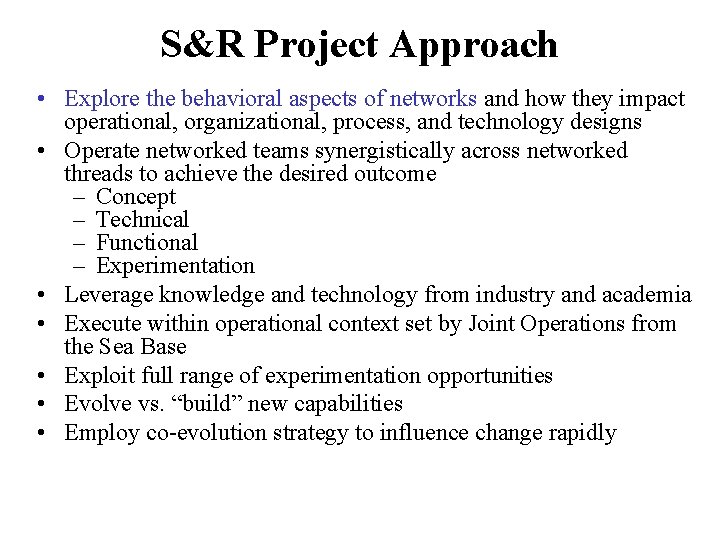
S&R Project Approach • Explore the behavioral aspects of networks and how they impact operational, organizational, process, and technology designs • Operate networked teams synergistically across networked threads to achieve the desired outcome – Concept – Technical – Functional – Experimentation • Leverage knowledge and technology from industry and academia • Execute within operational context set by Joint Operations from the Sea Base • Exploit full range of experimentation opportunities • Evolve vs. “build” new capabilities • Employ co-evolution strategy to influence change rapidly
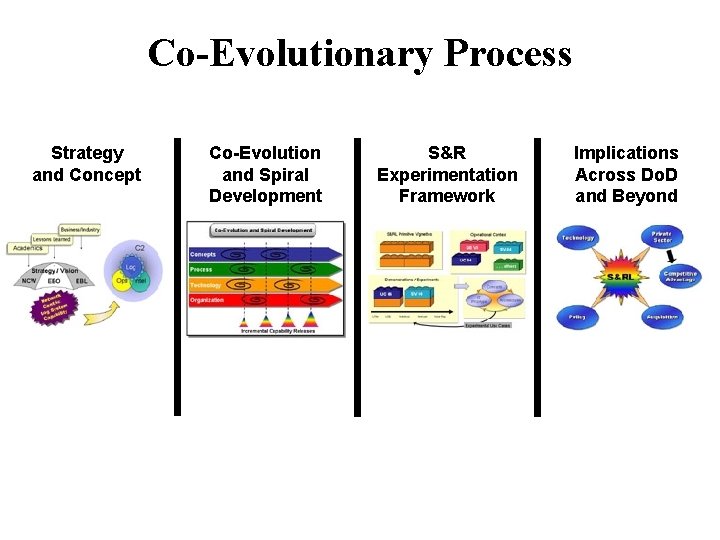
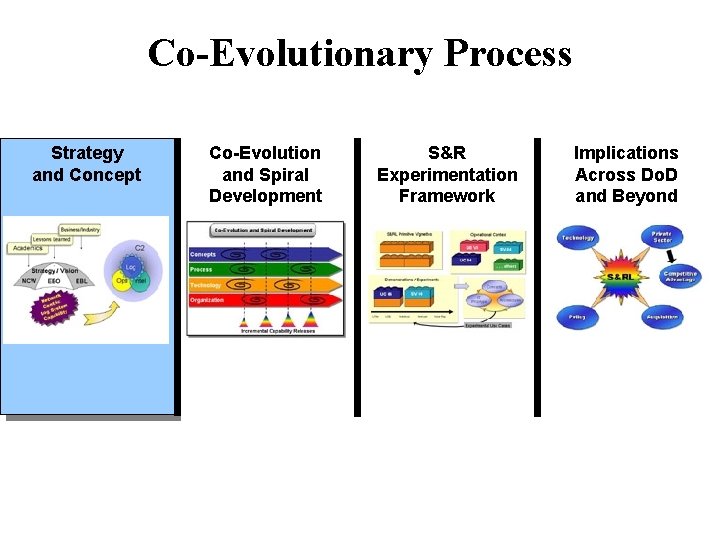
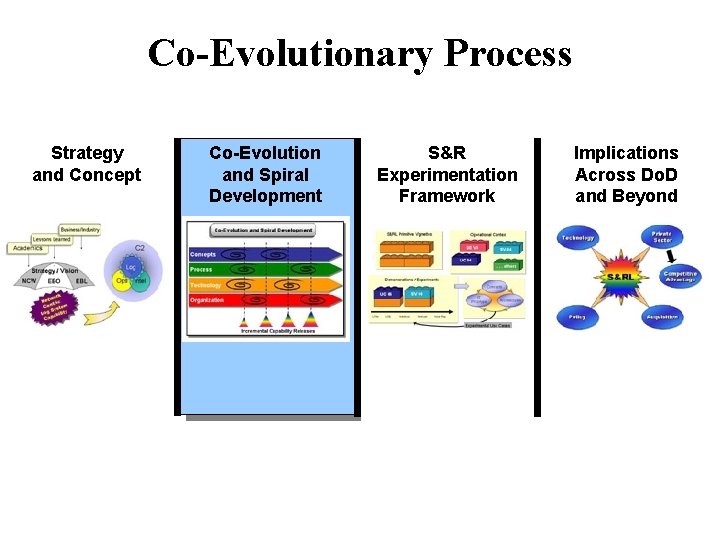
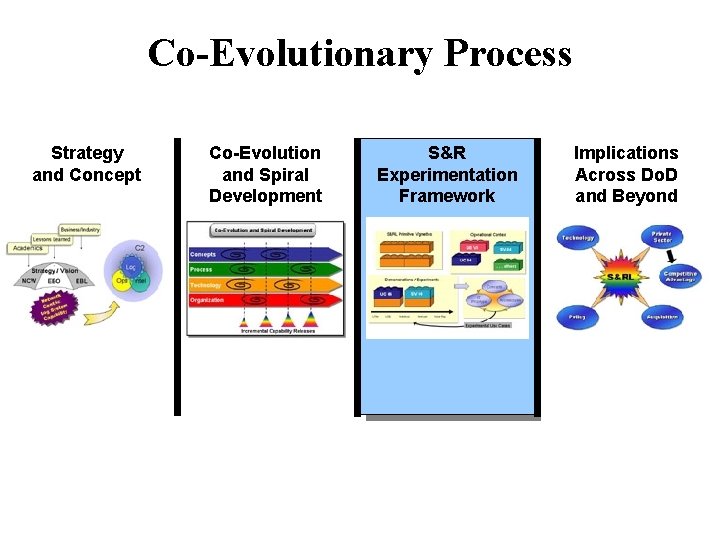
Co-Evolutionary Process Strategy and Concept Co-Evolution and Spiral Development S&R Experimentation Framework Implications Across Do. D and Beyond
Co-Evolutionary Process Strategy and Concept Co-Evolution and Spiral Development S&R Experimentation Framework Implications Across Do. D and Beyond
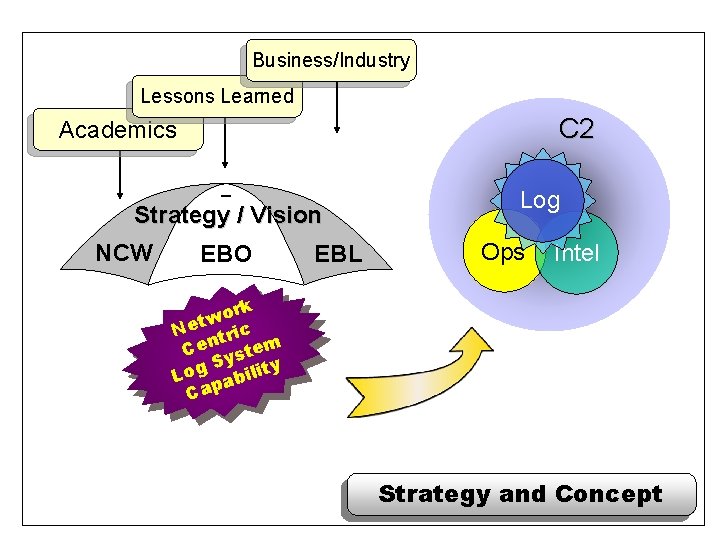
Business/Industry Lessons Learned C 2 Academics Strategy / Vision NCW EBO EBL Log Ops Intel rk o w Net tric Cen ystem S y Log abilit Cap Strategy and Concept
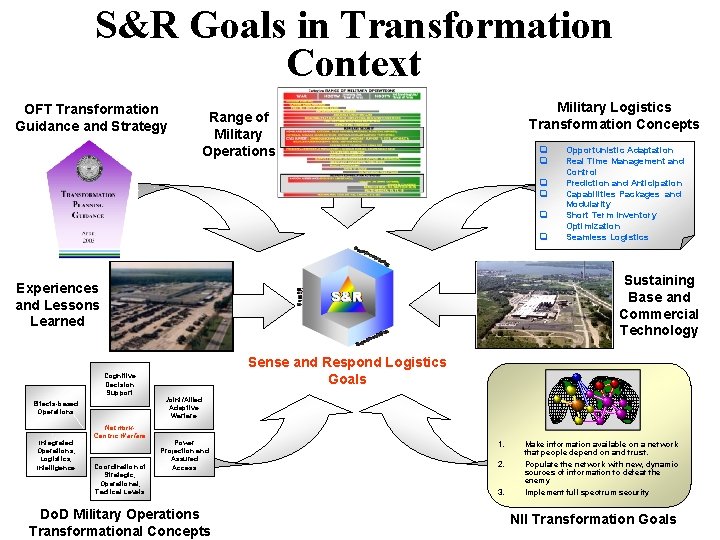
S&R Goals in Transformation Context OFT Transformation Guidance and Strategy Military Logistics Transformation Concepts Range of Military Operations q q q Sustaining Base and Commercial Technology Experiences and Lessons Learned Cognitive Decision Support Effects-based Operations Integrated Operations, Logistics, Intelligence Opportunistic Adaptation Real Time Management and Control Prediction and Anticipation Capabilities Packages and Modularity Short Term Inventory Optimization Seamless Logistics Network. Centric Warfare Coordination of Strategic, Operational, Tactical Levels Sense and Respond Logistics Goals Joint/Allied Adaptive Warfare Power Projection and Assured Access Do. D Military Operations Transformational Concepts 1. Make information available on a network that people depend on and trust. 2. Populate the network with new, dynamic sources of information to defeat the enemy 3. Implement full spectrum security NII Transformation Goals
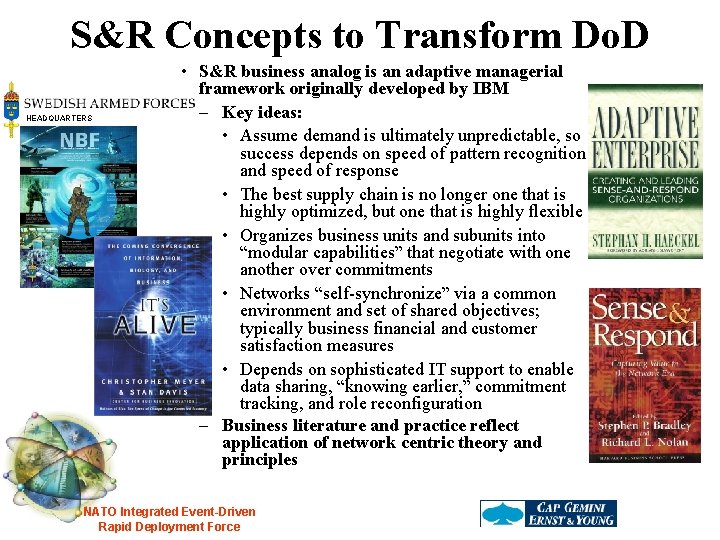
S&R Concepts to Transform Do. D HEADQUARTERS • S&R business analog is an adaptive managerial framework originally developed by IBM – Key ideas: • Assume demand is ultimately unpredictable, so success depends on speed of pattern recognition and speed of response • The best supply chain is no longer one that is highly optimized, but one that is highly flexible • Organizes business units and subunits into “modular capabilities” that negotiate with one another over commitments • Networks “self-synchronize” via a common environment and set of shared objectives; typically business financial and customer satisfaction measures • Depends on sophisticated IT support to enable data sharing, “knowing earlier, ” commitment tracking, and role reconfiguration – Business literature and practice reflect application of network centric theory and principles NATO Integrated Event-Driven Rapid Deployment Force
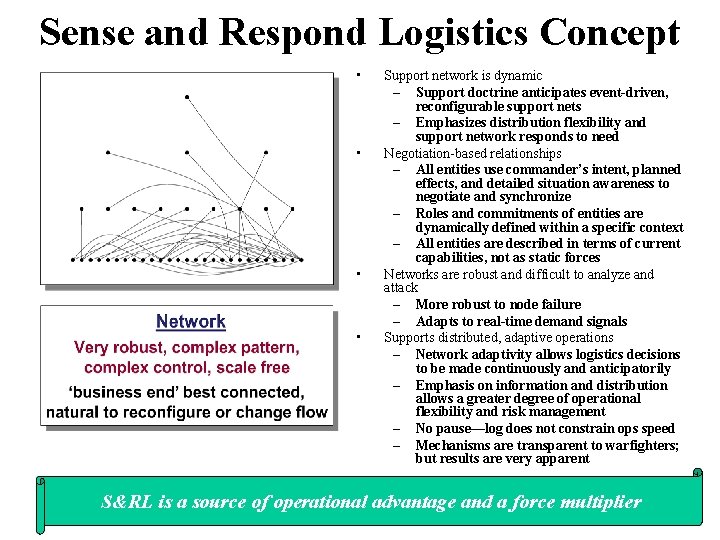
Sense and Respond Logistics Concept • • Support network is dynamic – Support doctrine anticipates event-driven, reconfigurable support nets – Emphasizes distribution flexibility and support network responds to need Negotiation-based relationships – All entities use commander’s intent, planned effects, and detailed situation awareness to negotiate and synchronize – Roles and commitments of entities are dynamically defined within a specific context – All entities are described in terms of current capabilities, not as static forces Networks are robust and difficult to analyze and attack – More robust to node failure – Adapts to real-time demand signals Supports distributed, adaptive operations – Network adaptivity allows logistics decisions to be made continuously and anticipatorily – Emphasis on information and distribution allows a greater degree of operational flexibility and risk management – No pause—log does not constrain ops speed – Mechanisms are transparent to warfighters; but results are very apparent S&RL is a source of operational advantage and a force multiplier
Co-Evolutionary Process Strategy and Concept Co-Evolution and Spiral Development S&R Experimentation Framework Implications Across Do. D and Beyond
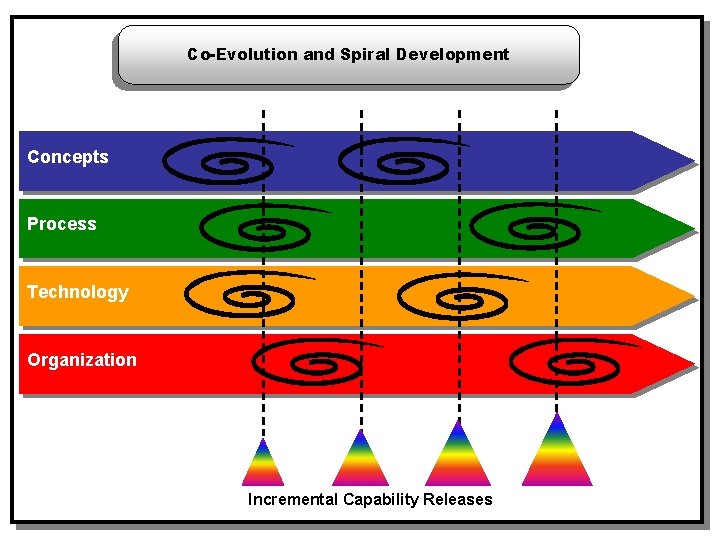
Co-Evolution and Spiral Development Concepts Process Technology Organization Incremental Capability Releases
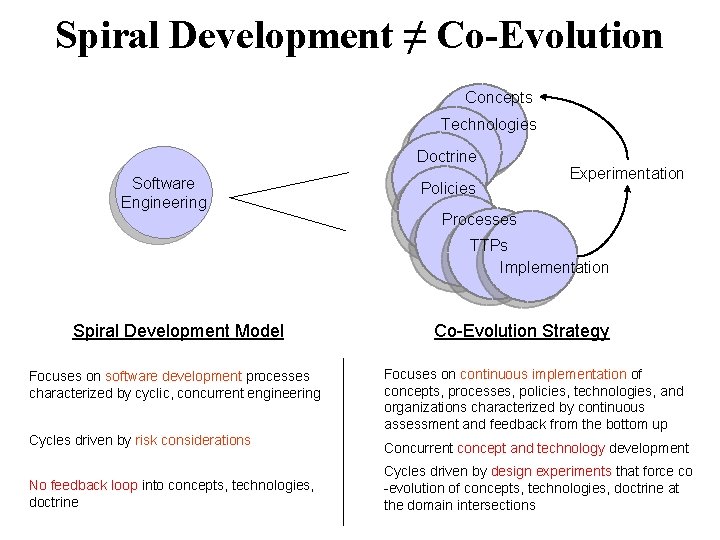
Spiral Development ≠ Co-Evolution Concepts Technologies Doctrine Software Engineering Policies Experimentation Processes TTPs Implementation Spiral Development Model Focuses on software development processes characterized by cyclic, concurrent engineering Cycles driven by risk considerations No feedback loop into concepts, technologies, doctrine Co-Evolution Strategy Focuses on continuous implementation of concepts, processes, policies, technologies, and organizations characterized by continuous assessment and feedback from the bottom up Concurrent concept and technology development Cycles driven by design experiments that force co -evolution of concepts, technologies, doctrine at the domain intersections
Co-Evolutionary Process Strategy and Concept Co-Evolution and Spiral Development S&R Experimentation Framework Implications Across Do. D and Beyond
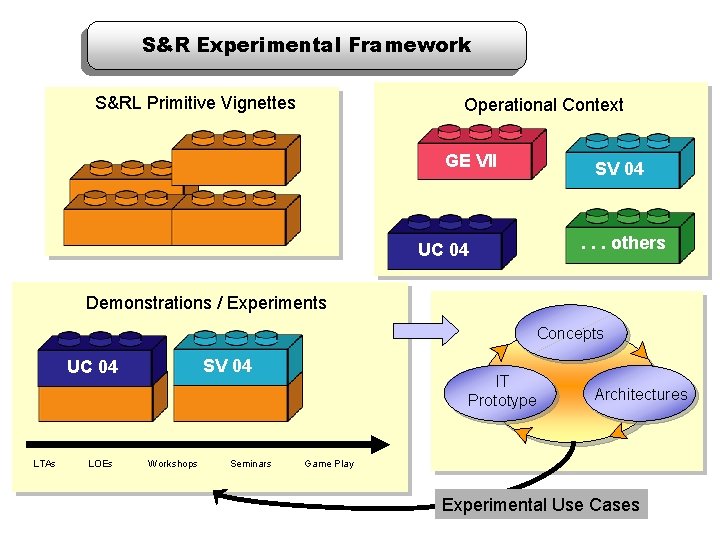
S&R Experimental Framework S&RL Primitive Vignettes Operational Context GE VII UC 04 SV 04 . . . others Demonstrations / Experiments Concepts SV 04 UC 04 LTAs LOEs Workshops Seminars IT Prototype Architectures Game Play Experimental Use Cases
Co-Evolutionary Process Strategy and Concept Co-Evolution and Spiral Development S&R Experimentation Framework Implications Across Do. D and Beyond
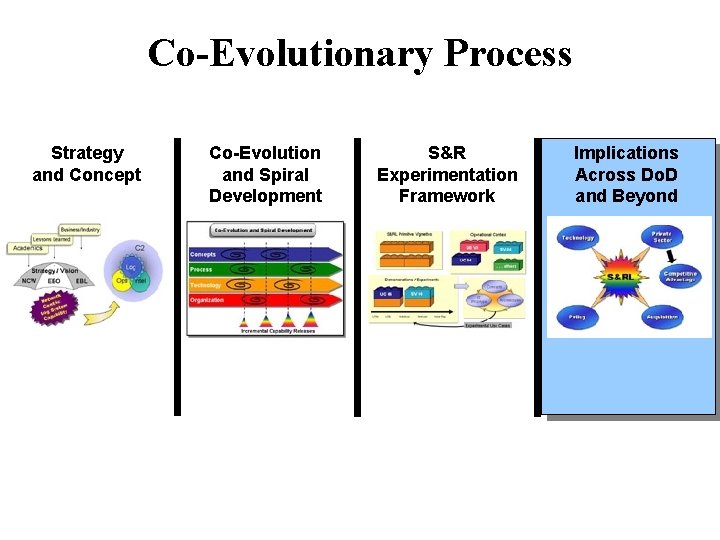
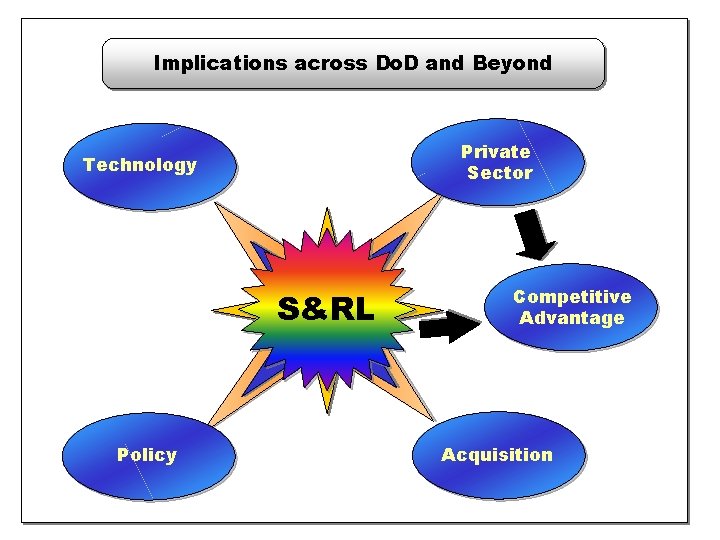
Implications across Do. D and Beyond Private Sector Technology S&RL Policy Competitive Advantage Acquisition
Synchronizing S&R and the Force -Centric Logistics Enterprise • Overall Objective: Develop a coherent, convergent Do. D Logistics Transformation Strategy that reconciles and builds on S&RL, FLE, and PBL initiatives • Near-term: Identify linkages and specific leverage points in programs and initiatives in these areas: – Concept – Process – Metrics – Experimentation • Apply S&RL concepts and co-evolution strategies and processes, end-to-end at all levels (strategic, operational, tactical—these blur in the S&R concept) to evaluate current and design future initiatives • Present a concept for joint prototyping and experimentation to explore these interactions directly
Linkages • Concept: Apply NCW, EBO, and EBL (Effects Based Logistics) Concepts to Logistics Transformation • Metrics: Emphasize customer-back approach: – Primary Logistics objective: Support to joint, adaptive, distributed operations effectiveness and capabilities; Secondary objective: Efficiency, cost and footprint reductions – Build on Balanced Scorecard concept to drive Logistics system behavior and design by adding a more comprehensive set of effects-based, operational metrics – Drive Supply Chains directly by military operational demand signals and increase supplier visibility over operational drivers to reduce risk and uncertainty and increase effectiveness • Process: Link S&RL Operational process model directly to SCOR process model • Experimentation: Bring suppliers into end-to-end prototype and experimentation plan, including SV 04 and Joint Sea Basing, to explore dynamics and policies
Emerging Insights: Achieving the Tipping Point • Move now towards a joint, adaptive logistics capability based on the S&R concept • Charter a joint effort to co-evolve a networkcentric capability rapidly from the bottom up • Lead disruptive change – Force cross-enterprise behavior • Foster an innovative public-private partnership – Industry – Academia