
Sensation PHT 1261 C Tests and Measurements Dr
- Slides: 19
Sensation PHT 1261 C Tests and Measurements Dr. Kane
Definitions �Somatosensory �Sensory Integration �Purposes (3) �Feedback vs. Feed forward
Why do we test for Sensation? �Pattern �Completeness �CNS vs. PNS �Dermatomal, glove and stocking = PNS �CVA, SCI = CNS
When do we test for Sensation? �Prior to motor function �Initial Evaluation �Progress �Discharge �Other
What is considered prior to sensation testing? � Arousal �Alert �Lethargic �Obtunded �Stuporous �Comatose � Attention Span � Orientation (x 3) � Cognition �Fund of knowledge �Calculation ability �Proverb interpretation
Considerations prior to sensation testing? �Memory �Short term �Long term �Hearing �Visual Acuity �Peripheral vision �Depth perception
What are you testing with sensation testing? �Classification of Sensory System �By stimulus type/location of receptors �Mechanoreceptors �Thermoreceptors �Nocioreceptors �Chemoreceptors �Photic Receptors �By Spinal pathway mediating information to higher centers �Spinothalmic tract �Dorsal Column Medial Lemniscus Pathway
Types of Sensory Receptors �Cutaneous Receptors �Free nerve endings �Hair follicle Endings �Merkel’s discs �Ruffini Endings �Krause’s end-bulbs �Meissner’s corpuscles �Pacinian Corpuscles
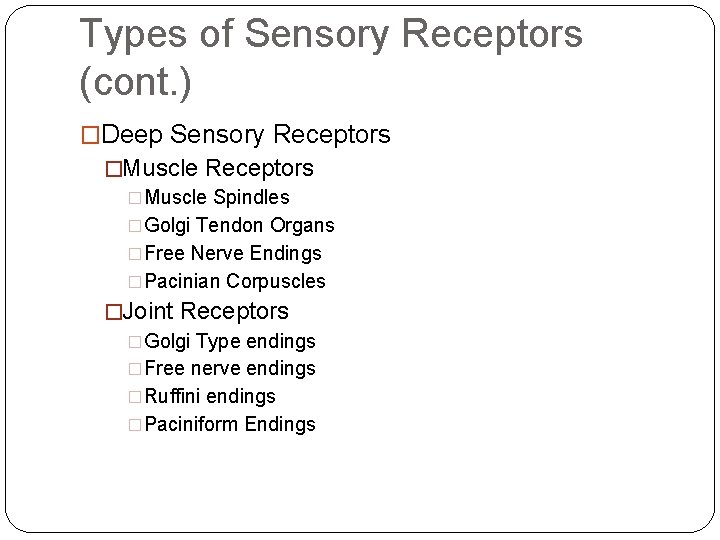
Types of Sensory Receptors (cont. ) �Deep Sensory Receptors �Muscle Spindles �Golgi Tendon Organs �Free Nerve Endings �Pacinian Corpuscles �Joint Receptors �Golgi Type endings �Free nerve endings �Ruffini endings �Paciniform Endings
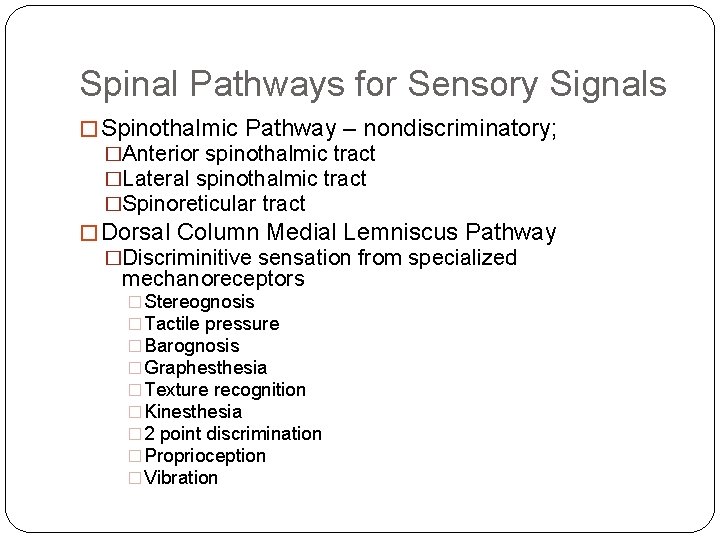
Spinal Pathways for Sensory Signals � Spinothalmic Pathway – nondiscriminatory; �Anterior spinothalmic tract �Lateral spinothalmic tract �Spinoreticular tract � Dorsal Column Medial Lemniscus Pathway �Discriminitive sensation from specialized mechanoreceptors � Stereognosis � Tactile pressure � Barognosis � Graphesthesia � Texture recognition � Kinesthesia � 2 point discrimination � Proprioception � Vibration
The Somatosensory Cortex �Post Central Gyrus �Sensory Homonculus
Treatment Approaches �Sensory Integration Approach �Compensatory Approach
Sensory Examination �Occlude vision (if possible) �Conduct a demonstration to familiarize your patient
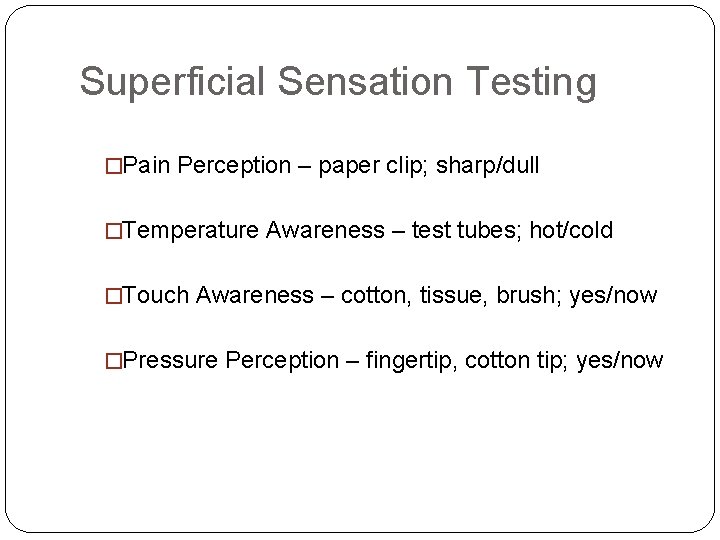
Superficial Sensation Testing �Pain Perception – paper clip; sharp/dull �Temperature Awareness – test tubes; hot/cold �Touch Awareness – cotton, tissue, brush; yes/now �Pressure Perception – fingertip, cotton tip; yes/now
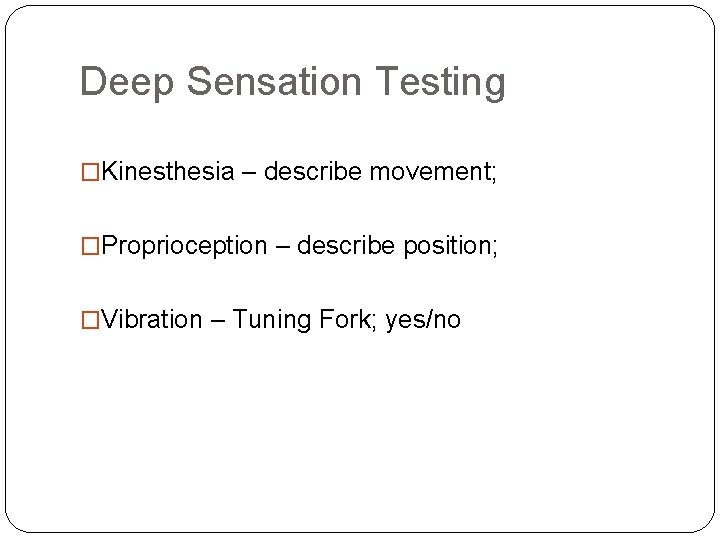
Deep Sensation Testing �Kinesthesia – describe movement; �Proprioception – describe position; �Vibration – Tuning Fork; yes/no
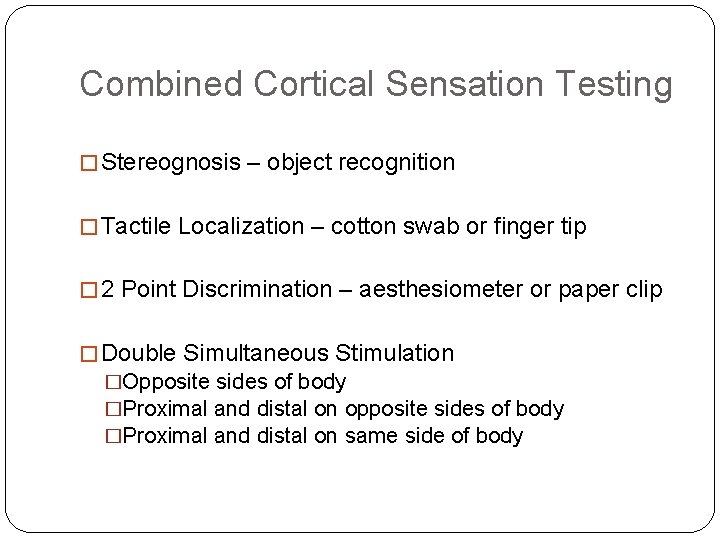
Combined Cortical Sensation Testing � Stereognosis – object recognition � Tactile Localization – cotton swab or finger tip � 2 Point Discrimination – aesthesiometer or paper clip � Double Simultaneous Stimulation �Opposite sides of body �Proximal and distal on opposite sides of body �Proximal and distal on same side of body
Combined Cortical Sensation (cont) �Graphesthesia – tracing finger ID �Texture Recognition – cotton, silk, wool; rough/smooth �Barognosis – weight recognition; heavier/lighter
Cranial Nerve Screening – see Table 5. 3 pg. 151 & Box 5. 5 pg. 152 �I – Olfactory – non noxious odor �II – Optic – Snellen Chart; Peripheral Vision �III – Oculomotor – see below �IV – Trochlear – see below �V – Trigeminal – Sensory of face; Motor – jaw motions �VI – Abducent – see below �Note: III, IV, & VI are tested together – pupil equality & size; presence of strabismus; eye tracking; presence of ptosis of eyelid
Cranial Nerves - continued �VII Facial – facial expressions & symmetry �VIII Auditory – hearing; tuning fork �IX Glossopharyngeal – taste posterior 1/3 of tongue; gag reflex �X – Vagus – swallowing; uvula & soft palette symmetry �XI – Accessory – SCM and Trapezius �XII – Hypoglossal – tongue movements