
Sensation Perception The Forest Has Eyes Bev Doolittle
Sensation & Perception

The Forest Has Eyes Bev Doolittle
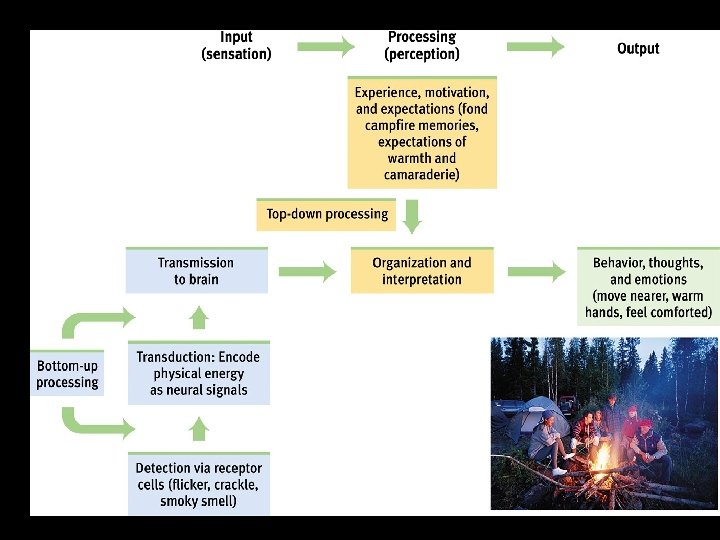
I. General Characteristics of Sensation • A. Basic Definitions: – 1. Sensation = the process by which our sensory receptors and nervous system receive and represent stimulus energies from our environment – 2. Perception = The process of organizing and interpreting sensory information, enabling us to recognize meaningful objects and events
Processing – 3. Bottom-up-processing = analysis that begins with the sense receptors and works up to the brain’s integration of sensory information • AKA: Sensory Anaylsis – 4. Top-down-processing = information processing guided by higher level mental processes as when we construct perceptions drawing on our experience and expectations. • AKA: Interpretation of what our senses detect
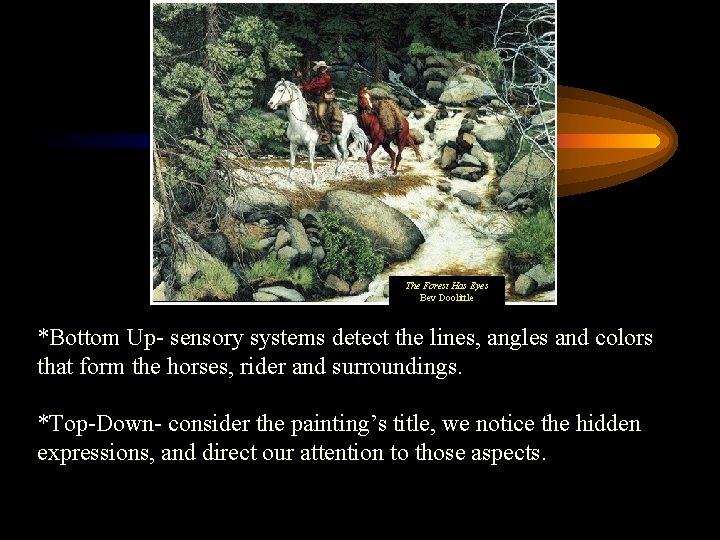
The Forest Has Eyes Bev Doolittle *Bottom Up- sensory systems detect the lines, angles and colors that form the horses, rider and surroundings. *Top-Down- consider the painting’s title, we notice the hidden expressions, and direct our attention to those aspects.
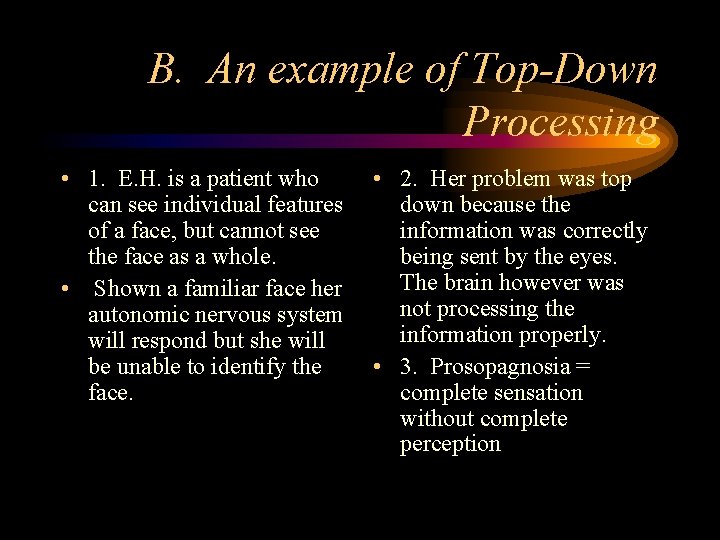
B. An example of Top-Down Processing • 1. E. H. is a patient who can see individual features of a face, but cannot see the face as a whole. • Shown a familiar face her autonomic nervous system will respond but she will be unable to identify the face. • 2. Her problem was top down because the information was correctly being sent by the eyes. The brain however was not processing the information properly. • 3. Prosopagnosia = complete sensation without complete perception
Selective Attention • The focusing of conscious awareness on a particular stimulus. – Your five senses take in 11 million bits of info per second – You consciously process about 40 – Unconsciously your mind makes use of the other million upon million bits • You don’t realize but your nose is in your line of vision. • SELECTIVE ATTENTION TEST
Inattentional Blindness • Failing to see visible objects when out attention is directed elsewhere. • At the level of conscious awareness, we are “blind” to all but a tiny fraction of stuff occurring in front of us.
Change Blindness • Failing to notice changes in the environment. • A form of inattentional blindness.
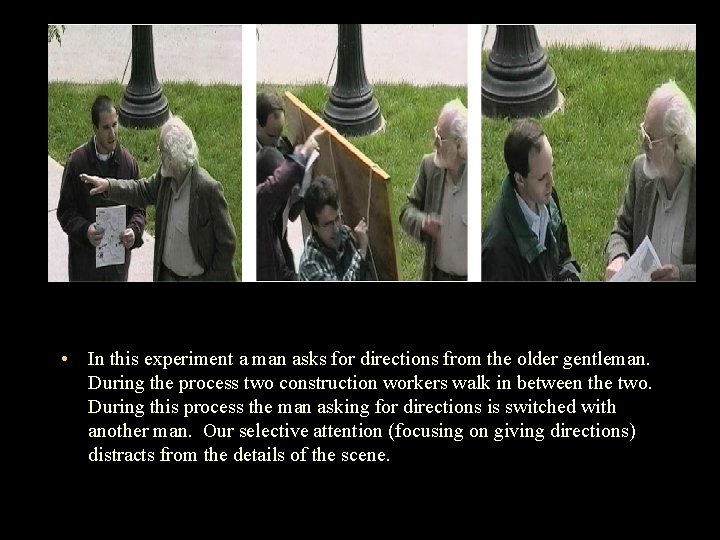
• In this experiment a man asks for directions from the older gentleman. During the process two construction workers walk in between the two. During this process the man asking for directions is switched with another man. Our selective attention (focusing on giving directions) distracts from the details of the scene.
• Mindfulness - our awareness of and attention to what is taking place. • Brown & Ryan Mindful Attention Awareness Scale
• Range 15 -90 • Higher scores reflect greater mindfulness or greater attention to and awareness of current experiences. • People with higher scores tend to be more observant of what is occuring both internally & externally. • Average Score: 55. 8
• 1. Psychophysics = the study of relationships between the physical characteristics of stimuli, such as their intensity, and our psychological experience of them
Sensing the World
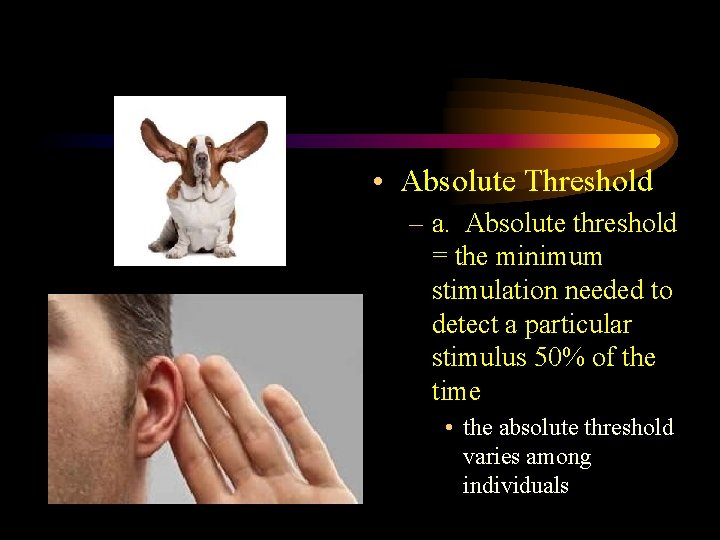
• Absolute Threshold – a. Absolute threshold = the minimum stimulation needed to detect a particular stimulus 50% of the time • the absolute threshold varies among individuals
– Signal detection = • a. predicts how and when we detect the presence of a faint stimulus amid background stimulation • b. Assumes that there is no single absolute threshold and that detection depends partly on a person’s experience, expectations, motivation and level of fatigue – Subliminal Stimulation • a. We can sense stimuli below our threshold • b. The controversy first arose over a claim that movie theatres were inserting subliminal messages into their movies • c. Much of our information processing occurs automatically, out of sight, off the radar screen of our conscious mind.
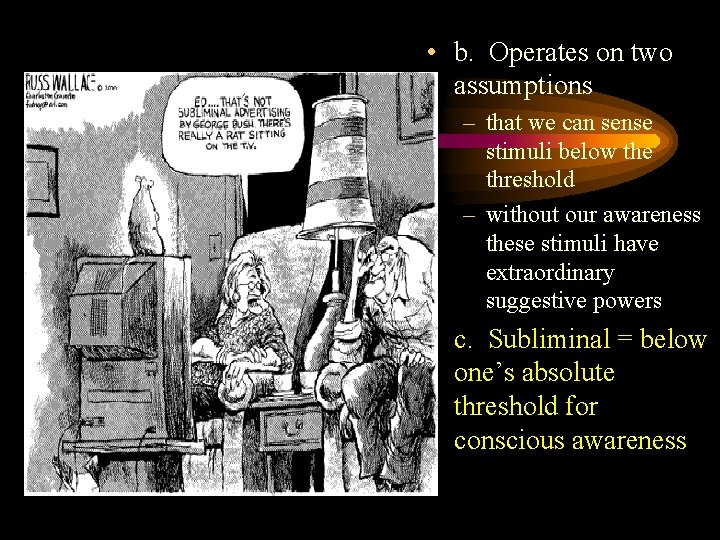
• b. Operates on two assumptions – that we can sense stimuli below the threshold – without our awareness these stimuli have extraordinary suggestive powers • c. Subliminal = below one’s absolute threshold for conscious awareness
• d. Studies supporting subliminal perception – Krosnick & Others 1992 = flashed either a bad image or good image before showing a person’s face - the bad image created a bad image of the person’s face – Murphy & Zajonc = similar study using Chinese characters found similar results • e. Studies disproving subliminal perception – The Canadian Brodcasting Corp. participated in a study that flashed a message 352 times during a TV show. Then asked people to call in and guess the message. None did. The message was “Telephone Now!” - there was no increase in phone usage after the messages
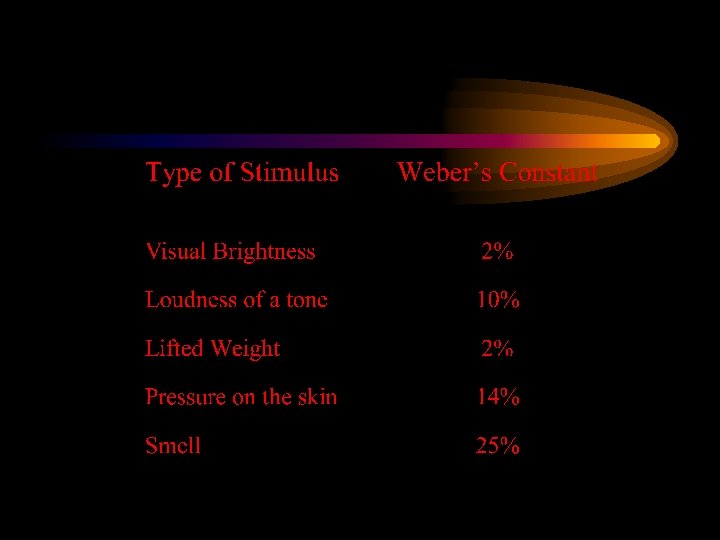
Difference Threshold • a. Difference threshold (aka Just-noticeabledifference) = the minimum difference that a person can detect between two stimuli • b. First studied by Ernst Heinrich Weber • c. Weber’s Law =the principle that, to perceive their difference, two stimuli must differ by a constant minimum percentage
Sensory Adaptation – 1. Sensory adaptation = diminished sensitivity as a consequence of constant stimulation • After constant exposure to a stimulus, our nerve cells fire less frequently – 2. For example • a. We often stop noticing our own cologne or perfume • b. We ignore the repetitive noises around us • c. We ignore the feeling of glasses on our face – So if we stare at a point long enough, what would happen? Would sensory adaptation occur and the point disappear?

• Get out a piece of white paper!
• Stare directly at the center for 1 minute!
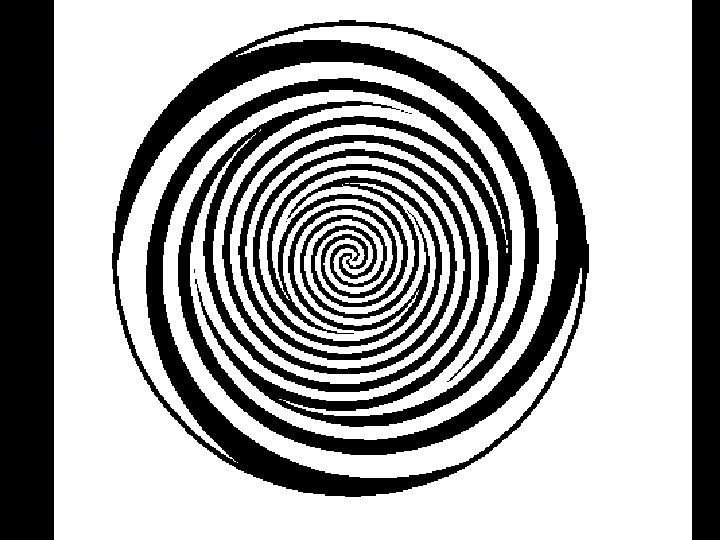
• Stare directly at the center dot for 1 minute!
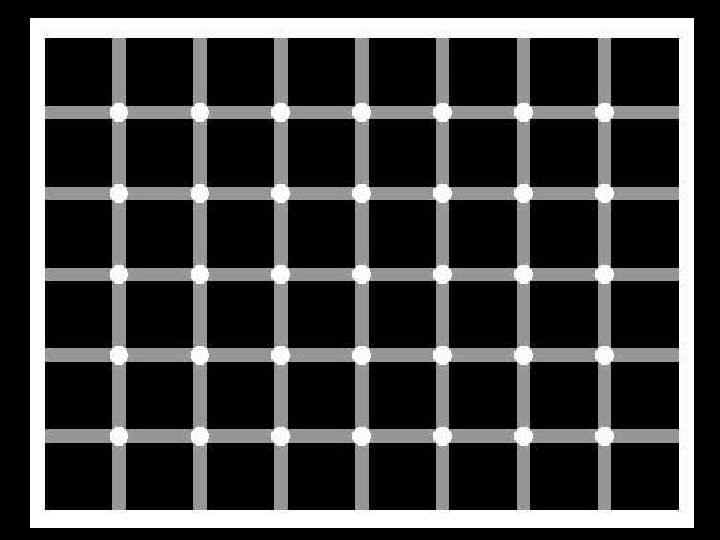
Have Fun! • http: //www. illusions. org/

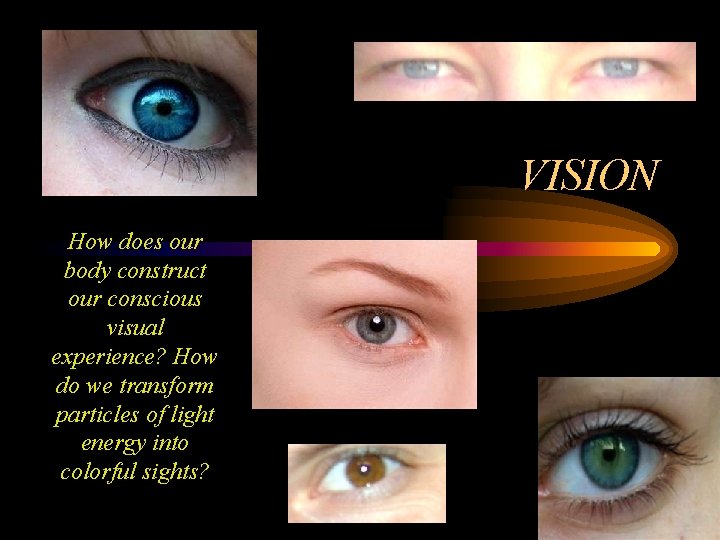
VISION How does our body construct our conscious visual experience? How do we transform particles of light energy into colorful sights?
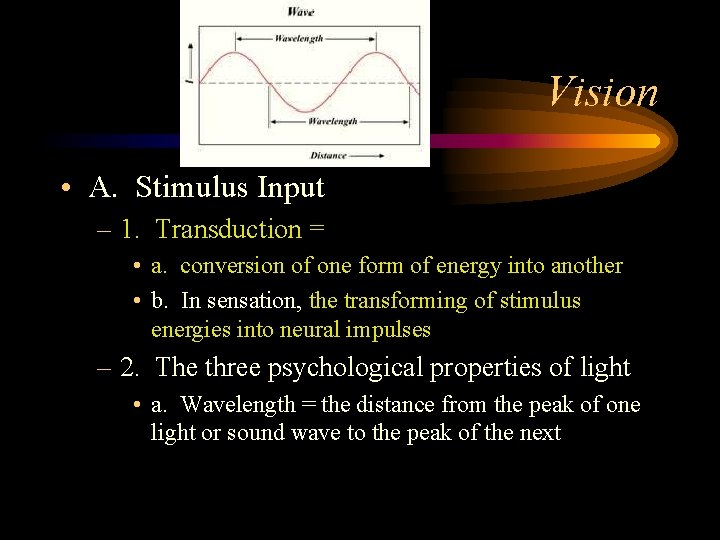
Vision • A. Stimulus Input – 1. Transduction = • a. conversion of one form of energy into another • b. In sensation, the transforming of stimulus energies into neural impulses – 2. The three psychological properties of light • a. Wavelength = the distance from the peak of one light or sound wave to the peak of the next
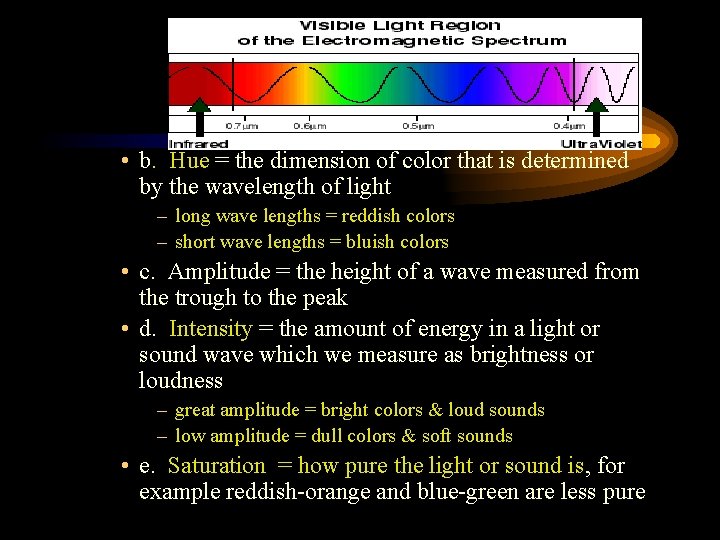
• b. Hue = the dimension of color that is determined by the wavelength of light – long wave lengths = reddish colors – short wave lengths = bluish colors • c. Amplitude = the height of a wave measured from the trough to the peak • d. Intensity = the amount of energy in a light or sound wave which we measure as brightness or loudness – great amplitude = bright colors & loud sounds – low amplitude = dull colors & soft sounds • e. Saturation = how pure the light or sound is, for example reddish-orange and blue-green are less pure
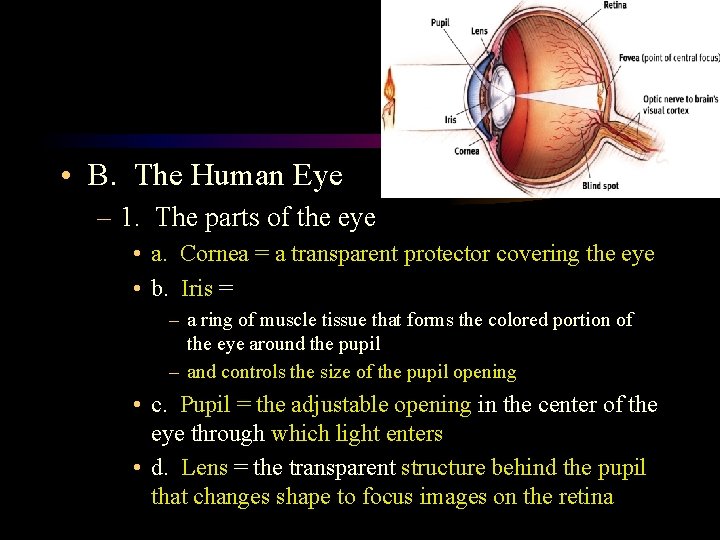
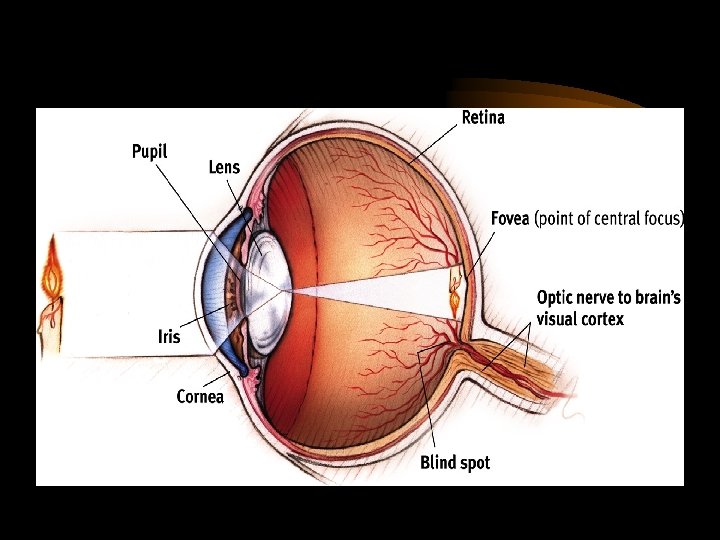
• B. The Human Eye – 1. The parts of the eye • a. Cornea = a transparent protector covering the eye • b. Iris = – a ring of muscle tissue that forms the colored portion of the eye around the pupil – and controls the size of the pupil opening • c. Pupil = the adjustable opening in the center of the eye through which light enters • d. Lens = the transparent structure behind the pupil that changes shape to focus images on the retina
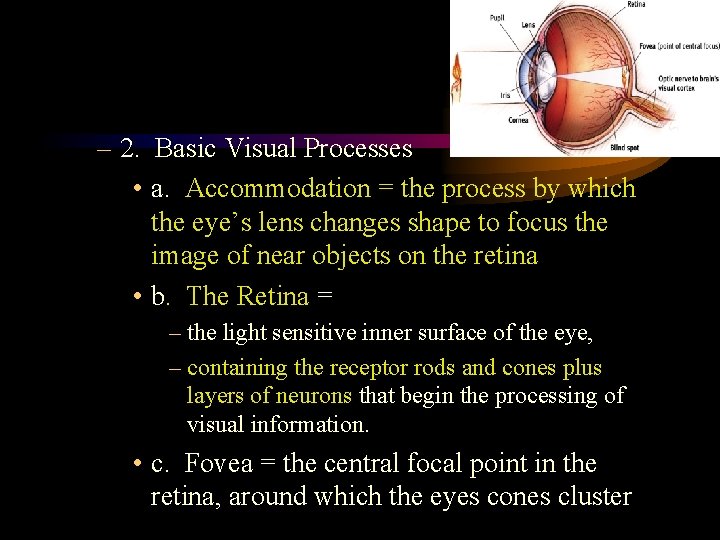
– 2. Basic Visual Processes • a. Accommodation = the process by which the eye’s lens changes shape to focus the image of near objects on the retina • b. The Retina = – the light sensitive inner surface of the eye, – containing the receptor rods and cones plus layers of neurons that begin the processing of visual information. • c. Fovea = the central focal point in the retina, around which the eyes cones cluster
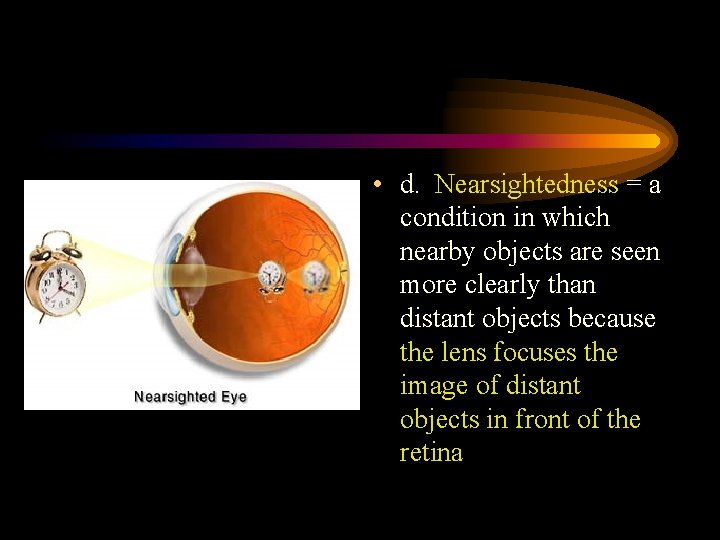
• d. Nearsightedness = a condition in which nearby objects are seen more clearly than distant objects because the lens focuses the image of distant objects in front of the retina
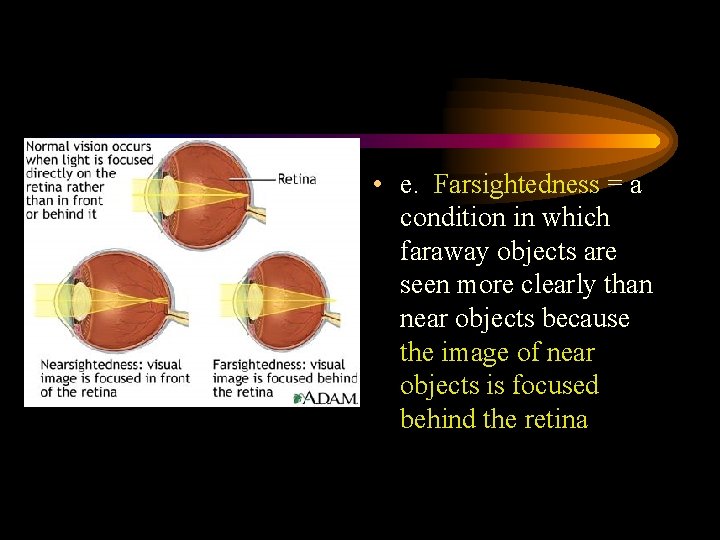
• e. Farsightedness = a condition in which faraway objects are seen more clearly than near objects because the image of near objects is focused behind the retina
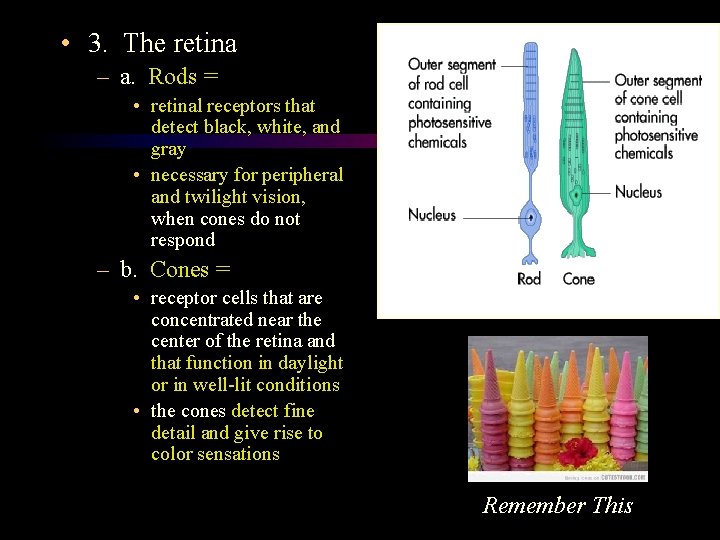
• 3. The retina – a. Rods = • retinal receptors that detect black, white, and gray • necessary for peripheral and twilight vision, when cones do not respond – b. Cones = • receptor cells that are concentrated near the center of the retina and that function in daylight or in well-lit conditions • the cones detect fine detail and give rise to color sensations Remember This
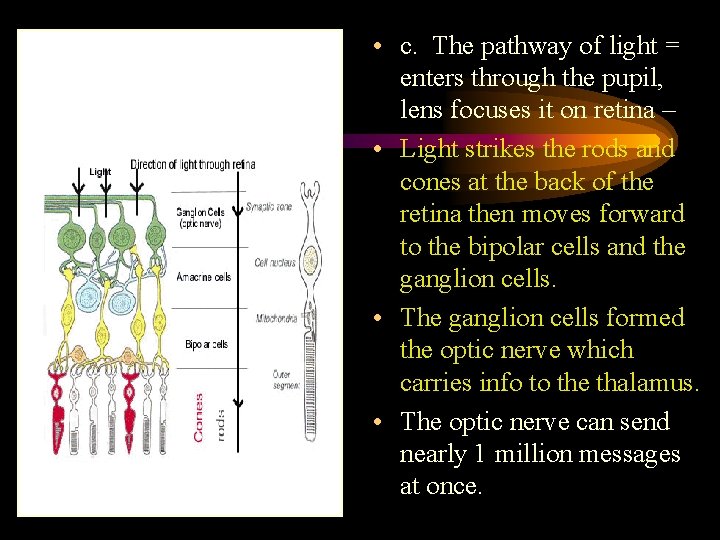
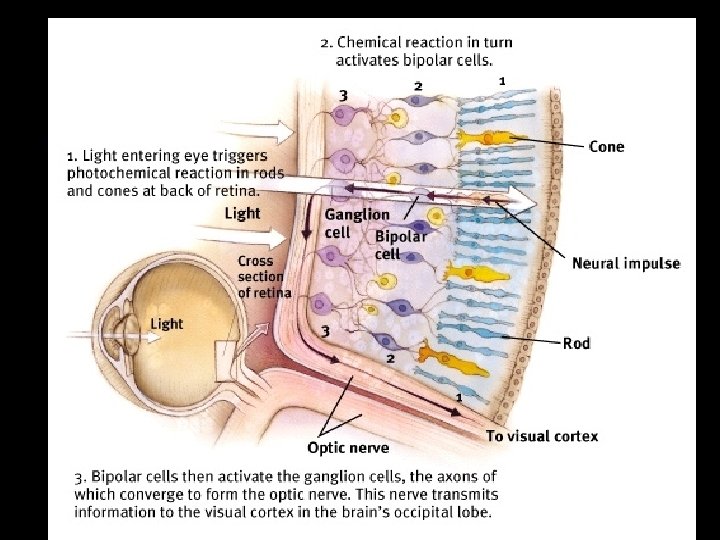
• c. The pathway of light = enters through the pupil, lens focuses it on retina – • Light strikes the rods and cones at the back of the retina then moves forward to the bipolar cells and the ganglion cells. • The ganglion cells formed the optic nerve which carries info to the thalamus. • The optic nerve can send nearly 1 million messages at once.
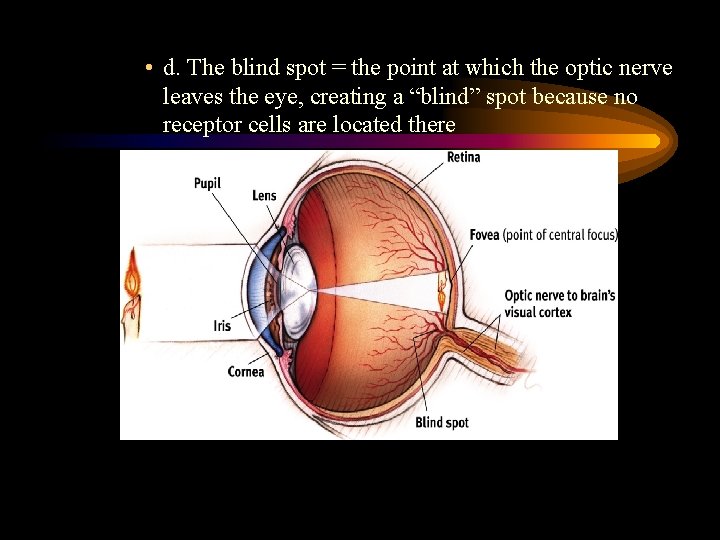
• d. The blind spot = the point at which the optic nerve leaves the eye, creating a “blind” spot because no receptor cells are located there
• C. Feature Detection- nerve cells in the brain that respond to specific features of the stimulus, such as shape, angle or movement. – Detectors in the visual cortex pass info to other areas of the brain in order to response. • Ex: Face Recognition occurs in the temporal lobe just behind the right ear.
• D. Visual Processing: Parallel processing – 1. Parallel processing = • a. The processing of several aspects of a problem simultaneously • b. The brain’s natural mode of information processing for many functions, including vision – The brain divides a visual scene into sub dimensions such as color, movement, form, and depth. We then construct our perceptions by integrating the separate but parallel work of the different visual teams.
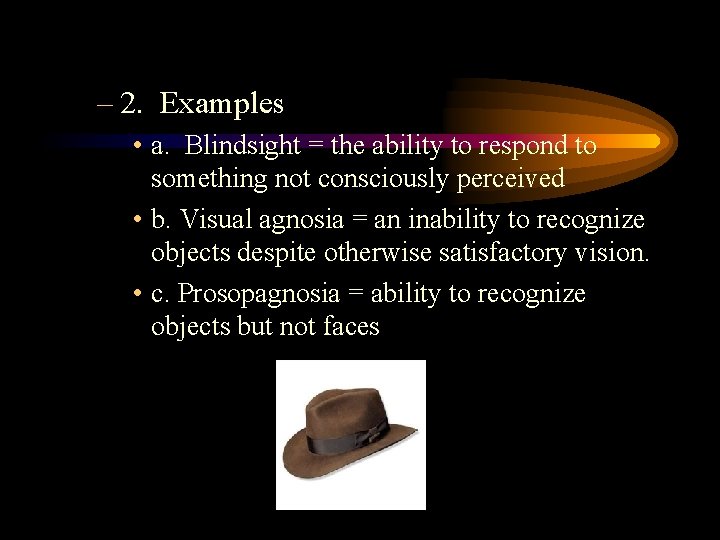
– 2. Examples • a. Blindsight = the ability to respond to something not consciously perceived • b. Visual agnosia = an inability to recognize objects despite otherwise satisfactory vision. • c. Prosopagnosia = ability to recognize objects but not faces
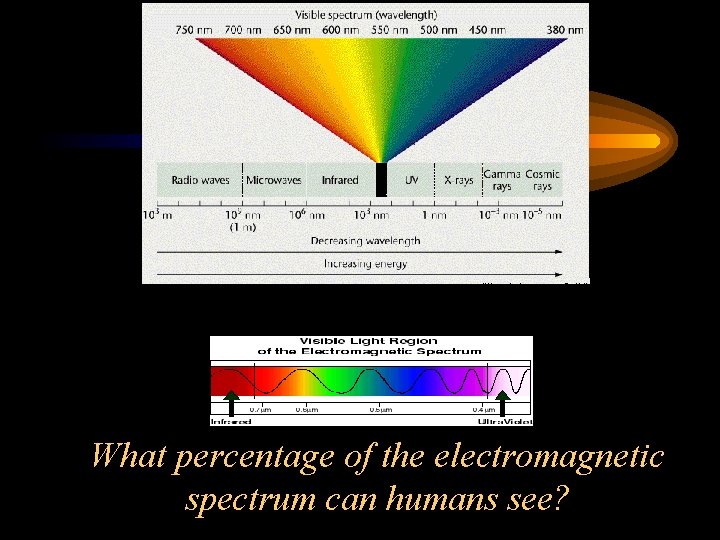
What percentage of the electromagnetic spectrum can humans see?
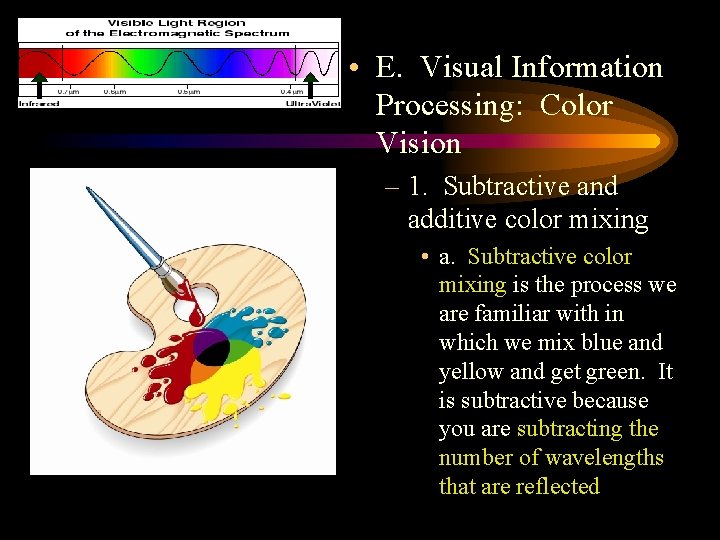
• E. Visual Information Processing: Color Vision – 1. Subtractive and additive color mixing • a. Subtractive color mixing is the process we are familiar with in which we mix blue and yellow and get green. It is subtractive because you are subtracting the number of wavelengths that are reflected
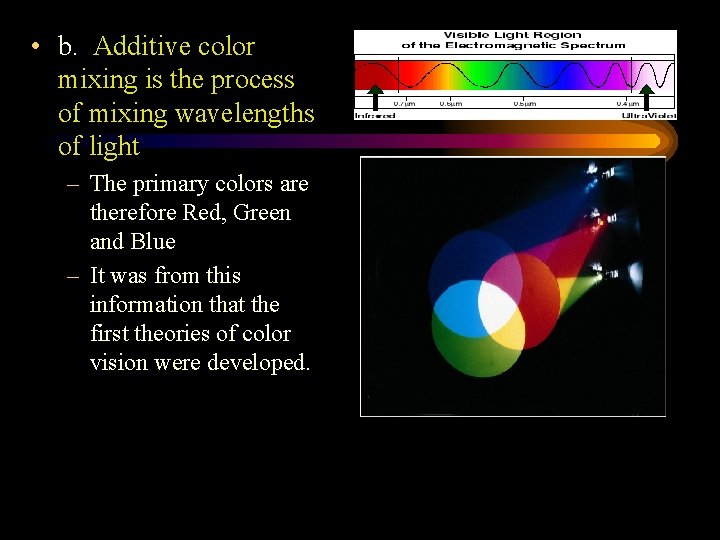
• b. Additive color mixing is the process of mixing wavelengths of light – The primary colors are therefore Red, Green and Blue – It was from this information that the first theories of color vision were developed.
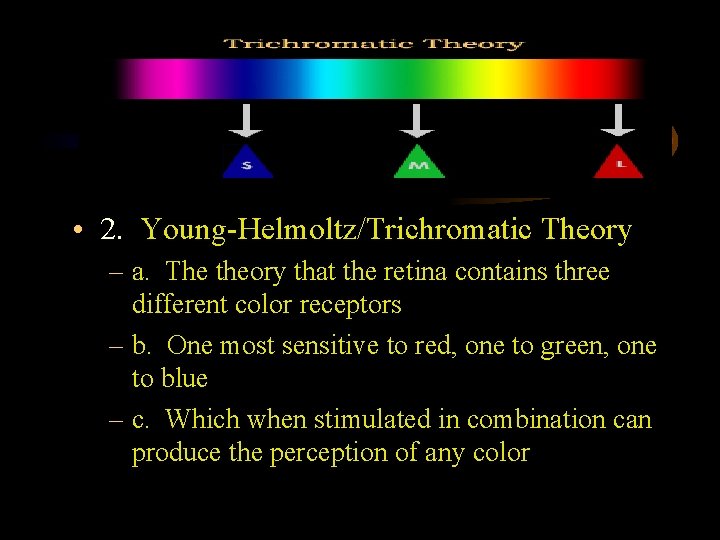
• 2. Young-Helmoltz/Trichromatic Theory – a. The theory that the retina contains three different color receptors – b. One most sensitive to red, one to green, one to blue – c. Which when stimulated in combination can produce the perception of any color
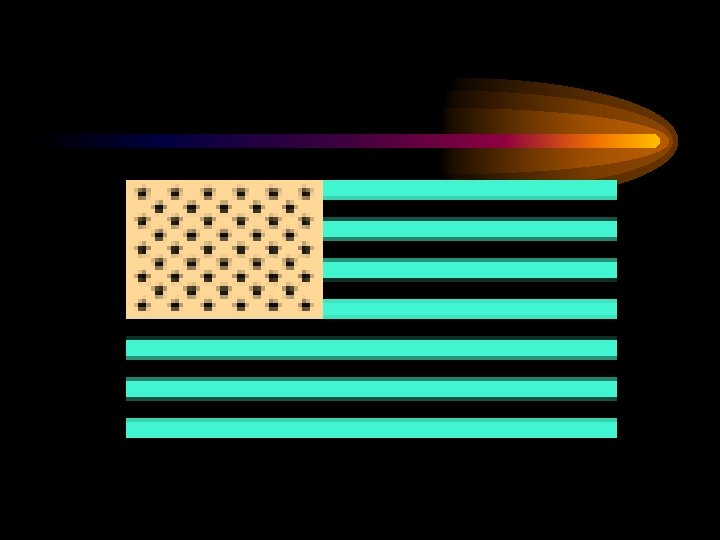
• d. Color blindness = not actually blind but they lack the proper receptors for red or green • Lack of functioning cones • e. Problems with theory – Why is it that people who are color blind for red are also color blind for green. Yet they see yellow fine which is produced by combining red wavelengths with green wavelengths – After images = when you stare at a green square for a while and look at a white sheet of paper you see red, green’s opponent color.
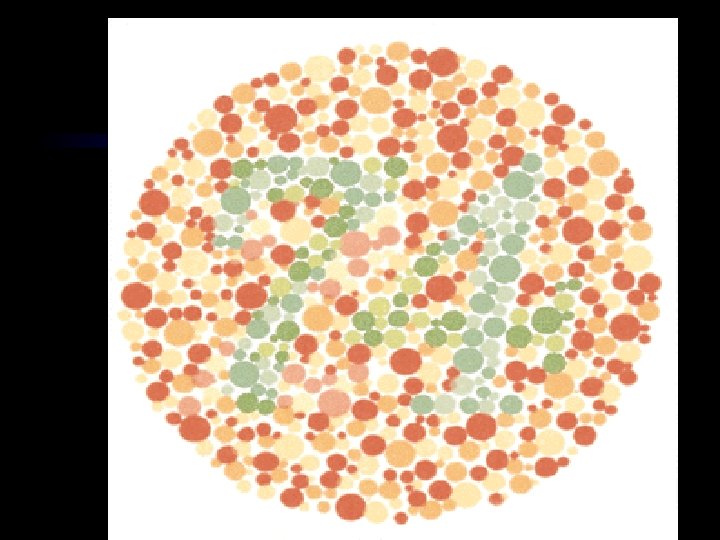
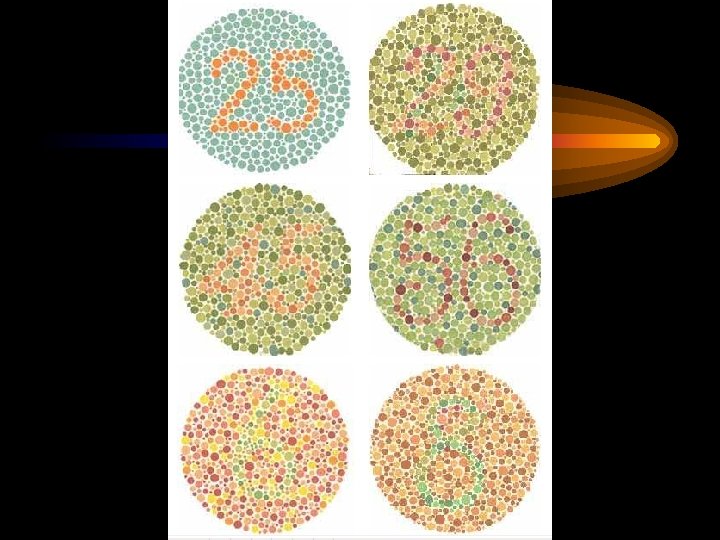
– 3. The Hering Opponent Process Theory • a. The theory that opposing retinal process (redgreen, yellow- blue, white - black) enable color vision • b. For example, some cells are stimulated by green and inhibited by red; others are stimulated by red and inhibited by green • c. Color Constancy a problem for the Opponent Process Theory – perceiving familiar objects as having consistent color, even if changing illumination alters the wavelengths reflected by the object
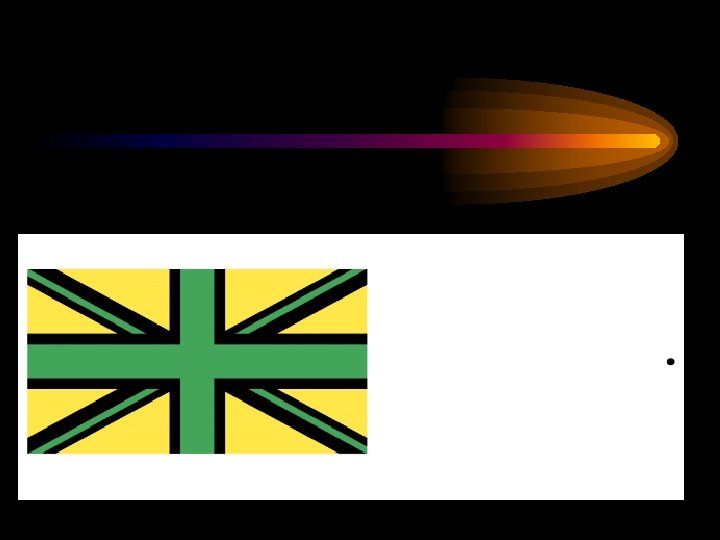
– If you put on green tinted glasses you still see objects as the correct color. Your brain subtracts the green from the object and sees the true color – 4. The Retinex Theory • a. A combination of the words retina and cortex • b. When information from various parts of the retina reaches the cortex, the cortex compares the inputs to determine the brightness and color perception for each area



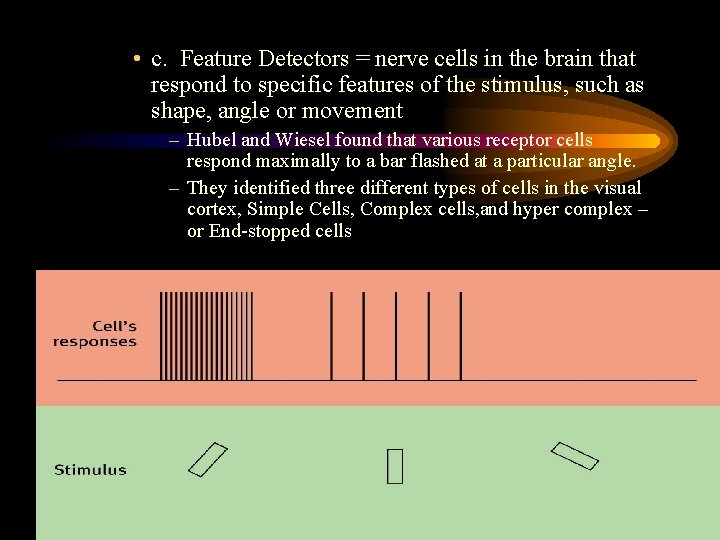
• c. Feature Detectors = nerve cells in the brain that respond to specific features of the stimulus, such as shape, angle or movement – Hubel and Wiesel found that various receptor cells respond maximally to a bar flashed at a particular angle. – They identified three different types of cells in the visual cortex, Simple Cells, Complex cells, and hyper complex – or End-stopped cells
• C. Visual Information Processing: Feature Detection – 1. Some basic terms • a. Visual Field = the whole area of the world that you can see at any time. Divided into left and right visual fields • b. Receptive Field = the part of the visual field to which any one neuron responds
The Auditory Sense
How do we hear? • Draw a bow across a violin and the resulting stimulus energy is sound waves- molecules of air, each bumping into the next. Our ears detect these brief air pressure changes. The ears then transforms the vibrating air into nerve impulses, which our brain decodes as sound.
Sound • A. The Auditory Stimulus – 1. Audition = the sense of hearing – 2. Sound is caused by vibrations of air molecules – 3. Three psychological properties of sound • a. Frequency = the number of complete wavelengths that pass a point in a given time • b. Pitch = a tone’s highness or lowness; depends on frequency • c. Loudness is determined by the amplitude of the sound wave. Loudness is measured in decibels.
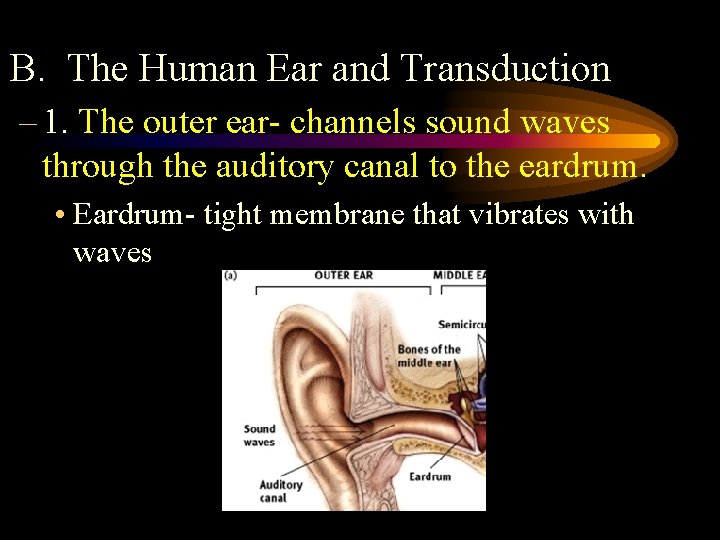
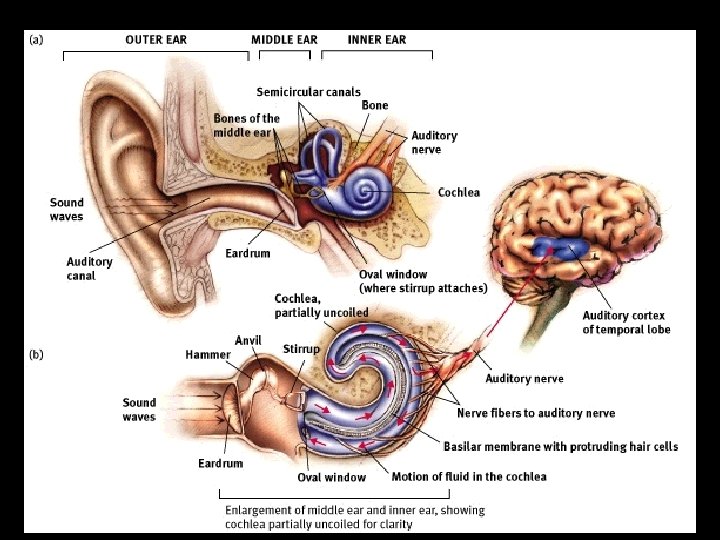
B. The Human Ear and Transduction – 1. The outer ear- channels sound waves through the auditory canal to the eardrum. • Eardrum- tight membrane that vibrates with waves
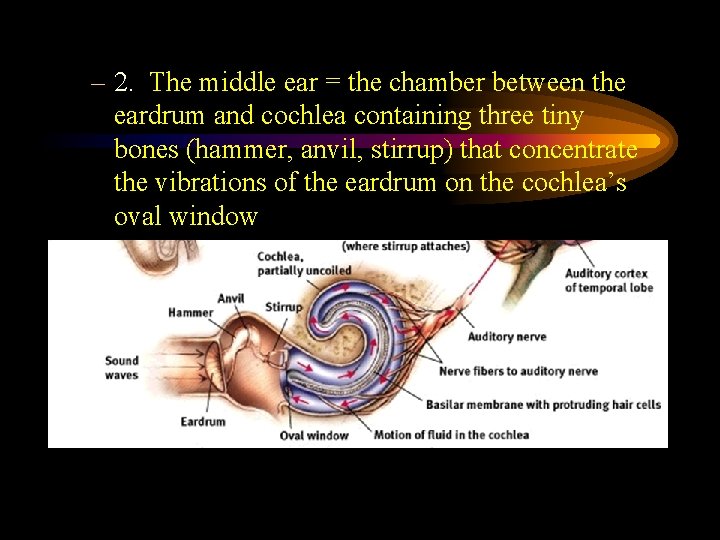
– 2. The middle ear = the chamber between the eardrum and cochlea containing three tiny bones (hammer, anvil, stirrup) that concentrate the vibrations of the eardrum on the cochlea’s oval window
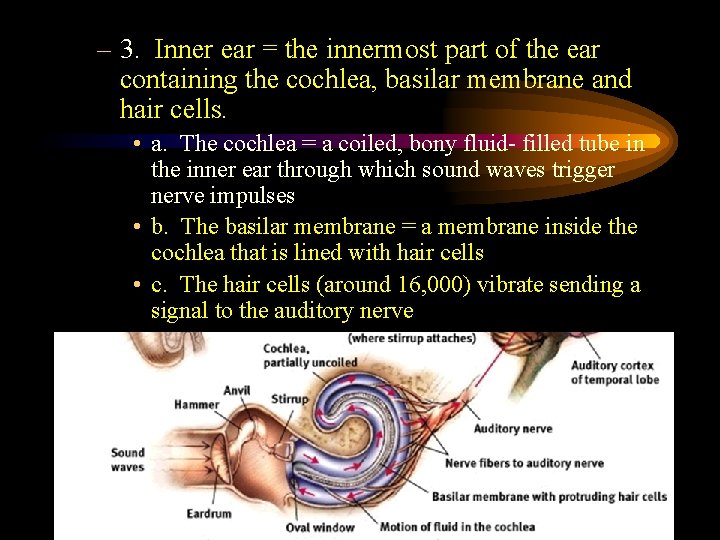
– 3. Inner ear = the innermost part of the ear containing the cochlea, basilar membrane and hair cells. • a. The cochlea = a coiled, bony fluid- filled tube in the inner ear through which sound waves trigger nerve impulses • b. The basilar membrane = a membrane inside the cochlea that is lined with hair cells • c. The hair cells (around 16, 000) vibrate sending a signal to the auditory nerve
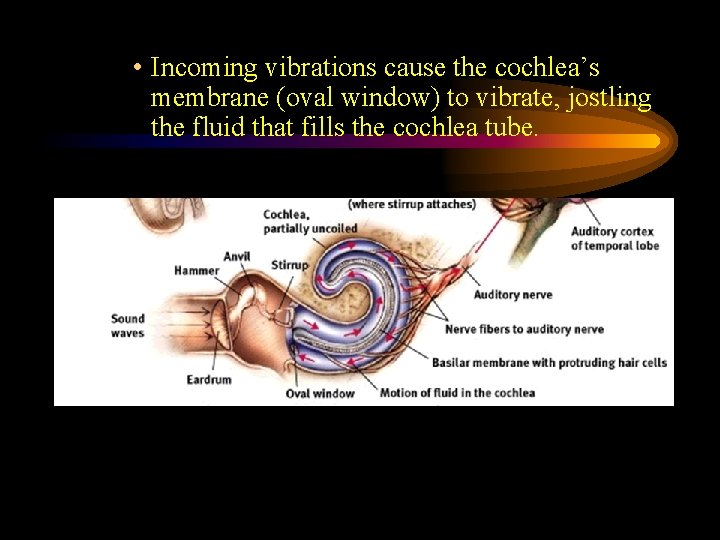
• Incoming vibrations cause the cochlea’s membrane (oval window) to vibrate, jostling the fluid that fills the cochlea tube.
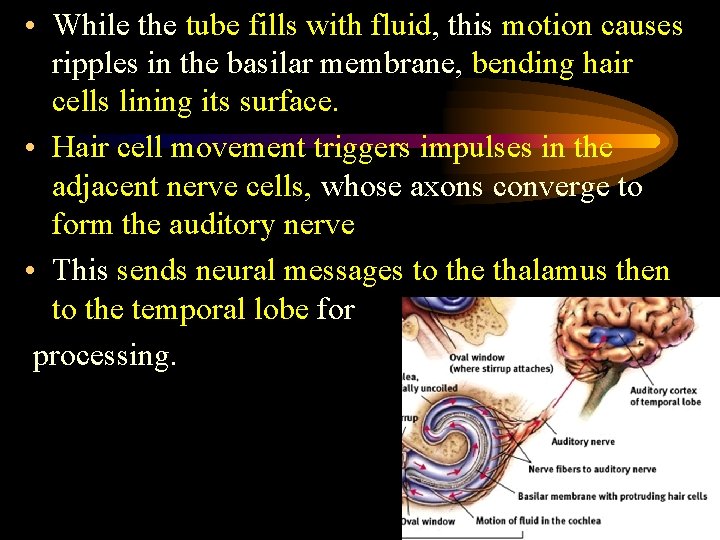
• While the tube fills with fluid, this motion causes ripples in the basilar membrane, bending hair cells lining its surface. • Hair cell movement triggers impulses in the adjacent nerve cells, whose axons converge to form the auditory nerve • This sends neural messages to the thalamus then to the temporal lobe for processing.
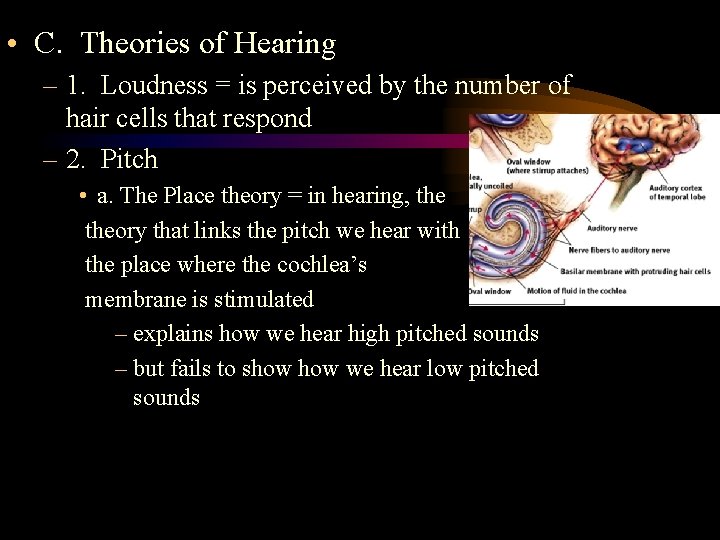
• C. Theories of Hearing – 1. Loudness = is perceived by the number of hair cells that respond – 2. Pitch • a. The Place theory = in hearing, theory that links the pitch we hear with the place where the cochlea’s membrane is stimulated – explains how we hear high pitched sounds – but fails to show we hear low pitched sounds
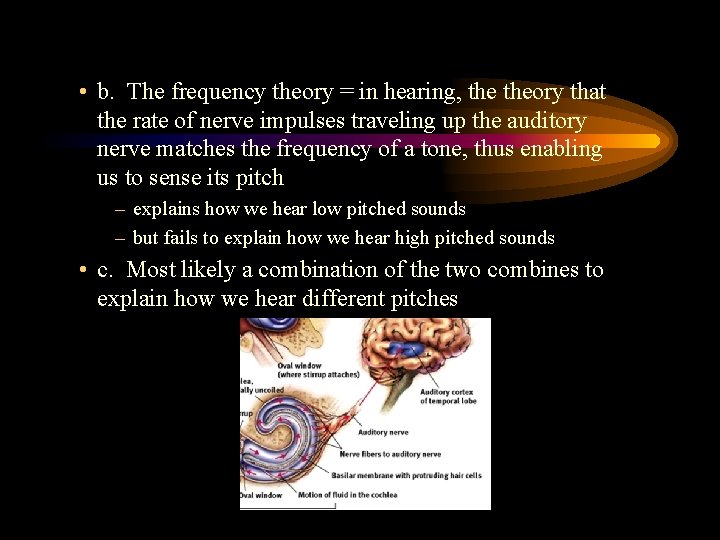
• b. The frequency theory = in hearing, theory that the rate of nerve impulses traveling up the auditory nerve matches the frequency of a tone, thus enabling us to sense its pitch – explains how we hear low pitched sounds – but fails to explain how we hear high pitched sounds • c. Most likely a combination of the two combines to explain how we hear different pitches
• d. The Volley Principle – shows how when hair cells fire in alternating patterns we can hear sounds that have frequencies above 1000 times per second – 3. Determining the location of a sound • a. Having two ears allows us to locate the source of a sound • b. Our auditory system is extremely sensitive to how intense and when a sound arrives
• D. Hearing Loss – 1. Conduction deafness = hearing loss caused by damage to the mechanical system that conducts sound waves to the cochlea – 2. Sensorineural or nerve deafness = hearing loss caused by damage to the cochlea’s receptor cells or to the auditory nerves – 3. Deaf advocates disagree with the use of cochlear implants for children born deaf. They reason that deafness is NOT a disability.
Hearing through bone conduction • When you plug your ears and listen to yourself speak, you hear both the sound conducted by air waves to the outer ear and that carried directly to the auditory nerve by bone conduction. • Bone conduction demonstration.
Hearing through bone conduction • People who are deaf due to a defect in the inner or middle ear will still be able to hear by bone conduction. • Beethoven, could still hear his piano by placing one end of his walking stick against it and gripping the other end between his teeth.
• How well can you hear?

• D. The Organ of Corti are neurons activated by the hair cells vibrating
V. The Other Senses • A. Touch = Four skin senses - warm, cold, pressure and pain – 1. Pain • a. Phantom Limb sensations indicate that with pain, the brain can misinterpret the spontaneous central nervous system activity • b. Rubber-hand illusion • c. Gate Control theory = – The theory that the spinal cord contains a neurological “gate” that blocks pain signals or allows them to pass on to the brain
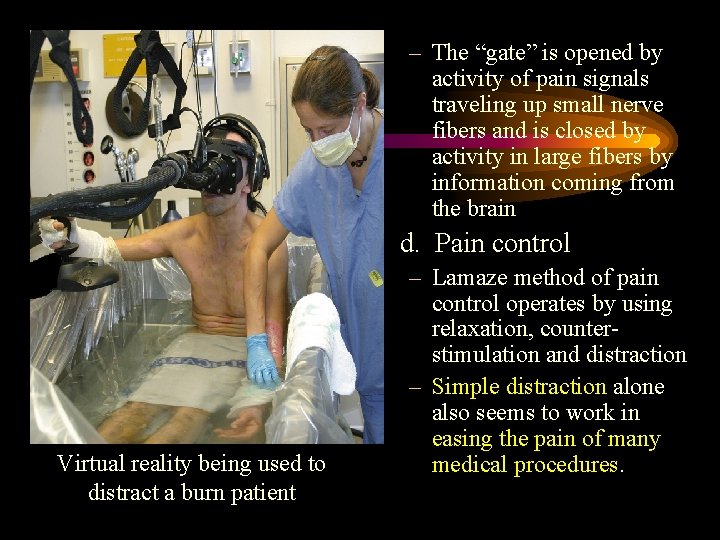
– The “gate” is opened by activity of pain signals traveling up small nerve fibers and is closed by activity in large fibers by information coming from the brain • d. Pain control Virtual reality being used to distract a burn patient – Lamaze method of pain control operates by using relaxation, counterstimulation and distraction – Simple distraction alone also seems to work in easing the pain of many medical procedures.
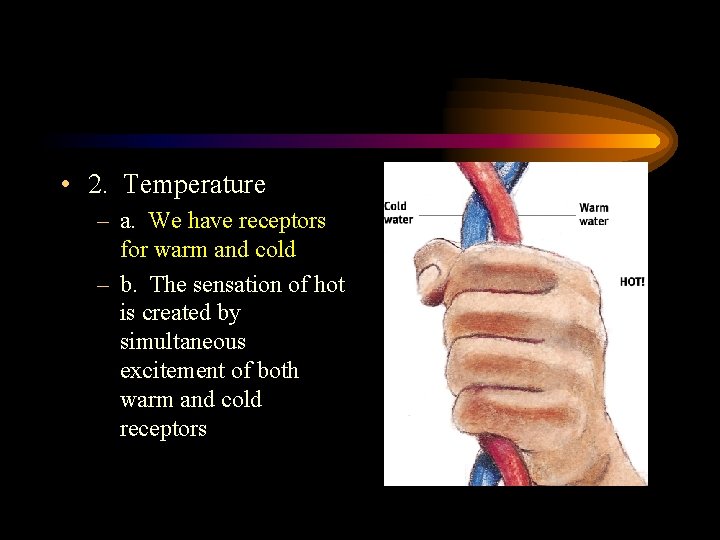
• 2. Temperature – a. We have receptors for warm and cold – b. The sensation of hot is created by simultaneous excitement of both warm and cold receptors
• C. Body senses – 1. Kinesthesis(proprioception) = the system for sensing the body position and movement of individual body parts – Ian Waterman
• B. The Chemical Senses – 1. Taste = Five basic sensations • • a. Sweet, sour, salty, umami, and bitter b. Taste buds are replaced throughout our lives c. We have less taste buds as we get older d. Sensory interaction = the principle that one sense may influence another, as when the smell of food influences the taste
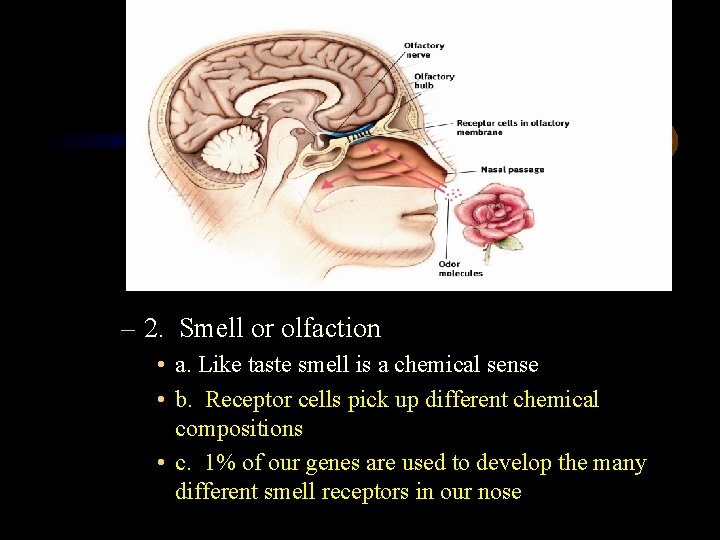
– 2. Smell or olfaction • a. Like taste smell is a chemical sense • b. Receptor cells pick up different chemical compositions • c. 1% of our genes are used to develop the many different smell receptors in our nose


Bell-ringer 1 • Write 3 M/C questions on the material we have already covered. Make one for each of the following concepts • 1. General Sensation • 2. Vision • 3. Audition
– 3. Pressure • a. We can feel very minor points of pressure • b. Pressure is sensed through specialized receptor cells known as pancinian corpuscles
– 3. Vestibular sense = the sense of body movement and position including the sense of balance – 4 Sensory Restriction • a. Includes loss of a sense such as sight, resulting in increased perception in other senses • b. Also includes sensory monotony - like that of a prisoner in solitary confinement • c. Has been used in therapeutic models – REST = Restricted environmental stimulation therapy – Has worked well with smokers who want to quit
• Copy the phrase below and then provide the punctuation that would make it a meaningful sentence. – “TIME FLIES I CANT THEYRE TOO FAST”
VI. Perception • A. Selective Attention – 1. Selective Attention = the focusing of conscious awareness on a particular stimulus, as in the cocktail party effect – 2. The cocktail party effect = the ability to attend selectively to only one voice among many
• Inattentional blindness: a form of selective attention in which we are focused in on one thing that we miss obvious things in front of us • Changed Blindness: a form of selective attention in which we are focused in on one thing that we do notice changes in front of us
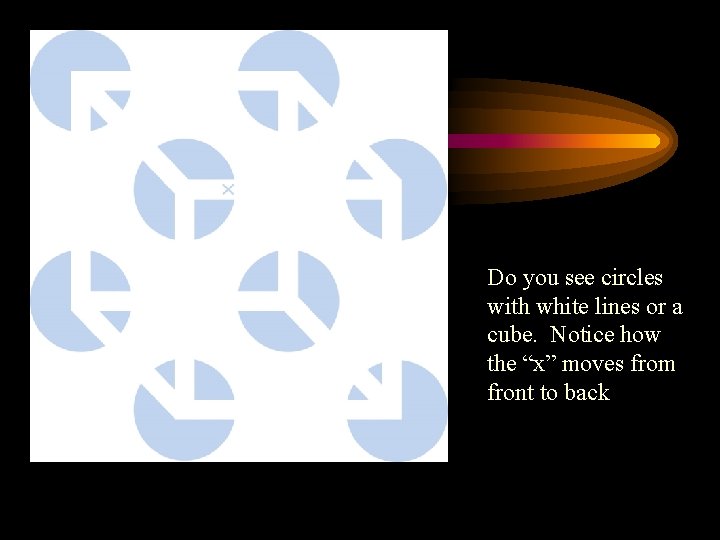
Do you see circles with white lines or a cube. Notice how the “x” moves from front to back
Bell Ringer 2 • Draw a picture that describes the scene below. • You are seated on the beach of a tropical island. In front of you several palm trees sway in the breeze. Young children can be seen playing in the sand at the shore line while older children and adults are splashing in the water. A windsurfer glides by on the calm water while a cruise ship sits off in the distance waiting to enter port. Add one other object of your choice that would be near to you and one that you can see in the distance.

– 3. The Ulric Neisser Basketball experiment • a. Subjects shown a video of two three man teams passing a basketball • b. Asked to count the number of times black shirted B-ball players passed the balls • c. Half way through the video a woman with a red umbrella walked through the scene • d. Most subjects failed to notice the woman
• B. Perceptual Illusions – 1. The Muller-Lyer Illusion created in 1889 uses two lines with arrows pointing in or out. The carpentered world phenomenon comes into play here as this illusion does not work well with people who do not live in a “square” world.
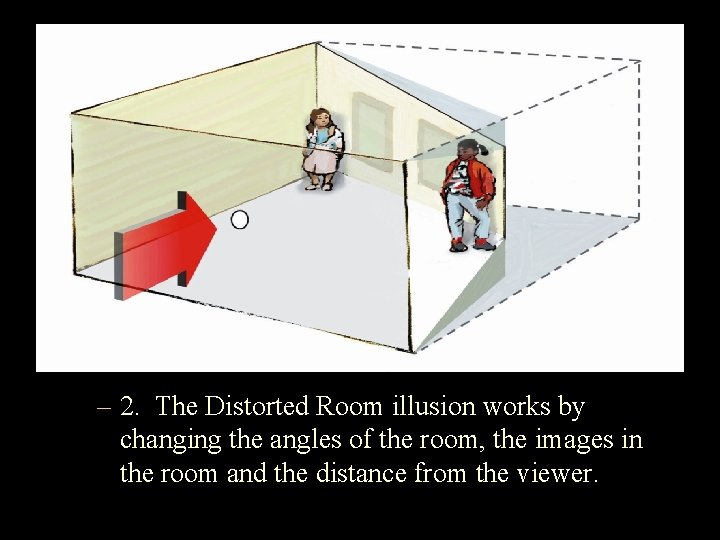
– 2. The Distorted Room illusion works by changing the angles of the room, the images in the room and the distance from the viewer.
Optical Illusion Web Sites • Click to visit these sites Color Cube. com NIEHS Kids Pages Brainbashers Just Riddles Paintings Moillusions Lightisreal. com Optillusions. com

More Illusions Allpsych. com Meltingpot Psycharts Premier photographer MIT Amazing Brain Optical Illusions UK 123 opticalillusions Eye magic Exploratorium Bristol Omnibrain

Echalk Optillusions. com lycos Optillusions. com Info about Opt Illusions Optillusions. com
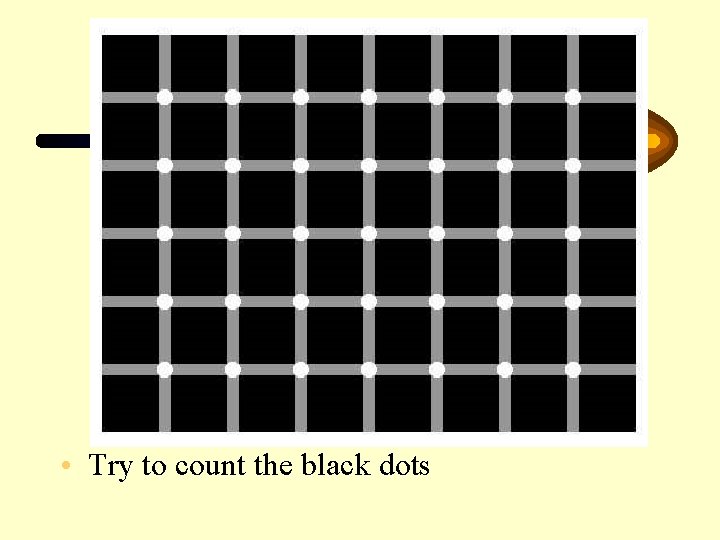
• Try to count the black dots
• C. Perceptual Organization – 1. Gestalt = • a. an organized whole • b. Gestalt psychologists emphasize our tendency to integrate pieces of information into meaningful wholes • c. can be summarized by the statement “the whole is greater than the sum of its parts • d. The Law of Pragnanz states that we tend to see things in their simplest form.
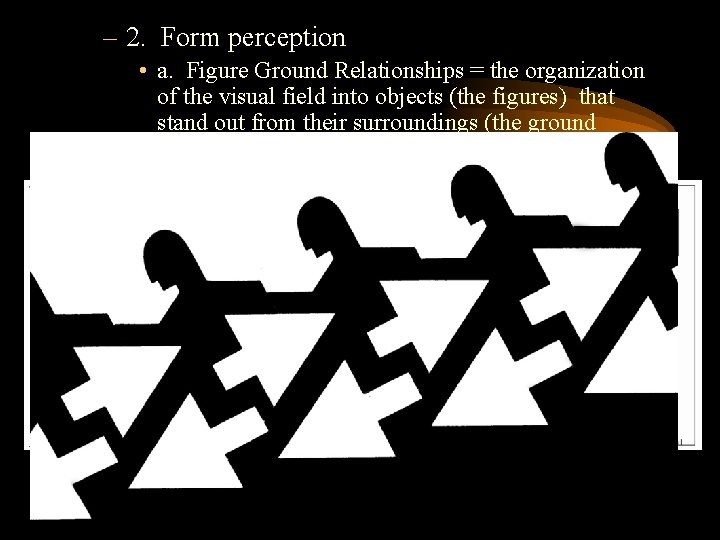
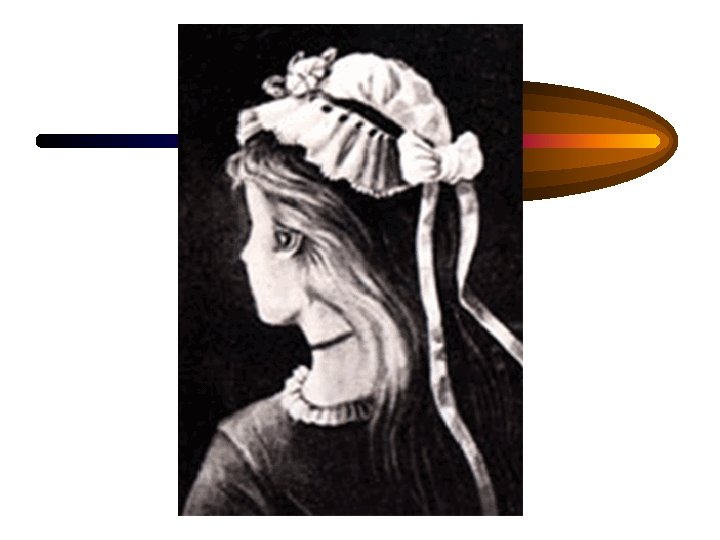
– 2. Form perception • a. Figure Ground Relationships = the organization of the visual field into objects (the figures) that stand out from their surroundings (the ground

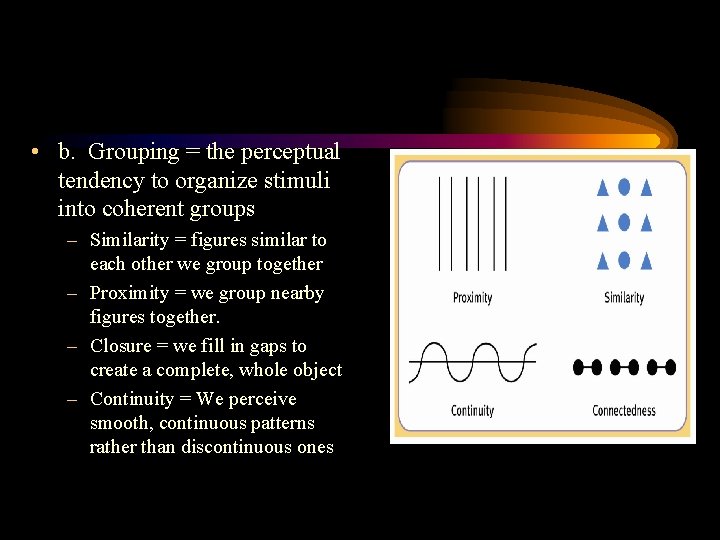
• b. Grouping = the perceptual tendency to organize stimuli into coherent groups – Similarity = figures similar to each other we group together – Proximity = we group nearby figures together. – Closure = we fill in gaps to create a complete, whole object – Continuity = We perceive smooth, continuous patterns rather than discontinuous ones
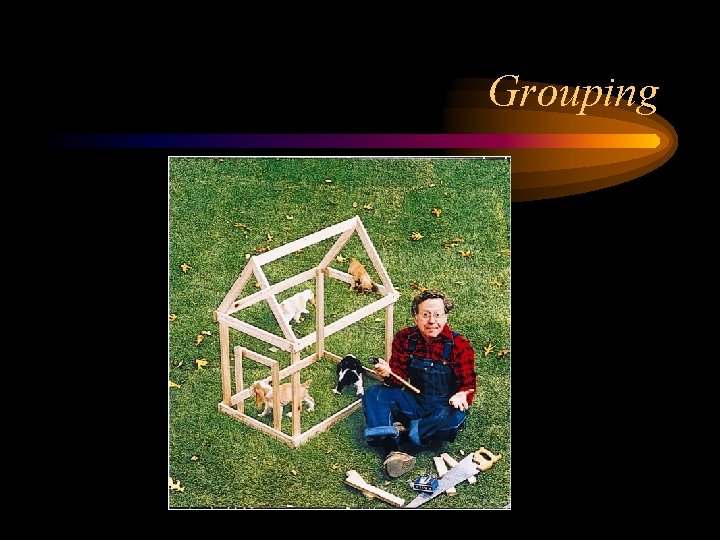
Grouping
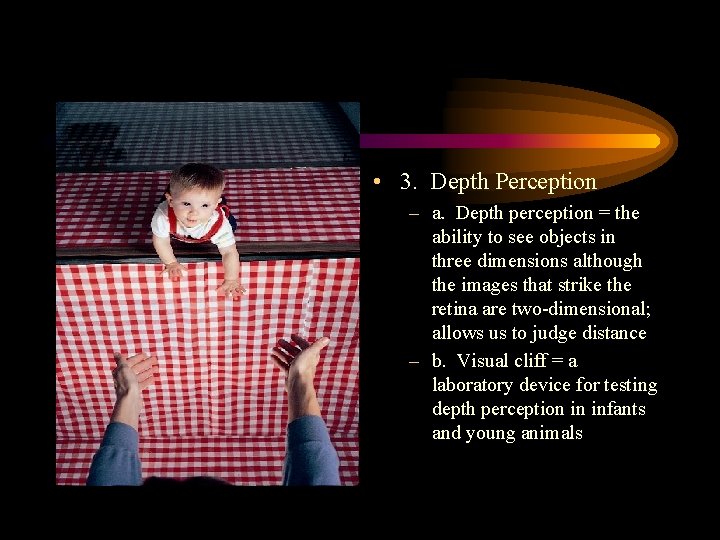
• 3. Depth Perception – a. Depth perception = the ability to see objects in three dimensions although the images that strike the retina are two-dimensional; allows us to judge distance – b. Visual cliff = a laboratory device for testing depth perception in infants and young animals
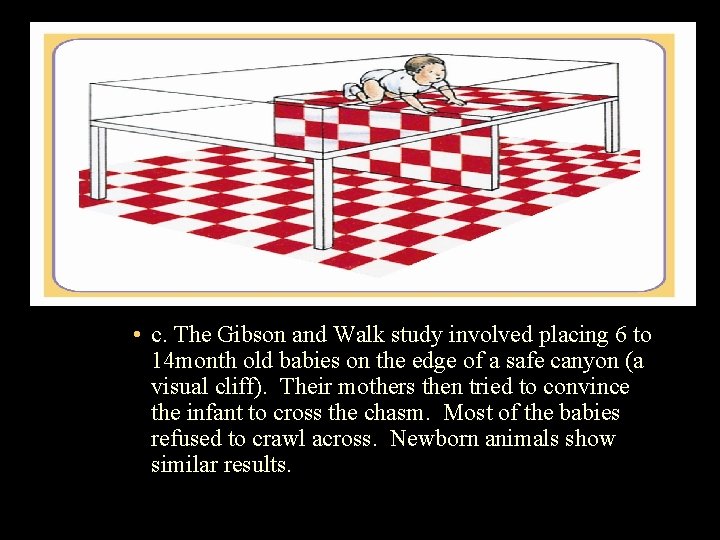
• c. The Gibson and Walk study involved placing 6 to 14 month old babies on the edge of a safe canyon (a visual cliff). Their mothers then tried to convince the infant to cross the chasm. Most of the babies refused to crawl across. Newborn animals show similar results.
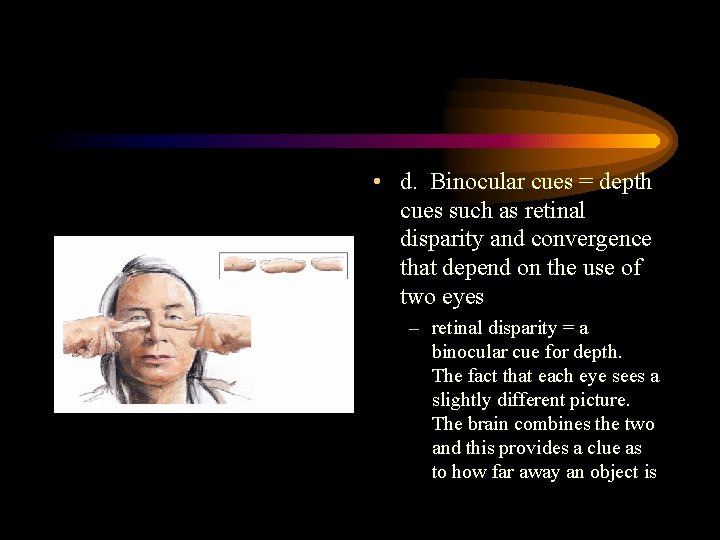
• d. Binocular cues = depth cues such as retinal disparity and convergence that depend on the use of two eyes – retinal disparity = a binocular cue for depth. The fact that each eye sees a slightly different picture. The brain combines the two and this provides a clue as to how far away an object is
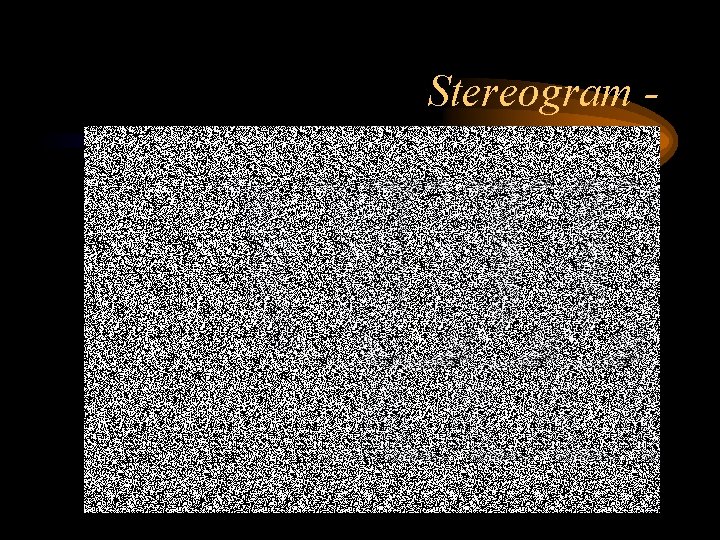
Stereogram -
– convergence = a binocular cue for depth; the extent to which the eyes converge inward when looking at an object. The closer the object the greater convergence • e. Monocular Cues = distance cues such as linear perspective and overlap, available to either eye alone – interposition = if one object blocks another we perceive it as closer – Relative Size = if we assume that two objects are similar in size, we see the smaller one as being farther away
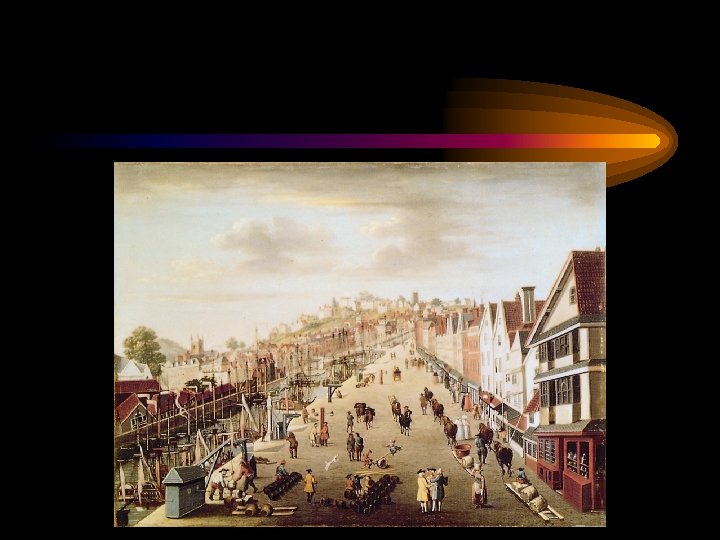
– Aerial Haze = hazy objects seem farther away – texture gradient = a change from coarse, distinct features to fine indistinct features. Up close you see individual blades of grass, while you see a field of green farther away – Relative height = objects higher in our field of vision seem to be farther away – Linear perspective = parallel lines seem to converge as distance increases
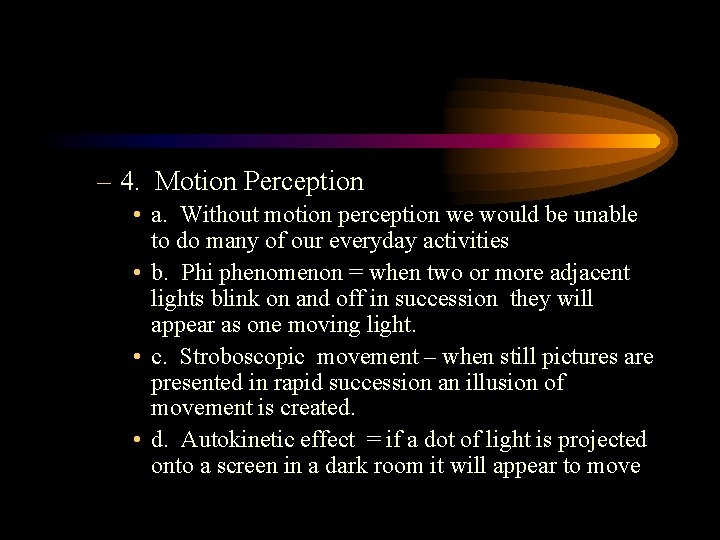
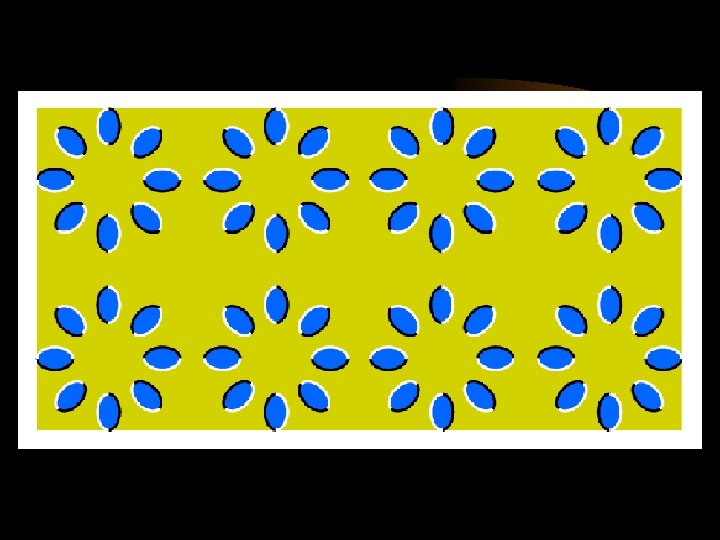
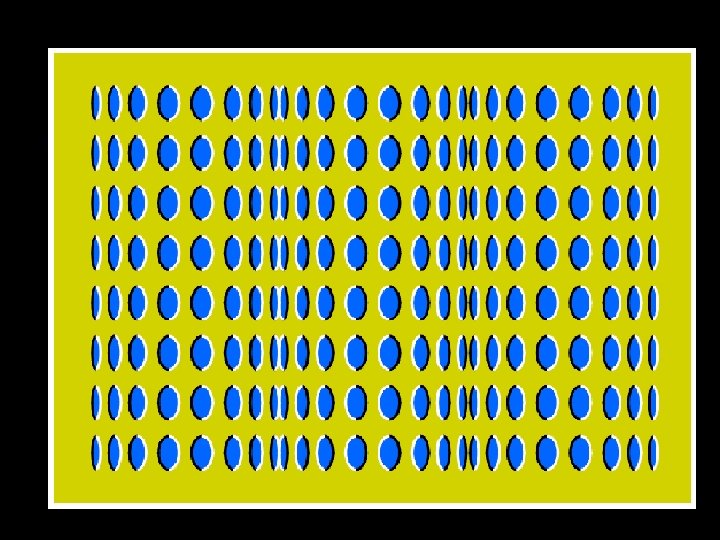
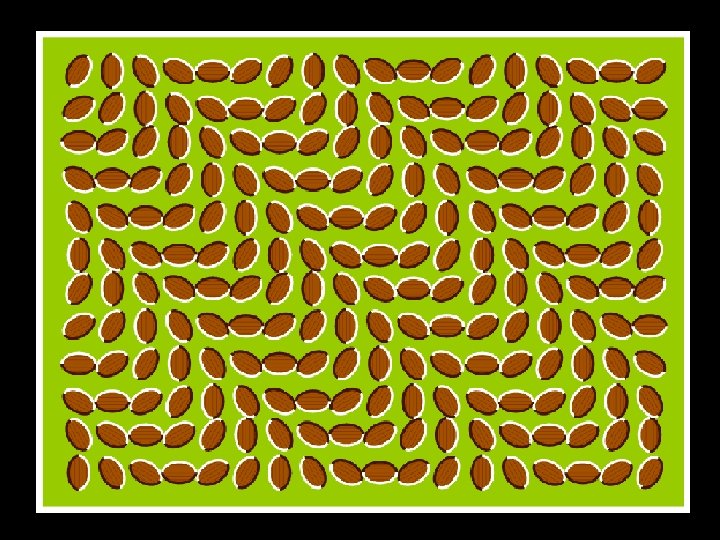
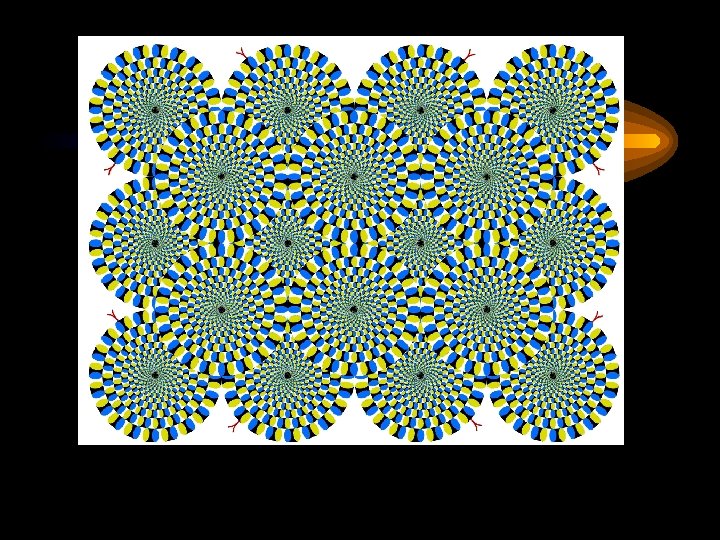
– 4. Motion Perception • a. Without motion perception we would be unable to do many of our everyday activities • b. Phi phenomenon = when two or more adjacent lights blink on and off in succession they will appear as one moving light. • c. Stroboscopic movement – when still pictures are presented in rapid succession an illusion of movement is created. • d. Autokinetic effect = if a dot of light is projected onto a screen in a dark room it will appear to move
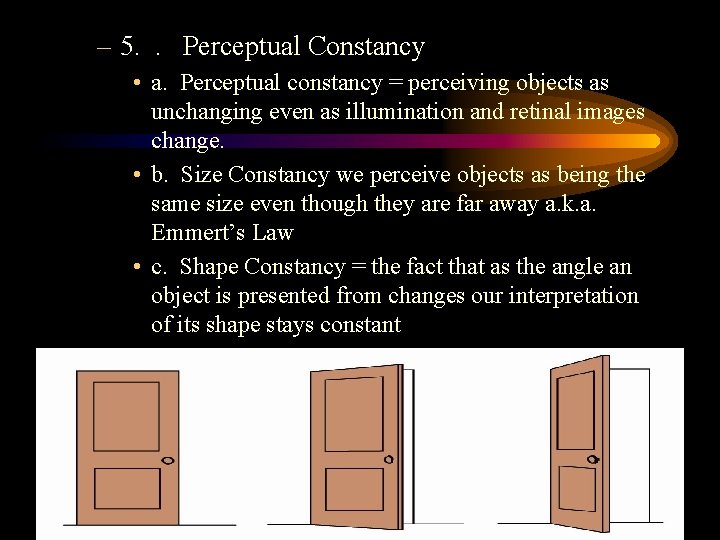
– 5. . Perceptual Constancy • a. Perceptual constancy = perceiving objects as unchanging even as illumination and retinal images change. • b. Size Constancy we perceive objects as being the same size even though they are far away a. k. a. Emmert’s Law • c. Shape Constancy = the fact that as the angle an object is presented from changes our interpretation of its shape stays constant
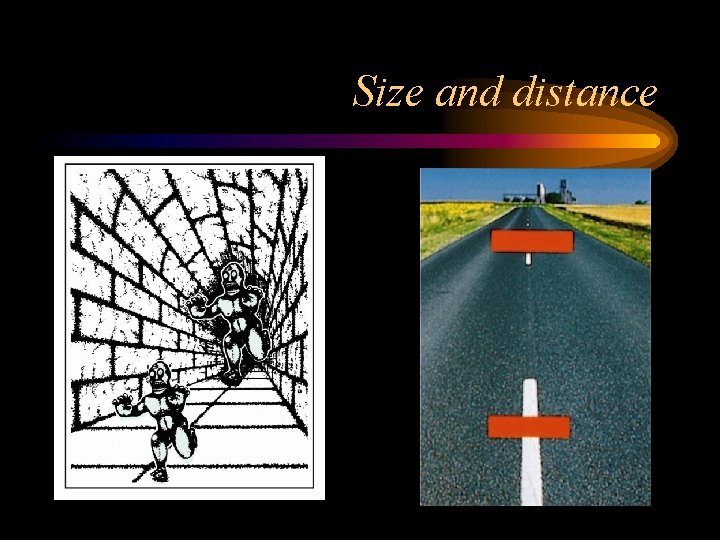
Size and distance
VII. Perceptual Interpretation • A. Perceptual Adaptation – 1. the ability to adjust to an artificially displaced or even inverted visual field. – 2. For example students with upside down vision goggles will eventually adapt. • B. Perceptual Set – 1. A mental predisposition to perceive one thing and not another.
• Schemas are concepts that help us mentally organize our world.
VIII. ESP • A. ESP = The controversial claim that perception can occur apart from sensory input. Said to include telepathy clairvoyance and precognition • B. Parapsychology = the study of paranormal phenomena including ESP and psychokinetic powers.
Bell-ringer 2 • Without using your book, give me your best guess at to how we: – See color – Hear different pitches of sound
Bell-ringer 3 • Describe the two competing theories of color vision.
- Slides: 130