
Sensation Perception Ch 15 The Chemical Senses Revised
- Slides: 21
Sensation & Perception Ch. 15: The Chemical Senses Revised from © Takashi Yamauchi (Dept. of Psychology, Texas A&M University) Main topics Olfactory system odors Taste ch 15 1
Functions of Olfaction • Many animals are macrosmatic – having a keen sense of smell that is necessary for survival • Humans are microsmatic – a less keen sense of smell that is not crucial to survive ch 15 2
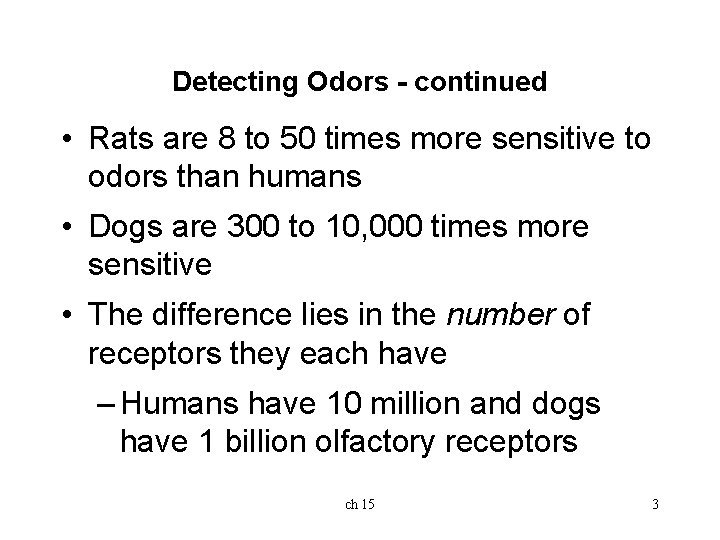
Detecting Odors - continued • Rats are 8 to 50 times more sensitive to odors than humans • Dogs are 300 to 10, 000 times more sensitive • The difference lies in the number of receptors they each have – Humans have 10 million and dogs have 1 billion olfactory receptors ch 15 3
Detecting Odors • Measuring the detection threshold – Yes/no procedure - participants are given trials with odors along with “blank” trials • They respond by saying yes or no – Forced-choice - two trials are given, one with odorant and one without • Participant indicates which smells strongest ch 15 4
Detecting Odors - continued • Measuring the difference threshold – Measure the smallest difference that can be detected between two samples ch 15 5
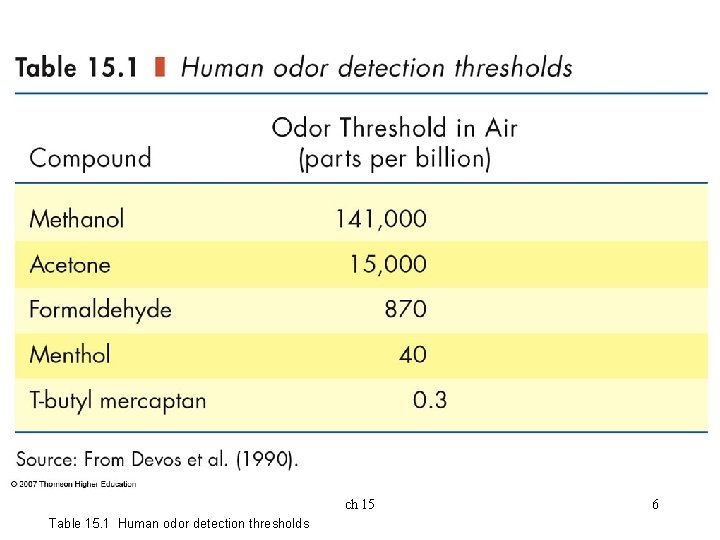
ch 15 Table 15. 1 Human odor detection thresholds 6
Identifying Odors • Humans can discriminate among 100, 000 odors but they cannot label them accurately – This appears to be caused by an inability to retrieve the name from memory, from a lack of sensitivity ch 15 7
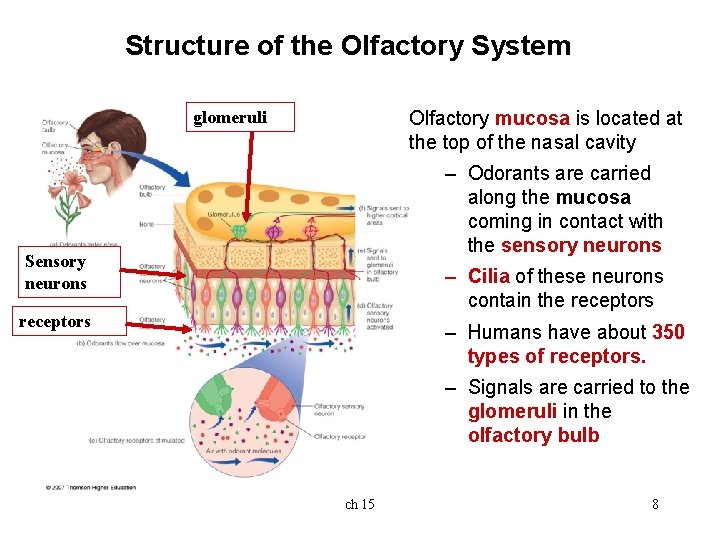
Structure of the Olfactory System glomeruli Olfactory mucosa is located at the top of the nasal cavity – Odorants are carried along the mucosa coming in contact with the sensory neurons Sensory neurons – Cilia of these neurons contain the receptors – Humans have about 350 types of receptors. – Signals are carried to the glomeruli in the olfactory bulb ch 15 8
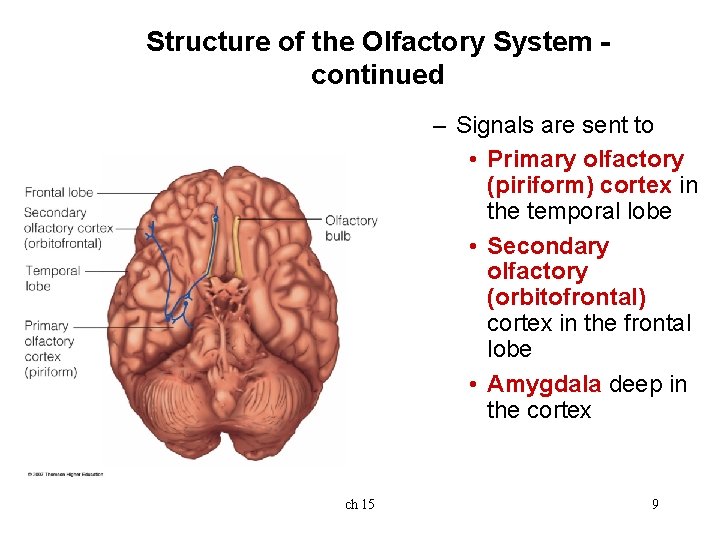
Structure of the Olfactory System continued – Signals are sent to • Primary olfactory (piriform) cortex in the temporal lobe • Secondary olfactory (orbitofrontal) cortex in the frontal lobe • Amygdala deep in the cortex ch 15 9
Functions of Taste • Sweetness is usually associated with substances that have nutritive value • Bitter is usually associated with substances that are potentially harmful • Salty taste indicates the presence of sodium • However, there is not a perfect connection between tastes and function of substances ch 15 10
Basic Taste Qualities • Five basic taste qualities: – Salty – Sour – Sweet – Bitter – Umami - described as meaty, brothy or savory and associated with MSG ch 15 11
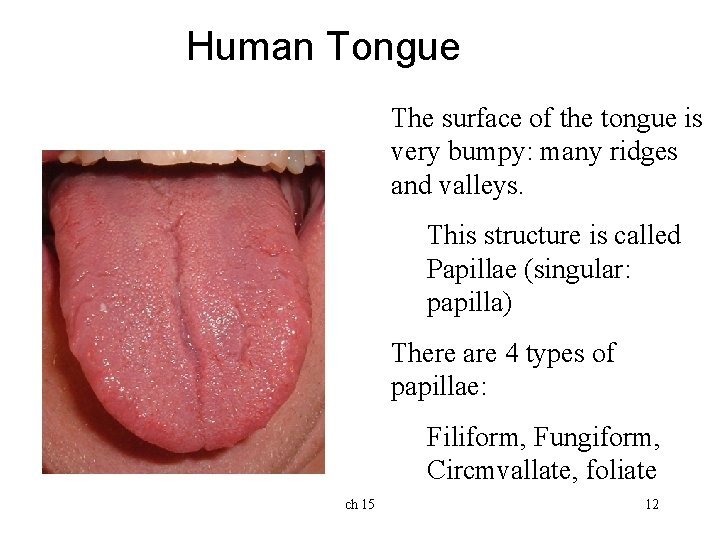
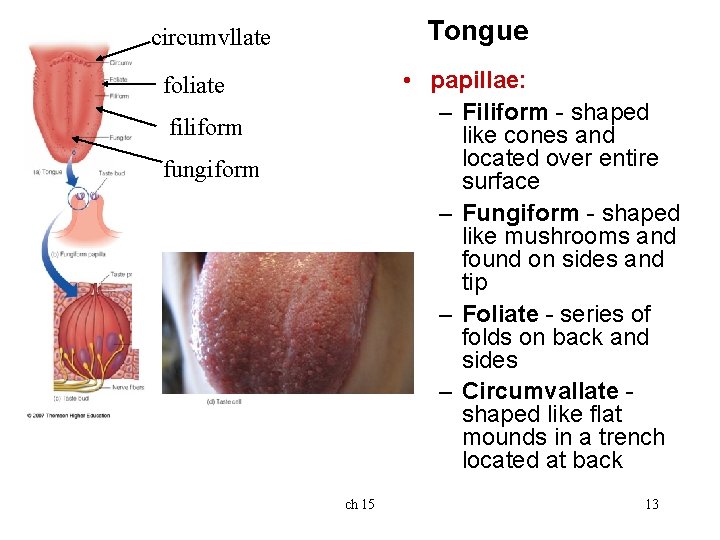
Human Tongue The surface of the tongue is very bumpy: many ridges and valleys. This structure is called Papillae (singular: papilla) There are 4 types of papillae: Filiform, Fungiform, Circmvallate, foliate ch 15 12
Tongue circumvllate • papillae: – Filiform - shaped like cones and located over entire surface – Fungiform - shaped like mushrooms and found on sides and tip – Foliate - series of folds on back and sides – Circumvallate shaped like flat mounds in a trench located at back foliate filiform fungiform ch 15 13
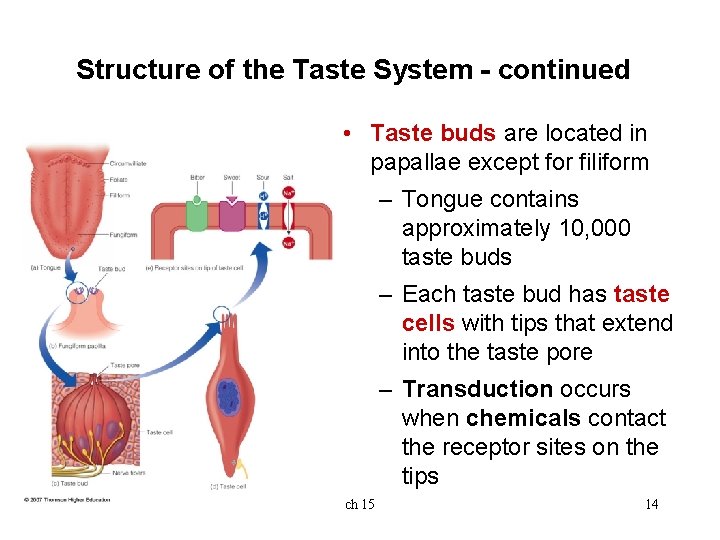
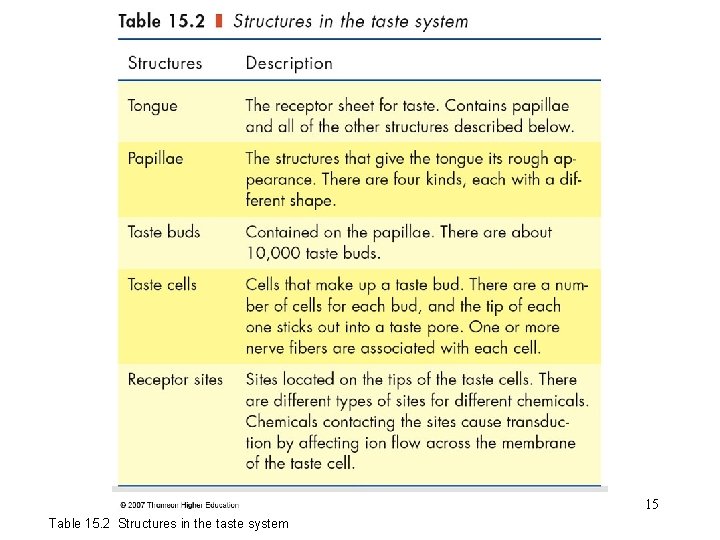
Structure of the Taste System - continued • Taste buds are located in papallae except for filiform – Tongue contains approximately 10, 000 taste buds – Each taste bud has taste cells with tips that extend into the taste pore – Transduction occurs when chemicals contact the receptor sites on the tips ch 15 14
ch 15 Table 15. 2 Structures in the taste system 15
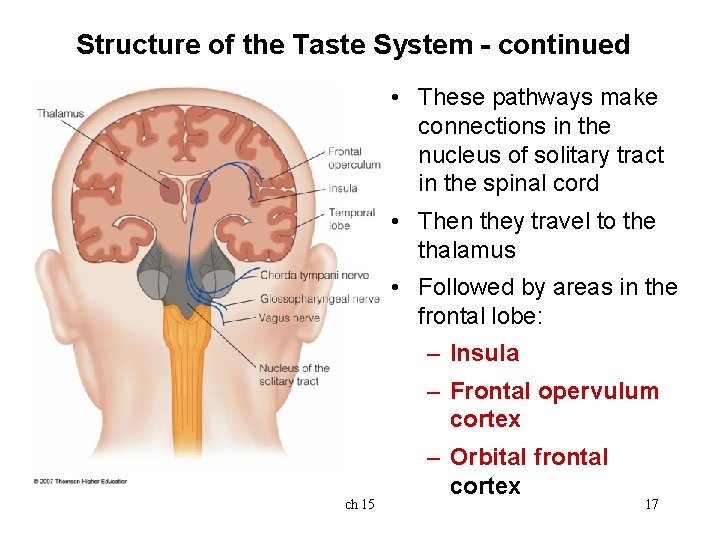
Structure of the Taste System - continued • Signals from taste cells travel along a set of pathways: – Chorda tympani nerve from front and sides of tongue – Glossopharyngeal nerve from back of tongue – Vagus nerve from mouth and throat – Superficial petronasal nerve from soft palate ch 15 16
Structure of the Taste System - continued • These pathways make connections in the nucleus of solitary tract in the spinal cord • Then they travel to the thalamus • Followed by areas in the frontal lobe: – Insula – Frontal opervulum cortex ch 15 – Orbital frontal cortex 17
Neural Coding for Taste - continued • Evidence exists for both specificity and distributed coding • Some researchers suggest that the neural system for taste may function like the visual system for color • Currently there is no agreed upon explanation for the neural system for taste ch 15 18
The Perception of Flavor • Combination of smell, taste, and other sensations (such as burning of hot peppers) • Odor stimuli from food in the mouth reaches the olfactory mucosa through the retronasal route • The taste of most compounds is influenced by olfaction, but a few, such as MSG are not ch 15 19
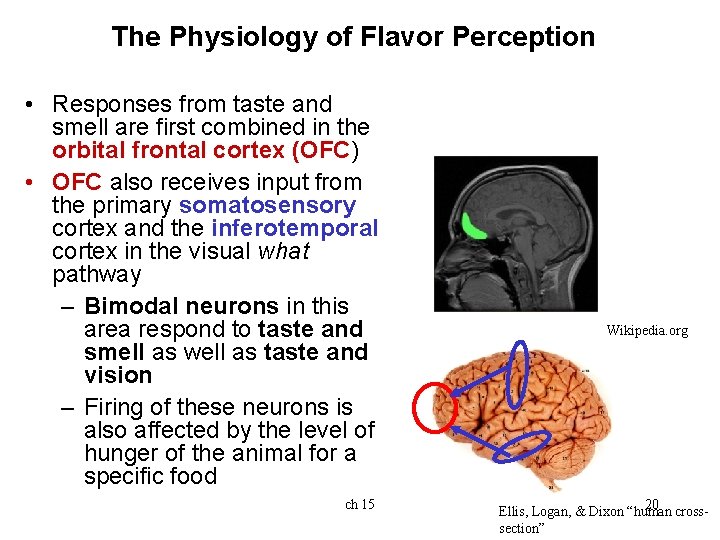
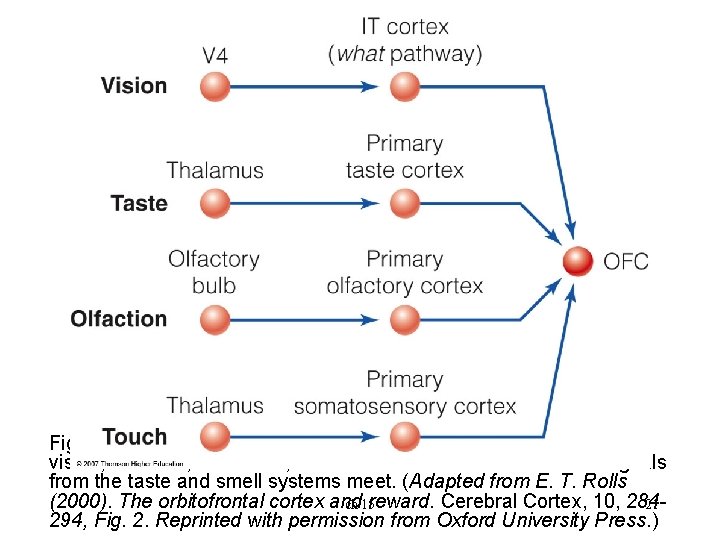
The Physiology of Flavor Perception • Responses from taste and smell are first combined in the orbital frontal cortex (OFC) • OFC also receives input from the primary somatosensory cortex and the inferotemporal cortex in the visual what pathway – Bimodal neurons in this area respond to taste and smell as well as taste and vision – Firing of these neurons is also affected by the level of hunger of the animal for a specific food ch 15 Wikipedia. org 20 Ellis, Logan, & Dixon “human crosssection”
Figure 15. 22 The orbital frontal cortex (OFC) receives inputs from vision, olfaction, and touch, as shown. It is the first area where signals from the taste and smell systems meet. (Adapted from E. T. Rolls (2000). The orbitofrontal cortex and reward. Cerebral Cortex, 10, 284 ch 15 21 294, Fig. 2. Reprinted with permission from Oxford University Press. )