Sensation Origins of Our Knowledge http en wikipedia
- Slides: 8
Sensation: Origins of Our Knowledge
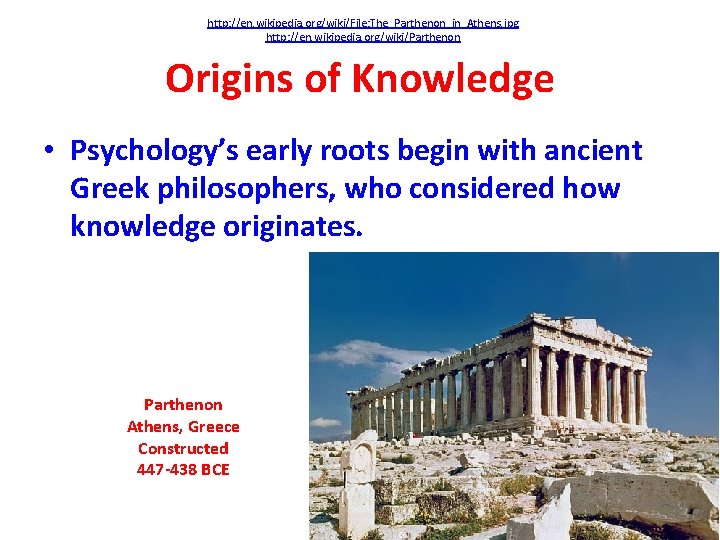
http: //en. wikipedia. org/wiki/File: The_Parthenon_in_Athens. jpg http: //en. wikipedia. org/wiki/Parthenon Origins of Knowledge • Psychology’s early roots begin with ancient Greek philosophers, who considered how knowledge originates. Parthenon Athens, Greece Constructed 447 -438 BCE
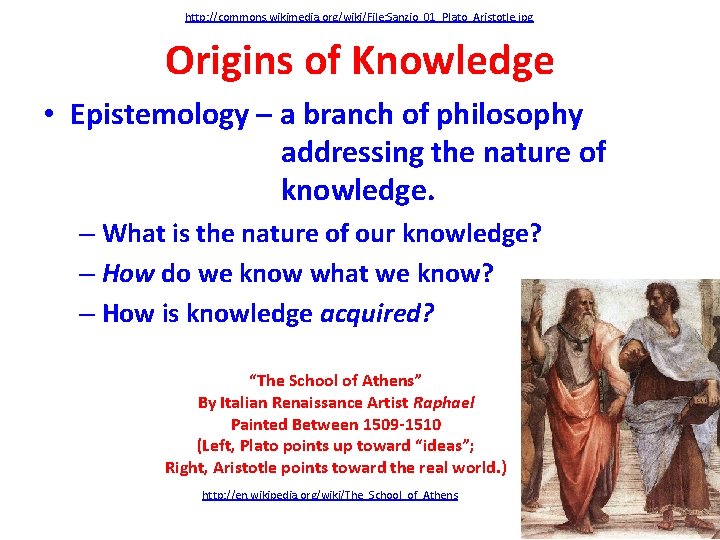
http: //commons. wikimedia. org/wiki/File: Sanzio_01_Plato_Aristotle. jpg Origins of Knowledge • Epistemology – a branch of philosophy addressing the nature of knowledge. – What is the nature of our knowledge? – How do we know what we know? – How is knowledge acquired? “The School of Athens” By Italian Renaissance Artist Raphael Painted Between 1509 -1510 (Left, Plato points up toward “ideas”; Right, Aristotle points toward the real world. ) http: //en. wikipedia. org/wiki/The_School_of_Athens
Origins of Knowledge • Questions about the origin of knowledge led to the study of Sensation. • Sensation – The psychological experience that arises from stimulation of the senses (vision, hearing, touch, taste, smell) • Our study of sensation will build on our earlier discussions of the environment (big history), evolution, and the nervous system.
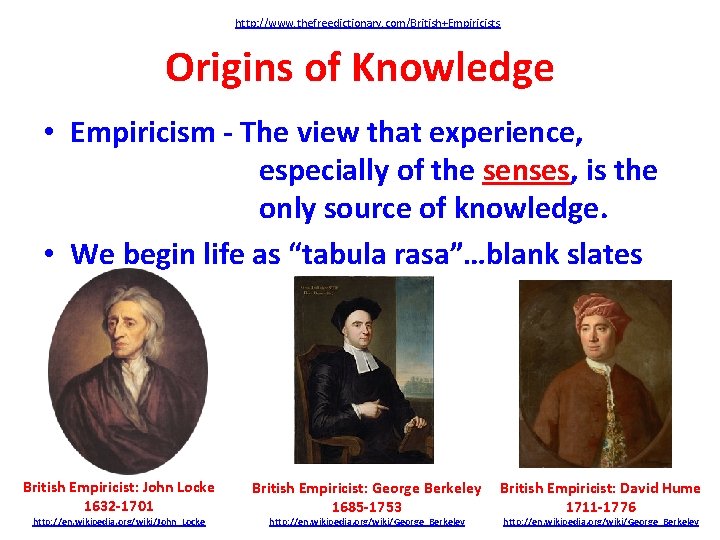
http: //www. thefreedictionary. com/British+Empiricists Origins of Knowledge • Empiricism - The view that experience, especially of the senses, is the only source of knowledge. • We begin life as “tabula rasa”…blank slates British Empiricist: John Locke 1632 -1701 http: //en. wikipedia. org/wiki/John_Locke British Empiricist: George Berkeley 1685 -1753 http: //en. wikipedia. org/wiki/George_Berkeley British Empiricist: David Hume 1711 -1776 http: //en. wikipedia. org/wiki/George_Berkeley
Origins of Knowledge • Stimulus – any form of environmental energy. Could be visual, auditory, tactile, chemical (gas, liquid or solid) • Mantra: – The word “stimulus” is singular; – The word “stimuli” is plural! • Examples: – The stimulus is important. – The stimuli are important.
Origins of Knowledge • Distal Stimulus – Energy in the environment that stimulates the senses. • Proximal Stimulus – The nervous system’s response to energy from the environment. • Potential Pop Quiz Item – Generate three novel examples of distal stimuli, and their corresponding proximal stimuli.