
Sensation and Perception The Nature of Sensation Visual
- Slides: 51
Sensation and Perception The Nature of Sensation Visual Organization and Interpretation Hearing Other Senses
Activity – Day 1 Watch the Brain Games Video – Sensation and Perception 50 minutes
Bell Ringer Read the story about Helen Keller and how she was able to perceive the world, despite lacking certain senses.
Bell Ringer In a few seconds, something peculiar will start hap pening to the material youa rereading. Iti soft ennotre alized howcom plext heproces sof rea ding is.
Objectives Describe the field of study known as psychophysics. Define and discuss threshold, Weber’s law, and signal detection.
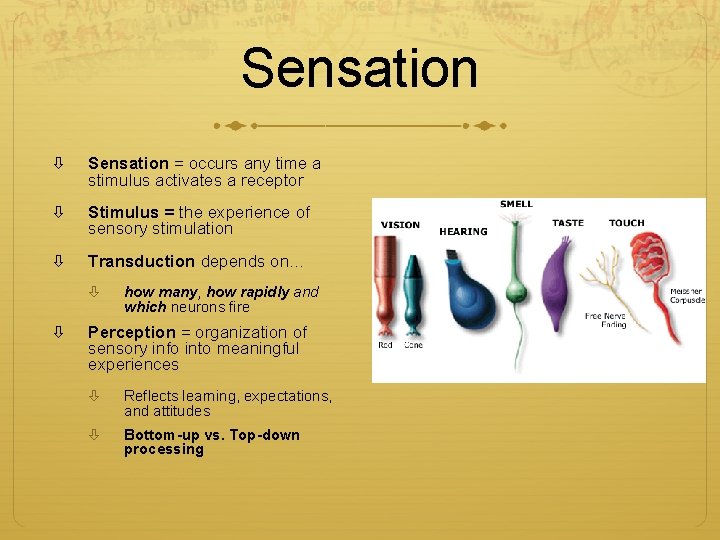
Sensation = occurs any time a stimulus activates a receptor Stimulus = the experience of sensory stimulation Transduction depends on… how many, how rapidly and which neurons fire Perception = organization of sensory info into meaningful experiences Reflects learning, expectations, and attitudes Bottom-up vs. Top-down processing
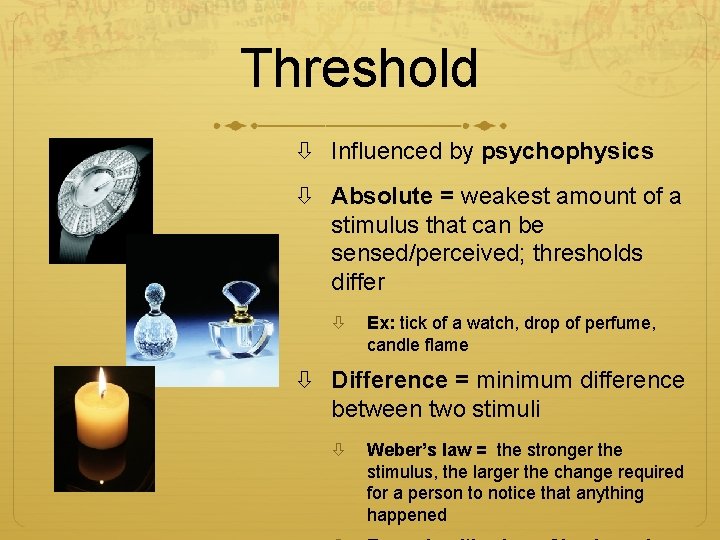
Threshold Influenced by psychophysics Absolute = weakest amount of a stimulus that can be sensed/perceived; thresholds differ Ex: tick of a watch, drop of perfume, candle flame Difference = minimum difference between two stimuli Weber’s law = the stronger the stimulus, the larger the change required for a person to notice that anything happened
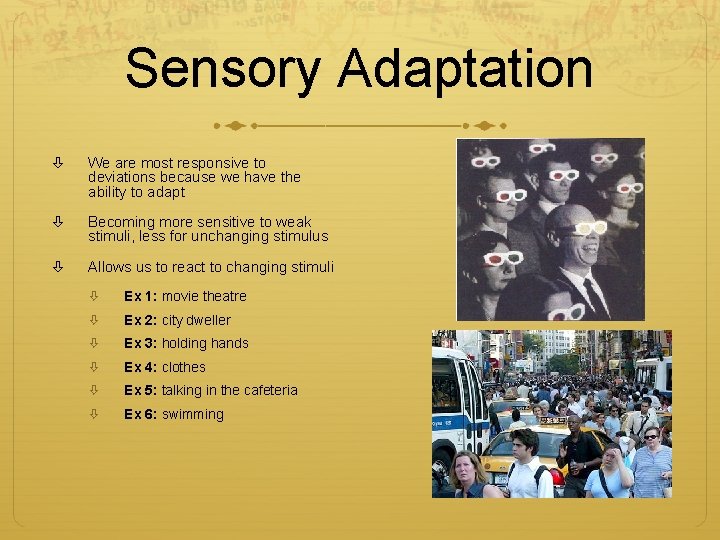
Sensory Adaptation We are most responsive to deviations because we have the ability to adapt Becoming more sensitive to weak stimuli, less for unchanging stimulus Allows us to react to changing stimuli Ex 1: movie theatre Ex 2: city dweller Ex 3: holding hands Ex 4: clothes Ex 5: talking in the cafeteria Ex 6: swimming
Signal Detection Theory Studying relations between motivation, expectations, sensitivity, and decision making in detecting presence or absence of a stimulus. Based on the stimulus being detected in the presence of competing stimuli Ex: conversations Preattentive process – extract information automatically/simultaneously when presented the stimuli Attentive process – procedure that considers only one part of the stimuli presented
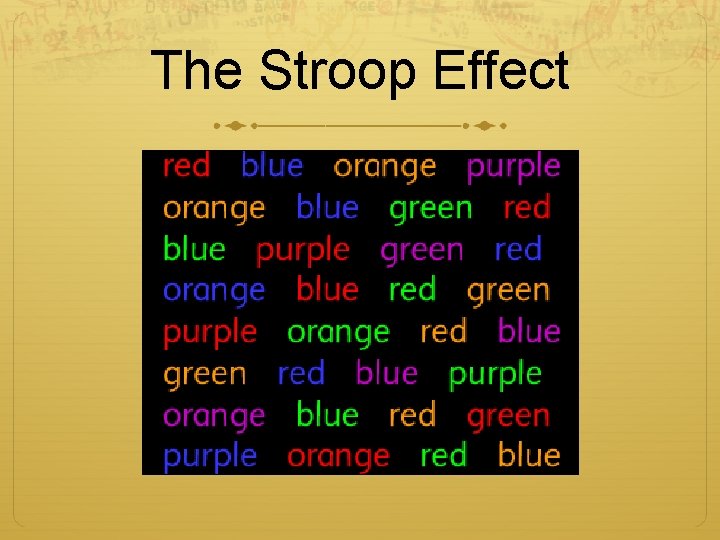
The Stroop Effect
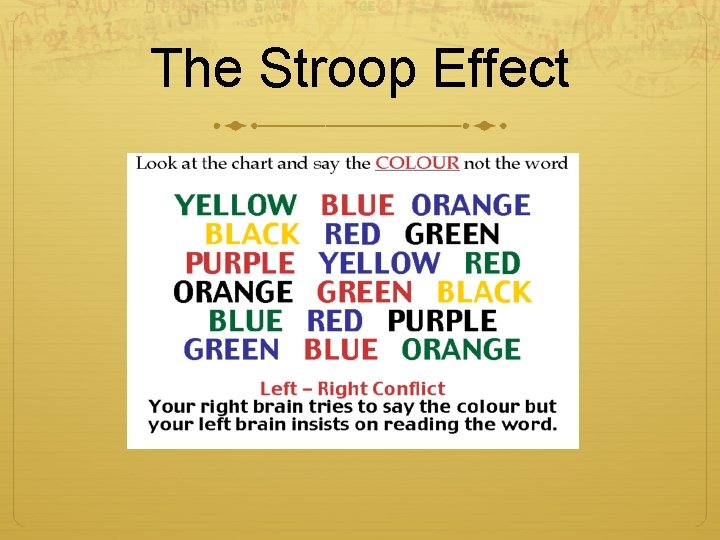
The Stroop Effect
Extra Sensory Perception Receiving information about the world through channels other than our normal senses Clairvoyance – perceiving objects without sensory input Telepathy – reading someone else’s mind Psychokinesis – moving objects through mental effort Precognition – ability to foretell events Many people are convinced it exist, scientists do not accept the findings
Sensation and Perception The Nature of Sensation Visual Organization and Interpretation Hearing Other Senses
Objective Describe the nature and function of sense organs.
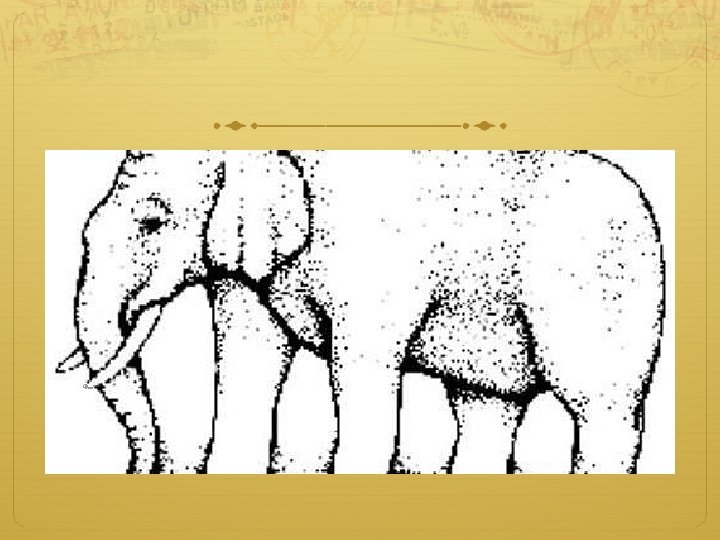
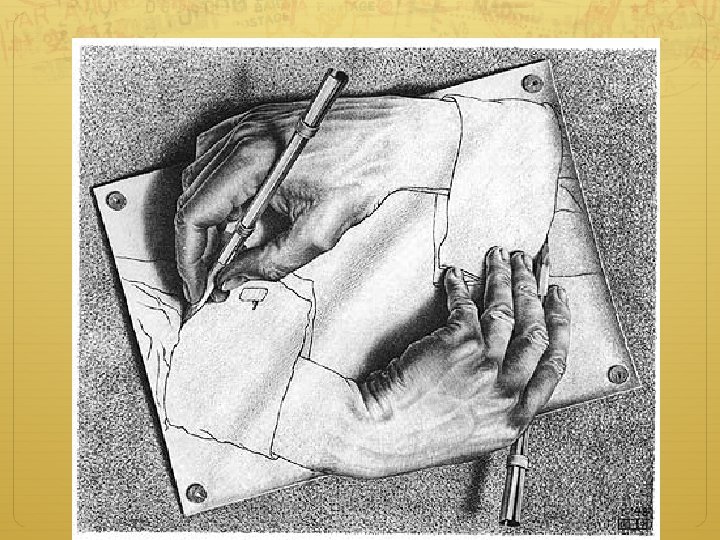
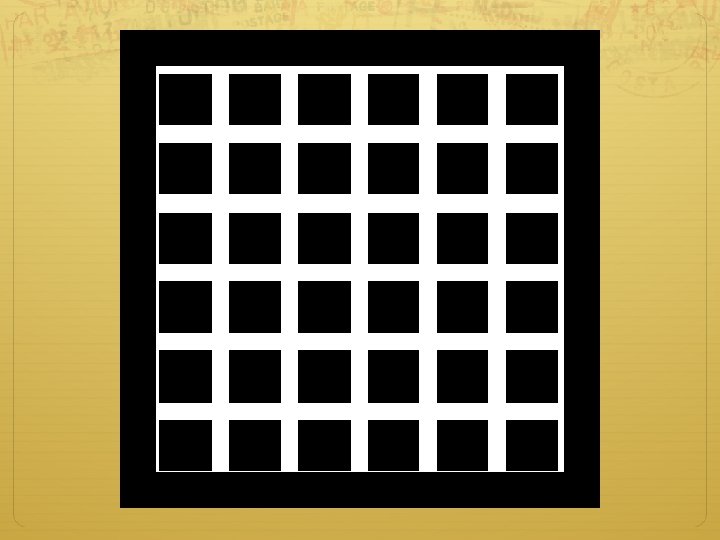
Bell Ringer Class Website – Eye Openers: Exploring optical illusions
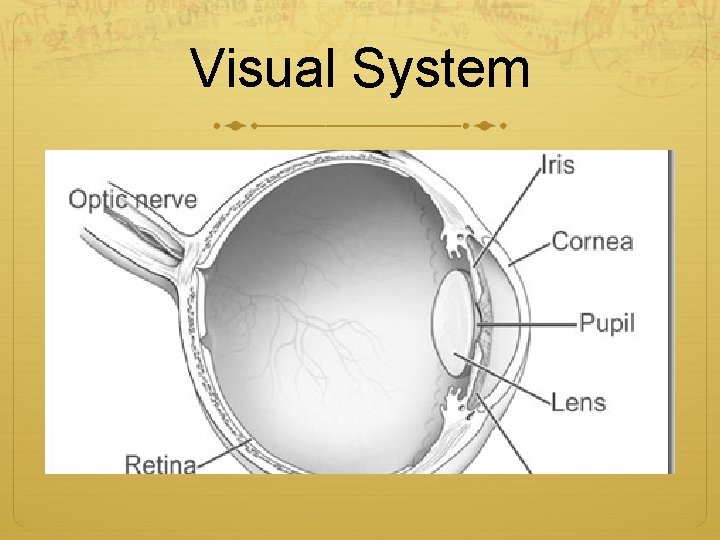
Visual System
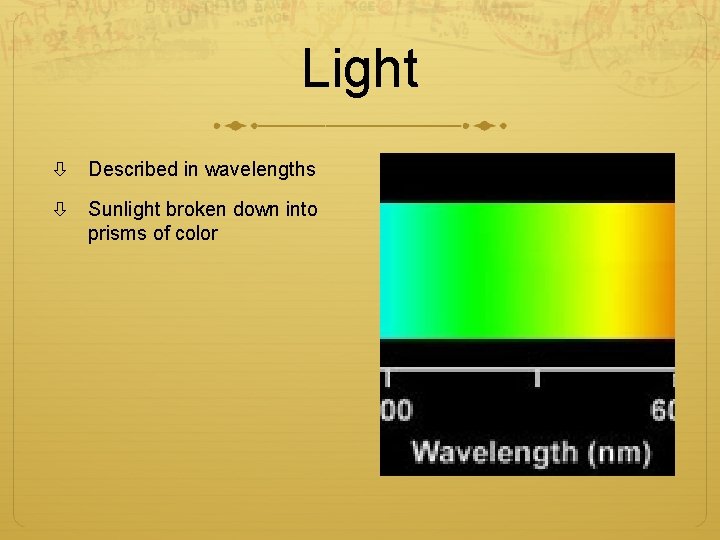
Light Described in wavelengths Sunlight broken down into prisms of color
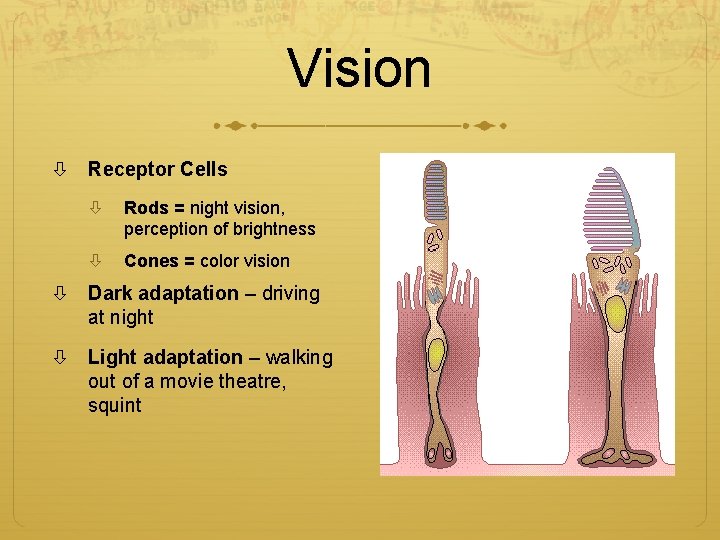
Vision Receptor Cells Rods = night vision, perception of brightness Cones = color vision Dark adaptation – driving at night Light adaptation – walking out of a movie theatre, squint
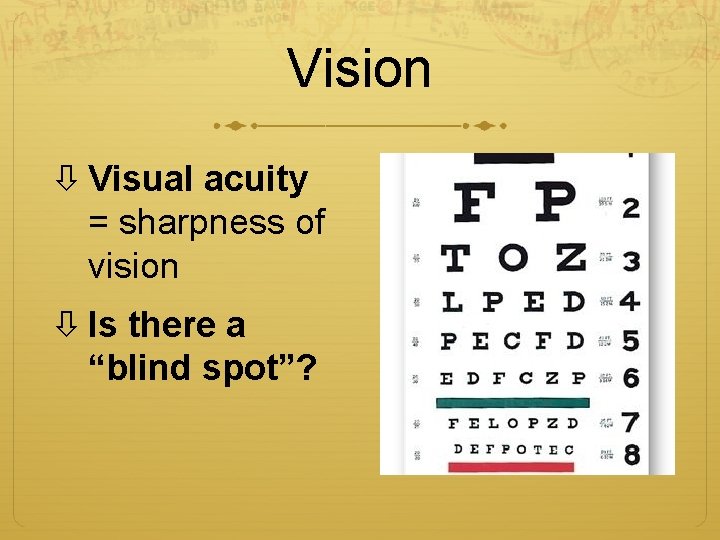
Vision Visual acuity = sharpness of vision Is there a “blind spot”?
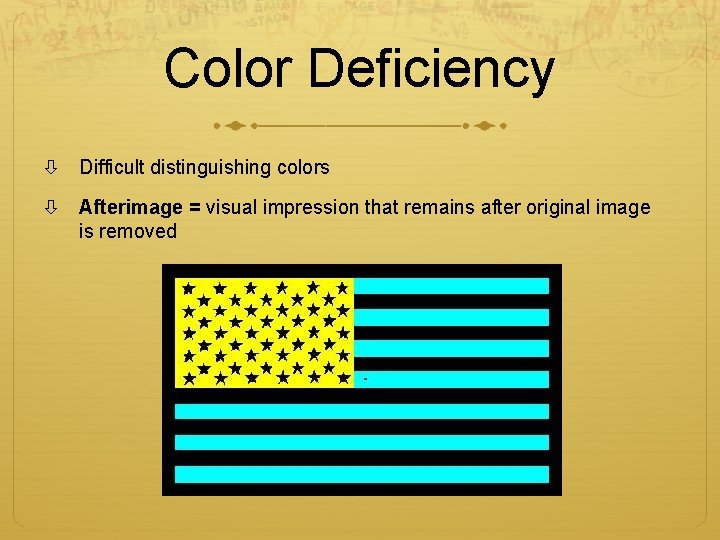
Color Deficiency Difficult distinguishing colors Afterimage = visual impression that remains after original image is removed
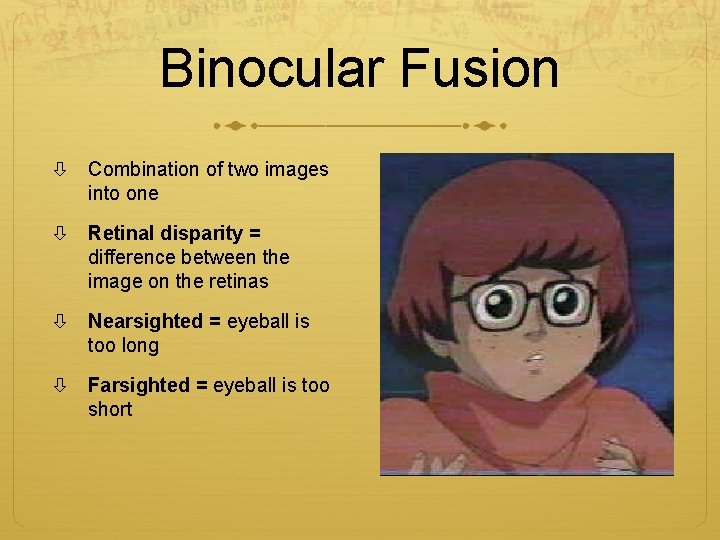
Binocular Fusion Combination of two images into one Retinal disparity = difference between the image on the retinas Nearsighted = eyeball is too long Farsighted = eyeball is too short
Sensation and Perception The Nature of Sensation Visual Organization and Interpretation Hearing Other Senses
Bell Ringer When a tree falls in the forest and no one is around to hear it, does it make a sound?
Objectives Outline the principles involved in perception. Describe how we learn to perceive and what illusions are.
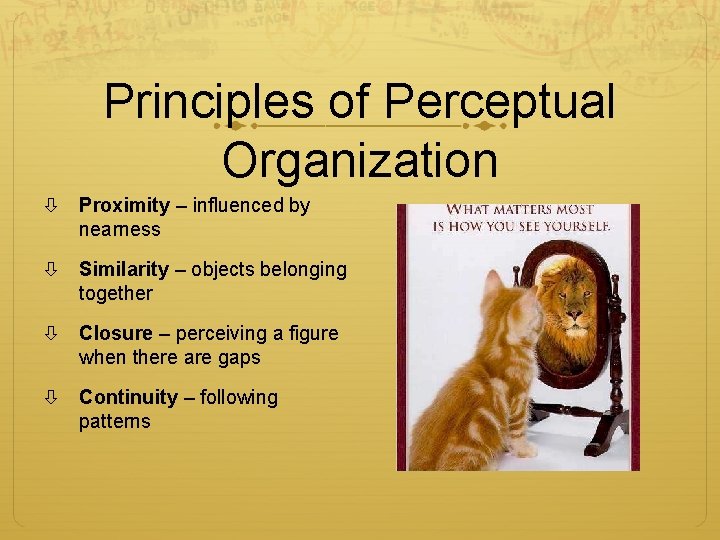
Principles of Perceptual Organization Proximity – influenced by nearness Similarity – objects belonging together Closure – perceiving a figure when there are gaps Continuity – following patterns
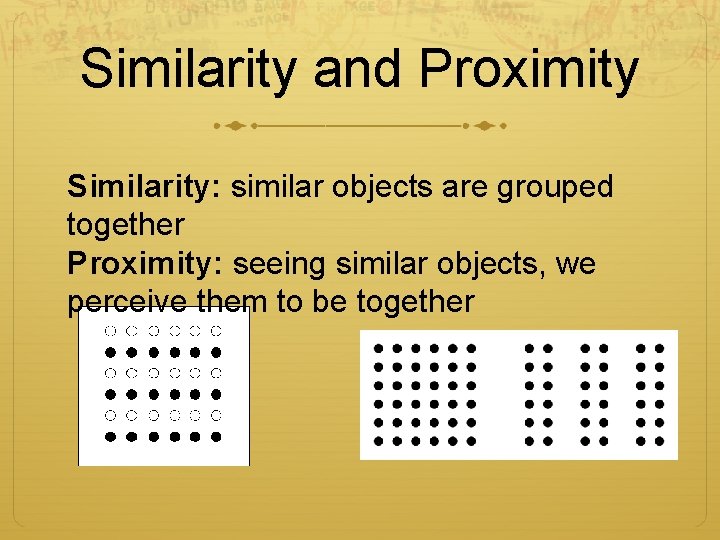
Similarity and Proximity Similarity: similar objects are grouped together Proximity: seeing similar objects, we perceive them to be together
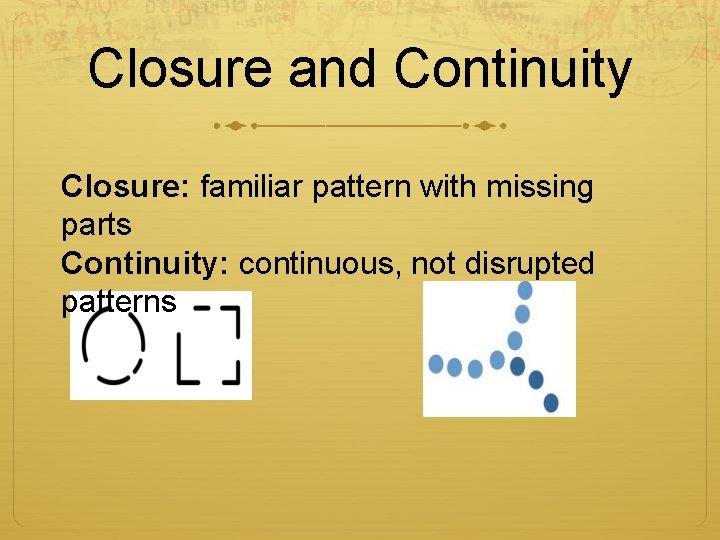
Closure and Continuity Closure: familiar pattern with missing parts Continuity: continuous, not disrupted patterns
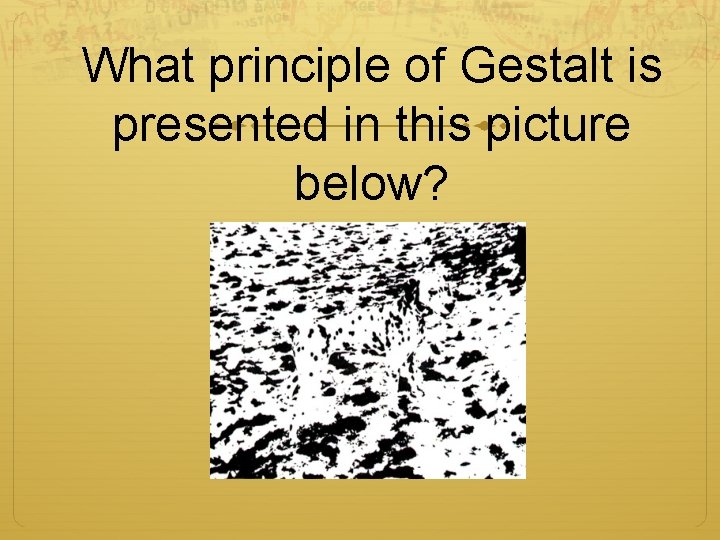
What principle of Gestalt is presented in this picture below?
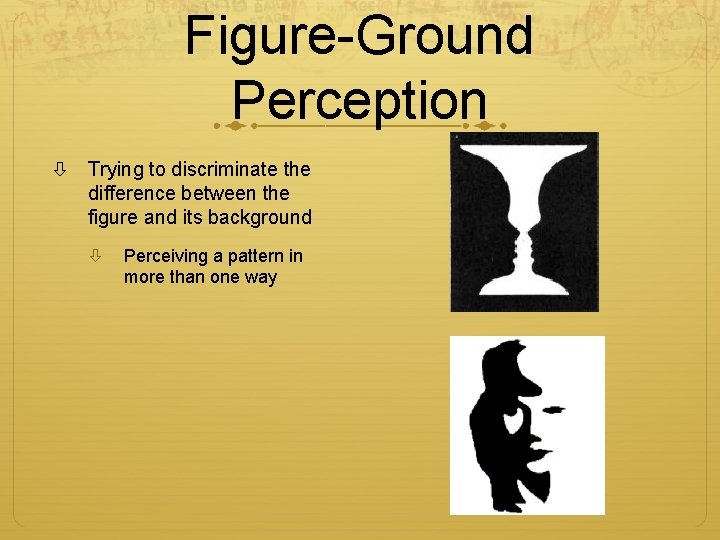
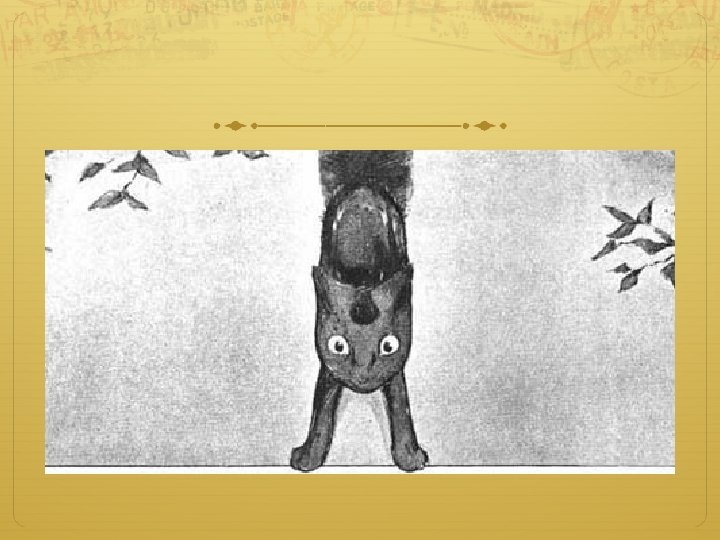
Figure-Ground Perception Trying to discriminate the difference between the figure and its background Perceiving a pattern in more than one way
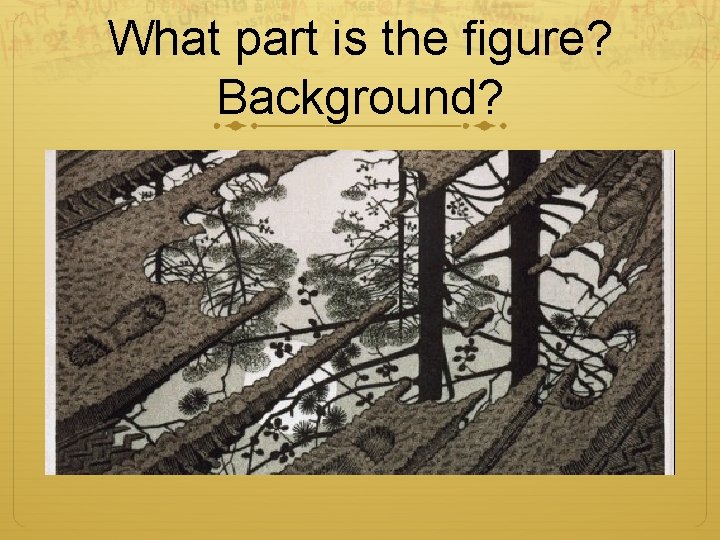
What part is the figure? Background?
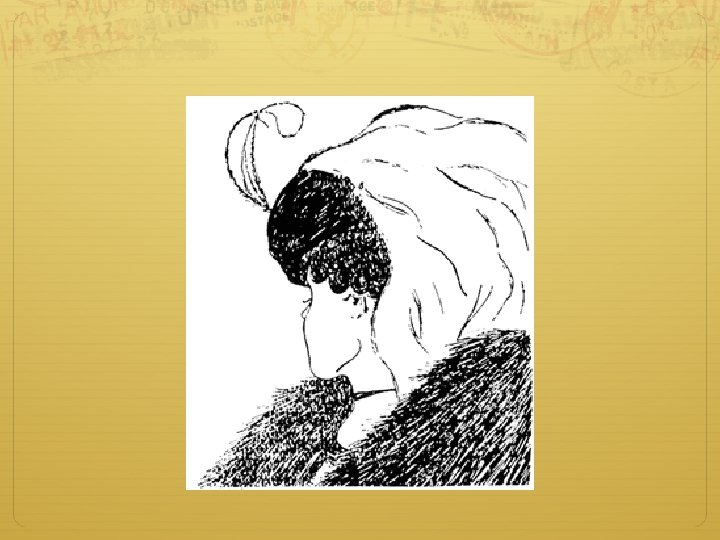
Perceptual Inference Filling in the gaps in what our senses tell us Need for only a few cues that inform us, examples… Sound of a bark Sitting down on a chair Road climbs up a steep hill Often depends on experience, occurs automatically and unconsciously Learning to perceive = influenced by needs, beliefs and expectations Previous experiences influence what we see Ex: elderly lady - honest
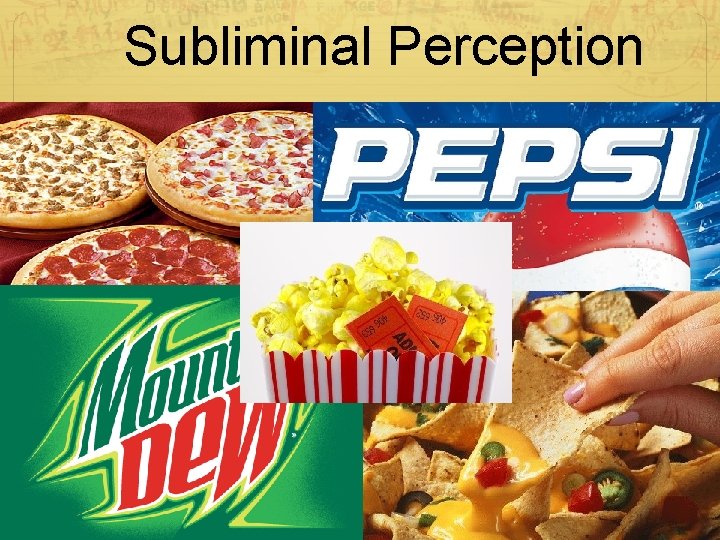
Subliminal Perception
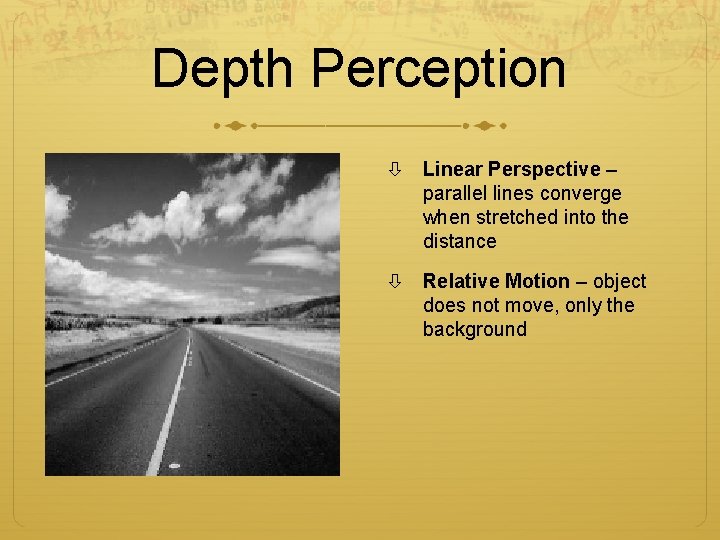
Depth Perception Linear Perspective – parallel lines converge when stretched into the distance Relative Motion – object does not move, only the background
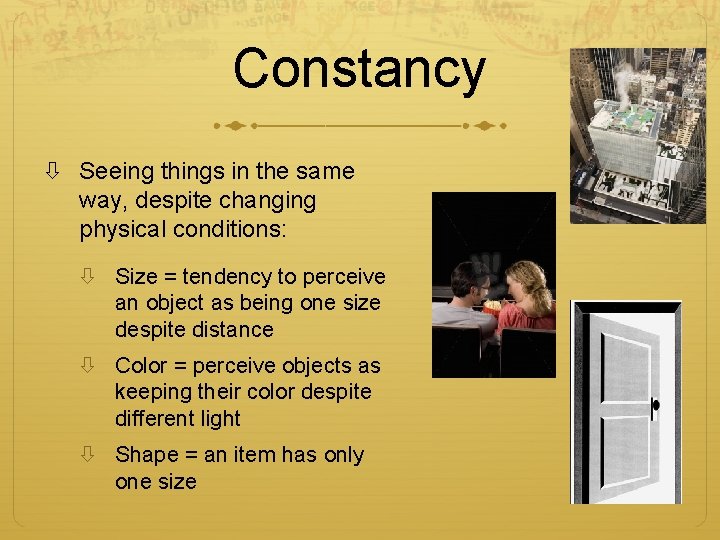
Constancy Seeing things in the same way, despite changing physical conditions: Size = tendency to perceive an object as being one size despite distance Color = perceive objects as keeping their color despite different light Shape = an item has only one size
Sensation and Perception The Nature of Sensation Visual Organization and Interpretation Hearing Other Senses
Bell Ringer You. Tube: First time hearing Mosquito Ringtone The Sensation Box
Objective Identify the skin and body senses and explain how they work.
The Pathway of Sound Hearing caused by vibrations of the air Loudness is measured in decibels Vocal cords – higher pitch for women = short vocal cords
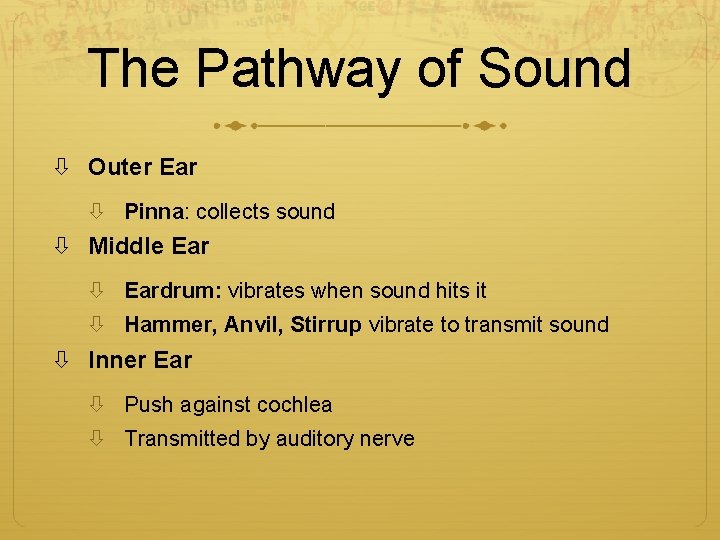
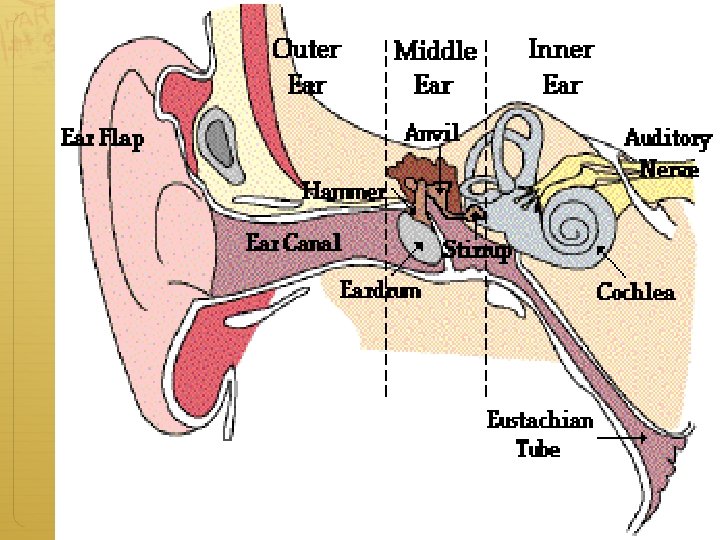
The Pathway of Sound Outer Ear Pinna: collects sound Middle Eardrum: vibrates when sound hits it Hammer, Anvil, Stirrup vibrate to transmit sound Inner Ear Push against cochlea Transmitted by auditory nerve
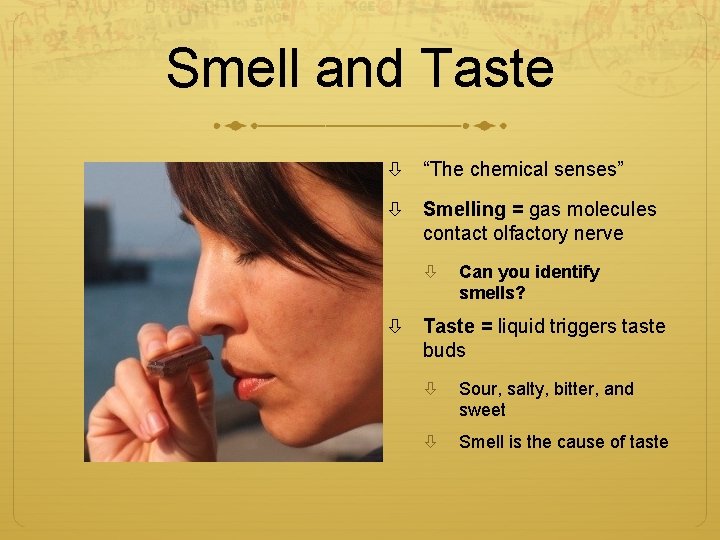
Smell and Taste “The chemical senses” Smelling = gas molecules contact olfactory nerve Can you identify smells? Taste = liquid triggers taste buds Sour, salty, bitter, and sweet Smell is the cause of taste
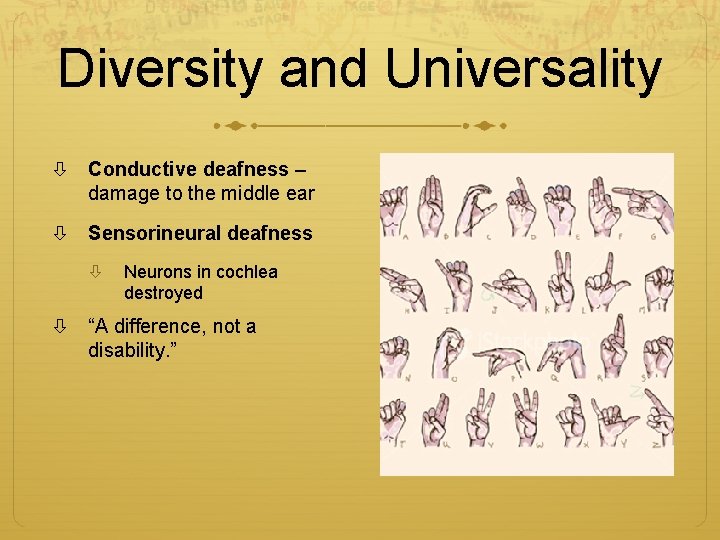
Diversity and Universality Conductive deafness – damage to the middle ear Sensorineural deafness Neurons in cochlea destroyed “A difference, not a disability. ”
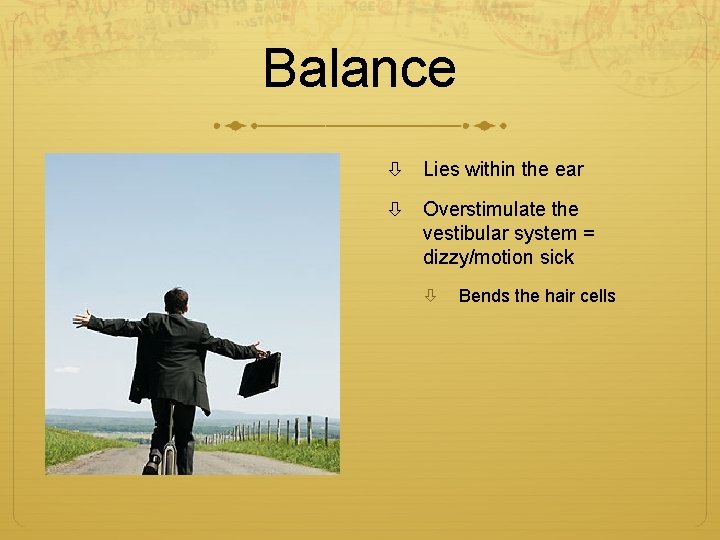
Balance Lies within the ear Overstimulate the vestibular system = dizzy/motion sick Bends the hair cells
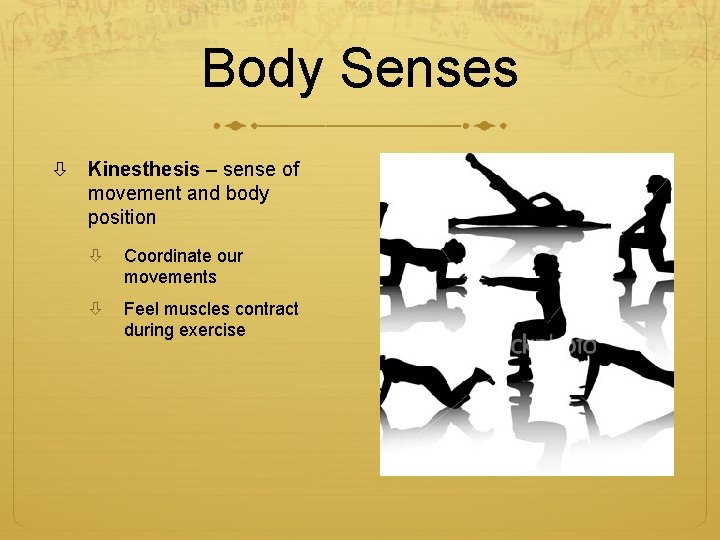
Body Senses Kinesthesis – sense of movement and body position Coordinate our movements Feel muscles contract during exercise
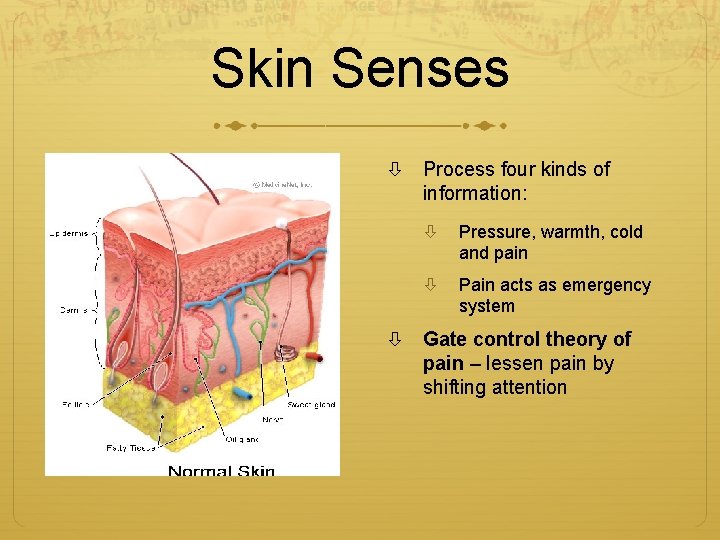
Skin Senses Process four kinds of information: Pressure, warmth, cold and pain Pain acts as emergency system Gate control theory of pain – lessen pain by shifting attention