
Sensation and Perception Sensation The detection of physical


- Slides: 50
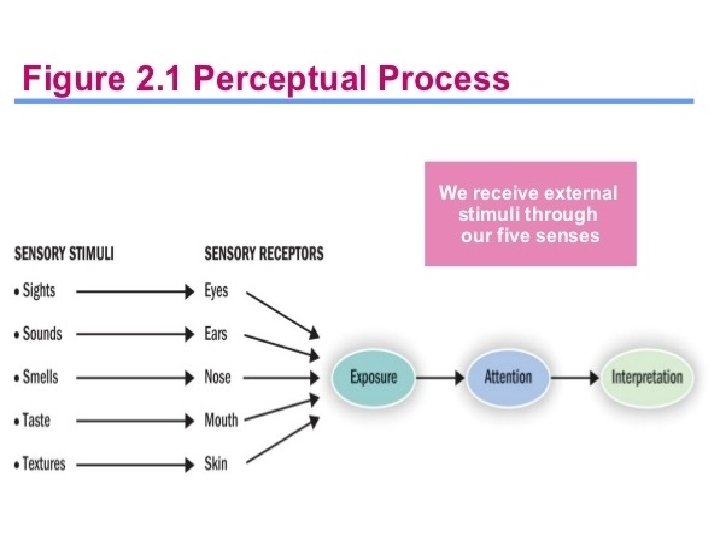
Sensation and Perception Sensation – The detection of physical energy emitted or reflected by physical objects. – It occurs when energy in the external environment or the body stimulates receptors in the sense organs. Perception – The mental process by which the brain organizes and interprets sensory information.
Measuring Senses • Absolute threshold • Difference threshold • Signal-detection theory
Absolute Threshold • The smallest quantity of physical energy that can be reliably detected by an observer.
Difference Threshold • The smallest difference in stimulation that can be reliably detected by an observer when two stimuli are compared; • Also called Just Noticeable Difference (JND).
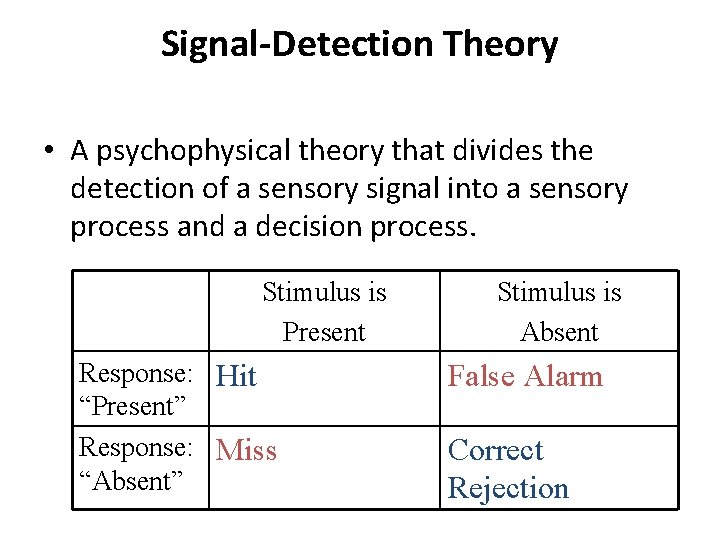
Signal-Detection Theory • A psychophysical theory that divides the detection of a sensory signal into a sensory process and a decision process. Stimulus is Present Response: Hit “Present” Response: Miss “Absent” Stimulus is Absent False Alarm Correct Rejection
Sensory Adaptation and Deprivation • Adaptation – The reduction or disappearance of sensory responsiveness when stimulation is unchanging or repetitious. – Prevents us from having to continuously respond to unimportant information. • Deprivation – The absence of normal levels of sensory stimulation.
Sensory Overload • Overstimulation of the senses. • occurs when one or more of the body's senses experiences over-stimulation from the environment. There are many environmental elements that affect an individual. • Examples of these elements are crowding, noise, mass media, technology. • Can use selective attention to reduce sensory overload. – Selective attention • The focusing of attention on selected aspects of the environment and the blocking out of others.
Perception is the organization, identification, and interpretation of sensory information in order to represent and understand the presented information, or the environment.
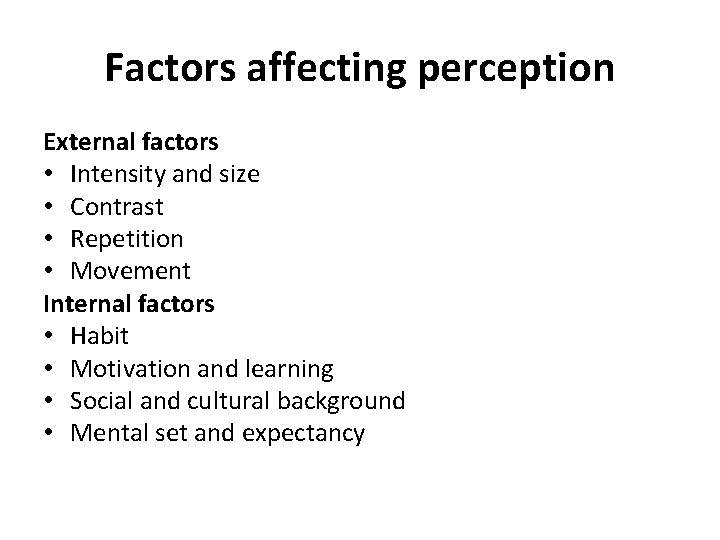
Factors affecting perception External factors • Intensity and size • Contrast • Repetition • Movement Internal factors • Habit • Motivation and learning • Social and cultural background • Mental set and expectancy
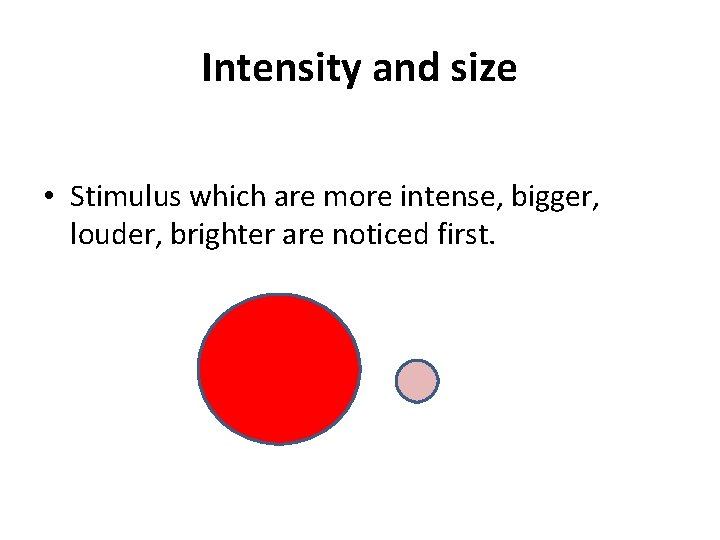
Intensity and size • Stimulus which are more intense, bigger, louder, brighter are noticed first.
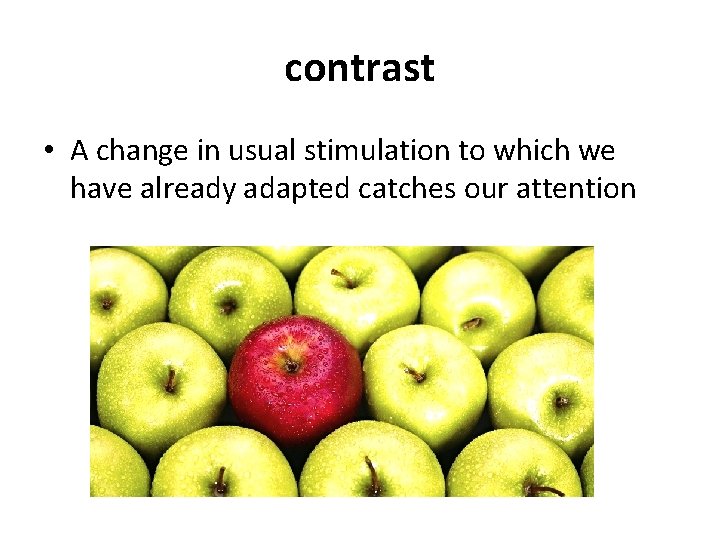
contrast • A change in usual stimulation to which we have already adapted catches our attention
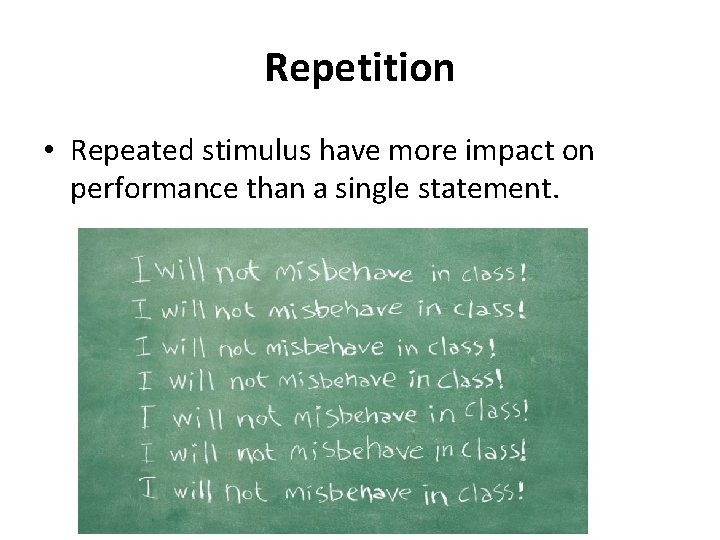
Repetition • Repeated stimulus have more impact on performance than a single statement.
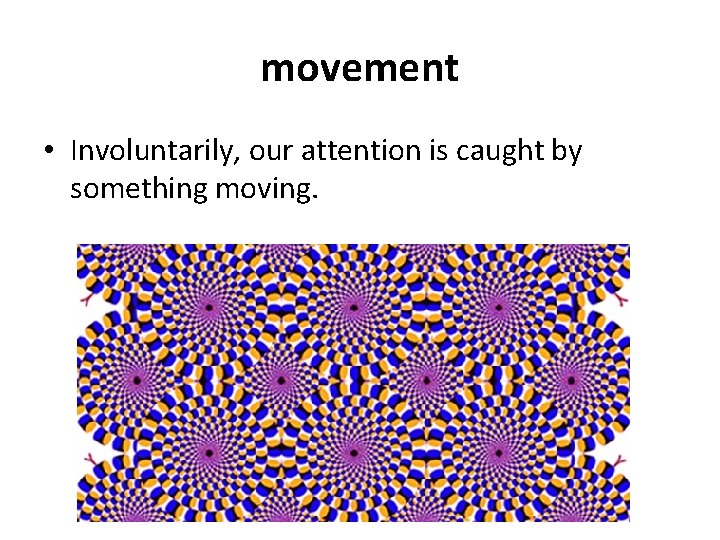
movement • Involuntarily, our attention is caught by something moving.
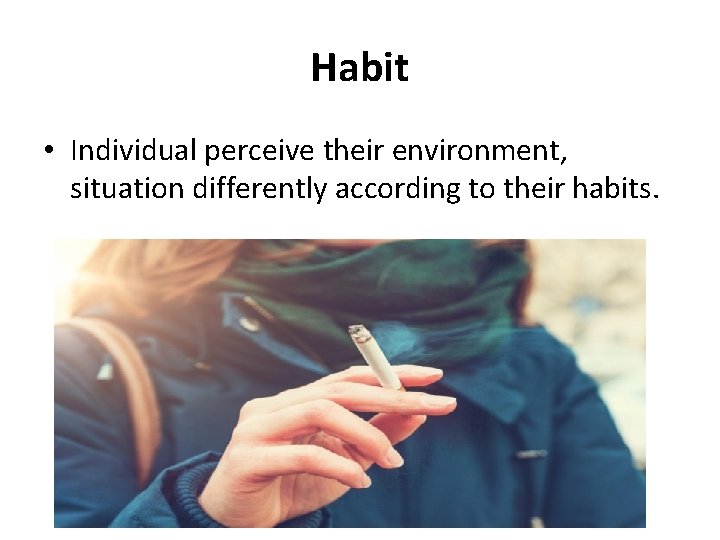
Habit • Individual perceive their environment, situation differently according to their habits.
Motivation and Learning • Motivation factors increase reactivity toward those stimuli which are relevant to the satisfaction of needs in view of past experiences. • The task which we have already learned, perceived simple and vice versa.
Social and cultural background • Perception depends on the social and cultural values , beliefs , norms of the society. • As two people may perceive same stimulus differently because both the person impacted by lifestyle, value, culture which may be different from each other.
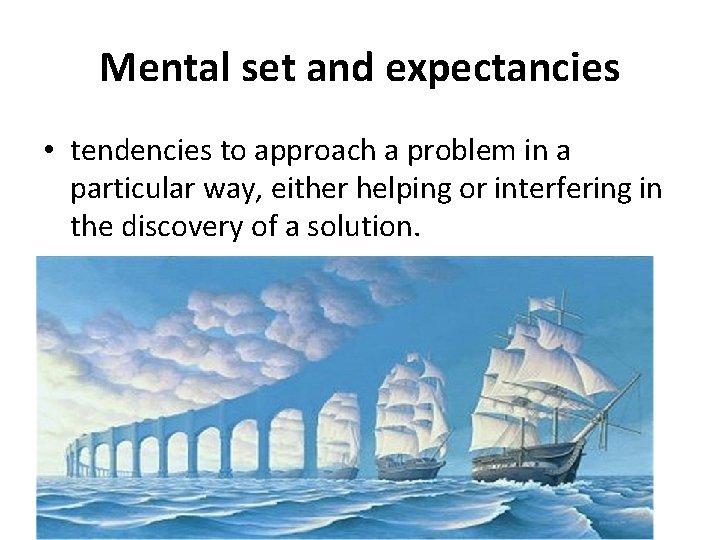
Mental set and expectancies • tendencies to approach a problem in a particular way, either helping or interfering in the discovery of a solution.
Principles of perception • Form perception: Tendency to perceive stimulus in very specific form or patterns. • Perceptual constancy: Tendency of individual to see or perceive stimulus approximately same regardless of changes in circumstances.
Form Perception • Gestalt principles describe the brain’s organization of sensory building blocks into meaningful units and patterns. • Figure in background in form perception • organization in form perception.
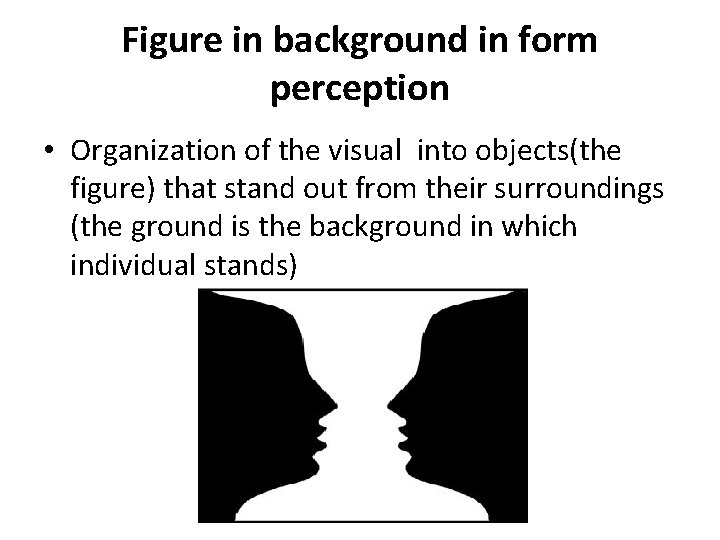
Figure in background in form perception • Organization of the visual into objects(the figure) that stand out from their surroundings (the ground is the background in which individual stands)
Organization form perception • According to Gestalt psychology, whole is different from the sums of its parts. • Smaller object group together to form larger ones.
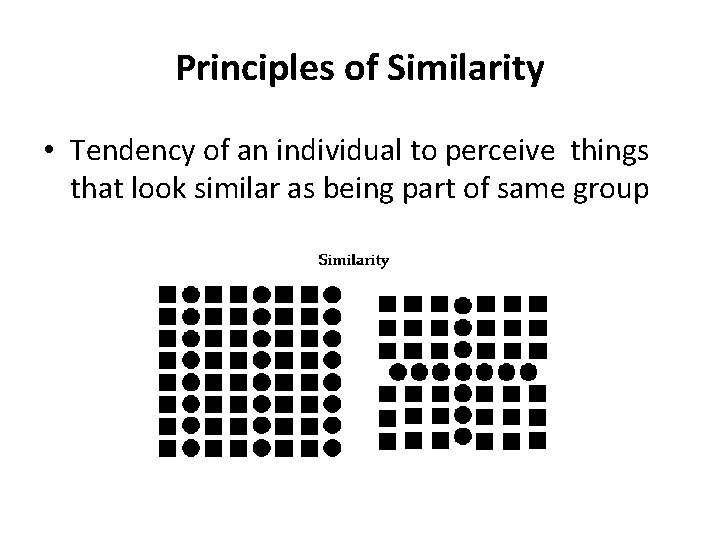
Principles of Similarity • Tendency of an individual to perceive things that look similar as being part of same group
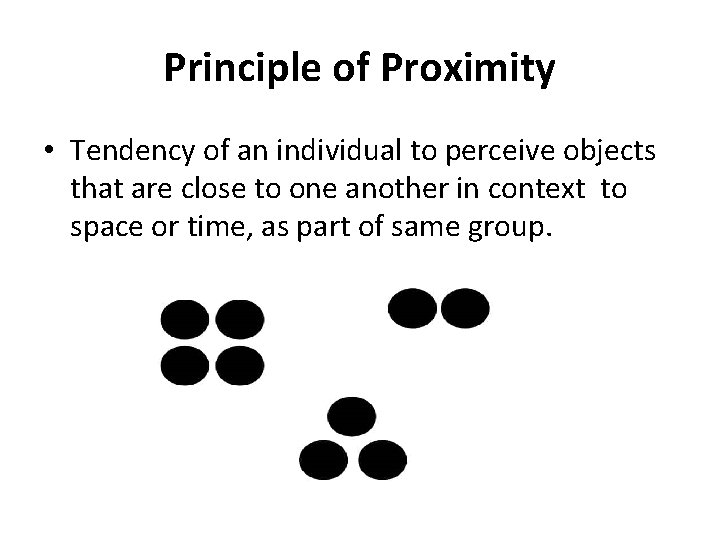
Principle of Proximity • Tendency of an individual to perceive objects that are close to one another in context to space or time, as part of same group.
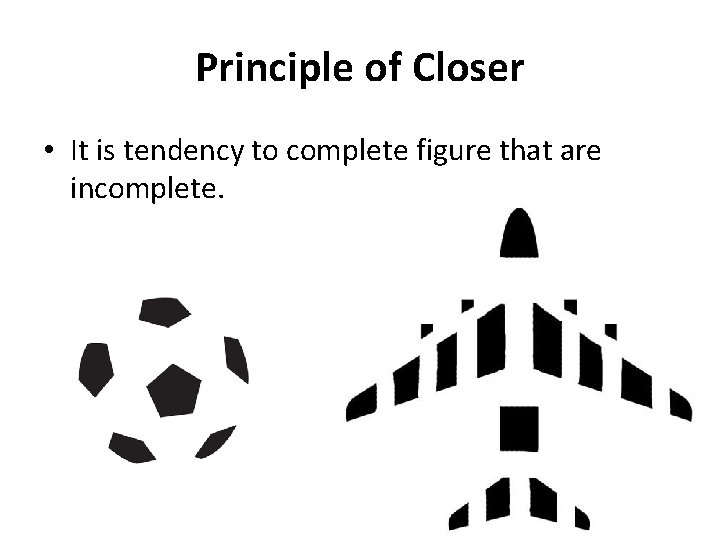
Principle of Closer • It is tendency to complete figure that are incomplete.
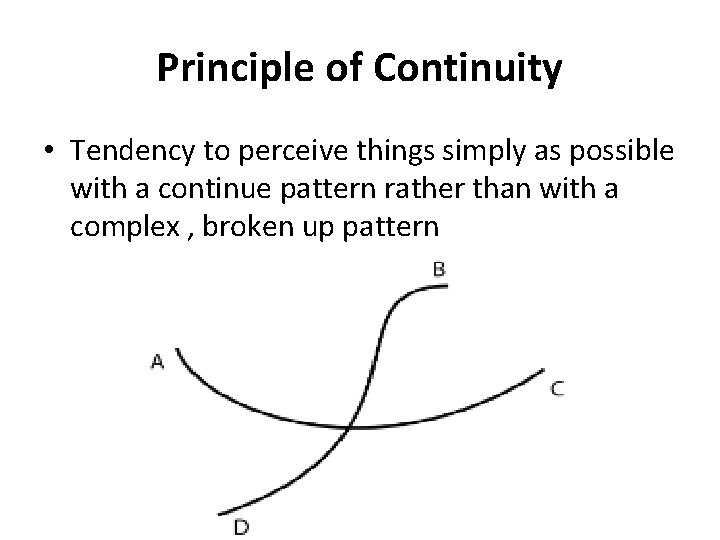
Principle of Continuity • Tendency to perceive things simply as possible with a continue pattern rather than with a complex , broken up pattern
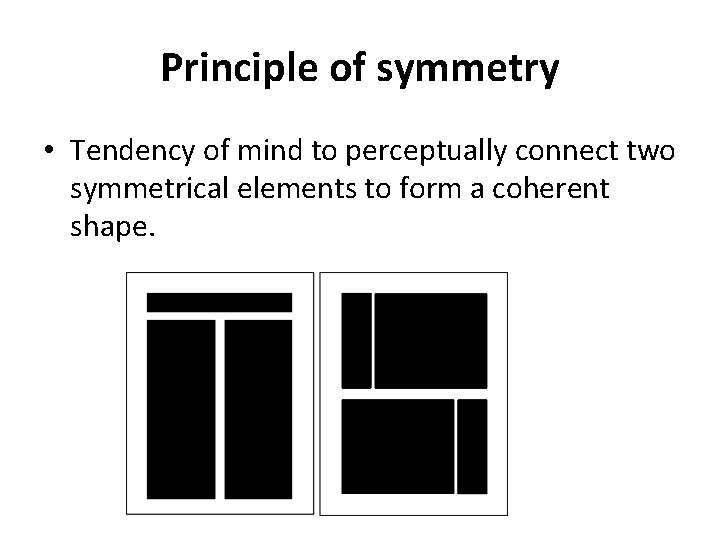
Principle of symmetry • Tendency of mind to perceptually connect two symmetrical elements to form a coherent shape.
Perceptual constancies • Size constancies • Shape constancies • Brightness constancies
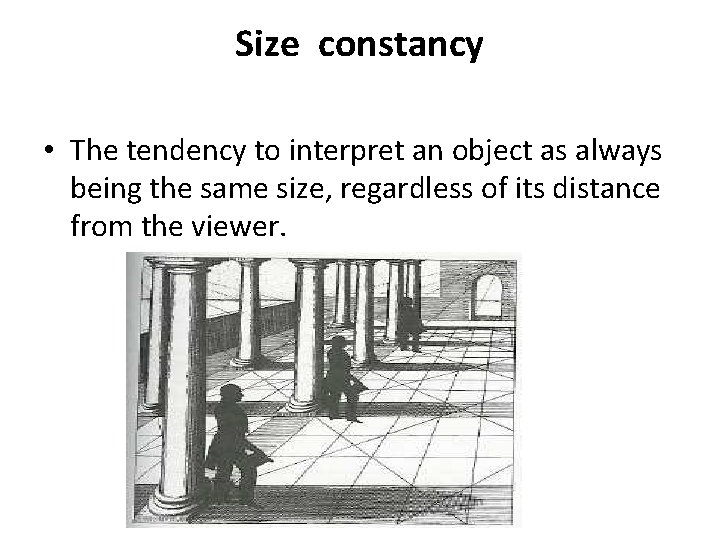
Size constancy • The tendency to interpret an object as always being the same size, regardless of its distance from the viewer.
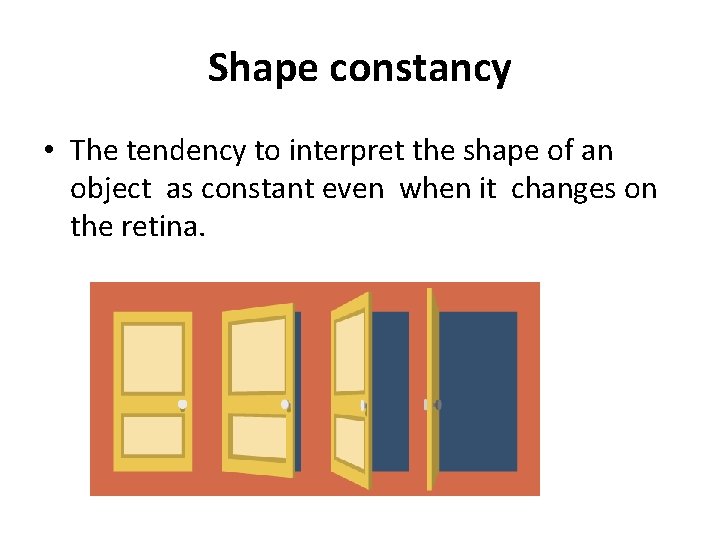
Shape constancy • The tendency to interpret the shape of an object as constant even when it changes on the retina.
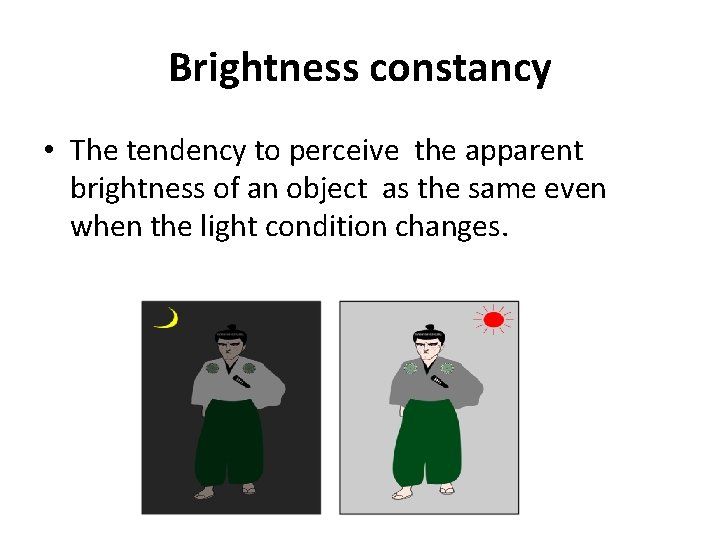
Brightness constancy • The tendency to perceive the apparent brightness of an object as the same even when the light condition changes.
Attention • The activity of concentrating mind on a particular matter is called attention. • Attention is an active part of consciousness. • Attention is not possible in the absence of consciousness, but attention and consciousness are not one. • The field of consciousness is vast and attention is one of its parts. • For example, I am reading at this time. Book, note, table, chair, etc. , all this can be under my consciousness, but my attention is on the words being read on the paper.
Definition • Attention is the cognitive process of selectively concentrating on one aspect of the environment while ignoring other things – John R. Anderson. • Attention is the concentration of consciousness upon one object rather than others – Dumvile.
Nature • Attention is focusing of consciousness on a particular object. • Attention is constantly shifting/changeable • Attention is selective • Attention is a mental process • Attention is a state of preparedness or alertness • Attention has narrow range/span 8
Characteristics • It is Selective mental activity: It is a filtering process through which we respond selectively to the incoming stimuli. We may ignore something or accept something else. • Shifting from one object to another. : Attracted by new things. It is not a fixed thing. Shifting eyes from one part of the body others. • Makes clear in our consciousness the object which we attend to: Arouses the individual to attend the particular objects • Creates a attentive attitude of the individual. • It creates motor adjustments such as muscles and sense organs to improve the response.
Factors Related to Attention • Attention depends upon several factors. These factors may be of two types: • A. External • B. Internal.
External • Intensity: Loud sounds, strong smells and deep colours are attractive in nature. If a sound is intense then it would attract our attention. The thunder is louder than a car sound. So, our attention is drawn on thunder. • Movement: Moving things draws our attention more than stationary one. A moving car attracts faster than a stationary car. • Contrast: Anything that is different from its surrounding is contrast. A black dust in the milk drawn attention quickly. A swan among the crows attracts suddenly. • Repetition: If a thing or person or event is repeated several times, then our attention drawn to it. When an advertisement is repeated in the walls drawn our attention. • Duration: attention is drawn to a thing that lasts longer. A salesperson draws attention by lengthening his voice. • Change: Change draws our attention easily. In the midst of continuous noise a slight moment of silence draws our attention. • Novelty: Newness attracts quickly than traditional one. A new teacher attracts the children very much in the school.
Internal Factors • Interest: we are interested in some things and disinterested in other things. Interesting things draws our attention soon. An engineer and a botanist going down the same path will attend entirely different things on the way. Engineer attention will be on the buildings and botanist attention will be on the trees. • Desire: A person’s desire becomes a cause of paying attention to a thing. For example, a person has to desire of buying a hammer. There are many things available in a market, but when he goes to a shop where hammers are available.
Internal Factors • Motives: Basic motives are important in drawing attention. Human motives like hungry, thirst, sex, safety, etc. , play a vital role in drawing attention. A thirst person attention always on where water is available. • Aim/Goal: Every man has some immediate aim and ultimate goal in their life. The immediate aim of a student is to pass in the examination while his ultimate goal may be to become a doctor. The student, whose goal is not to pass the examination, will not be concerned with textbooks or note, etc, but who has the aim to pass in the examination, will at once attend to them.
Internal Factors • Habit: Habit is also a vital determinant of attention. The kind of habit we found in our life, our attention is drawn to such things. if a person has habit to play cricket, then his attention is always drawn to it, and he will listen to cricket commentaries with attention. • Past Experience: It is also affect attention. If we know by our past experience that a particular person is sincere to us, we shall pay attention to whatever he advises us. If our experience is contrary, we shall not attend even to his most serous advice. • Apart from these above factors, aptitude, attitude, mental set, disposition and temperament etc. , are also an internal factors.
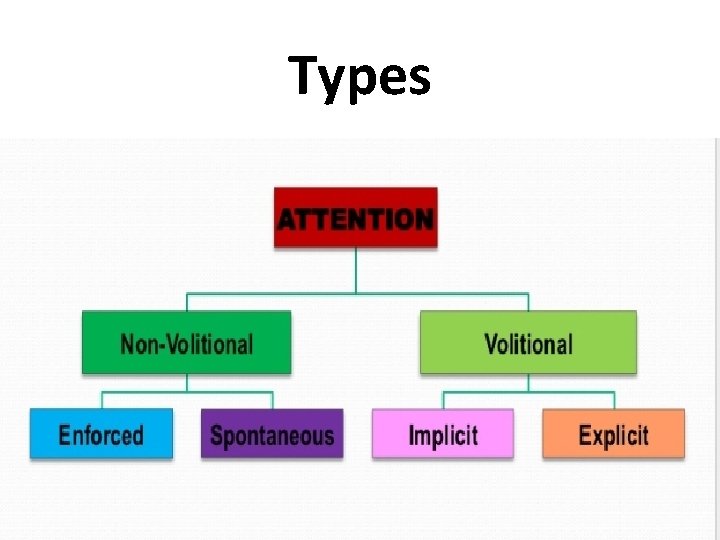
Types
Non-Volitional Non-volitional: attention aroused without will. • Enforced –(sustained by instincts): the attention which is grab through instinct(unlearned behavior cry, fear, curiosity) Some one is moving from here we would curious to know. e. g Some one is crying. • Spontaneous -(sustained by a sentiment): It is produced by sentiments or by my interest. It involve personal interest. • E. g mothers attention to child’s cry.
Volitional: Voluntary with will. There is always a goal behind it. • Implicit -(obtained by a single act of will) The act which is introduced by motive such as reward and punishment Teacher has assigned task and showed reward • Explicit -(obtained by repeated acts of will. It requires strong will power and strong motives. ) • E. g Child is repeating again and again A for apple
Meaning: Degree/Span of Attention • Attention may not be constricted to one object at a time; it may be more than one objects. • Span means the number of objects or events one individual can attend to at a given time • It is a threshold to perceive at a glance at a given duration of exposure: At a glance how many letters, digits one can see and reproduce • Amount of information which can be received from a complex stimulus in a single moment. • Eg. Remembering phone no. , learning spelling etc
Duration of Attention • It is defined as the length of one’s ability to pay attention toward perceived stimuli. • It is understood under two divisions. a. • Shifting /fluctuation of attention: in the course of time the centre our consciousness shifts either from one stimulus to another stimulus or from one part to another part in the same stimulus. We have central and marginal consciousness. • A wall clock in a room is central consciousness and other things in the room are marginal. b. • Sustained attention: done with the help of strong desire. Continuous concentration on one happening/object. Eg. A hunter waits for his shot, solving a Math’s problem.
Alteration in attention/Distraction • It is the changes in the forms, modes and quality of the attention paid to a stimulus. Kind of stimulus which distracts our attention from the objects which we are focusing • A distracter may be defined as any stimulus whose presence interferes with the process of attention. • Example: -Sound of music played on streets – disturbs – attention of the students in a classroom
Causes of Distraction Internal: headache, stomachache, emotional disturbance, anxiety, mis-happening etc. External: noise, music, improper lighting, uncomfortable seats, unfavorable temperature, inadequate ventilation, improper behavior of person dealing with us.
Inattention • The absence of attention to a particular stimuli. • Its outward signs – a. The student is careless about the object which of primary attention b. Movement of students’ eyes are random and not fixed c. Seems to be perplexed – does not understand receive clear impressions d. Seems to be restless and writhing/squirming movements of the body. • Causes of Inattention Lack of interest or need Fatigue Presence of distraction Lack of Motivation
Methods of Eliminating Distraction • Much emphasis and importance must be given to the task • Create favorable situation • Make lesson interesting • Training in concentration • Attention-distracting objects removed from the neighborhood • Encounter same type of distraction everyday – used to them and start ignoring it