
Sensation and Perception Module 19 Visual Organization and
- Slides: 21
Sensation and Perception Module 19 Visual Organization and Interpretation
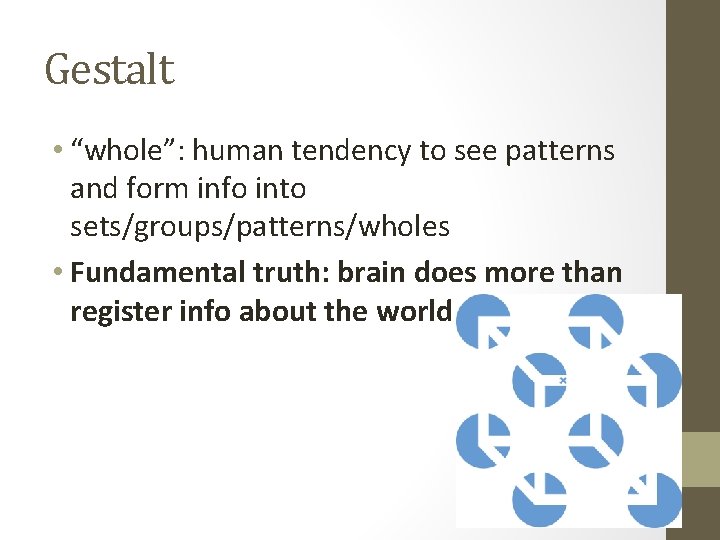
Gestalt • “whole”: human tendency to see patterns and form info into sets/groups/patterns/wholes • Fundamental truth: brain does more than register info about the world
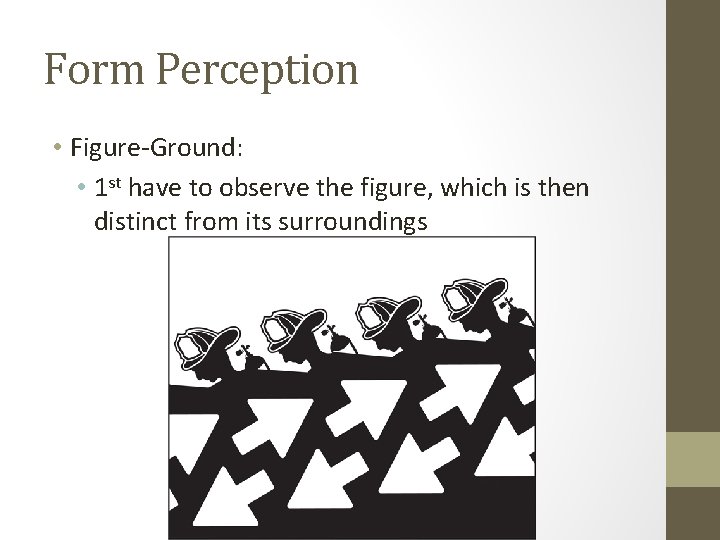
Form Perception • Figure-Ground: • 1 st have to observe the figure, which is then distinct from its surroundings
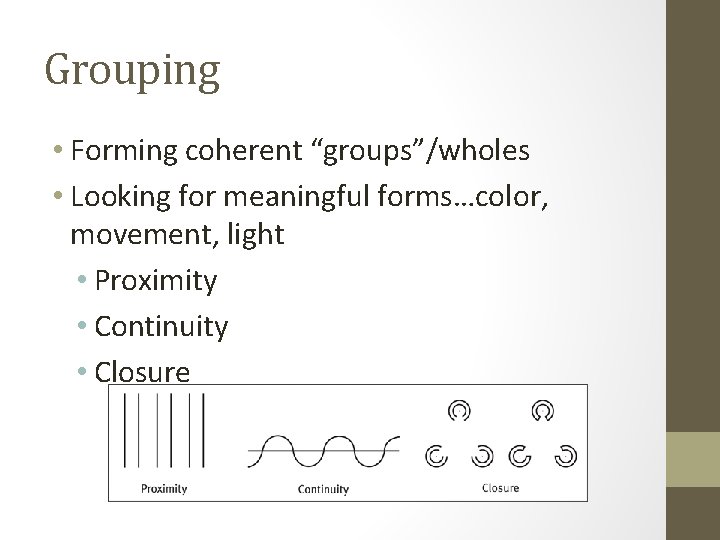
Grouping • Forming coherent “groups”/wholes • Looking for meaningful forms…color, movement, light • Proximity • Continuity • Closure
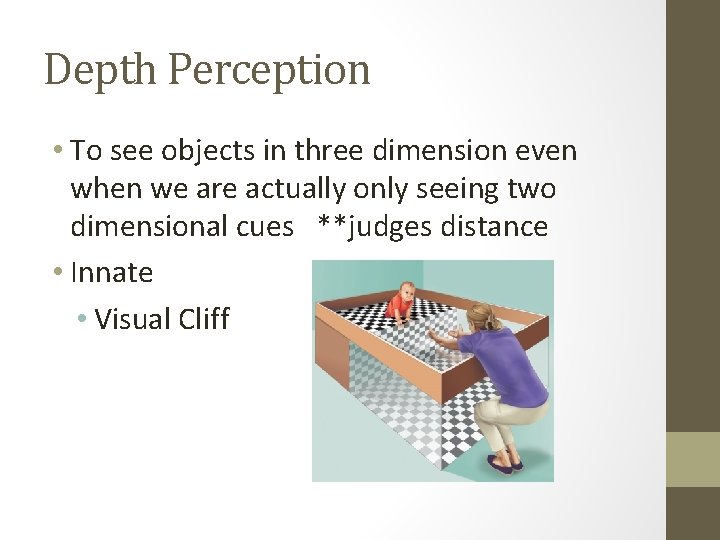
Depth Perception • To see objects in three dimension even when we are actually only seeing two dimensional cues **judges distance • Innate • Visual Cliff
Binocular Cues • Two eyes are better for judging distance • Retinal disparity: comparing images from retinas, brain computes the distance • The greater the difference between the two images, the closer the object is to the viewer. • The more alike the two images, the further away the object is perceived. • Is most effective when the item is quite close to the person Example: hold a pencil just in front of your nose and close one eye, then the other. The pencil should move showing the disparity. Now focus on something far away and do the same. It should not move very much showing less disparity perceived
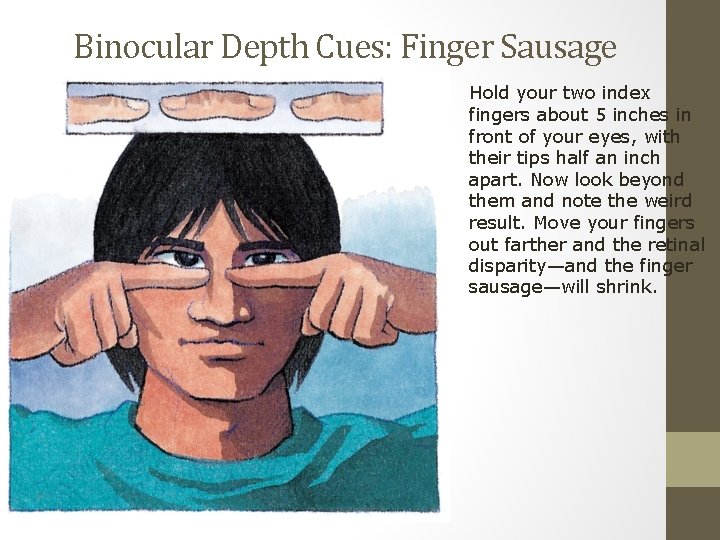
Binocular Depth Cues: Finger Sausage Hold your two index fingers about 5 inches in front of your eyes, with their tips half an inch apart. Now look beyond them and note the weird result. Move your fingers out farther and the retinal disparity—and the finger sausage—will shrink.
Monocular Cues • Depth cues that require the use of only one eye • Monocular depth cues include: • relative size • relative motion • interposition • relative height • texture gradient • relative clarity • linear perspective.
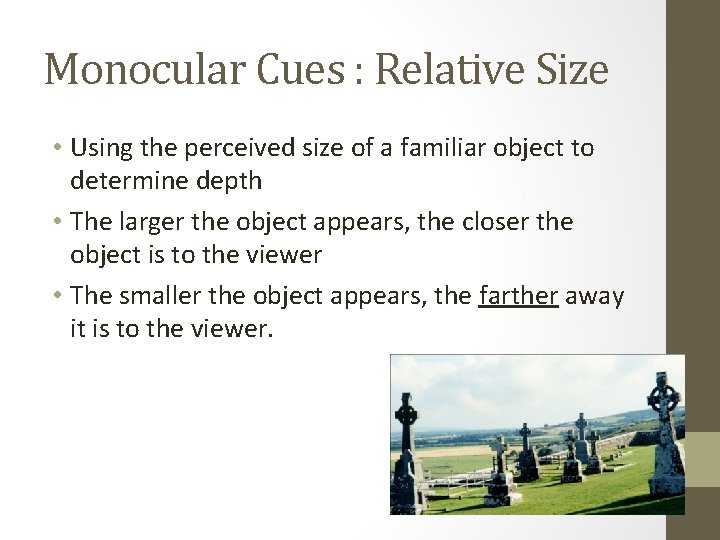
Monocular Cues : Relative Size • Using the perceived size of a familiar object to determine depth • The larger the object appears, the closer the object is to the viewer • The smaller the object appears, the farther away it is to the viewer.
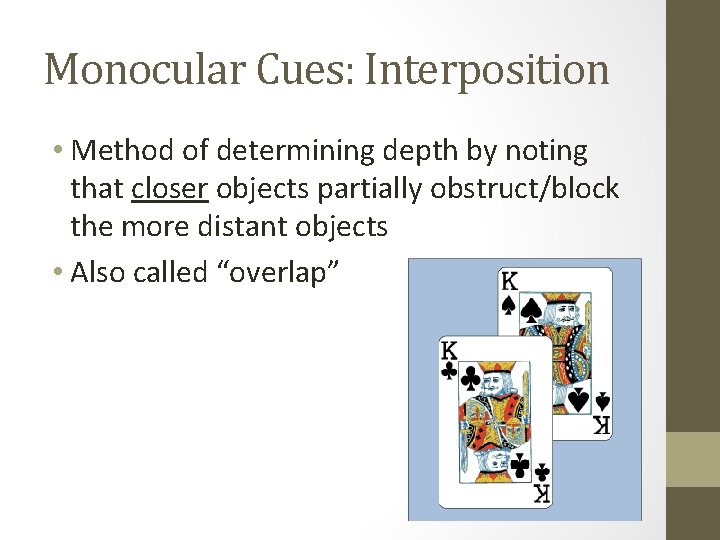
Monocular Cues: Interposition • Method of determining depth by noting that closer objects partially obstruct/block the more distant objects • Also called “overlap”
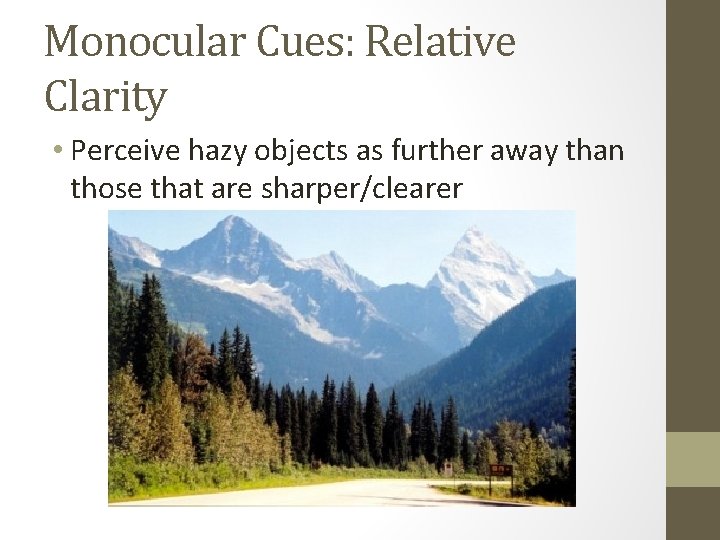
Monocular Cues: Relative Clarity • Perceive hazy objects as further away than those that are sharper/clearer
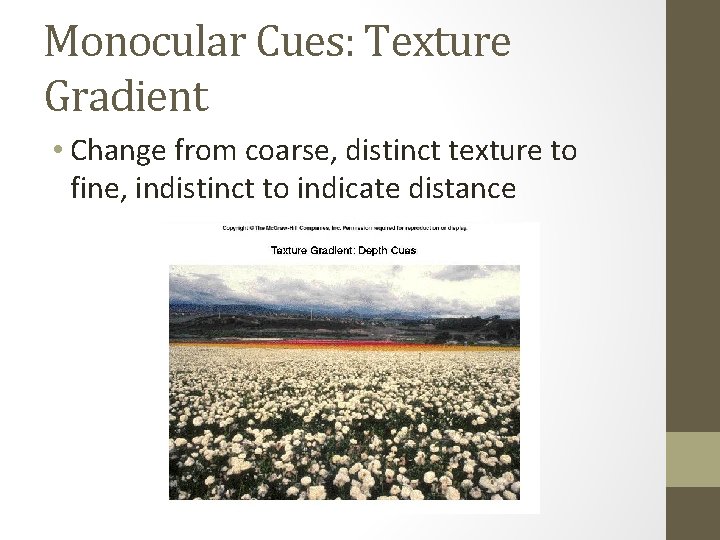
Monocular Cues: Texture Gradient • Change from coarse, distinct texture to fine, indistinct to indicate distance
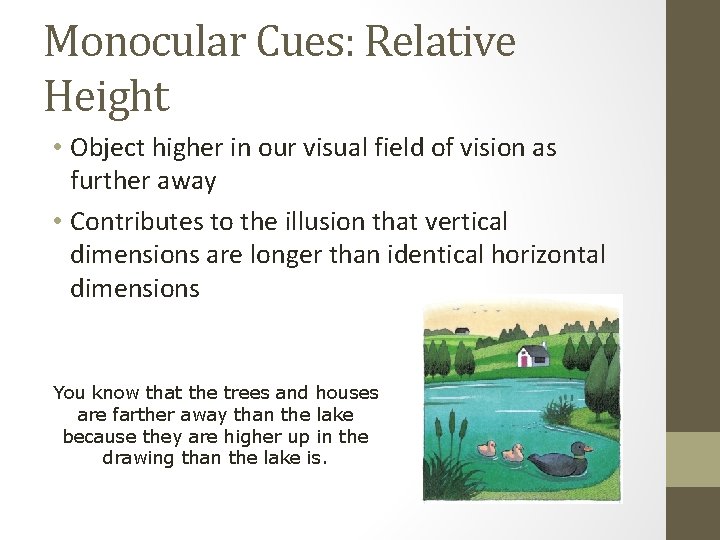
Monocular Cues: Relative Height • Object higher in our visual field of vision as further away • Contributes to the illusion that vertical dimensions are longer than identical horizontal dimensions You know that the trees and houses are farther away than the lake because they are higher up in the drawing than the lake is.
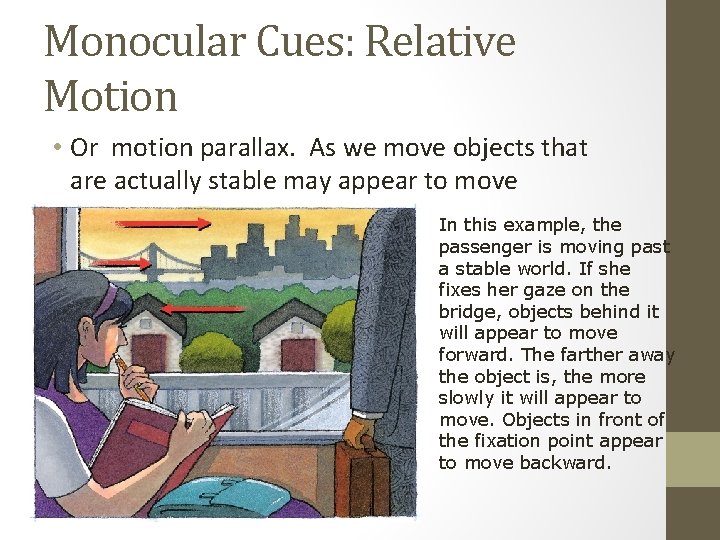
Monocular Cues: Relative Motion • Or motion parallax. As we move objects that are actually stable may appear to move In this example, the passenger is moving past a stable world. If she fixes her gaze on the bridge, objects behind it will appear to move forward. The farther away the object is, the more slowly it will appear to move. Objects in front of the fixation point appear to move backward.
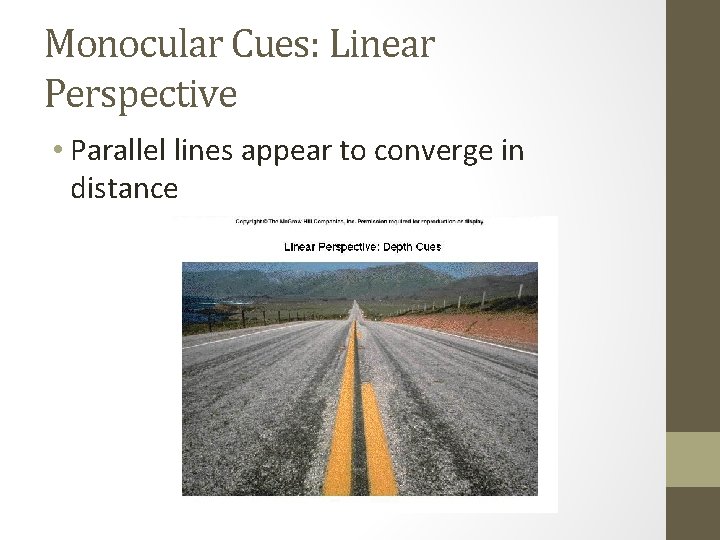
Monocular Cues: Linear Perspective • Parallel lines appear to converge in distance
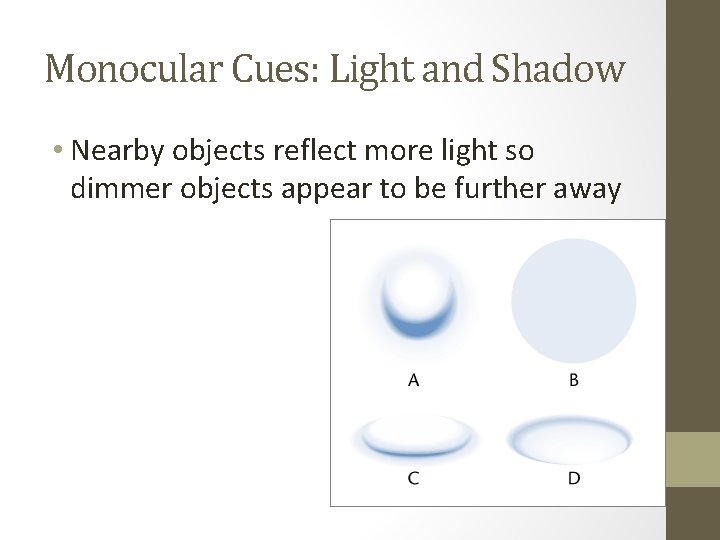
Monocular Cues: Light and Shadow • Nearby objects reflect more light so dimmer objects appear to be further away
Motion Perception • Stroboscopic motion: how animation works. Slightly varied pictures flashed at a high speed • Phi phenomenon: perceived motion, lights blink on and off in quick succession
Perceptual Constancy • Perception where objects do not change even as illumination or retinal images change (top-down) Color and Brightness Constancies • Color is derived from its context ** Comparisons govern our perceptions
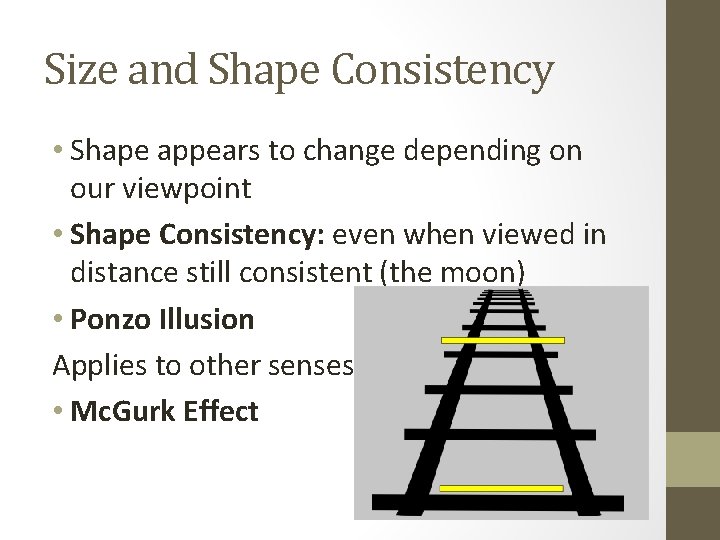
Size and Shape Consistency • Shape appears to change depending on our viewpoint • Shape Consistency: even when viewed in distance still consistent (the moon) • Ponzo Illusion Applies to other senses • Mc. Gurk Effect
Sensory Deprivation and Restored Vision • Born without sight and later gain it…can they recognize things they know by touch only? • Could distinguish figure and ground • Sense colors, suggests we are born with abilities • Could not recognize by vision things they knew by touch
Perceptual Adaptation • Ability to adjust to changes in out senses. • New glasses…blurry at first, will adjust