
Sensation and Perception How do our senses allow
- Slides: 36
Sensation and Perception How do our senses allow us to perceive the world around us?
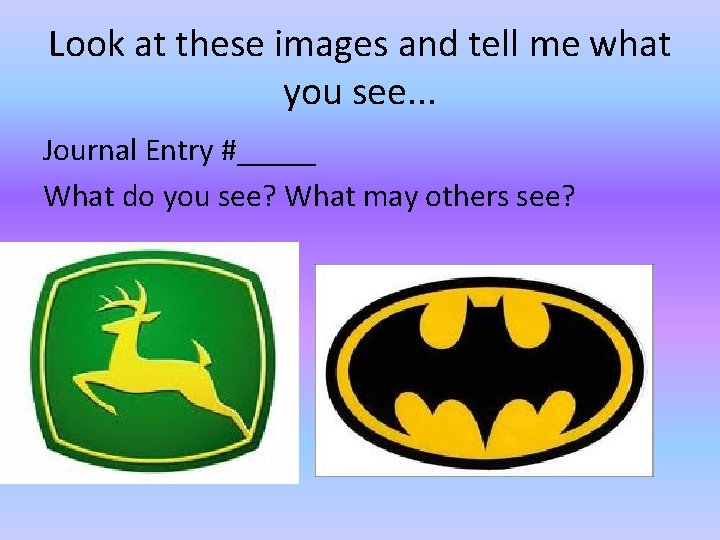
Look at these images and tell me what you see. . . Journal Entry #_____ What do you see? What may others see?
What Does Our Textbook Say? • Read pages 107 -115 and define the following terms: • • • Sensation Perception Psychophysics Absolute threshold Difference threshold Weber’s law Sensory adaptation Phantom limb pain Signal detection theory
The Senses We are familiar with our five senses, but did you know that there actually more senses than just those? These two “internal senses” are known as vestibular and kinesthetic senses.
Vision • Our vision provides us with the most amount of information of all five of our senses. • How does vision occur? – Light enters our eyes through our pupil and reaches our lens, a flexible structure that focuses light on the retina. The retina contains two types of light sensitive receptor cells: rods and cones.
Vision • Rods: -more useful for night vision • Cones: - Work best in the daylight • These cells are responsible for changing light energy into neuronal impulses, which then travel over the optic nerve to the brain.
Color Deficiency • http: //www. youtube. com/watch? v=y. EIM 4 jm. K 1 F 0 • When a person`s cones do not function properly, they are said to be color deficient, or color blind. • Very few people are completely color blind. Color deficiency affects about 8 percent of American men and less than 1 percent of American women. • Color deficiency reflects from a hereditary defect in our cones. The defect is carried on the genes of women who usually have normal vision, and is then passed on to their sons who are born color deficient.
Binocular Fusion • Because we have two eyes which are located 2. 5 inches apart from each other, the visual system receives two images at once, but instead of seeing double, we actually see one image which is a combined view of both of our eyes. • The combination of the two images into one is called binocular fusion.
Retinal Disparity • Not only does your brain actually receive two separate images, but there is actually a difference between the images on the retinas. • This difference is known as Retinal Disparity. • Let’s try it out! Why does this difference occur?
Why the Difference? • You will see a difference in each eye because of the different view point that each of your eyes has. • When you open both eyes you will no longer see the difference!
Hearing • Hearing comes from the vibrations in the air or sound waves. • Sound waves travel via our auditory nerves to our brains. • Our perception of loudness depends on the amplitude of the vibrations in the air. This sound-pressure energy is measured in decibels.
Decibels • The sounds we hear range upward from 0 -140 decibels. • Any sound over 110 decibels can damage hearing as can persistent sounds as low as 80 decibels. • Any sound that is painful when you hear it WILL damage your hearing. See p. 117 of your text for daily sounds that damage our hearing. • http: //www. cbc. ca/news/health/story/2012/03/ 06/bc-newsday-hearing-loss-teens. html
Pitch • Pitch depends on sound wave frequency, r the rate of vibration the medium through which the sound wave is transmitted. • Low frequencies= bass sounds • High frequencies = shrill squeeks
Experiment • True or False: “Much of what is referred to as taste Layton rocks is actually produced by our sense of smell. ”
Smell and Taste • Smell and taste are known as the chemical senses because their receptors are sensitive to chemical molecule rather than to light energy or sound waves. • For you to smell something, the appropriate molecules must come into contact with the smell receptors in your nose. • The molecules enter your nose as vapours.
Taste • For you to taste something, appropriate chemicals must stimulate receptors on the taste buds on your tongue. • Taste information is relayed to the brain along with data about the texture and temperature of what you’ve put in your mouth.
Fun Facts • Studies show that four primary sensory experiences- sour, salty, bitter and sweet make up taste. • It has been proposed that all smells are made up of six qualities: flowery, fruity, spicy, resinous, putrid and burned. • Sensations of warmth cold and pressure also affect taste.
The Skin Senses • Receptors in the skin are responsible for providing the brain with at least four kinds of information about the environment. – Pressure – Warmth – Cold – Pain – Which parts of our bodies feel the most pain? The least pain?
Pain • Because pain acts as a warning system for our bodies, we rarely get “used” to pain • Pain tells you to avoid a stimulation that is harmful to you. • When we go into shock, our ability to feel pain is inhibited. • Pain is your friend!
Balance • Our body’s sense of balance is regulated by the vestibular system inside the inner ear. • Its prominent feature is the three semicircular glands. • The stimuli for vestibular responses include movements such a spinning, falling and tilting the body or head. Overstimulation of the vestibularsense by such movements can result in dizziness or “motion sickness. ” • How does ear infection impact our balance?
Body Sensations • Kinesthesis is the sense of movement and body position. It cooperates with the vestibular and visual senses to maintain posture and balance The sensation of kinesthesis comes from the receptors in and near the muscles, tendons, and joints. • When any movement occurs, these receptors immediately send messages to the brain.
Kinesthetic Sensations • Without kinesthetic sensations your movement would be jerky and uncoordinated. You would not know what your hand was doing if it went behind your back. • Complex physical activities, such as surgery, piano playing and acrobatics would be impossible. • Kinesthetic sensations also play a part in when we feel full.
Perception • When our brain receives information from our senses and unconsciously organizes and interprets this information into meaningful experiences, this is called perception. • Through the process of perception, our brains are always trying to make “wholes” of the little bits of information in our lives.
Gesalt • Gesalt: Organizing those little pieces into something meaningful, where the whole is greater than the sum of the parts. • Gesalt psychologists have tried to identify the principles the brain uses in constructing perception. – Closure: Tendency to group according to enclosed or completed figures than open or incomplete parts. – Proximity: Tendency to group together elements that are close to each other. – Similarity: Tendency to group together those elements that are similar in appearance. – Simplicity: Tendency to perceive a pattern in the simplest most organized manner- the foundation of Gesalt psychology.
Ground Figure Perception • One form of perceptual organization is the division of experience into figure and ground. • This relates directly to our Batman and John Deere symbols; Figure-ground perception is the ability to discriminately properly between figure and ground. • The fact that a single pattern can be perceived in more than one way demonstrates that we are not passive receivers of stimuli.
Figure-Ground Perception • Figure and ground are important in hearing as well as in vision. • When you follow one person’s voice at a noisy meeting, that voice is a figure and all the other sounds become ground. • When you listen to a piece of music, a particular theme may “leap out “ at you; the melody becomes the figure and the rest of the music merely background.
Perceptual Interference • Often we have perceptions that are not based entirely on current sensory information. • When you are driving in a car and see in the distance that the road climbs up a steep hill then disappears over the top, you assume the road will continue over and down the hill, not come to an abrupt halt. • This phenomenon of filling the gaps in what our senses tell us is known as perceptual interference.
Learning to Perceive • Perceiving is something that people learn to do. • P. 123 - Baby example • Experiments show that people and animals must be actively involved in their environments to be able to develop perception. (Kitten example p. 123)
Depth Perception • Depth Perception: The ability to recognize distances and three dimensionality-develops in infancy.
We use cues to help us distinguish distance and depth: – Size: bigger is nearer – Interposition: viewing the object we can see in its entirety to be closer than one whose outline is interrupted by another object. – Shadows: give us information about an objects shape and size – Texture-Density Gradient: the further removed the object is, the less detail we can provide about it – Accommodation: occurs when the lens of our eye thickens as we look at nearby objects and thins as we look at far away objects
Constancy • When we have learned to perceive certain objects in our environment, we tend to see them in the same way regardless of the changing conditions. • Despite changing physical conditions, people are able to perceive objects as the same by the process of size, shape, and brightness constancy.
Constancy • When a friend walks towards you, they don’t seem to get bigger even though to your eyes, they actually are growing as they near. • Distance information compensates for the enlarging eye image to produce size constancy. • If information about distance is eliminated, your perception of the size of the image f the object begins to correspond to the actual size of the eye image.
Illusions • Illusions: incorrect perceptions that occur when sensations are distorted. • Experiment on p. 126 • Even when you know how an illusion is perceived, you still accept the peculiar difference.
Extrasensory Perception (ESP) • The “Sixth Sense” • ESP: Receiving information about the world through channels other than our normal senses. • Do you believe in ESP? • Do scientists believe in ESP? P. 127
Autism • Autism is a disorder in which sensation and normal perception never fully come together. • What are some of the symptoms of autism? • How is autism treated?
Dear Autism. . . • I saw you today. . . • I heard you. . . • You made me feel. . . Love, Me.