
Sensation and Perception By Course Instructor Samreen Umar
Sensation and Perception By Course Instructor: Samreen Umar Lecturer at Department of Psychology, UOS
Perception n n Perception refers to interpretation of what we take in through our senses. The way we perceive our environment is what makes us different from other animals and different from each other Perception is influenced by a person's experiences, motives, expectations, and goals.
Principles of perception n n Gestalt Psychologist believed that the whole is different from the sum of its parts. In other words, the brain creates a perception that is more than simply the sum of available sensory inputs, and it does so in predictable ways. Gestalt psychologists translated these predictable ways into principles by which we organize sensory information. As a result, Gestalt psychology has been extremely influential in the area of sensation and perception. Gestalt principles such as figure-ground relationship, grouping by proximity or similarity, the law of good continuation, and closure all used to help explain how we organize sensory information. Our perceptions are not infallible, and they can be influenced by bias, prejudice, and other factors
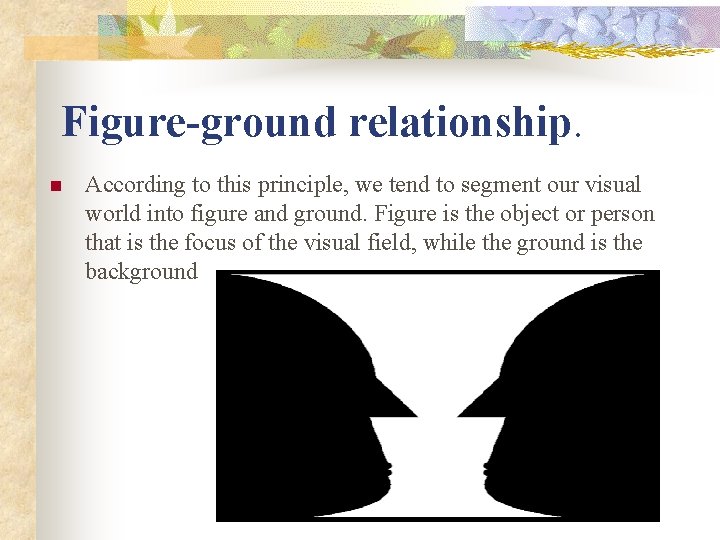
Figure-ground relationship. n According to this principle, we tend to segment our visual world into figure and ground. Figure is the object or person that is the focus of the visual field, while the ground is the background
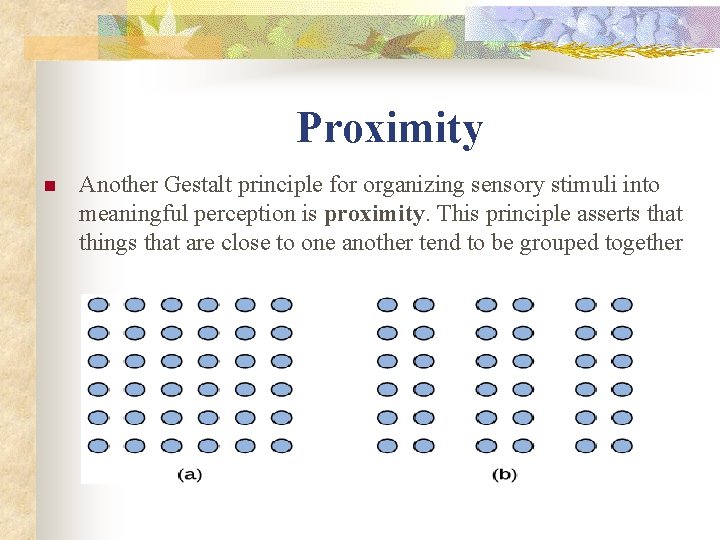
Proximity n Another Gestalt principle for organizing sensory stimuli into meaningful perception is proximity. This principle asserts that things that are close to one another tend to be grouped together

Similarity n According to this principle, things that are alike tend to be grouped together is Similarity. For example, When looking at this array of dots, we likely perceive alternating rows of colors. We are grouping these dots according to the principle of similarity.
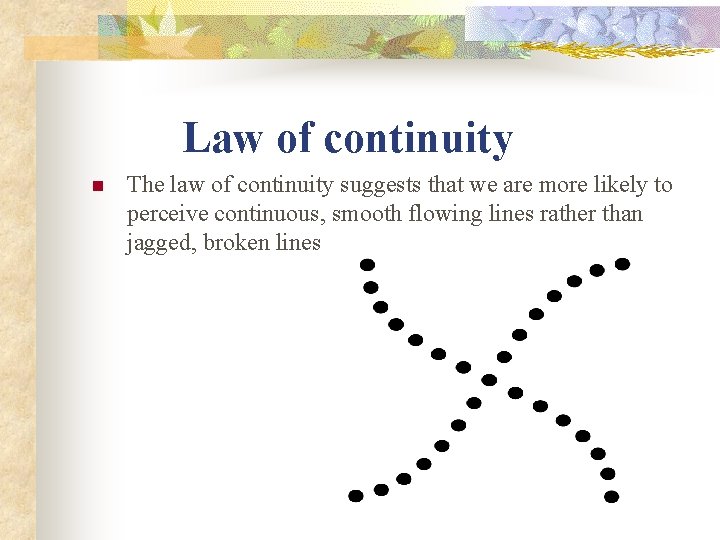
Law of continuity n The law of continuity suggests that we are more likely to perceive continuous, smooth flowing lines rather than jagged, broken lines
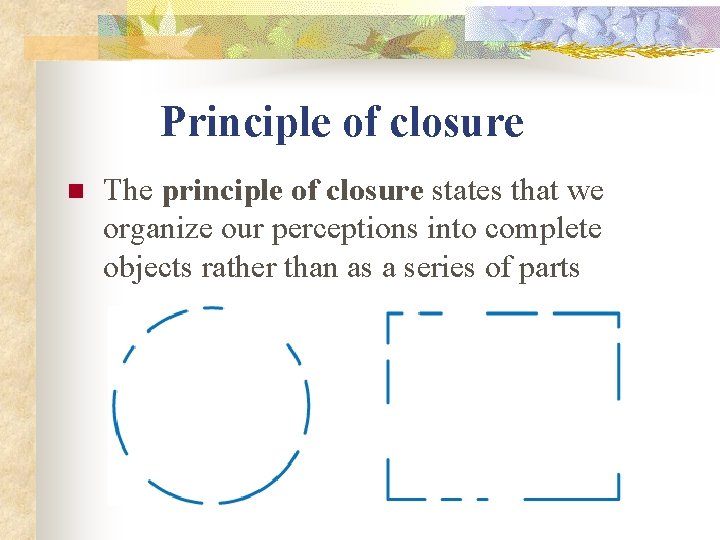
Principle of closure n The principle of closure states that we organize our perceptions into complete objects rather than as a series of parts
q According to Gestalt theorists, pattern perception, or our ability to discriminate among different figures and shapes, occurs by following the principles described above. You probably feel fairly certain that your perception accurately matches the real world, q Perception is a complex process. Built from sensations, but influenced by our own experiences, biases, prejudices, and cultures, perceptions can be very different from person to person
Role of perception in human cognition n Perception refers to the ability of the mind to apprehend objects through the sensory modalities of sight, hearing, smell touch and taste while cognition is the thinking about the perceptions in terms of individual previous experience. Hence cognitive process may entail the recall of previous experience or the evaluation of the objects perceived
- Slides: 10