
Sensation and Perception 2 Body and Mind Unit
Sensation and Perception 2 Body and Mind Unit 2
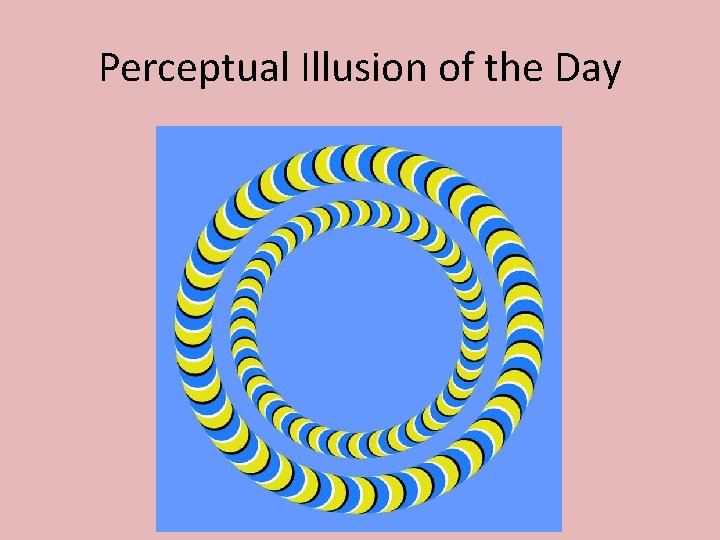
Perceptual Illusion of the Day
Bellringer (in journals 5 -7 sentences) Look back in your notes at the definition of perception. In this room right now, what do you perceive? What might your perceptions be drawn on?
Today We will learn about how sensory information is transformed into our thoughts, beliefs, behaviors, and perceptions. AND We will discuss what influences our perception of the world. – Selective Attention – Perceptual Set – Cocktail Party Effect
Sensation or Perception: Demonstration • On each slide, write down whether these stimuli are being processed by sensation or perception.
Sensation or Perception? • The receptor cells in your eyes pick up a sleek silver object moving through the sky.
Sensation or Perception? • Seeing an airplane
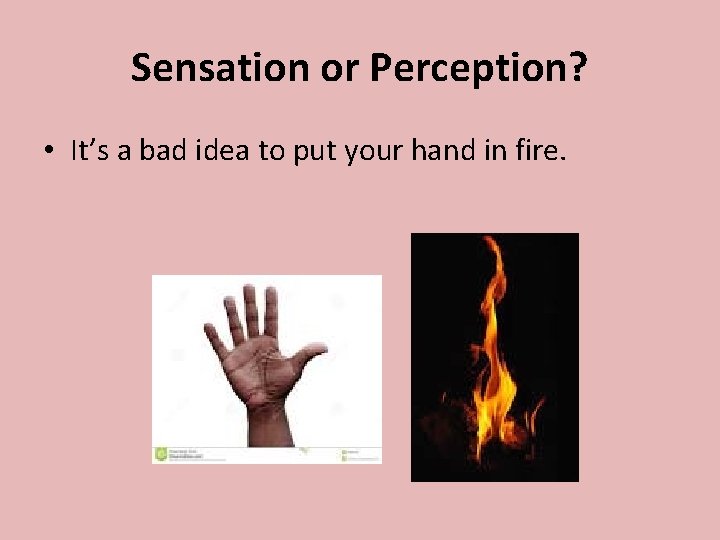
Sensation or Perception? • It’s a bad idea to put your hand in fire.
Sensation or Perception? • Receptor cells in your hand relay pain signals to your brain when you put your hand in fire.
Sensation or Perception? • I smell chicken.
Sensation or Perception? • Receptor cells in your butt pick up the pressure from the seat.
Sensation or Perception? • This chair is uncomfortable
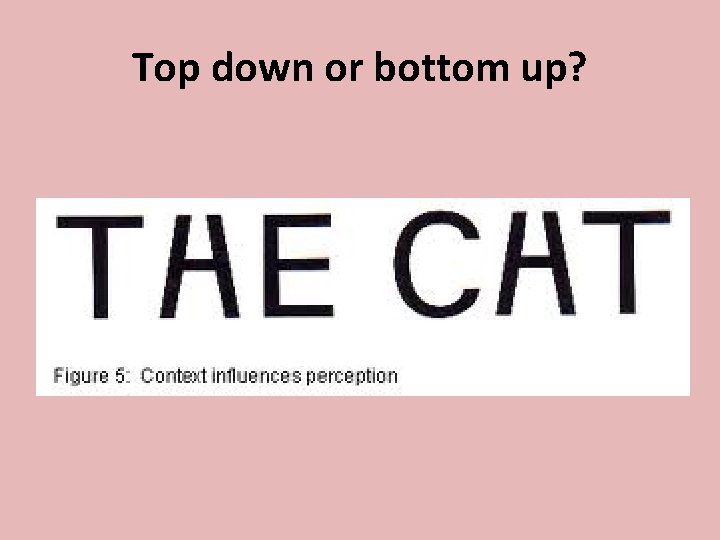
Top down or bottom up?
Think… • How many of you are 100% aware of everything your body is sensing right now? – Your shirt on your skin? – Your sock on your foot? – Your butt on the seat? – The smell in the air? – The taste in your mouth? – The hair on your head? – What would happen if we paid attention to all these things at once?
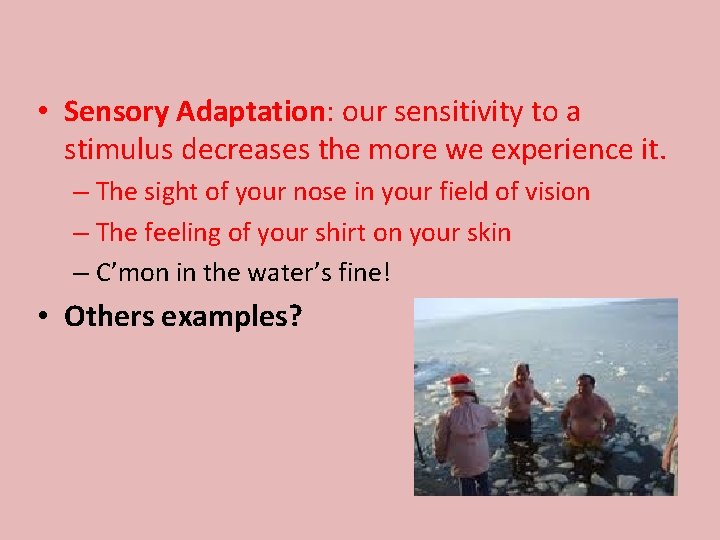
• Sensory Adaptation: our sensitivity to a stimulus decreases the more we experience it. – The sight of your nose in your field of vision – The feeling of your shirt on your skin – C’mon in the water’s fine! • Others examples?
So… • If we perceive things less that we experience a lot, what do we perceive strongly?
• “We need above all to know about changes. No one wants or needs to be reminded his shoes are on 16 hours a day. ” • Neuroscientist David Hubel – When the air turns off – When a baby starts crying – When something moves across your field of vision
So… • Why is it that when we stare at one thing for a long time, it doesn’t disappear?
BONUS: Why is it important to notice change? Think about WHY we need our sensory and perceptual systems in the first place.
Well it does…
II
• Eye Movements: help prevent parts of our visual field from disappearing – Whether you know it or not, your eyes are always slightly moving. This prevents sensory adaptation from making images we see disappear. • TURN TO A PARTNER – P 1 – look at the wall P 2 – stare at their eyes
So… • Now we know WHAT STIMULI our body senses. • We also know a stimuli is an event or energy that causes a reaction… The question is, “How does a stimulus cause a reaction? ”
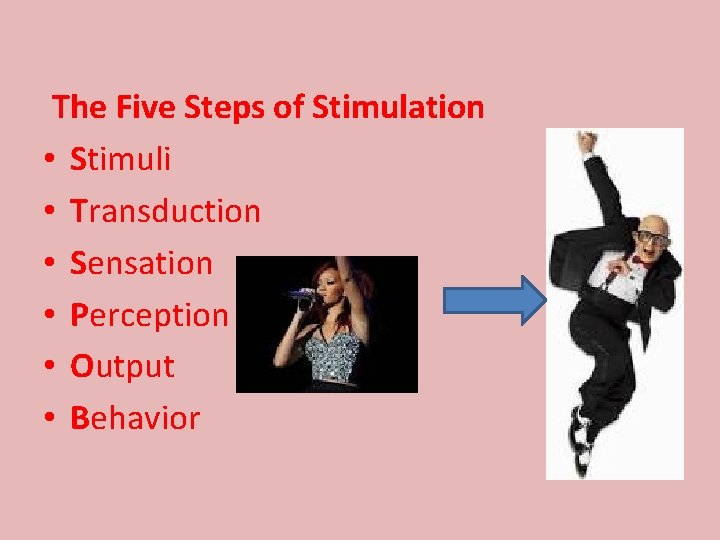
The Five Steps of Stimulation • Stimuli • Transduction • Sensation • Perception • Output • Behavior
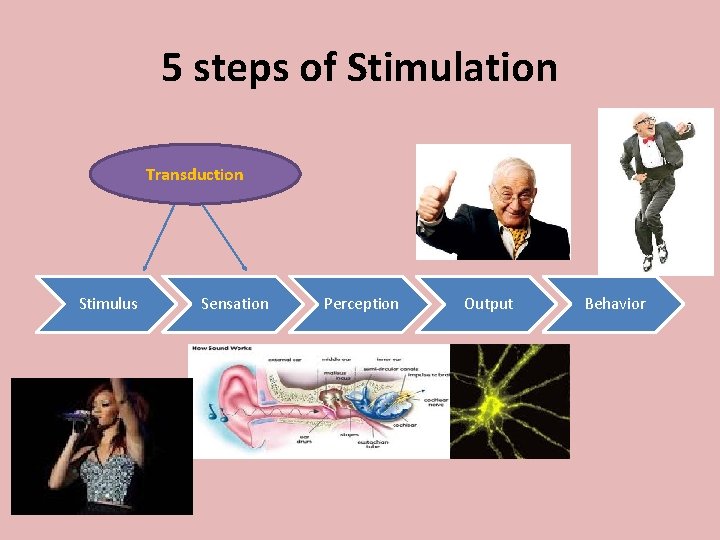
5 steps of Stimulation Transduction Stimulus Sensation Perception Output Behavior

STIMULUS
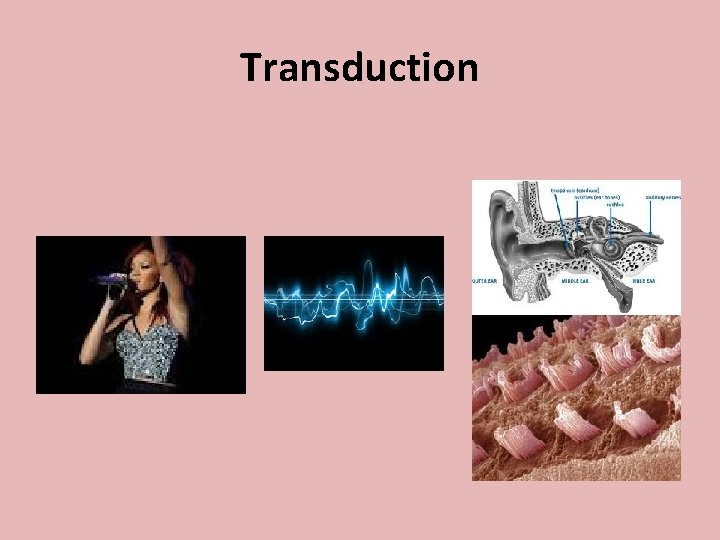
Transduction
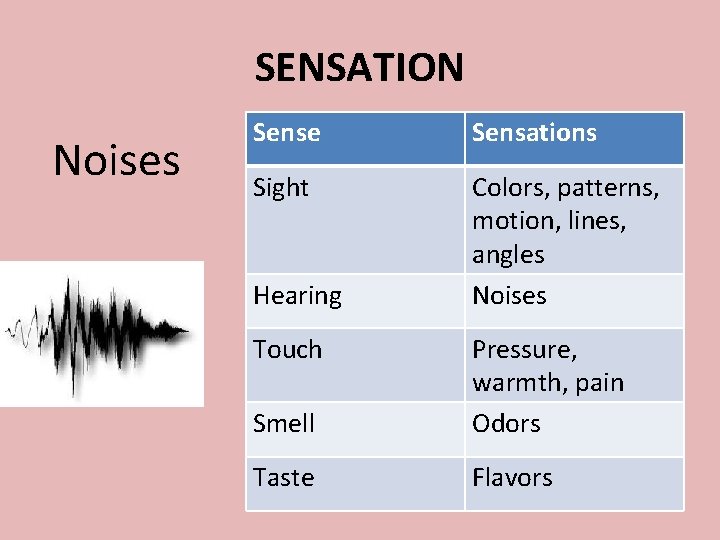
SENSATION Noises Sense Sensations Sight Colors, patterns, motion, lines, angles Noises Hearing Touch Smell Pressure, warmth, pain Odors Taste Flavors
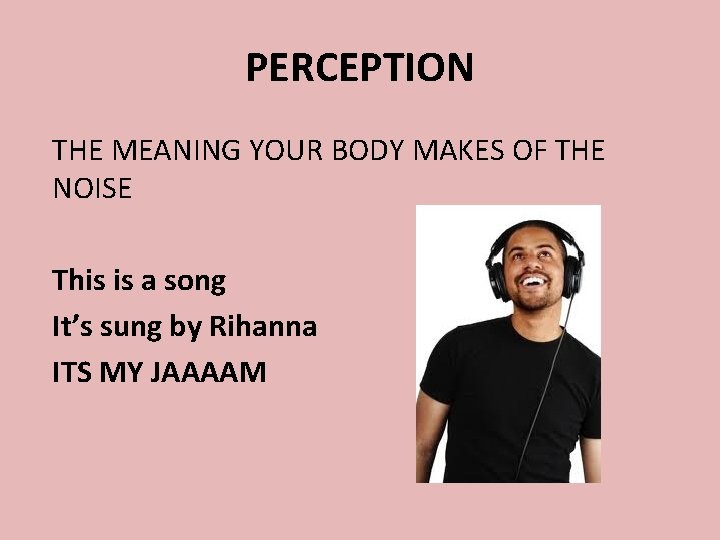
PERCEPTION THE MEANING YOUR BODY MAKES OF THE NOISE This is a song It’s sung by Rihanna ITS MY JAAAAM
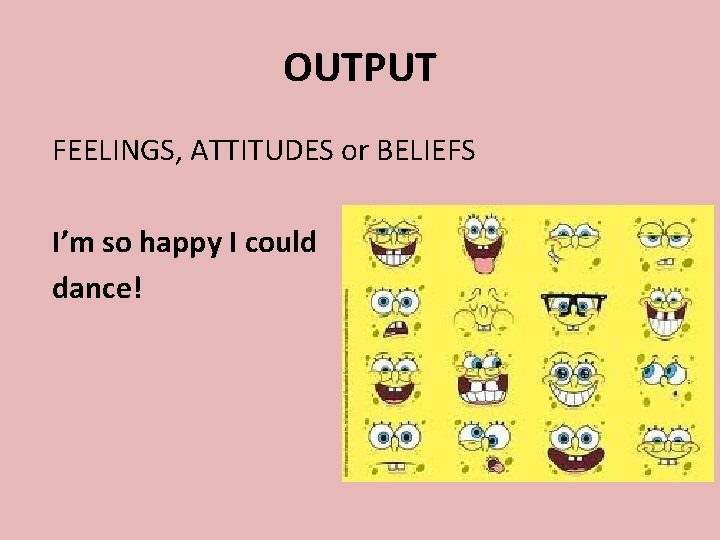
OUTPUT FEELINGS, ATTITUDES or BELIEFS I’m so happy I could dance!
Behavior
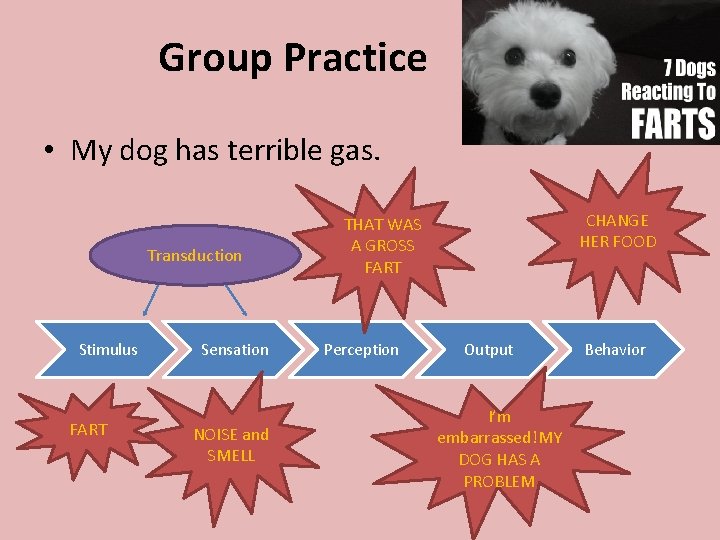
Group Practice • My dog has terrible gas. Transduction Stimulus FART Sensation NOISE and SMELL CHANGE HER FOOD THAT WAS A GROSS FART Perception Output I’m embarrassed!MY DOG HAS A PROBLEM Behavior
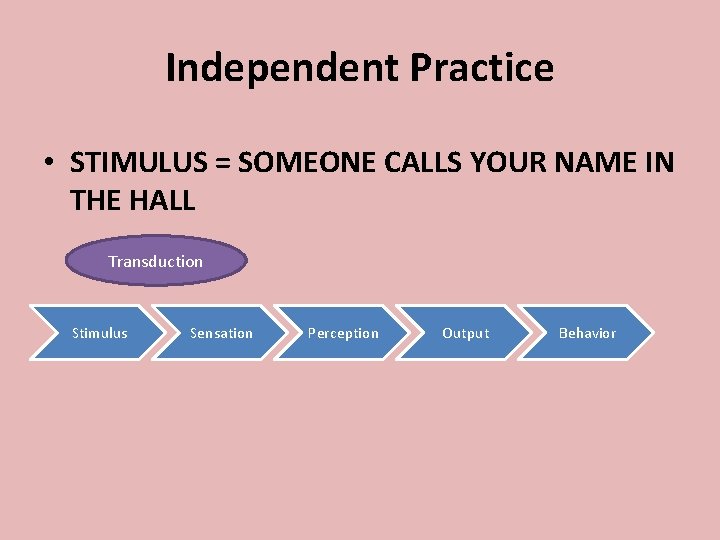
Independent Practice • STIMULUS = SOMEONE CALLS YOUR NAME IN THE HALL Transduction Stimulus Sensation Perception Output Behavior
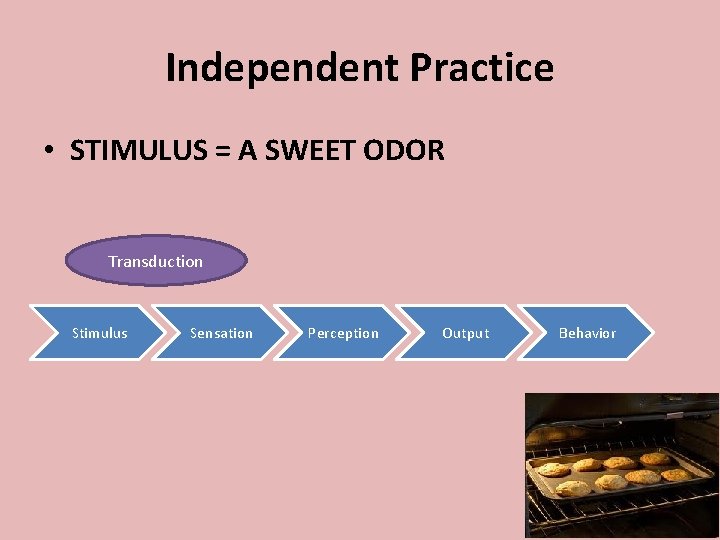
Independent Practice • STIMULUS = A SWEET ODOR Transduction Stimulus Sensation Perception Output Behavior
Video https: //www. youtube. com/watch? v=v. JG 698 U 2 Mvo • Just watch SILENTLY. Follow the directions they give you in the video. • Who saw the dancing gorilla?
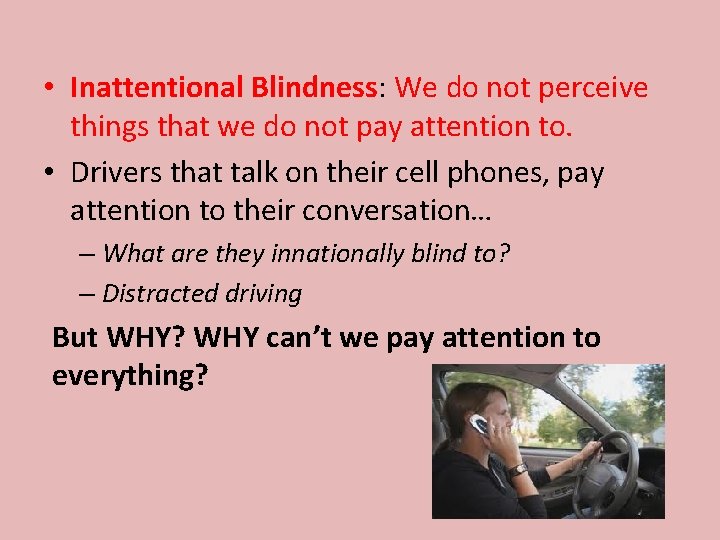
• Inattentional Blindness: We do not perceive things that we do not pay attention to. • Drivers that talk on their cell phones, pay attention to their conversation… – What are they innationally blind to? – Distracted driving But WHY? WHY can’t we pay attention to everything?
As we speak… Your senses are taking in 11, 000 bits of information per second. We pay attention to about 40.
The power of perception • Selective Attention: You choose what you attend to in the world – Imagine the world is a dark forest. Our attention is like a flashlight. We select what we want to pay attention to. • Recall: What is our sensory system good at “paying attention to? ”
Think… • 10% of what we perceive in the world depends on the stimulus – i. e. we can’t hear it when someone whispers in China • 90% depends on other things happening in the brain – Is top down or bottom up processing more powerful?
The power of perception A pilot tells his co-pilot to “cheer up, ” because he looks depressed. The co-pilot hears “gear up” and pulls up the landing gear while the plane is on the runway. Why did he pull up the gear on the runway? !? !
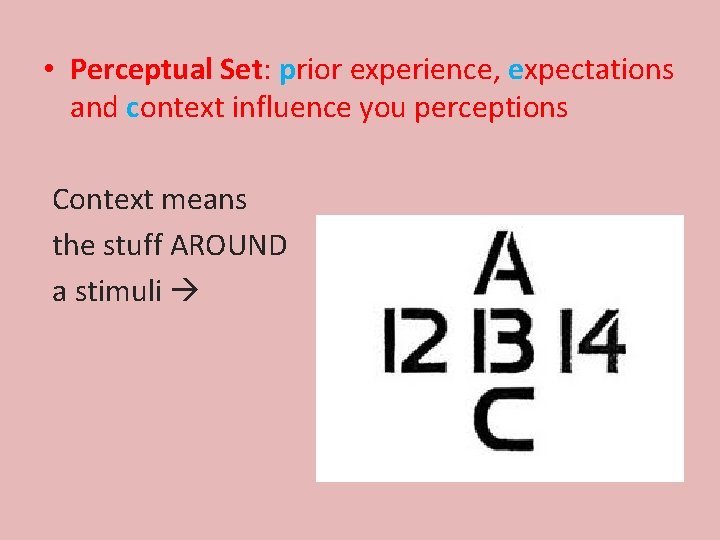
• Perceptual Set: prior experience, expectations and context influence you perceptions Context means the stuff AROUND a stimuli
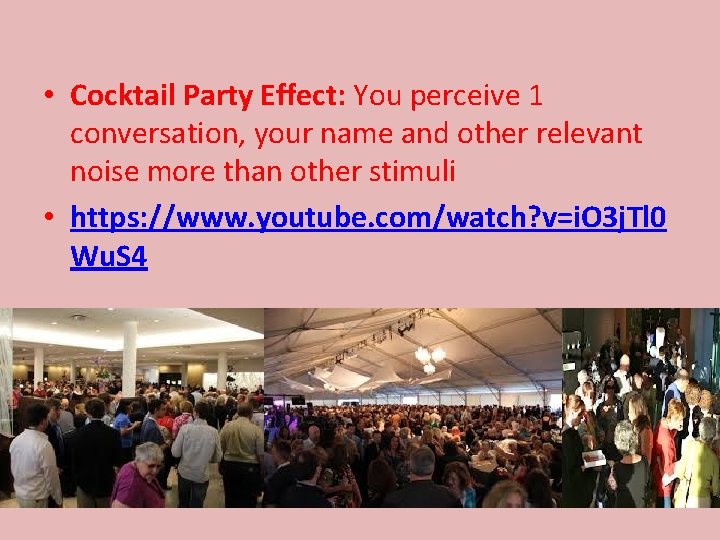
• Cocktail Party Effect: You perceive 1 conversation, your name and other relevant noise more than other stimuli • https: //www. youtube. com/watch? v=i. O 3 j. Tl 0 Wu. S 4
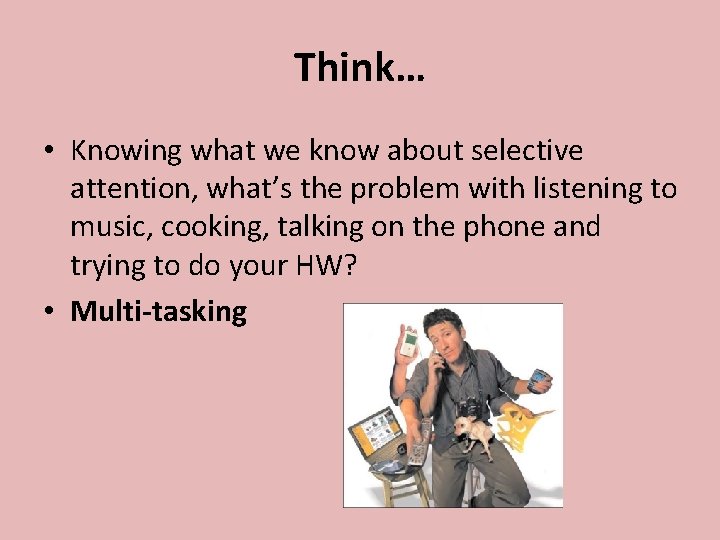
Think… • Knowing what we know about selective attention, what’s the problem with listening to music, cooking, talking on the phone and trying to do your HW? • Multi-tasking
Guided Practice Identify whether SELECTIVE ATTENTION, INNATENTIONAL BLINDNESS, PERCEPTUAL SET or THE COCKTAIL PARTY EFFECT best explains the following perceptual situations Heads Up: The first practice situation covers 2 slides. Don’t answer until you have seen both.
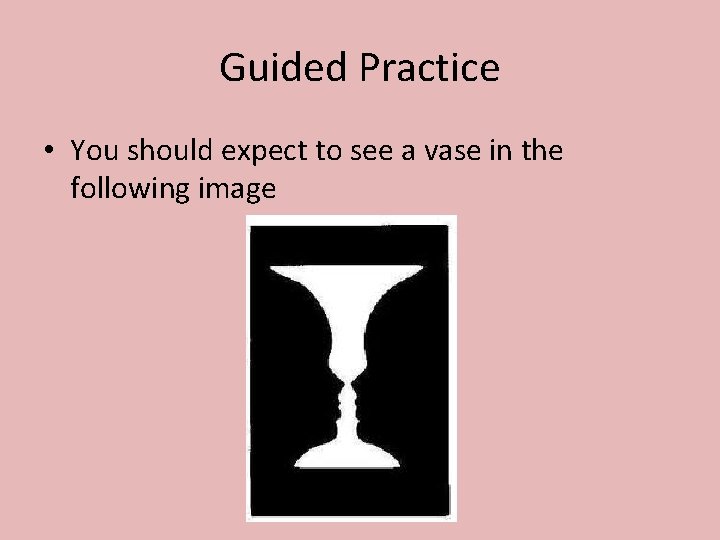
Guided Practice • You should expect to see a vase in the following image
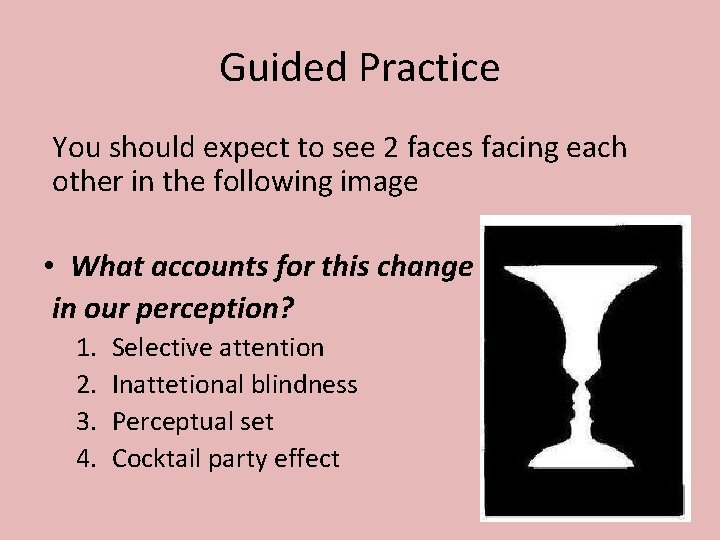
Guided Practice You should expect to see 2 faces facing each other in the following image • What accounts for this change in our perception? 1. 2. 3. 4. Selective attention Inattetional blindness Perceptual set Cocktail party effect
Guided practice Abdul is playing basketball. The crowd is cheering and rowdy. The other team is yelling at their defense to keep their hands up. Above it all, Abdul hears his name called out when his teammate finds an open spot behind the arc, and is able to make a pass for the assist. • What best explains why Abdul is able to hear his name over all of the noise in the gym? 1. 2. 3. 4. Selective attention Inattetional blindness Perceptual set Cocktail party effect
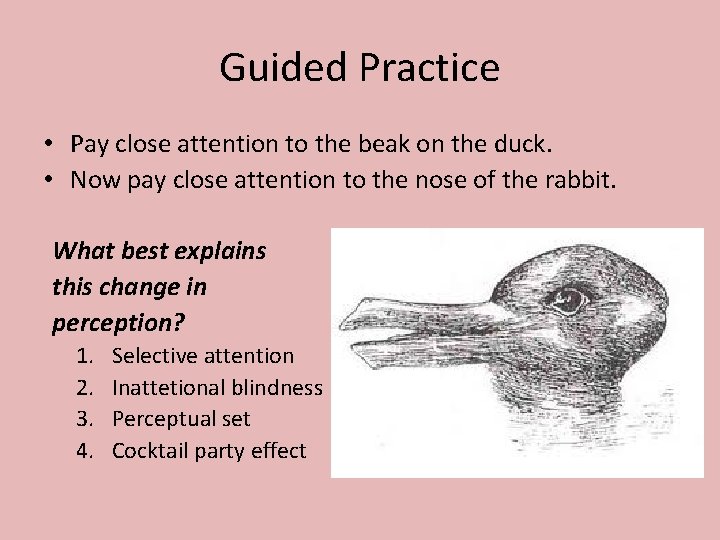
Guided Practice • Pay close attention to the beak on the duck. • Now pay close attention to the nose of the rabbit. What best explains this change in perception? 1. 2. 3. 4. Selective attention Inattetional blindness Perceptual set Cocktail party effect
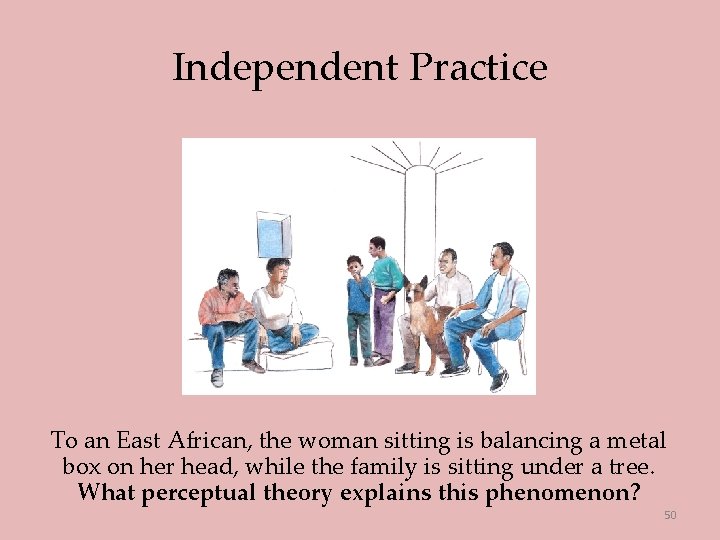
Independent Practice To an East African, the woman sitting is balancing a metal box on her head, while the family is sitting under a tree. What perceptual theory explains this phenomenon? 50
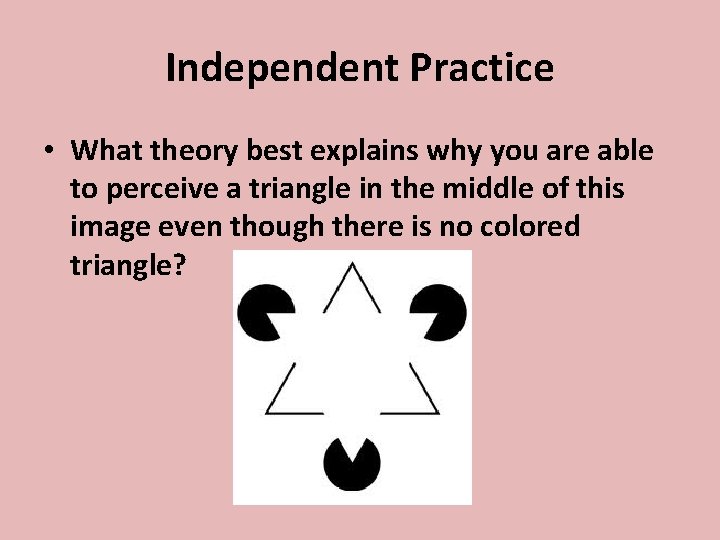
Independent Practice • What theory best explains why you are able to perceive a triangle in the middle of this image even though there is no colored triangle?
Independent Practice Certain students who will go unnamed sometimes spend portions of Ms. Knight’s 4 th period psychology class looking at the window or counting the bricks in the wall. When it comes time for independent practice or an exit ticket, these students often say to Ms. Knight, “I don’t get it. What do I have to do? ” What perceptual theory best explains why these students don’t know what they are expected to do?
Exit Ticket https: //www. youtube. com/watch? v=yn. EOo 28 ls bc “Rhapsody in Blue” Listen to the music. Draw a picture of how it is perceived in your mind. Use any type of writing utensil that you would like.
- Slides: 53