
Senior Showcase Presentation The next three slides are

- Slides: 8
Senior Showcase Presentation The next three slides are an example of what the final presentation will look like Template after it is assembled. We will be constructing your Power. Point based on the information you send to us in the RSVP form. Here’s a look at what your final product will look like. -Slide 2 is the title slide, where we will include your name, thesis title, and major. -Slide 3 is the figure/image slide. We will use the one image or figure that you send us as a visual aid for your presentation. This is also the slide we will include your audio recording on, if you choose to send us one. You can listen to an example audio recording in this slide (it will automatically play when you run the slideshow, audio controls are in the bottom right corner). -Slide 4 includes the script of your voice recording, or if you do not include a voice recording, a project summary. This should not exceed 250 words.
Jason Gordon Linear Non-Equilibrium Thermodynamics of Human Voluntary Behavior: A Canonical. Dissipative Fokker-Planck Equation Approach Involving Potentials Beyond the Harmonic Oscillator Case Ecological Psychology
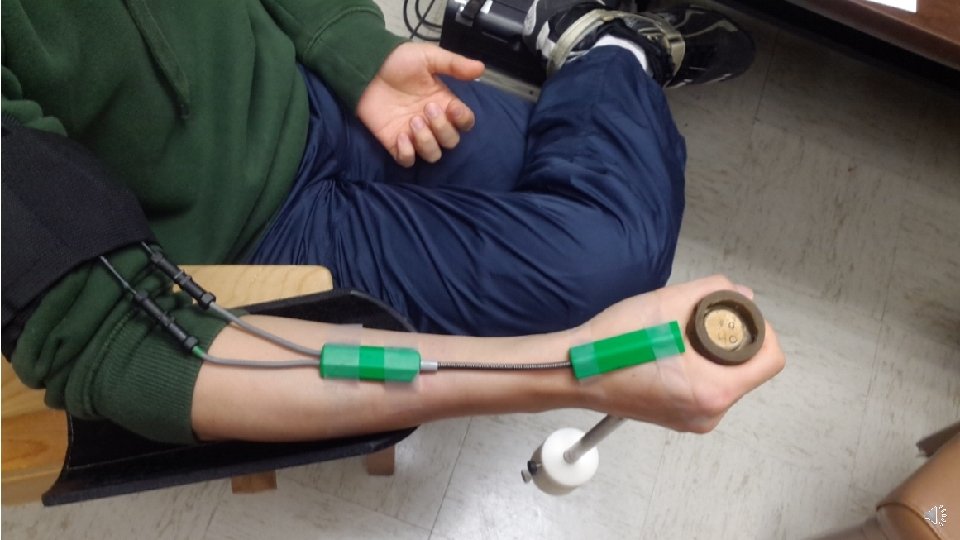
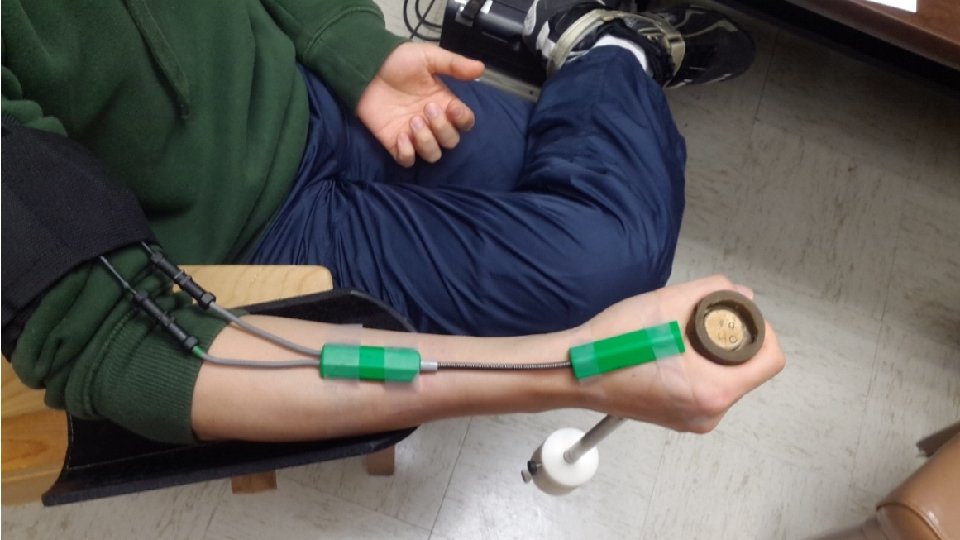
Script/Project Summary In the current work, we developed a simple rhythmic movement task and develop modeling techniques that give rhythmic motion a basis in physics, which can serve in turn to inform our interdisciplinary understanding of voluntary movement generation. We seek to explore the physical principles that constrain rhythmic movement by exploring a variety of modeling techniques. The experimental setup consists of a pendulum swinging task, in which the participant’s wrist movement is measured by the two green markers, while the participant swings the pendulum back and forth. Participants were instructed to swing the pendulum back and forth at one of three self-selected frequencies: at a “comfortable” pace, at a “faster-than-usual” pace, and at a “slower-than-usual” pace. The goal was for the participants to determine this on their own, record their movement for one-minute trials (repeated five times for each condition), and then analyze the data. When modeling human data, such movement tends to be “messy”. This was true across all 30 participants; yet we also propose that a lack of consistency is a hallmark of normal movement. As such, data should not be fitted with a rigid model, but with something more flexible. By describing data in terms of bifurcation theory, we can better capture and explain how and why humans move in the patterns that they do. We propose continued research with such simple and
The “original” thesis These last three slides contain the “original” thesis project for reference, when my abstract was geared toward a technical audience, instead of a general audience. -The main difference is seen on slide 8. This is my original “technical” abstract, which needed to be revised for the Senior Showcase format. This language is geared toward publication in a peer-reviewed physics journal; for Senior Showcase, I converted it to more general terms, heard in my narration on slide 3, and seen in my project summary on slide 4.
Jason Gordon Linear Non-Equilibrium Thermodynamics of Human Voluntary Behavior: A Canonical. Dissipative Fokker-Planck Equation Approach Involving Potentials Beyond the Harmonic Oscillator Case Ecological Psychology
Original Technical Abstract A novel experimental paradigm and a novel modelling approach are presented to investigate oscillatory human motor performance by means of a key concept from condensed matter physics, namely, thermodynamic state variables. To this end, in the novel experimental paradigm participants performed pendulum swinging movements at self-selected oscillation frequencies in contrast to earlier studies in which pacing signals were used. Moreover, in the novel modelling approach, a canonical-dissipative limit cycle oscillator model was used with a conservative part that accounts for nonharmonic oscillator components in contrast to earlier studies in which only harmonic components were considered. Consistent with the Landau theory of magnetic phase transitions, we found that the oscillator model free energy decayed when participants performed oscillations further and further away from