
Senior Nurture Provision at Quarryhill Laura Lister Nurture
- Slides: 1
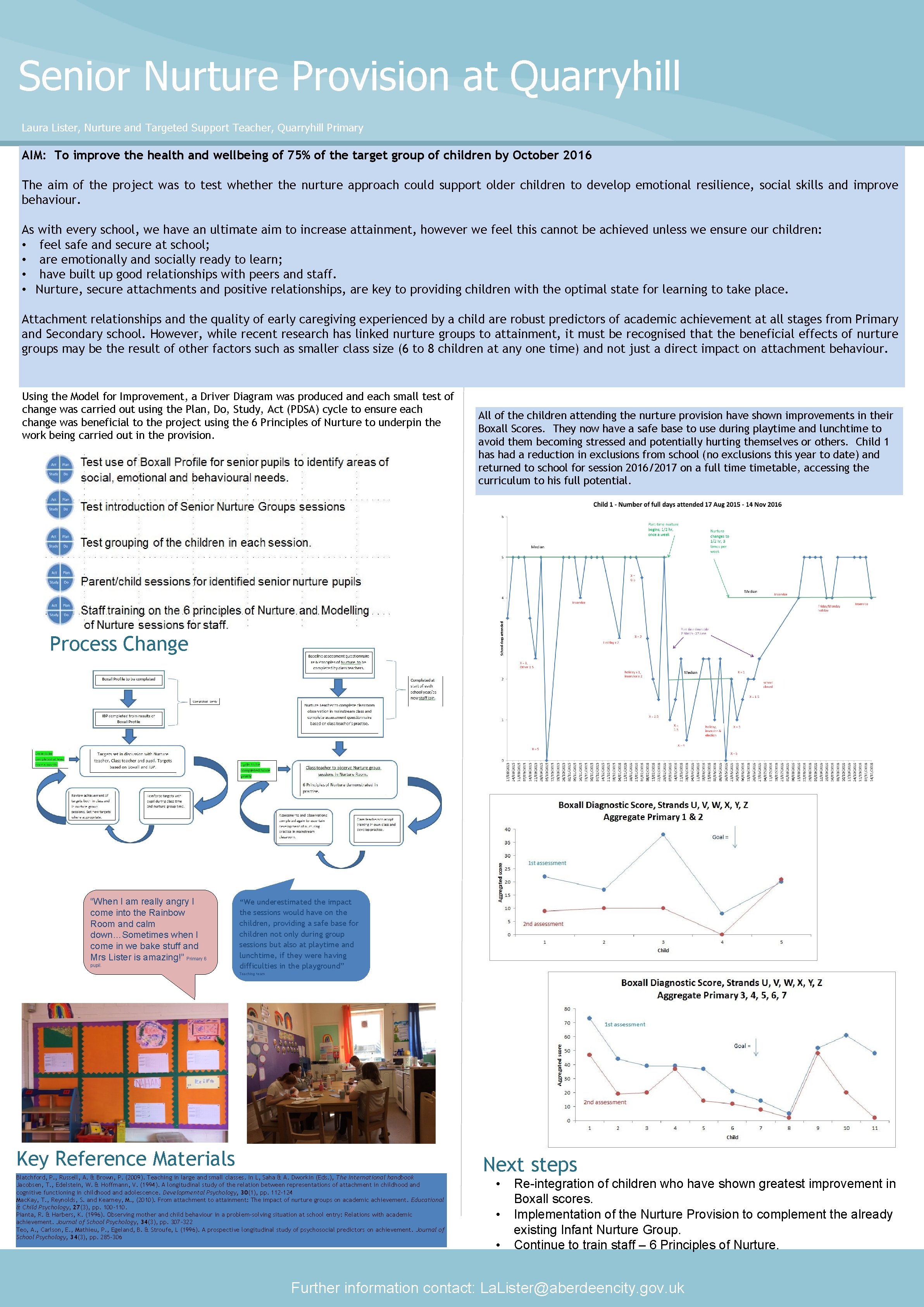
Senior Nurture Provision at Quarryhill Laura Lister, Nurture and Targeted Support Teacher, Quarryhill Primary AIM: To improve the health and wellbeing of 75% of the target group of children by October 2016 The aim of the project was to test whether the nurture approach could support older children to develop emotional resilience, social skills and improve behaviour. As with every school, we have an ultimate aim to increase attainment, however we feel this cannot be achieved unless we ensure our children: • feel safe and secure at school; • are emotionally and socially ready to learn; • have built up good relationships with peers and staff. • Nurture, secure attachments and positive relationships, are key to providing children with the optimal state for learning to take place. Attachment relationships and the quality of early caregiving experienced by a child are robust predictors of academic achievement at all stages from Primary and Secondary school. However, while recent research has linked nurture groups to attainment, it must be recognised that the beneficial effects of nurture groups may be the result of other factors such as smaller class size (6 to 8 children at any one time) and not just a direct impact on attachment behaviour. Achievements Method Using the Model for Improvement, a Driver Diagram was produced and each small test of change was carried out using the Plan, Do, Study, Act (PDSA) cycle to ensure each change was beneficial to the project using the 6 Principles of Nurture to underpin the work being carried out in the provision. All of the children attending the nurture provision have shown improvements in their Boxall Scores. They now have a safe base to use during playtime and lunchtime to avoid them becoming stressed and potentially hurting themselves or others. Child 1 has had a reduction in exclusions from school (no exclusions this year to date) and returned to school for session 2016/2017 on a full timetable, accessing the curriculum to his full potential. Process Change “When I am really angry I come into the Rainbow Room and calm down…Sometimes when I come in we bake stuff and Mrs Lister is amazing!” Primary 6 pupil. “We underestimated the impact the sessions would have on the children, providing a safe base for children not only during group sessions but also at playtime and lunchtime, if they were having difficulties in the playground” Teaching team Key Reference Materials Blatchford, P. , Russell, A. & Brown, P. (2009). Teaching in large and small classes. In L, Saha & A. Dworkin (Eds. ), The International handbook Jacobsen, T. , Edelstein, W. & Hoffmann, V. (1994). A longitudinal study of the relation between representations of attachment in childhood and cognitive functioning in childhood and adolescence. Developmental Psychology, 30(1), pp. 112 -124 Mac. Kay, T. , Reynolds, S. and Kearney, M. , (2010). From attachment to attainment: The impact of nurture groups on academic achievement. Educational & Child Psychology, 27(3), pp. 100 -110. Pianta, R. & Harbers, K. (1996). Observing mother and child behaviour in a problem-solving situation at school entry: Relations with academic achievement. Journal of School Psychology, 34(3), pp. 307 -322 Teo, A. , Carlson, E. , Mathieu, P. , Egeland, B. & Stroufe, L (1996). A prospective longitudinal study of psychosocial predictors on achievement. Journal of School Psychology, 34(3), pp. 285 -306 Next steps • • • Re-integration of children who have shown greatest improvement in Boxall scores. Implementation of the Nurture Provision to complement the already existing Infant Nurture Group. Continue to train staff – 6 Principles of Nurture. Further information contact: La. Lister@aberdeencity. gov. uk