
Senior Management Review of Fundamental Elements of Readiness
- Slides: 22
Senior Management Review of Fundamental Elements of Readiness Process December 9, 2004
Background and Purpose § Overall Contractor Readiness Preparation Is Not Improving – Continue to have complex wide issues with Readiness Process – In 2002 initiated Readiness Workshops to support resolving readiness issues and exchanging experience/initiatives from other sites – Readiness Workshop-May 2004 identified follow-up action to brief senior managers on continuing Complex-wide Challenges with Achieving Readiness
Causes of Readiness Problems: § § § Inadequate Readiness Planning Ineffective Management Self Assessment Process Starting Readiness Reviews prior to achieving readiness; – Safety bases not implemented, equipment not ready, procedures don’t work, operators not trained Results – Readiness reviews suspended or failed – Inability to meet schedules, increased project cost
Objective of Readiness Process Overview Training § The Restart/Startup of a process involves line management getting the process ready for operation and then the verification of that readiness. The following overview training focuses on how line management prepares and declares a process ready for operation. § Given an overview of the principles and fundamental elements of the readiness preparation, managers will have a better understanding of the readiness process areas where more line management attention and improved performance is required if Readiness improvements are to be realized
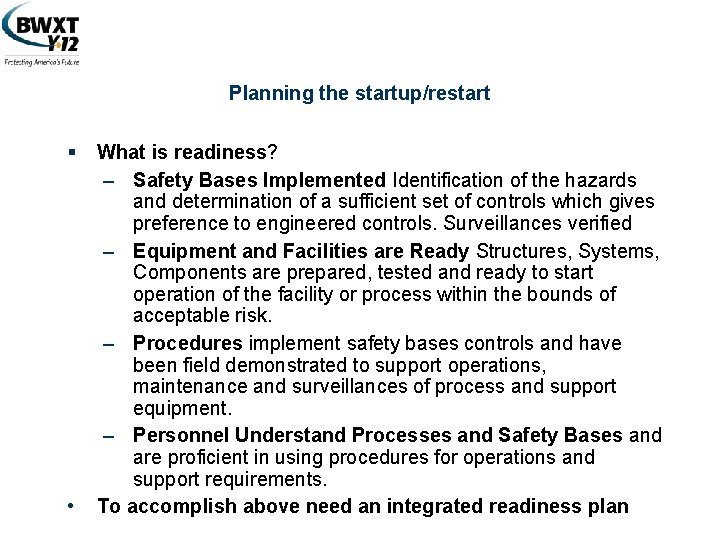
Planning the startup/restart § • What is readiness? – Safety Bases Implemented Identification of the hazards and determination of a sufficient set of controls which gives preference to engineered controls. Surveillances verified – Equipment and Facilities are Ready Structures, Systems, Components are prepared, tested and ready to start operation of the facility or process within the bounds of acceptable risk. – Procedures implement safety bases controls and have been field demonstrated to support operations, maintenance and surveillances of process and support equipment. – Personnel Understand Processes and Safety Bases and are proficient in using procedures for operations and support requirements. To accomplish above need an integrated readiness plan
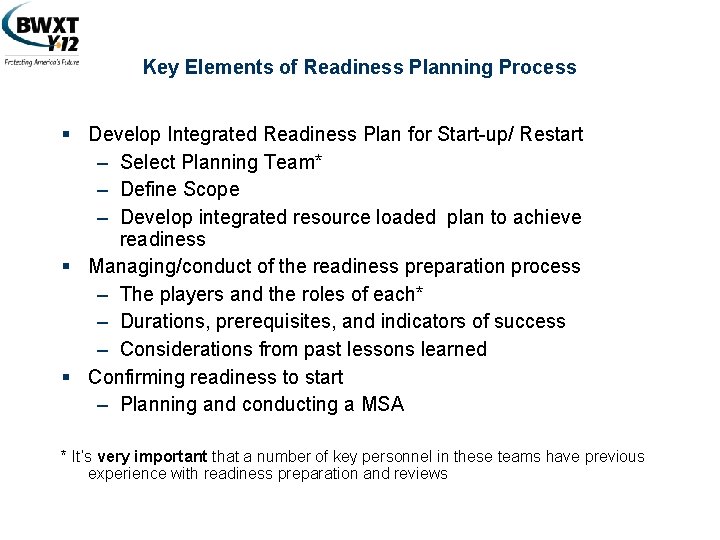
Key Elements of Readiness Planning Process § Develop Integrated Readiness Plan for Start-up/ Restart – Select Planning Team* – Define Scope – Develop integrated resource loaded plan to achieve readiness § Managing/conduct of the readiness preparation process – The players and the roles of each* – Durations, prerequisites, and indicators of success – Considerations from past lessons learned § Confirming readiness to start – Planning and conducting a MSA * It’s very important that a number of key personnel in these teams have previous experience with readiness preparation and reviews
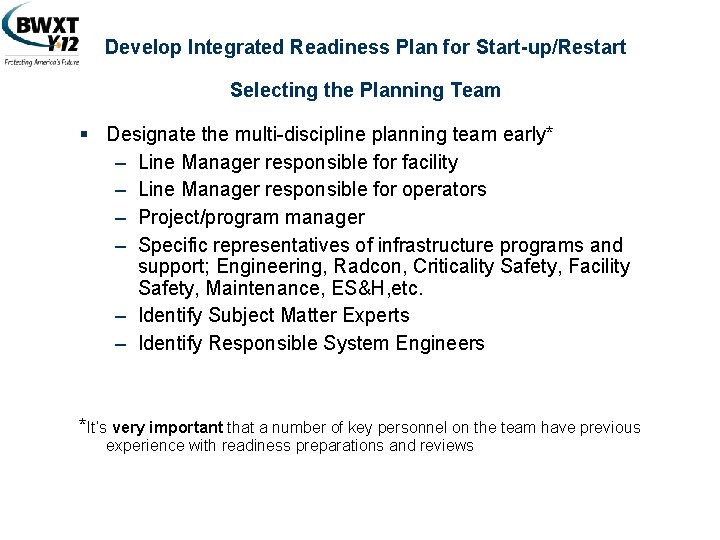
Develop Integrated Readiness Plan for Start-up/Restart Selecting the Planning Team § Designate the multi-discipline planning team early* – Line Manager responsible for facility – Line Manager responsible for operators – Project/program manager – Specific representatives of infrastructure programs and support; Engineering, Radcon, Criticality Safety, Facility Safety, Maintenance, ES&H, etc. – Identify Subject Matter Experts – Identify Responsible System Engineers *It’s very important that a number of key personnel on the team have previous experience with readiness preparations and reviews
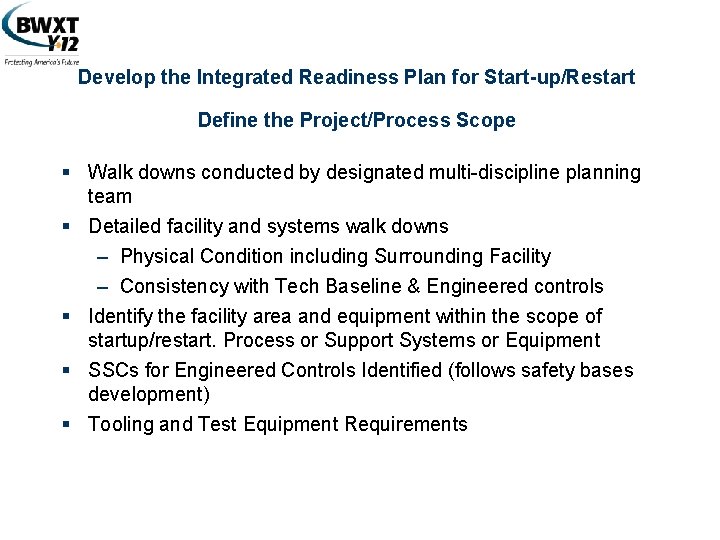
Develop the Integrated Readiness Plan for Start-up/Restart Define the Project/Process Scope § Walk downs conducted by designated multi-discipline planning team § Detailed facility and systems walk downs – Physical Condition including Surrounding Facility – Consistency with Tech Baseline & Engineered controls § Identify the facility area and equipment within the scope of startup/restart. Process or Support Systems or Equipment § SSCs for Engineered Controls Identified (follows safety bases development) § Tooling and Test Equipment Requirements
Develop Integrated Readiness Plan for Startup/ Restart Define the Project/Process Scope (cont’d) § Completed walk downs provide information on scope of process which is then used to develop scheduling requirements that address : – Authorization Basis (AB) that accurately identifies the hazards and approved controls – Equipment (SSCs)-Identification, PM, CM, etc – Documentation—procedures, work packages CSE, etc – Personnel training—Operators, managers, support – Infrastructure Programs; maintenance, fire protection, radcon, etc.
Develop Integrated Readiness Plan for Startup/Restart Defining the Scope; The Authorization Basis § Authorization Basis (AB) -USQD required for the new/restarting activities -Criticality Safety Updates -Update required for BIO/ SAR and TSR/OSR § AB update development requires facility walk downs – SSCs consistent with the process requirements – Sufficient set of engineered and admin controls – Infrastructure systems functional to provide support § Define the Technical Baseline. Identify design data, process description, as built, component id. and plan to correct any inadequacies
Develop Integrated Readiness Plan for Startup/Restart Defining the Scope; Equipment Readiness § Maintenance and Test and Calibration Documentation requirements § Required Corrective Maintenance Identified/Scheduled § Equipment Preventive Maintenance Scheduled Based on Status – Actual versus required – Adequacy of the identified requirements § Functional and integrated test requirements scheduled § Equipment calibration scheduled based on status – Actual versus required – Adequacy of identified requirements § Surveillances of credited controls scheduled and completed satisfactory
Develop Integrated Readiness Plan for Startup/Restart Define the Scope, Procedure Requirements § Required Operating procedures, Abnormal Operations procedures, AB Implementation surveillances are identified -Worker input included -On the floor Verification/Validation done -AB requirements need to be available and included as appropriate § Schedule verification of integration of system procedures into process operation § Training and Qualification/Certification documentation requirements established
Develop Integrated Readiness Plan for Startup/Restart Define the Scope; Personnel Requirements § Supervisors, operators, support personnel required are identified § Basic qualification and system specific classroom training identified § Need AB approved and AB requirements incorporated into procedures to support training § Operational training and procedure familiarization scheduled § Practical training, Practical training Must be scheduled, Must be completed, Must demonstrate the procedures work, Must keep operators proficient
Fundamental Elements of Readiness Process; Identify Level of the Readiness Review § § Once the Scope of Work is identified • Responsible Manager should review and evaluate scope and approve Readiness Review level When Readiness Review level is determined hold a scoping meeting • Between contractor and site office • Provides an opportunity for joint walk downs • Finalize scope and review level basis Use the joint scoping meeting readiness review decision as input in the Integrated Readiness Plan Must have open communications with the site office during this and other phases of readiness preparation.
Fundamental Elements of Readiness Process; Integrated Readiness Planning Process Deliverables § Individual Site procedures should identify deliverables from the process – Project/Startup plan description – Integrated Readiness Plan for Startup/Restart – Startup Review Decision Paper – Draft Start up Notification Report § Plant Procedure identify decision/approval positions for plan § Senior Managers’ approval signature implies understanding of the plan, key deliverables, and key milestones
Fundamental Elements of Readiness Process; Management of Integrated Readiness Startup/Restart Plan § The Integrated Readiness Plan document defines – Scope, requirements, schedule and cost agreed to between Contractor and the NNSA § The Integrated Readiness Plan for Startup/Restart is the tool that should be used by Management to direct the readiness process § The Project Leader and Readiness Leader are responsible for preparing , revising and executing the Integrated Readiness Plan § Readiness plans span a number of months or a year therefore there is a tendency to push milestones to right. All schedule delays must be treated as serious issues whenever they occur from a cost and readiness perspective
Fundamental Elements of Readiness Process; Clear Roles and Responsibilities for Completing Readiness Plan § Key personnel roles & responsibilities are identified § *Personnel accountability and expectations of competence are identified and communicated § Address conflicting priorities with other responsibilities early – Operations line Management must recognize the importance of Readiness Activities and the potential of impacting other facility activities – Business as usual will not further readiness goals or sustain normal operations, both areas will suffer *It’s very important that a number of key personnel on the team have previous experience with readiness preparations and reviews
Fundamental Elements of the Readiness Process; Managing Project Readiness Plan § Managing/Conducting the Process to Achieve Readiness – Readiness Leader, the Responsible Manager of the activity/task, and representatives of support organizations e. g. , IH, Rad Con, Con Ops, etc. Review readiness progress on a continuing basis § Following the Integrated Readiness Plan being issued, line management must ensure – Readiness Leader must frequently determine the true status, and ensure issues are evaluated and plan updated – Senior Management Role is to ensure through over-sight of readiness plan that Readiness Process requirements are being followed § Readiness plans span a number of months or a year therefore there is a tendency to push milestones to right. All schedule delays must be treated as serious issues whenever they occur from a cost and readiness perspective
When Are You Ready? § Premature declaration of readiness has been a recurring problem – Poor assumptions – Lack of understanding of requirements – Lack of understanding of scope – Operators/equipment not ready § Use of reviews to get ready Remember You Are Declaring Readiness to Operate Not Readiness for Review
Fundamental Elements of Readiness Process; Confirming Readiness, Management Self Assessment – The Readiness Leader and Responsible Manager need to develop the Management Self Assessment (MSA) • Integrated with the development of the Readiness Plan • Err toward maximum level of Review – The MSA is the most critical, in-depth, and demanding review and must be conducted by a well qualified team – The MSA must be objective, use meaningful prerequisites and evaluate all areas of preparation • Document the results and complete corrective actions • Validate corrective actions are complete and resolve the problem
Fundamental Elements of Readiness Process; Readiness for Contractor ORR § The MSA must be complete and all Pre-start issues resolved prior to a declaration of readiness to operate § As a minimum; A) Safety Bases Implemented B) Equipment Operational C) Procedures Validated, Validated D) Staff and Operators Qualified and they are proficient
Conclusion § Readiness can be achieved with planning and management § Achieving readiness takes time “many action must be sequential” § Must develop plan early, allow sufficient time but hold personnel responsible for meeting milestones § Planning must address safety bases, control implementation, equipment, procedures, training, and operational practice § Management must be involved in planning § Management must monitor progress frequently to be able to take action early to limit effects of problems