
Senior Design Project P 14452 Why What Ease
- Slides: 1
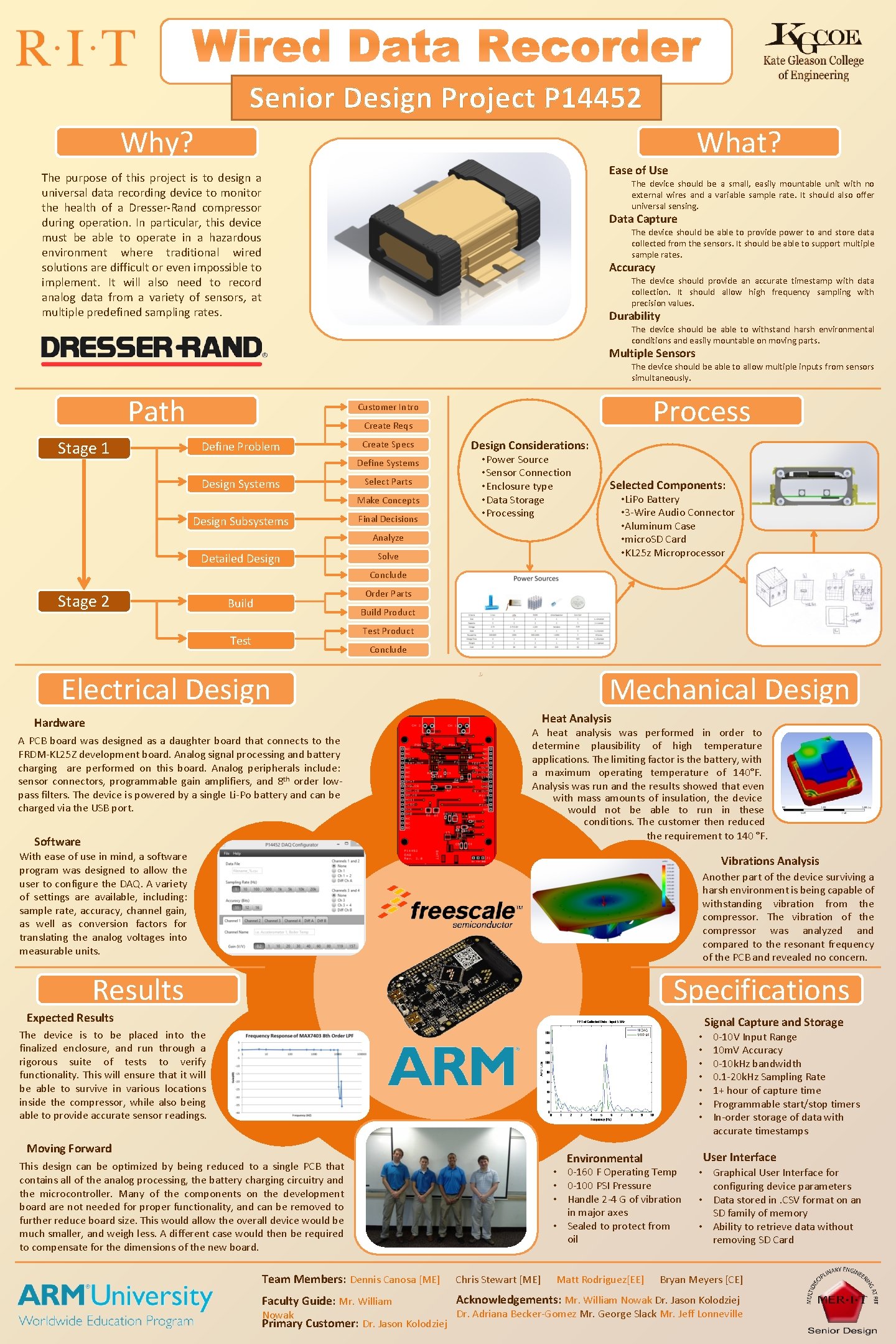
Senior Design Project P 14452 Why? What? Ease of Use The purpose of this project is to design a universal data recording device to monitor the health of a Dresser-Rand compressor during operation. In particular, this device must be able to operate in a hazardous environment where traditional wired solutions are difficult or even impossible to implement. It will also need to record analog data from a variety of sensors, at multiple predefined sampling rates. The device should be a small, easily mountable unit with no external wires and a variable sample rate. It should also offer universal sensing. Data Capture The device should be able to provide power to and store data collected from the sensors. It should be able to support multiple sample rates. Accuracy The device should provide an accurate timestamp with data collection. It should allow high frequency sampling with precision values. Durability The device should be able to withstand harsh environmental conditions and easily mountable on moving parts. Multiple Sensors The device should be able to allow multiple inputs from sensors simultaneously. Path Stage 1 Process Customer Intro Create Reqs Define Problem Create Specs Define Systems Design Systems Select Parts Make Concepts Design Subsystems Final Decisions Design Considerations: • Power Source • Sensor Connection • Enclosure type • Data Storage • Processing Selected Components: • Li. Po Battery • 3 -Wire Audio Connector • Aluminum Case • micro. SD Card • KL 25 z Microprocessor Analyze Detailed Design Solve Conclude Stage 2 Order Parts Build Product Test Conclude Electrical Design Mechanical Design Heat Analysis Hardware A PCB board was designed as a daughter board that connects to the FRDM-KL 25 Z development board. Analog signal processing and battery charging are performed on this board. Analog peripherals include: sensor connectors, programmable gain amplifiers, and 8 th order lowpass filters. The device is powered by a single Li-Po battery and can be charged via the USB port. Software A heat analysis was performed in order to determine plausibility of high temperature applications. The limiting factor is the battery, with a maximum operating temperature of 140°F. Analysis was run and the results showed that even with mass amounts of insulation, the device would not be able to run in these conditions. The customer then reduced the requirement to 140 °F. With ease of use in mind, a software program was designed to allow the user to configure the DAQ. A variety of settings are available, including: sample rate, accuracy, channel gain, as well as conversion factors for translating the analog voltages into measurable units. Vibrations Analysis Another part of the device surviving a harsh environment is being capable of withstanding vibration from the compressor. The vibration of the compressor was analyzed and compared to the resonant frequency of the PCB and revealed no concern. Results Specifications Expected Results Signal Capture and Storage The device is to be placed into the finalized enclosure, and run through a rigorous suite of tests to verify functionality. This will ensure that it will be able to survive in various locations inside the compressor, while also being able to provide accurate sensor readings. • • Moving Forward Environmental This design can be optimized by being reduced to a single PCB that contains all of the analog processing, the battery charging circuitry and the microcontroller. Many of the components on the development board are not needed for proper functionality, and can be removed to further reduce board size. This would allow the overall device would be much smaller, and weigh less. A different case would then be required to compensate for the dimensions of the new board. 0 -10 V Input Range 10 m. V Accuracy 0 -10 k. Hz bandwidth 0. 1 -20 k. Hz Sampling Rate 1+ hour of capture time Programmable start/stop timers In-order storage of data with accurate timestamps User Interface • 0 -160 F Operating Temp • 0 -100 PSI Pressure • Handle 2 -4 G of vibration in major axes • Sealed to protect from oil • Graphical User Interface for configuring device parameters • Data stored in. CSV format on an SD family of memory • Ability to retrieve data without removing SD Card Team Members: Dennis Canosa [ME] Chris Stewart [ME] Faculty Guide: Mr. William Acknowledgements: Mr. William Nowak Dr. Jason Kolodziej Nowak Primary Customer: Dr. Jason Kolodziej Matt Rodriguez[EE] Bryan Meyers [CE] Dr. Adriana Becker-Gomez Mr. George Slack Mr. Jeff Lonneville