
Senator Walter Boasso St Bernard Parish Chamber Meeting
Senator Walter Boasso • St. Bernard Parish Chamber Meeting 2 -18 -2004
Budgetary Pie Charts Financial Data
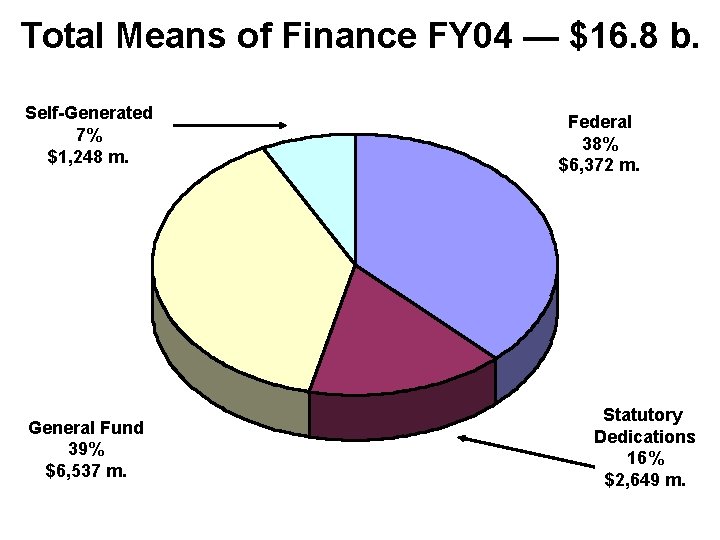
Total Means of Finance FY 04 — $16. 8 b. Self-Generated 7% $1, 248 m. General Fund 39% $6, 537 m. Federal 38% $6, 372 m. Statutory Dedications 16% $2, 649 m.
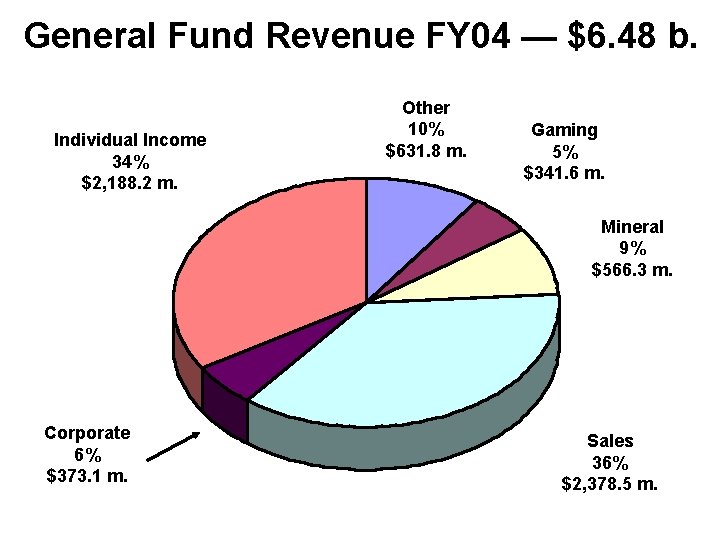
General Fund Revenue FY 04 — $6. 48 b. Individual Income 34% $2, 188. 2 m. Other 10% $631. 8 m. Gaming 5% $341. 6 m. Mineral 9% $566. 3 m. Corporate 6% $373. 1 m. Sales 36% $2, 378. 5 m.
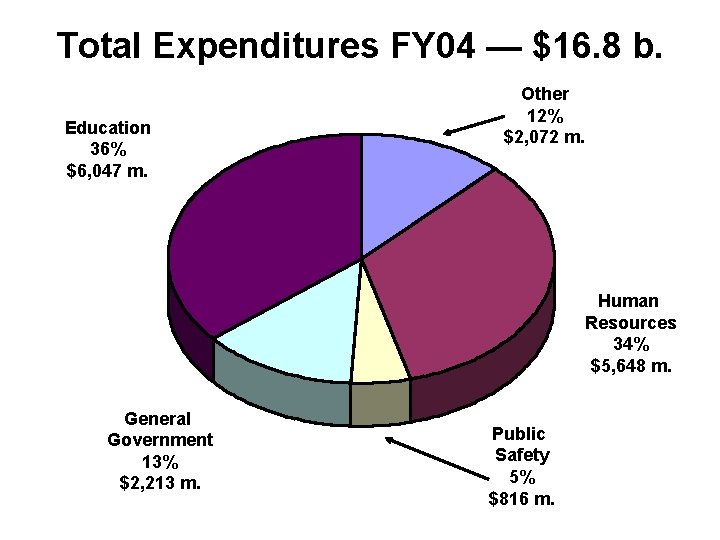
Total Expenditures FY 04 — $16. 8 b. Education 36% $6, 047 m. Other 12% $2, 072 m. Human Resources 34% $5, 648 m. General Government 13% $2, 213 m. Public Safety 5% $816 m.
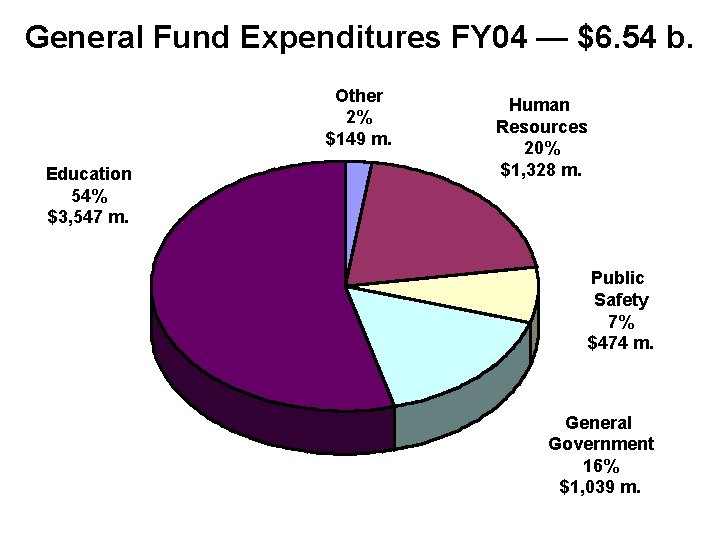
General Fund Expenditures FY 04 — $6. 54 b. Other 2% $149 m. Education 54% $3, 547 m. Human Resources 20% $1, 328 m. Public Safety 7% $474 m. General Government 16% $1, 039 m.
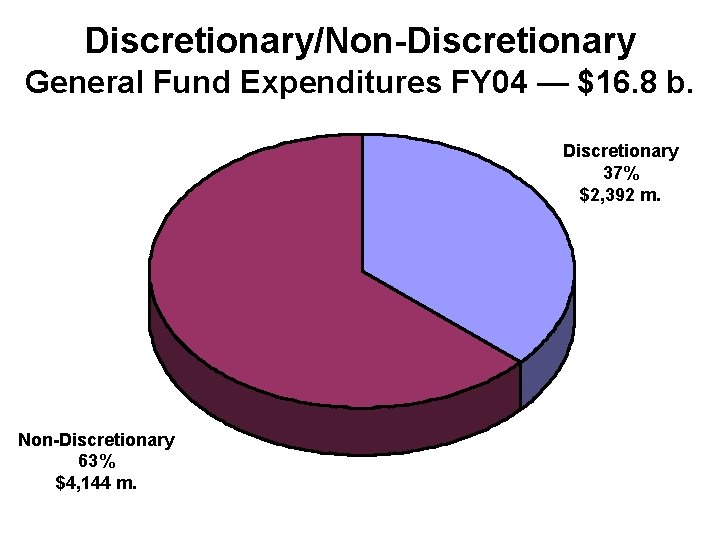
Discretionary/Non-Discretionary General Fund Expenditures FY 04 — $16. 8 b. Discretionary 37% $2, 392 m. Non-Discretionary 63% $4, 144 m.
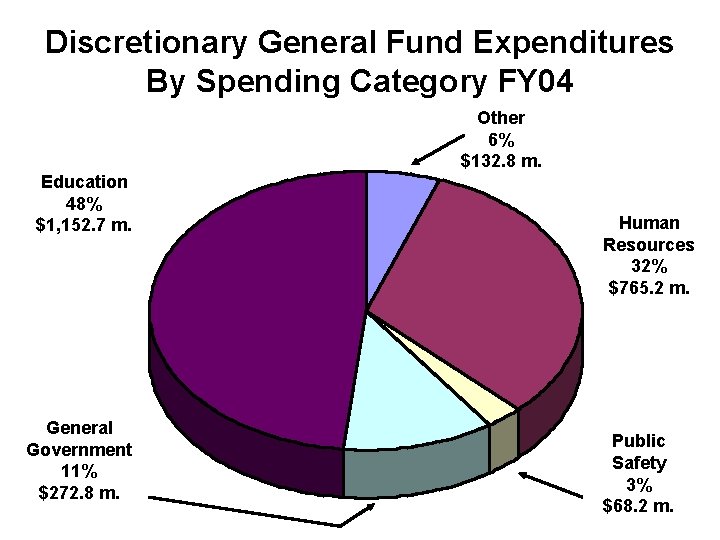
Discretionary General Fund Expenditures By Spending Category FY 04 Other 6% $132. 8 m. Education 48% $1, 152. 7 m. General Government 11% $272. 8 m. Human Resources 32% $765. 2 m. Public Safety 3% $68. 2 m.
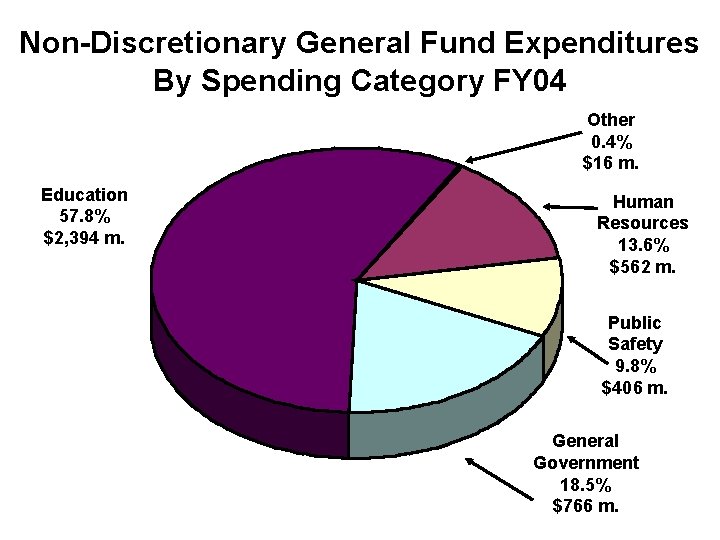
Non-Discretionary General Fund Expenditures By Spending Category FY 04 Other 0. 4% $16 m. Education 57. 8% $2, 394 m. Human Resources 13. 6% $562 m. Public Safety 9. 8% $406 m. General Government 18. 5% $766 m.
Major Fiscal Issues Challenges for FY 05 As of Feb. 10, 2004
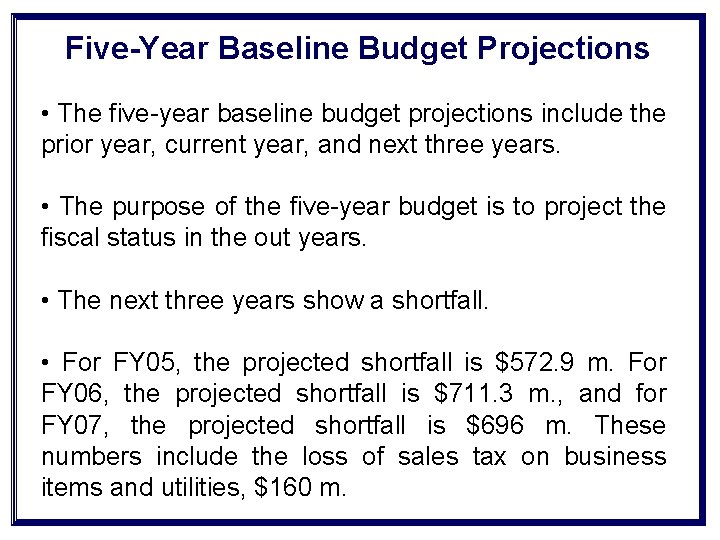
Five-Year Baseline Budget Projections • The five-year baseline budget projections include the prior year, current year, and next three years. • The purpose of the five-year budget is to project the fiscal status in the out years. • The next three years show a shortfall. • For FY 05, the projected shortfall is $572. 9 m. For FY 06, the projected shortfall is $711. 3 m. , and for FY 07, the projected shortfall is $696 m. These numbers include the loss of sales tax on business items and utilities, $160 m.
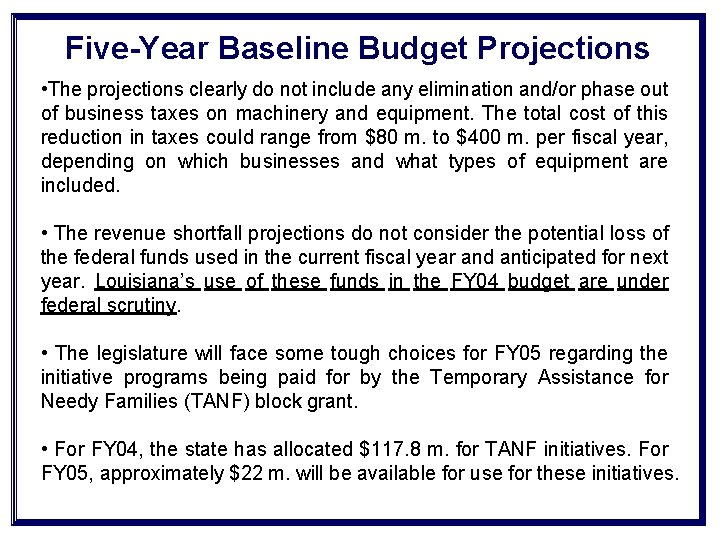
Five-Year Baseline Budget Projections • The projections clearly do not include any elimination and/or phase out of business taxes on machinery and equipment. The total cost of this reduction in taxes could range from $80 m. to $400 m. per fiscal year, depending on which businesses and what types of equipment are included. • The revenue shortfall projections do not consider the potential loss of the federal funds used in the current fiscal year and anticipated for next year. Louisiana’s use of these funds in the FY 04 budget are under federal scrutiny. • The legislature will face some tough choices for FY 05 regarding the initiative programs being paid for by the Temporary Assistance for Needy Families (TANF) block grant. • For FY 04, the state has allocated $117. 8 m. for TANF initiatives. For FY 05, approximately $22 m. will be available for use for these initiatives.
Financing Mechanisms in the FY 04 Budget Under Scrutiny by the Federal Government • The FY 04 Medicaid budget contains approximately $233 million in state matching revenues from two funding mechanisms not yet approved for use by the federal government — • the intergovernmental transfer of Medicaid Upper Payment Limits (UPL) payments between non-state, public hospitals and the Medicaid program; and, • the use of the federal portion of the additional 75% of Disproportionate Share (DSH) cost payments at the state hospitals as state match in the Medicaid program. • As of now, the federal Centers for Medicare and Medicaid Services (CMS) has not approved the necessary state plan amendments to generate these revenues. Unless the federal government approves these state plan amendments, the Medicaid program will face a shortfall of nearly $900 million in the current fiscal year. • To further complicate matters, the use of these same funding mechanisms is planned for FY 05. If the mechanisms are no longer possible, the projected deficit for FY 05 will grow. • In any event, the use of the excess 75% of DSH costs will terminate at the end of FY 05 requiring an infusion of state matching funds to replace the recycled federal funding in FY 06.
Increase in the Cap on Federal Financial Participation in Disproportionate Share Payments • The Medicare Prescription Drug, Improvement, and Modernization Act of 2003 contained a provision increasing the cap on federal funding of Medicaid Disproportionate Share (DSH) payments to hospitals by sixteen (16) percent. • For Louisiana, the federal DSH allotment will increase by $101 million to $732 million in Federal Fiscal Year 2004. • If Louisiana can generate the roughly $40 million in required state matching funds, then the additional $101 million may be utilized to reimburse hospitals for health care services for the uninsured. • The Administration is in the process of developing plans to utilize the new federal funds. The JLCB will consider a BA-7 at the Feb. 20 th meeting in the amount of approximately $32 m for a partial restoration to the Charity Hospitals in the amount of $22. 9 m.
Educational Funding Needs • The cost of bringing Louisiana K-12 teachers’ salaries up to the Southern average is approximately $270 million. • The cost of bringing higher education funding to the Southern average is approximately $250 million, which includes about $54 million to bring instructional faculty pay to the Southern average. • Combined, these costs total about $520 million, and even though other states are temporarily suffering budget conditions that are similar if not worse than Louisiana’s, their economies are likely to recover faster than ours. • As their economies recover, they will begin reinvesting in K-12 and higher education, and Louisiana’s cost of reaching “average” funding will for these programs will increase.
Minimum Foundation Program (MFP) • The Minimum Foundation Program (MFP) will require an additional $71 m. to cover normal growth for FY 05. • The MFP typically grows by an amount in excess of $50 m. per year. In FY 04, funding for the MFP totaled $2. 5 billion. • It is one of the many reasons why it costs more each year to provide the same level of government services offered in the prior year.
Risk Management Reserves • Reserves in the state’s self-insurance fund have been gradually depleted because of the underfunding of premiums. • The current reserve balance is approximately $4 million while the actuarial valuation of outstanding claims approaches $1 billion. • Recent district court and appellate court decisions in favor of oyster fishermen who suffered “economic loss” as a result of state sponsored freshwater diversion projects have increased outstanding claims by over $2 billion. • Even though some of the claims may never materialize, and the size of these judgments may eventually be reduced, any amount will be detrimental to the state’s under-funded risk management program.
Potential Federal Liabilities • The federal government contends the state owes it approximately $322 million for violations of federal regulations in the state Medicaid Program for the operation of the Eldercare Program, and an estimated $240 million for the improper billing of DOTD risk management premiums to other federally funded programs. • There is also another $211 million in potential liabilities for DSH overpayments in the Medical Vendor Payments Program. • The likelihood that the state will ever repay all of these liabilities is remote. Nevertheless, with an aggregate value of $773 million, even a small percentage recovery by the federal government could wreck the budget.
Rising Transportation Costs • Revenue generated by the gasoline and special fuels taxes grows at a rate of approximately 1% per year while the cost of highway construction and maintenance increases at an annual rate of 4. 5%. • According to the state Department of Transportation and Development, the state is currently $9 billion behind in highway construction and maintenance, and the gap widens annually.
State Employee Health Insurance • The cost of providing health care insurance for state employees, teachers, and retirees is growing at an annual rate of between 13% and 15%. • The cost of maintaining current benefits grows three to five times faster than general fund revenues. • As the base cost of this employee benefit increases, the high percent annual growth will accelerate the rate at which this program consumes discretionary revenue.
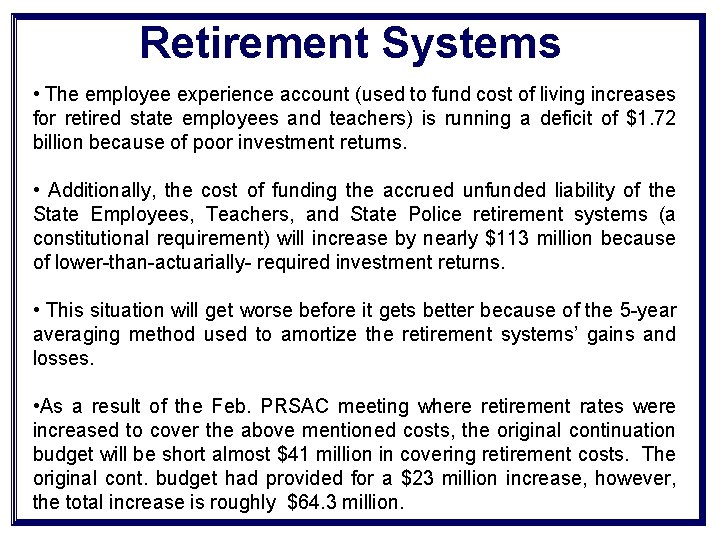
Retirement Systems • The employee experience account (used to fund cost of living increases for retired state employees and teachers) is running a deficit of $1. 72 billion because of poor investment returns. • Additionally, the cost of funding the accrued unfunded liability of the State Employees, Teachers, and State Police retirement systems (a constitutional requirement) will increase by nearly $113 million because of lower-than-actuarially- required investment returns. • This situation will get worse before it gets better because of the 5 -year averaging method used to amortize the retirement systems’ gains and losses. • As a result of the Feb. PRSAC meeting where retirement rates were increased to cover the above mentioned costs, the original continuation budget will be short almost $41 million in covering retirement costs. The original cont. budget had provided for a $23 million increase, however, the total increase is roughly $64. 3 million.
The Minimum Foundation Program FY 05 Budget Issues
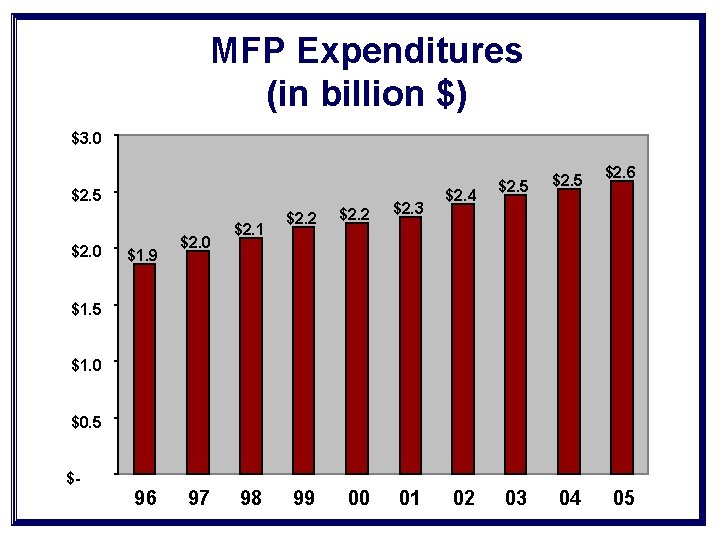
MFP Expenditures (in billion $) $3. 0 $2. 5 $2. 0 $1. 9 $2. 0 $2. 1 $2. 2 $2. 3 99 00 01 $2. 4 $2. 5 $2. 6 03 04 05 $1. 0 $0. 5 $- 96 97 98 02
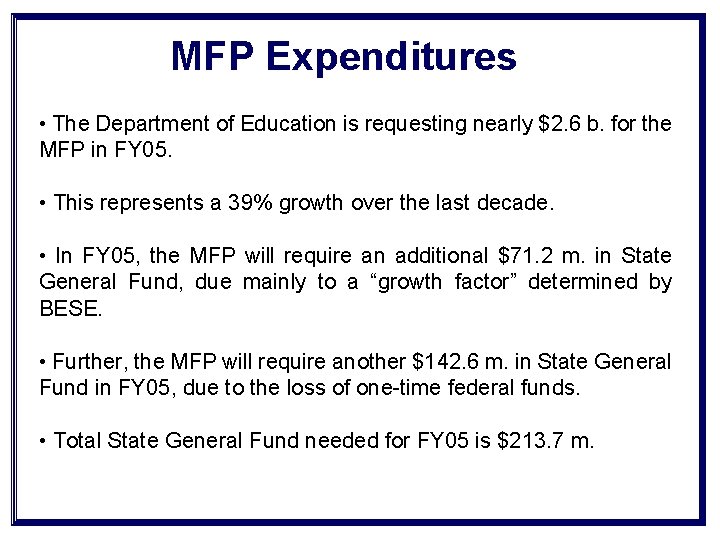
MFP Expenditures • The Department of Education is requesting nearly $2. 6 b. for the MFP in FY 05. • This represents a 39% growth over the last decade. • In FY 05, the MFP will require an additional $71. 2 m. in State General Fund, due mainly to a “growth factor” determined by BESE. • Further, the MFP will require another $142. 6 m. in State General Fund in FY 05, due to the loss of one-time federal funds. • Total State General Fund needed for FY 05 is $213. 7 m.
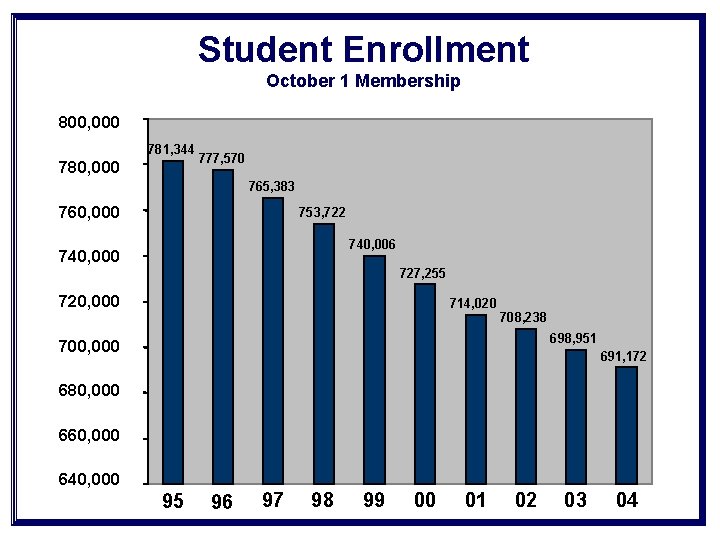
Student Enrollment October 1 Membership 800, 000 781, 344 777, 570 765, 383 760, 000 753, 722 740, 006 740, 000 727, 255 720, 000 714, 020 708, 238 698, 951 700, 000 691, 172 680, 000 660, 000 640, 000 95 96 97 98 99 00 01 02 03 04
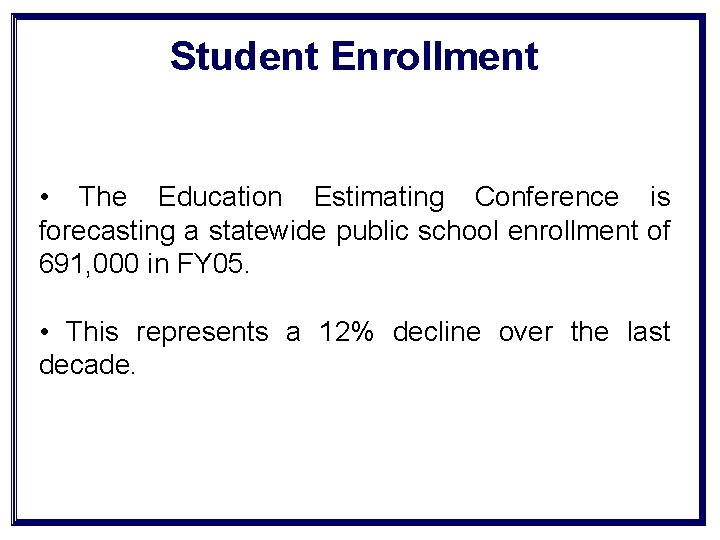
Student Enrollment • The Education Estimating Conference is forecasting a statewide public school enrollment of 691, 000 in FY 05. • This represents a 12% decline over the last decade.
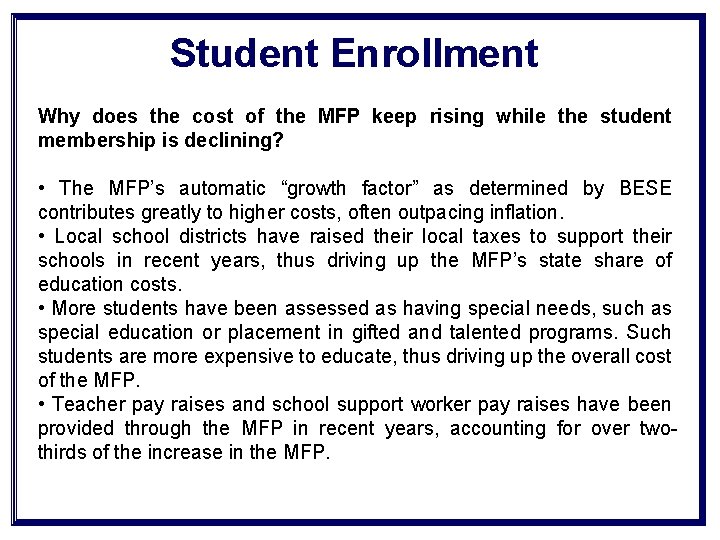
Student Enrollment Why does the cost of the MFP keep rising while the student membership is declining? • The MFP’s automatic “growth factor” as determined by BESE contributes greatly to higher costs, often outpacing inflation. • Local school districts have raised their local taxes to support their schools in recent years, thus driving up the MFP’s state share of education costs. • More students have been assessed as having special needs, such as special education or placement in gifted and talented programs. Such students are more expensive to educate, thus driving up the overall cost of the MFP. • Teacher pay raises and school support worker pay raises have been provided through the MFP in recent years, accounting for over twothirds of the increase in the MFP.
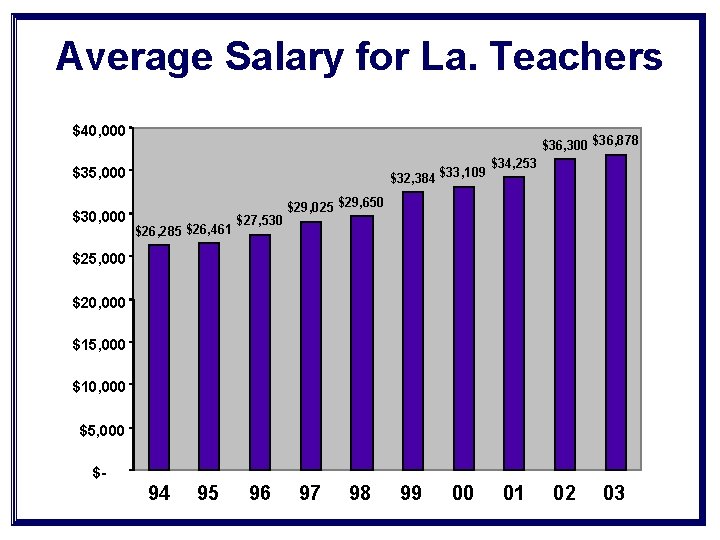
Average Salary for La. Teachers $40, 000 $36, 300 $36, 878 $35, 000 $30, 000 $32, 384 $33, 109 $26, 285 $26, 461 $27, 530 $34, 253 $29, 025 $29, 650 $25, 000 $20, 000 $15, 000 $10, 000 $5, 000 $- 94 95 96 97 98 99 00 01 02 03
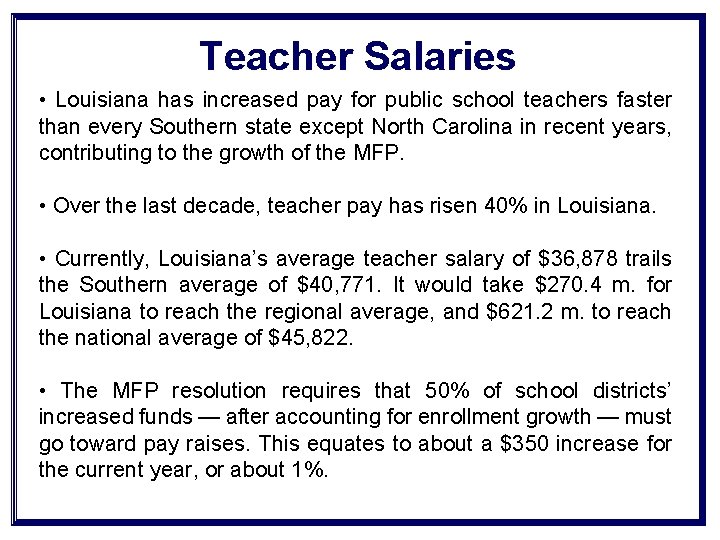
Teacher Salaries • Louisiana has increased pay for public school teachers faster than every Southern state except North Carolina in recent years, contributing to the growth of the MFP. • Over the last decade, teacher pay has risen 40% in Louisiana. • Currently, Louisiana’s average teacher salary of $36, 878 trails the Southern average of $40, 771. It would take $270. 4 m. for Louisiana to reach the regional average, and $621. 2 m. to reach the national average of $45, 822. • The MFP resolution requires that 50% of school districts’ increased funds — after accounting for enrollment growth — must go toward pay raises. This equates to about a $350 increase for the current year, or about 1%.
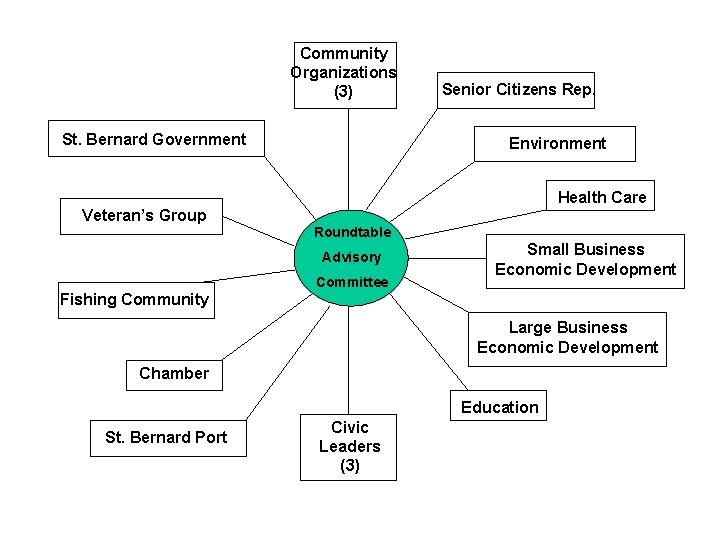
Community Organizations (3) St. Bernard Government Senior Citizens Rep. Environment Health Care Veteran’s Group Roundtable Advisory Fishing Community Committee Small Business Economic Development Large Business Economic Development Chamber Education St. Bernard Port Civic Leaders (3)
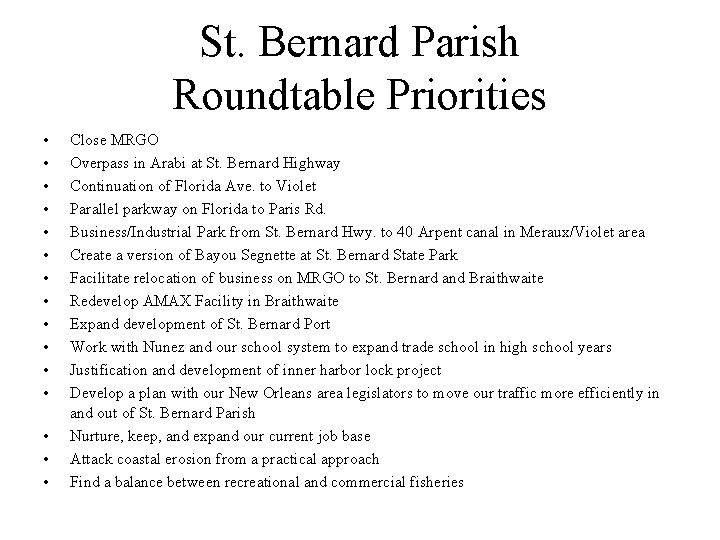
St. Bernard Parish Roundtable Priorities • • • • Close MRGO Overpass in Arabi at St. Bernard Highway Continuation of Florida Ave. to Violet Parallel parkway on Florida to Paris Rd. Business/Industrial Park from St. Bernard Hwy. to 40 Arpent canal in Meraux/Violet area Create a version of Bayou Segnette at St. Bernard State Park Facilitate relocation of business on MRGO to St. Bernard and Braithwaite Redevelop AMAX Facility in Braithwaite Expand development of St. Bernard Port Work with Nunez and our school system to expand trade school in high school years Justification and development of inner harbor lock project Develop a plan with our New Orleans area legislators to move our traffic more efficiently in and out of St. Bernard Parish Nurture, keep, and expand our current job base Attack coastal erosion from a practical approach Find a balance between recreational and commercial fisheries
Concurrent Priorities • Gather all information on what’s pending in St. Bernard • Assembling Roundtable • St. Bernard Legislative Alliance 1 -888 -W-BOASSO (1 -888 -926 -2776)
- Slides: 32