
SEN Assessment and Progress CSP Senco Networks Kathryn


- Slides: 36
SEN Assessment and Progress – CSP Senco Networks Kathryn Parkinson Educational Psychologist PIVOT Associate
Overview of the morning • Catch up and review of how PIVOT delivery is going for you. What else would be helpful? • Observation as a method of assessment • Is it all about the numbers? • What is happening in your school now?
Formative and summative assessment • Assessment serves a range of functions. It can be used for either formative or summative purposes. An assessment is formative if it is used to help inform teaching and lesson planning. It can enable teachers to identify any gaps or misconceptions and can help them to plan the necessary steps towards learning for their pupils. Formative assessment is an on-going process that takes place on a day-to-day basis in the classroom. • A summative assessment is carried out at the end of a course of study, period of time or unit of work to summarise and evaluate pupils’ knowledge and understanding. It can also be used to measure the progress pupils have made from a previous summative assessment.
Accountability • Schools are held to account in a number of ways: • directly by parents, carers and school governors • through published data in the performance tables and floor standards • through inspection
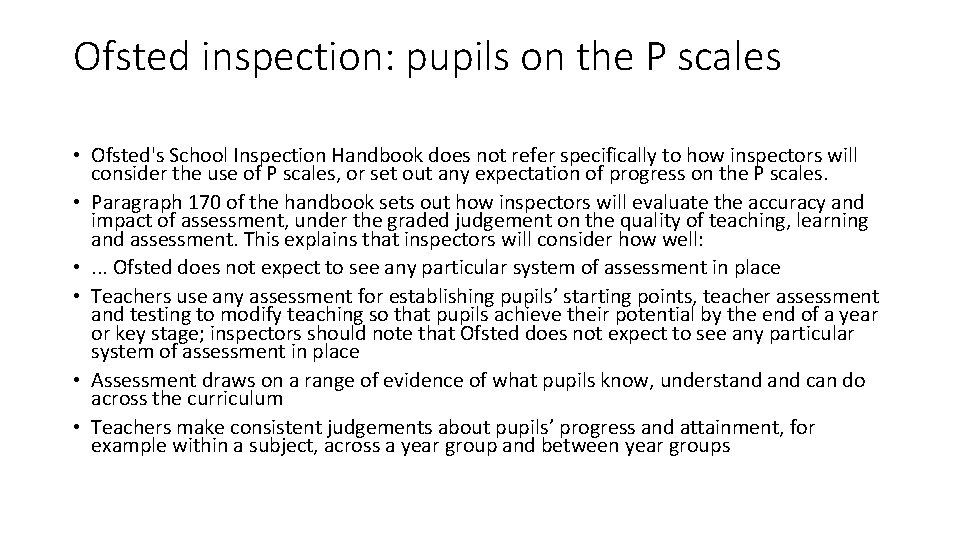
Ofsted inspection: pupils on the P scales • Ofsted's School Inspection Handbook does not refer specifically to how inspectors will consider the use of P scales, or set out any expectation of progress on the P scales. • Paragraph 170 of the handbook sets out how inspectors will evaluate the accuracy and impact of assessment, under the graded judgement on the quality of teaching, learning and assessment. This explains that inspectors will consider how well: • . . . Ofsted does not expect to see any particular system of assessment in place • Teachers use any assessment for establishing pupils’ starting points, teacher assessment and testing to modify teaching so that pupils achieve their potential by the end of a year or key stage; inspectors should note that Ofsted does not expect to see any particular system of assessment in place • Assessment draws on a range of evidence of what pupils know, understand can do across the curriculum • Teachers make consistent judgements about pupils’ progress and attainment, for example within a subject, across a year group and between year groups
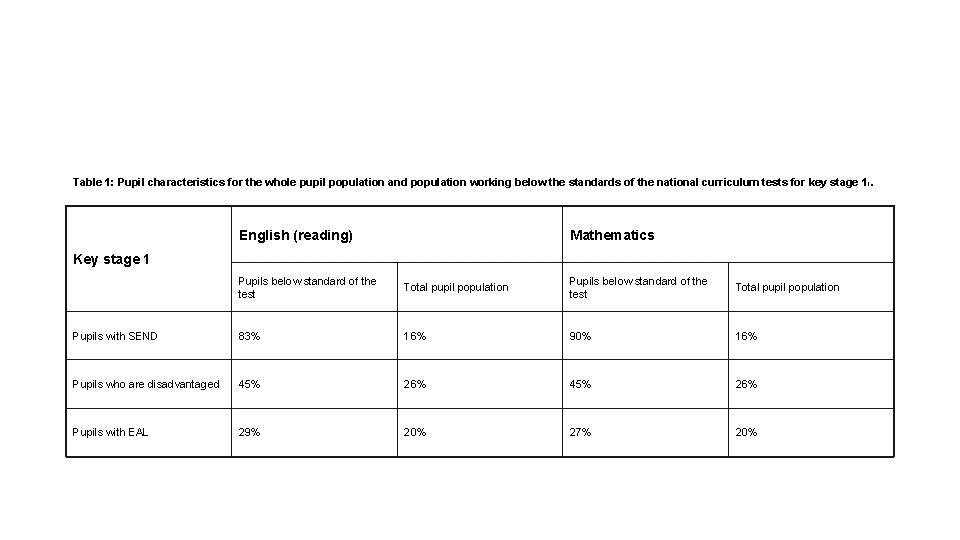
Table 1: Pupil characteristics for the whole pupil population and population working below the standards of the national curriculum tests for key stage 11. English (reading) Mathematics Key stage 1 Pupils below standard of the test Total pupil population Pupils with SEND 83% 16% 90% 16% Pupils who are disadvantaged 45% 26% Pupils with EAL 29% 20% 27% 20%
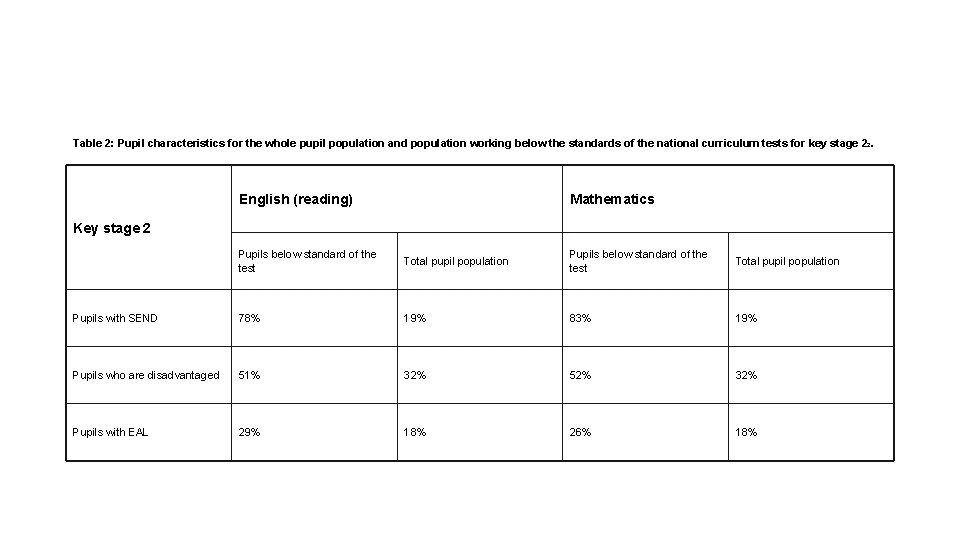
Table 2: Pupil characteristics for the whole pupil population and population working below the standards of the national curriculum tests for key stage 22. English (reading) Mathematics Key stage 2 Pupils below standard of the test Total pupil population Pupils with SEND 78% 19% 83% 19% Pupils who are disadvantaged 51% 32% 52% 32% Pupils with EAL 29% 18% 26% 18%
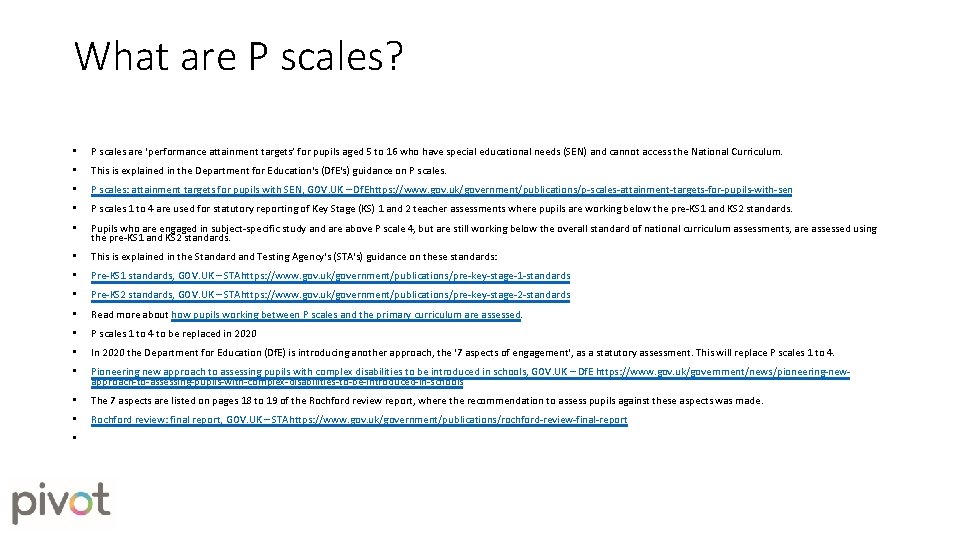
What are P scales? • P scales are ‘performance attainment targets’ for pupils aged 5 to 16 who have special educational needs (SEN) and cannot access the National Curriculum. • This is explained in the Department for Education's (Df. E's) guidance on P scales. • P scales: attainment targets for pupils with SEN, GOV. UK – Df. Ehttps: //www. gov. uk/government/publications/p-scales-attainment-targets-for-pupils-with-sen • P scales 1 to 4 are used for statutory reporting of Key Stage (KS) 1 and 2 teacher assessments where pupils are working below the pre-KS 1 and KS 2 standards. • Pupils who are engaged in subject-specific study and are above P scale 4, but are still working below the overall standard of national curriculum assessments, are assessed using the pre-KS 1 and KS 2 standards. • This is explained in the Standard and Testing Agency's (STA's) guidance on these standards: • Pre-KS 1 standards, GOV. UK – STAhttps: //www. gov. uk/government/publications/pre-key-stage-1 -standards • Pre-KS 2 standards, GOV. UK – STAhttps: //www. gov. uk/government/publications/pre-key-stage-2 -standards • Read more about how pupils working between P scales and the primary curriculum are assessed. • P scales 1 to 4 to be replaced in 2020 • In 2020 the Department for Education (Df. E) is introducing another approach, the '7 aspects of engagement', as a statutory assessment. This will replace P scales 1 to 4. • Pioneering new approach to assessing pupils with complex disabilities to be introduced in schools, GOV. UK – Df. E https: //www. gov. uk/government/news/pioneering-newapproach-to-assessing-pupils-with-complex-disabilities-to-be-introduced-in-schools • The 7 aspects are listed on pages 18 to 19 of the Rochford review report, where the recommendation to assess pupils against these aspects was made. • Rochford review: final report, GOV. UK – STAhttps: //www. gov. uk/government/publications/rochford-review-final-report •
P scales 1 to 4 to be replaced in 2020 • In 2020 the Department for Education (Df. E) is introducing another approach, the '7 aspects of engagement', as a statutory assessment. This will replace P scales 1 to 4. • Pioneering new approach to assessing pupils with complex disabilities to be introduced in schools, GOV. UK – Df. E https: //www. gov. uk/government/news/pioneering-new-approach-toassessing-pupils-with-complex-disabilities-to-be-introduced-in-schools • The 7 aspects are listed on pages 18 to 19 of the Rochford review report, where the recommendation to assess pupils against these aspects was made. • Rochford review: final report, GOV. UK – STAhttps: //www. gov. uk/government/publications/rochford-review-finalreport
The Rochford Review • • The following key principles have guided this work: • • Equality is not always about inclusion. Sometimes equality is about altering the approach according to the needs of the pupils. Every pupil should be able to demonstrate his or her attainment and progress. Parents and carers should receive meaningful information about the achievement and progress their child makes and should be involved appropriately in assessment processes. Assessment for pupils with SEND should take into account the complexity, nature and combination of SEND. It should take account of recent SEND reforms including the introduction of Education Health and Care plans (EHC plans). As far as possible, there should be one assessment system for all pupils, so long as this is meaningful and appropriate for the pupils in question. The recommended approach to assessment should cover key milestones in English/literacy and mathematics/ numeracy. Curriculum should drive assessment and not the other way round. Key milestones should be clear and unambiguous. It should be possible to assess movement between milestones objectively. It should also be possible to assess the application of knowledge, understanding and skills in a range of different contexts. The language used to describe the achievements and progress of these pupils should always be positive, inclusive and should be jargon free.
Aspects of engagement • The Complex Learning Disabilities and Difficulties project identified 7 areas of engagement for learning against which pupils can be assessed. These inter- related indicators can be used to inform the assessment of pupils with severe or profound and multiple learning difficulties and to provide evidence of pupil progress. The different indicators should not be viewed in a strict hierarchical sense, but more as a guide for assessing a pupil’s effective engagement in the learning process. • The 7 areas of engagement can be used as an observational framework to monitor the varying ways in which, and degrees to which, a pupil demonstrates attention, interest and involvement in new learning. They provide the scaffolding that will enable a pupil ultimately to become autonomous in the acquisition of a new skill or concept. • The skills and concepts pupils acquire through the application of these indicators form the necessary foundations for moving on to later subject-specific learning. Statutory assessment of these aspects of engagement will therefore provide a solid basis for moving on to the subject-specific assessment defined in the early pre-key stage standards.
The 7 aspects of engagement are as follows: • Responsiveness: Assessment of responsiveness should evaluate any change in a pupil’s behaviour that demonstrates he or she is being attentive to a new stimulus or reacting in a meaningful way. This type of assessment is important for establishing what differing stimuli motivate a pupil to pay attention. This is a pre- requisite for learning. It is particularly relevant for assessing pupils with multiple sensory needs which are reduced and/or atypical sensory awareness and perception.
• Curiosity: Assessment of curiosity demonstrates how a pupil is building on an initial reaction to a new stimulus, perhaps by reaching out or seeking the source of a new stimulus. • Discovery: Assessment of discovery provides information about the changing ways in which a pupil interacts with, or responds to, a new stimulus, sometimes accompanied by expressions such as enjoyment and excitement. Curiosity and discovery are closely linked. At a more advanced point of development they both help to demonstrate a pupil’s degree of interest in, and exploration of, activities and concepts. These both help to drive the acquisition of new knowledge and skills. • Anticipation: Assessment of anticipation should demonstrate whether a pupil is able to predict, expect or associate a particular stimulus with an event. This is important for measuring a pupil’s concept of cause and effect.
• Persistence: Assessment of persistence measures the extent to which a pupil is sustaining attention towards a particular item or action and is therefore beginning to develop conceptual understanding. The ability to sustain attention is important for maintaining an activity long enough to develop the learning associated with it and for consolidating that learning. • Initiation: Assessment of initiation demonstrates the different ways, and extent to which, a pupil investigates an activity or stimulus in order to bring about a desired outcome. It is an important part of developing the autonomy required for more advanced cognitive development and learning.
• Investigation: Assessment of investigation measures the extent to which a pupil is actively trying to find out more about an object or activity via prolonged, independent experimentation. This demonstrates a more advanced degree of autonomy than the other aspects of engagement and is important for ongoing learning.
Recommendation 9 from the Rochford report • There is currently a statutory duty to submit P scales data to the Df. E. The review is recommending a statutory duty to assess pupils not engaged in subject specific-learning on the 7 areas of cognition and learning. • The review believes that there should be no requirement to submit this assessment information to the Df. E, but schools should be required to report the number of pupils working below the pre-key stage standards. In addition schools must be able to provide evidence to support a dialogue with parents and carers, inspectors, school governors and those engaged in peer review to ensure robust and effective accountability for assessing pupils not engaged in subject specific-learning with SEND.
So how do we assess these areas? • What is already happening in your schools? • Be prepared to share your practice and ideas in the group.
Comfort Break
Observation… • Observation of learners, particularly those with SEND, provides a foundation for assessment of, and planning for, tasks and activities that will meet their needs and impact on their progress. There are many different types of observations that can be used in schools and settings and it is important for teachers and practitioners to use a variety of observation methods to give a holistic picture of learners’ needs. • There a number of different ways to observe children.
Narrative Observation • Several periods of 5 -10 minutes across different activities, times of the day and days of the week, are planned for where the observer watches and records everything the child does. These observations will show what a child does when they are not being directed, whether they are able to make a choice of activity and how long they focus on something they have chosen to do.
Structured Observation • For periods of 5 -10 minutes, across different activities and times of the day, the observer looks out for a particular behaviour and marks each time the child performs this focus behaviour. This could be starting a conversation with an adult, taking turns or changing from one activity to another. The record will show the frequency of a particular behaviour, for example, a child may only initiate conversation with one particular adult in the setting.
Spidergraphs • The observer sketches a plan of the setting or classroom with all activity areas marked. Over a period of 5 -10 minutes, they mark the child’s journey around the setting, noting how long they spend at particular activities. The record will show where a child chooses to go, if they are engaging fully in anything and if they are avoiding particular areas that might require a particular skill, for example the graphics table or the reading corner.
Incidental notes • These could be sticky notes, incident records or home/setting diaries which help to identify patterns in behaviour or common circumstances. It can be helpful to sort notes by different criteria such as time of the day, day of the week, adult-led or child-initiated activity to provide information to form a more holistic picture of learners which can easily be missed.
Anecdotal Record • This focuses on what is significant and is recorded in sequential order after an event has occurred. The observer records what the learner has said and done and can include direct quotes. It is a useful method for recording significant actions or events that provide information about the child’s skills, abilities, interests and needs.
Running Record • A running record, not to be confused with a running record completed whilst a child is reading, gives an account of a child’s behaviour by detailing everything a child says over a period of 5 -10 minutes or during time increments, for example, every 3 minutes over a half hour period. They provide in depth information and are useful in determining why a child is behaving in a particular way, for example, refusing to read or becoming upset in Maths lessons.
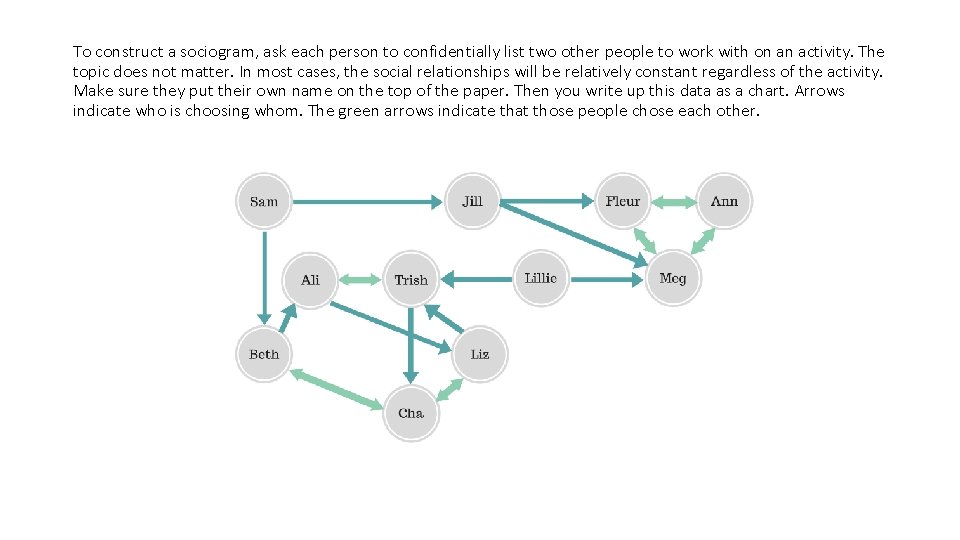
Sociogram • This technique can be used across all age groups and involves the observer mapping a child or young person’s interactions or friendships within a group during social times such as break times or lunch times. It provides a clear indication of whom a child prefers to socialise with and if they need support with social skills.
To construct a sociogram, ask each person to confidentially list two other people to work with on an activity. The topic does not matter. In most cases, the social relationships will be relatively constant regardless of the activity. Make sure they put their own name on the top of the paper. Then you write up this data as a chart. Arrows indicate who is choosing whom. The green arrows indicate that those people chose each other.
Time Sample Observation • This involves the observer recording the occurrence of a particular behaviour throughout the day with a tally and a note of the time and length of time that the behaviour occurred. It could be used to reduce negative behaviour by giving an insight into why and when it occurs during the day.
Event Sample Observation • Short observations of a child’s response in a situation. The observer records the child’s behaviour pattern which gives an indication of why the behaviour is happening. If antecedents and consequences to the behaviour are identified, strategies are likely to be found to support the child more effectively. For example, stress triggers could be identified for an autistic child and strategies put into place to remove or reduce them, which could have significant effects on the child’s learning.
Observation Checklists • Observation checklists allow teachers to record information quickly about how students perform in relation to specific objectives and outcomes. Written in a yes/no format with space for any additional notes of observations not covered in the checklist, they can be used to assist in observing student performance as an individual or in a group. Before using an observation checklist it should be made clear to students what information will be gathered and how it will be used. They should be dated to provide a record over time.
Guidance for using an observation checklist • Determine specific outcomes to observe and assess. • Write down criteria or evidence that indicate the student is demonstrating the outcome. • Ensure students know and understand what the criteria are. • Target your observation by selecting four to five students per class and two or three specific outcomes to observe. • Share observations with students, both individually and in a group. Make the observations specific and describe how this demonstrates thinking and learning. For example: "Ben, you contributed several ideas to your group's design plan. You really helped your group finish their task within the time limit. " • Use the information gathered from observation to enhance or modify future learning.
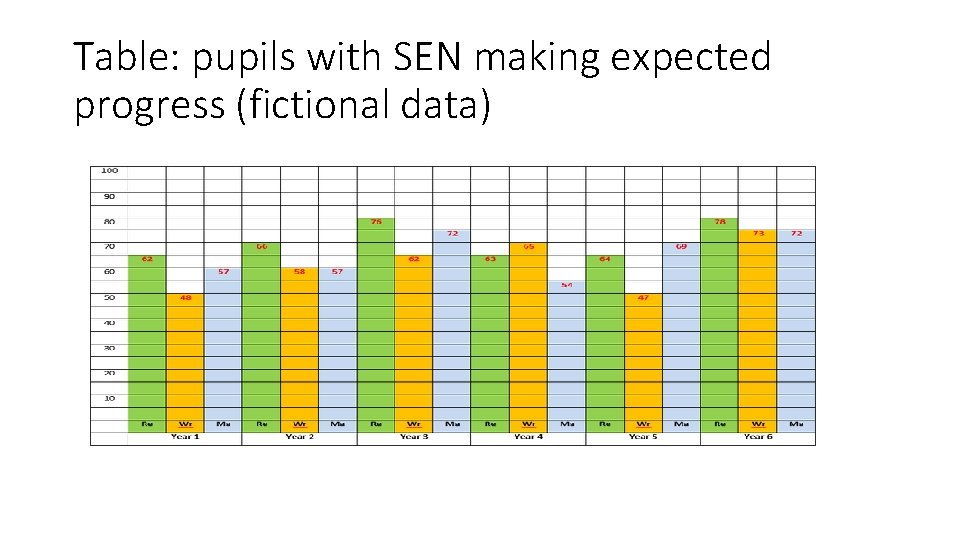
Table: pupils with SEN making expected progress (fictional data)
What does the data show us? • The numbers in red show the exact number of pupils with SEN for that subject and year group who made expected progress during that term. • Presenting the data in a visual way helps to see patterns and trends. Using the table above, it is easy to see from the data that, for example: • The number of pupils achieving expected progress in writing improves year on year, except for in year 5 where there is a sudden dip • Areas most in need of development are writing in years 1 and 5, and maths in year 4 • Pupils make most progress in year 6
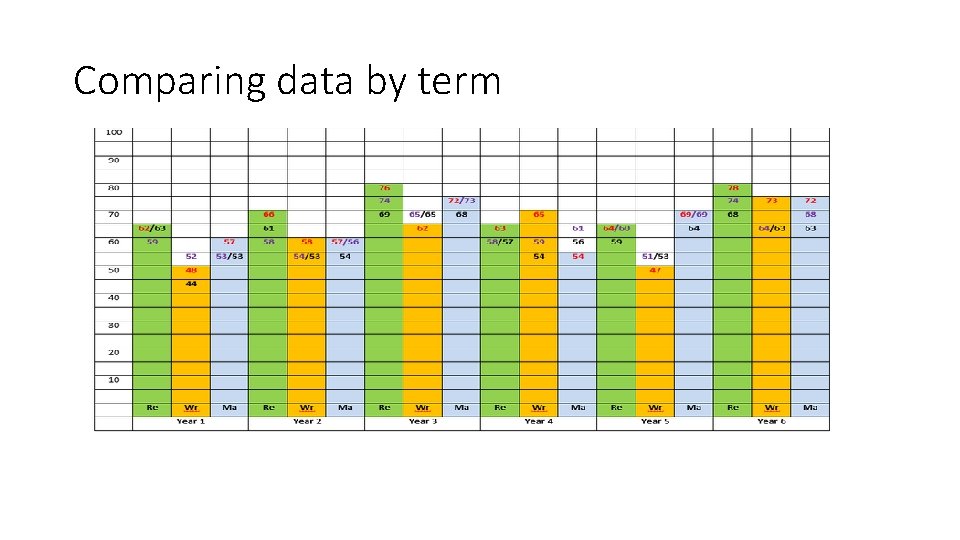
Comparing data by term
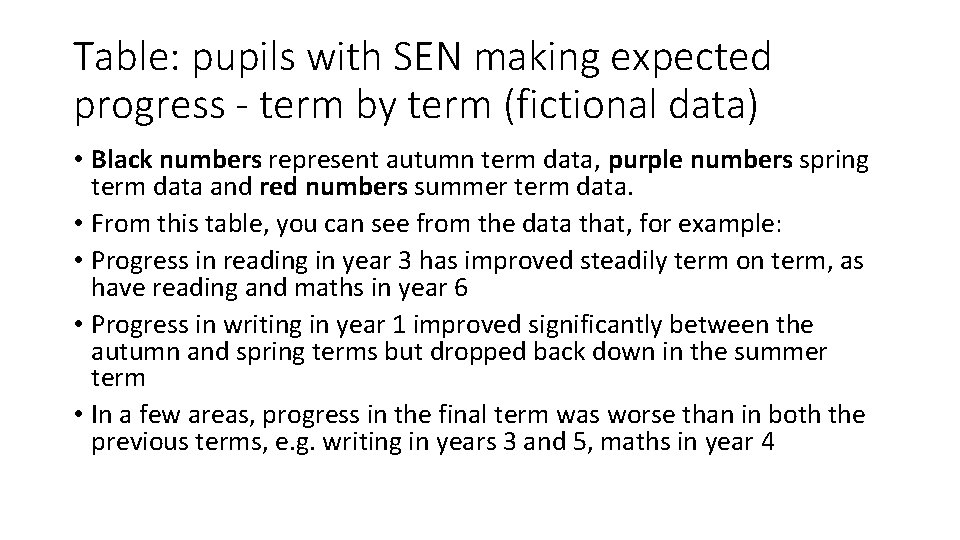
Table: pupils with SEN making expected progress - term by term (fictional data) • Black numbers represent autumn term data, purple numbers spring term data and red numbers summer term data. • From this table, you can see from the data that, for example: • Progress in reading in year 3 has improved steadily term on term, as have reading and maths in year 6 • Progress in writing in year 1 improved significantly between the autumn and spring terms but dropped back down in the summer term • In a few areas, progress in the final term was worse than in both the previous terms, e. g. writing in years 3 and 5, maths in year 4