
Semisolid external preparations External preparations Applied to the
- Slides: 56
Semisolid external preparations
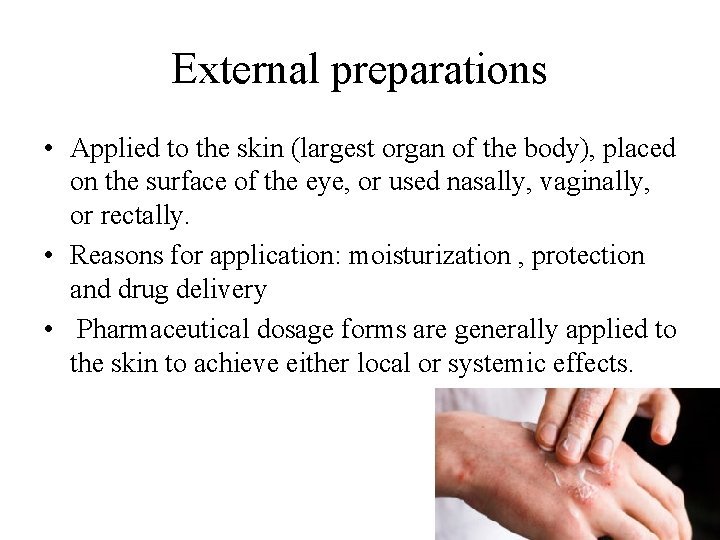
External preparations • Applied to the skin (largest organ of the body), placed on the surface of the eye, or used nasally, vaginally, or rectally. • Reasons for application: moisturization , protection and drug delivery • Pharmaceutical dosage forms are generally applied to the skin to achieve either local or systemic effects.
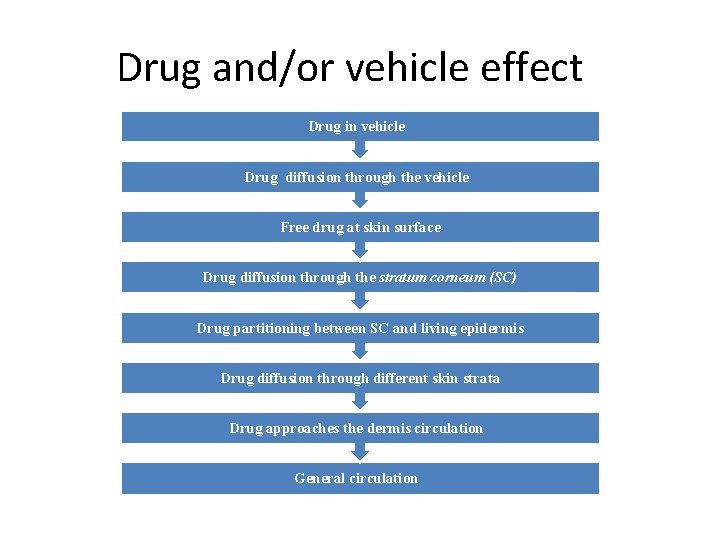
Topical vs transdermal • Once through the stratum corneum, drug molecules may pass through the deeper epidermal tissue and into the dermis. If the drug reaches the vascularized dermal layer, it becomes available for absorption into the general circulation, resulting in wanted/unwanted systemic side effects. • In general, drug penetration through skin depends on: ØThe drug: physicochemical properties of the API. ØThe vehicle: characteristics of the pharmaceutical vehicle. ØThe skin: conditions of the skin itself.
Permeability through the skin • Major barrier is the stratum corneum • Brick and mortar model • Three different pathways for drug permeation ü Transcellular ü Intercellular ü Transappendageal • A drug to passively permeate through the skin should be of ü Low molecular weight ü Balanced hydophlicity/ lipophilicity
Drug and/or vehicle effect Drug in vehicle Drug diffusion through the vehicle Free drug at skin surface Drug diffusion through the stratum corneum (SC) Drug partitioning between SC and living epidermis Drug diffusion through different skin strata Drug approaches the dermis circulation General circulation
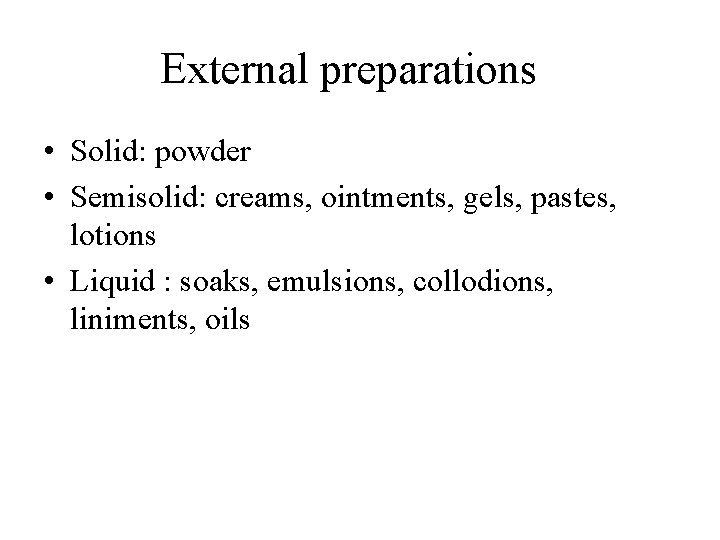
External preparations • Solid: powder • Semisolid: creams, ointments, gels, pastes, lotions • Liquid : soaks, emulsions, collodions, liniments, oils
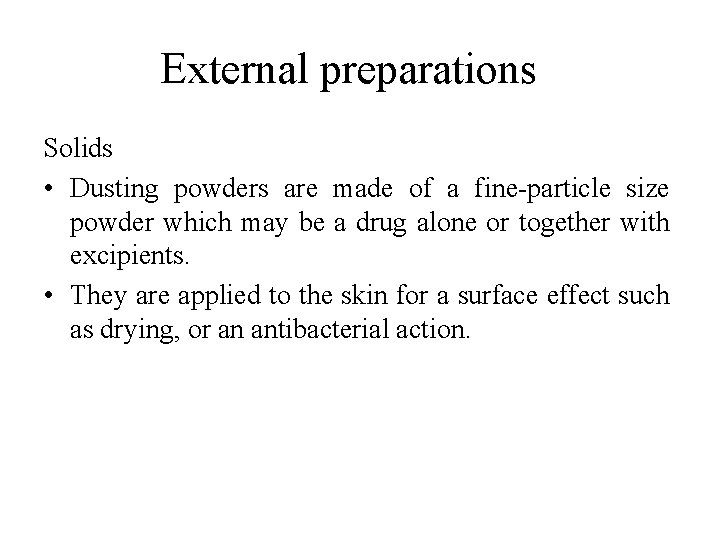
External preparations Solids • Dusting powders are made of a fine-particle size powder which may be a drug alone or together with excipients. • They are applied to the skin for a surface effect such as drying, or an antibacterial action.
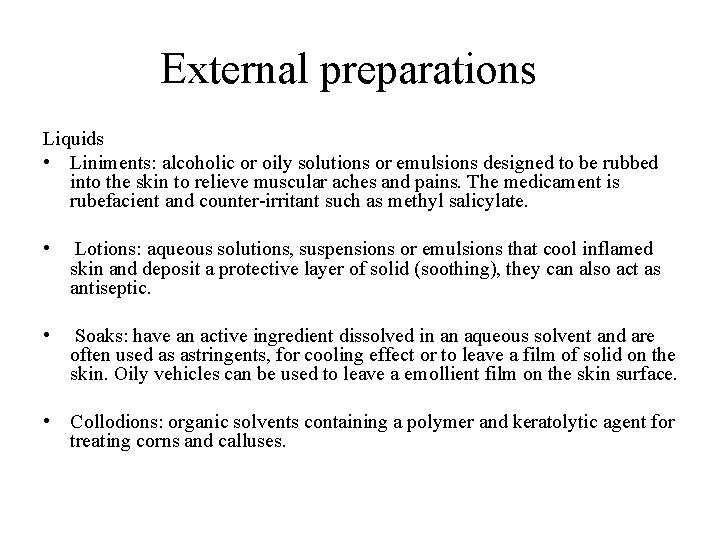
External preparations Liquids • Liniments: alcoholic or oily solutions or emulsions designed to be rubbed into the skin to relieve muscular aches and pains. The medicament is rubefacient and counter-irritant such as methyl salicylate. • Lotions: aqueous solutions, suspensions or emulsions that cool inflamed skin and deposit a protective layer of solid (soothing), they can also act as antiseptic. • Soaks: have an active ingredient dissolved in an aqueous solvent and are often used as astringents, for cooling effect or to leave a film of solid on the skin. Oily vehicles can be used to leave a emollient film on the skin surface. • Collodions: organic solvents containing a polymer and keratolytic agent for treating corns and calluses.
External preparations Semisolids • Creams: semisolid emulsions which may be o/w (e. g. aqueous cream) or w/o (e. g. oily cream). • Ointments: Semisolid greasy preparations usually composed of oily vehicles that may contain a surfactant to allow them to be washed off easily. The base is usually anhydrous and immiscible with skin secretions. • Gels (Jellies): Transparent semisolid dosage forms for topical or other local uses. They are aqueous or oily gels. • Pastes: Semisolids for external use, they are aqueous or oily vehicles that contain a high concentration of fine powder (added solid).
External preparations • Differences in emmolient and occlusion effects and the ease of application and removal is a factor of how to choose vehicle to be used and the product type. • Most of these preparations are used for the effects of therapeutic agents they contain. • The unmedicated ones are used for their physical effects as protectants or lubricants.
Ointments • Ointments are semisolid preparations intended for external application to the skin or mucous membranes. • greasy preparations usually composed of oily vehicles that may contain a surfactant to allow them to be washed off easily. The base is usually anhydrous and immiscible with skin secretions. • Ointments are either ü Medicated: which contains dissolved or dispersed medicaments. ü Non medicated ointments are called ointment bases and used for their emollient or lubricating effect or as vehicles for medicated ointments.
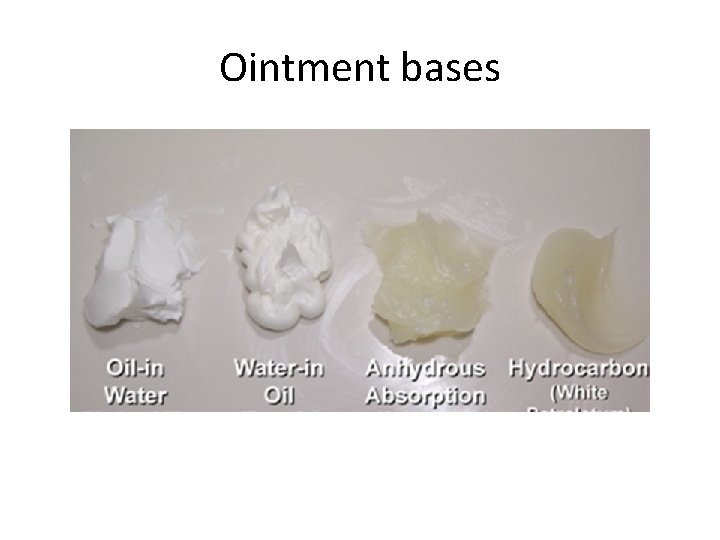
Ointment bases • Ointment bases are generally classified by the USP into four groups: • (a) oleaginous bases • (b) absorption bases • (c) water-removable bases (water washable) • (d) water-soluble bases.
Ointment bases
Selection of the base to use in the formulation of an ointment preparation depends on: • • • Desired release rate of the drug substance from the ointment base Desirability of topical or percutaneous drug absorption Desirability of occlusion of moisture from the skin Stability of the drug in the ointment base Effect of the drug on the consistency or other features of the ointment base • Desire for a base easily removed by washing with water • Characteristics of the surface to which it is applied • Shelf life of the product
Desirable properties on ointment bases • Chemically and physically stable under normal conditions of use and storage • Nonreactive and compatible with a wide variety of drugs and auxiliary agents • Free from objectionable odor • Nontoxic, nonsensitizing, and nonirritating • Aesthetically appealing, easy to apply, and nongreasy and nonstaining • Remains in contact with the skin until removal is desired.
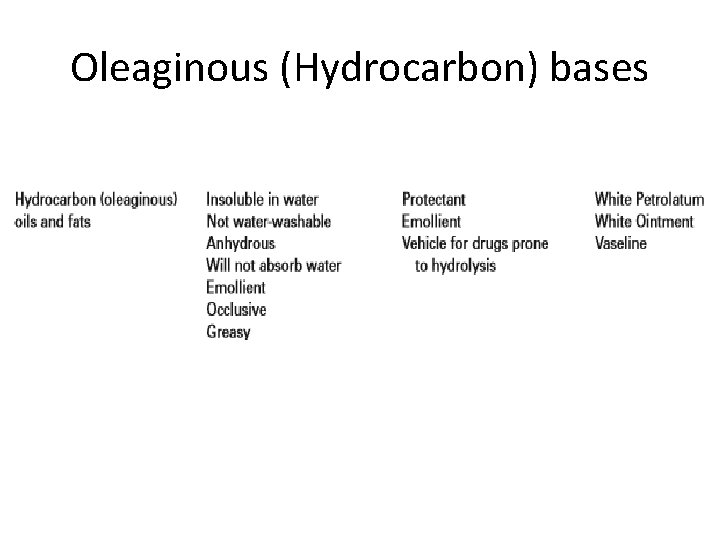
Oleaginous (Hydrocarbon) bases • Water immicible bases • Good emollient, protective, and occlusive properties • Not water-washable so they stay on the skin and keep incorporated medications in contact with the skin • Give warm effect • They are not removed easily with washing (may be removed using mineral oil, which is then washed off with soap and warm water). • Can not absorb water and can absorb only limited amounts of alcoholic solutions, so most liquid ingredients are difficult to incorporate into hydrocarbon bases. • Because these bases do not absorb or mix with aqueous solutions, aqueous skin secretions do not readily dissipate.
Oleaginous (Hydrocarbon) bases
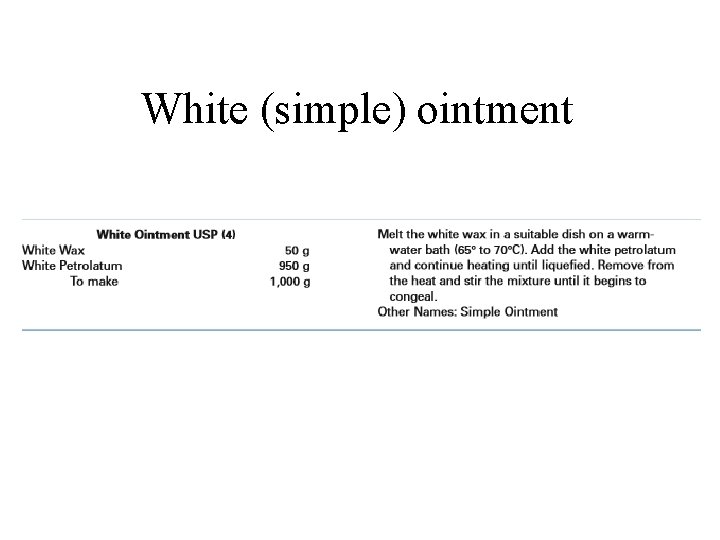
White (simple) ointment
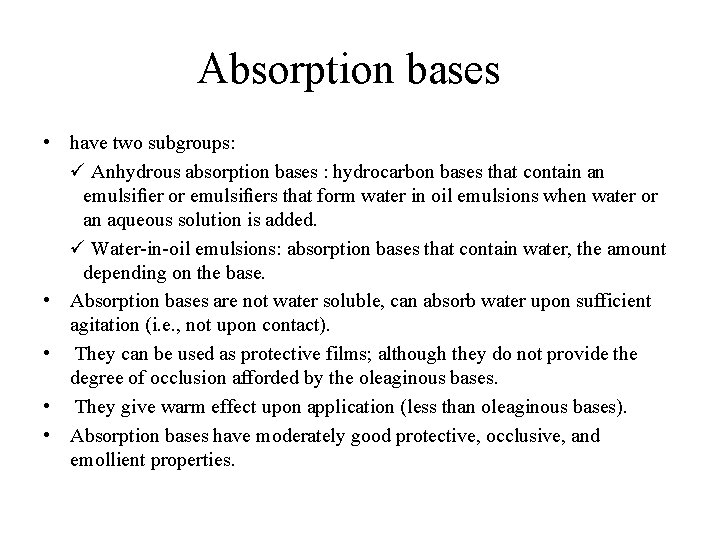
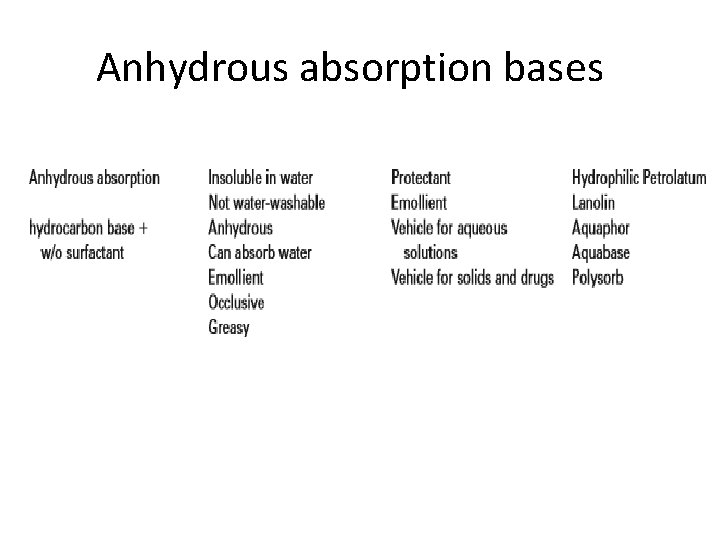
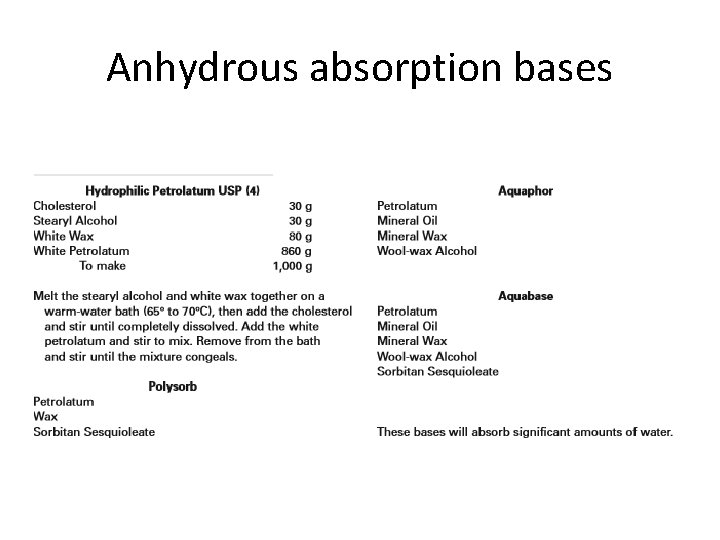
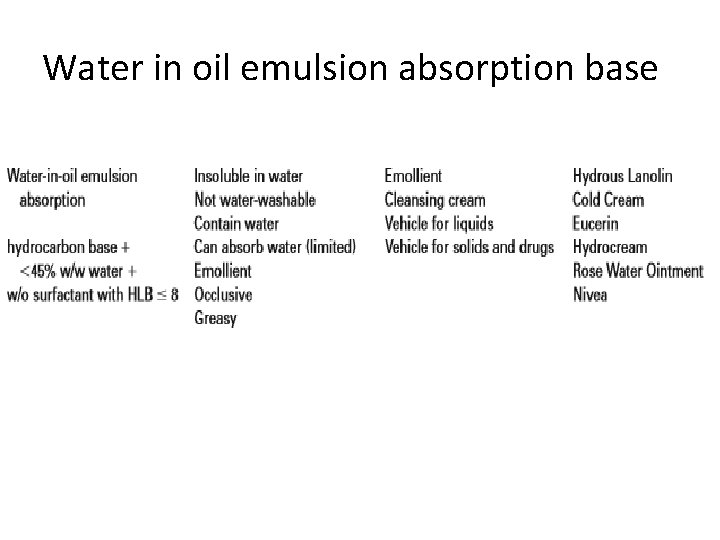
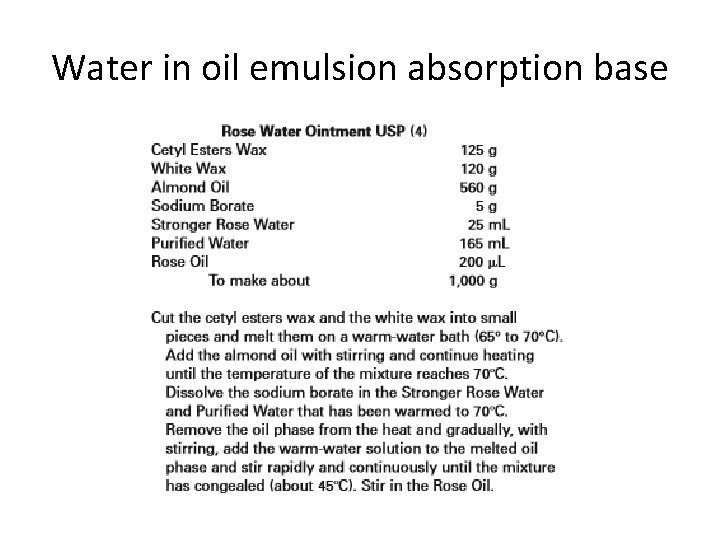
Absorption bases • have two subgroups: ü Anhydrous absorption bases : hydrocarbon bases that contain an emulsifier or emulsifiers that form water in oil emulsions when water or an aqueous solution is added. ü Water-in-oil emulsions: absorption bases that contain water, the amount depending on the base. • Absorption bases are not water soluble, can absorb water upon sufficient agitation (i. e. , not upon contact). • They can be used as protective films; although they do not provide the degree of occlusion afforded by the oleaginous bases. • They give warm effect upon application (less than oleaginous bases). • Absorption bases have moderately good protective, occlusive, and emollient properties.
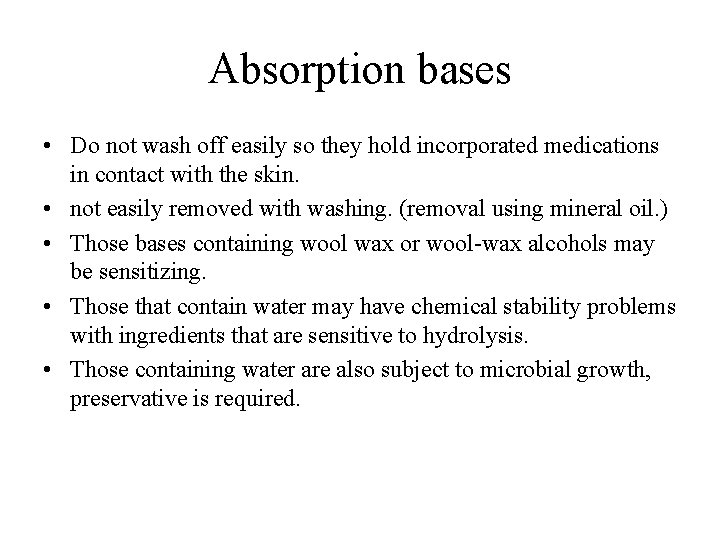
Absorption bases • Do not wash off easily so they hold incorporated medications in contact with the skin. • not easily removed with washing. (removal using mineral oil. ) • Those bases containing wool wax or wool-wax alcohols may be sensitizing. • Those that contain water may have chemical stability problems with ingredients that are sensitive to hydrolysis. • Those containing water are also subject to microbial growth, preservative is required.
Anhydrous absorption bases
Anhydrous absorption bases
Water in oil emulsion absorption base
Water in oil emulsion absorption base
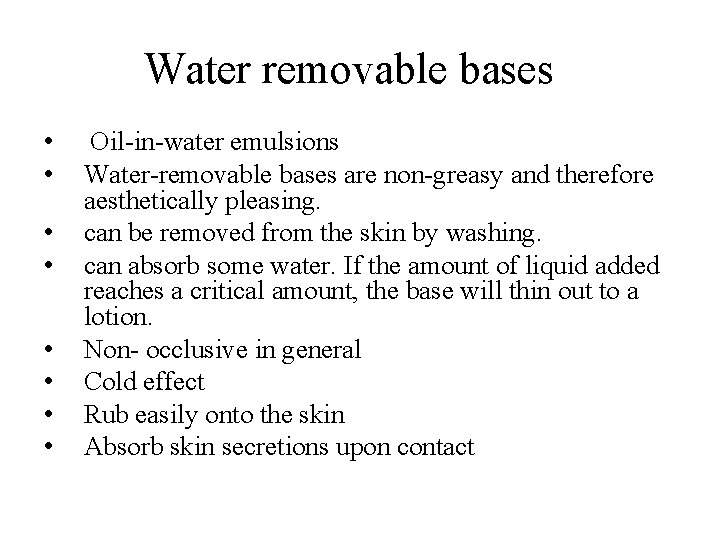
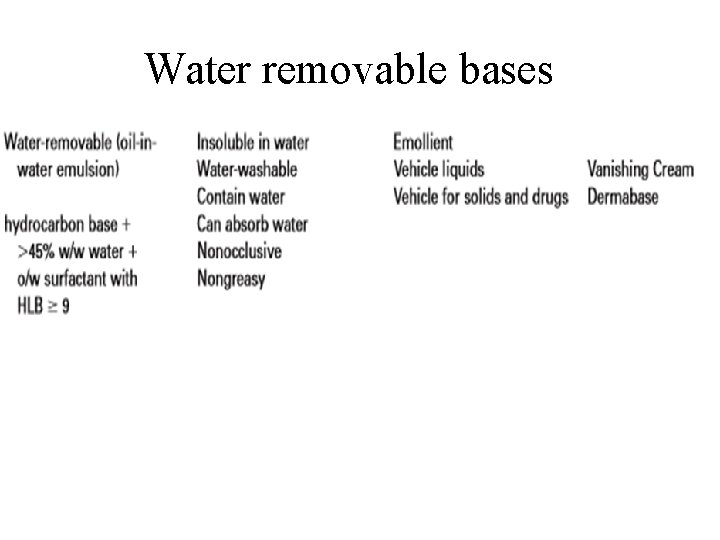
Water removable bases • • Oil-in-water emulsions Water-removable bases are non-greasy and therefore aesthetically pleasing. can be removed from the skin by washing. can absorb some water. If the amount of liquid added reaches a critical amount, the base will thin out to a lotion. Non- occlusive in general Cold effect Rub easily onto the skin Absorb skin secretions upon contact
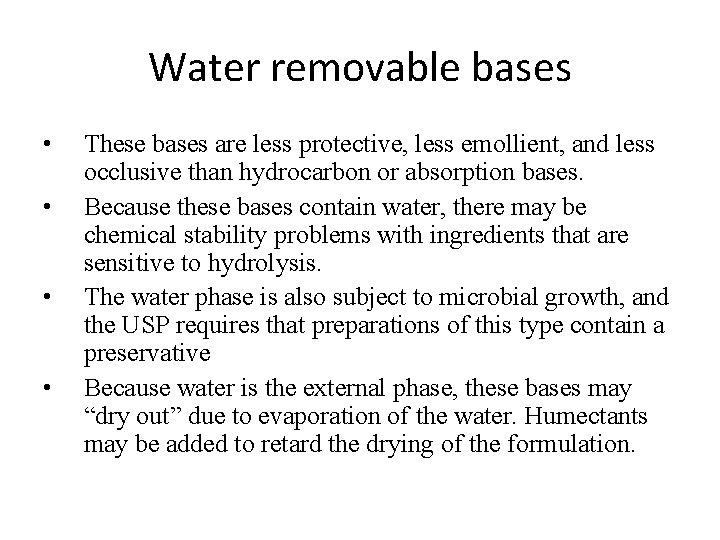
Water removable bases • • These bases are less protective, less emollient, and less occlusive than hydrocarbon or absorption bases. Because these bases contain water, there may be chemical stability problems with ingredients that are sensitive to hydrolysis. The water phase is also subject to microbial growth, and the USP requires that preparations of this type contain a preservative Because water is the external phase, these bases may “dry out” due to evaporation of the water. Humectants may be added to retard the drying of the formulation.
Water removable bases
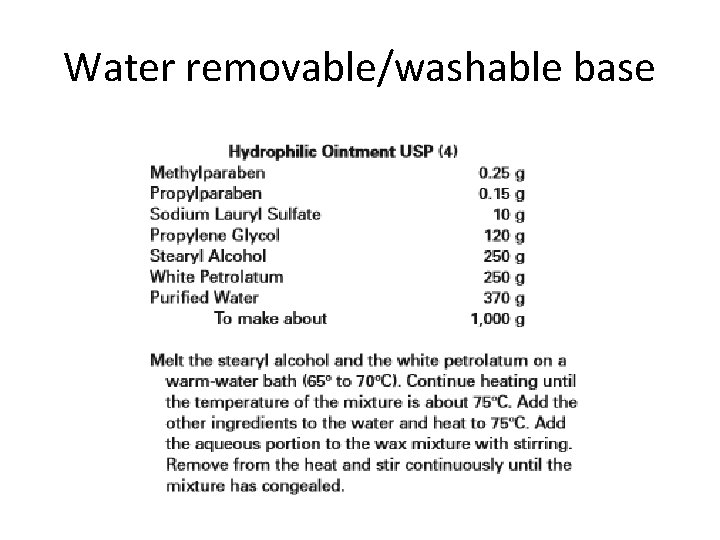
Water removable/washable base
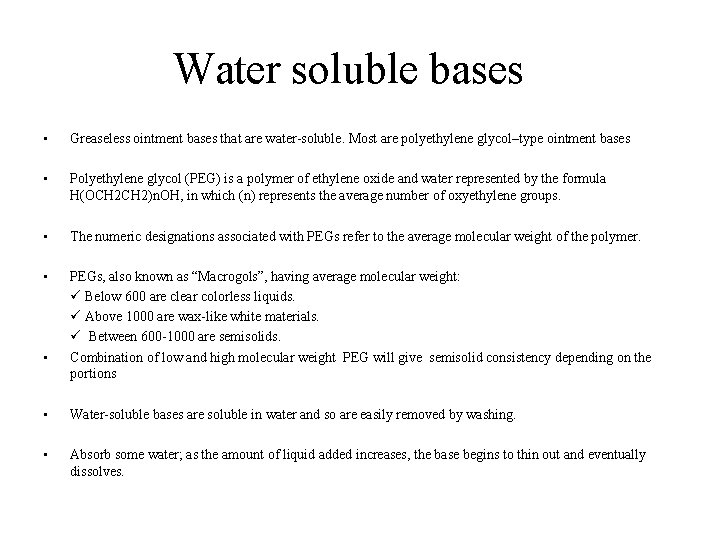
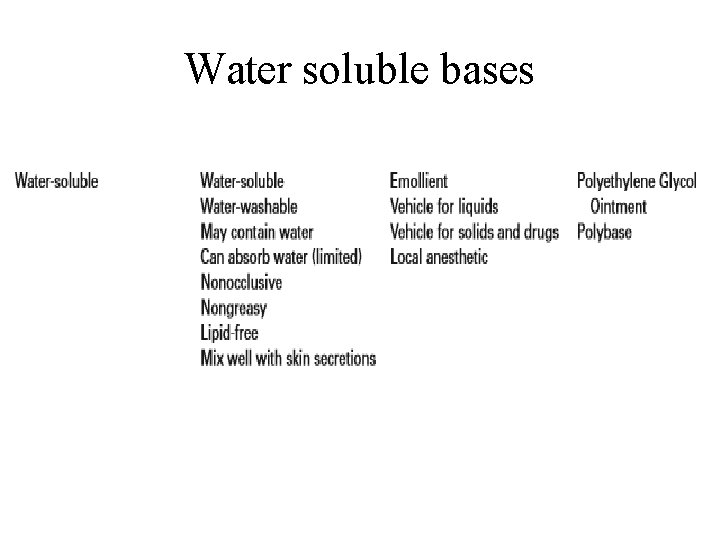
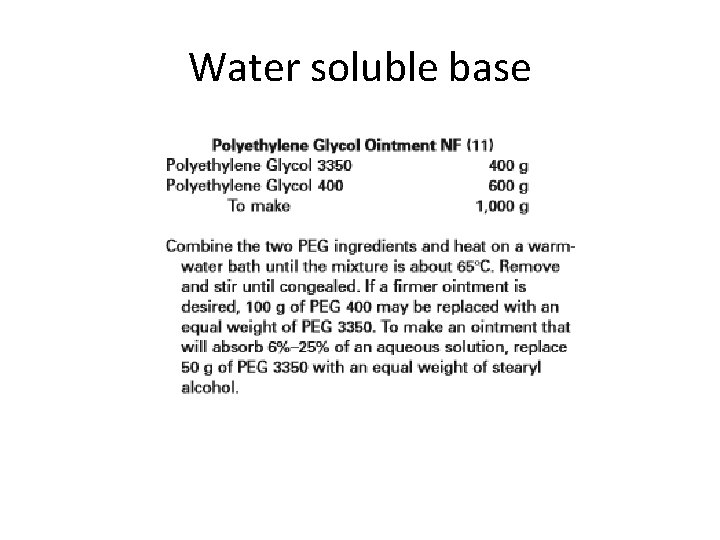
Water soluble bases • Greaseless ointment bases that are water-soluble. Most are polyethylene glycol–type ointment bases • Polyethylene glycol (PEG) is a polymer of ethylene oxide and water represented by the formula H(OCH 2)n. OH, in which (n) represents the average number of oxyethylene groups. • The numeric designations associated with PEGs refer to the average molecular weight of the polymer. • PEGs, also known as “Macrogols”, having average molecular weight: ü Below 600 are clear colorless liquids. ü Above 1000 are wax-like white materials. ü Between 600 -1000 are semisolids. Combination of low and high molecular weight PEG will give semisolid consistency depending on the portions • • Water-soluble bases are soluble in water and so are easily removed by washing. • Absorb some water; as the amount of liquid added increases, the base begins to thin out and eventually dissolves.
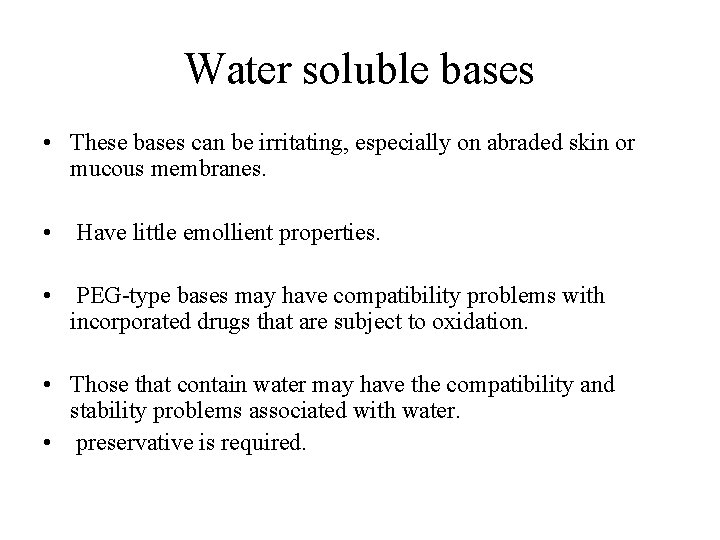
Water soluble bases • These bases can be irritating, especially on abraded skin or mucous membranes. • Have little emollient properties. • PEG-type bases may have compatibility problems with incorporated drugs that are subject to oxidation. • Those that contain water may have the compatibility and stability problems associated with water. • preservative is required.
Water soluble bases
Water soluble base
Ointment excipiants • Petrolatum (soft paraffin) and mineral oil (liquid paraffin) works as oleaginous bases. • Petrolatum and white petrolatum (vaseline) are mixtures of purified semisolid saturated hydrocarbons extracted from petroleum. • White petrolatum has undergone additional treatment so that it is nearly decolorized, and it is preferred for pharmaceutical preparations because it is reported to cause fewer hypersensitivity reactions. • White petrolatum is more aesthetically accepted. • Fats and fixed oils of vegetable origins, such as almond oil, castor oil, olive oil and coconut oil.
Wool fat (anhydrous lanolin) and lanolin • Wool fat (anhydrous lanolin): It is a complex mixture of fatty acid esters of cholesterol and other sterols and alcohols. • Lanolin and modified lanolin are the purified, fatty, waxlike substances obtained from the wool of sheep. • These substances are purified, cleaned, decolorized, and deodorized. • Modified lanolin has undergone additional treatment to reduce the contents of free lanolin alcohols and detergent and pesticide residues. Thus, minimizing hypersensitivity reactions • Lanolin may be used by itself, but it will also mix with vegetable oils or petrolatum to give an emollient. (base and emulsifying agent)
Hydrocarbon waxes • produce stiffer ointment • Paraffin wax : Paraffin wax is a purified mixture of solid hydrocarbons from petroleum • Bees wax and white beeswax: White wax is the bleached, purified wax of honeybees. It consists mainly of esters of long-chain hydrocarbons, with myricyl palmitate the principle ester. It also contains free fatty acids with a small amount of free alcohols.
Fatty acids and fatty alcohols • Emollient effects, emulsifying and stiffening agents • Cetyl alcohol, stearyl alcohol and lanolin alcohols. • Give ointment formulations fine texture and good consistency • When added to oleaginous bases such as petrolatum, it increases their ability to absorb water
Fatty acids and fatty alcohols • Glyceryl Monostearate: mixture primarily of the monoesters of glycerin with stearic acid, , and palmitic acid. It is used as a nonionic emulsifier for both oil-in -water and water in-oil emulsions. • Has emollient properties and imparts texture and viscosity to topical preparations of various types. • Stearic acid: widely used as an emulsifying agent in topical preparations
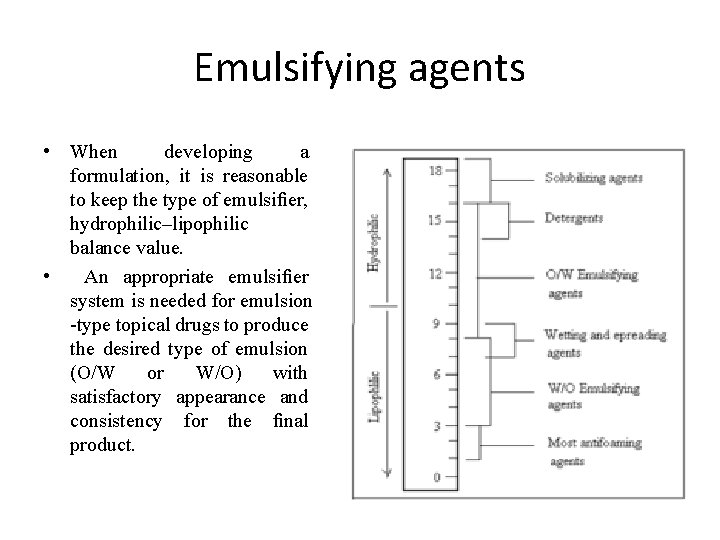
Emulsifying agents • When developing a formulation, it is reasonable to keep the type of emulsifier, hydrophilic–lipophilic balance value. • An appropriate emulsifier system is needed for emulsion -type topical drugs to produce the desired type of emulsion (O/W or W/O) with satisfactory appearance and consistency for the final product.
Polyols • propyleneglycol (PG), glycerol, and polyethyleneglycol (PEG) • work as humectants (enhancing water absorbing capacity of the ointment) • PEG with different grades can be used as base for water soluble ointments.
Preparation of ointments Ointments are prepared by two general methods: • Fusion • Trituration • Depending primarily on the nature of the ingredients.
Fusion method • By the fusion method, all or some of the components of an ointment are combined by being melted together in evaporation basin on a water bath (60 -70°C ) and cooled with constant stirring until congealed. • Components not melted are added to the congealing mixture as it is being cooled and stirred. • Naturally, heat-labile substances and any volatile components are added last, when the temperature of the mixture is low enough not to cause decomposition or volatilization of the components. • Waxy materials should be grated and added first. • Mixing is necessary to avoid lumping yet it should be gentle to avoid air bubbles. • recovery of all product is not possible, so it is necessary to make an excess of the product.
Fusion method • The drug can be added at different stages of preparation depending on drug properties: üIf soluble and stable, can be added when the base is molten. üIf less stable or insoluble but easy to disperse, can be added during cooling. üIf unstable or dispersion is difficult drug should be added when cold using mixing by trituration.
Trituration method • Insoluble solids or liquids are incorporated into bases using technique called “mixing by trituration”. • Carried out on an ointment slab or tile along with a flexible spatula. • Powders are placed on the tile and incorporated into the base using “doubling up”, however, it is necessary to have 2 to 3 times the volume of base to powder to avoid crumbling. • Powders should be passed through a 180 µm sieve before weighing to avoid grittiness in final preparation. • To incorporate a liquid, a portion of the base is placed on slab and a hole is made to hold the liquid which is then worked in gently. • Make an excess of about 10% to allow for losses.
Incorporation of liquids and solids • Solid components are mixed using a mortar and pestle before incorporation into the ointment base • Stainless steel spatula having a long, broad blade may be used to rub the ingredients together on an ointment slab (a large glass or porcelain tile). • accumulation of ointment on the large spatula should be removed with a smaller one.
Incorporation of liquids and solids • Liquid substances or solutions of drugs, as described above, are added to an ointment only after due consideration of an ointment base’s capacity to accept the volume required. • For example, only very small amounts of an aqueous solution may be incorporated into an oleaginous ointment, whereas hydrophilic ointment bases readily accept aqueous solutions.
Methods of preparation https: //www. youtube. com/watch? v=d 4 pp. Ka. KV 3 g
Creams and lotions
Creams • In USP , creams are defined as “ semisolid emulsions of either oil in water or water in oil type. ” • Creams are either water-in-oil emulsions (oily creams), oil-in-water emulsions (aqueous creams. • Creams are formulated to provide preparation that are essentially miscible with skin secretion. • Creams are used as emollients, moisturizing agents, cleansing agents, or as carriers for drugs. • .
Creams (Cont’d) • Creams find primary applications in topical skin products and in products used rectally and vaginally. • Many patients and physicians prefer creams to ointments because they are easier to spread and remove. • Pharmaceutical manufacturers frequently manufacture topical preparations of a drug in both cream and ointment bases to satisfy the preference of a patient and a physician.
Types of creams/ Functional • • • Cleansing/cold creams Hand body creams Vanishing creams Night and message creams All purpose creams
Cleansing creams/Cold creams • Cleansing cream is required for removal of facial make up, surface grime, sebum, dead cells. • Medium to high oil content • Mainly of W/O emulsion type
Night creams • Creams which are generally applied on skin and left for few and several hours mostly overnight, known as night cream. • Creams which act by providing emollient action by rubbing , called as massage cream. • Oily nature/ high oil content/ W/O emulsions
Vanishing creams • Vanishing creams are oil-in-water emulsions containing a large percentage of water and stearic acid or other oleaginous components. After application of the cream, the water evaporates, leaving behind a thin residue film of stearic acid or other oleaginous component • spread easily and seem to disappear rapidly when rubbed. • The basic ingredients are - 65%-75% water , 15%-20% stearic acid , 8 -12% glycerol, 0. 5 -15% alkali (KOH), preservative and perfume. • Available as lotions
Hand body creams • Moisturizers: Keep the skin smooth but not greasy • Easy to apply • Low oil content • Easily spread able, rub-in quickly • Available as lotions
All purpose creams • They act nourishing or night cream when applied excessively, they function as hand creams when applied sparingly, thus they are called All purpose cream • Medium oil content • O/W or W/O
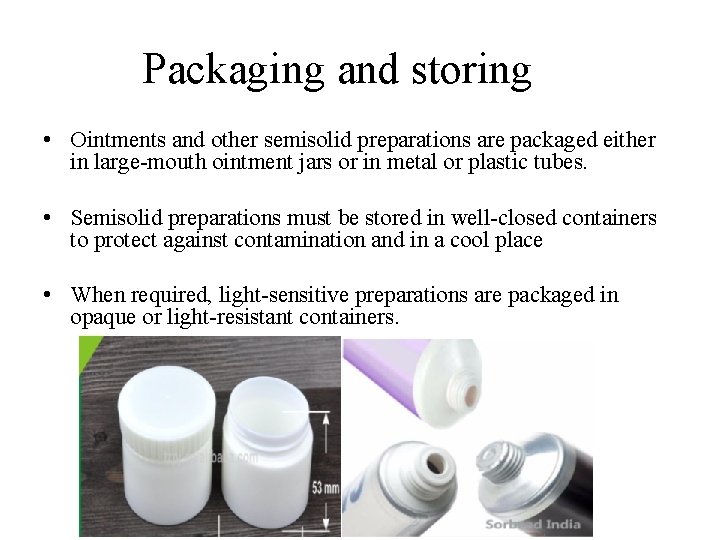
Packaging and storing • Ointments and other semisolid preparations are packaged either in large-mouth ointment jars or in metal or plastic tubes. • Semisolid preparations must be stored in well-closed containers to protect against contamination and in a cool place • When required, light-sensitive preparations are packaged in opaque or light-resistant containers.