
Semiotics The study of systems of signs the

- Slides: 20
Semiotics: The study of systems of signs, the process of signification, and the production of codes Some terms: Sign: signifier/signified Syntagmatic/paradigmatic relations.
Roland Barthes (12 November 1915 – 25 March 1980)
Barthes: why advertising? In advertising, the message is so intentional. It is frank, it is emphatic. There are typically 3 messages in advertising: a) A linguistic message b) A coded iconic message c) A non-coded iconic message
Barthes: the Panzini ad • It provides a linguistic message in the text below, as well as on the product • It depicts a series of images that are carefully clustered together (signifiers) • These singifiers imply a set of signifieds: freshness; home cooking; Italianicity; and an aesthetic signified harkening back to the idea of the “still life painting”
Barthes: Anchorage Images are polysemous. In the process of anchorage, the textual information fixes the process of signification and limits the polysemic possibilities of an image. In anchoring, we are also dispatching.
Barthes: Relay • The dispatching associated with the anchoring of an image by a text is different than the process of relay, the second function of the linguistic message. • “Here text and image stand in a complementary relationship; the words , in the same way as the images, are fragments of a more general syntagm and the unity of the message is realized at a higher level, that the of the story, the anecdote, the diegesis…” it may elucidate and advance the action in a film, for example, by setting out “in a sequence of messages, meanings that are not found in the image itself” (21)
Barthes: Denotated Images • Ideally, a denotated image is purely anological, a “message without a code” • Photographic images, which have an iconic relationship to that which is represented, seem unlike drawings to be a “message without a code”. • Drawings are rule governed and historical; their operation is selective; it is an activity that must be learned.
Barthes: photographs • Seem to be natural and merely a recording of reality, as is. Its reality is a “having-beenthere. ” (23) • “the denotated image naturalizes the symbolic message, it innocents the semantic artifice of connotation, which is extremely dense, especially in advertising. ” (23)
Barthes: rhetoric of the image • Advertising is effective, suggests Barthes implicitly because the image (a lexia) engages with different potential lexicons. • The readings can vary with individuals, however, the variation in readings is not “anarchic. ” (24) • A lexicon is a portion of language which corresponds to “a body of practices. ” (24) There is a lexicon of cooking; of different sports; of art; of musical genres. • An idiolect is the plurality and co-existence of a lexicon in an individual.
Barthes notion of rhetoric • …signifiers are connotative and this connotation is an aspect of ideology. • For Barthes, rhetoric is the “signifying aspect of ideology. ” (25) There are omissions and absences (an asyndeton) • Asyndeton: “the omission or absence of a conjunction between parts of a sentence” • But, iconic denotation is only syntagm, associative elements that become connected, even when they are presented as fragments. • This iconic denotation, the literal message, naturalizes the system of connotation even though its adequate decoding requires that we mobilize our own knowledge and practices (lexicon) in order to make sense of its meaning. •
De Certeau • Like Barthes, he uses a blend of concepts drawn from semiotics and rhetoric. • In this instance, he also is connected to that tradition of thought known as phenomenology, specifically the work of Maurice Merleau-Ponty who understood all of communications and acts of significations in as an embodied practice.
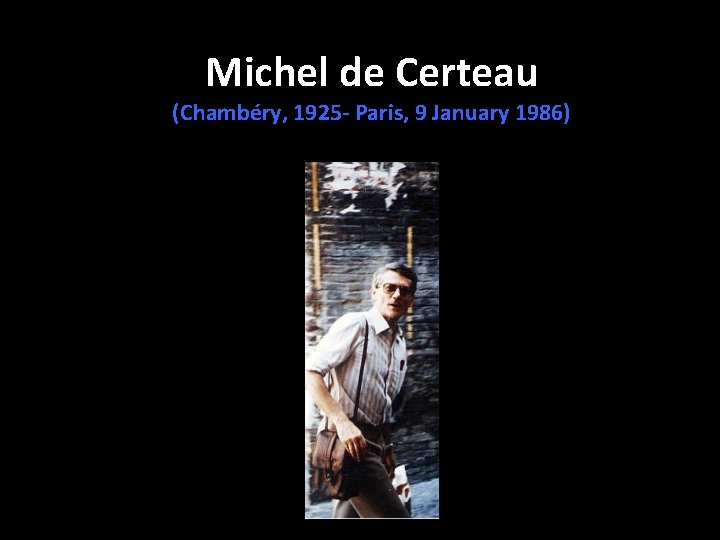
Michel de Certeau (Chambéry, 1925 - Paris, 9 January 1986)
De Certeau • Is also concerned with the visual field, but his gaze and speculations are not turned to the advertising image but to the city. • Opens his essay by describing two perspectives on Manhattan, that of the voyeur and that of the walker. • These become conceptual metaphors for his discussion of two implied ideas: strategies and tactics.
De Certeau • Famous for his interest in the practices of everyday life, but as well for his writing on the city and his delineation of strategies and tactics. • Strategies: the structured dynamics of power that are set out for us to follow. Connected to systems. • Tactics: how users negotiate the strategies that are put into place. • (see pp. 154 -155, where these terms of mentioned, but not fully explained). •
De Certeau: cities • The city, he says is comprised of a 3 -fold operation. • 1. rational systems of organization • 2. these try to impose a “no-when” or erase a history of a space and limit the tactics of users, but this is impossible says de Certeau. • 3. create identities for themselves as ‘subjects’. (think how different cities brand market their image)
De Certeau Cities are defined, in part, by their “spatial practices” (157). “Their intertwined paths give their shape to spaces. ” Walking rhetorics: This is an invitation for you to consider just how you move through the city, or observe others moving through your city, or suburb.
Identify 4 types of mobility you have observed. • Take one and describe in detail, how this informs the relationship that you have with others in city space.
De Certeau: parting remarks • “Stories about places are makeshift things. They are composed with the world’s debris”
• “Things extra and other (details and excesses coming from elsewhere) insert themselves into the accepted framework, the imposed order. One has thus the very relationship between spatial practices and the constructed order. The surface of this order is everywhere punched and torn open by ellipses, drifts and leaks of meaning: it is a sieve order. ” (160)