
Seminar on Trade Facilitation at the Border in
Seminar on Trade Facilitation at the Border in Central Asia 11 -13 May 2009, Dushanbe, Tajikistan Trade facilitation in Central Asia: A regional perspective Mr. Peng Bin Economic Affairs Officer Trade Facilitation Section Trade and Investment Division ESCAP

Trade in Central Asia: An overview q The growth of international merchandise trade is above the world’s average in recent years q International merchandise trade volume is still small ü The rank in world merchandise export among 180 economies: Afghanistan 160, Kyrgyzstan 141, Tajikistan 131, Uzbekistan 86, Turkmenistan 81, Azerbaijan 78, Kazakhstan 51 (WTO, 2007) q High percentage of fuels and mining products in export and manufactures in import q High trade dependence ü Trade to GDP ratio 65 – 105% q Low level of intra-regional trade 2
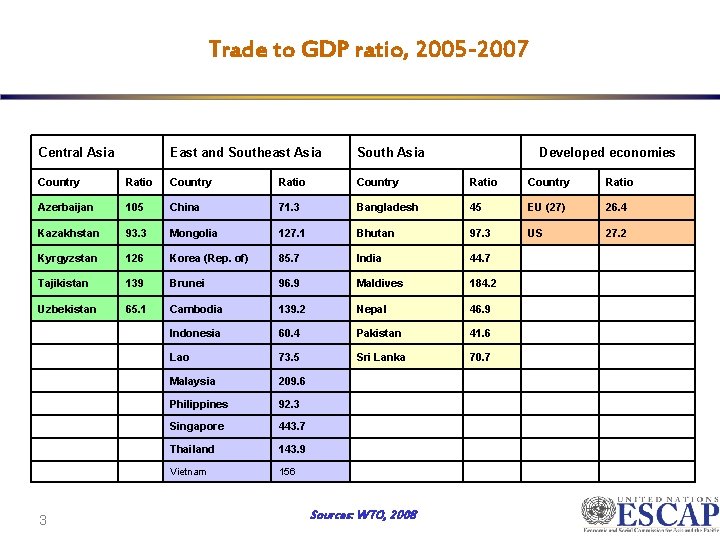
Trade to GDP ratio, 2005 -2007 Central Asia East and Southeast Asia South Asia Developed economies Country Ratio Azerbaijan 105 China 71. 3 Bangladesh 45 EU (27) 26. 4 Kazakhstan 93. 3 Mongolia 127. 1 Bhutan 97. 3 US 27. 2 Kyrgyzstan 126 Korea (Rep. of) 85. 7 India 44. 7 Tajikistan 139 Brunei 96. 9 Maldives 184. 2 Uzbekistan 65. 1 Cambodia 139. 2 Nepal 46. 9 Indonesia 60. 4 Pakistan 41. 6 Lao 73. 5 Sri Lanka 70. 7 Malaysia 209. 6 Philippines 92. 3 Singapore 443. 7 Thailand 143. 9 Vietnam 156 3 Sources: WTO, 2008
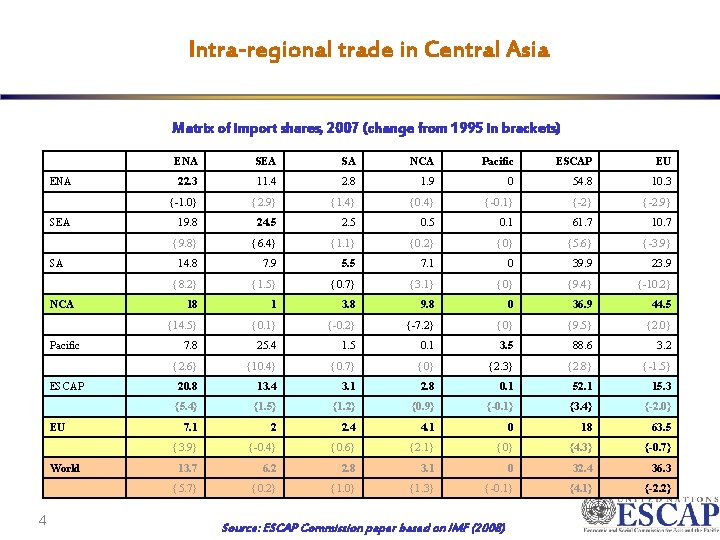
Intra-regional trade in Central Asia Matrix of import shares, 2007 (change from 1995 in brackets) ENA SEA SA NCA Pacific ESCAP EU 22. 3 11. 4 2. 8 1. 9 0 54. 8 10. 3 {-1. 0} {2. 9} {1. 4} {0. 4} {-0. 1} {-2. 9} 19. 8 24. 5 2. 5 0. 1 61. 7 10. 7 {9. 8} {6. 4} {1. 1} {0. 2} {0} {5. 6} {-3. 9} 14. 8 7. 9 5. 5 7. 1 0 39. 9 23. 9 {8. 2} {1. 5} {0. 7} {3. 1} {0} {9. 4} {-10. 2} 18 1 3. 8 9. 8 0 36. 9 44. 5 {14. 5} {0. 1} {-0. 2} {-7. 2} {0} {9. 5} {2. 0} 7. 8 25. 4 1. 5 0. 1 3. 5 88. 6 3. 2 {2. 6} {10. 4} {0. 7} {0} {2. 3} {2. 8} {-1. 5} ESCAP 20. 8 13. 4 3. 1 2. 8 0. 1 52. 1 15. 3 {5. 4} {1. 5} {1. 2} {0. 9} {-0. 1} {3. 4} {-2. 0} 7. 1 2 2. 4 4. 1 0 18 63. 5 {3. 9} {-0. 4} {0. 6} {2. 1} {0} {4. 3} {-0. 7} 13. 7 6. 2 2. 8 3. 1 0 32. 4 36. 3 {5. 7} {0. 2} {1. 0} {1. 3} {-0. 1} {4. 1} {-2. 2} ENA SEA SA NCA Pacific EU World 4 Source: ESCAP Commission paper based on IMF (2008)
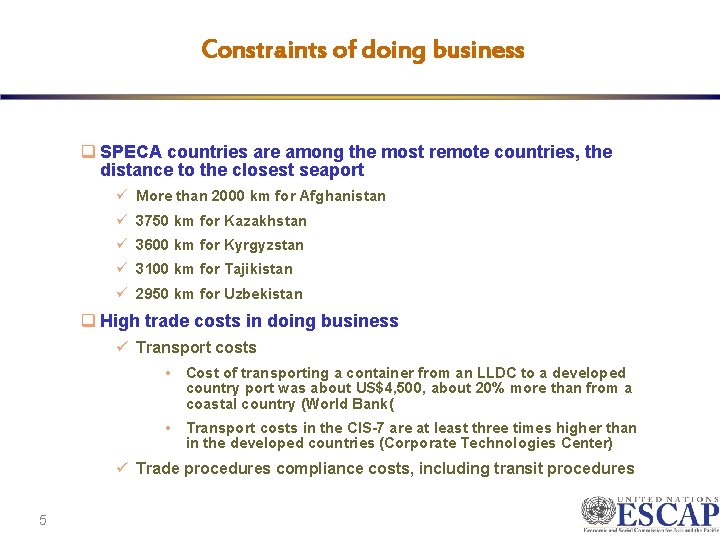
Constraints of doing business q SPECA countries are among the most remote countries, the distance to the closest seaport ü More than 2000 km for Afghanistan ü 3750 km for Kazakhstan ü 3600 km for Kyrgyzstan ü 3100 km for Tajikistan ü 2950 km for Uzbekistan q High trade costs in doing business ü Transport costs • Cost of transporting a container from an LLDC to a developed country port was about US$4, 500, about 20% more than from a coastal country (World Bank( • Transport costs in the CIS-7 are at least three times higher than in the developed countries (Corporate Technologies Center) ü Trade procedures compliance costs, including transit procedures 5
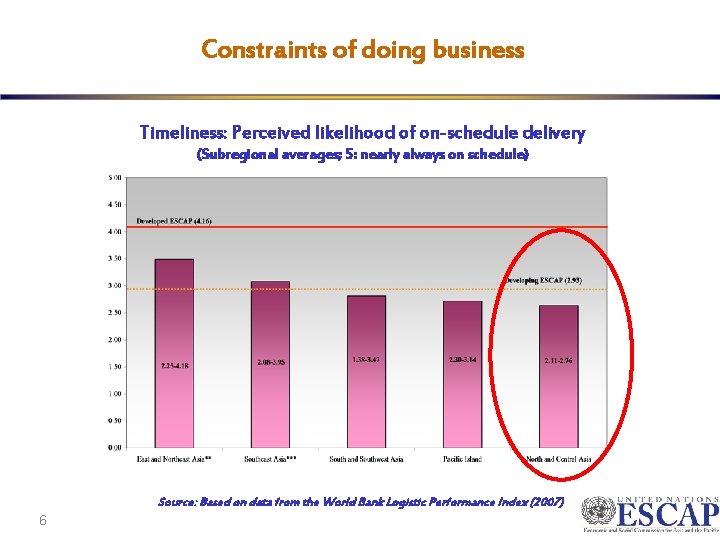
Constraints of doing business Timeliness: Perceived likelihood of on-schedule delivery (Subregional averages; 5: nearly always on schedule) Source: Based on data from the World Bank Logistic Performance Index (2007) 6
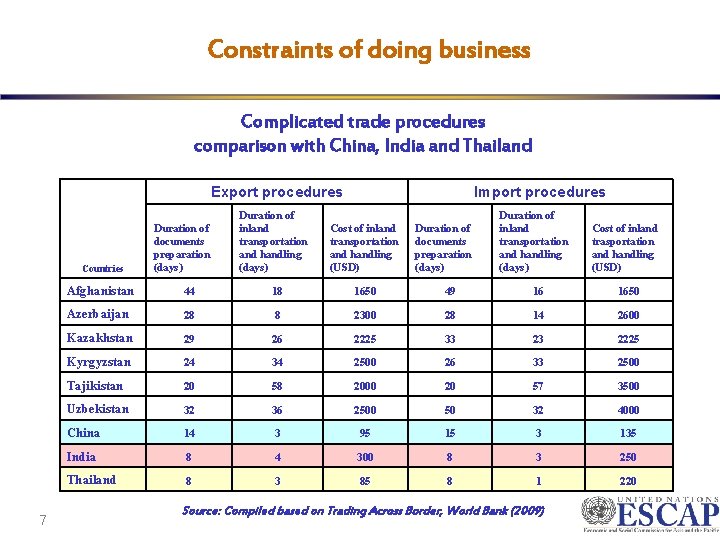
Constraints of doing business Complicated trade procedures comparison with China, India and Thailand Export procedures Countries 7 Duration of documents preparation (days) Import procedures Duration of inland transportation and handling (days) Cost of inland transportation and handling (USD) Duration of documents preparation (days) Duration of inland transportation and handling (days) Cost of inland trasportation and handling (USD) Afghanistan 44 18 1650 49 16 1650 Azerbaijan 28 8 2300 28 14 2600 Kazakhstan 29 26 2225 33 23 2225 Kyrgyzstan 24 34 2500 26 33 2500 Tajikistan 20 58 2000 20 57 3500 Uzbekistan 32 36 2500 50 32 4000 China 14 3 95 15 3 135 India 8 4 300 8 3 250 Thailand 8 3 85 8 1 220 Source: Compiled based on Trading Across Border, World Bank (2009)
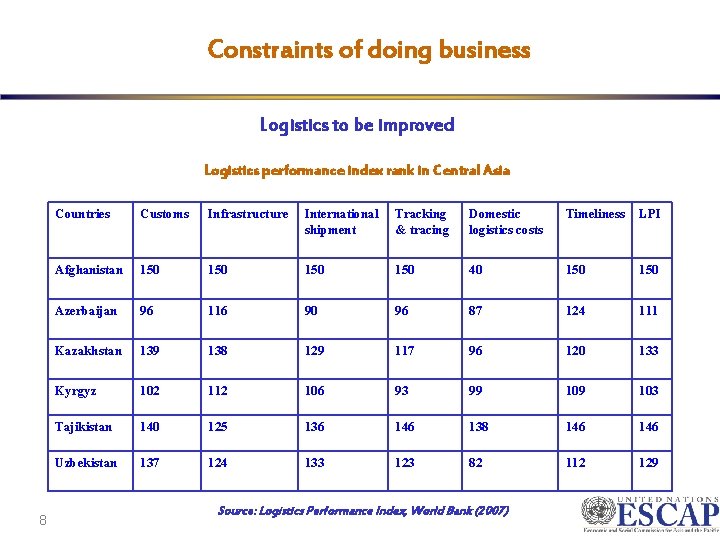
Constraints of doing business Logistics to be improved Logistics performance index rank in Central Asia 8 Countries Customs Infrastructure International shipment Tracking & tracing Domestic logistics costs Timeliness LPI Afghanistan 150 150 40 150 Azerbaijan 96 116 90 96 87 124 111 Kazakhstan 139 138 129 117 96 120 133 Kyrgyz 102 112 106 93 99 103 Tajikistan 140 125 136 146 138 146 Uzbekistan 137 124 133 123 82 112 129 Source: Logistics Performance Index, World Bank (2007)
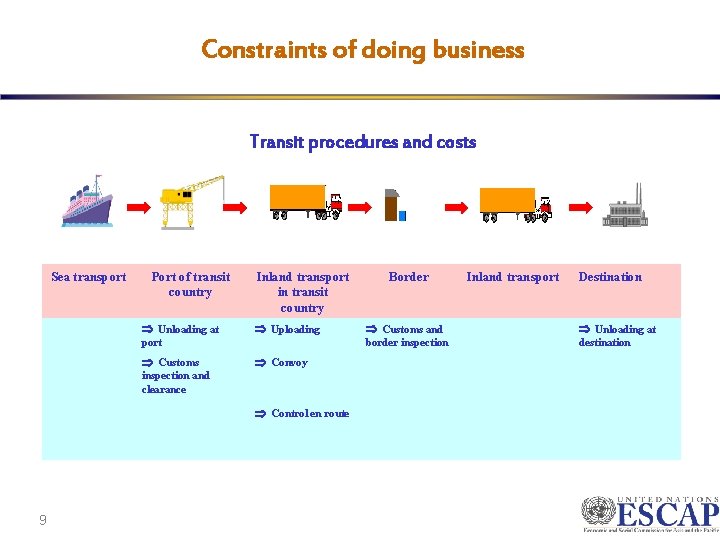
Constraints of doing business Transit procedures and costs Sea transport Port of transit country Inland transport in transit country Þ Unloading at port Þ Uploading Þ Customs inspection and clearance Þ Convoy Þ Control en route 9 Border Þ Customs and border inspection Inland transport Destination Þ Unloading at destination
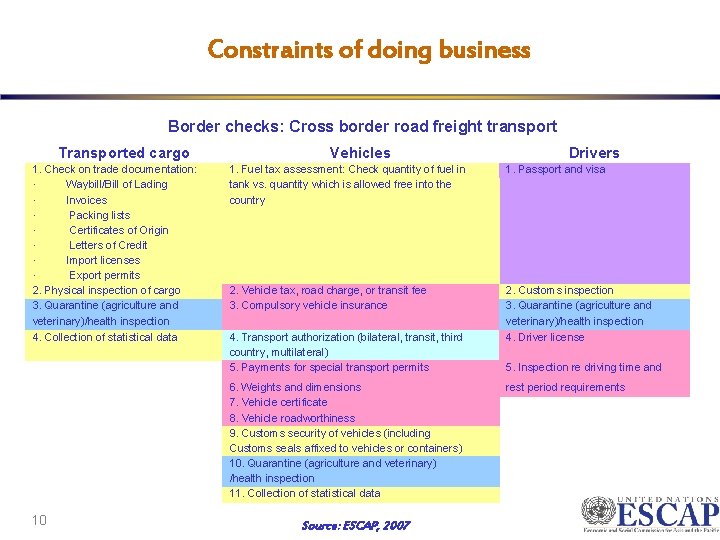
Constraints of doing business Border checks: Cross border road freight transport Transported cargo 1. Check on trade documentation: · Waybill/Bill of Lading · Invoices · Packing lists · Certificates of Origin · Letters of Credit · Import licenses · Export permits 2. Physical inspection of cargo 3. Quarantine (agriculture and veterinary)/health inspection 4. Collection of statistical data 10 Vehicles Drivers 1. Fuel tax assessment: Check quantity of fuel in tank vs. quantity which is allowed free into the country 2. Vehicle tax, road charge, or transit fee 3. Compulsory vehicle insurance 4. Transport authorization (bilateral, transit, third country, multilateral) 5. Payments for special transport permits 1. Passport and visa 6. Weights and dimensions 7. Vehicle certificate 8. Vehicle roadworthiness 9. Customs security of vehicles (including Customs seals affixed to vehicles or containers) 10. Quarantine (agriculture and veterinary) /health inspection 11. Collection of statistical data rest period requirements Source: ESCAP, 2007 2. Customs inspection 3. Quarantine (agriculture and veterinary)/health inspection 4. Driver license 5. Inspection re driving time and
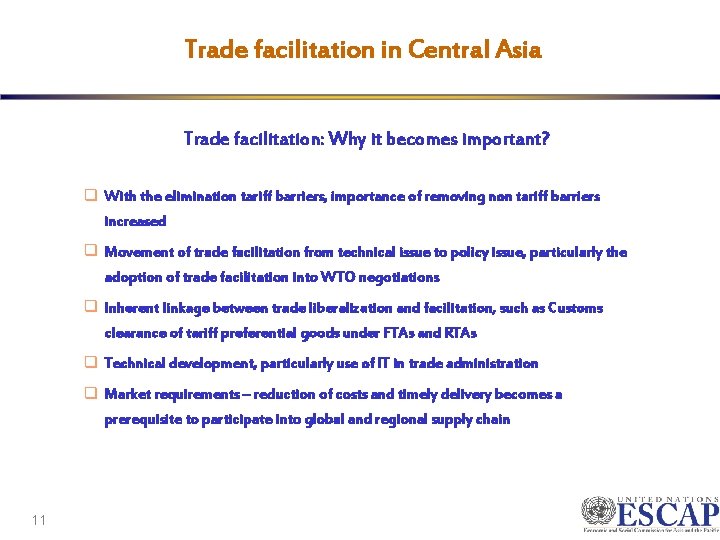
Trade facilitation in Central Asia Trade facilitation: Why it becomes important? q With the elimination tariff barriers, importance of removing non tariff barriers increased q Movement of trade facilitation from technical issue to policy issue, particularly the adoption of trade facilitation into WTO negotiations q Inherent linkage between trade liberalization and facilitation, such as Customs clearance of tariff preferential goods under FTAs and RTAs q Technical development, particularly use of IT in trade administration q Market requirements – reduction of costs and timely delivery becomes a prerequisite to participate into global and regional supply chain 11
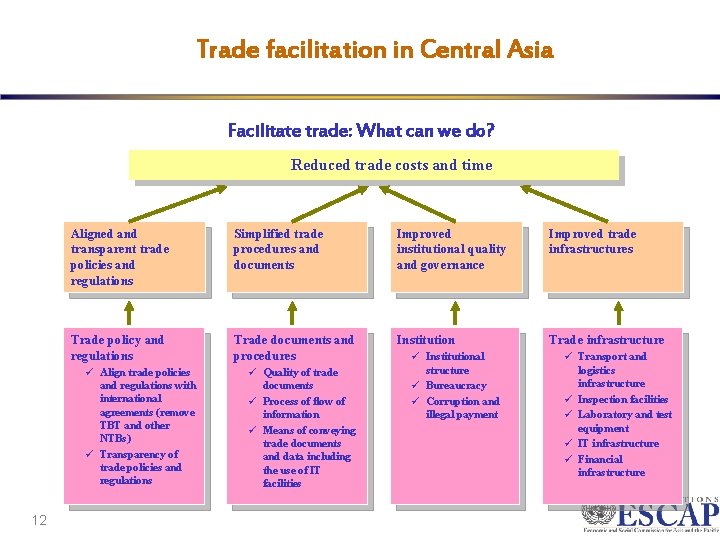
Trade facilitation in Central Asia Facilitate trade: What can we do? Reduced trade costs and time Aligned and transparent trade policies and regulations Simplified trade procedures and documents Improved institutional quality and governance Improved trade infrastructures Trade policy and regulations Trade documents and procedures Institution Trade infrastructure ü Align trade policies and regulations with international agreements (remove TBT and other NTBs) ü Transparency of trade policies and regulations 12 ü Quality of trade documents ü Process of flow of information ü Means of conveying trade documents and data including the use of IT facilities ü Institutional structure ü Bureaucracy ü Corruption and illegal payment ü Transport and logistics infrastructure ü Inspection facilities ü Laboratory and test equipment ü IT infrastructure ü Financial infrastructure
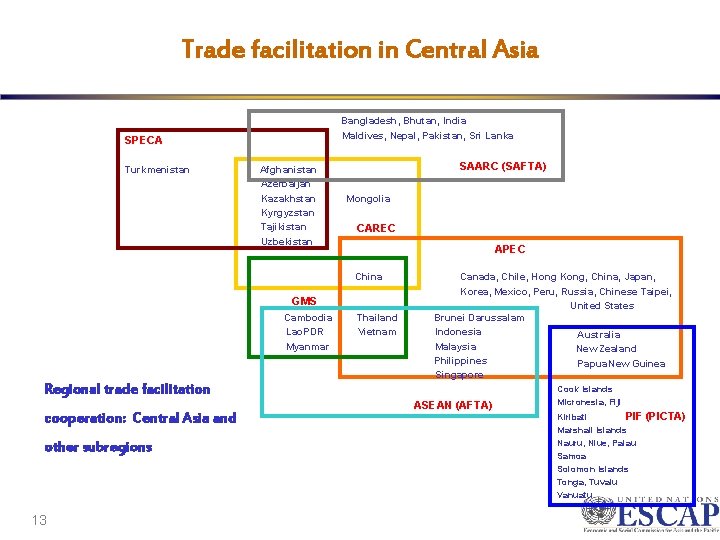
Trade facilitation in Central Asia Bangladesh, Bhutan, India SPECA Maldives, Nepal, Pakistan, Sri Lanka SAARC (SAFTA) Turkmenistan Afghanistan Azerbaijan Kazakhstan Mongolia Kyrgyzstan Tajikistan CAREC Uzbekistan APEC China Canada, Chile, Hong Kong, China, Japan, Korea, Mexico, Peru, Russia, Chinese Taipei, United States Cambodia Thailand Brunei Darussalam Lao. PDR Vietnam Indonesia Australia Myanmar Malaysia New Zealand Philippines Papua New Guinea Singapore GMS Regional trade facilitation cooperation: Central Asia and other subregions 13 ASEAN (AFTA) Cook Islands Micronesia, Fiji Kiribati PIF (PICTA) Marshall Islands Nauru, Niue, Palau Samoa Solomon Islands Tonga, Tuvalu Vanuatu
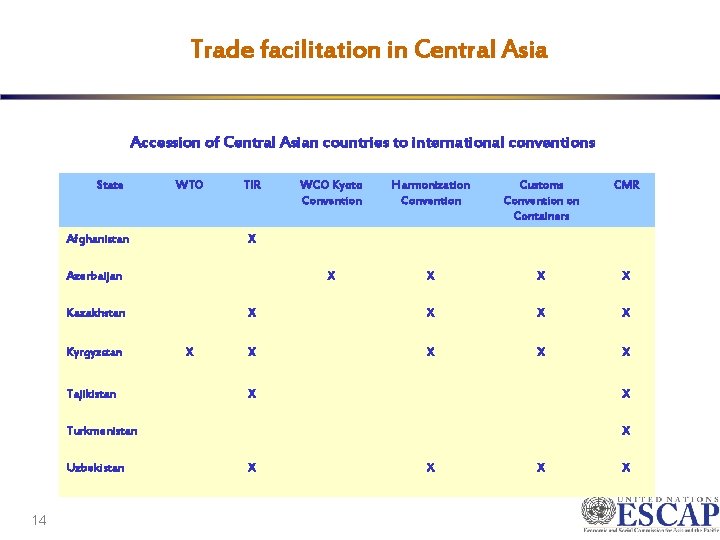
Trade facilitation in Central Asia Accession of Central Asian countries to international conventions State WTO Afghanistan TIR WCO Kyoto Convention Harmonization Convention Customs Convention on Containers CMR X X X X Azerbaijan Kazakhstan Kyrgyzstan Tajikistan X X X Turkmenistan Uzbekistan 14 X X X
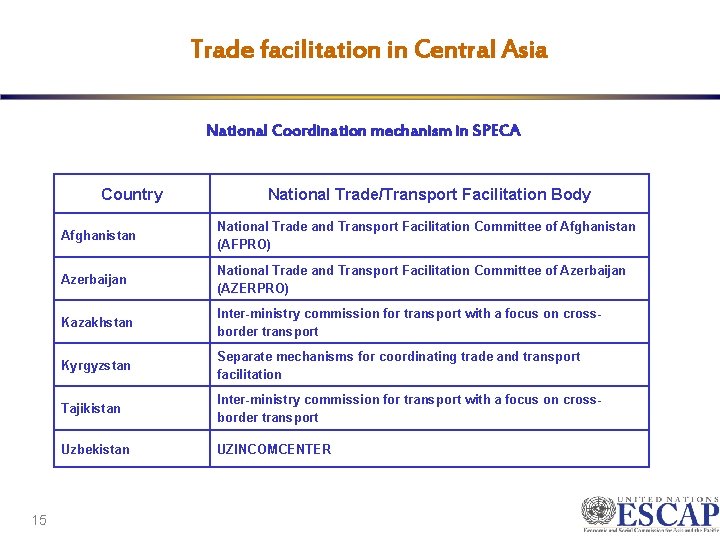
Trade facilitation in Central Asia National Coordination mechanism in SPECA Country 15 National Trade/Transport Facilitation Body Afghanistan National Trade and Transport Facilitation Committee of Afghanistan (AFPRO) Azerbaijan National Trade and Transport Facilitation Committee of Azerbaijan (AZERPRO) Kazakhstan Inter-ministry commission for transport with a focus on crossborder transport Kyrgyzstan Separate mechanisms for coordinating trade and transport facilitation Tajikistan Inter-ministry commission for transport with a focus on crossborder transport Uzbekistan UZINCOMCENTER
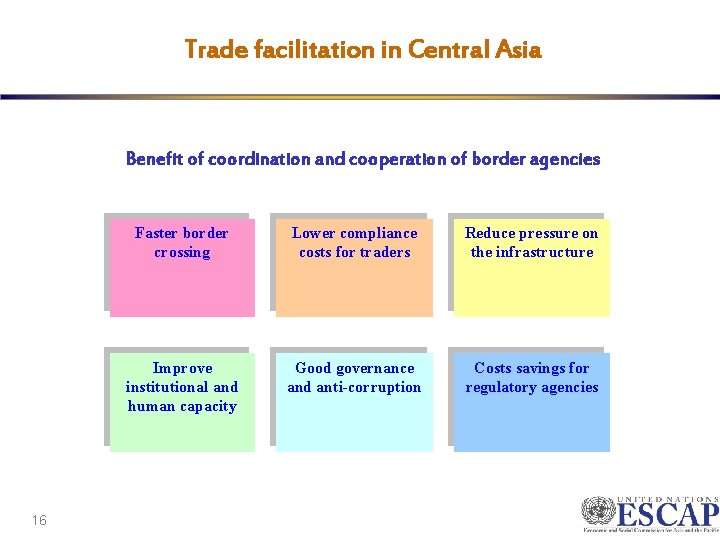
Trade facilitation in Central Asia Benefit of coordination and cooperation of border agencies 16 Faster border crossing Lower compliance costs for traders Reduce pressure on the infrastructure Improve institutional and human capacity Good governance and anti-corruption Costs savings for regulatory agencies
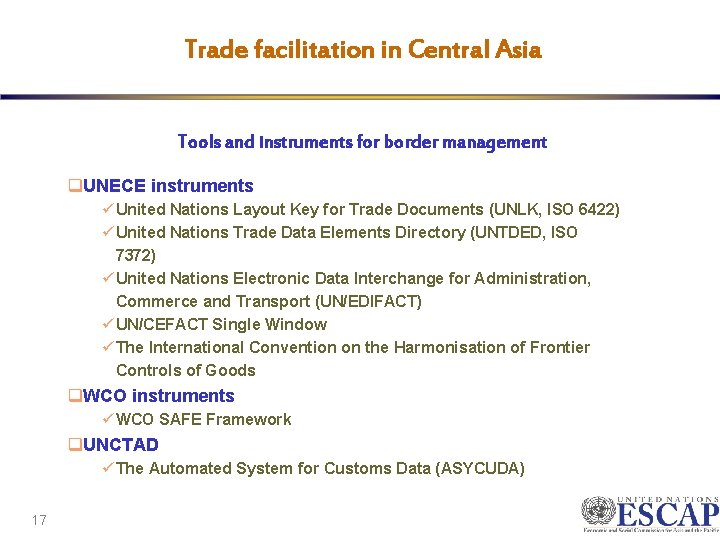
Trade facilitation in Central Asia Tools and instruments for border management q. UNECE instruments ü United Nations Layout Key for Trade Documents (UNLK, ISO 6422) ü United Nations Trade Data Elements Directory (UNTDED, ISO 7372) ü United Nations Electronic Data Interchange for Administration, Commerce and Transport (UN/EDIFACT) ü UN/CEFACT Single Window ü The International Convention on the Harmonisation of Frontier Controls of Goods q. WCO instruments ü WCO SAFE Framework q. UNCTAD ü The Automated System for Customs Data (ASYCUDA) 17
Seminar on Trade Facilitation at the Border in Central Asia 11 -13 May 2009, Dushanbe, Tajikistan Thank you pengb@un. org 18
- Slides: 18