
Seminar on Service Oriented Architecture Composite Services Architecture




- Slides: 30
Seminar on Service Oriented Architecture Composite Services Architecture (CSA) Sources: www. osoa. org “SOA for the Business Developer” by Margolis “Introducing SCA” by Chappell SOA Seminar 1
Composite Services Architecture (CSA) • In March 2007, Composite Services Architecture (CSA) is passed on to OASIS by the Open Service Oriented Architecture collaboration. • CSA is supported by BEA, IBM, Oracle, Sun, Tibco, Red Hat and others. • CSA Consists of SCA (Service Component Architecture) and SDO (Service Data Objects). • Implemented by IBM Web. Sphere, Oracle, Red Hat, Tibco, and the open source Apache Tuscany. • Describes how to compose and deploy applications supporting SOA. • Decouple business logic from details associated with the call on that logic. • Introduces The Service Component Definition Language (“skiddle”) to describe composites. SOA Seminar 2
SCA Specifications (1) • Assembly model defining composites, components, references and wires • Policy Framework allowing analysts to define constraints, capabilities and qualities of service expectations • Bindings allowing heterogeneous transports (SOAP, JMS, IIOP, etc. ) • Java annotations, API’s and component implementation (@Remotable) • C++, BPEL, PHP, EJB and Spring for SCA SOA Seminar 3
SCA Specifications (2) • The Assembly model defines composites, components, references and wires. The assembly model defines how components are combined into composites and are packaged and deployed as services. We specify such details as encryption, authentication and queuing outside of the business service. SOA Seminar 4
SCA Specifications (3) • The Policy Framework allows analysts to define constraints, capabilities and qualities of service expectations. WSDL does not support the description of policies. The SCA Policy Framework uses WS-Policy and WS-Policy. Framework to describe policies for service users. From www. osoa. org: Business value: The ability to define policies outside the services themselves lets administrators set and change the policies without changing code. It also means administrators know their policies are implemented globally. Master of Information System SOA Seminar Management 5
SCA Specifications (4) • Bindings allow heterogeneous transports (SOAP, JMS, IIOP, etc. ) to be used. From www. osoa. org: Bindings specify the mechanisms to access particular kinds of components. Applications built with SCA can use Web services, JMS, JCA and EJBs. (More bindings are on the way from osoa. org. ) As you would expect, the bindings can be defined outside the code itself. Business value: The bindings provided in SCA allow developers to use a wide variety of services without knowing the details of how those services are accessed. With the bindings external to the code, the bindings can be changed without changing the code. Master of Information System SOA Seminar Management 6
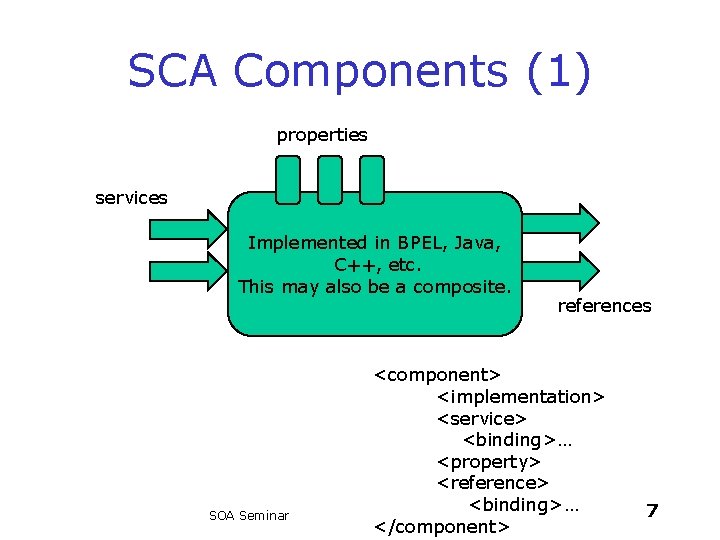
SCA Components (1) properties services Implemented in BPEL, Java, C++, etc. This may also be a composite. SOA Seminar references <component> <implementation> <service> <binding>… <property> <reference> <binding>… </component> 7
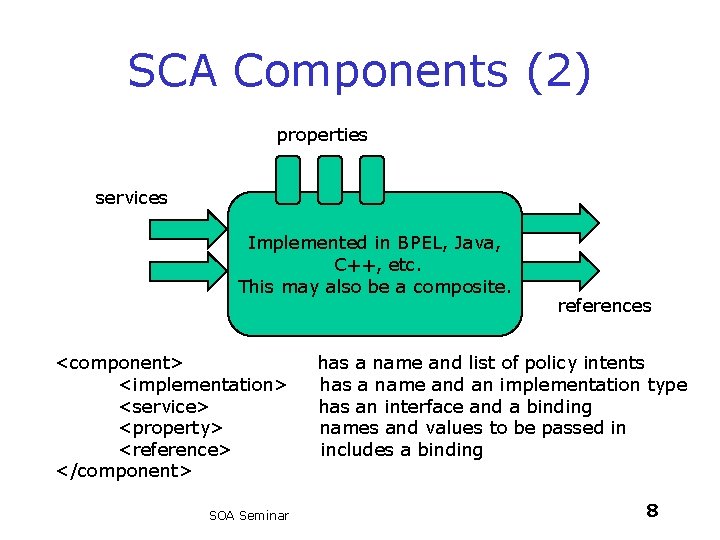
SCA Components (2) properties services Implemented in BPEL, Java, C++, etc. This may also be a composite. references <component> has a name and list of policy intents <implementation> has a name and an implementation type <service> has an interface and a binding <property> names and values to be passed in <reference> includes a binding </component> SOA Seminar 8
SCA Components (3) Property values passed in at runtime. services Operations available to clients. Business logic Implementation Other services this client depends on. references Dependency injection: The SCA runtime performs a lookup for the reference. The business logic need not be concerned with how the other service is accessed. Nor is the business logic developer concerned with how this component is accessed. That detail is specified as a binding - outside of the business logic. SOA Seminar 9
SCA Components (4) <composite> A component is the atom of an SCA application. It lives within a composite. <service> <property> A component is a configured <reference> implementation. <wire> <component> SCA is language agnostic. <implementation> <service> SCDL defines how the component <property> interacts with the outside world. <reference> </component> A component might talk to other components within its own domain or <more components > outside of its own domain. : </composite> An SCA runtime knows what to do with this. 10 SOA Seminar
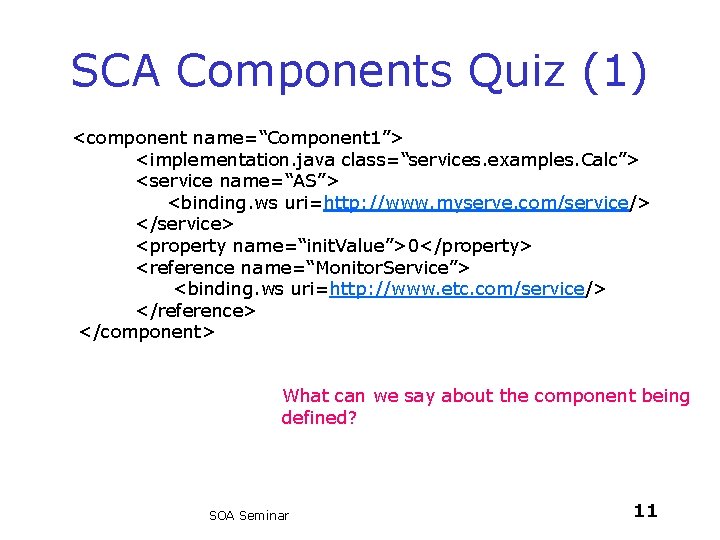
SCA Components Quiz (1) <component name=“Component 1”> <implementation. java class=“services. examples. Calc”> <service name=“AS”> <binding. ws uri=http: //www. myserve. com/service/> </service> <property name=“init. Value”>0</property> <reference name=“Monitor. Service”> <binding. ws uri=http: //www. etc. com/service/> </reference> </component> What can we say about the component being defined? SOA Seminar 11
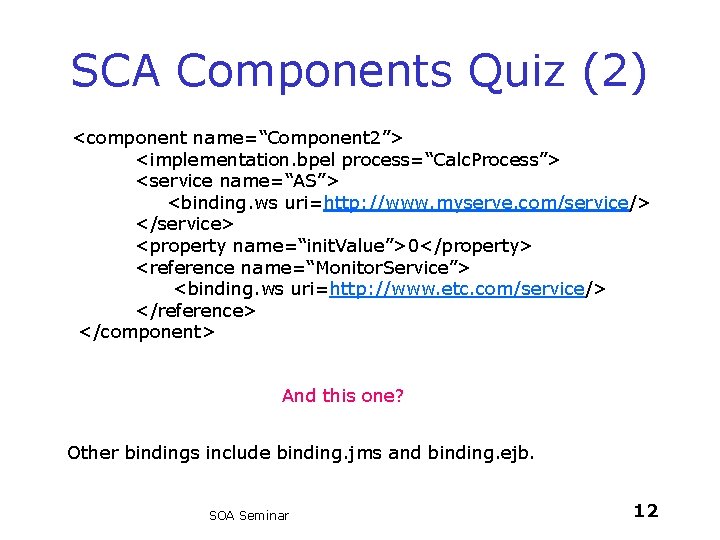
SCA Components Quiz (2) <component name=“Component 2”> <implementation. bpel process=“Calc. Process”> <service name=“AS”> <binding. ws uri=http: //www. myserve. com/service/> </service> <property name=“init. Value”>0</property> <reference name=“Monitor. Service”> <binding. ws uri=http: //www. etc. com/service/> </reference> </component> And this one? Other bindings include binding. jms and binding. ejb. SOA Seminar 12
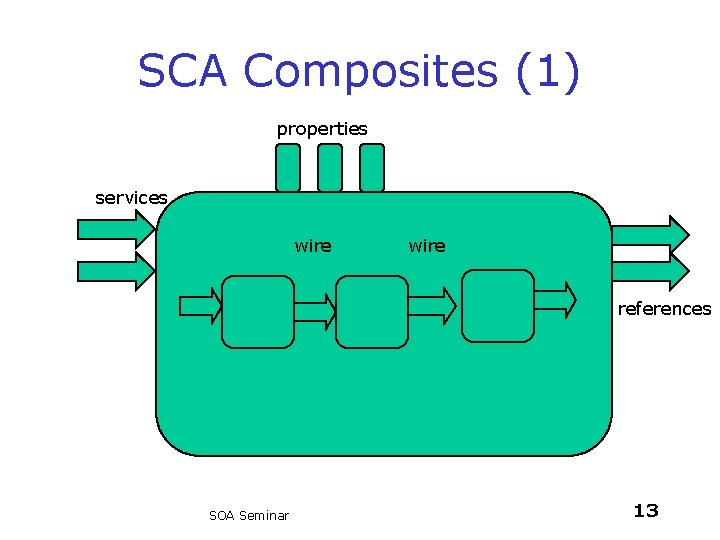
SCA Composites (1) properties services wire references SOA Seminar 13
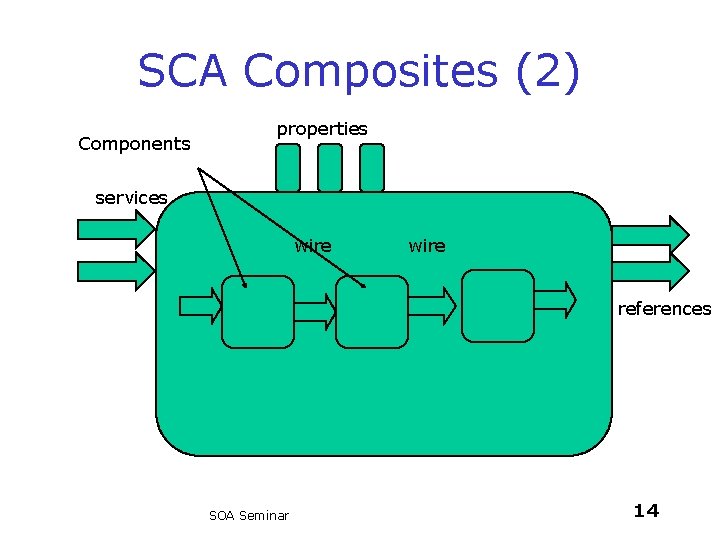
SCA Composites (2) Components properties services wire references SOA Seminar 14
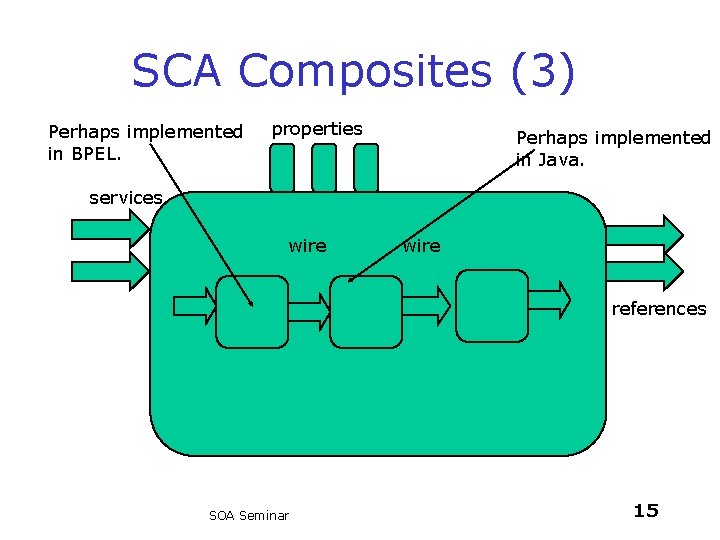
SCA Composites (3) Perhaps implemented in BPEL. properties Perhaps implemented in Java. services wire references SOA Seminar 15
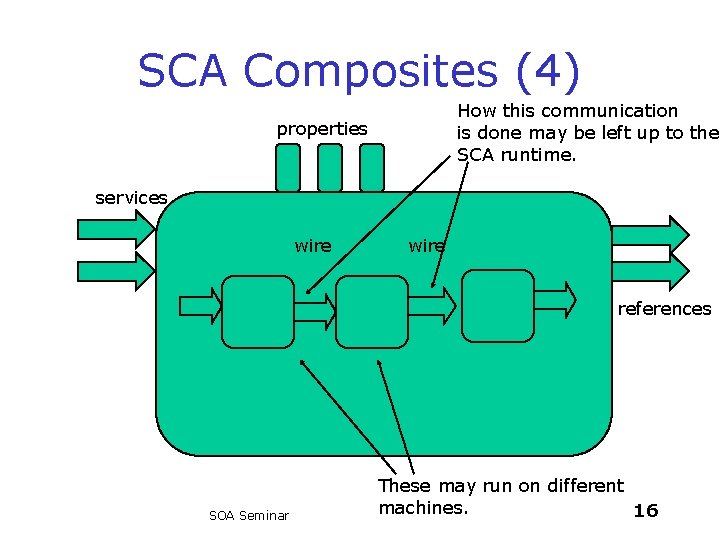
SCA Composites (4) How this communication is done may be left up to the SCA runtime. properties services wire references SOA Seminar These may run on different machines. 16
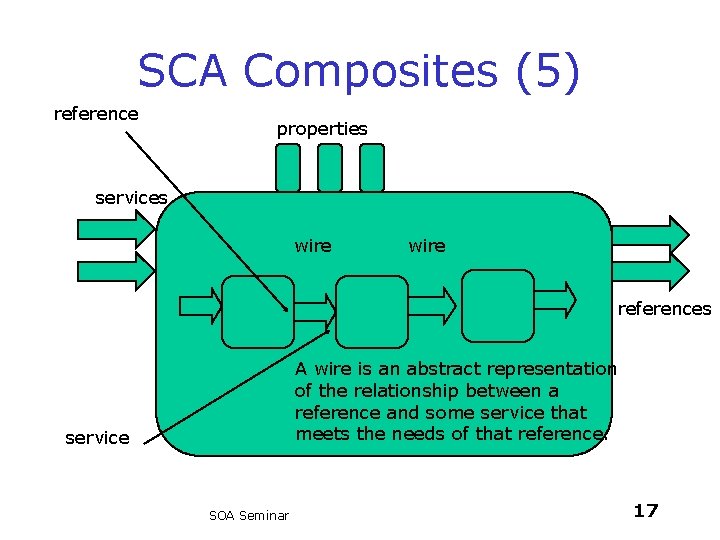
SCA Composites (5) reference properties services wire references A wire is an abstract representation of the relationship between a reference and some service that meets the needs of that reference. service SOA Seminar 17
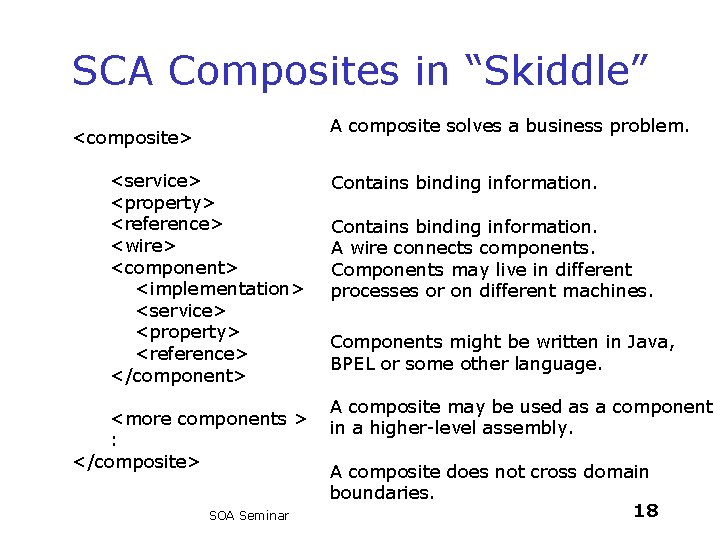
SCA Composites in “Skiddle” A composite solves a business problem. <composite> <service> <property> <reference> <wire> <component> <implementation> <service> <property> <reference> </component> <more components > : </composite> SOA Seminar Contains binding information. A wire connects components. Components may live in different processes or on different machines. Components might be written in Java, BPEL or some other language. A composite may be used as a component in a higher-level assembly. A composite does not cross domain boundaries. 18
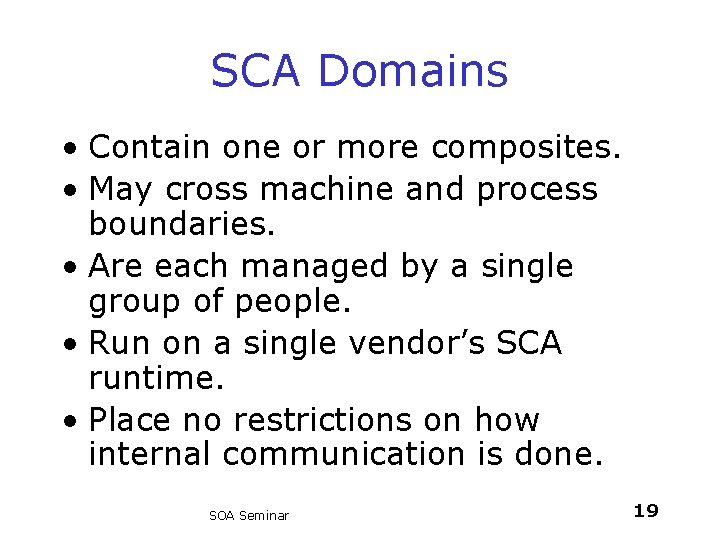
SCA Domains • Contain one or more composites. • May cross machine and process boundaries. • Are each managed by a single group of people. • Run on a single vendor’s SCA runtime. • Place no restrictions on how internal communication is done. SOA Seminar 19
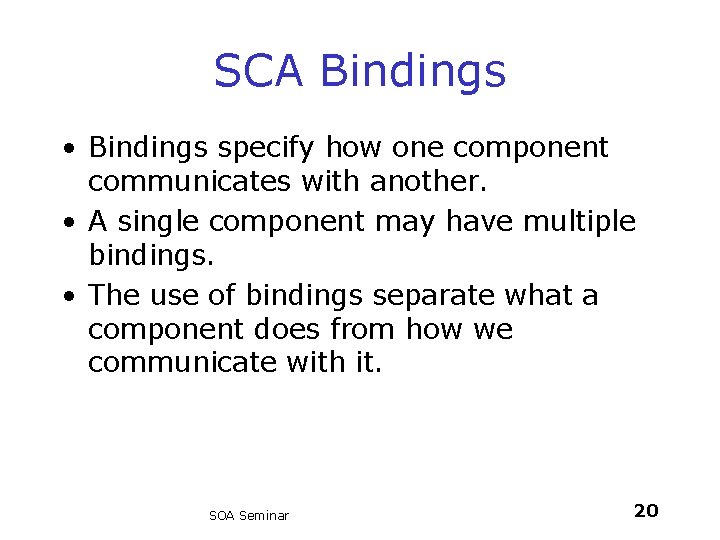
SCA Bindings • Bindings specify how one component communicates with another. • A single component may have multiple bindings. • The use of bindings separate what a component does from how we communicate with it. SOA Seminar 20
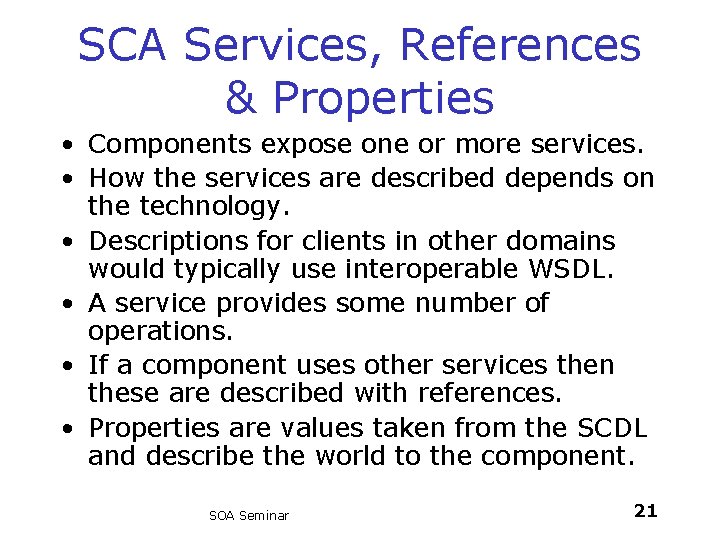
SCA Services, References & Properties • Components expose one or more services. • How the services are described depends on the technology. • Descriptions for clients in other domains would typically use interoperable WSDL. • A service provides some number of operations. • If a component uses other services then these are described with references. • Properties are values taken from the SCDL and describe the world to the component. SOA Seminar 21
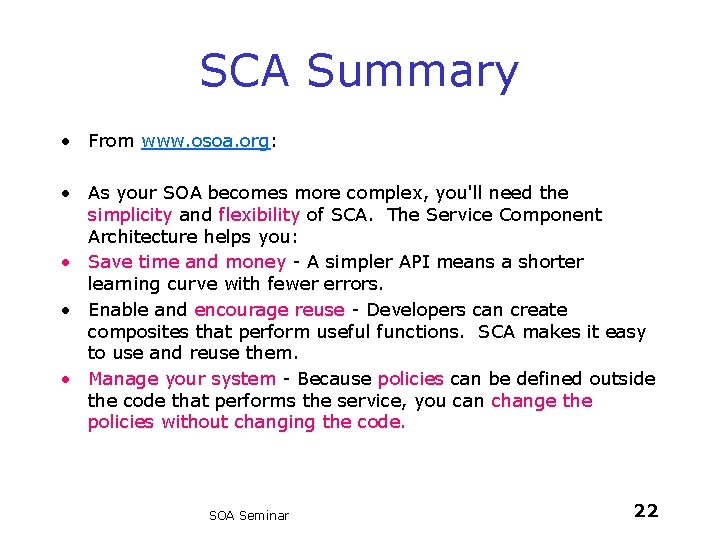
SCA Summary • From www. osoa. org: • As your SOA becomes more complex, you'll need the simplicity and flexibility of SCA. The Service Component Architecture helps you: • Save time and money - A simpler API means a shorter learning curve with fewer errors. • Enable and encourage reuse - Developers can create composites that perform useful functions. SCA makes it easy to use and reuse them. • Manage your system - Because policies can be defined outside the code that performs the service, you can change the policies without changing the code. SOA Seminar 22
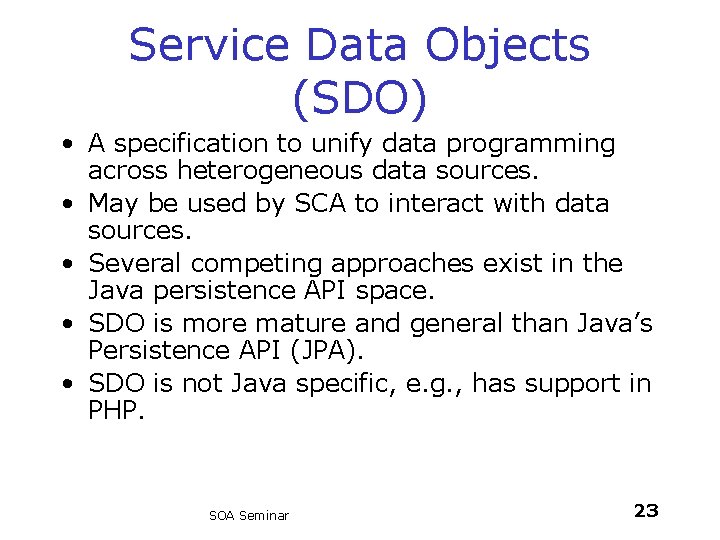
Service Data Objects (SDO) • A specification to unify data programming across heterogeneous data sources. • May be used by SCA to interact with data sources. • Several competing approaches exist in the Java persistence API space. • SDO is more mature and general than Java’s Persistence API (JPA). • SDO is not Java specific, e. g. , has support in PHP. SOA Seminar 23
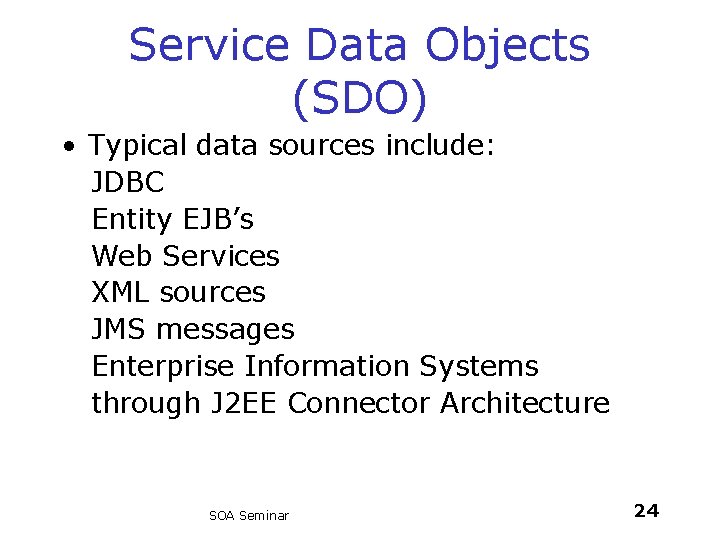
Service Data Objects (SDO) • Typical data sources include: JDBC Entity EJB’s Web Services XML sources JMS messages Enterprise Information Systems through J 2 EE Connector Architecture SOA Seminar 24
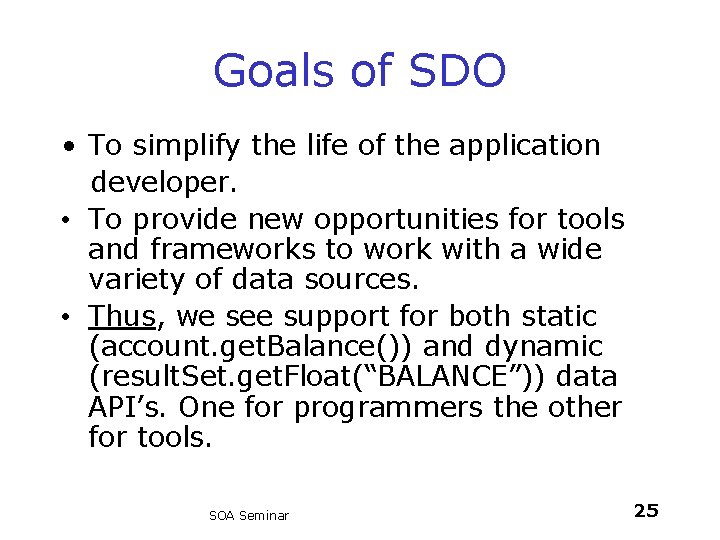
Goals of SDO • To simplify the life of the application developer. • To provide new opportunities for tools and frameworks to work with a wide variety of data sources. • Thus, we see support for both static (account. get. Balance()) and dynamic (result. Set. get. Float(“BALANCE”)) data API’s. One for programmers the other for tools. SOA Seminar 25
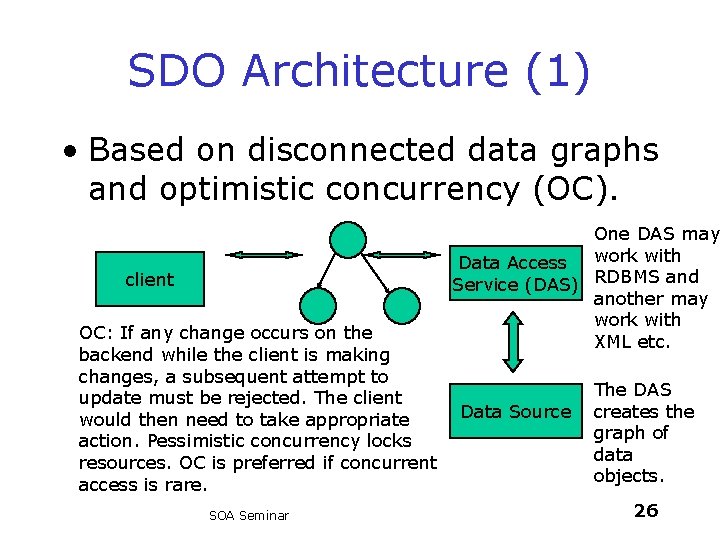
SDO Architecture (1) • Based on disconnected data graphs and optimistic concurrency (OC). client OC: If any change occurs on the backend while the client is making changes, a subsequent attempt to update must be rejected. The client would then need to take appropriate action. Pessimistic concurrency locks resources. OC is preferred if concurrent access is rare. SOA Seminar One DAS may Data Access work with Service (DAS) RDBMS and another may work with XML etc. Data Source The DAS creates the graph of data objects. 26
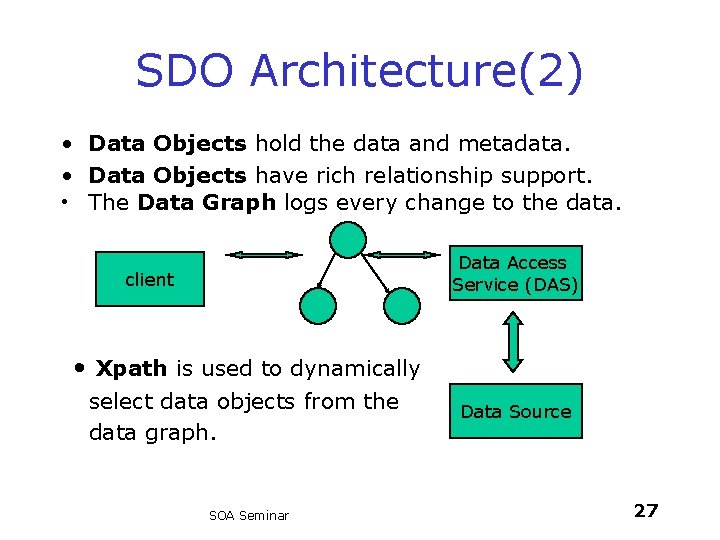
SDO Architecture(2) • Data Objects hold the data and metadata. • Data Objects have rich relationship support. • The Data Graph logs every change to the data. Data Access Service (DAS) client • Xpath is used to dynamically select data objects from the data graph. SOA Seminar Data Source 27
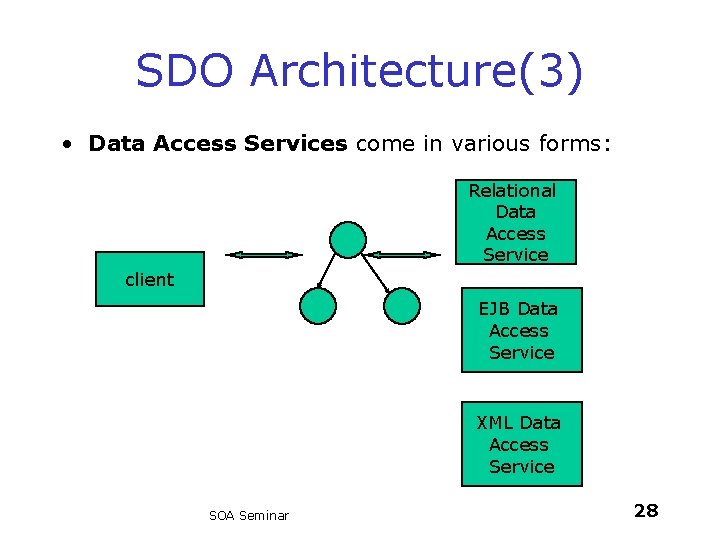
SDO Architecture(3) • Data Access Services come in various forms: Relational Data Access Service client EJB Data Access Service XML Data Access Service SOA Seminar 28
SCA and JBI • See article by Mike Edwards (IBM) at http: //www. osoa. org/display/Main/Relationship+of+SCA+and+JBI • How does SCA differ from JBI? • JBI stands for Java Business Integration • JBI defines a set of of Service Provider Interfaces for middleware providers to implement if they want to install new service engines (SCA implementation types) or binding components (SCA bindings). • SCA is for developers, assemblers and deployers of business services. SCA says nothing about how new implementation types or new bindings might be introduced. • JBI is for middleware vendors. SCA is for business developers. SOA Seminar 29
SCA and JBI Bottom Line • See article by Mike Edwards (IBM) at http: //www. osoa. org/display/Main/Relationship+of+SCA+and+JBI “JBI should be considered a Java technology that potentially helps middleware vendors to implement SCA. JBI and SCA do not compete or conflict with each other. ” “SCA, on the other hand, allows multiple technologies to be used to implement services( e. g. Java, BPEL, C++) and multiple bindings to communicate with services (e. g. web services, JMS). ” SOA Seminar 30