
Seminar on Homiletics Sunset Church Summer Bible Study
Seminar on Homiletics Sunset Church Summer Bible Study On I & II Thessalonians Sunday, June 24, 2018 Acknowledgement: Thanks to BSF International for permission to use of their materials as modified.

What is Homiletics? § Homiletics is an analysis of a Scripture passage that delves deep into God’s Word beyond mere reading or skimming the Bible, and can be used by anyone for personal devotion, or to prepare a lesson, talk or sermon. § Homiletics leads you directly to God’s Word without another person’s understanding or interpretation, and involves three skills of observation (facts), interpretation (lesson) and application.

Preparatory Step in Homiletics § Always start with prayer, asking the Holy Spirit to reveal directly to you profound insights and understanding of God’s Word that are personally relevant and applicable to you now – like asking for daily fresh manna after the morning dew. § Crave for intimacy with God – to know Him better, love Him deeper, follow Him closer, serve Him well, do as He would do, and become more like Christ. § Expect God to teach you His profound truth for your immediate or future use – not just head knowledge, but from mind of Christ to heart of Christ.

5 Basic Steps in Homiletics 1. Content 2. Divisions 3. Subject Sentence 4. Aim 5. Applications
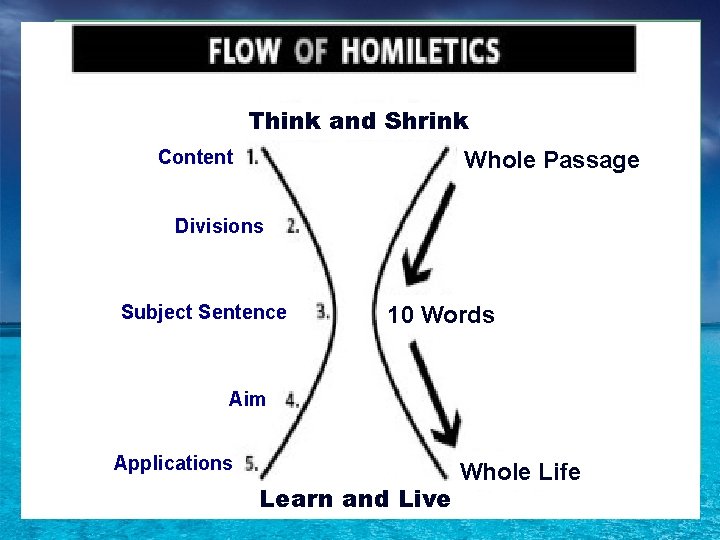
Think and Shrink Content Whole Passage Divisions Subject Sentence 10 Words Aim Applications Learn and Live Whole Life
Step 1: Contents § List 10 -20 items of topics or events with corresponding Bible verses. § Facts only on “who, what, when, where, how and why” of the event or topic. § Use same words as Bible may help. - Reduce to smaller portion that captures the content - Complete sentences not necessary § Note repeated words/phrases, contrast, comparison, names, place, time, conversation, terms of conclusion (therefore, thus, for this reason), etc. § Develop own style over time.
10 minutes exercise time to write Contents. Form groups of 6, and assign one member to take notes to report later.

Step 1: Contents: Example 1. I Thessalonians 3: 6 -8: Timothy reported Thessalonians’ faith and love, and standing firm in the Lord. 2. I Thessalonians 3: 9: Paul thanked God for his joy because of Thessalonians. 3. I Thessalonians 3: 10: Though Thessalonians were standing firm in the Lord, Paul still want to supply areas where their faith was lacking. 4. I Thessalonians 3: 11: Paul asked God to clear the way to visit Thessalonians. 5. I Thessalonians 3: 12: Paul prayed that their love will increase to overflow for each other and for everyone else. 6. I Thessalonians 3: 13: Paul prayed that their hearts will be strengthened, their lives be blameless and holy when Jesus returns with all His only ones.
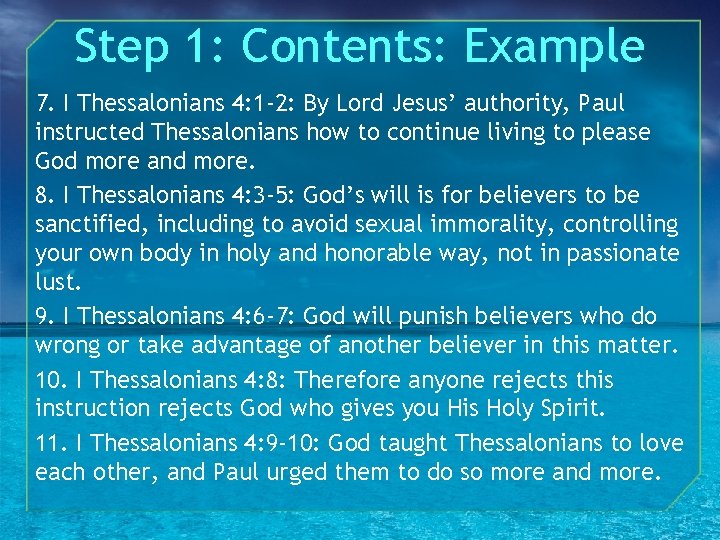
Step 1: Contents: Example 7. I Thessalonians 4: 1 -2: By Lord Jesus’ authority, Paul instructed Thessalonians how to continue living to please God more and more. 8. I Thessalonians 4: 3 -5: God’s will is for believers to be sanctified, including to avoid sexual immorality, controlling your own body in holy and honorable way, not in passionate lust. 9. I Thessalonians 4: 6 -7: God will punish believers who do wrong or take advantage of another believer in this matter. 10. I Thessalonians 4: 8: Therefore anyone rejects this instruction rejects God who gives you His Holy Spirit. 11. I Thessalonians 4: 9 -10: God taught Thessalonians to love each other, and Paul urged them to do so more and more.
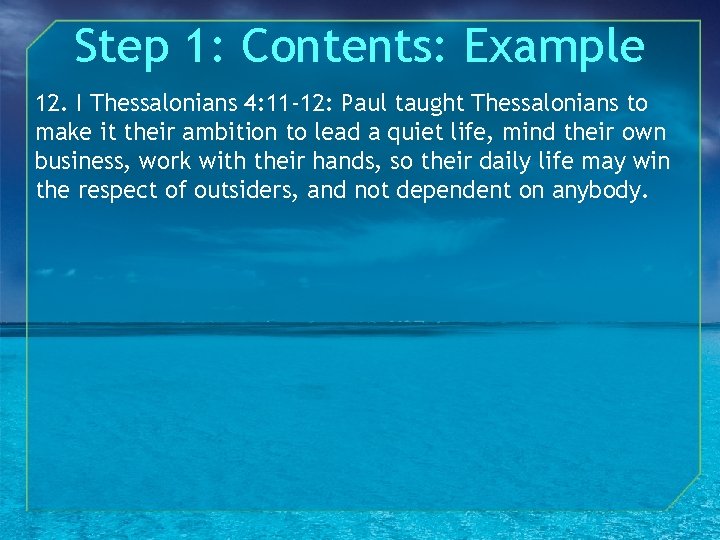
Step 1: Contents: Example 12. I Thessalonians 4: 11 -12: Paul taught Thessalonians to make it their ambition to lead a quiet life, mind their own business, work with their hands, so their daily life may win the respect of outsiders, and not dependent on anybody.
Step 2: Divisions § Summarize contents to 2 – 4 divisions - Look for natural breaks (Time, location, dialog, topic) § Facts only - Not interpretation or opinion § Grammatically correct sentence § Write verse references (e. g. 4: 6 -8)
Step 2: Divisions: Example Division 1 (I Thessalonians 3: 6 -13): ___________________________________ Division 2 (I Thessalonians 4: 1 -8): ___________________________________ Division 3 (I Thessalonians 4: 9 -12): ________________________________________
5 minutes exercise time to write Divisions. Continue working with same groups of 6, and assign one member to take notes to report later.

Step 2: Divisions: Example Division 1 (I Thessalonians 3: 6 -13): Paul encouraged by Timothy’s report about Thessalonians’ faith and love. Lesson: Faithful Christians encouraged by steadfast faith and love of other Christians. Division 2 (I Thessalonians 4: 1 -8): God’s will for holy and honorable living through sexual purity. Lesson: Faithful Christians live to please God by living holy and honorably with Holy Spirit inside them. Division 3 (I Thessalonians 4: 9 -12): Love others more, lead a quiet life, mind your own business, work with your hands, win respect of outsiders, and not be dependent on anybody. Lesson: Faithful Christians live to please God by loving each other, leading a quiet life, and working respectfully and not dependent on others.
Step 3: Subject Sentence 10 -word Subject Sentence summarizes the entire passage: - Incorporates your division sentences and reduces to a concise summary. - Allows a person who is familiar with the Bible, to identify the passage from your subject sentence.

Step 3: Subject Sentence Example: I Thess. 3: 6 -4: 12 § __________________ (no more than 10 words in a complete sentence) § 5 minutes exercise time to write Subject Sentence. § Continue working with same groups of 6, and assign one member to take notes to report later.

Step 3: Subject Sentence Example: I Thess. 3: 6 -4: 12 § Paul encouraged, and instructed Thessalonians in holy and respectful living.
Step 4: Aim is the main lesson, truth or principle you want yourself or the audience to learn, and begins with the phrase "CATL". . . cause audience (or me) to learn…. § Find the compelling motive of this passage that would cause you to change your life. § Ask yourself the question, “What action should I take in response to this passage of Scripture? ” § The aim must be doctrinally correct - in agreement with the teaching of the entire Bible (not taken out of context. ) § The aim may be a truth about God or people, leading you somewhere rather than summarizing facts.
Step 4: Aim: Example § "CATL". . . cause audience to learn… ________________ § 5 minutes exercise time to write Aim. § Continue working with the groups of 6, and assign one member to take notes to report later.

Step 4: Aim: Example: I Thess. 3: 6 -4: 12 § "CATL". . . cause audience to learn that - God’s will for believers is to rely on Holy Spirit to live a blameless, holy, faithful and loving life in God’s presence, and to live wisely and respectfully until Christ’s return. - Christian holy living is to encourage and love one another to live a holy, pure and respectable life, so non-Christian can see God’s love.

Step 5: Applications The purpose of application questions is to transform head knowledge to heart motivation to change in our daily life. § One open-ended (what, when, why, who, where, how) application question per division. § Balance questions that convict of wrong thinking with positive questions that encourage trust in and surrender to God. § Balance questions that encourage evaluation of thinking and actions with questions that invite change in thinking and living (for example a right view of God, trust in Him, priorities in life, etc. ) § Questions may be targeted at yourself or toward a particular category of people in your audience. Consider varying life stages (students, parents, workers, retired)

Step 5: Applications: Examples Division 1 (I Thessalonians 3: 6 -13): Paul rejoiced and encouraged by Timothy’s report about Thessalonians’ faith and love. Lesson: Faithful Christians encouraged by steadfast faith and love of other Christians. § Application Question: ____________________ Division 2 (I Thessalonians 4: 1 -8): God’s will for holy and honorable living through sexual purity. Lesson: Faithful Christians live to please God by living holy and honorably with Holy Spirit inside them. § Application Question: ____________________ Division 3 (I Thessalonians 4: 9 -12): Love others more, lead a quiet life, mind your own business, work with your hands, win respect of outsiders, and not be dependent on anybody. Lesson: Faithful Christians live to please God by loving each other, leading a quiet life, and working respectfully and not dependent on others. § Application Question: ____________________

Step 5: Applications: Examples Lesson: Faithful Christians encouraged by steadfast faith and love of other Christians. § Application Question: _____________________________ Lesson: Faithful Christians live to please God by living holy and honorably with Holy Spirit inside them. § Application Question: _____________________________ Lesson: Faithful Christians live to please God by loving each other, leading a quiet life, and working respectfully and not dependent on others § Application Question: _____________________________ 15 minutes exercise time to write Application Questions. Continue working with the groups of 6, and assign one member to take notes to report later.
Step 5: Applications: Examples 1. Lesson: Faithful Christians rejoice and are encouraged by steadfast faith and love of other Christians. a. How do other Christians’ faith, love and perseverance – or lack of – affect you? Cite examples. So how would you respond? How should you respond? b. Knowing that all blessings come from God, how do you thank God, the Giver, for the joy and encouragement you received from others, and to pray for others’ increased strength in their heart, and be blameless and holy, while waiting for Christ’s return with His holy ones? c. Considering your own faithfulness – or lack of – may have on others, how will you pray and ask God to help you contact someone today to make a difference in his/her life by your living in faith, love and holiness? d. Considering that love and holy living go side-by-side, as God is love and God is holy, how will you pray and ask God to increase your love to overflowing to Christians and everyone else, in His presence and for His glory? e. Considering that our Lord Jesus will return and come with all His holy ones, that He has been praying and interceding for them and you since His resurrection to heaven, how will you thank Jesus for His grace, mercy and love, and receive comfort and confidence that He will protect you until that Day? What specifically will you do today to thank Jesus?
Step 5: Applications: Examples 2. Lesson: Faithful Christians live to please God by living holy and honorably with Holy Spirit inside them. a. How are you living to please God and not yourself and others? What area(s) do you need God’s help to please Him more and more? b. How are you following the Basic Instructions to live Before Leaving Earth (BIBLE) by the authority of the Lord Jesus? (“. . turned to God from idols to serve the living and true God”) [I Thessalonians 1: 9]? ) Which area(s) will you turn to God from “idols”? c. How do you express your gratitude and joy for Christ who saved us from the power and penalty of sin, and adopted you as God’s children to live in His eternal presence? – What are you willing to give up to please God more and more. d. As Paul suggested the way to please God is to remember what was instructed by the authority of the Lord Jesus (Bible) and to receive the encouragement, inspiration, exhortation and reproof among other believers God placed in our community, how are you remembering and applying His Word while shepherding His flock? e. God’s will is for us to be sanctified, avoid sexual immorality, control our own body from passionate lust, not doing wrong or taking advantage of other person’s body, and to be morally set apart (sanctified) resulted in union with Christ, purified by His blood, cleansed and accepted before God our Heavenly Father. How do your views on sex and marriage reflect cultural norms or Gospel-convictions aligned with your new identity in Christ, being redeemed and purified by His blood? How do you want to change your view? f. As God has made you holy and you want to please Him, in which area(s) do you need God to help you transform into His holiness, and what are you going to do about it today?
Step 5: Applications: Examples 3. Lesson: Faithful Christians live to please God by loving each other, leading a quiet life, working respectfully and not dependent on others. a. What have you done to show your love to each other so God will be pleased and glorified? What else can you do now to love more and more, and not be complacent? b. As Paul and his co-laborers in Christ have acted gently like young children (I Thessalonians 2: 7), sacrificial caring like nursing mother (I Thessalonians 2: 7), co-laboring through thick-and-thin brothers and sisters (I Thessalonians 2: 9), encouraging, comforting and guiding father (I Thessalonians 2: 11), and feeling orphaned temporarily in person, not in thought, out of intense longing to see each other (I Thessalonians 2: 17), what ways will you increase love for your spiritual family in Christ? c. As we are called to live in this world, and not of this world, how are you to live wisely – to lead a quiet life, work respectfully and not dependent on others? Where do you want God to transform in you now?

Summary of the 5 -Step Homiletics Process Remember: § The first three steps are the facts: literal (what God said) § The fourth step is the truth/aim: spiritual (what God meant) § The fifth step is application: practical (how God’s Word apply to transform us)
Homiletics: Will it work for me? § You can gain fresh insights on what God is telling you now – personally relevant and applicable to you. § You can learn more with a big picture from facts to lessons to applications. § Homiletics helps us focus, and therefore improves our reading, critical thinking, writing, and speaking skills, together with organization and presentation skills. § It is work, but it works. It is challenging, but it is fun.

Homiletics On Verse Date: ________ Step One: Read the passage at least once. Draw up a list of 10 -20 topics or events from the passage. 1. Step 2: Divisions Separate the list into 2 to 4 groups to help you remember the structure; write a division sentence for each with the main thought. Division One: 2. Verses: Topic: 3. 4. 5. 6. Division Two: Verses: Topic: 7. 8. 9. 10. Verses: Topic: 11. 12. 13. 14. 15. Division Three: Verses: Topic: 16. 17. Division Four: 18. 19. 20. Step 3: Subject Sentence : Write a full sentence of no more than 10 words summarizing the entire passage, including a subject and verb. The subject sentence may be a compound sentence, but may not be a phrase. Step 4: Aim: The main lesson I want the audience to learn (to know, or to do in response), whether this is myself or others. Step 5: Applications: Several specific applications, for each division, from real life of self or audience
- Slides: 31