
Seminar on Enhanced Data Rates for GSM EvolutionEDGE
![EDGE Modulation, Channel Coding Scheme & Bit Rates Scheme Modulation Maximum rate [kb/s] Code](https://slidetodoc.com/presentation_image_h2/a7304f1c7aa8e11480480370c327aaef/image-15.jpg "EDGE Modulation, Channel Coding Scheme & Bit Rates Scheme Modulation Maximum rate [kb/s] Code")

- Slides: 20
Seminar on Enhanced Data Rates for GSM Evolution(EDGE)
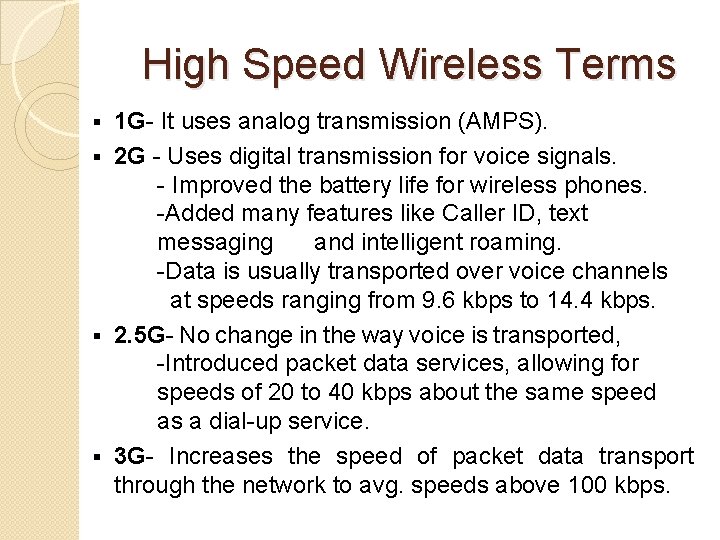
High Speed Wireless Terms 1 G- It uses analog transmission (AMPS). § 2 G - Uses digital transmission for voice signals. - Improved the battery life for wireless phones. -Added many features like Caller ID, text messaging and intelligent roaming. -Data is usually transported over voice channels at speeds ranging from 9. 6 kbps to 14. 4 kbps. § 2. 5 G- No change in the way voice is transported, -Introduced packet data services, allowing for speeds of 20 to 40 kbps about the same speed as a dial-up service. § 3 G- Increases the speed of packet data transport through the network to avg. speeds above 100 kbps. §
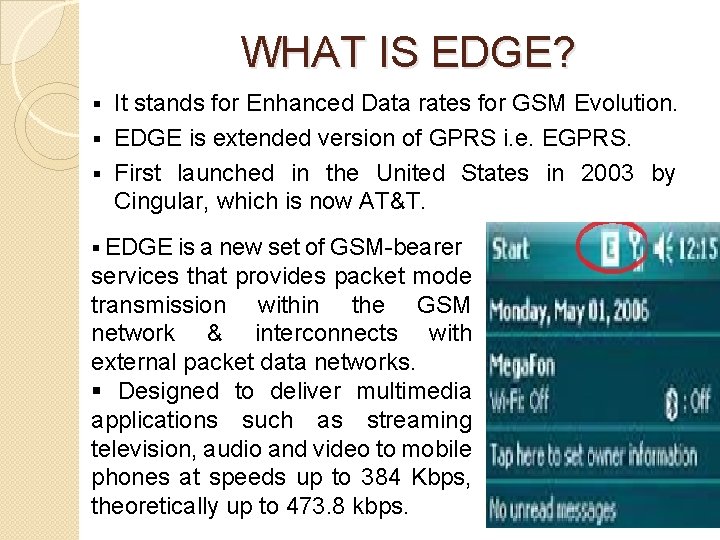
WHAT IS EDGE? It stands for Enhanced Data rates for GSM Evolution. § EDGE is extended version of GPRS i. e. EGPRS. § First launched in the United States in 2003 by Cingular, which is now AT&T. § § EDGE is a new set of GSM-bearer services that provides packet mode transmission within the GSM network & interconnects with external packet data networks. § Designed to deliver multimedia applications such as streaming television, audio and video to mobile phones at speeds up to 384 Kbps, theoretically up to 473. 8 kbps.
Salient Features of EDGE �Compliment to 3 G. �Standardized by ETSI. �EDGE is deployed over GPRS network. �Provides Data Packet delivery service. �Support for leading internet communication protocols. �Billing based on volume of data transferred. �Utilizes existing GSM/GPRS authentication and privacy procedures.
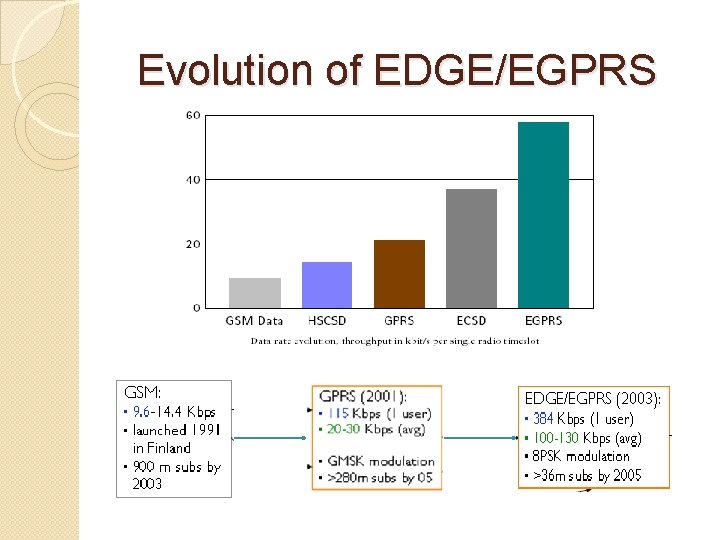
Evolution of EDGE/EGPRS
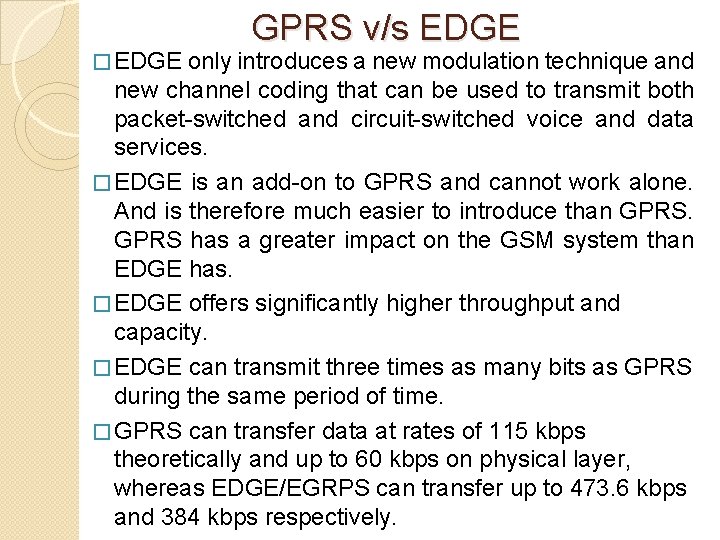
GPRS v/s EDGE � EDGE only introduces a new modulation technique and new channel coding that can be used to transmit both packet-switched and circuit-switched voice and data services. � EDGE is an add-on to GPRS and cannot work alone. And is therefore much easier to introduce than GPRS has a greater impact on the GSM system than EDGE has. � EDGE offers significantly higher throughput and capacity. � EDGE can transmit three times as many bits as GPRS during the same period of time. � GPRS can transfer data at rates of 115 kbps theoretically and up to 60 kbps on physical layer, whereas EDGE/EGRPS can transfer up to 473. 6 kbps and 384 kbps respectively.
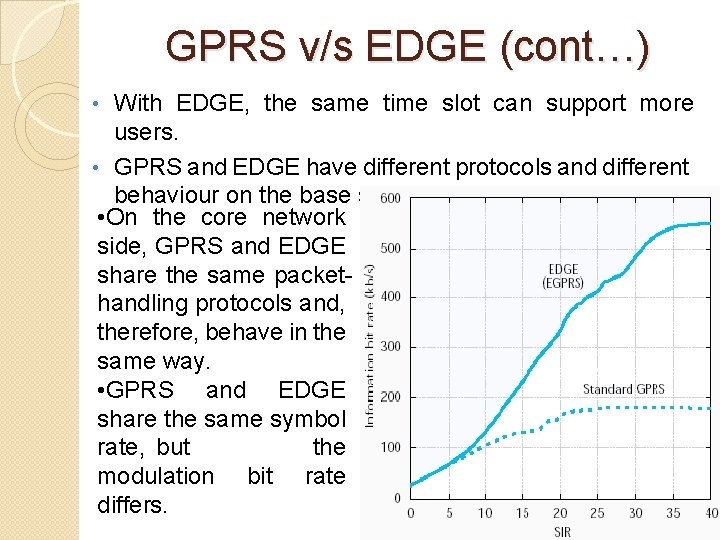
GPRS v/s EDGE (cont…) With EDGE, the same time slot can support more users. • GPRS and EDGE have different protocols and different behaviour on the base station system side. • On the core network side, GPRS and EDGE share the same packethandling protocols and, therefore, behave in the same way. • GPRS and EDGE share the same symbol rate, but the modulation bit rate differs. •
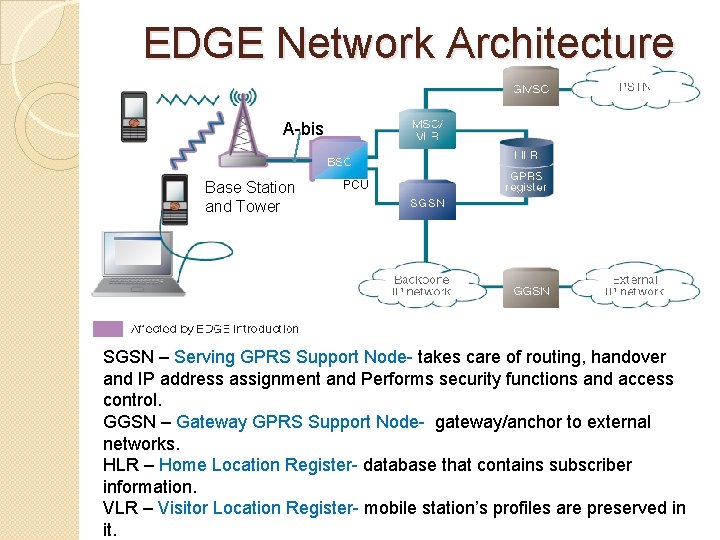
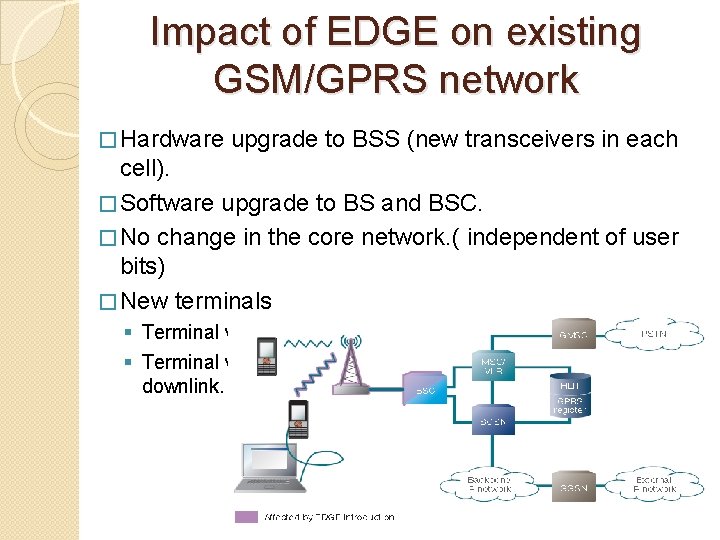
EDGE Network Architecture A-bis Base Station and Tower PCU SGSN – Serving GPRS Support Node- takes care of routing, handover and IP address assignment and Performs security functions and access control. GGSN – Gateway GPRS Support Node- gateway/anchor to external networks. HLR – Home Location Register- database that contains subscriber information. VLR – Visitor Location Register- mobile station’s profiles are preserved in it.
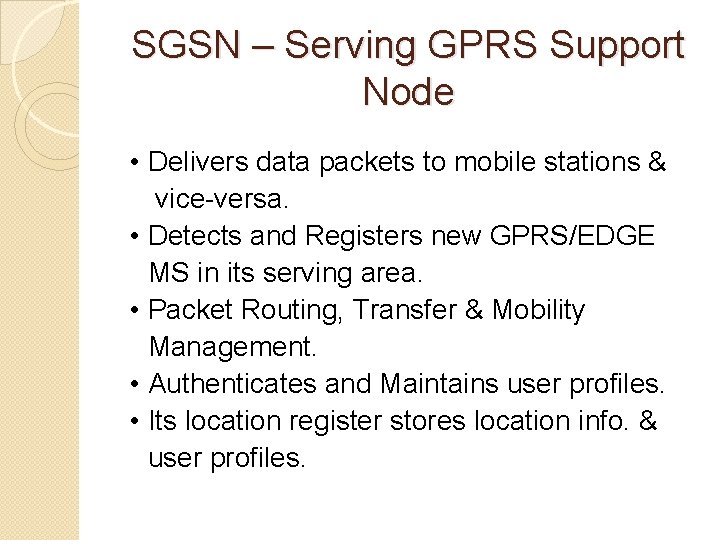
SGSN – Serving GPRS Support Node • Delivers data packets to mobile stations & vice-versa. • Detects and Registers new GPRS/EDGE MS in its serving area. • Packet Routing, Transfer & Mobility Management. • Authenticates and Maintains user profiles. • Its location register stores location info. & user profiles.
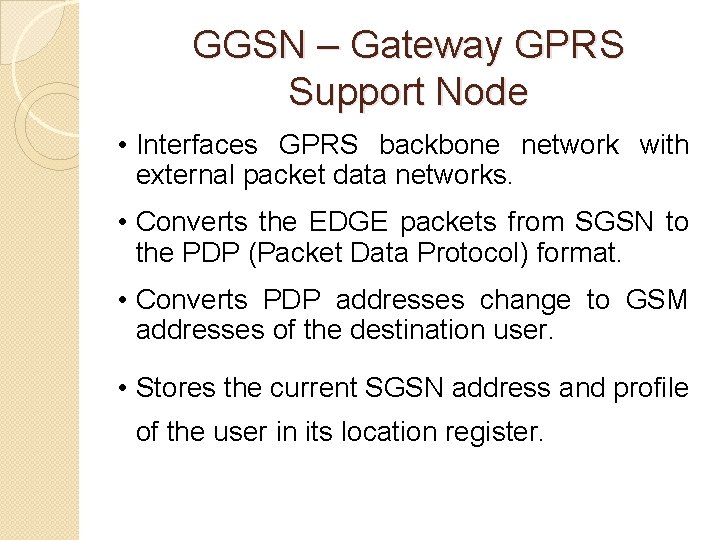
GGSN – Gateway GPRS Support Node • Interfaces GPRS backbone network with external packet data networks. • Converts the EDGE packets from SGSN to the PDP (Packet Data Protocol) format. • Converts PDP addresses change to GSM addresses of the destination user. • Stores the current SGSN address and profile of the user in its location register.
Impact of EDGE on existing GSM/GPRS network � Hardware upgrade to BSS (new transceivers in each cell). � Software upgrade to BS and BSC. � No change in the core network. ( independent of user bits) � New terminals § Terminal which provides 8 PSK in the uplink and downlink § Terminal which provides GMSK in the uplink and 8 PSK in the downlink.
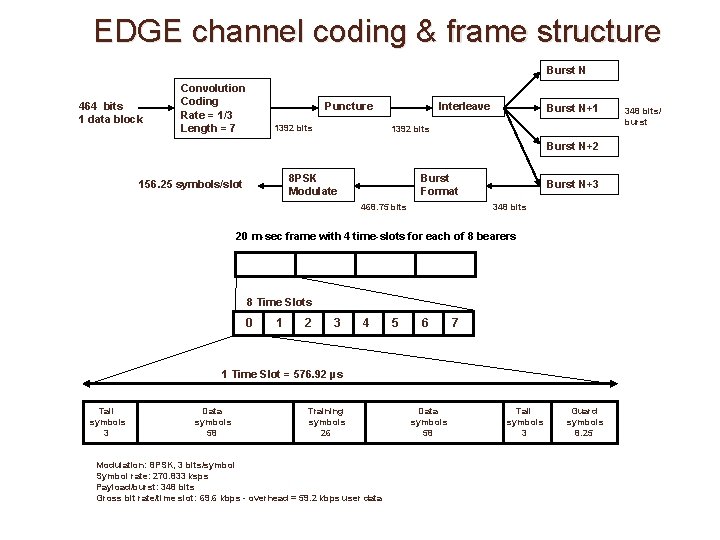
EDGE channel coding & frame structure Burst N 464 bits 1 data block Convolution Coding Rate = 1/3 Length = 7 Puncture 1392 bits Interleave Burst N+1 1392 bits Burst N+2 8 PSK Modulate 156. 25 symbols/slot Burst Format 468. 75 bits Burst N+3 348 bits 20 m-sec frame with 4 time-slots for each of 8 bearers 8 Time Slots 0 1 2 3 4 5 6 7 1 Time Slot = 576. 92 µs Tail symbols 3 Data symbols 58 Training symbols 26 Modulation: 8 PSK, 3 bits/symbol Symbol rate: 270. 833 ksps Payload/burst: 348 bits Gross bit rate/time slot: 69. 6 kbps - overhead = 59. 2 kbps user data Data symbols 58 Tail symbols 3 Guard symbols 8. 25 348 bits/ burst
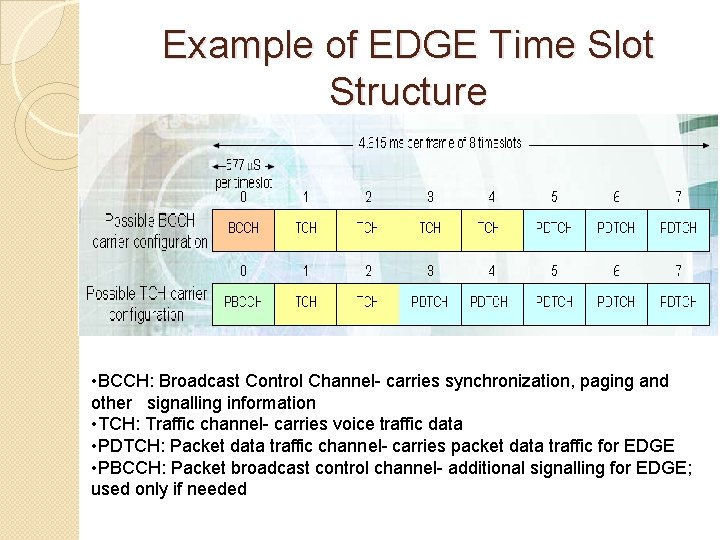
Example of EDGE Time Slot Structure • BCCH: Broadcast Control Channel- carries synchronization, paging and other signalling information • TCH: Traffic channel- carries voice traffic data • PDTCH: Packet data traffic channel- carries packet data traffic for EDGE • PBCCH: Packet broadcast control channel- additional signalling for EDGE; used only if needed
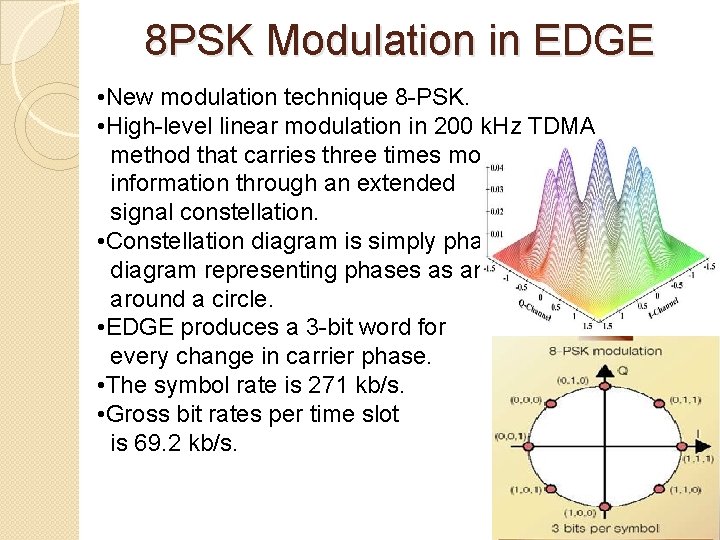
8 PSK Modulation in EDGE • New modulation technique 8 -PSK. • High-level linear modulation in 200 k. Hz TDMA method that carries three times more information through an extended signal constellation. • Constellation diagram is simply phasor diagram representing phases as angles around a circle. • EDGE produces a 3 -bit word for every change in carrier phase. • The symbol rate is 271 kb/s. • Gross bit rates per time slot is 69. 2 kb/s.
EDGE Modulation, Channel Coding Scheme & Bit Rates Scheme Modulation Maximum rate [kb/s] Code Rate MCS 9 8 PSK 59. 2 1. 0 MCS 8 8 PSK 54. 4 0. 92 MCS 7 8 PSK 44. 8 0. 76 MCS 6 8 PS 29. 6 0. 49 8 PS 22. 4 0. 37 GMS 17. 6 1. 0 GMS 14. 8 0. 80 MCS 5 MCS 4 MCS- K K K
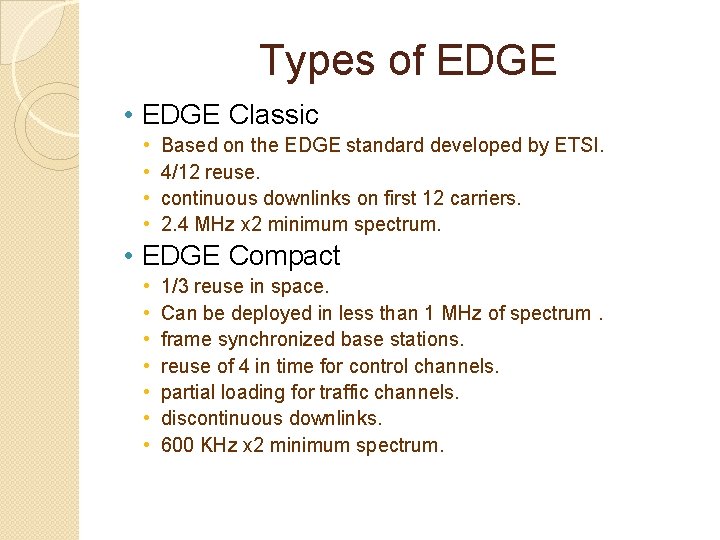
Types of EDGE • EDGE Classic • • Based on the EDGE standard developed by ETSI. 4/12 reuse. continuous downlinks on first 12 carriers. 2. 4 MHz x 2 minimum spectrum. • EDGE Compact • • 1/3 reuse in space. Can be deployed in less than 1 MHz of spectrum. frame synchronized base stations. reuse of 4 in time for control channels. partial loading for traffic channels. discontinuous downlinks. 600 KHz x 2 minimum spectrum.
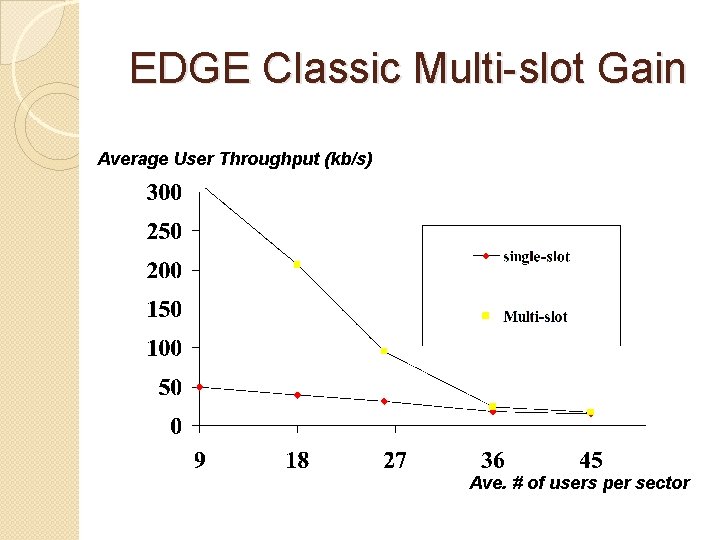
EDGE Classic Multi-slot Gain Average User Throughput (kb/s) Ave. # of users per sector
Application of EDGE � 30% - 50% of business to business use of internet carried out on mobile devices. � IBM wireless group working on application to track employees. � File transfer and document sharing for collaborative work. � Corporate e-mailing. � Vehicle positioning through GPS. � E-banking, Online reservation, E-shoping. � Pictures, Post cards, Greetings, Presentations. � Video messages and video conferencing. � News headlines, flight information, traffic reports, weather reports, maps etc.
EDGE Advantages �Time to market § Designed for existing spectrum: 800/900/1800/1900 MHz § Low risk technology evolution from GSM/GPRS �GSM global scale & scope § Chipsets, handsets, infrastructure and applications § Lower capital investment, better vendor selection § Global roaming �Short-term benefits: Capacity and performance § Easy implementation on a GSM/GPRS network § Cost effective § Increase the capacity and triples the data rate of
THANK YOU !