
SEMINAR ON DISCUSSION AS A TOOL FOR LEARNING
- Slides: 9
SEMINAR ON DISCUSSION AS A TOOL FOR LEARNING Presented By. Ramchandra Karjee Roll No-31 B. Ed, 1 st Semester (2018 -19) University B. T. And Evening College
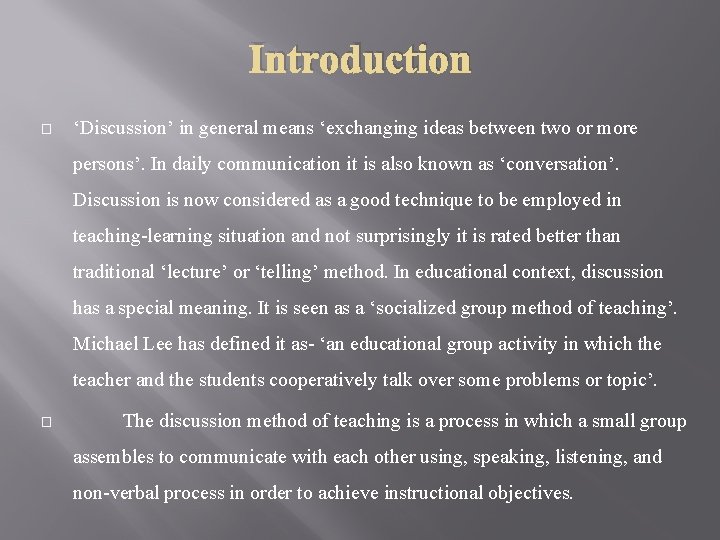
Introduction � ‘Discussion’ in general means ‘exchanging ideas between two or more persons’. In daily communication it is also known as ‘conversation’. Discussion is now considered as a good technique to be employed in teaching-learning situation and not surprisingly it is rated better than traditional ‘lecture’ or ‘telling’ method. In educational context, discussion has a special meaning. It is seen as a ‘socialized group method of teaching’. Michael Lee has defined it as- ‘an educational group activity in which the teacher and the students cooperatively talk over some problems or topic’. � The discussion method of teaching is a process in which a small group assembles to communicate with each other using, speaking, listening, and non-verbal process in order to achieve instructional objectives.
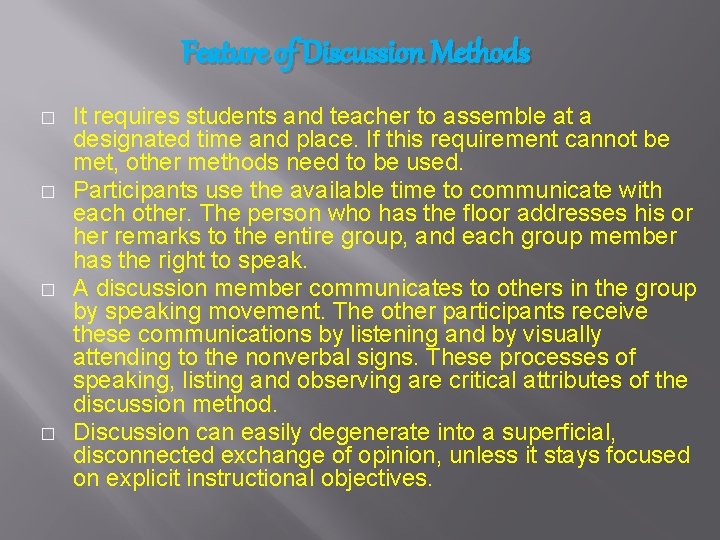
Feature of Discussion Methods � � It requires students and teacher to assemble at a designated time and place. If this requirement cannot be met, other methods need to be used. Participants use the available time to communicate with each other. The person who has the floor addresses his or her remarks to the entire group, and each group member has the right to speak. A discussion member communicates to others in the group by speaking movement. The other participants receive these communications by listening and by visually attending to the nonverbal signs. These processes of speaking, listing and observing are critical attributes of the discussion method. Discussion can easily degenerate into a superficial, disconnected exchange of opinion, unless it stays focused on explicit instructional objectives.
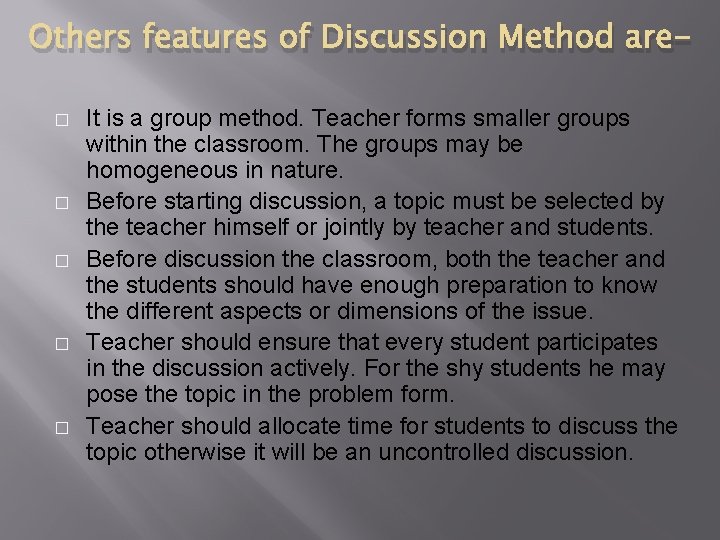
Others features of Discussion Method are� � � It is a group method. Teacher forms smaller groups within the classroom. The groups may be homogeneous in nature. Before starting discussion, a topic must be selected by the teacher himself or jointly by teacher and students. Before discussion the classroom, both the teacher and the students should have enough preparation to know the different aspects or dimensions of the issue. Teacher should ensure that every student participates in the discussion actively. For the shy students he may pose the topic in the problem form. Teacher should allocate time for students to discuss the topic otherwise it will be an uncontrolled discussion.
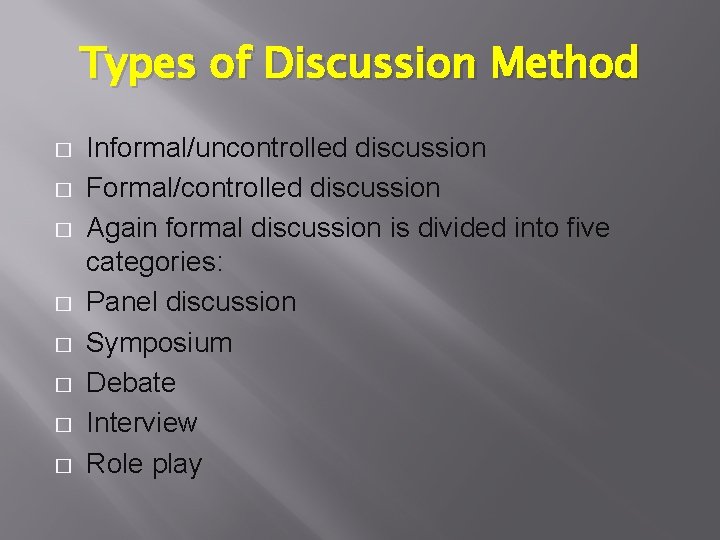
Types of Discussion Method � � � � Informal/uncontrolled discussion Formal/controlled discussion Again formal discussion is divided into five categories: Panel discussion Symposium Debate Interview Role play
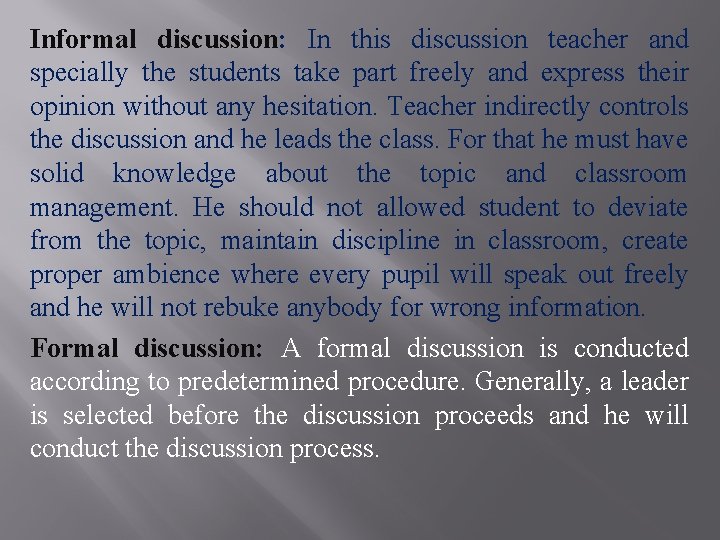
Informal discussion: In this discussion teacher and specially the students take part freely and express their opinion without any hesitation. Teacher indirectly controls the discussion and he leads the class. For that he must have solid knowledge about the topic and classroom management. He should not allowed student to deviate from the topic, maintain discipline in classroom, create proper ambience where every pupil will speak out freely and he will not rebuke anybody for wrong information. Formal discussion: A formal discussion is conducted according to predetermined procedure. Generally, a leader is selected before the discussion proceeds and he will conduct the discussion process.
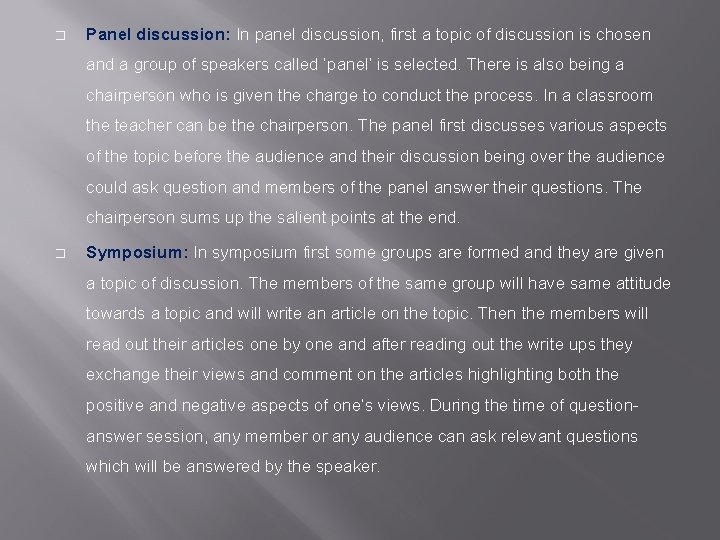
� Panel discussion: In panel discussion, first a topic of discussion is chosen and a group of speakers called ‘panel’ is selected. There is also being a chairperson who is given the charge to conduct the process. In a classroom the teacher can be the chairperson. The panel first discusses various aspects of the topic before the audience and their discussion being over the audience could ask question and members of the panel answer their questions. The chairperson sums up the salient points at the end. � Symposium: In symposium first some groups are formed and they are given a topic of discussion. The members of the same group will have same attitude towards a topic and will write an article on the topic. Then the members will read out their articles one by one and after reading out the write ups they exchange their views and comment on the articles highlighting both the positive and negative aspects of one’s views. During the time of questionanswer session, any member or any audience can ask relevant questions which will be answered by the speaker.
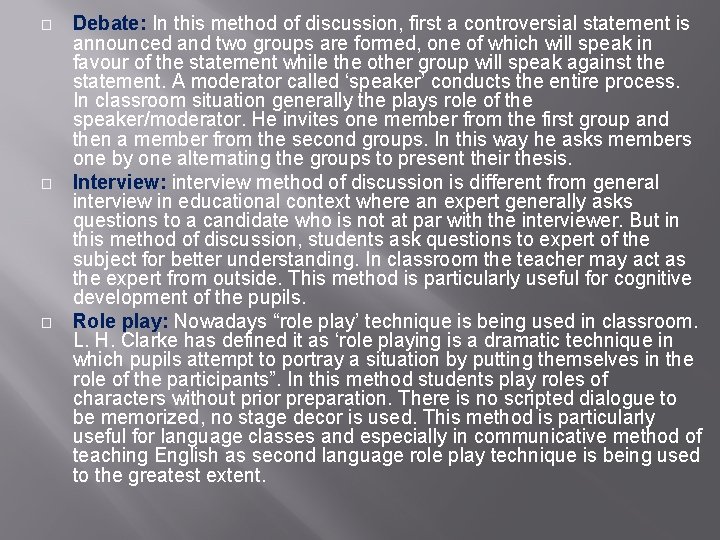
� � � Debate: In this method of discussion, first a controversial statement is announced and two groups are formed, one of which will speak in favour of the statement while the other group will speak against the statement. A moderator called ‘speaker’ conducts the entire process. In classroom situation generally the plays role of the speaker/moderator. He invites one member from the first group and then a member from the second groups. In this way he asks members one by one alternating the groups to present their thesis. Interview: interview method of discussion is different from general interview in educational context where an expert generally asks questions to a candidate who is not at par with the interviewer. But in this method of discussion, students ask questions to expert of the subject for better understanding. In classroom the teacher may act as the expert from outside. This method is particularly useful for cognitive development of the pupils. Role play: Nowadays “role play’ technique is being used in classroom. L. H. Clarke has defined it as ‘role playing is a dramatic technique in which pupils attempt to portray a situation by putting themselves in the role of the participants”. In this method students play roles of characters without prior preparation. There is no scripted dialogue to be memorized, no stage decor is used. This method is particularly useful for language classes and especially in communicative method of teaching English as second language role play technique is being used to the greatest extent.
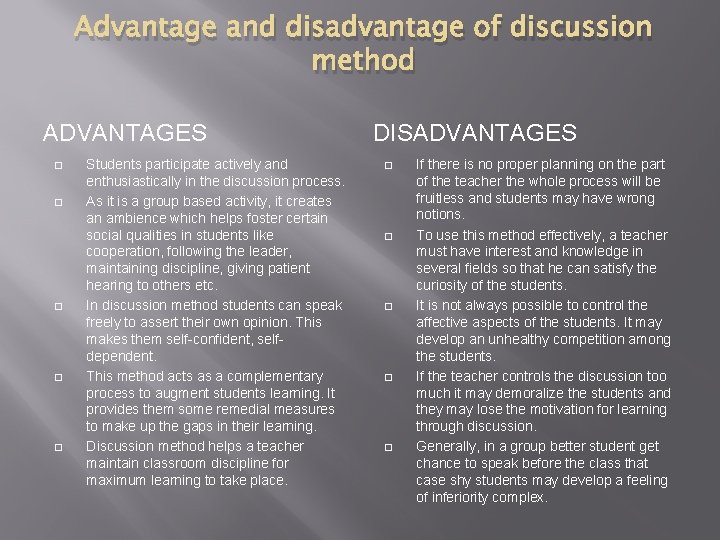
Advantage and disadvantage of discussion method ADVANTAGES � � � Students participate actively and enthusiastically in the discussion process. As it is a group based activity, it creates an ambience which helps foster certain social qualities in students like cooperation, following the leader, maintaining discipline, giving patient hearing to others etc. In discussion method students can speak freely to assert their own opinion. This makes them self-confident, selfdependent. This method acts as a complementary process to augment students learning. It provides them some remedial measures to make up the gaps in their learning. Discussion method helps a teacher maintain classroom discipline for maximum learning to take place. DISADVANTAGES � � � If there is no proper planning on the part of the teacher the whole process will be fruitless and students may have wrong notions. To use this method effectively, a teacher must have interest and knowledge in several fields so that he can satisfy the curiosity of the students. It is not always possible to control the affective aspects of the students. It may develop an unhealthy competition among the students. If the teacher controls the discussion too much it may demoralize the students and they may lose the motivation for learning through discussion. Generally, in a group better student get chance to speak before the class that case shy students may develop a feeling of inferiority complex.