
Seminar Metallography of casting alloys and metallurgical defects
- Slides: 45
Seminar: Metallography of casting alloys and metallurgical defects Fundamentals of solidification -1 -
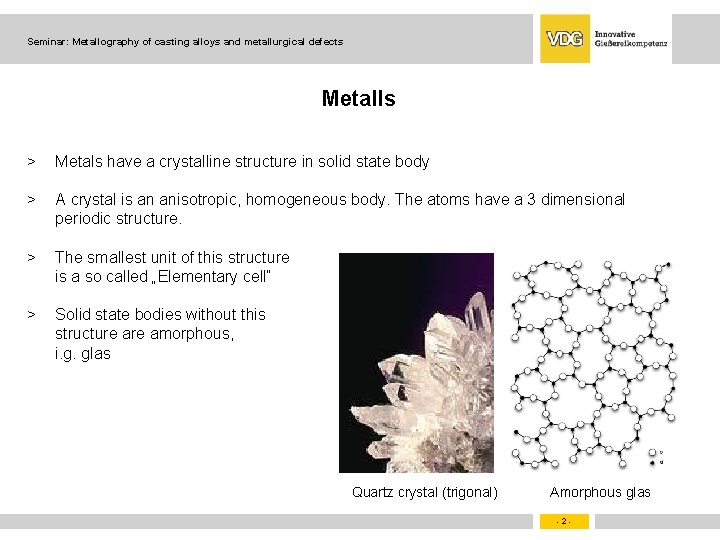
Seminar: Metallography of casting alloys and metallurgical defects Metalls > Metals have a crystalline structure in solid state body > A crystal is an anisotropic, homogeneous body. The atoms have a 3 dimensional periodic structure. > The smallest unit of this structure is a so called „Elementary cell“ > Solid state bodies without this structure amorphous, i. g. glas Quartz crystal (trigonal) Amorphous glas -2 -
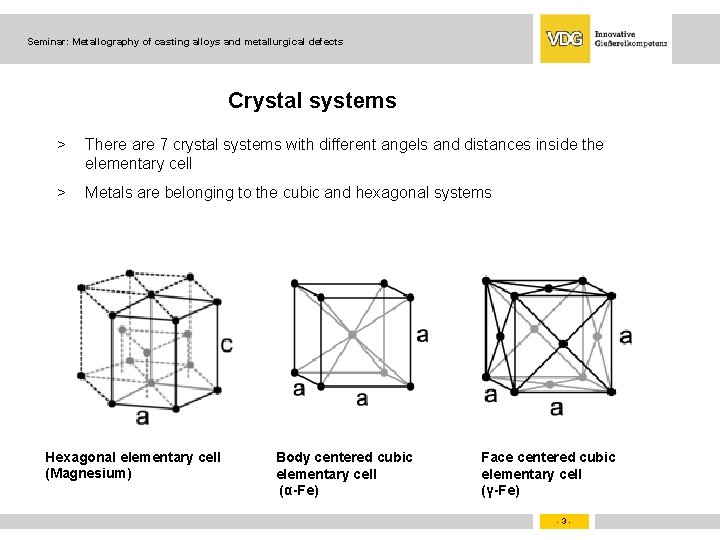
Seminar: Metallography of casting alloys and metallurgical defects Crystal systems > There are 7 crystal systems with different angels and distances inside the elementary cell > Metals are belonging to the cubic and hexagonal systems Hexagonal elementary cell (Magnesium) Body centered cubic elementary cell (α-Fe) Face centered cubic elementary cell (γ-Fe) -3 -
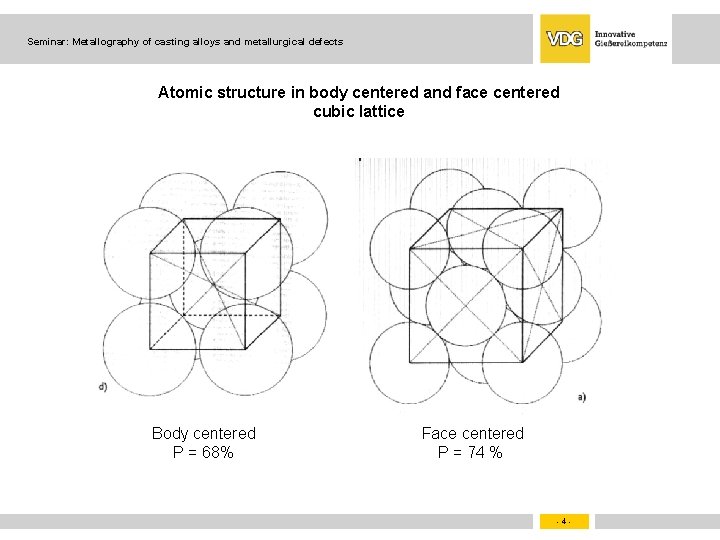
Seminar: Metallography of casting alloys and metallurgical defects Atomic structure in body centered and face centered cubic lattice Body centered P = 68% Face centered P = 74 % -4 -
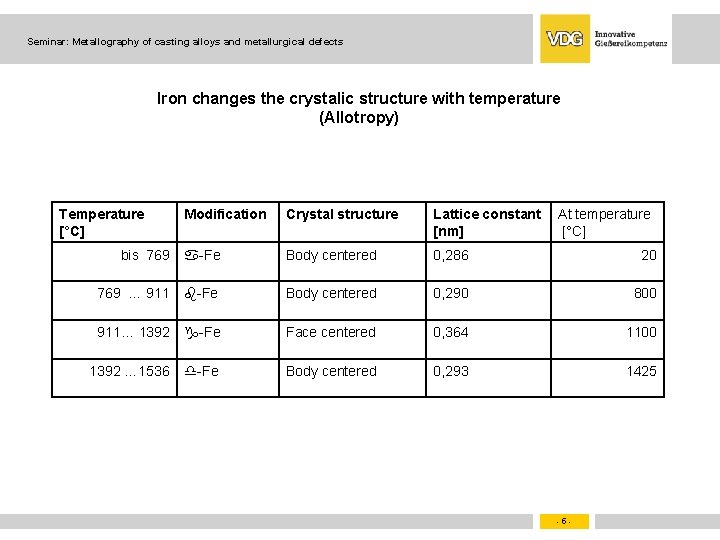
Seminar: Metallography of casting alloys and metallurgical defects Iron changes the crystalic structure with temperature (Allotropy) Temperature [°C] Modification Crystal structure Lattice constant [nm] At temperature [°C] bis 769 -Fe Body centered 0, 286 20 769 … 911 -Fe Body centered 0, 290 800 911… 1392 -Fe Face centered 0, 364 1100 1392 … 1536 -Fe Body centered 0, 293 1425 -5 -
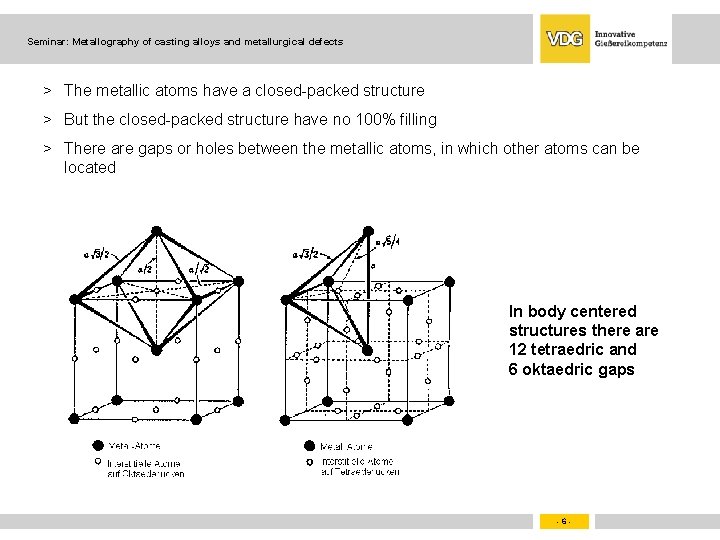
Seminar: Metallography of casting alloys and metallurgical defects > The metallic atoms have a closed-packed structure > But the closed-packed structure have no 100% filling > There are gaps or holes between the metallic atoms, in which other atoms can be located In body centered structures there are 12 tetraedric and 6 oktaedric gaps -6 -
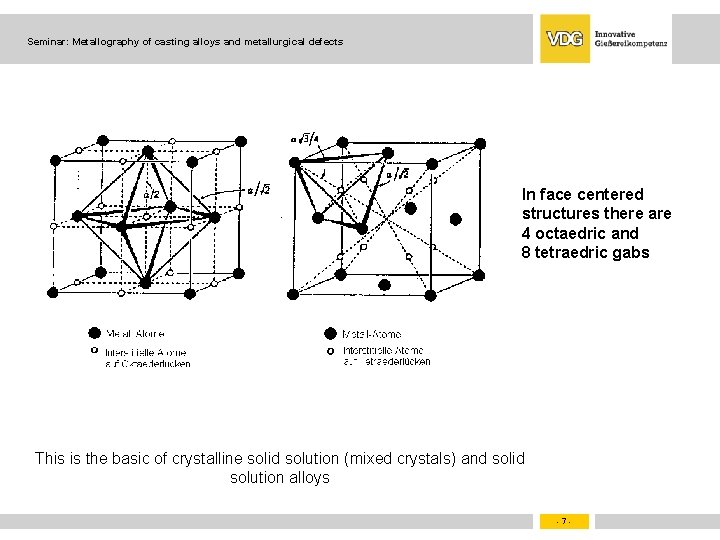
Seminar: Metallography of casting alloys and metallurgical defects In face centered structures there are 4 octaedric and 8 tetraedric gabs This is the basic of crystalline solid solution (mixed crystals) and solid solution alloys -7 -
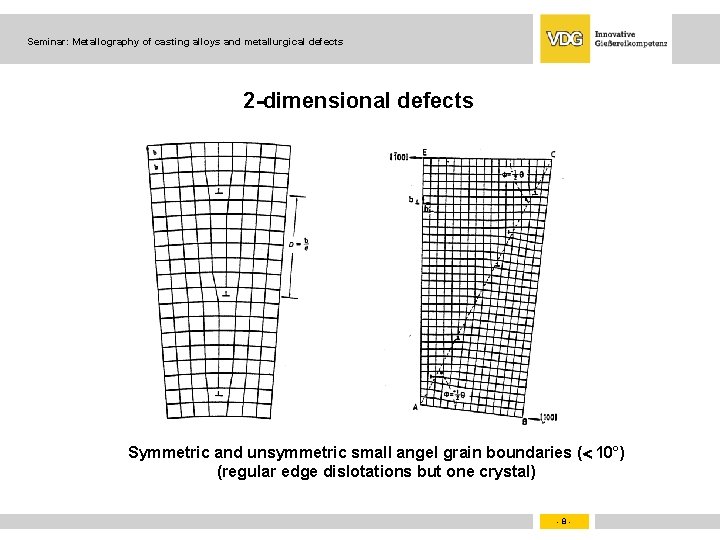
Seminar: Metallography of casting alloys and metallurgical defects 2 -dimensional defects Symmetric and unsymmetric small angel grain boundaries ( 10°) (regular edge dislotations but one crystal) -8 -
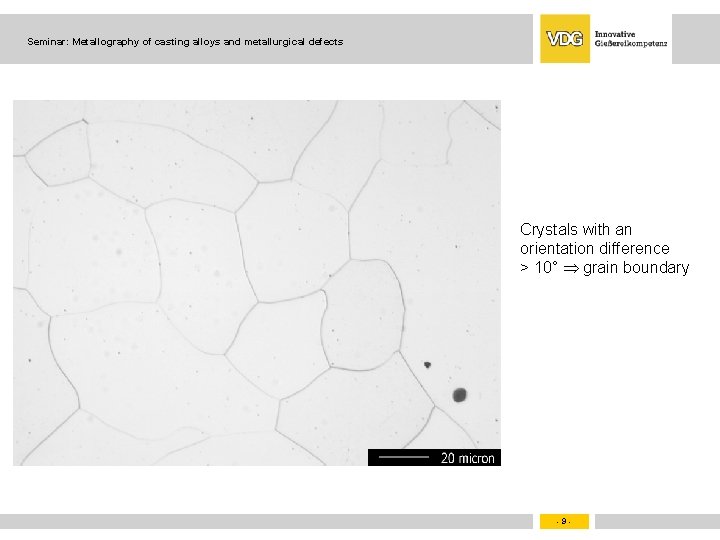
Seminar: Metallography of casting alloys and metallurgical defects Crystals with an orientation difference > 10° grain boundary -9 -
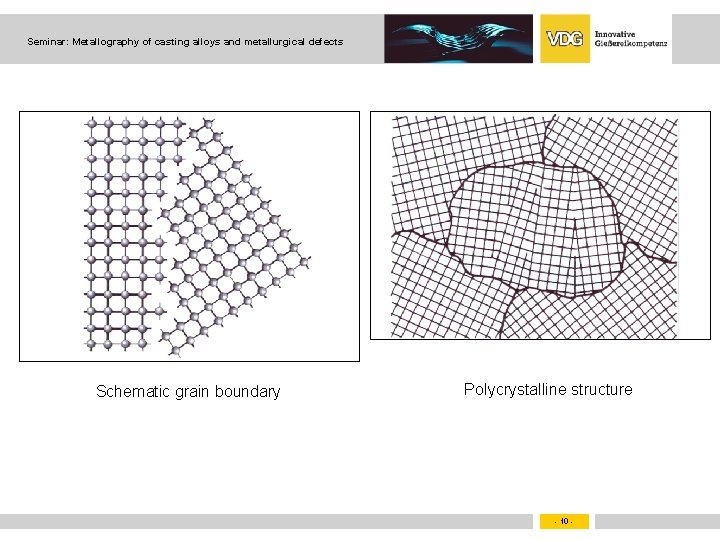
Seminar: Metallography of casting alloys and metallurgical defects Schematic grain boundary Polycrystalline structure - 10 -
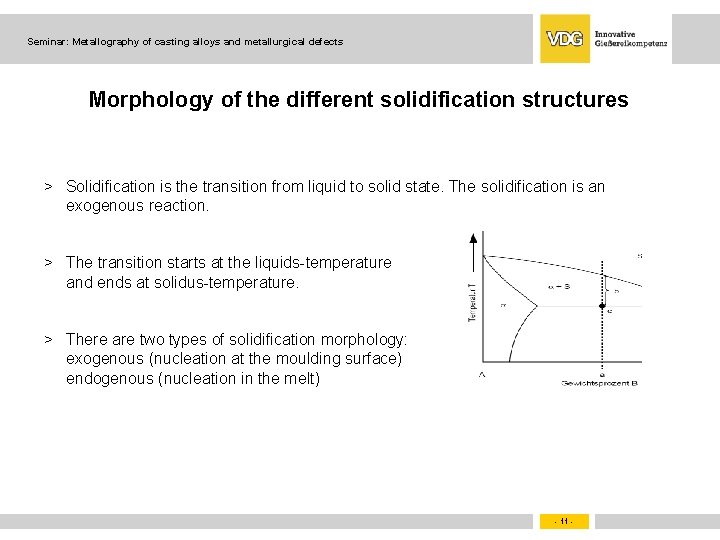
Seminar: Metallography of casting alloys and metallurgical defects Morphology of the different solidification structures > Solidification is the transition from liquid to solid state. The solidification is an exogenous reaction. > The transition starts at the liquids-temperature and ends at solidus-temperature. > There are two types of solidification morphology: exogenous (nucleation at the moulding surface) endogenous (nucleation in the melt) - 11 -
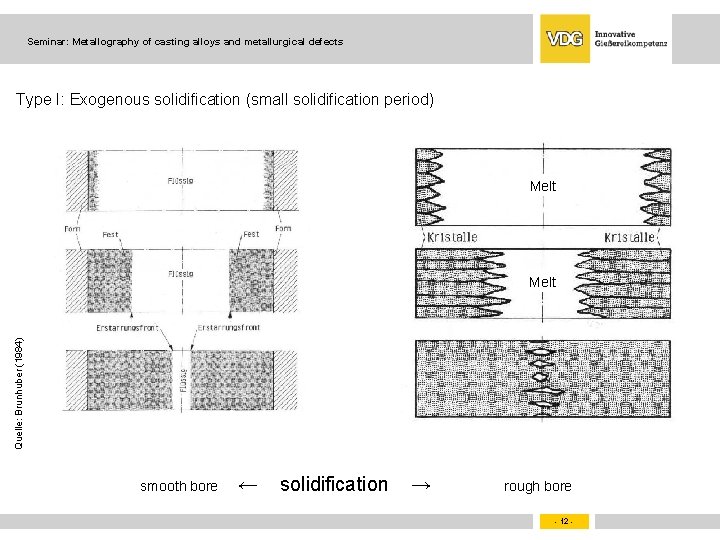
Seminar: Metallography of casting alloys and metallurgical defects Type I: Exogenous solidification (small solidification period) Melt Quelle: Brunhuber (1984) Melt smooth bore ← solidification → rough bore - 12 -
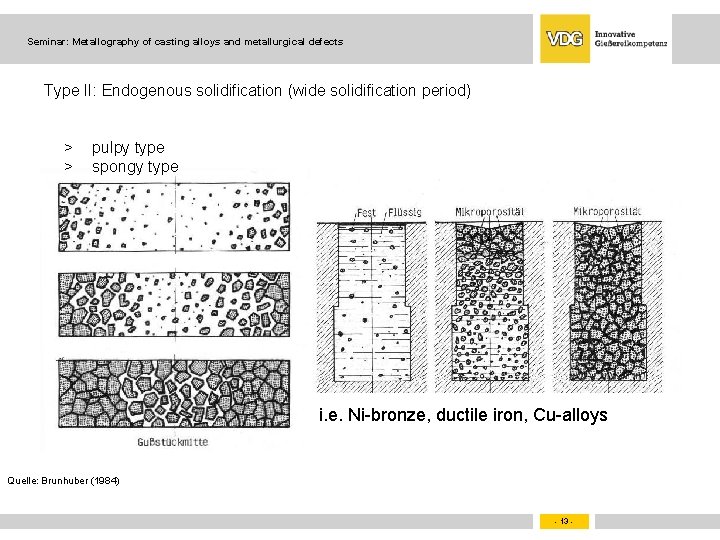
Seminar: Metallography of casting alloys and metallurgical defects Type II: Endogenous solidification (wide solidification period) > > pulpy type spongy type i. e. Ni-bronze, ductile iron, Cu-alloys Quelle: Brunhuber (1984) - 13 -
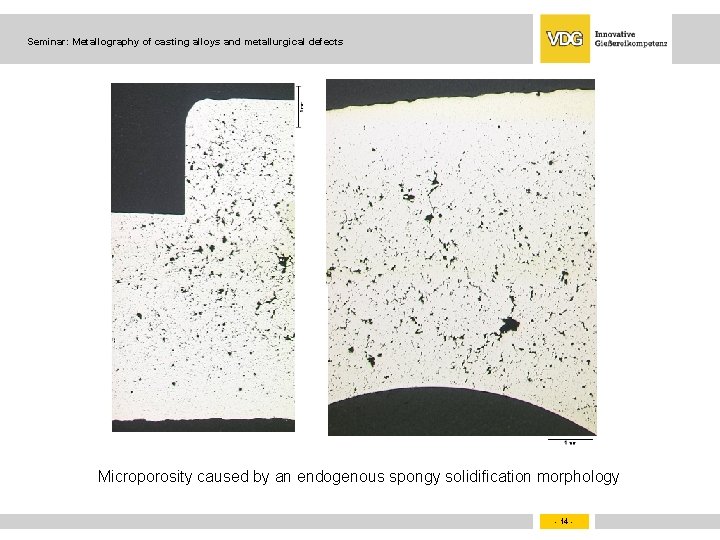
Seminar: Metallography of casting alloys and metallurgical defects Microporosity caused by an endogenous spongy solidification morphology - 14 -
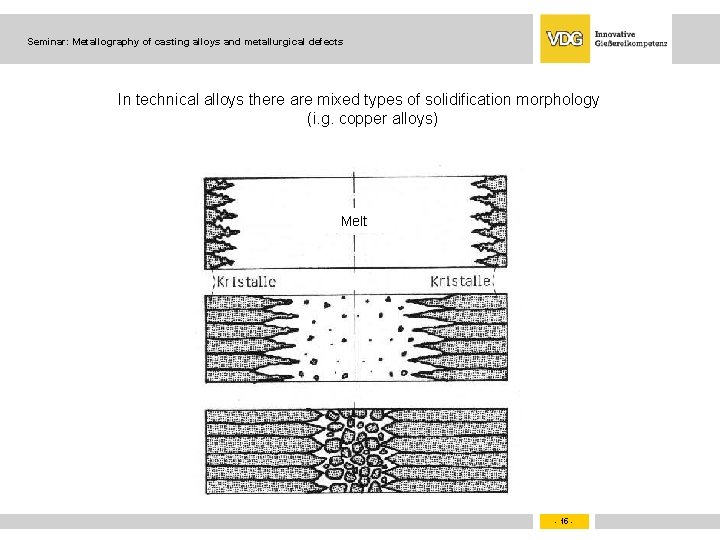
Seminar: Metallography of casting alloys and metallurgical defects In technical alloys there are mixed types of solidification morphology (i. g. copper alloys) Melt - 15 -
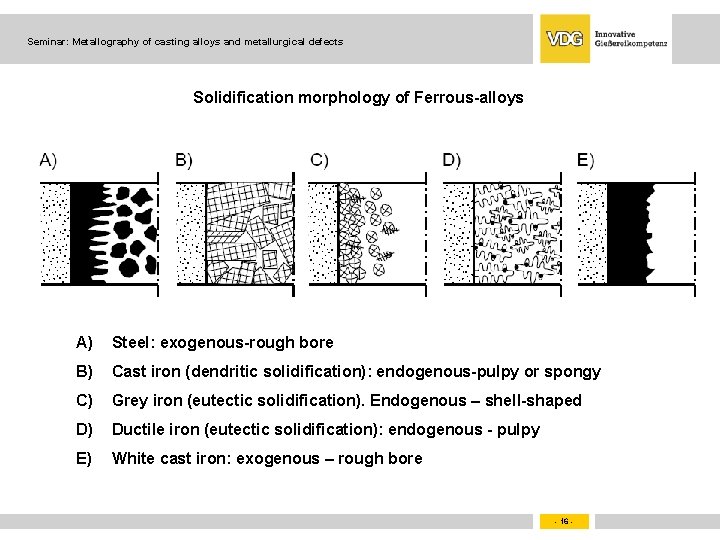
Seminar: Metallography of casting alloys and metallurgical defects Solidification morphology of Ferrous-alloys A) Steel: exogenous-rough bore B) Cast iron (dendritic solidification): endogenous-pulpy or spongy C) Grey iron (eutectic solidification). Endogenous – shell-shaped D) Ductile iron (eutectic solidification): endogenous - pulpy E) White cast iron: exogenous – rough bore - 16 -
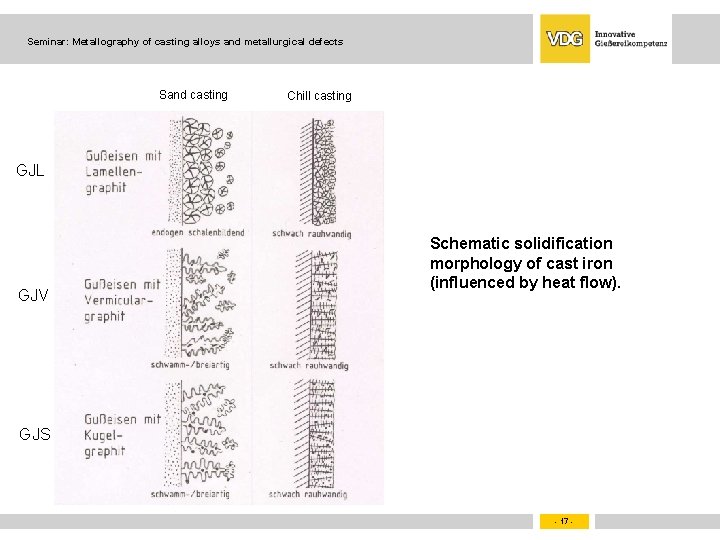
Seminar: Metallography of casting alloys and metallurgical defects Sand casting Chill casting GJL GJV Schematic solidification morphology of cast iron (influenced by heat flow). GJS - 17 -
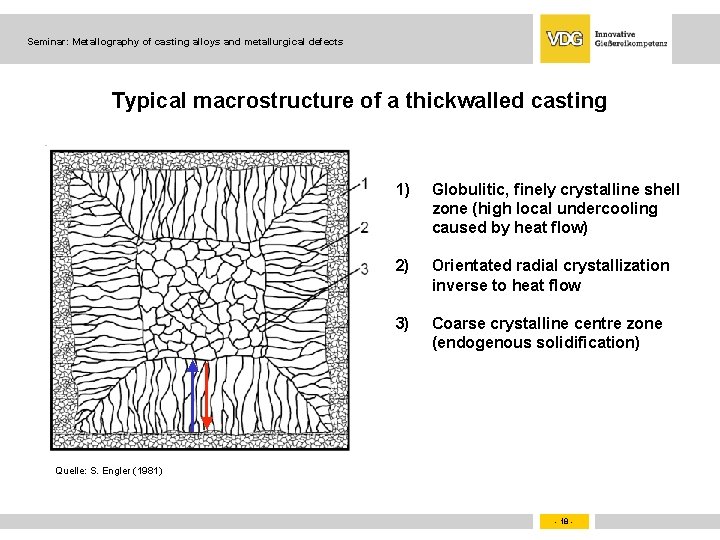
Seminar: Metallography of casting alloys and metallurgical defects Typical macrostructure of a thickwalled casting 1) Globulitic, finely crystalline shell zone (high local undercooling caused by heat flow) 2) Orientated radial crystallization inverse to heat flow 3) Coarse crystalline centre zone (endogenous solidification) Quelle: S. Engler (1981) - 18 -
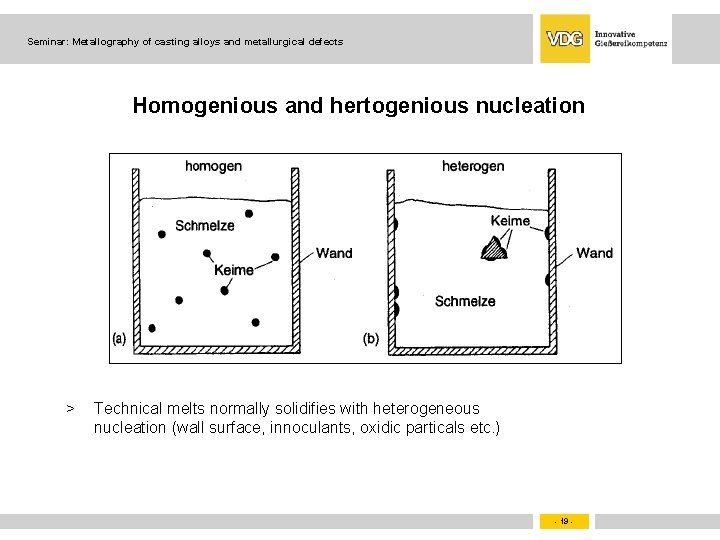
Seminar: Metallography of casting alloys and metallurgical defects Homogenious and hertogenious nucleation > Technical melts normally solidifies with heterogeneous nucleation (wall surface, innoculants, oxidic particals etc. ) - 19 -
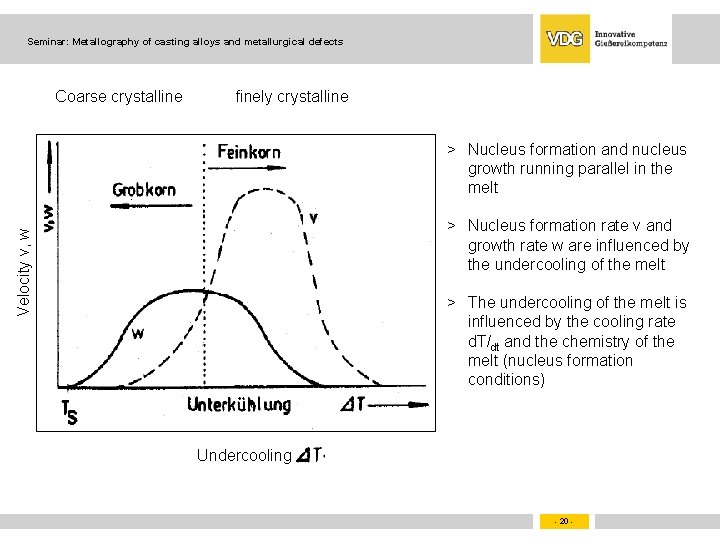
Seminar: Metallography of casting alloys and metallurgical defects Coarse crystalline finely crystalline > Nucleus formation and nucleus growth running parallel in the melt Velocity v, w > Nucleus formation rate v and growth rate w are influenced by the undercooling of the melt > The undercooling of the melt is influenced by the cooling rate d. T/dt and the chemistry of the melt (nucleus formation conditions) Undercooling - 20 -
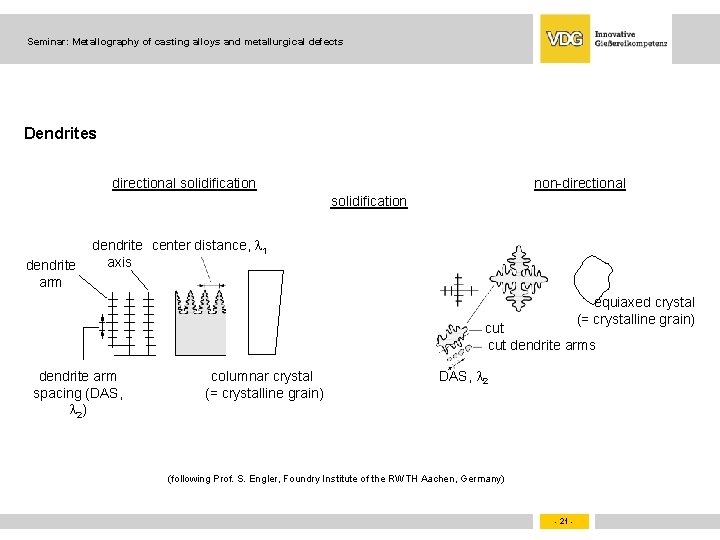
Seminar: Metallography of casting alloys and metallurgical defects Dendrites directional solidification non-directional solidification dendrite arm dendrite center distance, l 1 axis equiaxed crystal (= crystalline grain) cut dendrite arms dendrite arm spacing (DAS, l 2) columnar crystal (= crystalline grain) DAS, l 2 (following Prof. S. Engler, Foundry Institute of the RWTH Aachen, Germany) - 21 -
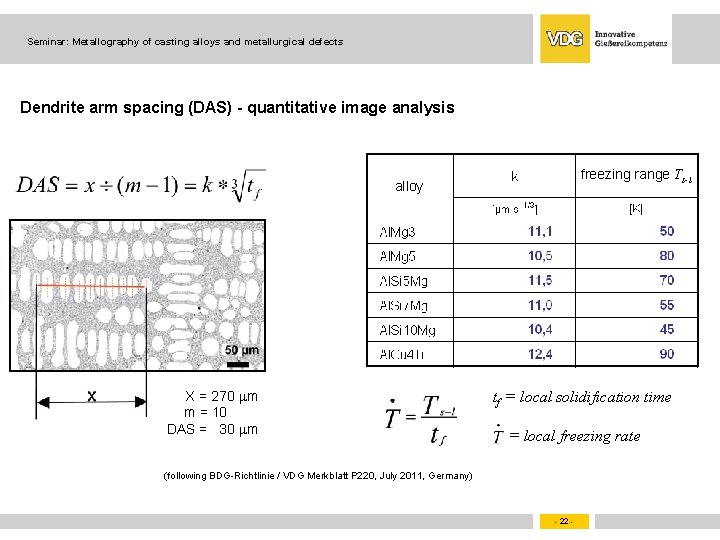
Seminar: Metallography of casting alloys and metallurgical defects Dendrite arm spacing (DAS) - quantitative image analysis freezing range Ts-l alloy X = 270 mm m = 10 DAS = 30 mm tf = local solidification time = local freezing rate (following BDG-Richtlinie / VDG Merkblatt P 220, July 2011, Germany) - 22 -
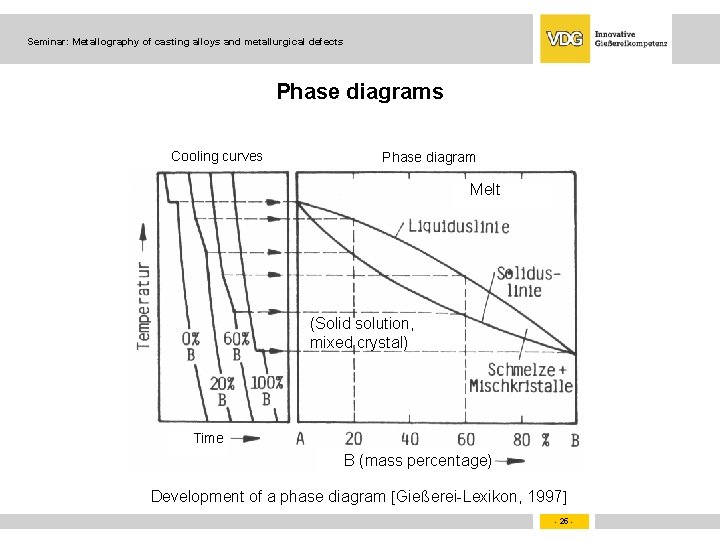
Seminar: Metallography of casting alloys and metallurgical defects A phase diagram shows us thermodynamic state of metals and alloys in thermodynamic equillibrium > It is a quantitative representation of the alloy as a function of temperature, chemical composition (and pressure) > Phase diagrams shows us the transition temperatures, the chemical composition of the phases and the metallurgical structure of phases > The phases diagrams are calculated for thermodynamic equillibrium, real cooling or heating rates influence the transition temperatures and the solubility (composition) of the phases - 23 -
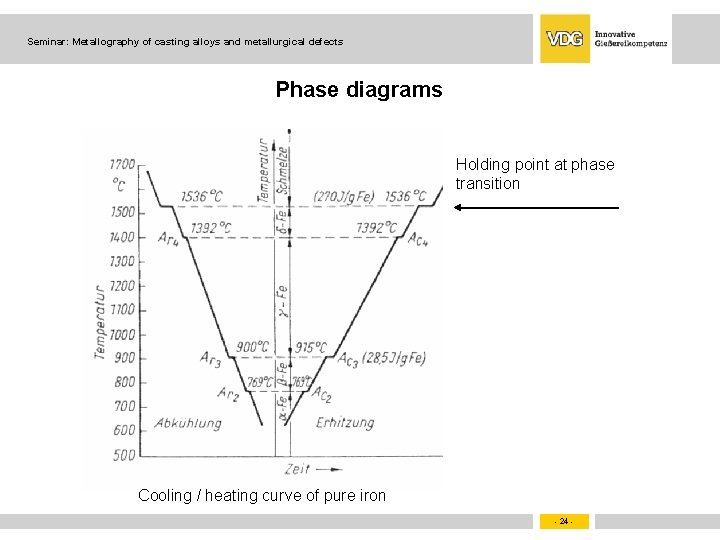
Seminar: Metallography of casting alloys and metallurgical defects Phase diagrams Holding point at phase transition Cooling / heating curve of pure iron - 24 -
Seminar: Metallography of casting alloys and metallurgical defects Phase diagrams Cooling curves Phase diagram Melt (Solid solution, mixed crystal) Time B (mass percentage) Development of a phase diagram Gießerei-Lexikon, 1997 - 25 -
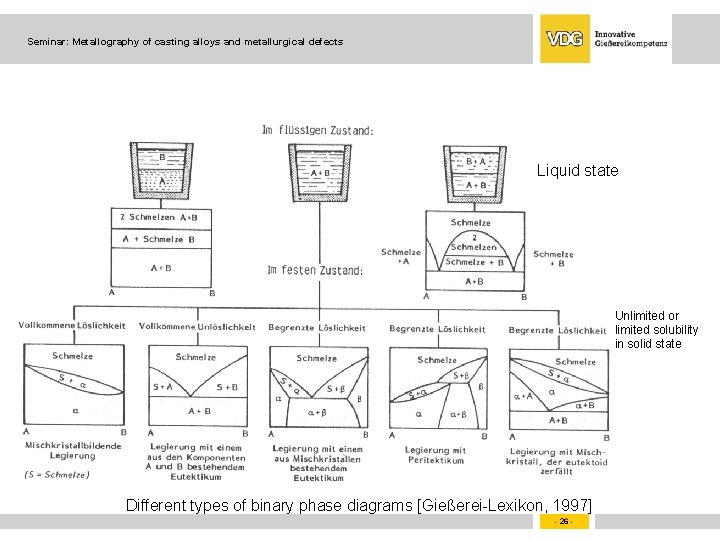
Seminar: Metallography of casting alloys and metallurgical defects Liquid state Unlimited or limited solubility in solid state Different types of binary phase diagrams [Gießerei-Lexikon, 1997] - 26 -
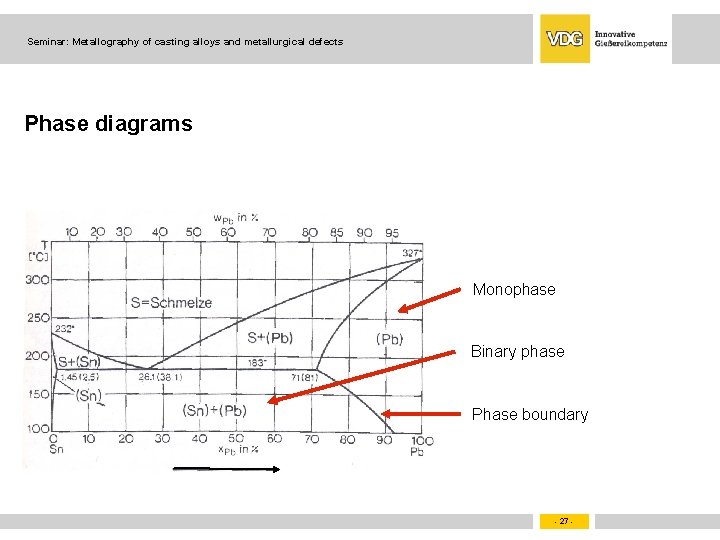
Seminar: Metallography of casting alloys and metallurgical defects Phase diagrams Monophase Binary phase Phase boundary - 27 -
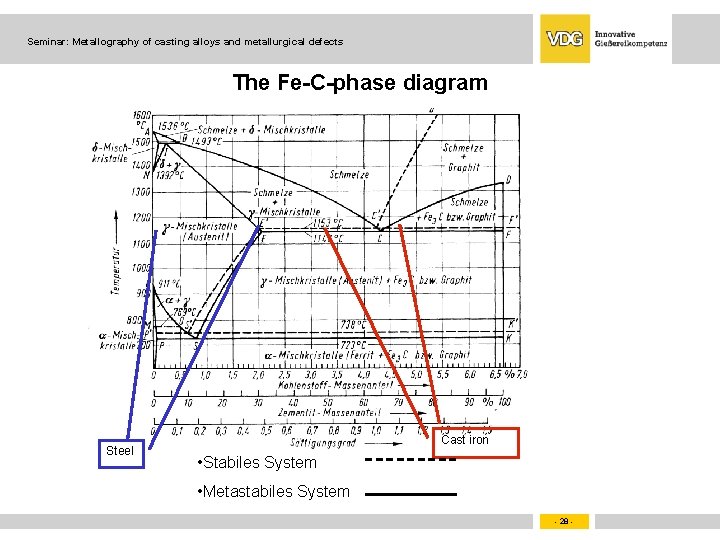
Seminar: Metallography of casting alloys and metallurgical defects The Fe-C-phase diagram Steel Cast iron • Stabiles System • Metastabiles System - 28 -
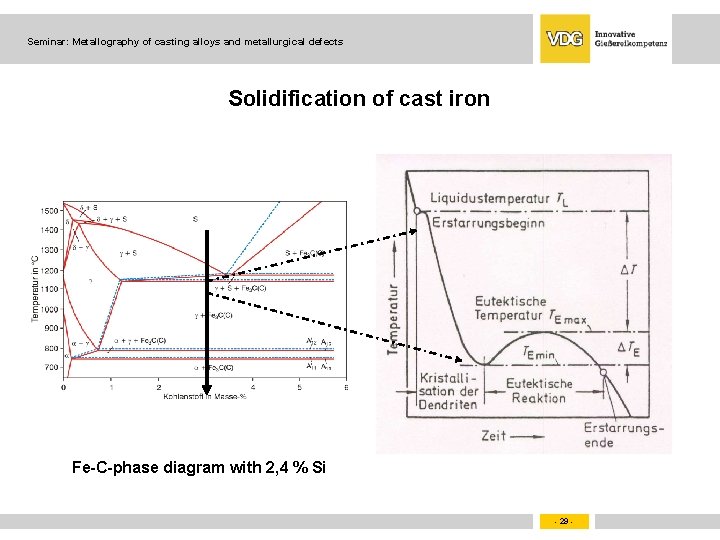
Seminar: Metallography of casting alloys and metallurgical defects Solidification of cast iron Fe-C-phase diagram with 2, 4 % Si - 29 -
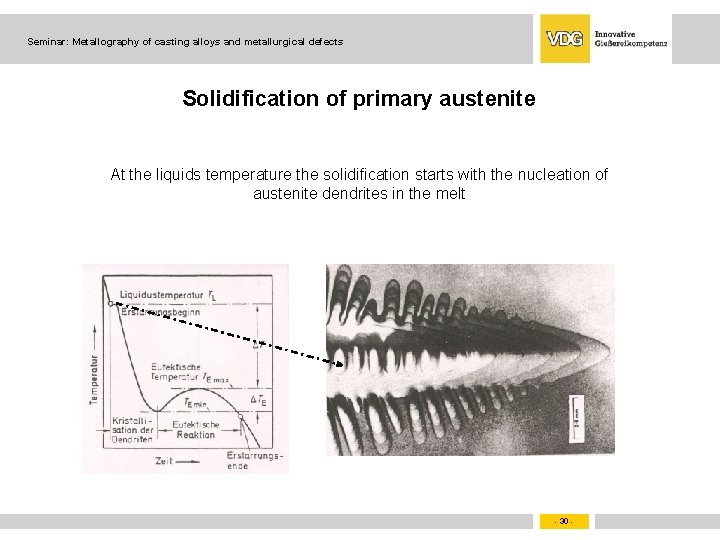
Seminar: Metallography of casting alloys and metallurgical defects Solidification of primary austenite At the liquids temperature the solidification starts with the nucleation of austenite dendrites in the melt - 30 -
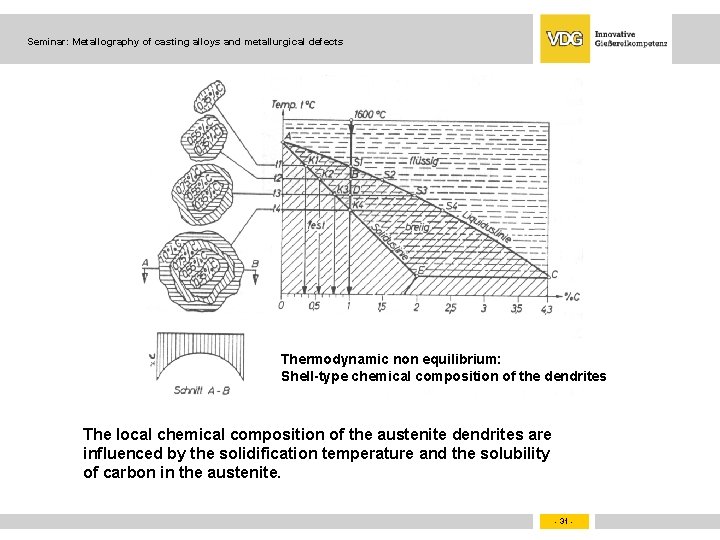
Seminar: Metallography of casting alloys and metallurgical defects Thermodynamic non equilibrium: Shell-type chemical composition of the dendrites The local chemical composition of the austenite dendrites are influenced by the solidification temperature and the solubility of carbon in the austenite. - 31 -
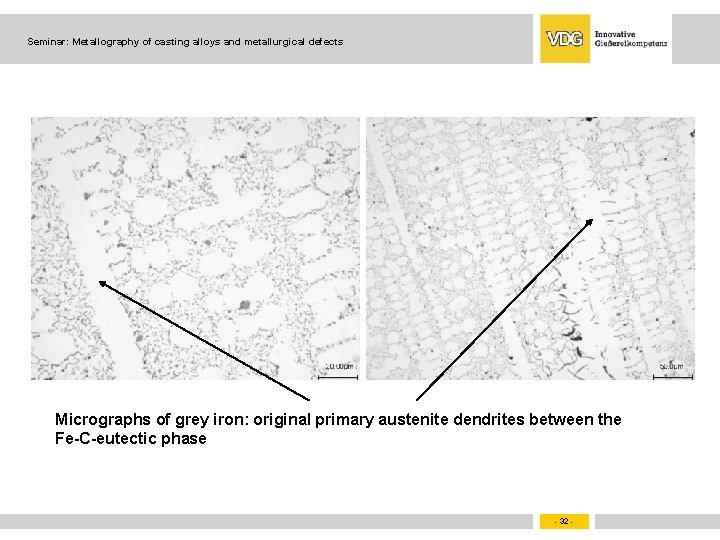
Seminar: Metallography of casting alloys and metallurgical defects Micrographs of grey iron: original primary austenite dendrites between the Fe-C-eutectic phase - 32 -
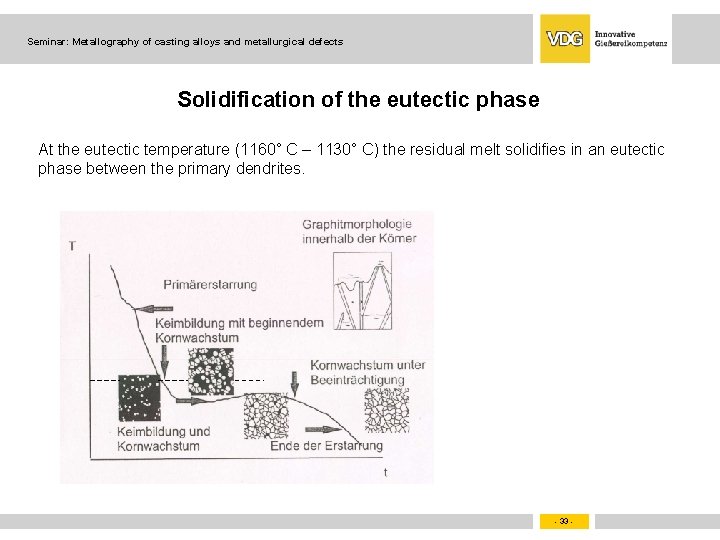
Seminar: Metallography of casting alloys and metallurgical defects Solidification of the eutectic phase At the eutectic temperature (1160° C – 1130° C) the residual melt solidifies in an eutectic phase between the primary dendrites. - 33 -
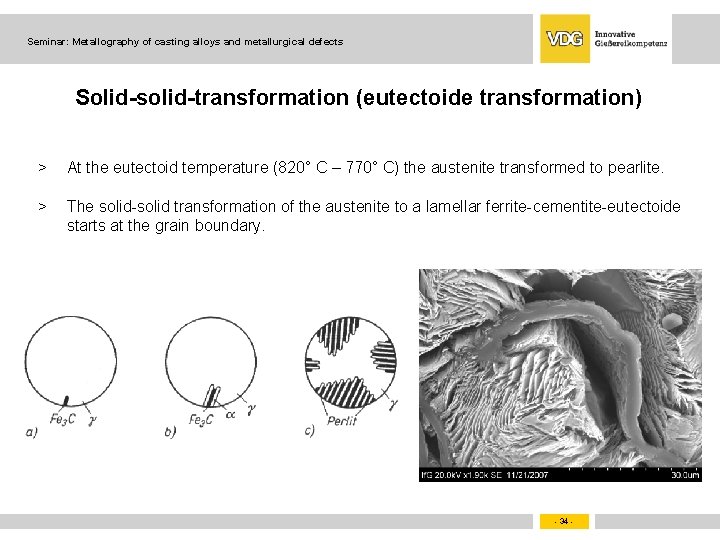
Seminar: Metallography of casting alloys and metallurgical defects Solid-solid-transformation (eutectoide transformation) > At the eutectoid temperature (820° C – 770° C) the austenite transformed to pearlite. > The solid-solid transformation of the austenite to a lamellar ferrite-cementite-eutectoide starts at the grain boundary. - 34 -
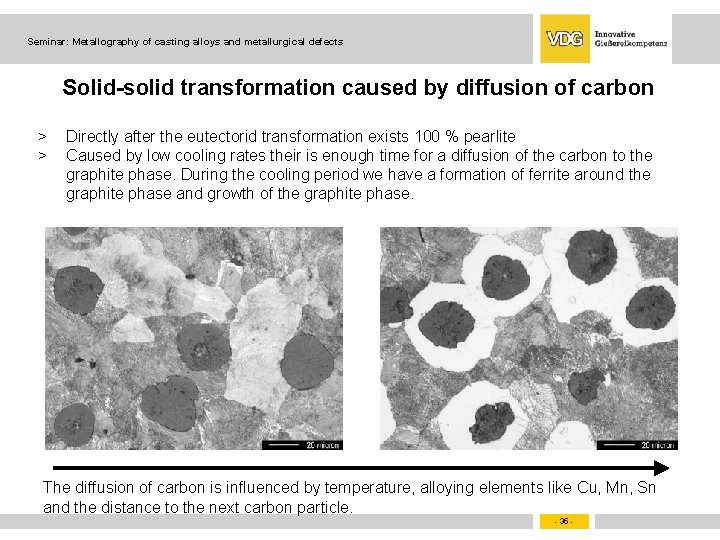
Seminar: Metallography of casting alloys and metallurgical defects Solid-solid transformation caused by diffusion of carbon > > Directly after the eutectorid transformation exists 100 % pearlite Caused by low cooling rates their is enough time for a diffusion of the carbon to the graphite phase. During the cooling period we have a formation of ferrite around the graphite phase and growth of the graphite phase. The diffusion of carbon is influenced by temperature, alloying elements like Cu, Mn, Sn and the distance to the next carbon particle. - 35 -
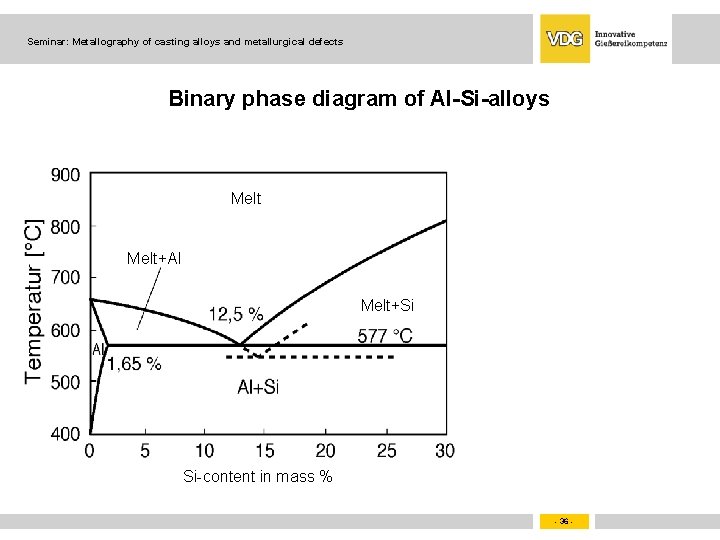
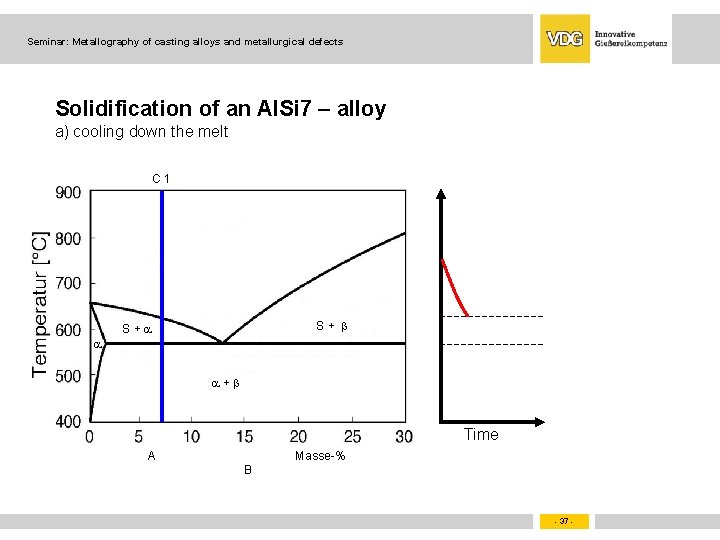
Seminar: Metallography of casting alloys and metallurgical defects Binary phase diagram of Al-Si-alloys Melt+Al Melt+Si Si-content in mass % - 36 -
Seminar: Metallography of casting alloys and metallurgical defects Solidification of an Al. Si 7 – alloy a) cooling down the melt C 1 S + S+ + Time A Masse-% B - 37 -
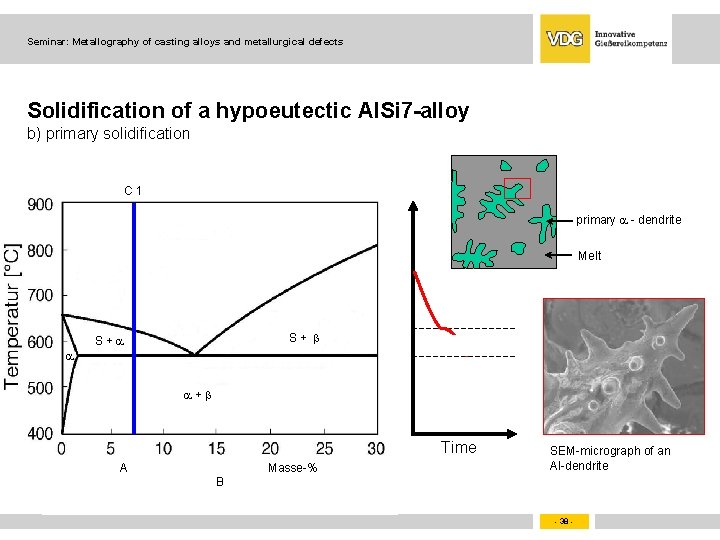
Seminar: Metallography of casting alloys and metallurgical defects Solidification of a hypoeutectic Al. Si 7 -alloy b) primary solidification C 1 primary - dendrite Melt S + S+ + Time A Masse-% SEM-micrograph of an Al-dendrite B - 38 -
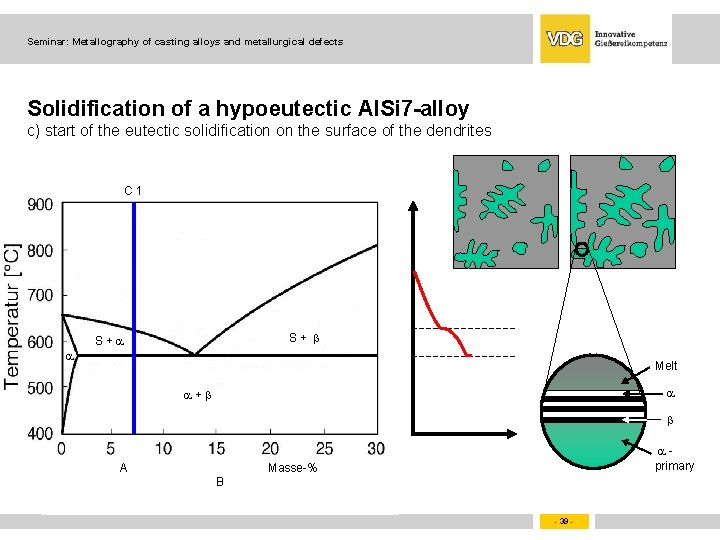
Seminar: Metallography of casting alloys and metallurgical defects Solidification of a hypoeutectic Al. Si 7 -alloy c) start of the eutectic solidification on the surface of the dendrites C 1 S + S+ Melt + A primary Masse-% B - 39 -
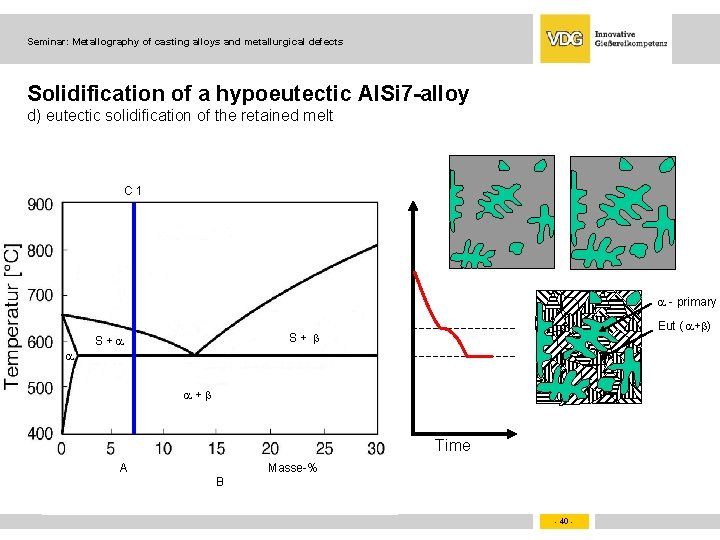
Seminar: Metallography of casting alloys and metallurgical defects Solidification of a hypoeutectic Al. Si 7 -alloy d) eutectic solidification of the retained melt C 1 - primary Eut ( + ) S + S+ + Time A Masse-% B - 40 -
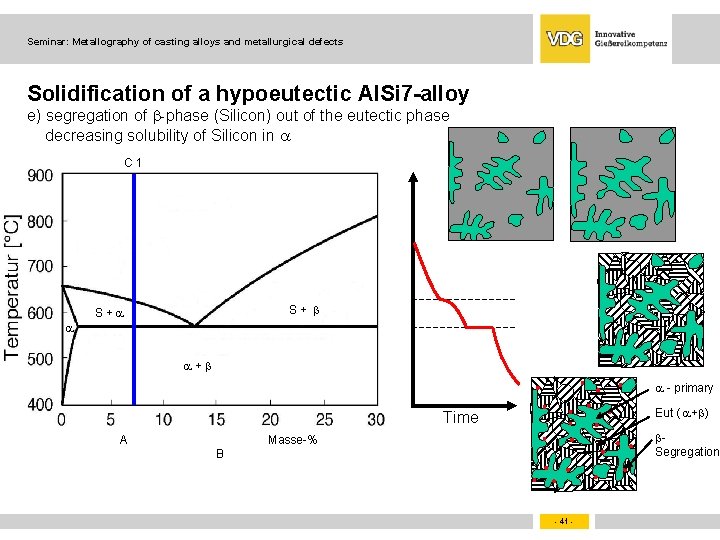
Seminar: Metallography of casting alloys and metallurgical defects Solidification of a hypoeutectic Al. Si 7 -alloy e) segregation of -phase (Silicon) out of the eutectic phase decreasing solubility of Silicon in C 1 S + S+ + - primary Eut ( + ) Time A Segregation Masse-% B - 41 -
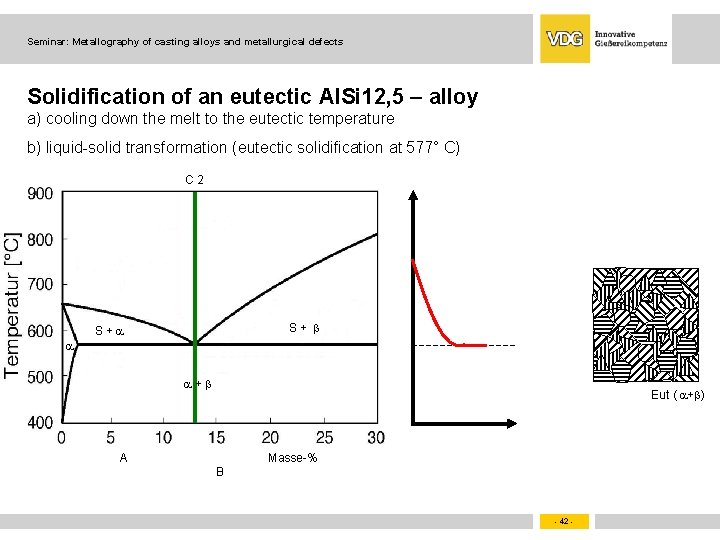
Seminar: Metallography of casting alloys and metallurgical defects Solidification of an eutectic Al. Si 12, 5 – alloy a) cooling down the melt to the eutectic temperature b) liquid-solid transformation (eutectic solidification at 577° C) C 2 S + S+ + Eut ( + ) A Masse-% B - 42 -
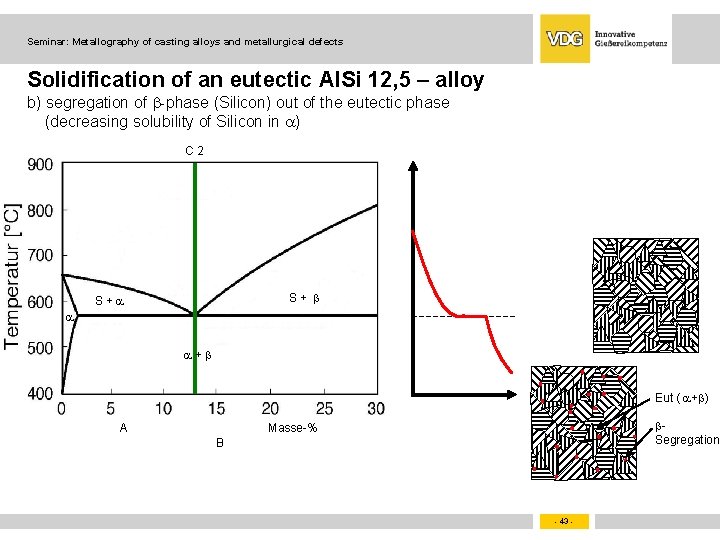
Seminar: Metallography of casting alloys and metallurgical defects Solidification of an eutectic Al. Si 12, 5 – alloy b) segregation of -phase (Silicon) out of the eutectic phase (decreasing solubility of Silicon in ) C 2 S + S+ + Eut ( + ) A Segregation Masse-% B - 43 -
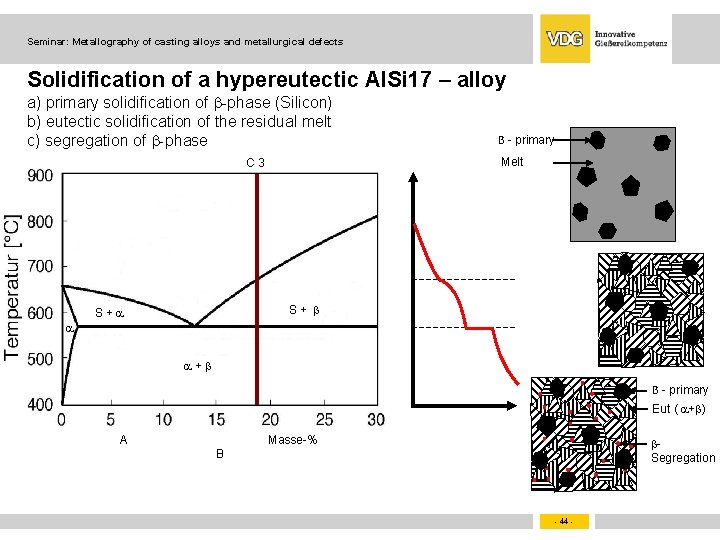
Seminar: Metallography of casting alloys and metallurgical defects Solidification of a hypereutectic Al. Si 17 – alloy a) primary solidification of -phase (Silicon) b) eutectic solidification of the residual melt c) segregation of -phase ß - primary Melt C 3 S + S+ + ß - primary Eut ( + ) A Masse-% Segregation B - 44 -
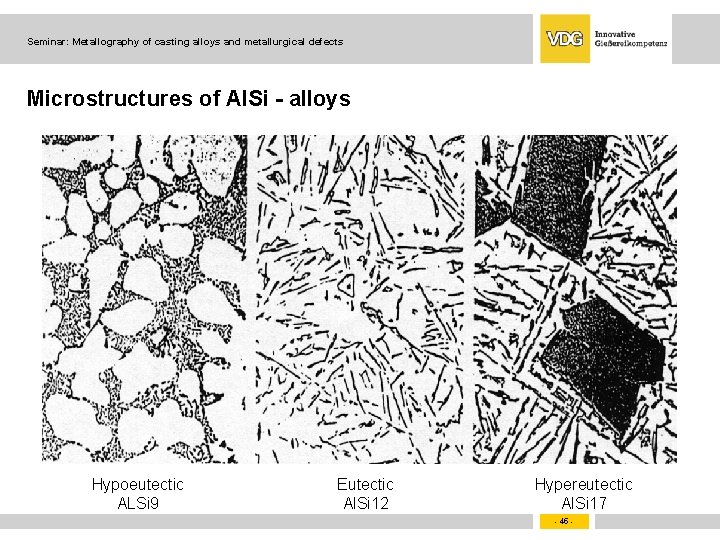
Seminar: Metallography of casting alloys and metallurgical defects Microstructures of Al. Si - alloys Hypoeutectic ALSi 9 Eutectic Al. Si 12 Hypereutectic Al. Si 17 - 45 -