
Seminar in Library Information Science Information transfer Content
Seminar in Library & Information Science Information transfer
Content • The nature of information transfer • Approaches to analysing information transfer • Early information transfer models • Refinements in information transfer models • Use and adaptation of information transfer models • Related models Seminar in Library & Information Science 2
Information transfer Information & knowledge are created from the application of new techniques, new insights, &/or new research to existing bodies of information & knowledge ‘If I have seen further it is by standing on the shoulders of giants’ (Isaac Newton) Seminar in Library & Information Science 3
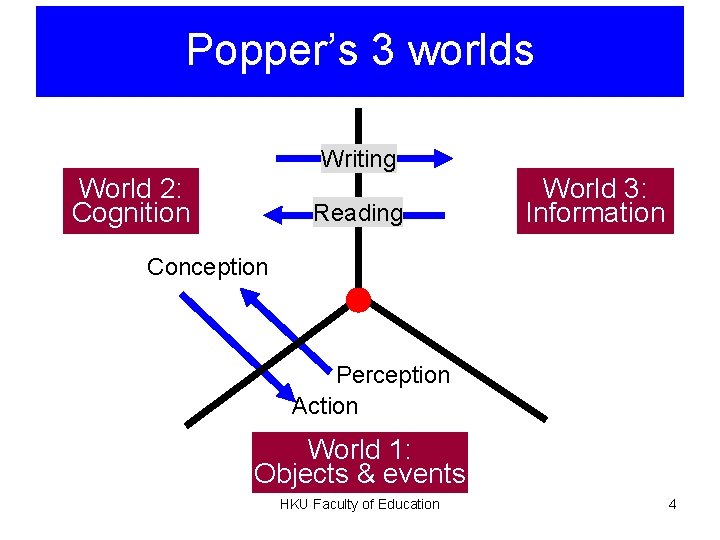
Popper’s 3 worlds Writing World 2: Cognition Reading World 3: Information Conception Perception Action World 1: Objects & events HKU Faculty of Education 4
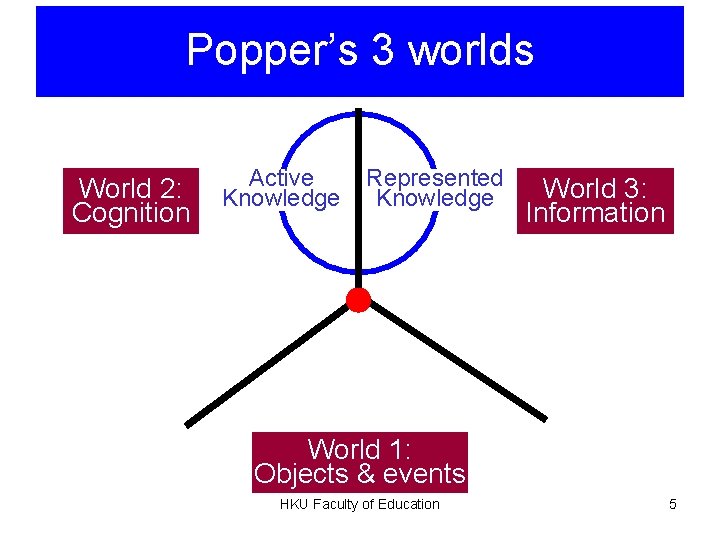
Popper’s 3 worlds World 2: Cognition Active Knowledge Represented Knowledge World 3: Information World 1: Objects & events HKU Faculty of Education 5
Models A model is a: • Representation of structure • Simplification of reality • Diagnostic tool OED Information transfer models highlight the stages where information needs to considered in order to get optimum advantages from it (& minimum negative results from its mismanagement) Seminar in Library & Information Science 6
Information transfer models The roles of information transfer models, include: • Understanding information transfer within different groups • Aids to designing systems for information flow • Diagnosing sources of information flow failure Seminar in Library & Information Science 7
Shannon – Weaver communication model The Shannon-Weaver communication model was initially developed in 1947 to improve telephone line transmission. It has been refined in the succeeding decades It is an influential model that can be applied to all forms of communication Seminar in Library & Information Science 8

Shannon – Weaver communication model È source È Å feedback Å Ç Ç Ætransmitter Æchannel Æreceiver Ædestination Ç noise data transfer message transfer information transfer Middleton, 2002 Seminar in Library & Information Science 9
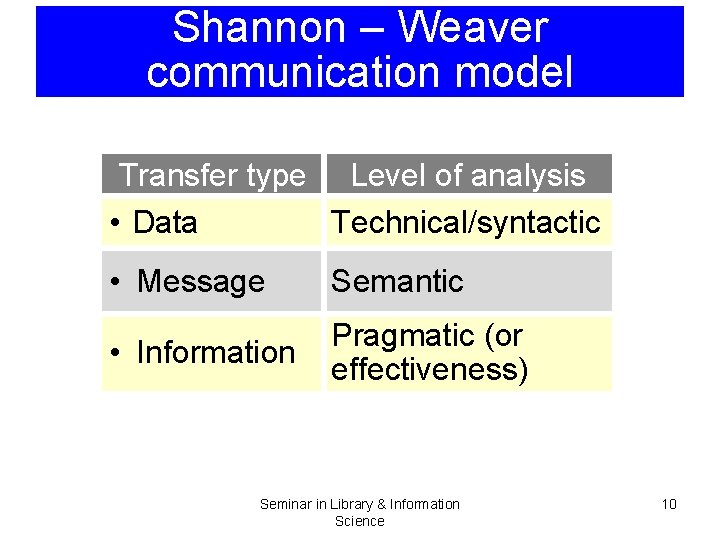
Shannon – Weaver communication model Transfer type Level of analysis • Data Technical/syntactic • Message Semantic • Information Pragmatic (or effectiveness) Seminar in Library & Information Science 10
Shannon – Weaver communication model Within the Shannon-Weaver model we refer to noise & filters. They may be: • Physical, eg poor technology, reception, competing noise etc • Semantic – refers to problems of meaning, understanding etc Seminar in Library & Information Science 11
Semantic noise can be a sender and/or receiver problem. It can be caused by: • • Literacy level Nerves Preconceptions Culture • • Ambiguity/semantics Mood/emotions Distractions Etc Seminar in Library & Information Science 12
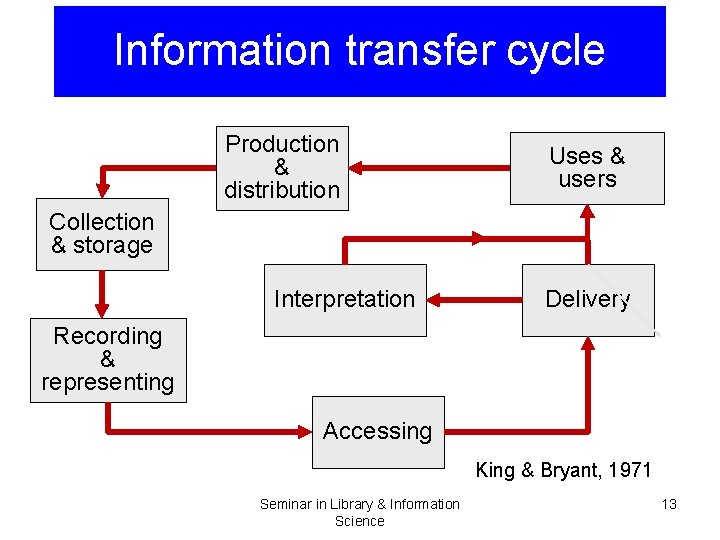
Information transfer cycle Production & distribution Uses & users Collection & storage Interpretation Delivery Recording & representing Accessing King & Bryant, 1971 Seminar in Library & Information Science 13
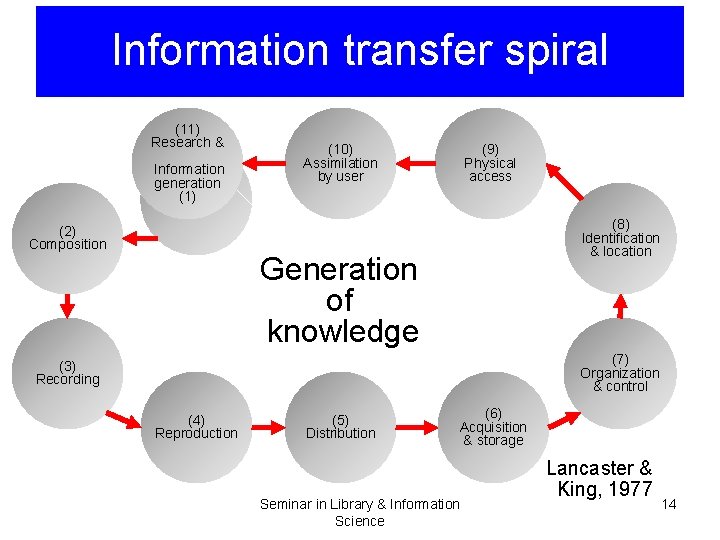
Information transfer spiral (11) Research & Information generation (1) (2) Composition (10) Assimilation by user (9) Physical access (8) Identification & location Generation of knowledge (7) Organization & control (3) Recording (4) Reproduction (5) Distribution (6) Acquisition & storage Seminar in Library & Information Science Lancaster & King, 1977 14
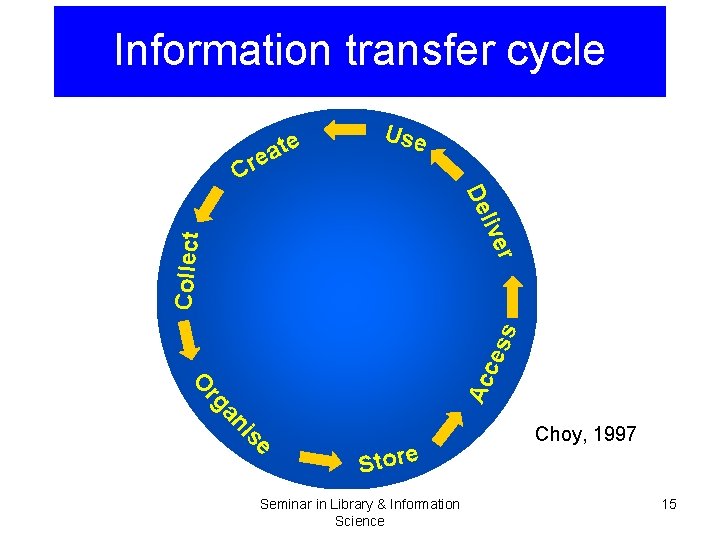
Information transfer cycle te a re Use C Ac ces s Collect r live De O ni a rg se Store Seminar in Library & Information Science Choy, 1997 15
Create ‘Basic research (fundamental or pure research) has as its primary objective the advancement of knowledge & theoretical understanding of the relations among variables…. It is conducted without a practical end in mind although it can have unexpected results that point to practical applications. The terms ‘basic’ or ‘fundamental’ research indicate that, through theory generation, basic research provides the foundation for further, often applied research’ Wikipedia Seminar in Library & Information Science 16
Create Applied research ‘is directed towards specific objectives such as the development of a new drug, therapy or surgical procedure. It involves the application of existing knowledge, much of which is obtained through basic research, to a specific. . … problem’ New Jersey Association for Biomedical Research leads to creation of new information. An individual can keep it to him/herself or record it & make it available to others Seminar in Library & Information Science 17
Collect Information/knowledge is recorded in a variety of formats & then made available for collection. Some knowledge may be made publicly available for free or for purchase; some information/knowledge may be kept confidential or have restricted access Organisations & individuals collect recorded information in a systematic way, ie to satisfy their information needs Seminar in Library & Information Science 18
Organise To make it easier to find required information sources, organisations & individuals arrange collected documents in a coherent way eg by: • • Subject/topic Format/medium Date creator/author etc Organisation should match the information seeking behaviour of potential users Seminar in Library & Information Science 19
Store Information may be kept for short or long periods of time. Storage needs to balance: • • • Cost Suitability to format/medium Preservation needs Speed of retrieval Security needs Orgnisations adopt a range of storage methods for different information sources Seminar in Library & Information Science 20
Access Information seekers require some methods for locating useful information/documents. The larger the quantity & the greater the diversity of information collected, the more complex the access systems required. Catalogs & indexes are typical access systems Access informs the information seeker that a document exists (or doesn’t) within a collection & where they can find it Seminar in Library & Information Science 21
Delivery involves the information seeker gaining possession of the document. Organisations provide different levels of delivery based on: • • • Nature of the items sought Nature of the information seeker Preferred format of the document Cost Security etc The information seeker can then use the information Seminar in Library & Information Science 22
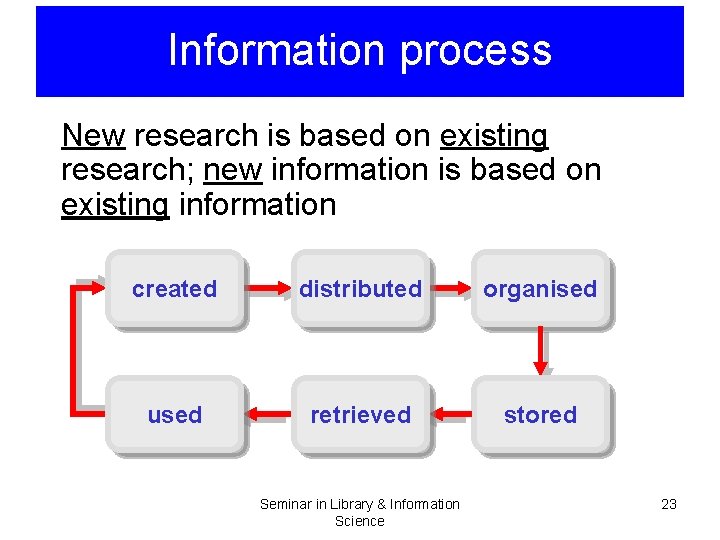
Information process New research is based on existing research; new information is based on existing information created distributed organised used retrieved stored Seminar in Library & Information Science 23
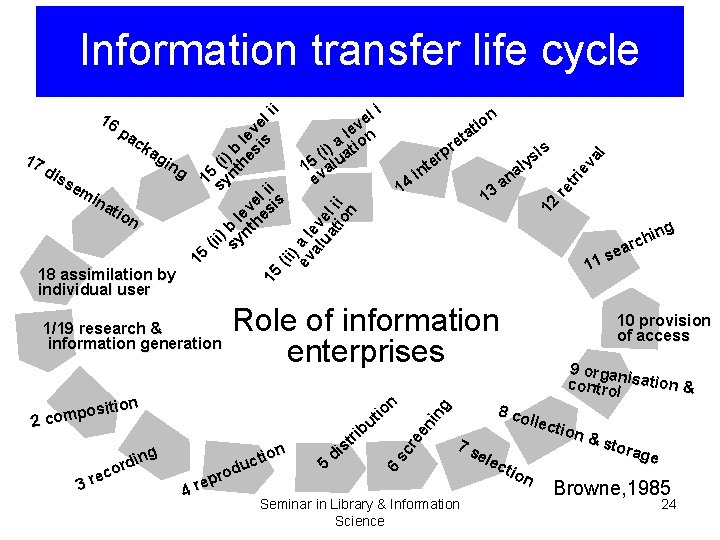
18 assimilation by individual user 15 1/19 research & information generation re tri ev al 11 Role of information enterprises sition o p m o 2 c ing d r co e r 3 n io t a et r is rp s e y t al in n a 14 13 12 ii l ve esis e l h t b n ) i (i sy i tion c u od r p 4 re 5 n io t bu i r st i d 6 sc re en in g 17 dis se mi na tio n el v le n a io (i) uat 15 val e 15 (ii ) ev a l al ev ua el tio ii n 16 pa ck ag in g 15 sy (i nt ) b he le si ve s li i Information transfer life cycle Seminar in Library & Information Science 10 provision of access 9 organ control isation & 8 co llect ion & 7 s ele cti on ing h c r sea stor age Browne, 1985 24
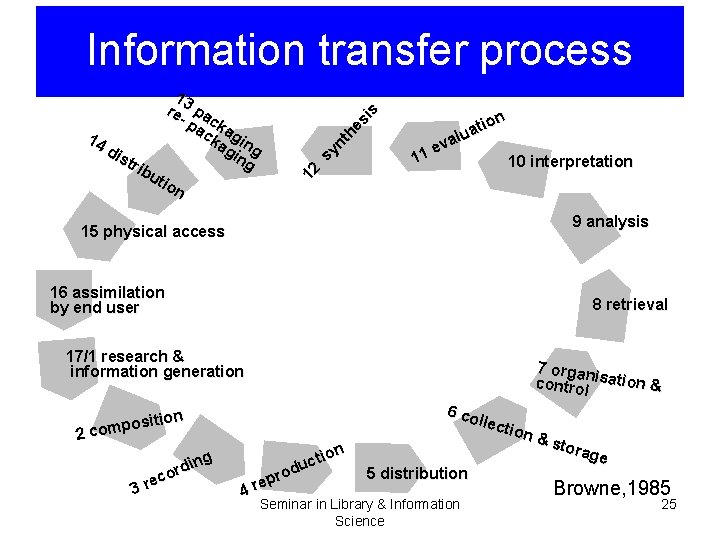
12 1 re 3 pa - p ck ac ag 14 ka in gi g dis ng tri bu tio n sy nt he si s Information transfer process on i t lua a v e 11 10 interpretation 9 analysis 15 physical access 16 assimilation by end user 8 retrieval 17/1 research & information generation sition o p m o 2 c ing d r co e r 3 7 orga controlnisation & tion c u od r p 4 re 6 co llect ion & 5 distribution Seminar in Library & Information Science stor age Browne, 1985 25
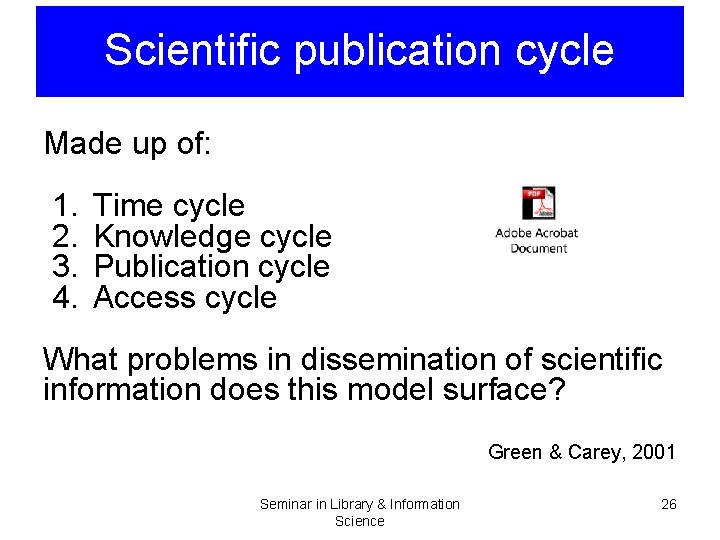
Scientific publication cycle Made up of: 1. 2. 3. 4. Time cycle Knowledge cycle Publication cycle Access cycle What problems in dissemination of scientific information does this model surface? Green & Carey, 2001 Seminar in Library & Information Science 26
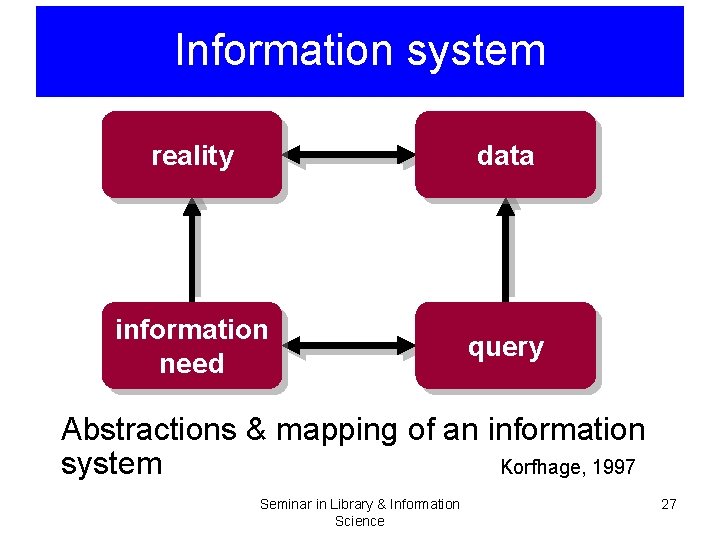
Information system reality data information need query Abstractions & mapping of an information system Korfhage, 1997 Seminar in Library & Information Science 27
Information system Abstraction 1 In any information system, the ‘real world’ is represented by a collection of data abstracted from observations of the real world & made available to the system Abstraction 2 A user’s information need, whether for production, storage, or retrieval of information, is abstracted into a form that is commensurate with the information system to be used Seminar in Library & Information Science 28
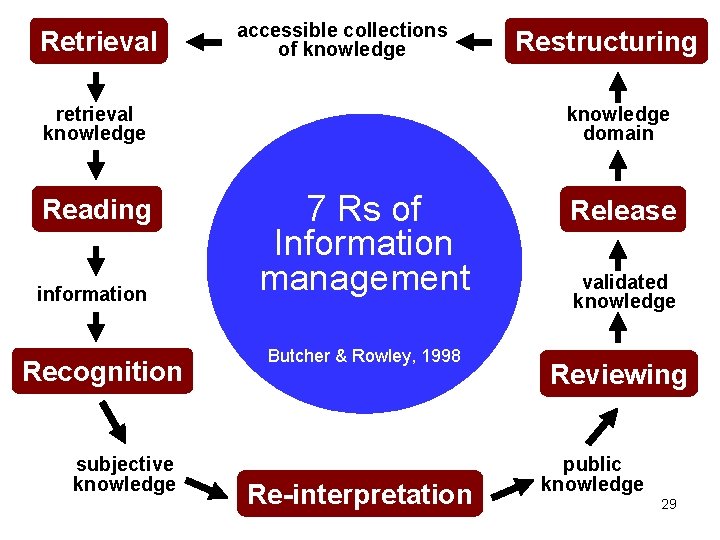
Retrieval accessible collections of knowledge retrieval knowledge Reading information Recognition subjective knowledge Restructuring knowledge domain 7 Rs of Information management Butcher & Rowley, 1998 Re-interpretation HKU Faculty of Education Release validated knowledge Reviewing public knowledge 29
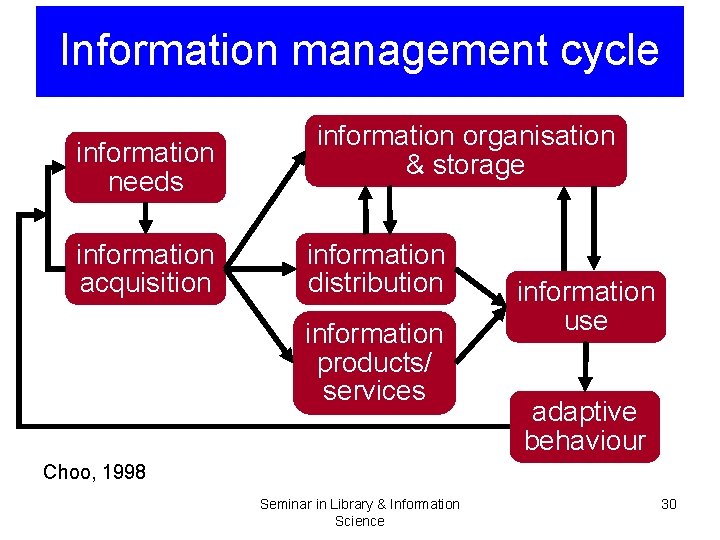
Information management cycle information needs information acquisition information organisation & storage information distribution information products/ services information use adaptive behaviour Choo, 1998 Seminar in Library & Information Science 30
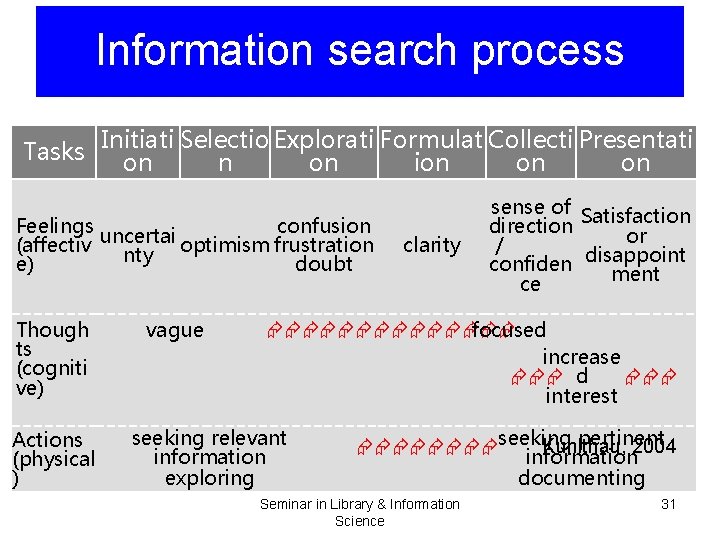
Information search process Selectio Explorati Formulat Collecti Presentati Tasks Initiati on n on ion on on Feelings uncertai confusion optimism frustration (affectiv nty e) doubt Though ts (cogniti ve) Actions (physical ) vague clarity sense of Satisfaction direction or / confiden disappoint ment ce focused ÆÆÆÆÆÆÆ increase ÆÆÆ d ÆÆÆ interest seeking relevant information exploring pertinent Kuhlthau, 2004 ÆÆÆÆseeking information documenting Seminar in Library & Information Science 31
References Browne, M. (1985). Information enterprises in Australia: A first profile. Sydney: Kuring-gai College of Advanced Education. School of Library & Information Science. Butcher, D, & Rowley, J. (1998). The 7 R’s of information management. Managing Information, 5(2), Choo Chun Wei, 1998. The knowing organization: How organizations use information to construct meaning create knowledge and make decisions. New York: Oxford UP. Choy, F. C. (1996). Educating the new parar-professionals for library and information services. Singapore Libraries, 25(1), 24 -37. Green, C. , & Carey, P. (2001). Scientific publication cycle. Retrieved February 5 2008, from http: //courses. washington. edu/info 220 a/pubcycle_files/fra me. htm Seminar in Library & Information Science 32
References Kennedy, J. & Schauder, C. (1994). Records management: a guide for students and practitioners of records and information management with exercises and case studies. Melbourne: Longman. King, D. & Bryant, E. (1971. The Evaluation of Information Services and Products. Arlington: Information resources press. Korfhage, R. (1997), Information storage & retrieval. New York: John Wiley. Kuhlthau, C. (2004). Seeking Meaning: A Process Approach to Library and Information Services. Westport: Libraries Unlimited. Seminar in Library & Information Science 33
References Kuhlthau, C. (2004). Seeking Meaning: A Process Approach to Library and Information Services. Westport: Libraries Unlimited. Middleton, M. (2002). Information management: A consolidation of operations, analysis and strategy, (Topics in Australasian Library and Information Studies, 18). Wagga: Centre for Information Studies, Charles Sturt University. Seminar in Library & Information Science 34
- Slides: 34