
Seminar class on RHIC Physics Richard SetoClass UCR

- Slides: 49
Seminar class on RHIC Physics Richard Seto+Class UCR Spring 2007 April 13, 2006 2 PM BNL time 11 AM UCR time bridge line 631 -344 -6363 room 2 -787 Website: https: //www. phenix. bnl. gov/WWW/publish/seto/ class/UCR%20 RHIC%20 seminar/
First some preliminaries n n n date/time OK for everyone? or before group meeting? I will go back and forth between BNL and UCR –we can usually only get a 6 port line keep for people at UCR – at BNL get a conference room q 631 -344 -6363 or 8383 q http: //www. phy. bnl. gov/schoolbell/groups/voco/calendar// introduce everyone
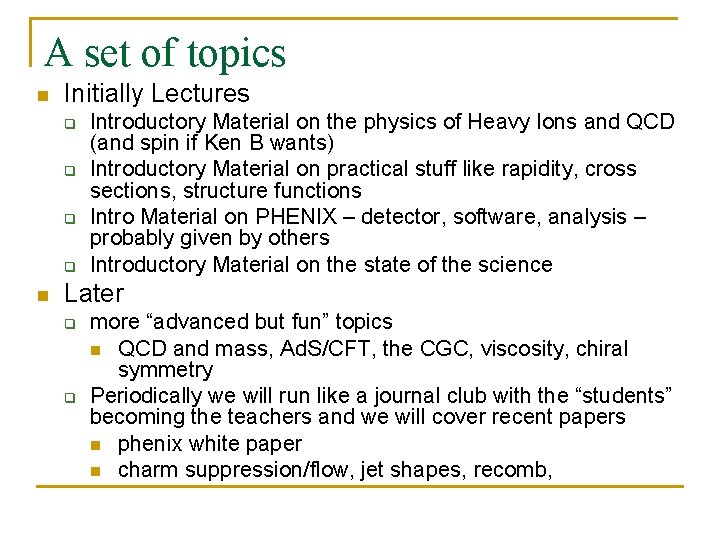
A set of topics n Initially Lectures q q n Introductory Material on the physics of Heavy Ions and QCD (and spin if Ken B wants) Introductory Material on practical stuff like rapidity, cross sections, structure functions Intro Material on PHENIX – detector, software, analysis – probably given by others Introductory Material on the state of the science Later q q more “advanced but fun” topics n QCD and mass, Ad. S/CFT, the CGC, viscosity, chiral symmetry Periodically we will run like a journal club with the “students” becoming the teachers and we will cover recent papers n phenix white paper n charm suppression/flow, jet shapes, recomb,
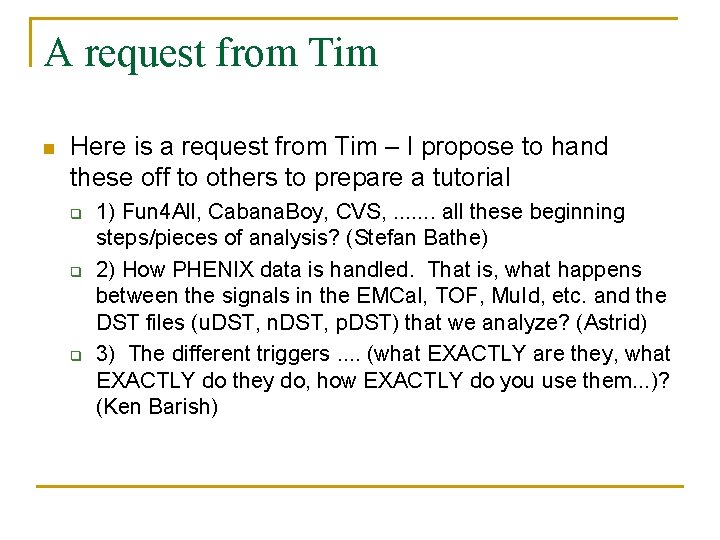
A request from Tim n Here is a request from Tim – I propose to hand these off to others to prepare a tutorial q q q 1) Fun 4 All, Cabana. Boy, CVS, . . . . all these beginning steps/pieces of analysis? (Stefan Bathe) 2) How PHENIX data is handled. That is, what happens between the signals in the EMCal, TOF, Mu. Id, etc. and the DST files (u. DST, n. DST, p. DST) that we analyze? (Astrid) 3) The different triggers. . (what EXACTLY are they, what EXACTLY do they do, how EXACTLY do you use them. . . )? (Ken Barish)
Some help from Astrid: n I would recommend to at least take a peek at the tutorials I organized last year, where people(experts) gave excellent talks accompanied by working examples on most of the topics below with a lot of detail and insight. n > 1) Fun 4 All, Cabana. Boy, CVS, . . . . all these beginning steps/pieces of analysis? n > ***Stefan*** n I am not sure about cabana boy. But for the Fun 4 all framework: n https: //www. phenix. bnl. gov/WWW/offline/wikioff/index. php? title=Framework_of_Fun 4 ALL n > 2) How PHENIX data is handled. That is, what happens between the signals in the EMCal, TOF, Mu. Id, etc. and the DST files (u. DST, n. DST, p. DST) that we analyze? n > *** Astrid *** n This took many speakers but for starters: n EMCal: https: //www. phenix. bnl. gov/WWW/offline/wikioff/index. php? title=How_to_analyze_EMCal_Clust er_Data n Muons(which all I know is what i read from this page): n https: //www. phenix. bnl. gov/WWW/offline/wikioff/index. php? title=How_to_Extract_Muons_from_ n. Dst n dst's and condor: n https: //www. phenix. bnl. gov/WWW/offline/wikioff/index. php? title=How_to_Run_Jobs_at_RCF n > 3) The different triggers. . (what EXACTLY are they, what EXACTLY n > do they do, how EXACTLY do you use them. . . )? n ***Ken Barish*** n Triggers: http: //www. phenix. bnl. gov/WWW/intro/dataflow/trigger. html Are these good enough? – or would it be useful is someone went through these tutorials in class and explained them (i. e. the folks in ****) n
Today n A research project for Ken S and Christophe q Specifics n n q State of the phi analysis The assignment Kinematics and Cross sections
The assignment: Part I the problem the phi to ee vs phi to KK n In helping to solve the problem we will all learn q q q some physics about chiral symmetry (an advanced topic) about cross sections about how PHENIX and STAR measures things About PID about errors
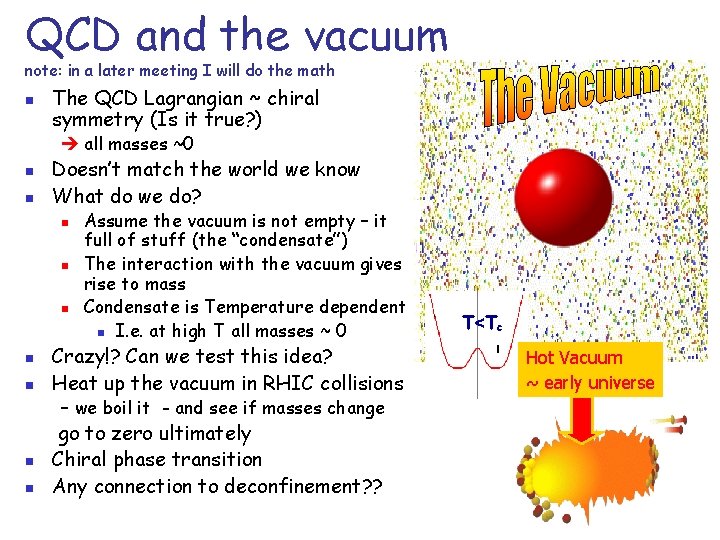
QCD and the vacuum note: in a later meeting I will do the math n The QCD Lagrangian ~ chiral symmetry (Is it true? ) all masses ~0 n n Doesn’t match the world we know What do we do? n n n Assume the vacuum is not empty – it full of stuff (the “condensate”) The interaction with the vacuum gives rise to mass Condensate is Temperature dependent n I. e. at high T all masses ~ 0 Crazy!? Can we test this idea? Heat up the vacuum in RHIC collisions – we boil it - and see if masses change n n go to zero ultimately Chiral phase transition Any connection to deconfinement? ? T>Tc Nothingness T<T T~T cc Hot Vacuum ~ early universe
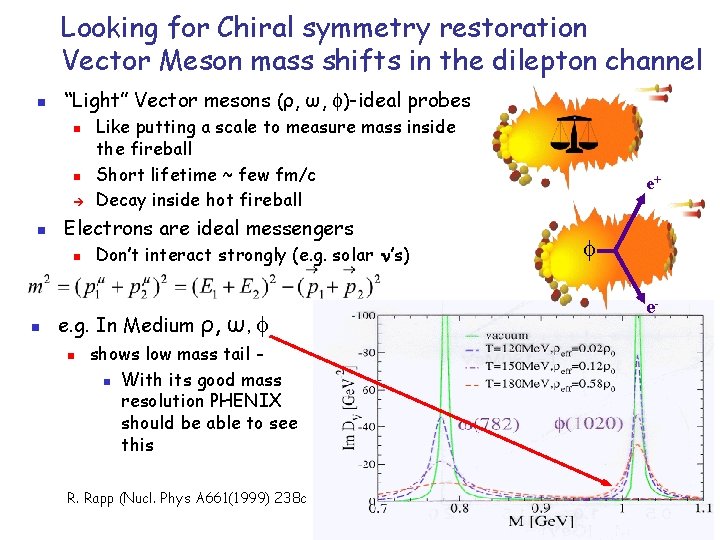
Looking for Chiral symmetry restoration Vector Meson mass shifts in the dilepton channel n “Light” Vector mesons (ρ, ω, )-ideal probes n n n Electrons are ideal messengers n n Like putting a scale to measure mass inside the fireball Short lifetime ~ few fm/c Decay inside hot fireball Don’t interact strongly (e. g. solar ’s) e. g. In Medium n ρ, ω, shows low mass tail n With its good mass resolution PHENIX should be able to see this R. Rapp (Nucl. Phys A 661(1999) 238 c e+ e-
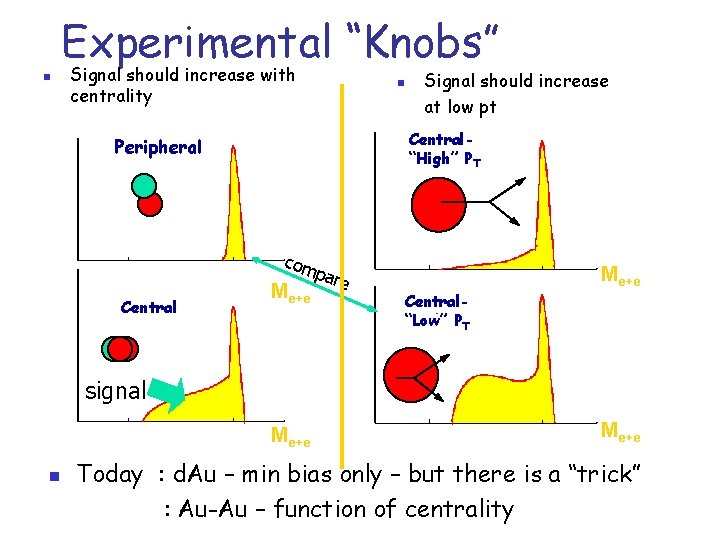
Experimental “Knobs” n Signal should increase with centrality n Central“High” PT Peripheral com Central Signal should increase at low pt Me+e pare Me+e Central“Low” PT signal Me+e n Me+e Today : d. Au – min bias only – but there is a “trick” : Au-Au – function of centrality
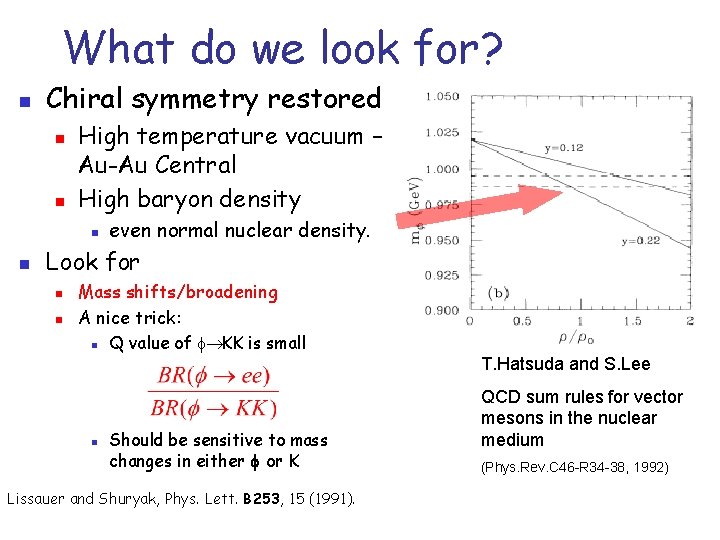
What do we look for? n Chiral symmetry restored n n High temperature vacuum – Au-Au Central High baryon density n n even normal nuclear density. Look for n n Mass shifts/broadening A nice trick: n Q value of KK is small T. Hatsuda and S. Lee n Should be sensitive to mass changes in either or K Lissauer and Shuryak, Phys. Lett. B 253, 15 (1991). QCD sum rules for vector mesons in the nuclear medium (Phys. Rev. C 46 -R 34 -38, 1992)
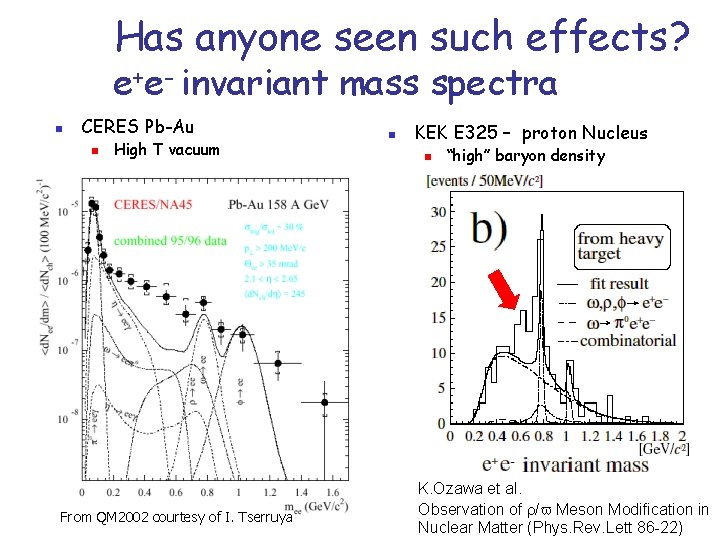
Has anyone seen such effects? e+e- invariant mass spectra n CERES Pb-Au n High T vacuum From QM 2002 courtesy of I. Tserruya n KEK E 325 – proton Nucleus n “high” baryon density K. Ozawa et al. Observation of r/v Meson Modification in Nuclear Matter (Phys. Rev. Lett 86 -22)
Let’s Look at RHIC (PHENIX) Outline n Compare BR (normal nuclear density) n n n d. Au ee d. Au KK Mass shifts/broadening n Au-Au KK n Guess: cannot see this to hadronic decays (only see stuff which decays outside fireball) – or the kaons which do decay and make it out rescattering
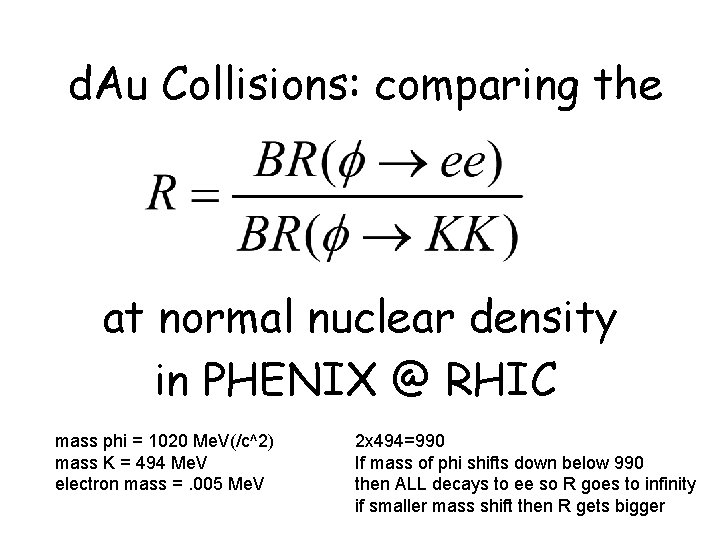
d. Au Collisions: comparing the at normal nuclear density in PHENIX @ RHIC mass phi = 1020 Me. V(/c^2) mass K = 494 Me. V electron mass =. 005 Me. V 2 x 494=990 If mass of phi shifts down below 990 then ALL decays to ee so R goes to infinity if smaller mass shift then R gets bigger
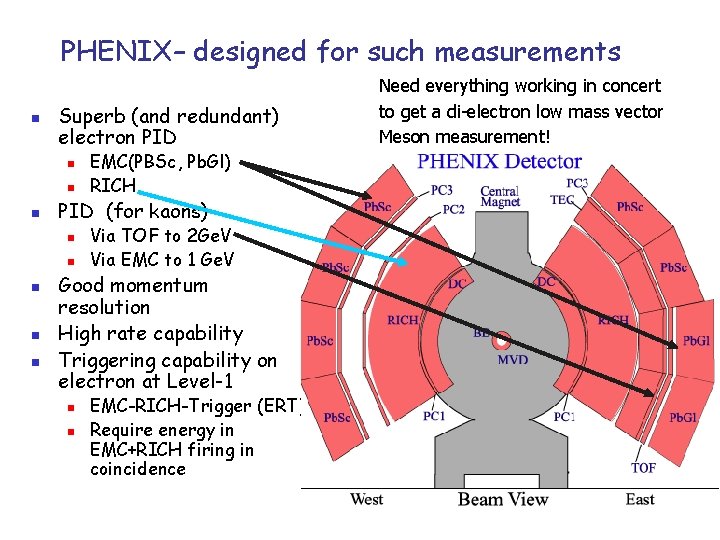
PHENIX– designed for such measurements n Superb (and redundant) electron PID n n n PID (for kaons) n n n EMC(PBSc, Pb. Gl) RICH Via TOF to 2 Ge. V Via EMC to 1 Ge. V Good momentum resolution High rate capability Triggering capability on electron at Level-1 n n EMC-RICH-Trigger (ERT) Require energy in EMC+RICH firing in coincidence Need everything working in concert to get a di-electron low mass vector Meson measurement!
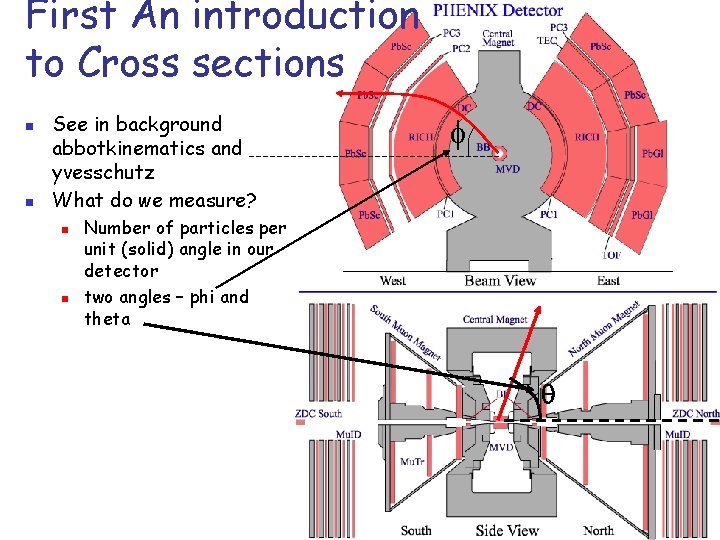
First An introduction to Cross sections n n See in background abbotkinematics and yvesschutz What do we measure? n n Number of particles per unit (solid) angle in our detector two angles – phi and theta
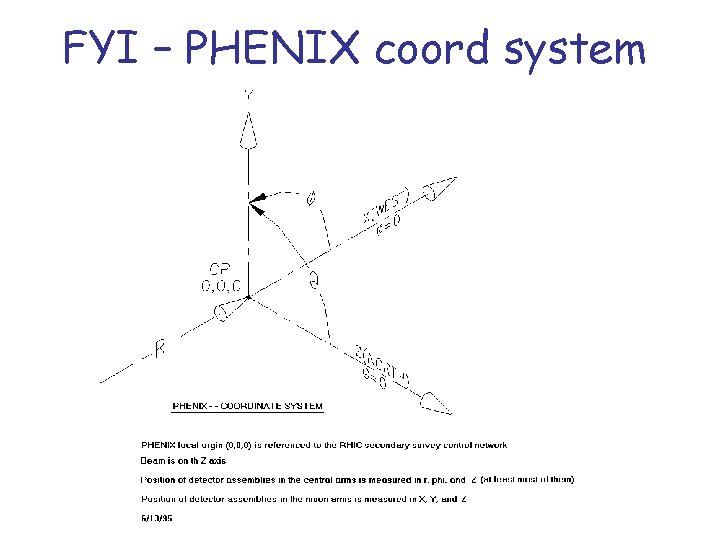
FYI – PHENIX coord system
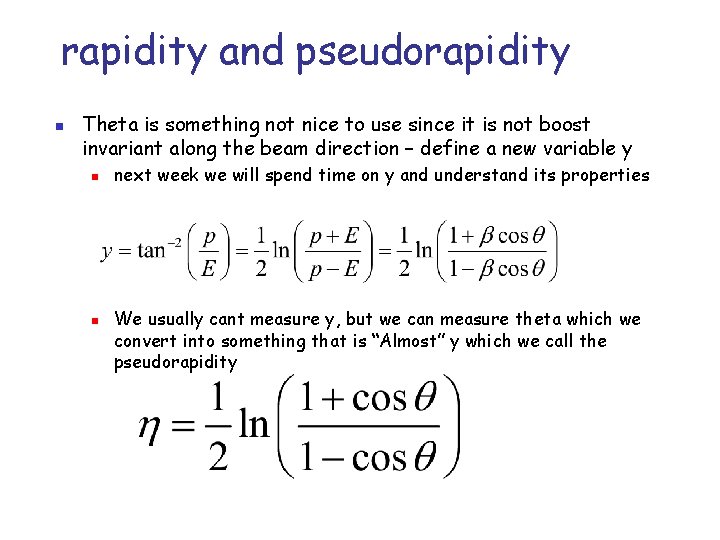
rapidity and pseudorapidity n Theta is something not nice to use since it is not boost invariant along the beam direction – define a new variable y n n next week we will spend time on y and understand its properties We usually cant measure y, but we can measure theta which we convert into something that is “Almost” y which we call the pseudorapidity
Measuring Yields n What can the yield depend on? n n n 3 -momentum lets break this down into transverse momentum Pt, y, and phi) How do you measure how many particles were produced in a collision when your detector only measures some? n n n Make some assumptions uniform in phi (makes sense) pick a central area around y=0 (theta=0) and just say you measure there i. e. d. N/dy (y=0 for a region of Δy=1) n There is an assumption that the yield is flat in y around y=0
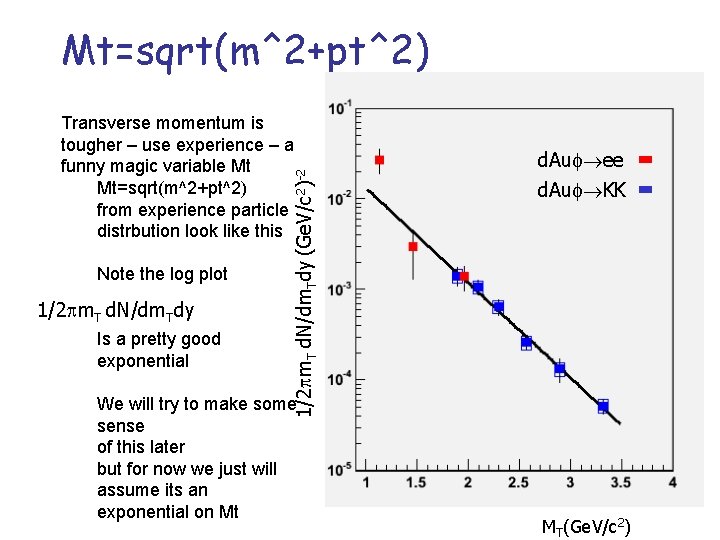
Mt=sqrt(m^2+pt^2) Note the log plot 1/2 m. T d. N/dm. Tdy Is a pretty good exponential 1/2 m. T d. N/dm. Tdy (Ge. V/c 2)-2 Transverse momentum is tougher – use experience – a funny magic variable Mt Mt=sqrt(m^2+pt^2) from experience particle distrbution look like this We will try to make some sense of this later but for now we just will assume its an exponential on Mt d. Au ee d. Au KK MT(Ge. V/c 2)
Light vector mesons ( ) from d. Au in PHENIX Richard Seto University of California, Riverside for the PHENIX Collaboration Quark Matter 2004 January 13, 2004
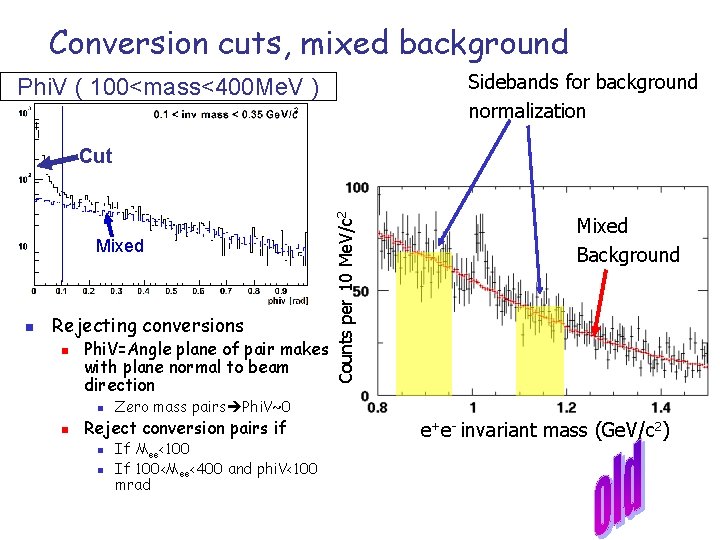
Conversion cuts, mixed background Sidebands for background normalization Phi. V ( 100<mass<400 Me. V ) Mixed n Rejecting conversions n Phi. V=Angle plane of pair makes with plane normal to beam direction n Mixed Background Zero mass pairs Phi. V~0 Reject conversion pairs if n Counts per 10 Me. V/c 2 Cut If Mee<100 If 100<Mee<400 and phi. V<100 mrad e+e- invariant mass (Ge. V/c 2)
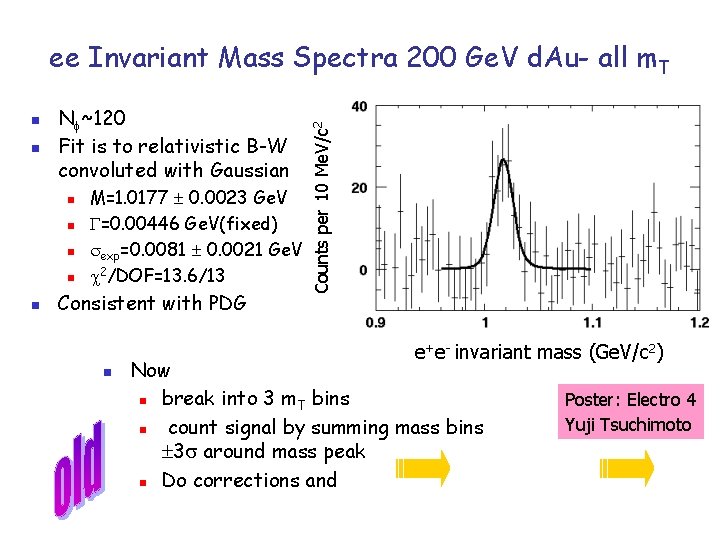
n n N ~120 Fit is to relativistic B-W convoluted with Gaussian n n M=1. 0177 0. 0023 Ge. V =0. 00446 Ge. V(fixed) exp=0. 0081 0. 0021 Ge. V 2/DOF=13. 6/13 Consistent with PDG Counts per 10 Me. V/c 2 ee Invariant Mass Spectra 200 Ge. V d. Au- all m. T e+e- invariant mass (Ge. V/c 2) n Now n break into 3 m. T bins n count signal by summing mass bins 3 around mass peak n Do corrections and Poster: Electro 4 Yuji Tsuchimoto
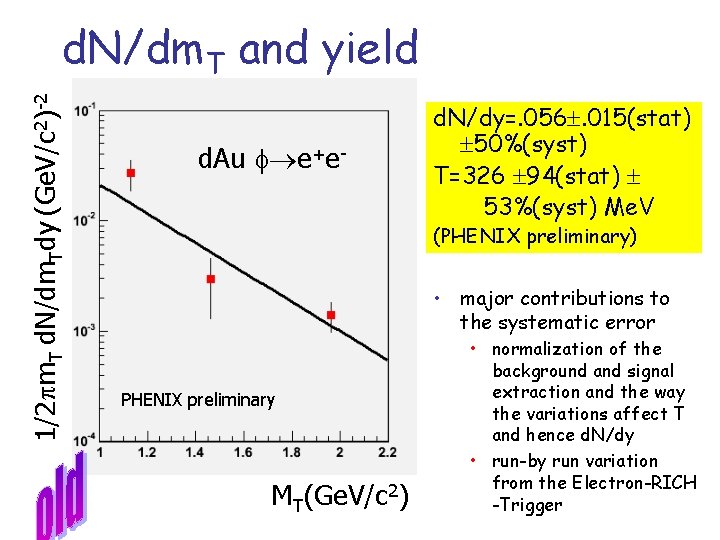
1/2 m. T d. N/dm. Tdy (Ge. V/c 2)-2 d. N/dm. T and yield d. Au e+e- d. N/dy=. 056. 015(stat) 50%(syst) T=326 94(stat) 53%(syst) Me. V (PHENIX preliminary) • major contributions to the systematic error PHENIX preliminary MT(Ge. V/c 2) • normalization of the background and signal extraction and the way the variations affect T and hence d. N/dy • run-by run variation from the Electron-RICH -Trigger
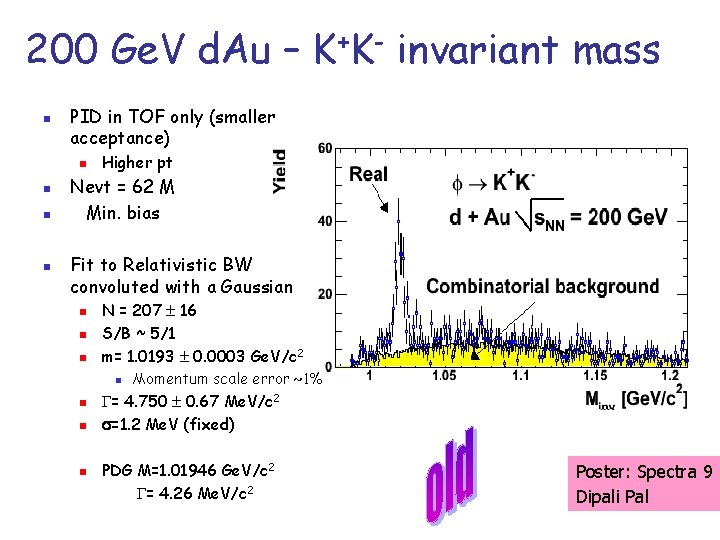
200 Ge. V d. Au – K+K- invariant mass n PID in TOF only (smaller acceptance) n n Higher pt Nevt = 62 M Min. bias Fit to Relativistic BW convoluted with a Gaussian n N = 207 16 S/B ~ 5/1 m= 1. 0193 0. 0003 Ge. V/c 2 n n Momentum scale error ~1% = 4. 750 0. 67 Me. V/c 2 =1. 2 Me. V (fixed) PDG M=1. 01946 Ge. V/c 2 = 4. 26 Me. V/c 2 Poster: Spectra 9 Dipali Pal
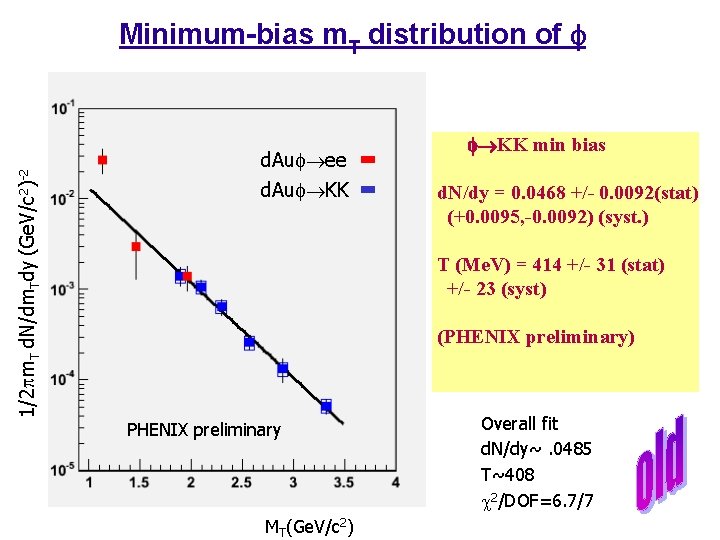
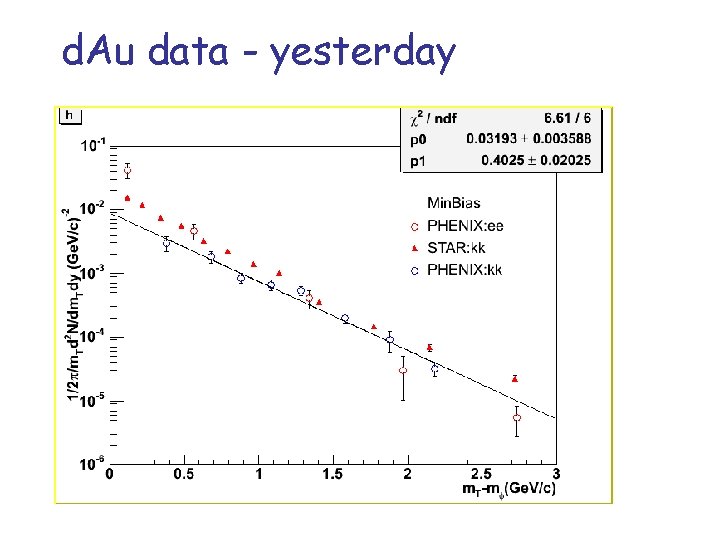
1/2 m. T d. N/dm. Tdy (Ge. V/c 2)-2 Minimum-bias m. T distribution of d. Au ee d. Au KK KK min bias d. N/dy = 0. 0468 +/- 0. 0092(stat) (+0. 0095, -0. 0092) (syst. ) T (Me. V) = 414 +/- 31 (stat) +/- 23 (syst) (PHENIX preliminary) PHENIX preliminary MT(Ge. V/c 2) Overall fit d. N/dy~. 0485 T~408 2/DOF=6. 7/7
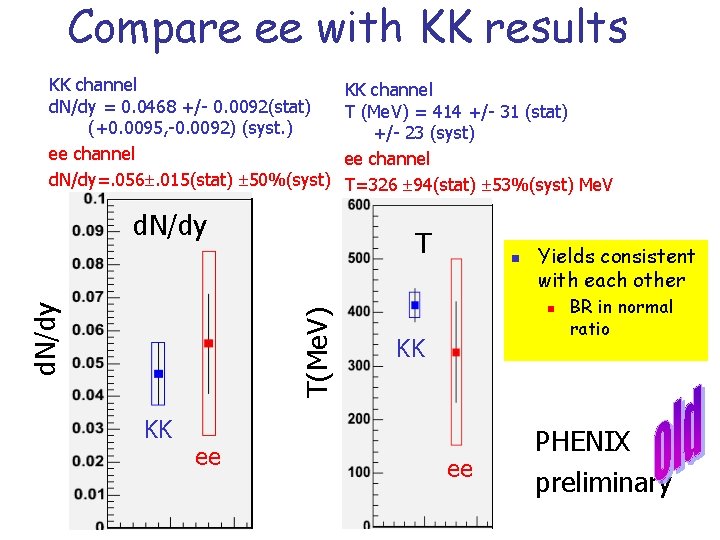
Compare ee with KK results KK channel d. N/dy = 0. 0468 +/- 0. 0092(stat) (+0. 0095, -0. 0092) (syst. ) ee channel d. N/dy=. 056. 015(stat) 50%(syst) T T(Me. V) d. N/dy KK ee KK channel T (Me. V) = 414 +/- 31 (stat) +/- 23 (syst) ee channel T=326 94(stat) 53%(syst) Me. V n Yields consistent with each other n KK ee BR in normal ratio PHENIX preliminary
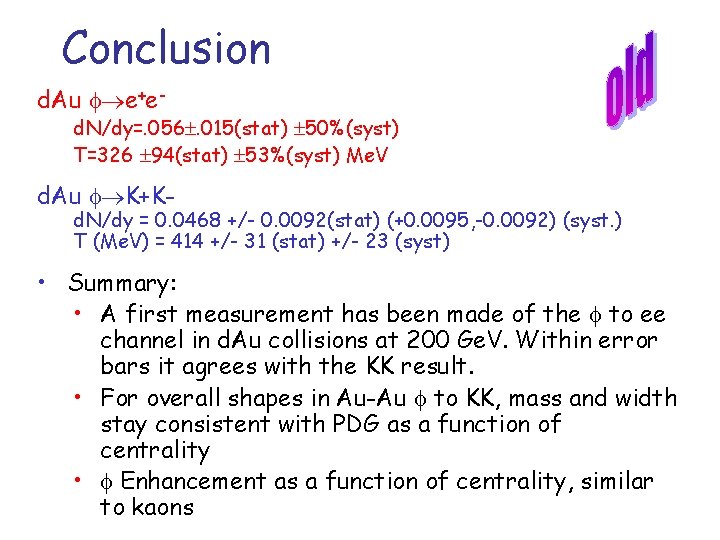
Conclusion d. Au e+e- d. N/dy=. 056. 015(stat) 50%(syst) T=326 94(stat) 53%(syst) Me. V d. Au K+K- d. N/dy = 0. 0468 +/- 0. 0092(stat) (+0. 0095, -0. 0092) (syst. ) T (Me. V) = 414 +/- 31 (stat) +/- 23 (syst) • Summary: • A first measurement has been made of the to ee channel in d. Au collisions at 200 Ge. V. Within error bars it agrees with the KK result. • For overall shapes in Au-Au to KK, mass and width stay consistent with PDG as a function of centrality • Enhancement as a function of centrality, similar to kaons
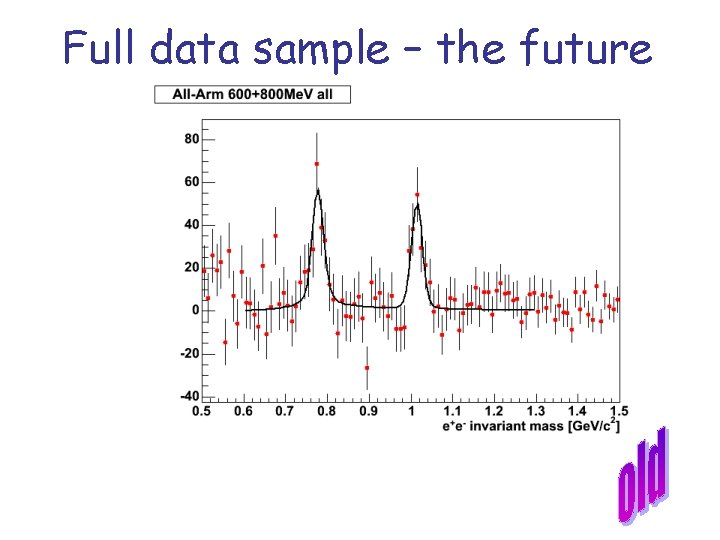
Outlook to the future Note: early in the story of lmvm ee physics at RHIC n Near term : this data n n n run 4 n n n Use rest of statistics (ert threshold>800 Me. V, min bias) Better control of systematics Centrality, pt dependence (d. Au-KK, ee? ) omega flow (poster Flow 7: Debsankar Mukhopadhyay) ee in Au-Au 50 x run-2 The far future n n Upgrades- the Hadron Blind Detector (Cerenkov) RHIC II
Full data sample – the future
d. Au data - yesterday
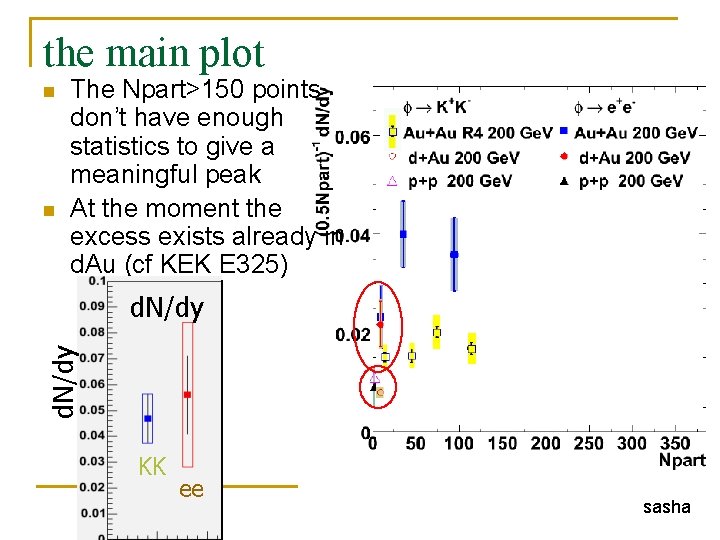
the main plot n n The Npart>150 points don’t have enough statistics to give a meaningful peak At the moment the excess exists already in d. Au (cf KEK E 325) d. N/dy KK ee sasha
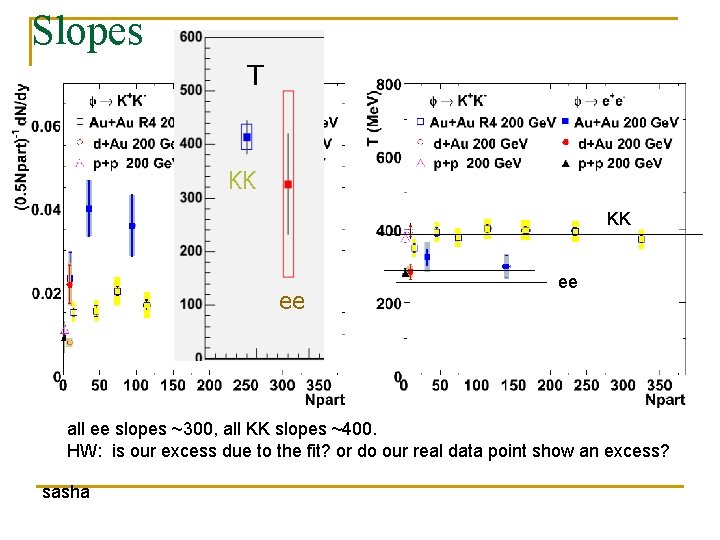
Slopes T KK KK ee ee all ee slopes ~300, all KK slopes ~400. HW: is our excess due to the fit? or do our real data point show an excess? sasha
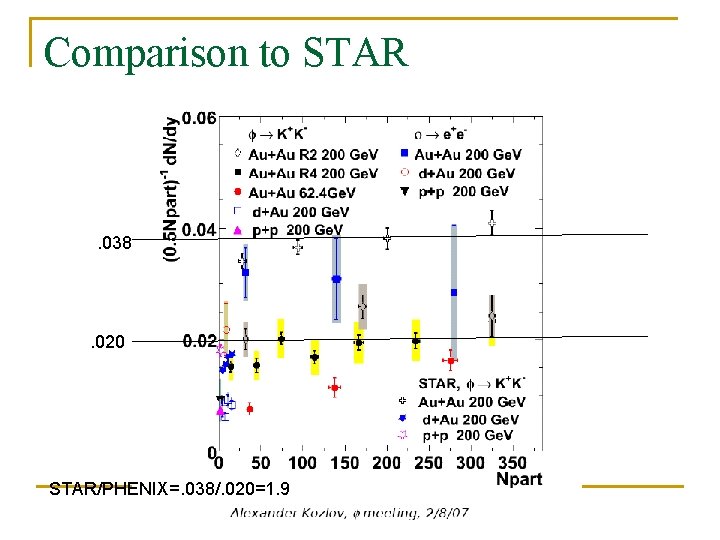
Comparison to STAR . 038 . 020 STAR/PHENIX=. 038/. 020=1. 9
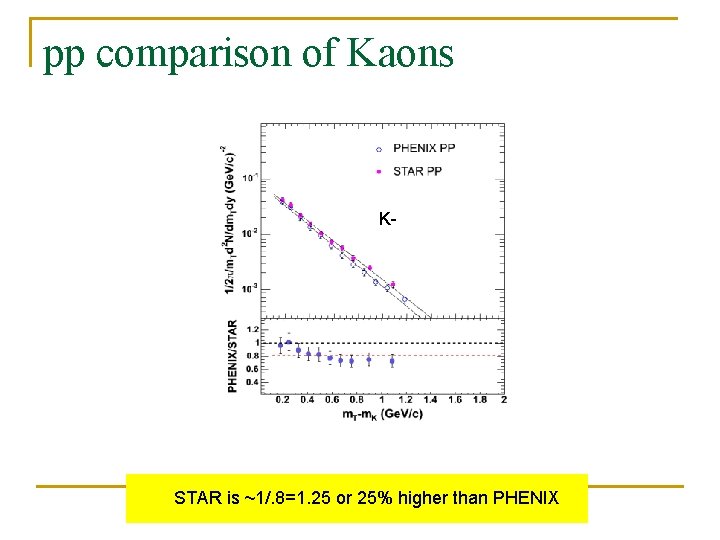
Make comparisons n n n PHENIX to STAR PHENIX to PHENIX! Many data sets q q n pp, d. Au, Au. Au 200 Ge. V, 63 Ge. V Many particles q q phi, K+, K-, Ks e+, epi+ pi- pi 0
pp comparison of Kaons K- STAR is ~1/. 8=1. 25 or 25% higher than PHENIX
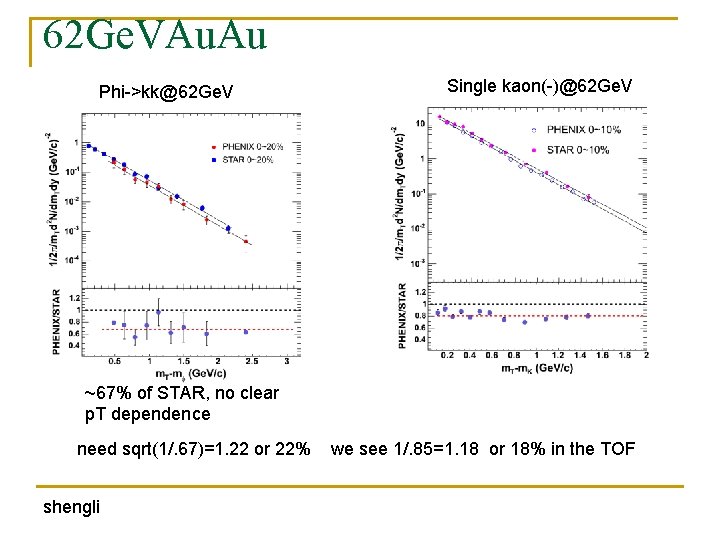
62 Ge. VAu. Au Phi->kk@62 Ge. V Single kaon(-)@62 Ge. V STAR Kaon By TOF ~67% of STAR, no clear p. T dependence need sqrt(1/. 67)=1. 22 or 22% shengli we see 1/. 85=1. 18 or 18% in the TOF
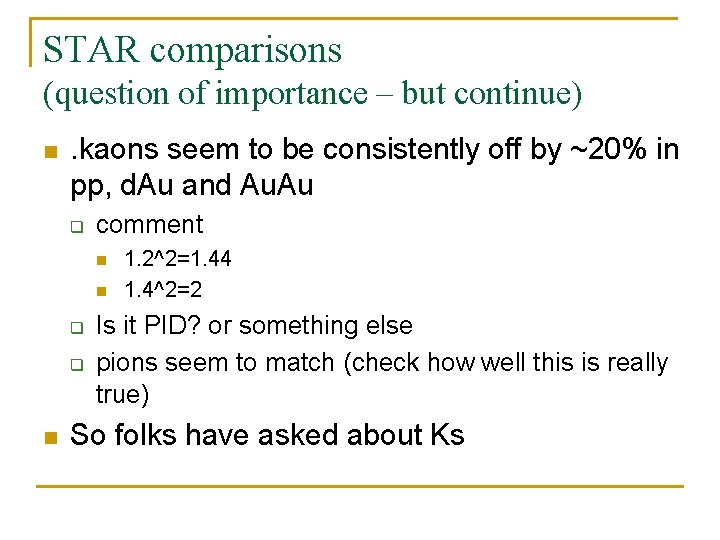
STAR comparisons (question of importance – but continue) n . kaons seem to be consistently off by ~20% in pp, d. Au and Au. Au q comment n n q q n 1. 2^2=1. 44 1. 4^2=2 Is it PID? or something else pions seem to match (check how well this is really true) So folks have asked about Ks
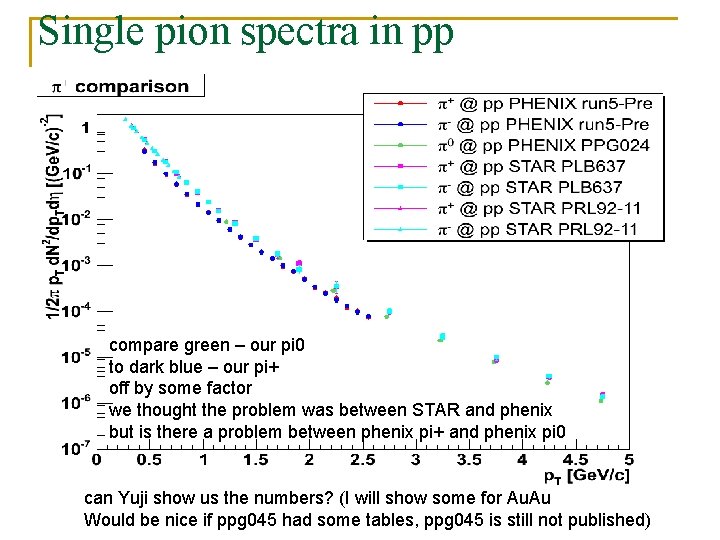
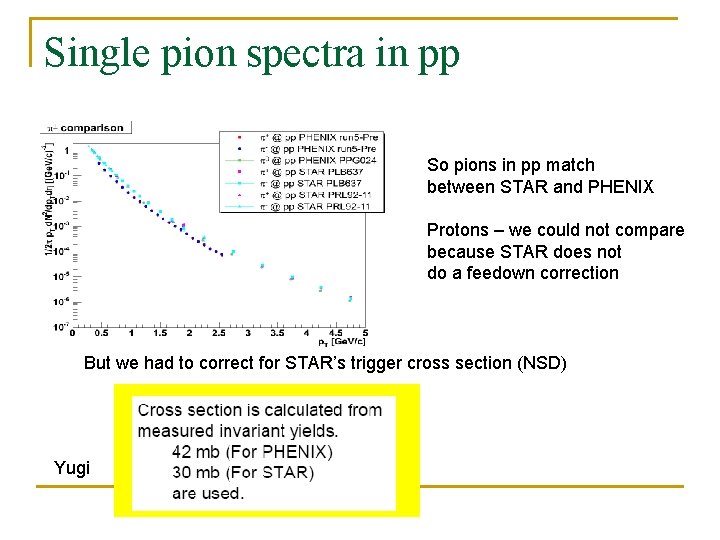
Single pion spectra in pp compare green – our pi 0 to dark blue – our pi+ off by some factor we thought the problem was between STAR and phenix but is there a problem between phenix pi+ and phenix pi 0 can Yuji show us the numbers? (I will show some for Au. Au Would be nice if ppg 045 had some tables, ppg 045 is still not published)
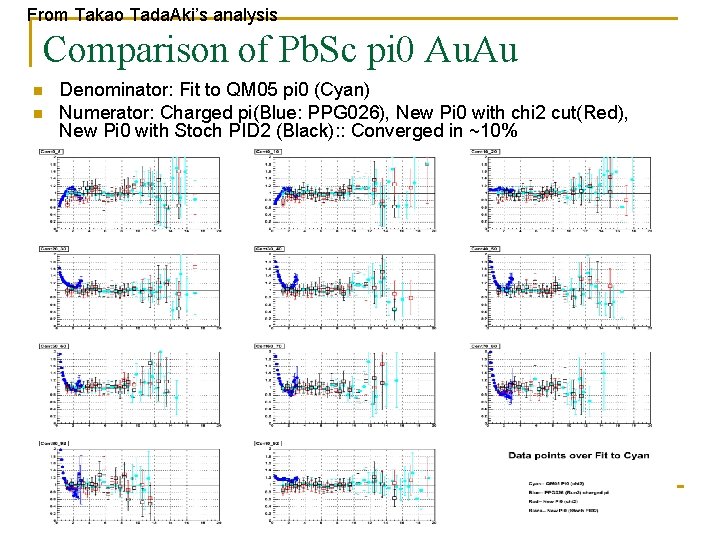
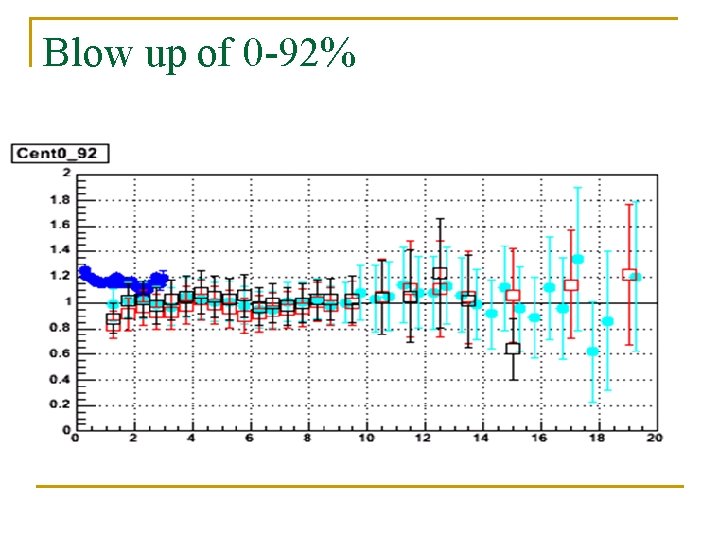
From Takao Tada. Aki’s analysis Comparison of Pb. Sc pi 0 Au. Au n n Denominator: Fit to QM 05 pi 0 (Cyan) Numerator: Charged pi(Blue: PPG 026), New Pi 0 with chi 2 cut(Red), New Pi 0 with Stoch PID 2 (Black): : Converged in ~10%
Blow up of 0 -92%
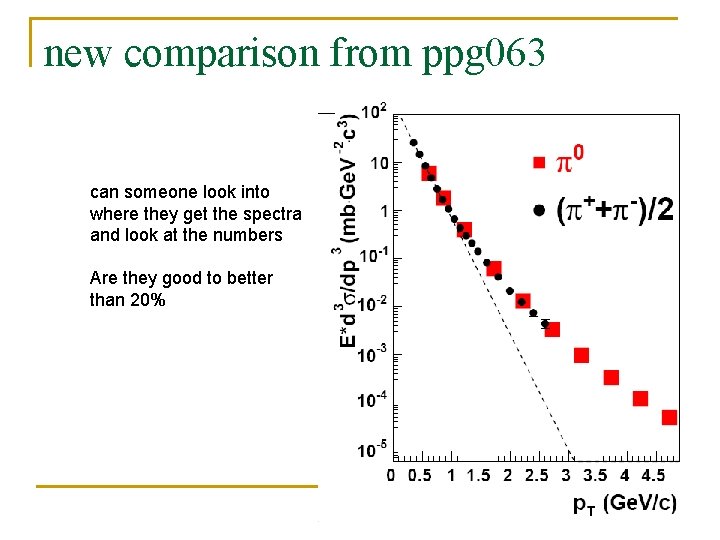
new comparison from ppg 063 can someone look into where they get the spectra and look at the numbers Are they good to better than 20%
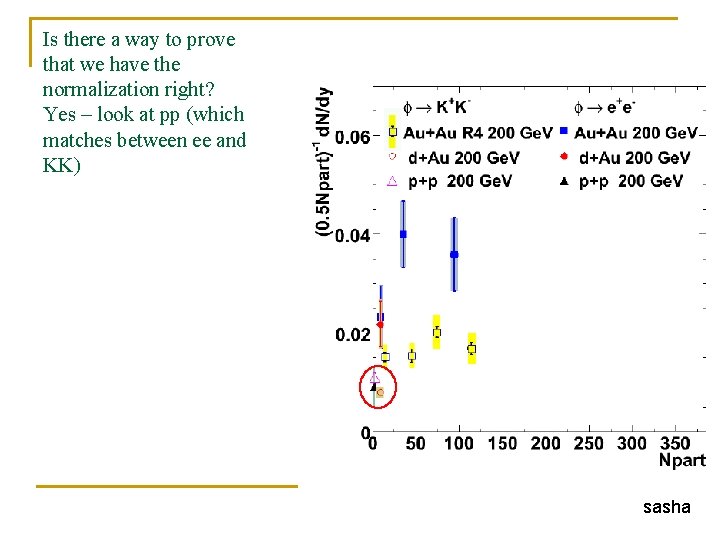
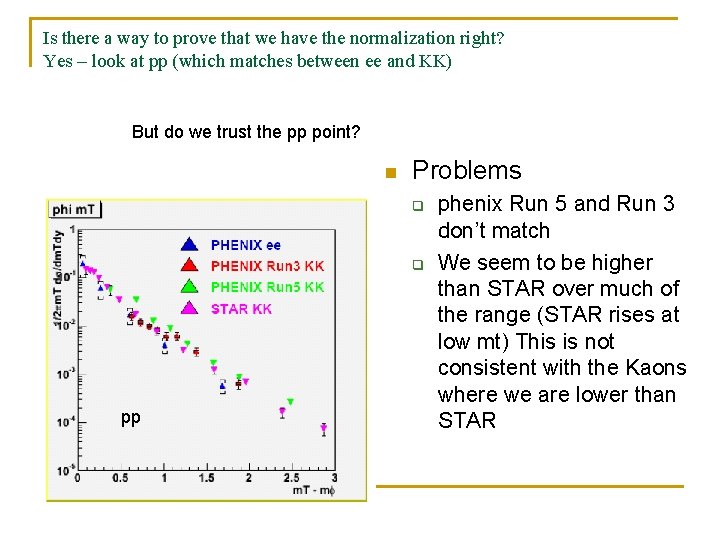
Is there a way to prove that we have the normalization right? Yes – look at pp (which matches between ee and KK) sasha
Is there a way to prove that we have the normalization right? Yes – look at pp (which matches between ee and KK) But do we trust the pp point? n Problems q q pp phenix Run 5 and Run 3 don’t match We seem to be higher than STAR over much of the range (STAR rises at low mt) This is not consistent with the Kaons where we are lower than STAR
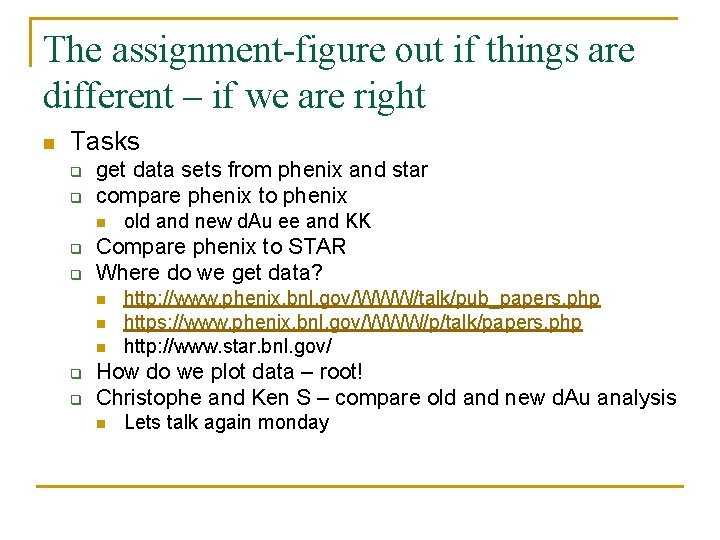
The assignment-figure out if things are different – if we are right n Tasks q q get data sets from phenix and star compare phenix to phenix n q q Compare phenix to STAR Where do we get data? n n n q q old and new d. Au ee and KK http: //www. phenix. bnl. gov/WWW/talk/pub_papers. php https: //www. phenix. bnl. gov/WWW/p/talk/papers. php http: //www. star. bnl. gov/ How do we plot data – root! Christophe and Ken S – compare old and new d. Au analysis n Lets talk again monday
Single pion spectra in pp So pions in pp match between STAR and PHENIX Protons – we could not compare because STAR does not do a feedown correction But we had to correct for STAR’s trigger cross section (NSD) Yugi
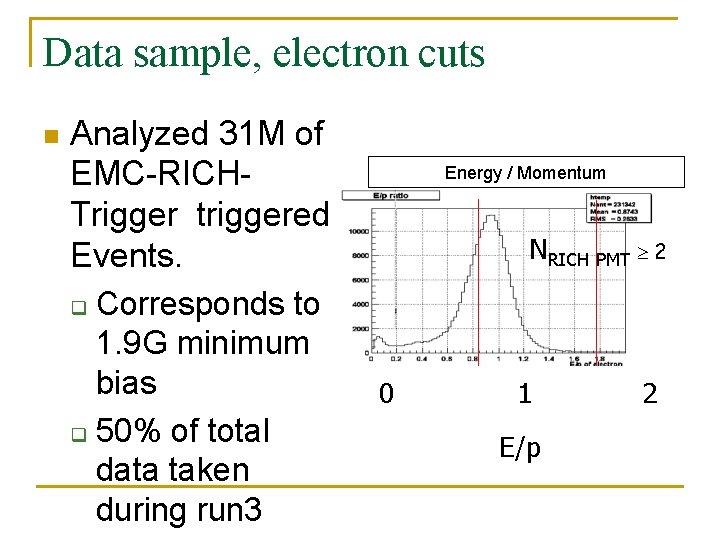
Data sample, electron cuts n Analyzed 31 M of EMC-RICHTrigger triggered Events. q Corresponds to 1. 9 G minimum bias q 50% of total data taken during run 3 Energy / Momentum NRICH PMT 2 0 1 E/p 2