
SEMINAR CENTRE FOR GLOBAL HIGHER EDUCATION UNIVERSITY COLLEGE

SEMINAR CENTRE FOR GLOBAL HIGHER EDUCATION UNIVERSITY COLLEGE LONDON MAY 22, 2018 Is There an International Crisis in the Humanities? Dennis A. Ahlburg Distinguished Professor of Economics Trinity University San Antonio, TX And Visiting Fellow Oxford Centre for Higher Education Policy Studies New College, University of Oxford
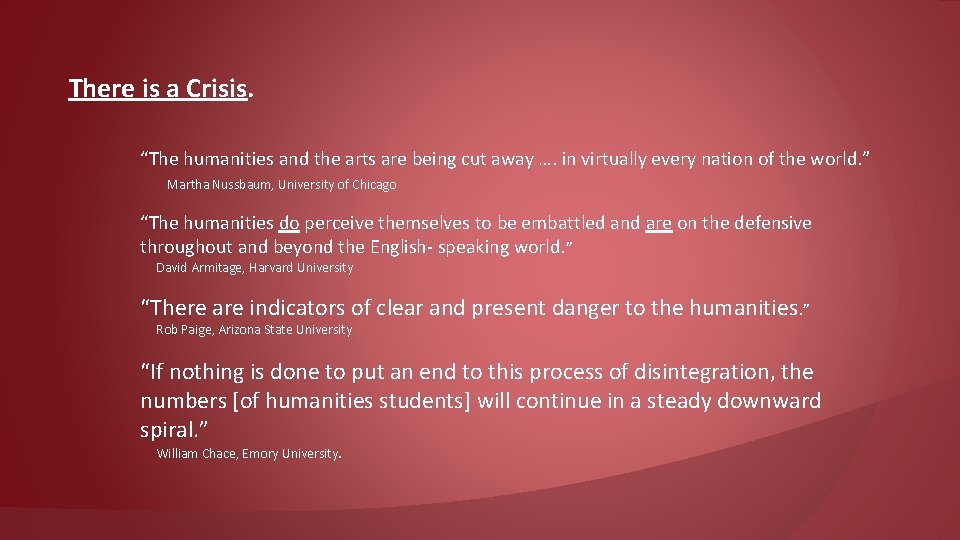
There is a Crisis. “The humanities and the arts are being cut away …. in virtually every nation of the world. ” Martha Nussbaum, University of Chicago “The humanities do perceive themselves to be embattled and are on the defensive throughout and beyond the English- speaking world. ” David Armitage, Harvard University “There are indicators of clear and present danger to the humanities. ” Rob Paige, Arizona State University “If nothing is done to put an end to this process of disintegration, the numbers [of humanities students] will continue in a steady downward spiral. ” William Chace, Emory University.
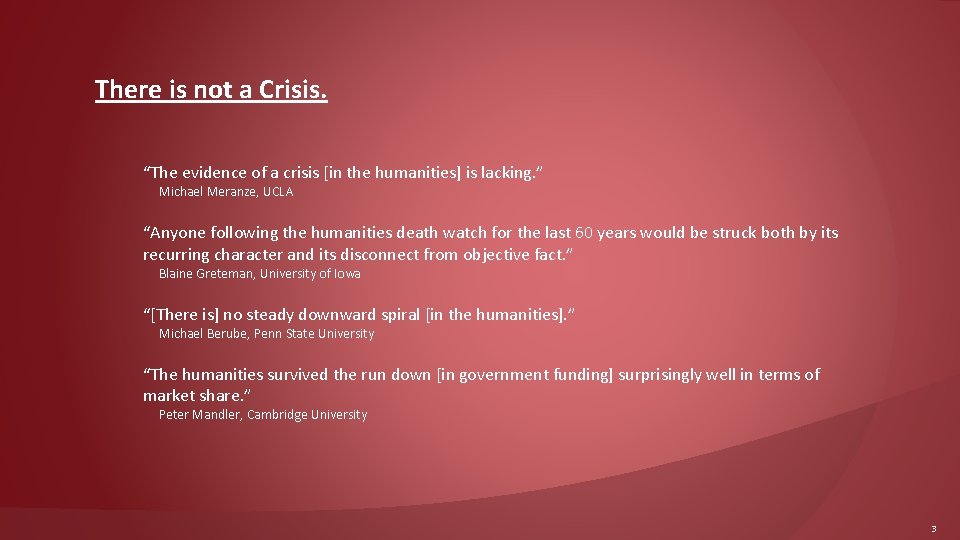
There is not a Crisis. “The evidence of a crisis [in the humanities] is lacking. ” Michael Meranze, UCLA “Anyone following the humanities death watch for the last 60 years would be struck both by its recurring character and its disconnect from objective fact. ” Blaine Greteman, University of Iowa “[There is] no steady downward spiral [in the humanities]. ” Michael Berube, Penn State University “The humanities survived the run down [in government funding] surprisingly well in terms of market share. ” Peter Mandler, Cambridge University 3
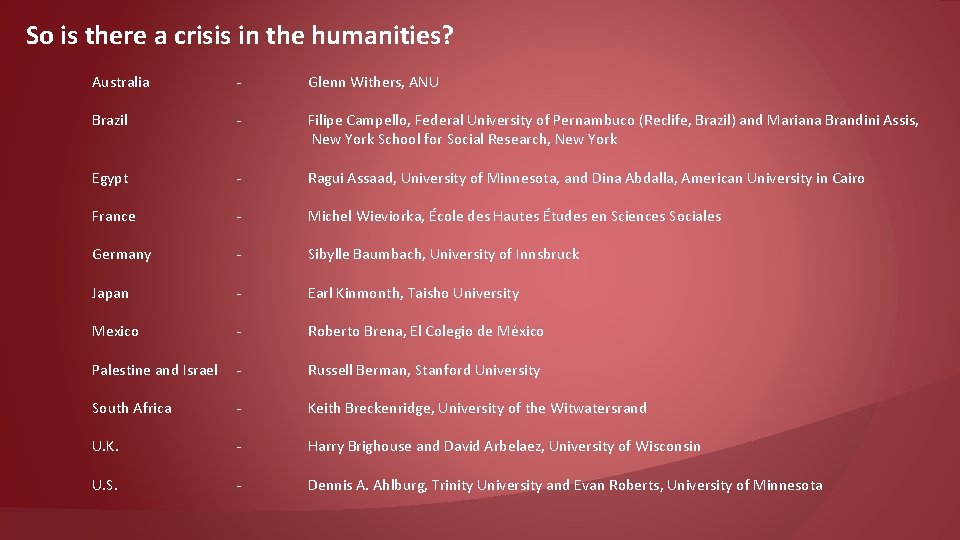
So is there a crisis in the humanities? Australia - Glenn Withers, ANU Brazil - Filipe Campello, Federal University of Pernambuco (Reclife, Brazil) and Mariana Brandini Assis, New York School for Social Research, New York Egypt - Ragui Assaad, University of Minnesota, and Dina Abdalla, American University in Cairo France - Michel Wieviorka, École des Hautes Études en Sciences Sociales Germany - Sibylle Baumbach, University of Innsbruck Japan - Earl Kinmonth, Taisho University Mexico - Roberto Brena, El Colegio de México Palestine and Israel - Russell Berman, Stanford University South Africa - Keith Breckenridge, University of the Witwatersrand U. K. - Harry Brighouse and David Arbelaez, University of Wisconsin U. S. - Dennis A. Ahlburg, Trinity University and Evan Roberts, University of Minnesota
The Questions: What are the humanities? Is there a crisis? If so, what form does it take (enrolment? , funding? , reputation? ). What are the causes? What are the implications? Avoid “being cast adrift on an ocean of anecdote masquerading as generalization or of ideology purporting to be fact. ” Francis Oakley 5
Why is it important to define the humanities? Mandler - The “humanities have held up well” - But languages, literature, history, philosophy, and religion have not. - Creative arts and design, communications, and education have. So what are the humanities? How are they defined? 6
Different ways to define the humanities: Stefan Collini Humanities is not a “timeless category. ” Brighouse and Arbelaez: Stipulative - designated by universities Principled – by subject matter and method of investigation Historical – what have been called humanities over time 7
So what are they? Core Humanities: languages and literatures, history, classical studies, philosophy Broader Humanities: religion, ethnic/gender/cultural studies, area studies, archeology, jurisprudence, selected arts, interdisciplinary studies What about: * creative arts and design, communications, education (Australia) * fashion and design, audiovisual and media studies (Brazil) * social sciences (France) * empirical aesthetics, digital humanities (Germany) * behavioral sciences (Mexico, Palestine) * psychology, public administration, management (South Africa) 8
What is a crisis? A departure from the norm and the departure is bad for somebody - students, faculty, society Brighouse and Arbelaez “A major and sustained decline in respect and commitment to humanities. ” Withers 9
Is a crisis measured by falling absolute numbers or a falling share? A falling market share does not “spell the end of civilization as we know it. ” Stefan Collini Or does it? 10
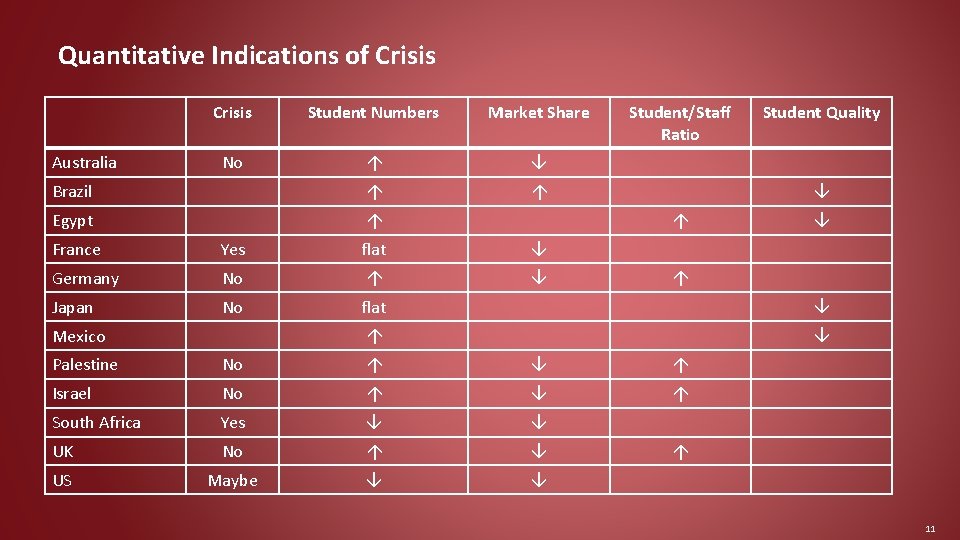
Quantitative Indications of Crisis Student Numbers Market Share No Brazil Egypt Australia Student/Staff Ratio Student Quality France Yes flat Germany No Japan No flat Mexico Palestine No Israel No South Africa Yes UK No US Maybe 11
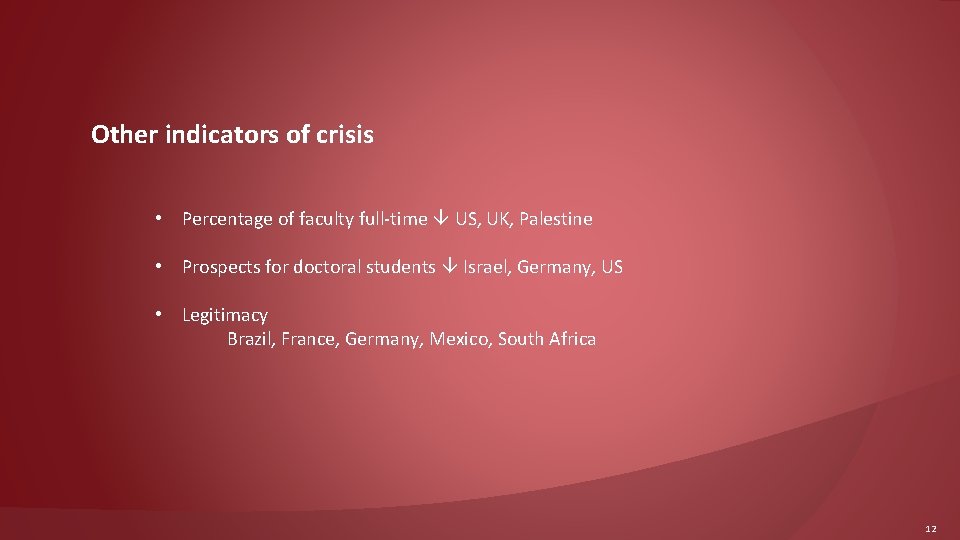
Other indicators of crisis • Percentage of faculty full-time US, UK, Palestine • Prospects for doctoral students Israel, Germany, US • Legitimacy Brazil, France, Germany, Mexico, South Africa 12
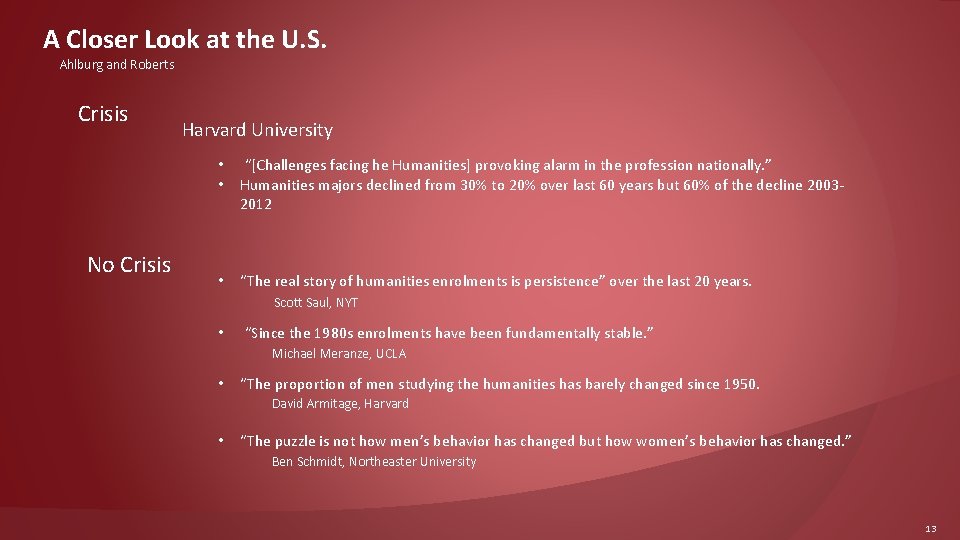
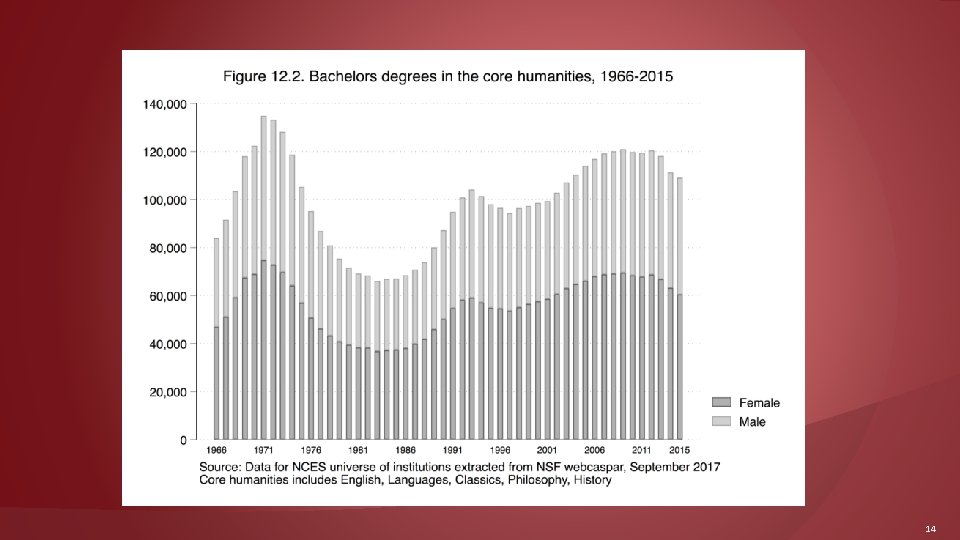
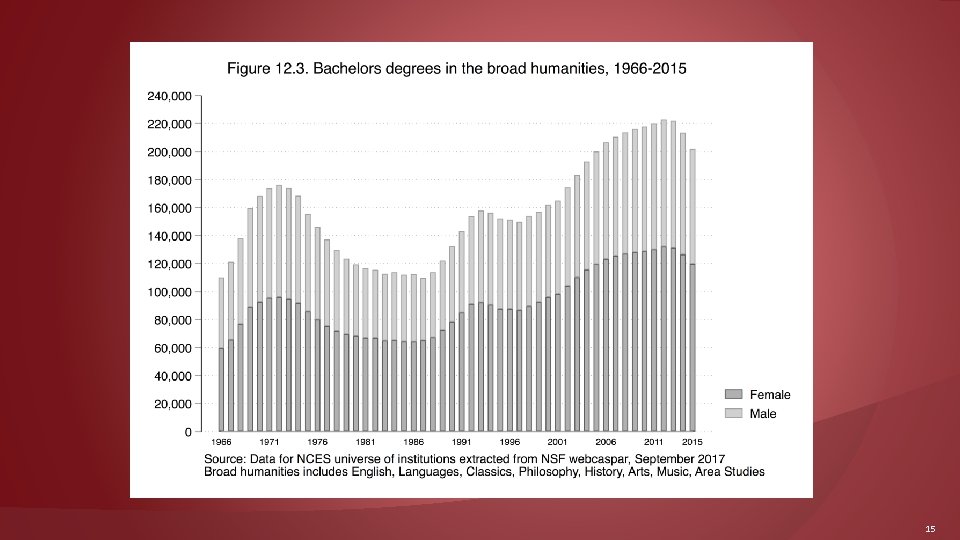
A Closer Look at the U. S. Ahlburg and Roberts Crisis No Crisis Harvard University • • “[Challenges facing he Humanities] provoking alarm in the profession nationally. ” Humanities majors declined from 30% to 20% over last 60 years but 60% of the decline 20032012 • “The real story of humanities enrolments is persistence” over the last 20 years. Scott Saul, NYT • “Since the 1980 s enrolments have been fundamentally stable. ” Michael Meranze, UCLA • “The proportion of men studying the humanities has barely changed since 1950. David Armitage, Harvard • “The puzzle is not how men’s behavior has changed but how women’s behavior has changed. ” Ben Schmidt, Northeaster University 13
14
15
Stability? Growth? • Significant fluctuation in numbers (rejects Mandler, Saul, Meranze) • Clear ‘crisis’ in 1970 s and 1980 s • Decline 2009 -2015 (core) 2012 -2015 (broad) • Similar pattern for men and women (rejects Schmidt) • Pattern same if add “Arts” • 1% point decline = 20, 000 majors = 600 faculty 16
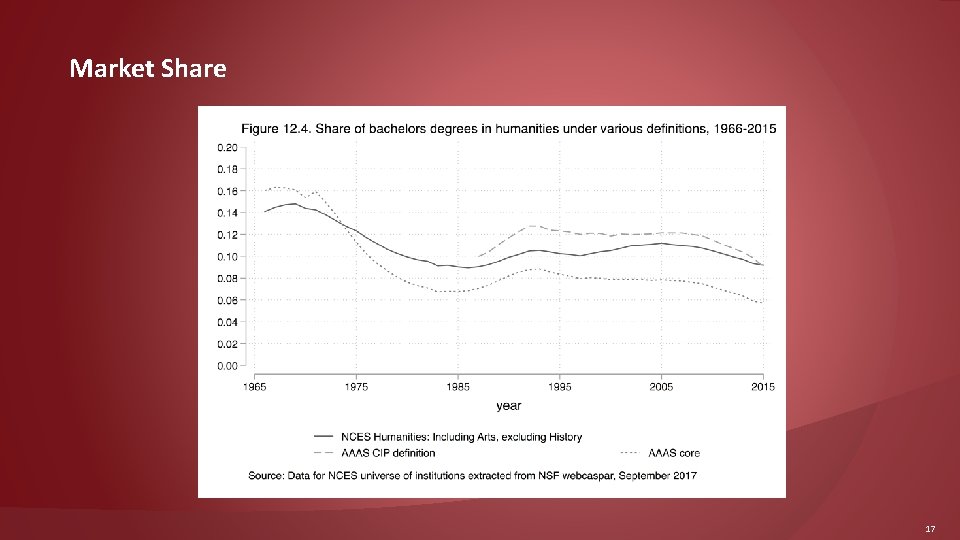
Market Share 17
Market Share Decline • Core share declined 69% over last 50 years • Broad definition share constant 1980 -2005 then declined • Crisis if reference point is 1970 otherwise perhaps not 18
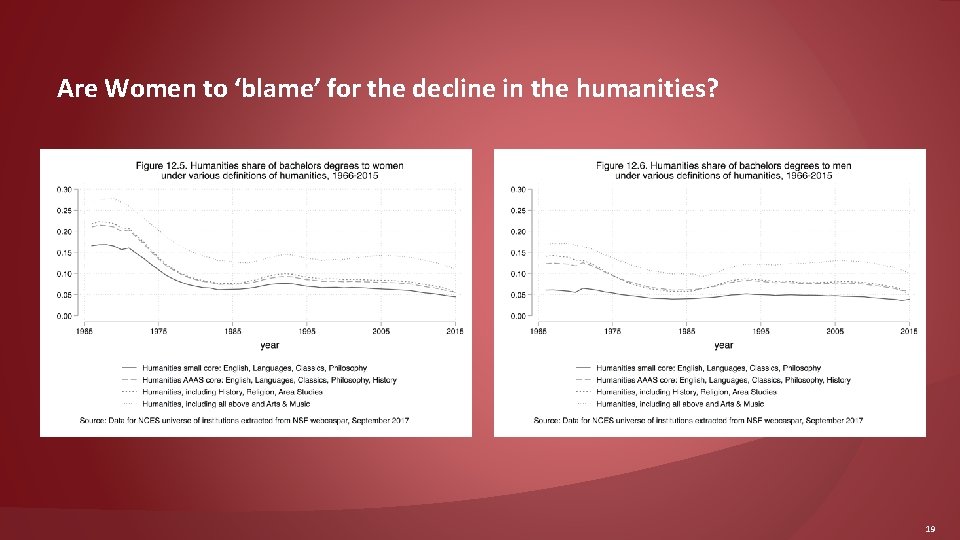
Are Women to ‘blame’ for the decline in the humanities? 19
Women unjustly accused. The pattern for men and women is similar and the male share has not stayed constant since 1950 – in fact it declined 1980 s to 2014. 20
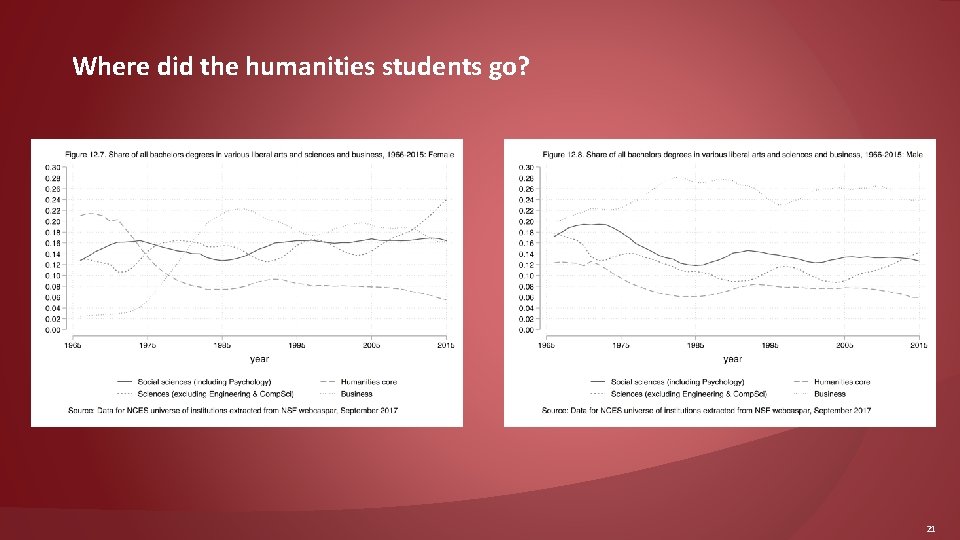
Where did the humanities students go? 21
• There is a simple “two cultures” explanation (the second culture is business) until 1990. • But not post-1990. 22
What Explains the Fate of the Humanities? We dismiss • Demographic change (disadvantaged students) does not correspond to humanities. • Culture wars - but they happened after the decline of the 1970 s and during the increase in 1980 s and 1990 s. • The Economy • Large increases in unemployment associated with very small humanities • No impact of stock market crashes • No impact of Wall Street scandals. 23
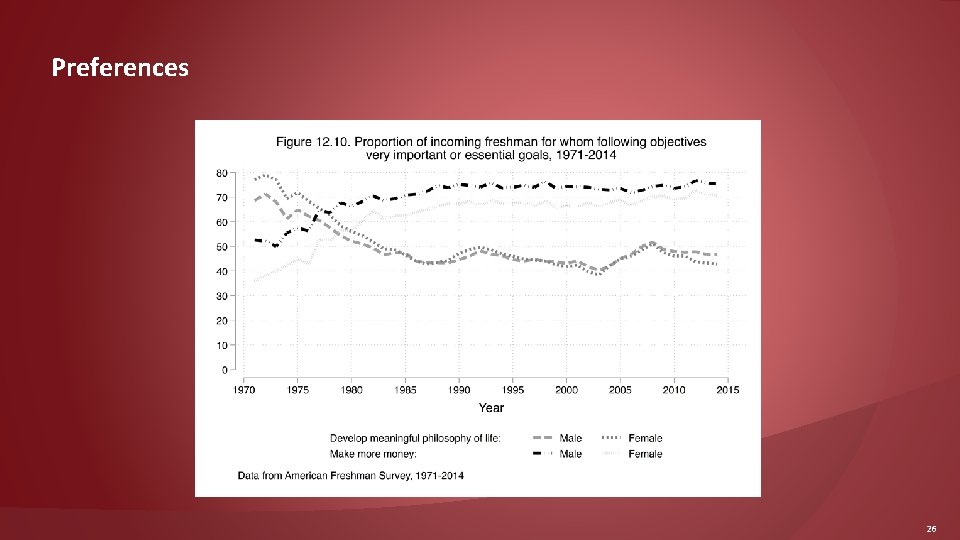
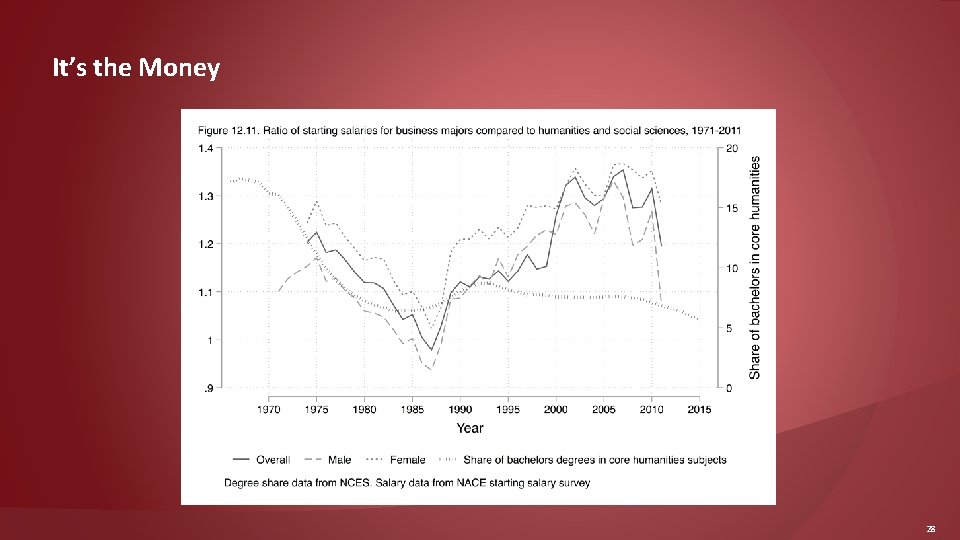
Fluctuations in the humanities are related to: • The pill • Changing preferences of students • Relative earnings
• Uptake of pill (and delayed marriage and childbirth) coincides with humanities (1970 -1985 and 2000 -2015 25
Preferences 26
Preferences Rise of importance of making money and decline of developing a meaningful philosophy of life tracks decline of humanities 1970 s and 1980 s. Post 1990 the fate of the humanities tracks more closely the importance of a meaningful philosophy of life. 27
It’s the Money 28
• It is clear students are influenced by starting salaries as relative earnings, and humanities shares move inversely – early 1970 s and post 1990. 29
A Closer Look at the UK Brighouse and Arbelaez Crisis “Currently fixed in the crosshairs are the disciplines of the humanities. ” Alex Preston, the Guardian “A key feature of the restructuring process has been the increasingly attenuated position of the humanities. ” Collen Lye and James Vernon No Crisis “There is no period to which one can point and say ‘there is a crisis of the humanities. ’ To the contrary, the absolute number of graduates has grown and grown. ” Pete Mandler 30
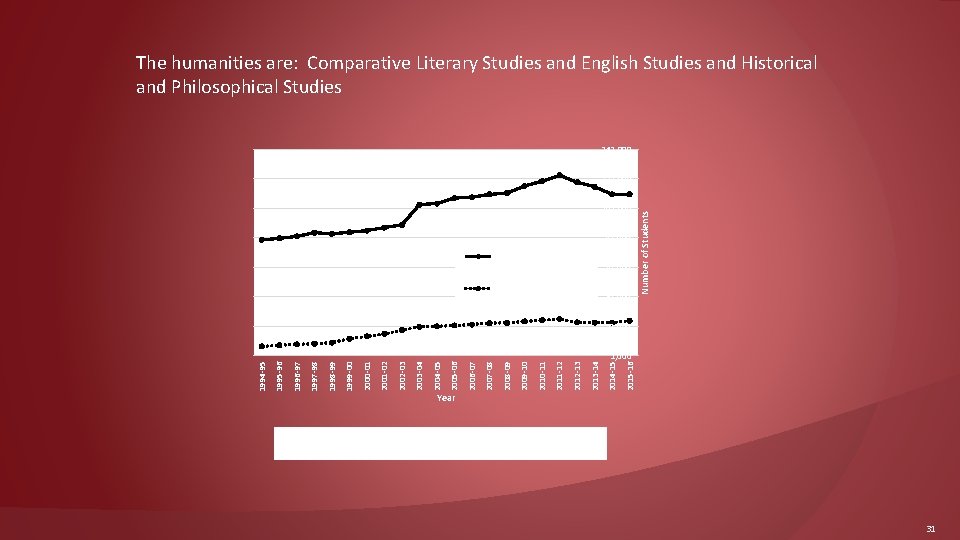
The humanities are: Comparative Literary Studies and English Studies and Historical and Philosophical Studies 141, 000 101, 000 81, 000 Humanities 61, 000 Media and Communication Studies 41, 000 Number of Students 121, 000 2015 -16 1, 000 2014 -15 2013 -14 2012 -13 2011 -12 2010 -11 2009 -10 2008 -09 2007 -08 Year 2006 -07 2005 -06 2004 -05 2003 -04 2002 -03 2001 -02 2000 -01 1999 -00 1998 -99 1997 -98 1996 -97 1995 -96 1994 -95 21, 000 Figure 11. 2. First degree students in the humanities and media and communication studies from 1994 -95 to 2015 -16. 31
• Enrolments rose 1994/5 – 2011/12 then slight decline • Increase driven by domestic students • Adding languages does not alter the story 32
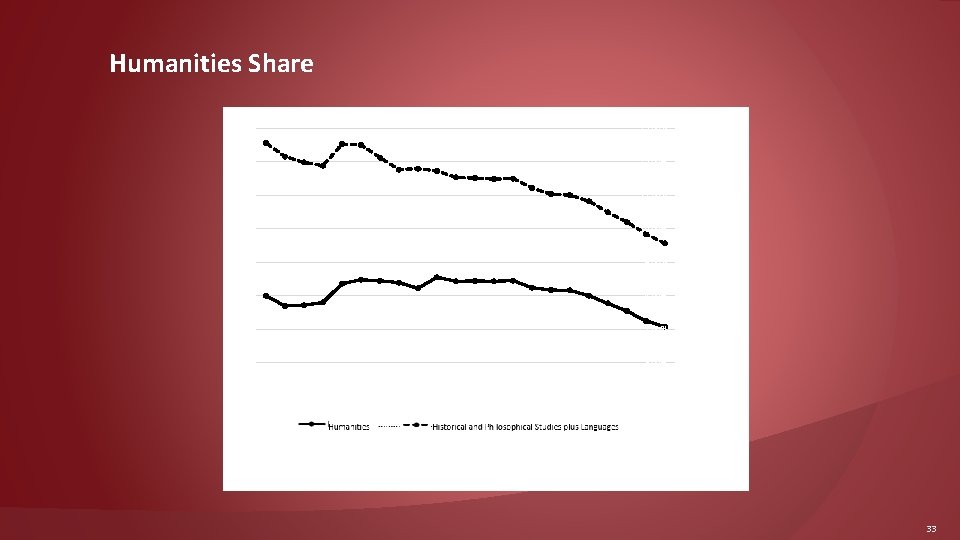
Humanities Share 13. 00% 12. 00% 10. 00% 9. 00% Percentage 11. 00% 8. 00% 2015 -16 6. 00% 2014 -15 2013 -14 2012 -13 2011 -12 2010 -11 2009 -10 2008 -09 2007 -08 Year 2006 -07 2005 -06 2004 -05 2003 -04 2002 -03 2001 -02 2000 -01 1999 -00 1998 -99 1997 -98 1996 -97 1995 -96 1994 -95 7. 00% Figure 11. 5. Share of the Humanities, and of Historical and Philosophical Studies plus Languages in the total of first degree students from 1994 -95 to 2015 -16. 33
• Share from 8% to 7% (2, 000 students) • Decline greater of languages included 34
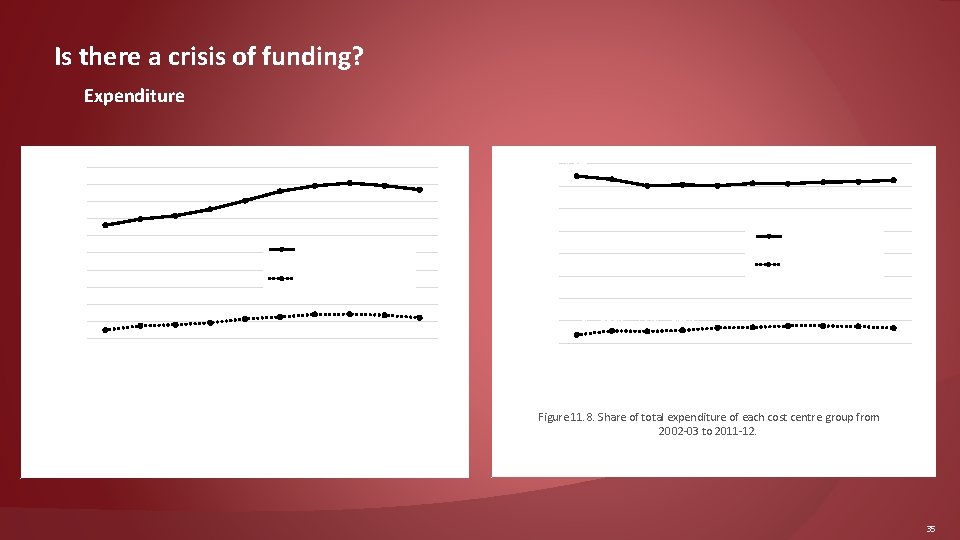
Is there a crisis of funding? Expenditure 1, 070, 000 9. 00% 970, 000 8. 00% Humanities and Language Based Studies* 570, 000 470, 000 Media Studies 370, 000 Percentage 670, 000 8. 03% 8. 07% 8. 03% 8. 12% 8. 19% 8. 21% 8. 27% 6. 00% Humanities and Language Based Studies* 5. 00% Media Studies 4. 00% Figure 11. 7. Expenditure by cost centre group in thousands of pounds from 2002 -03 to 2011 -12, indexed to 2017. 1. 56% 1. 53% 1. 58% 1. 69% 1. 71% 1. 77% 1. 78% 1. 75% 1. 68% 2004 -05 2005 -06 2006 -07 2007 -08 2008 -09 2009 -10 2010 -11 2011 -12 2010 -11 2009 -10 2008 -09 2007 -08 2006 -07 2005 -06 2004 -05 2003 -04 Year 1. 00% 1. 38% 2003 -04 2. 00% 170, 000 2002 -03 3. 00% 270, 000 8. 31% 7. 00% 770, 000 2002 -03 Thousands of Pounds 870, 000 8. 46% Year Figure 11. 8. Share of total expenditure of each cost centre group from 2002 -03 to 2011 -12. 35
The Pounds: • Real expenditure on the humanities increased by $200 million 2002/3 – 2009/10 • Humanities share of university spending fell 36
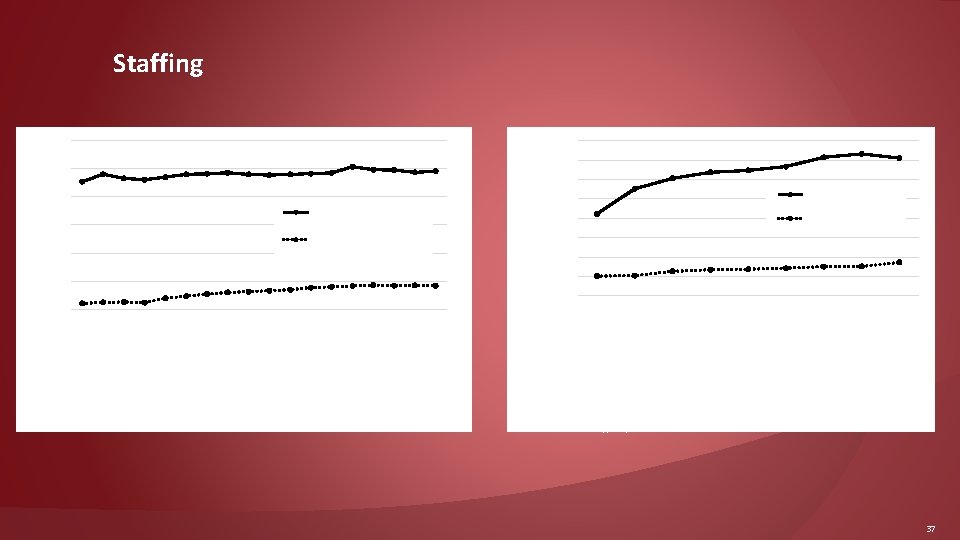
Staffing 12, 000 8, 000 7, 000 6, 000 Number of Staff 8, 000 Humanities and Language Based Studies* 6, 000 Media Studies 4, 000 3, 000 2, 000 Figure 11. 10. Number of full time academic staff by cost centre group from 1994 -95 to 2011 -12 2010 -11 2009 -10 Year 2008 -09 2007 -08 2006 -07 2005 -06 2011 -12 2010 -11 2009 -10 2008 -09 2007 -08 2006 -07 2005 -06 Year 2004 -05 2003 -04 2002 -03 2001 -02 2000 -01 1999 -00 1998 -99 1997 -98 1996 -97 1995 -96 1994 -95 0 2004 -05 1, 000 2, 000 0 Humanities and Language Based Studies* Media Studies 5, 000 2003 -04 Number of Staff 10, 000 Figure 11. Number of part time academic staff by cost centre group from 2003 -04 to 2011 -12. 37
The People • Full-time staff increased slightly and much less than other areas. • Considerable growth in part-time • Student/staff ratio increased 38
Conclusion: UK • Claims of crisis seem alarmist • Enrolment has increased • Resources have not declined • However, share of students and staff have declined • There could be a future crisis if: • • • the fall-off in enrolment continues if quality of instruction declines If quality of research declines If society’s support for the humanities declines If students become more sensitive to earnings differentials 39
Do the humanities contribute to society? Yes. • • Emphasize what gives meaning to life Teach how to deal with complex, non-routine problems Impart skills to interpret and communicate complex ideas Impart skills to evaluate information, ask difficult questions, and place in historical and cultural context Brighouse and Abelaez • Economic argument • Humanities impart “efficiency-enhancing” skills which are increasingly important • “soft-skills” “Society needs new narratives, revive family life, restore community bonds and shared moral culture. ” David Brooks • Humanities has a comparative advantage in these areas. 40
Is arguing in favour of the humanities a “sell-out? ” • Stefan Collini warns against “internalizing the language of contribution to economic growth as the defining purpose [of the humanities]. ” • The humanities are not “gadget-ready panacea for machinations of society, politics, and culture. ” Soni and Callebert 41
My position: • Parents, students, administrators, and politicians use the language of economic value. • A refusal to do so is equivalent to admitting the humanities do not contribute to the economy. • One can place a “lower-bound” estimate on the value of the humanities. “To take advantage of the vocational potential of the humanities is not to sell out to the corporate world, but to bring the critical perspective of the humanities into that world. ” Paul Jay 42
A few concluding thoughts • Should the definition of the humanities be broadened to include “useless degrees that won’t get you a job? ” Berube • Will this lead to a crisis within the humanities? • Should the humanities be defended using an economic argument? • Are the economic returns to a degree in the humanities underestimated? • Rise of the “soft-skills” post 2000 • Importance of graduate school 43
Conclusion There is no world-wide crisis in the humanities. However, the humanities do not have a “shining future” in many countries. 44
- Slides: 44