
Semiconductor Physics Introduction Semiconductors are materials whose electronic
- Slides: 19
Semiconductor Physics
Introduction • Semiconductors are materials whose electronic properties are intermediate between those of Metals and Insulators. • They have conductivities in the range of 10 +4 S/m. -4 to 10 • The interesting feature about semiconductors is that they are bipolar and current is transported by two charge carriers of opposite sign. • These intermediate properties are determined by 1. Crystal Structure bonding Characteristics. 2. Electronic Energy bands.
• Silicon and Germanium are elemental semiconductors and they have four valence electrons which are distributed among the outermost S and p orbital's. • These outer most S and p orbital's of Semiconductors involve in Sp 3 hybridanisation. • These Sp 3 orbital's form four covalent bonds of equal angular separation leading to a tetrahedral arrangement of atoms in space results tetrahedron shape, resulting crystal structure is known as Diamond cubic crystal structure
Semiconductors are mainly two types 1. Intrinsic (Pure) Semiconductors 2. Extrinsic (Impure) Semiconductors
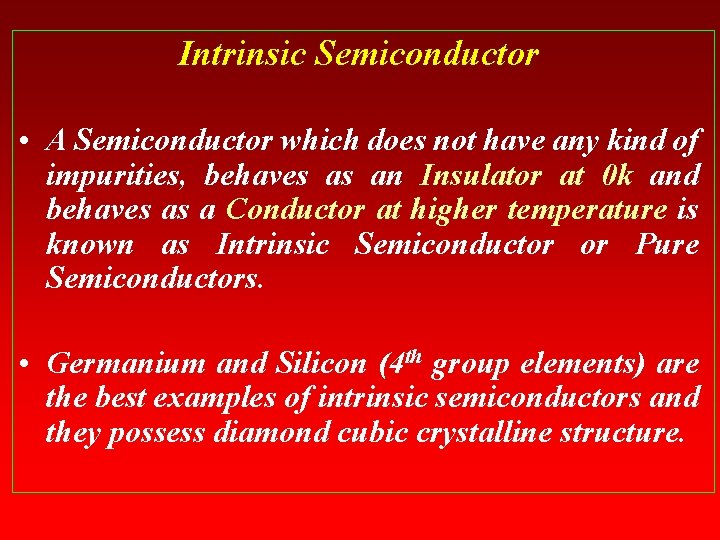
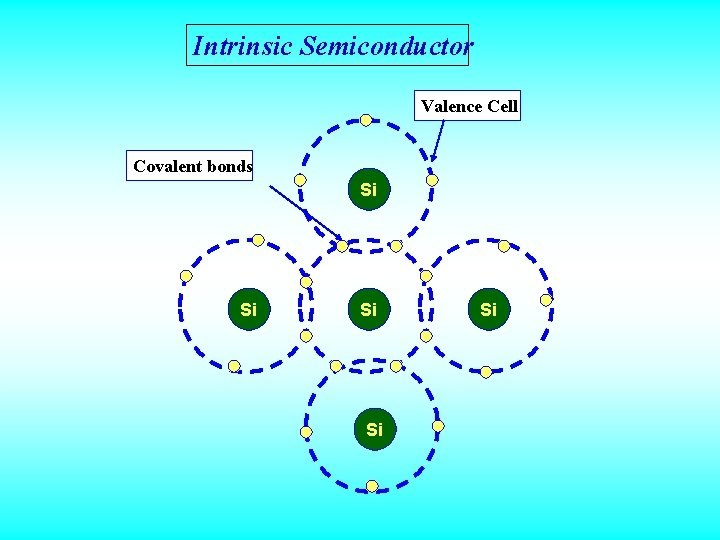
Intrinsic Semiconductor • A Semiconductor which does not have any kind of impurities, behaves as an Insulator at 0 k and behaves as a Conductor at higher temperature is known as Intrinsic Semiconductor or Pure Semiconductors. • Germanium and Silicon (4 th group elements) are the best examples of intrinsic semiconductors and they possess diamond cubic crystalline structure.
Intrinsic Semiconductor Valence Cell Covalent bonds Si Si Si
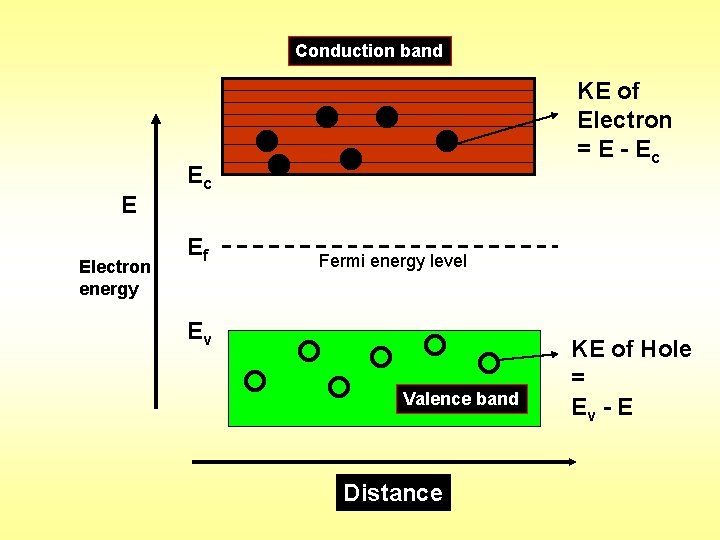
Conduction band Ec E Electron energy Ec Ef KE of Electron = E - Ec Fermi energy level Ev Valence band Distance KE of Hole = Ev - E
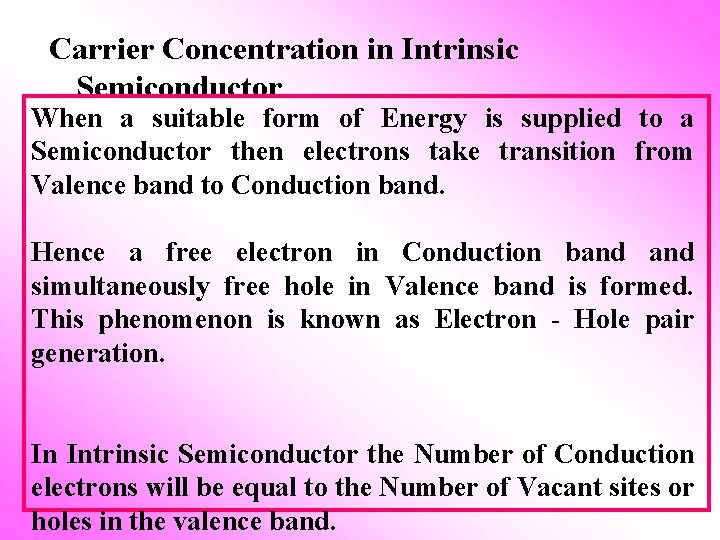
Carrier Concentration in Intrinsic Semiconductor When a suitable form of Energy is supplied to a Semiconductor then electrons take transition from Valence band to Conduction band. Hence a free electron in Conduction band simultaneously free hole in Valence band is formed. This phenomenon is known as Electron - Hole pair generation. In Intrinsic Semiconductor the Number of Conduction electrons will be equal to the Number of Vacant sites or holes in the valence band.
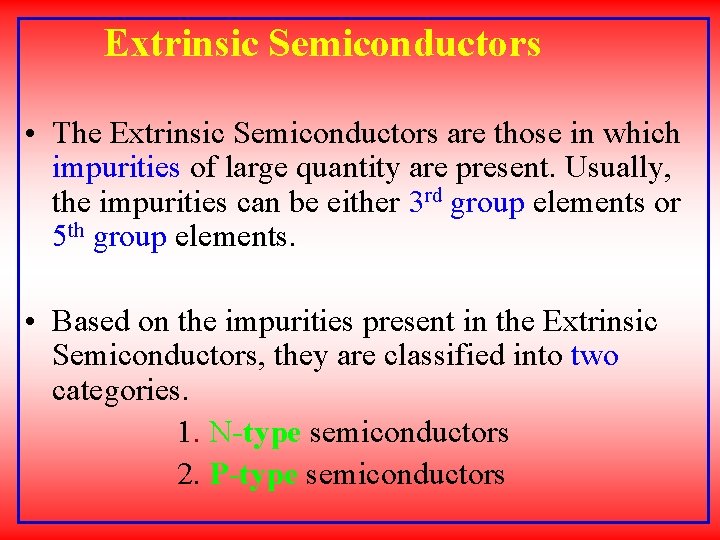
Extrinsic Semiconductors • The Extrinsic Semiconductors are those in which impurities of large quantity are present. Usually, the impurities can be either 3 rd group elements or 5 th group elements. • Based on the impurities present in the Extrinsic Semiconductors, they are classified into two categories. 1. N-type semiconductors 2. P-type semiconductors
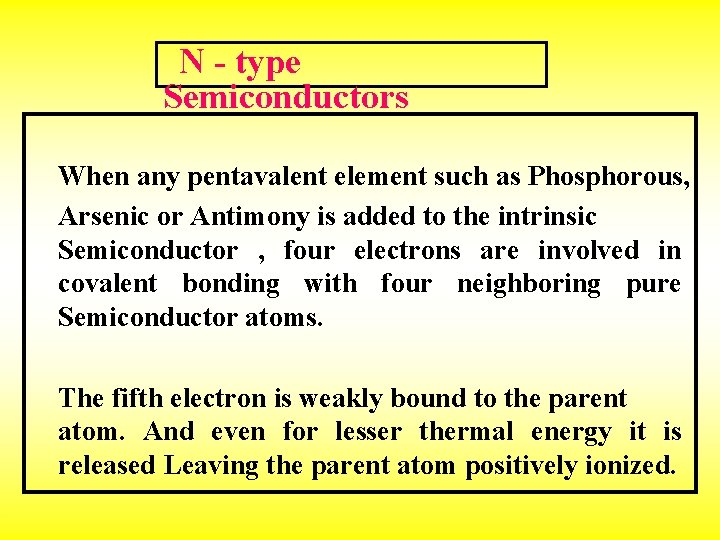
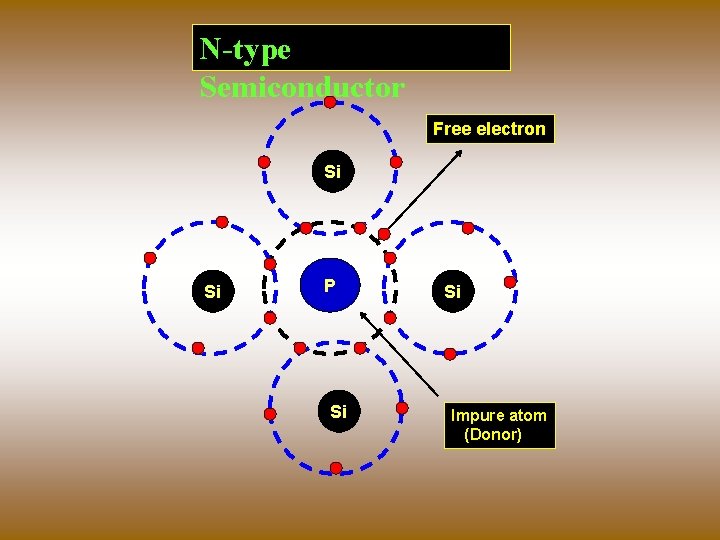
N - type Semiconductors When any pentavalent element such as Phosphorous, Arsenic or Antimony is added to the intrinsic Semiconductor , four electrons are involved in covalent bonding with four neighboring pure Semiconductor atoms. The fifth electron is weakly bound to the parent atom. And even for lesser thermal energy it is released Leaving the parent atom positively ionized.
N-type Semiconductor Free electron Si Si P Si Si Impure atom (Donor)
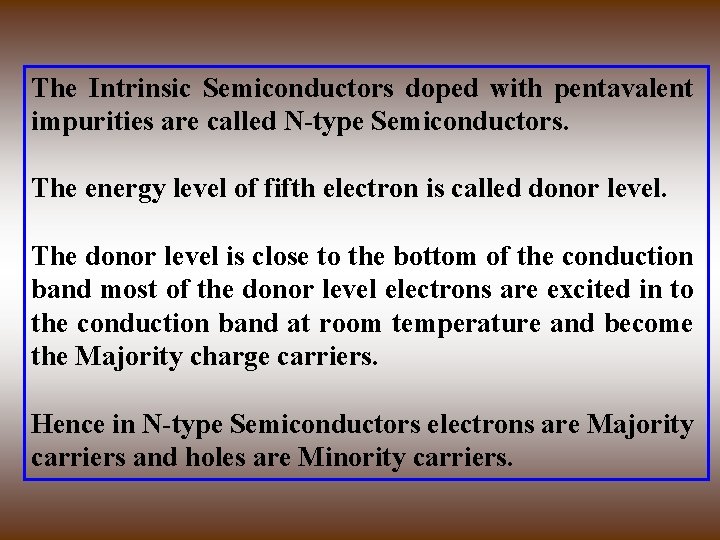
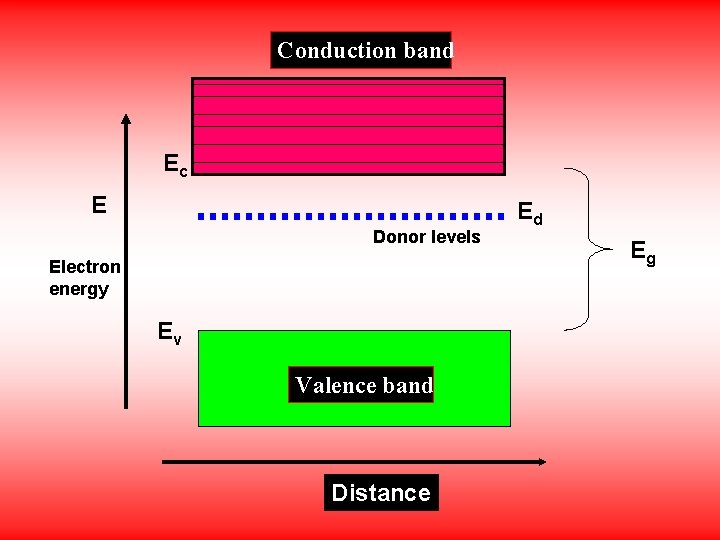
The Intrinsic Semiconductors doped with pentavalent impurities are called N-type Semiconductors. The energy level of fifth electron is called donor level. The donor level is close to the bottom of the conduction band most of the donor level electrons are excited in to the conduction band at room temperature and become the Majority charge carriers. Hence in N-type Semiconductors electrons are Majority carriers and holes are Minority carriers.
Conduction band Ec Ec E Donor levels Electron energy Ev Valence band Distance Ed Eg
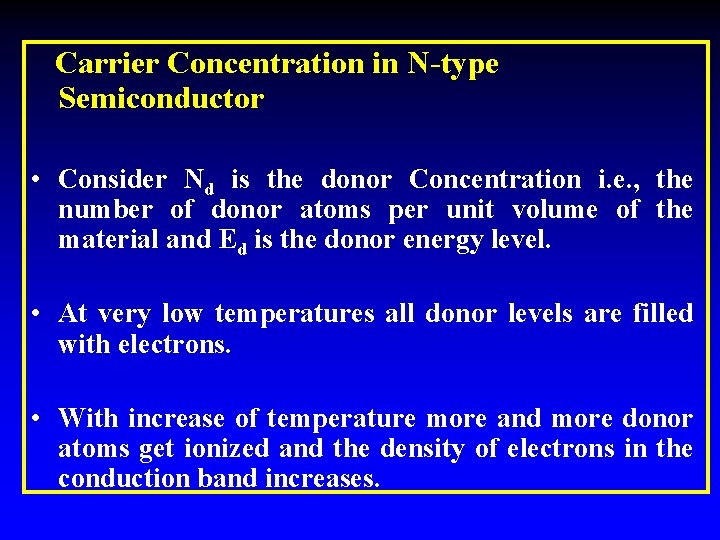
Carrier Concentration in N-type Semiconductor • Consider Nd is the donor Concentration i. e. , the number of donor atoms per unit volume of the material and Ed is the donor energy level. • At very low temperatures all donor levels are filled with electrons. • With increase of temperature more and more donor atoms get ionized and the density of electrons in the conduction band increases.
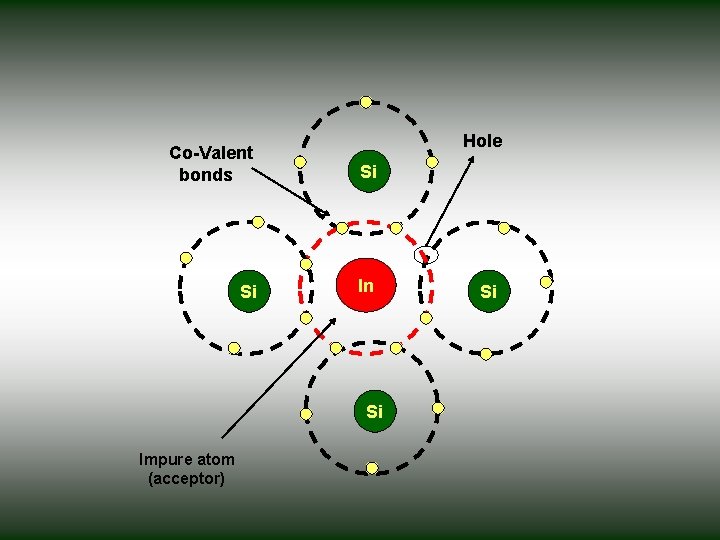
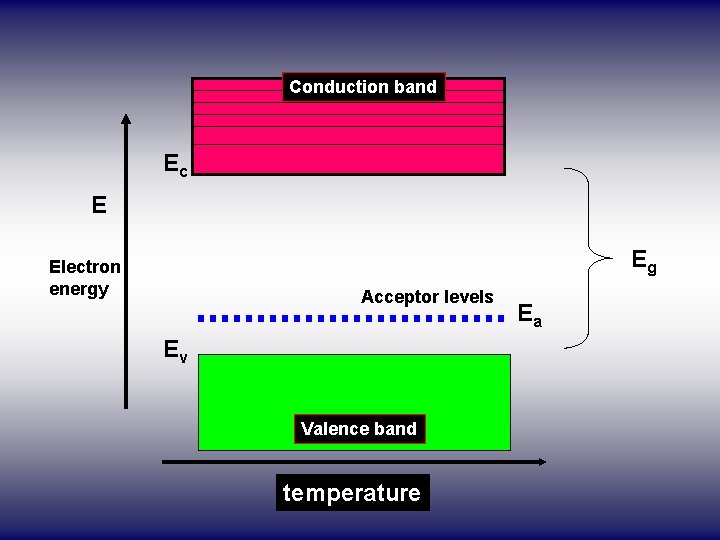
P-type semiconductors • When a trivalent elements such as Al, Ga or Indium have three electrons in their outer most orbits , added to the intrinsic semiconductor all the three electrons of Indium are engaged in covalent bonding with the three neighboring Si atoms. • Indium needs one more electron to complete its bond. this electron maybe supplied by Silicon , there by creating a vacant electron site or hole on the semiconductor atom. • Indium accepts one extra electron, the energy level of this impurity atom is called acceptor level and this acceptor level lies just above the valence band. • These type of trivalent impurities are called acceptor impurities and the semiconductors doped the acceptor impurities are called P-type semiconductors.
Hole Co-Valent bonds Si Si In Si Impure atom (acceptor) Si
Conduction band Ec Ec E Eg Electron energy Acceptor levels Ev Valence band temperature Ea
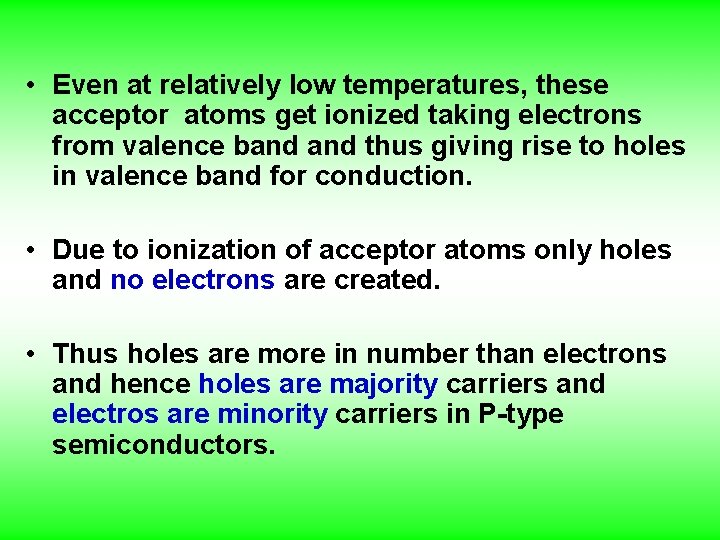
• Even at relatively low temperatures, these acceptor atoms get ionized taking electrons from valence band thus giving rise to holes in valence band for conduction. • Due to ionization of acceptor atoms only holes and no electrons are created. • Thus holes are more in number than electrons and hence holes are majority carriers and electros are minority carriers in P-type semiconductors.
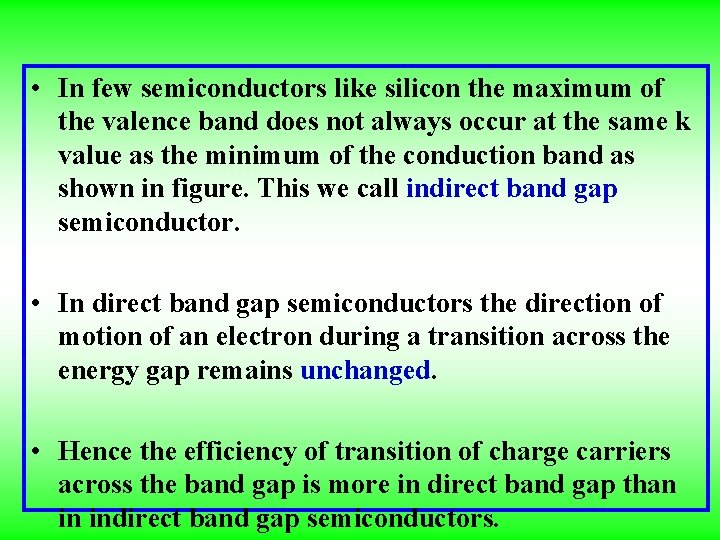
• In few semiconductors like silicon the maximum of the valence band does not always occur at the same k value as the minimum of the conduction band as shown in figure. This we call indirect band gap semiconductor. • In direct band gap semiconductors the direction of motion of an electron during a transition across the energy gap remains unchanged. • Hence the efficiency of transition of charge carriers across the band gap is more in direct band gap than in indirect band gap semiconductors.