
Semiconductor detectors for Compton imaging in nuclear medicine

- Slides: 24
Semiconductor detectors for Compton imaging in nuclear medicine Laura Harkness ljh@ns. ph. liv. ac. uk PSD 9 Conference, Aberystwyth, 12 th September 2011
Outline • Nuclear medicine • Compton imaging • Design Criteria • A High Purity Germanium detector • A Si(Li) detector
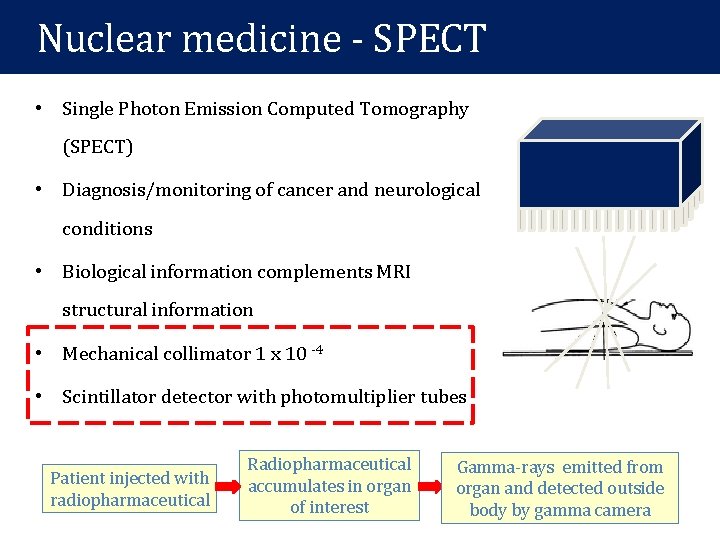
Nuclear medicine - SPECT • Single Photon Emission Computed Tomography (SPECT) • Diagnosis/monitoring of cancer and neurological conditions • Biological information complements MRI structural information • Mechanical collimator 1 x 10 -4 • Scintillator detector with photomultiplier tubes Patient injected with radiopharmaceutical Radiopharmaceutical accumulates in organ of interest Gamma-rays emitted from organ and detected outside body by gamma camera
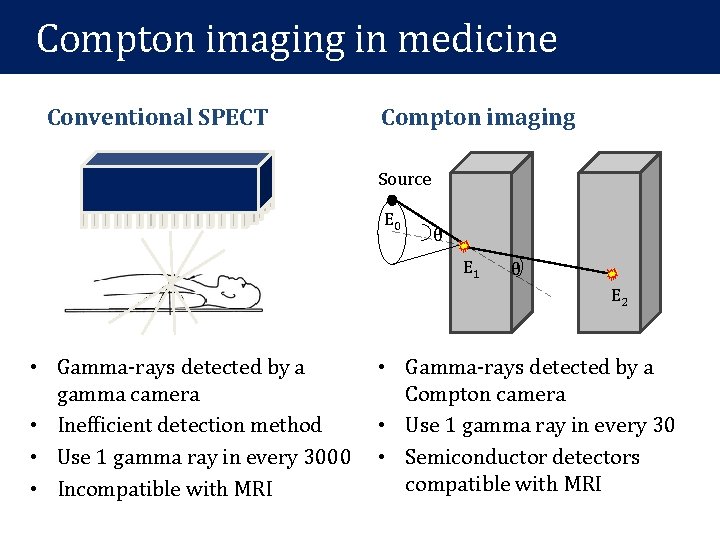
Compton imaging in medicine Conventional SPECT Compton imaging Source E 0 θ E 1 θ E 2 • Gamma-rays detected by a gamma camera • Inefficient detection method • Use 1 gamma ray in every 3000 • Incompatible with MRI • Gamma-rays detected by a Compton camera • Use 1 gamma ray in every 30 • Semiconductor detectors compatible with MRI
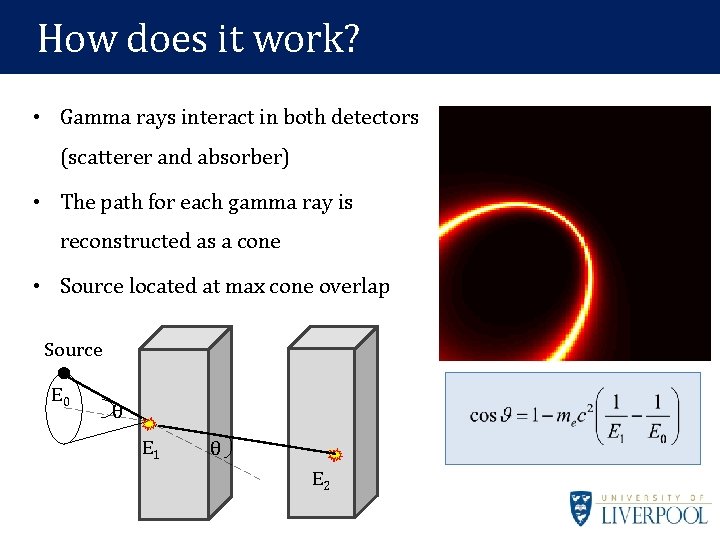
How does it work? • Gamma rays interact in both detectors (scatterer and absorber) • The path for each gamma ray is reconstructed as a cone • Source located at max cone overlap Source E 0 θ E 1 θ E 2
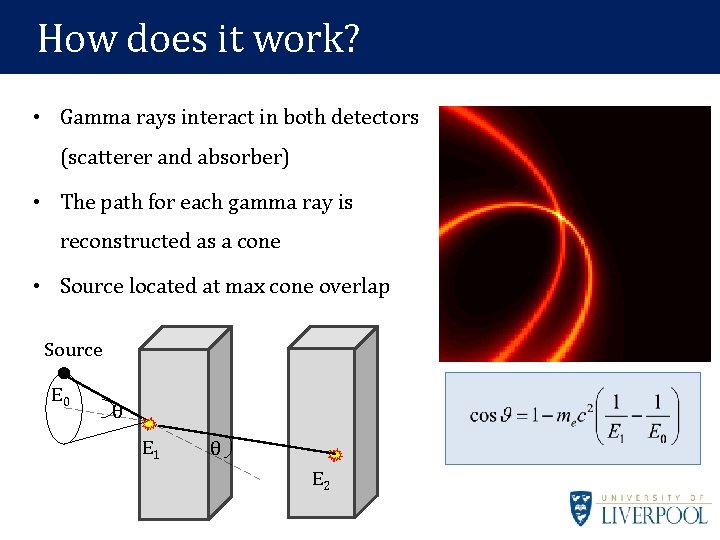
How does it work? • Gamma rays interact in both detectors (scatterer and absorber) • The path for each gamma ray is reconstructed as a cone • Source located at max cone overlap Source E 0 θ E 1 θ E 2
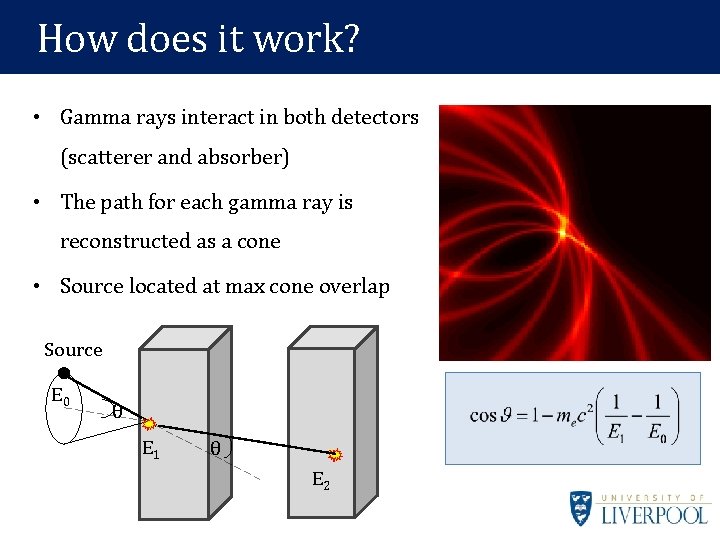
How does it work? • Gamma rays interact in both detectors (scatterer and absorber) • The path for each gamma ray is reconstructed as a cone • Source located at max cone overlap Source E 0 θ E 1 θ E 2
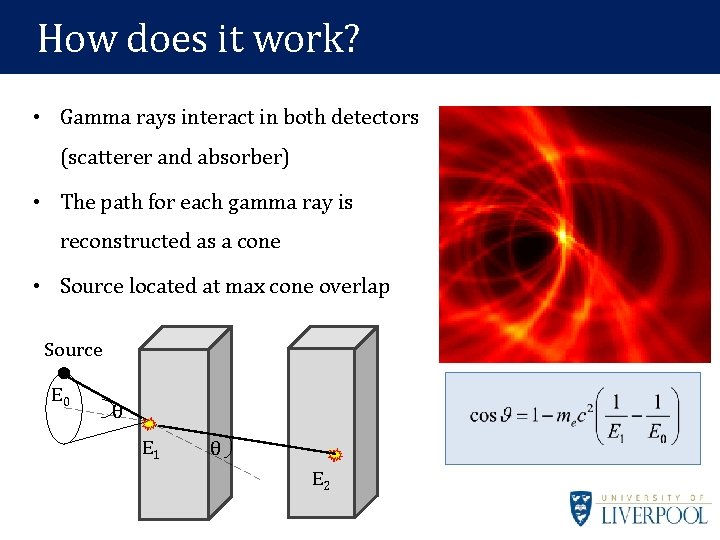
How does it work? • Gamma rays interact in both detectors (scatterer and absorber) • The path for each gamma ray is reconstructed as a cone • Source located at max cone overlap Source E 0 θ E 1 θ E 2
Design Criteria L J Harkness et. al, AIP Conf Proc (2009) 1194, 90 -95 • System for use with current medical radionuclides, with high sensitivity and excellent image quality • Sensitivity is a factor of: – Detector materials, thicknesses and configuration geometry – Low energy noise thresholds in scatterer detector • Image resolution is a factor of : – Energy resolution – Detector position resolution – Doppler broadening – Detector uniformity r o t c u d n o c i s r m o Se tect De
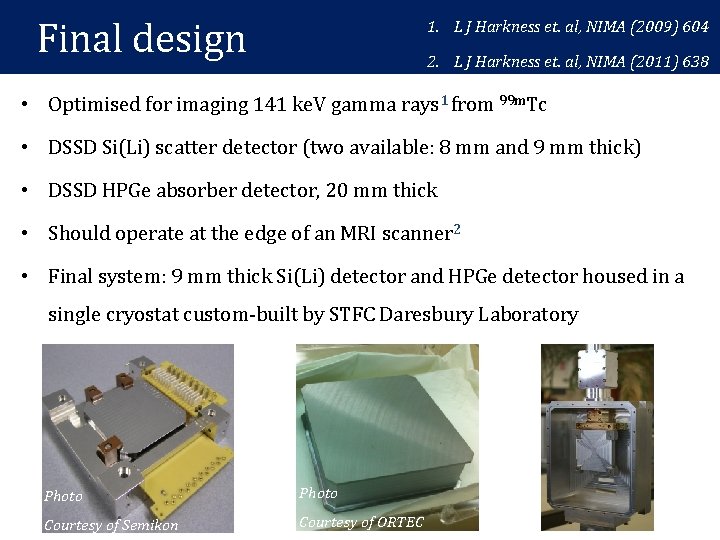
Final design 1. L J Harkness et. al, NIMA (2009) 604 2. L J Harkness et. al, NIMA (2011) 638 • Optimised for imaging 141 ke. V gamma rays 1 from 99 m. Tc • DSSD Si(Li) scatter detector (two available: 8 mm and 9 mm thick) • DSSD HPGe absorber detector, 20 mm thick • Should operate at the edge of an MRI scanner 2 • Final system: 9 mm thick Si(Li) detector and HPGe detector housed in a single cryostat custom-built by STFC Daresbury Laboratory Photo Courtesy of Semikon Courtesy of ORTEC
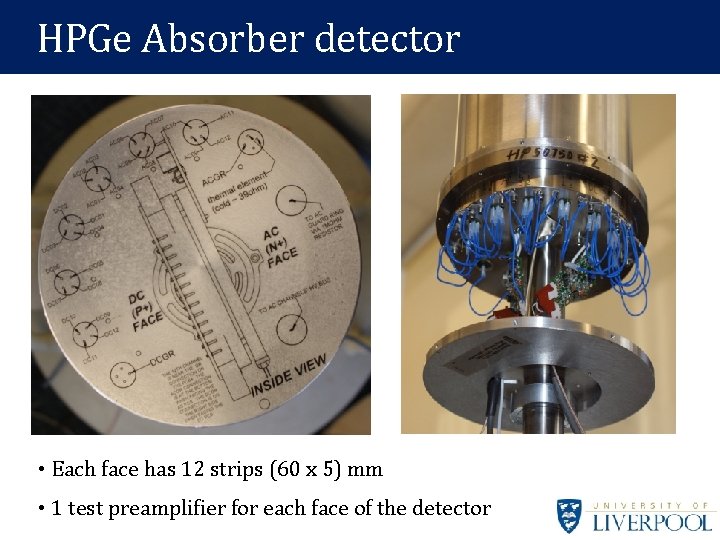
HPGe Absorber MRI images detector • Each face has 12 strips (60 x 5) mm • 1 test preamplifier for each face of the detector
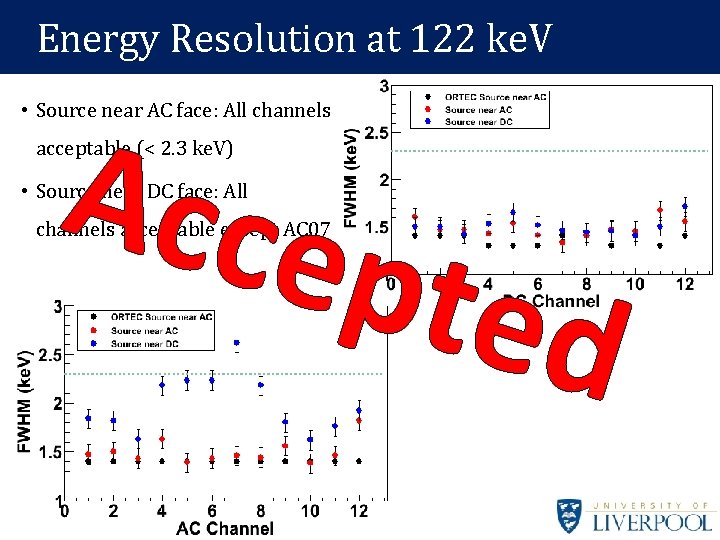
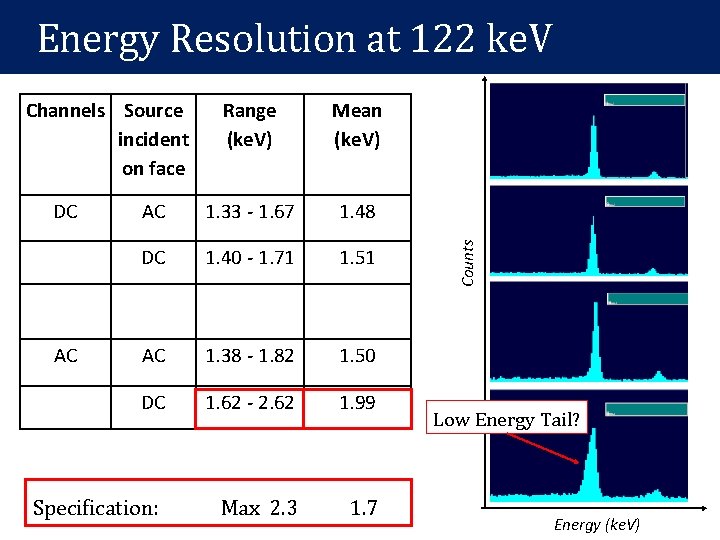
HPGe Performance MRI images Tests • FWHM measured at 122 ke. V using a 57 Co source • Measurements taken for each channel with: • The source near the AC face of the detector • The source near the DC face of the detector • Specified performance at 122 ke. V: • Average FWHM <= 1. 7 ke. V • All channels FWHM <= 2. 3 ke. V • No more than 2 strips per side > 1. 8 ke. V
Energy MRI images. Resolution at 122 ke. V Acce pted • Source near AC face: All channels acceptable (< 2. 3 ke. V) • Source near DC face: All channels acceptable except AC 07
Channels Source incident on face DC AC at 122 ke. V Range (ke. V) Mean (ke. V) AC 1. 33 - 1. 67 1. 48 DC 1. 40 - 1. 71 1. 51 AC 1. 38 - 1. 82 1. 50 DC 1. 62 - 2. 62 1. 99 Max 2. 3 1. 7 Specification: Counts Energy MRI images. Resolution Low Energy Tail? Energy (ke. V)
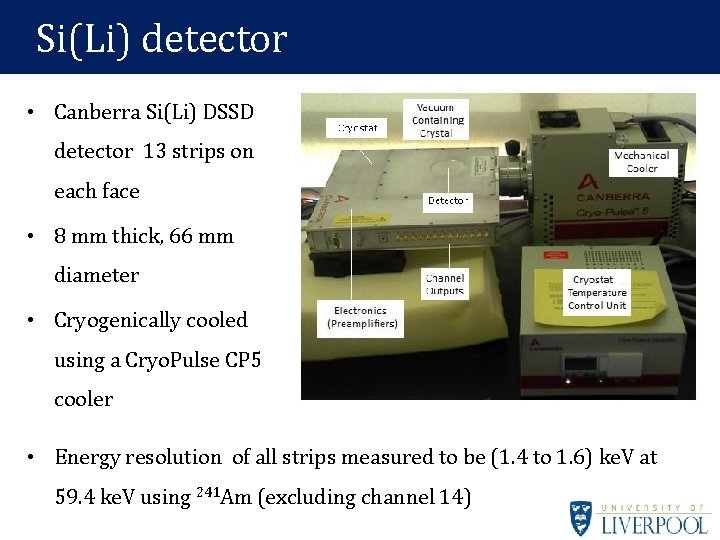
Si(Li) detector • Canberra Si(Li) DSSD detector 13 strips on each face • 8 mm thick, 66 mm diameter • Cryogenically cooled using a Cryo. Pulse CP 5 cooler • Energy resolution of all strips measured to be (1. 4 to 1. 6) ke. V at 59. 4 ke. V using 241 Am (excluding channel 14)
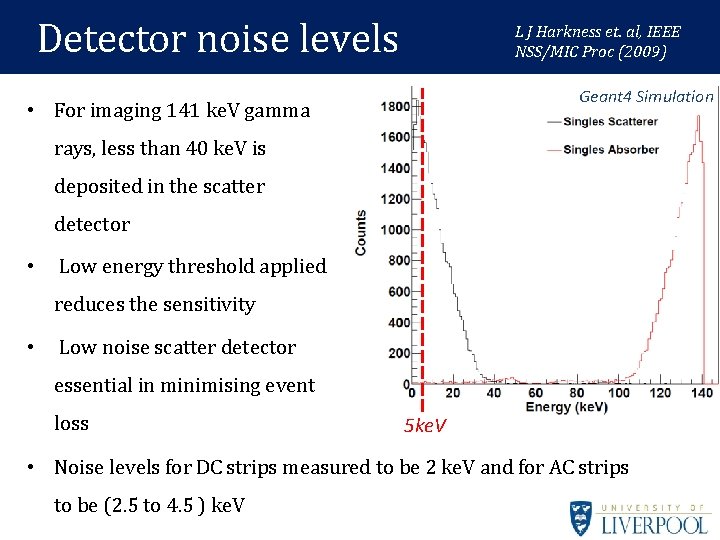
Detector noise levels L J Harkness et. al, IEEE NSS/MIC Proc (2009) Geant 4 Simulation • For imaging 141 ke. V gamma rays, less than 40 ke. V is deposited in the scatter detector • Low energy threshold applied reduces the sensitivity • Low noise scatter detector essential in minimising event loss 5 ke. V • Noise levels for DC strips measured to be 2 ke. V and for AC strips to be (2. 5 to 4. 5 ) ke. V
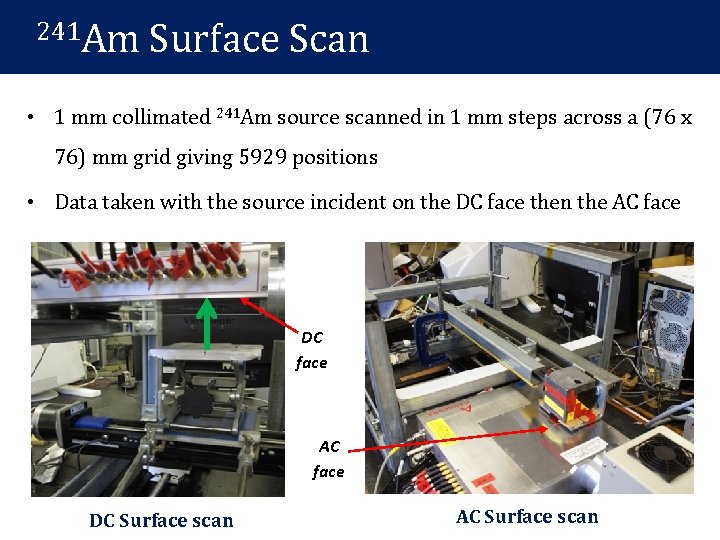
241 Am Surface Scan • 1 mm collimated 241 Am source scanned in 1 mm steps across a (76 x 76) mm grid giving 5929 positions • Data taken with the source incident on the DC face then the AC face DC face AC face DC Surface scan AC Surface scan
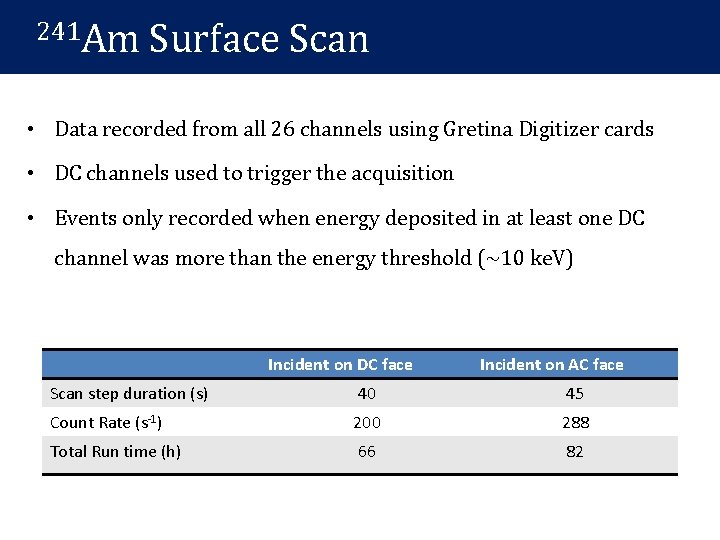
241 Am Surface Scan • Data recorded from all 26 channels using Gretina Digitizer cards • DC channels used to trigger the acquisition • Events only recorded when energy deposited in at least one DC channel was more than the energy threshold (~10 ke. V) Incident on DC face Incident on AC face Scan step duration (s) 40 45 Count Rate (s-1) 200 288 Total Run time (h) 66 82
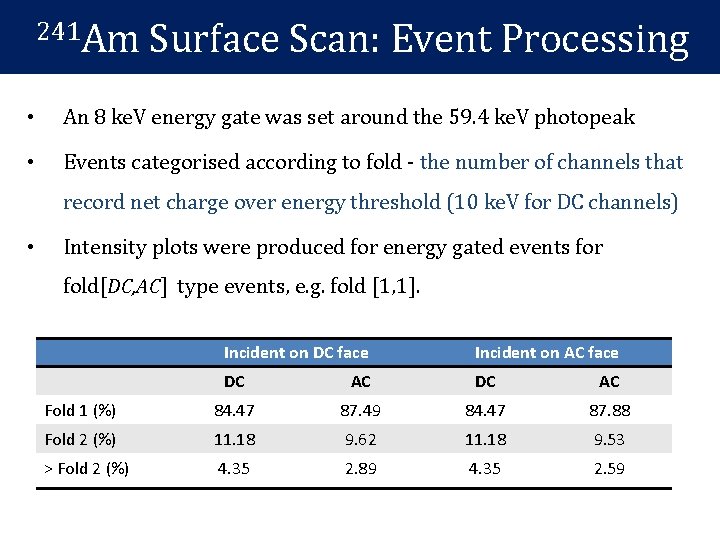
241 Am Surface Scan: Event Processing • An 8 ke. V energy gate was set around the 59. 4 ke. V photopeak • Events categorised according to fold - the number of channels that record net charge over energy threshold (10 ke. V for DC channels) • Intensity plots were produced for energy gated events for fold[DC, AC] type events, e. g. fold [1, 1]. Incident on DC face Incident on AC face DC AC Fold 1 (%) 84. 47 87. 49 84. 47 87. 88 Fold 2 (%) 11. 18 9. 62 11. 18 9. 53 > Fold 2 (%) 4. 35 2. 89 4. 35 2. 59
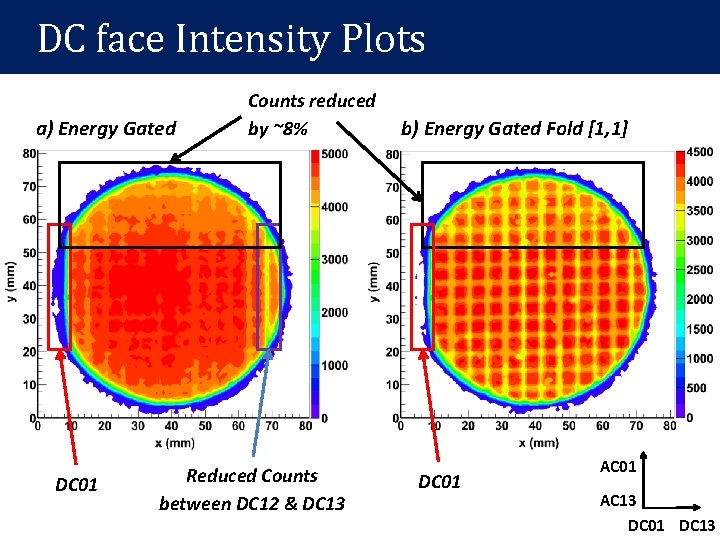
DC face Intensity Plots a) Energy Gated DC 01 Counts reduced by ~8% Reduced Counts between DC 12 & DC 13 b) Energy Gated Fold [1, 1] DC 01 AC 13 DC 01 DC 13
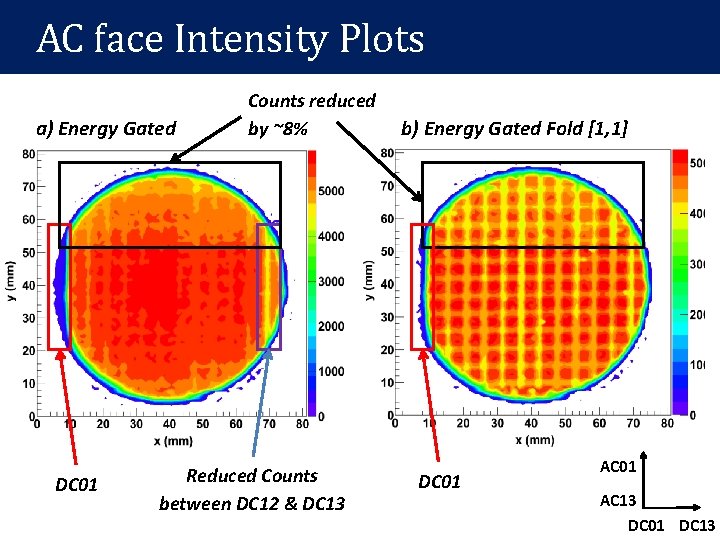
AC face Intensity Plots a) Energy Gated DC 01 Counts reduced by ~8% Reduced Counts between DC 12 & DC 13 b) Energy Gated Fold [1, 1] DC 01 AC 13 DC 01 DC 13
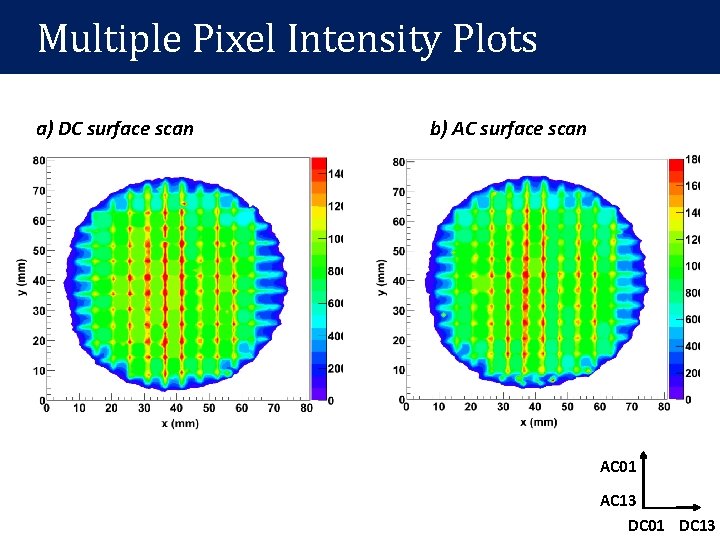
Multiple Pixel Intensity Plots a) DC surface scan b) AC surface scan AC 01 AC 13 DC 01 DC 13
Current Status and Future Work • HPGe absorber detector: acceptable for Compton imaging. Surface and side scan measurements planned • Further analysis of the Si(Li) detector surface scan results • Pro. SPECTus cryostat: vacuum testing underway • Pro. SPECTus Si(Li) detector: acceptance tests imminent • First Pro. SPECTus imaging measurements –Winter 2011 • Pro. SPECTus imaging with MRI system – 2012
The Pro. SPECTus Collaboration Department of Physics, The University of Liverpool, UK AJ Boston, HC Boston, JR Cresswell, DS Judson, PJ Nolan, JA Sampson, DP Scraggs, A Sweeney STFC Daresbury Laboratory, UK I Burrows, N Clague, M Cordwell, J Groves, J Headspith, A Hill, IH Lazarus, V Pucknell, J Simpson MARIARC, The University of Liverpool, UK B Bimson, G Kemp Special Thanks to Hannah Kennedy