
Semiconductor detectors An introduction to semiconductor detector physics
- Slides: 101
Semiconductor detectors An introduction to semiconductor detector physics as applied to particle physics PPE S/C detector lectures Dr R. Bates 1
Contents 4 lectures – can’t cover much of a huge field n n Introduction Fundamentals of operation The micro-strip detector Radiation hardness issues PPE S/C detector lectures Dr R. Bates 2
Lecture 1 - Introduction n What do we want to do Past, present and near future Why use semiconductor detectors PPE S/C detector lectures Dr R. Bates 3
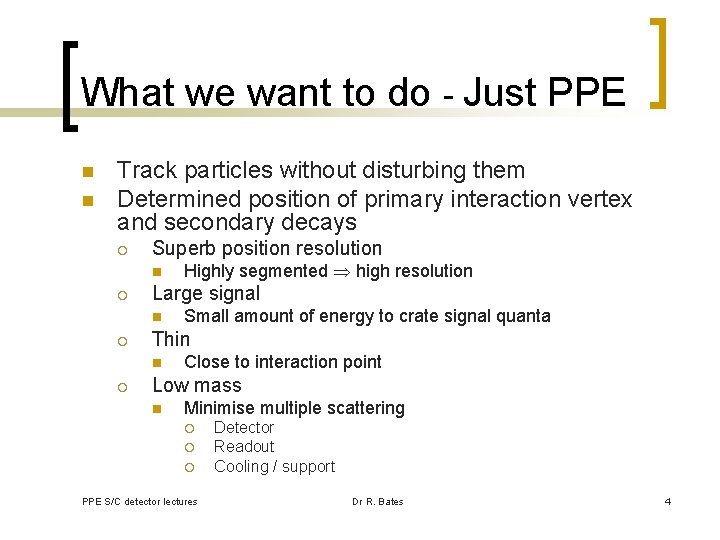
What we want to do - Just PPE n n Track particles without disturbing them Determined position of primary interaction vertex and secondary decays ¡ Superb position resolution n ¡ Large signal n ¡ Small amount of energy to crate signal quanta Thin n ¡ Highly segmented high resolution Close to interaction point Low mass n Minimise multiple scattering ¡ ¡ ¡ PPE S/C detector lectures Detector Readout Cooling / support Dr R. Bates 4
Ages of silicon - the birth n J. Kemmer ¡ ¡ ¡ * Fixed target experiment with a planar diode* Later strip devices -1980 Larger devices with huge ancillary components J. Kemmer: “Fabrication of a low-noise silicon radiation detector by the planar process”, NIM A 169, pp 499, 1980 PPE S/C detector lectures Dr R. Bates 5
Ages of Silicon - vertex detectors n LEP and SLAC ¡ ¡ n ASIC’s at end of ladders Minimise the mass inside tracking volume Minimise the mass between interaction point and detectors Minimise the distance between interaction point and the detectors Enabled heavy flavour physics i. e. short lived particles PPE S/C detector lectures Dr R. Bates 6
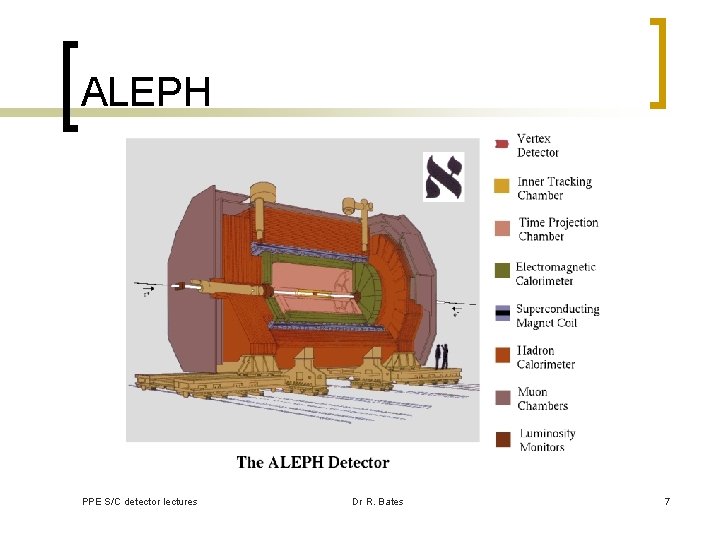
ALEPH PPE S/C detector lectures Dr R. Bates 7
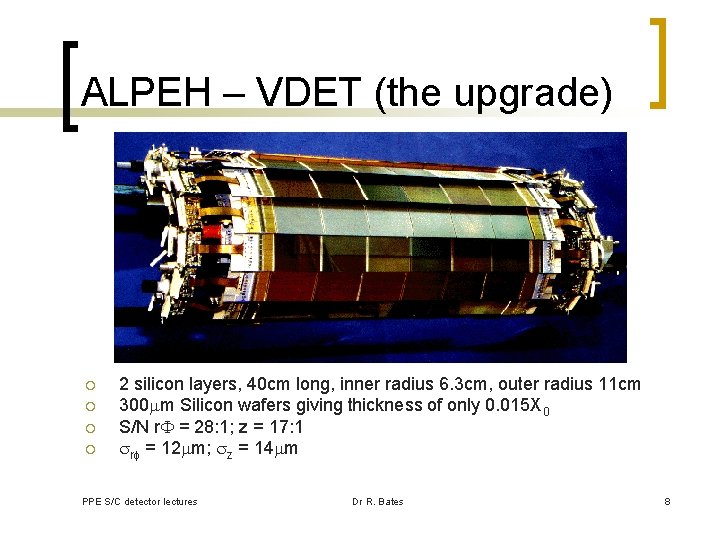
ALPEH – VDET (the upgrade) ¡ ¡ 2 silicon layers, 40 cm long, inner radius 6. 3 cm, outer radius 11 cm 300 m Silicon wafers giving thickness of only 0. 015 X 0 S/N r = 28: 1; z = 17: 1 srf = 12 m; sz = 14 m PPE S/C detector lectures Dr R. Bates 8
Ages of silicon - tracking paradigm n CDF/D 0 & LHC ¡ ¡ n n n Emphasis shifted to tracking + vertexing Only possible as increased energy of particles Cover large area with many silicon layers Detector modules including ASIC’s and services INSIDE the tracking volume Module size limited by electronic noise due to fast shaping time of electronics (bunch crossing rate determined) PPE S/C detector lectures Dr R. Bates 9
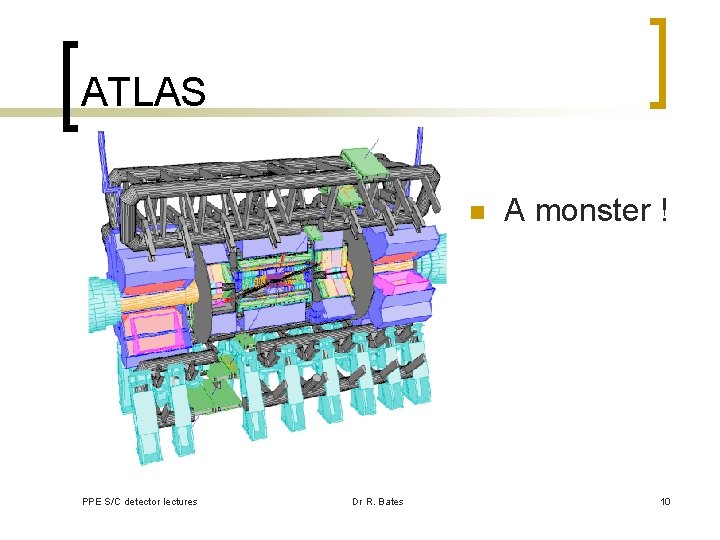
ATLAS n PPE S/C detector lectures Dr R. Bates A monster ! 10
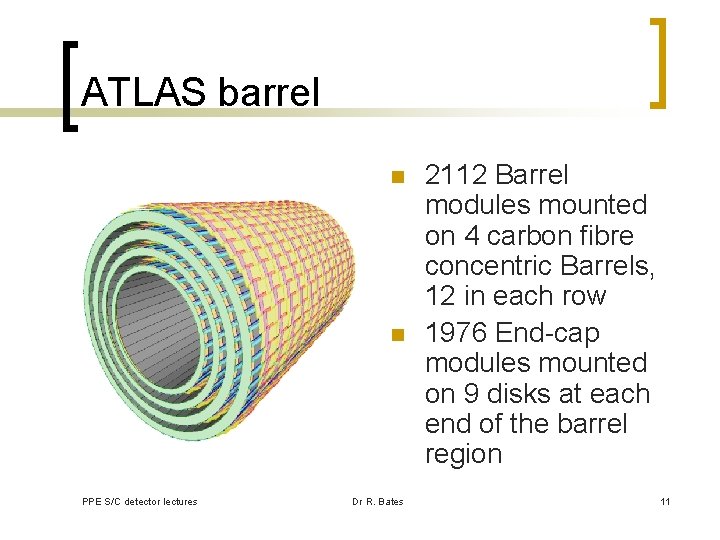
ATLAS barrel n n PPE S/C detector lectures Dr R. Bates 2112 Barrel modules mounted on 4 carbon fibre concentric Barrels, 12 in each row 1976 End-cap modules mounted on 9 disks at each end of the barrel region 11
What is measured n n Measure space points Deduce ¡ ¡ ¡ Vertex location Decay lengths Impact parameters PPE S/C detector lectures Dr R. Bates 12
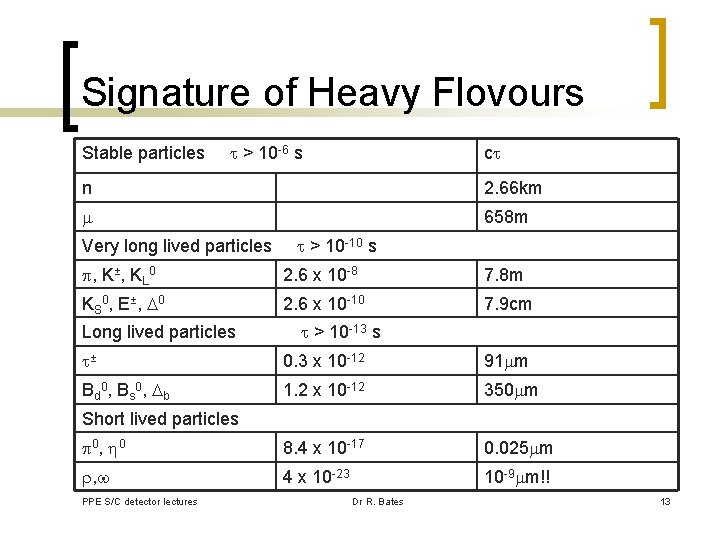
Signature of Heavy Flovours Stable particles > 10 -6 s c n 2. 66 km 658 m Very long lived particles > 10 -10 s p, K±, KL 0 2. 6 x 10 -8 7. 8 m KS 0, E±, D 0 2. 6 x 10 -10 7. 9 cm Long lived particles > 10 -13 s ± 0. 3 x 10 -12 91 m Bd 0 , B s 0 , Db 1. 2 x 10 -12 350 m p 0 , 0 8. 4 x 10 -17 0. 025 m r, w 4 x 10 -23 10 -9 m!! Short lived particles PPE S/C detector lectures Dr R. Bates 13
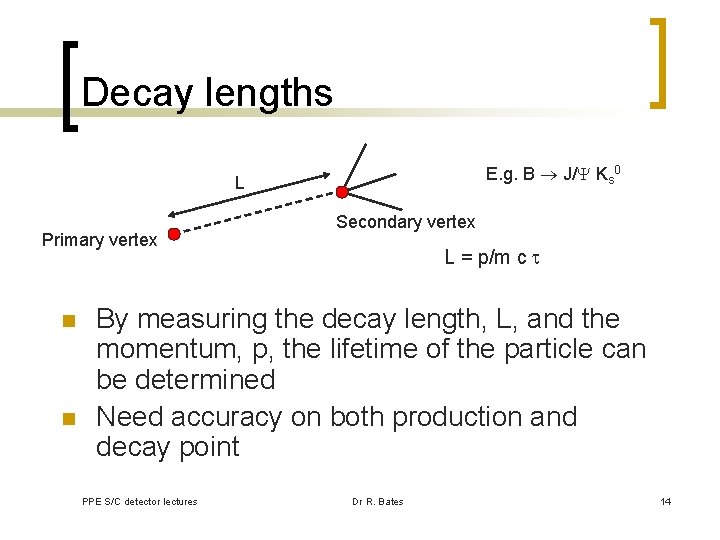
Decay lengths E. g. B J/Y Ks 0 L Primary vertex n n Secondary vertex L = p/m c By measuring the decay length, L, and the momentum, p, the lifetime of the particle can be determined Need accuracy on both production and decay point PPE S/C detector lectures Dr R. Bates 14
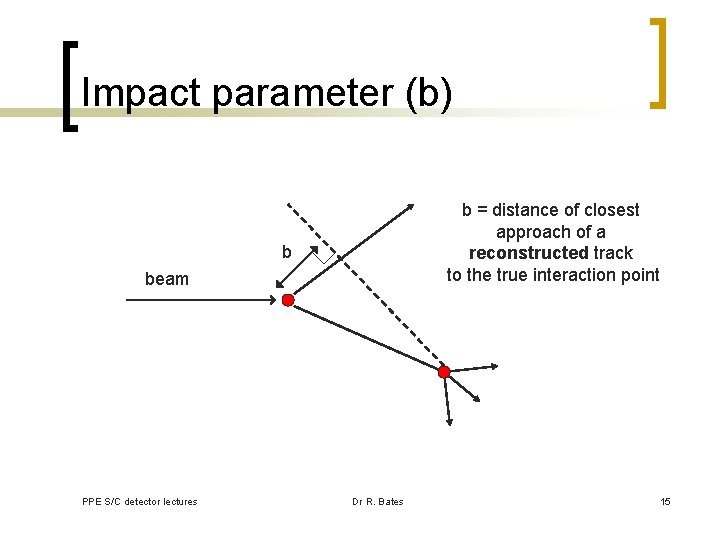
Impact parameter (b) b = distance of closest approach of a reconstructed track to the true interaction point b beam PPE S/C detector lectures Dr R. Bates 15
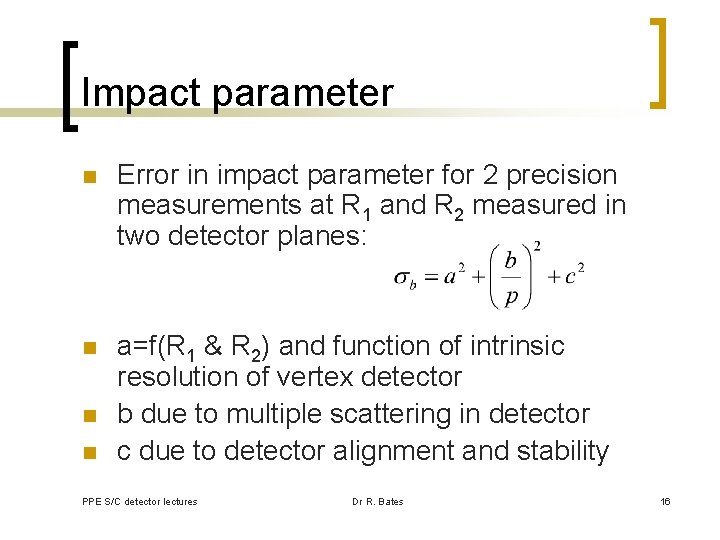
Impact parameter n Error in impact parameter for 2 precision measurements at R 1 and R 2 measured in two detector planes: n a=f(R 1 & R 2) and function of intrinsic resolution of vertex detector b due to multiple scattering in detector c due to detector alignment and stability n n PPE S/C detector lectures Dr R. Bates 16
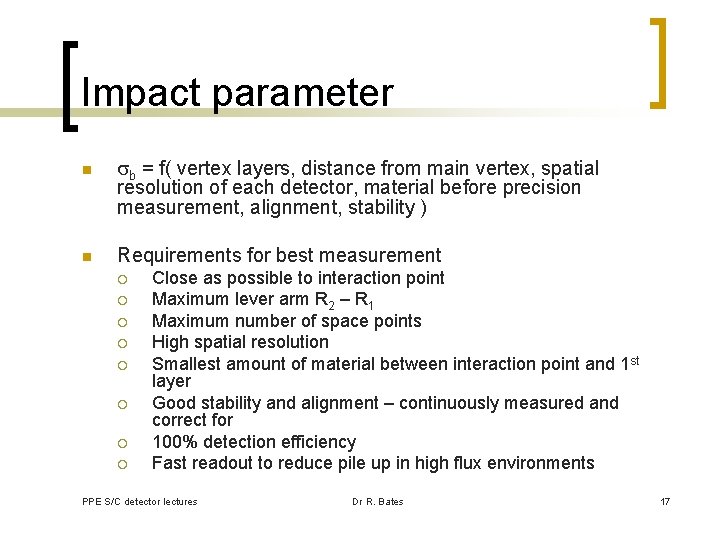
Impact parameter n sb = f( vertex layers, distance from main vertex, spatial resolution of each detector, material before precision measurement, alignment, stability ) n Requirements for best measurement ¡ ¡ ¡ ¡ Close as possible to interaction point Maximum lever arm R 2 – R 1 Maximum number of space points High spatial resolution Smallest amount of material between interaction point and 1 st layer Good stability and alignment – continuously measured and correct for 100% detection efficiency Fast readout to reduce pile up in high flux environments PPE S/C detector lectures Dr R. Bates 17
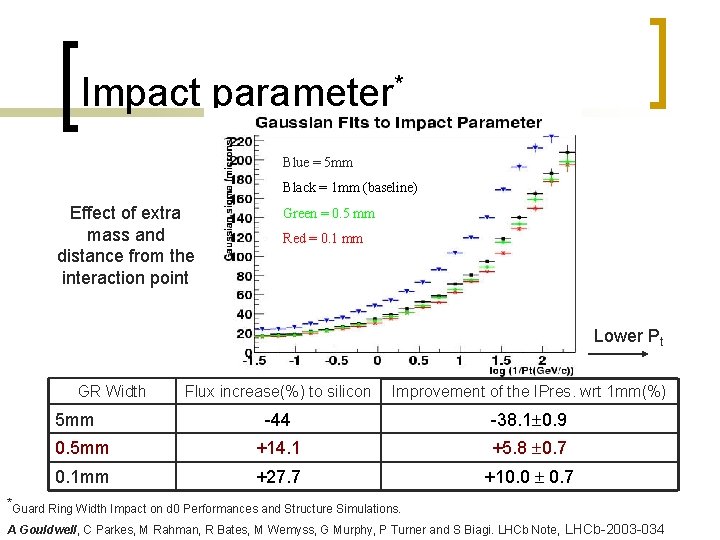
Impact parameter* Blue = 5 mm Black = 1 mm (baseline) Effect of extra mass and distance from the interaction point Green = 0. 5 mm Red = 0. 1 mm Lower Pt GR Width Flux increase(%) to silicon Improvement of the IPres. wrt 1 mm(%) -44 -38. 1 0. 9 0. 5 mm +14. 1 +5. 8 0. 7 0. 1 mm +27. 7 +10. 0 0. 7 5 mm *Guard Ring Width Impact on d 0 Performances and Structure Simulations. A Gouldwell, C Parkes, M Rahman, R Bates, M Wemyss, G Murphy, P Turner and S Biagi. LHCb Note, LHCb-2003 -034
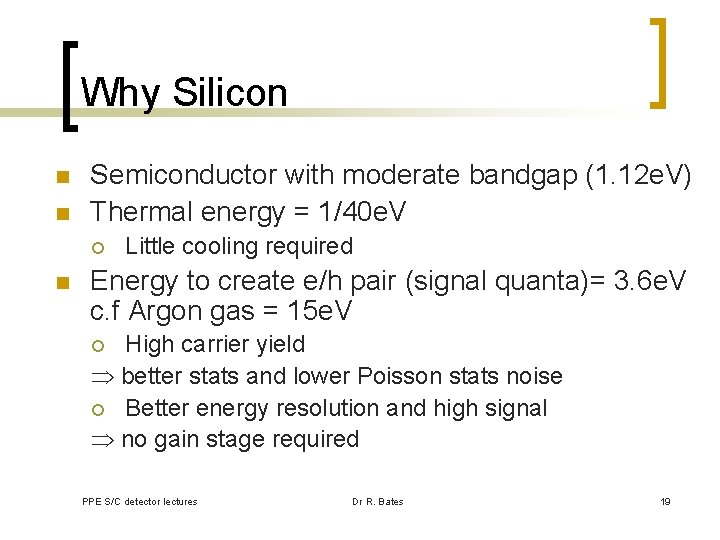
Why Silicon n n Semiconductor with moderate bandgap (1. 12 e. V) Thermal energy = 1/40 e. V ¡ n Little cooling required Energy to create e/h pair (signal quanta)= 3. 6 e. V c. f Argon gas = 15 e. V High carrier yield better stats and lower Poisson stats noise ¡ Better energy resolution and high signal no gain stage required ¡ PPE S/C detector lectures Dr R. Bates 19
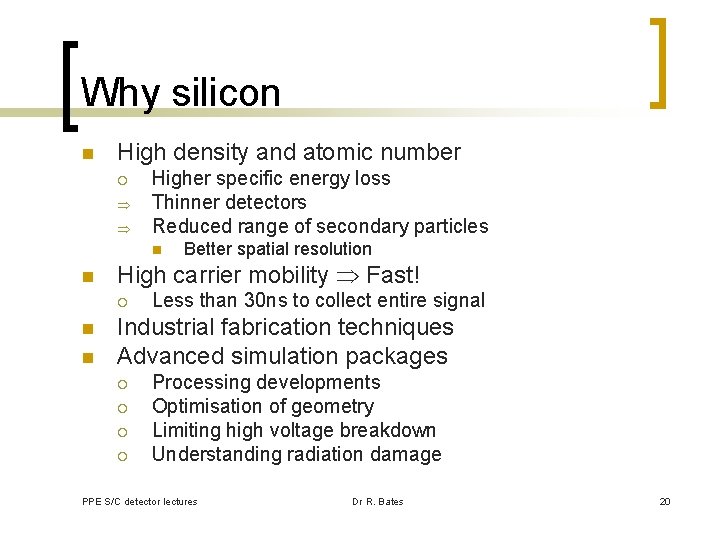
Why silicon n High density and atomic number ¡ Higher specific energy loss Thinner detectors Reduced range of secondary particles n n High carrier mobility Fast! ¡ n n Better spatial resolution Less than 30 ns to collect entire signal Industrial fabrication techniques Advanced simulation packages ¡ ¡ Processing developments Optimisation of geometry Limiting high voltage breakdown Understanding radiation damage PPE S/C detector lectures Dr R. Bates 20
Disadvantages n Cost Area covered ¡ ¡ n Detector material could be cheap – standard Si Most cost in readout channels Material budget ¡ Radiation length can be significant n n n Effects calorimeters Tracking due to multiple scattering Radiation damage ¡ Replace often or design very well – see lecture 4 PPE S/C detector lectures Dr R. Bates 21
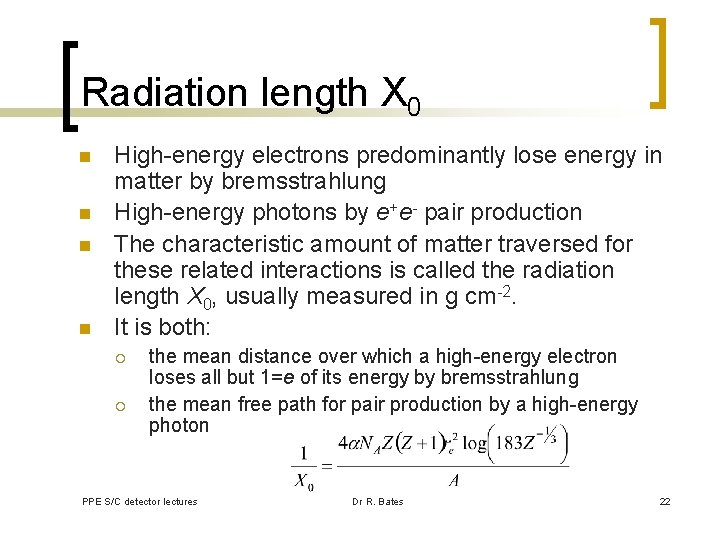
Radiation length X 0 n n High-energy electrons predominantly lose energy in matter by bremsstrahlung High-energy photons by e+e- pair production The characteristic amount of matter traversed for these related interactions is called the radiation length X 0, usually measured in g cm-2. It is both: ¡ ¡ the mean distance over which a high-energy electron loses all but 1=e of its energy by bremsstrahlung the mean free path for pair production by a high-energy photon PPE S/C detector lectures Dr R. Bates 22
Lecture 2 – lots of details n n Simple diode theory Fabrication Energy deposition Signal formation PPE S/C detector lectures Dr R. Bates 23
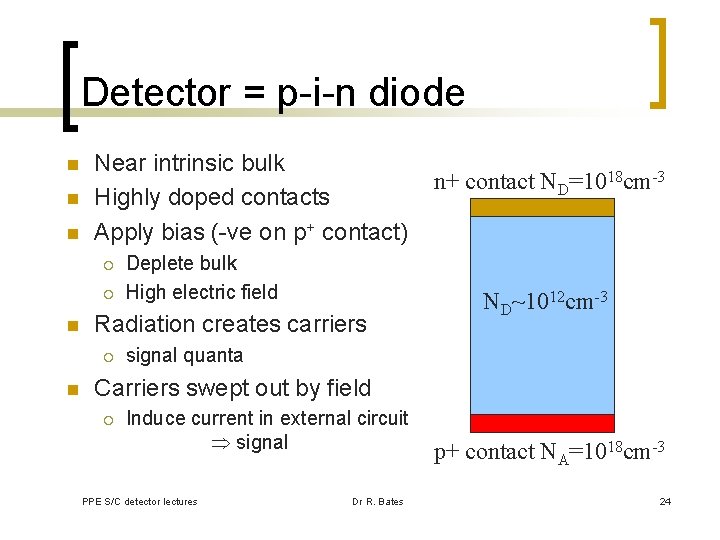
Detector = p-i-n diode n n n Near intrinsic bulk Highly doped contacts Apply bias (-ve on p+ contact) ¡ ¡ n Radiation creates carriers ¡ n Deplete bulk High electric field n+ contact ND=1018 cm-3 ND~1012 cm-3 signal quanta Carriers swept out by field ¡ Induce current in external circuit signal PPE S/C detector lectures Dr R. Bates p+ contact NA=1018 cm-3 24
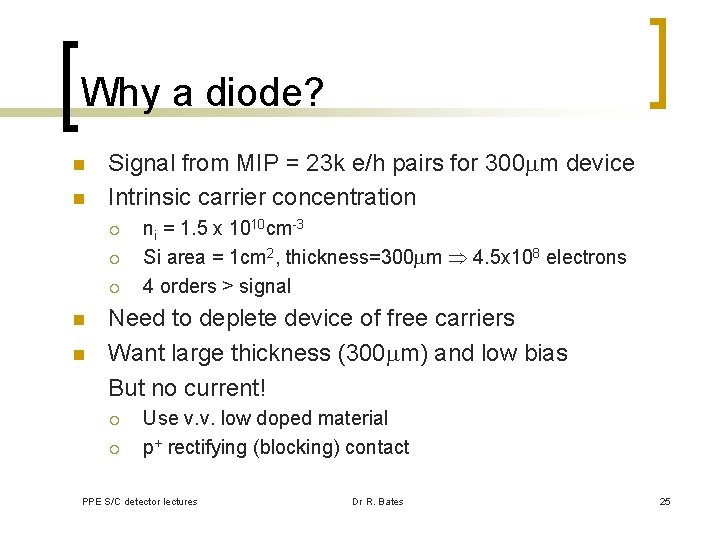
Why a diode? n n Signal from MIP = 23 k e/h pairs for 300 m device Intrinsic carrier concentration ¡ ¡ ¡ n n ni = 1. 5 x 1010 cm-3 Si area = 1 cm 2, thickness=300 m 4. 5 x 10⁸ electrons 4 orders > signal Need to deplete device of free carriers Want large thickness (300 m) and low bias But no current! ¡ ¡ Use v. v. low doped material p+ rectifying (blocking) contact PPE S/C detector lectures Dr R. Bates 25
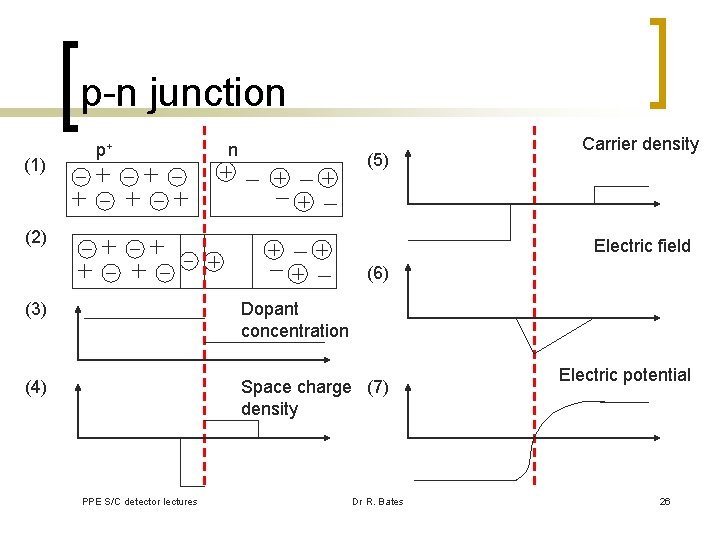
p-n junction (1) p+ n (5) (2) Carrier density Electric field (6) (3) Dopant concentration (4) Space charge (7) density PPE S/C detector lectures Dr R. Bates Electric potential 26
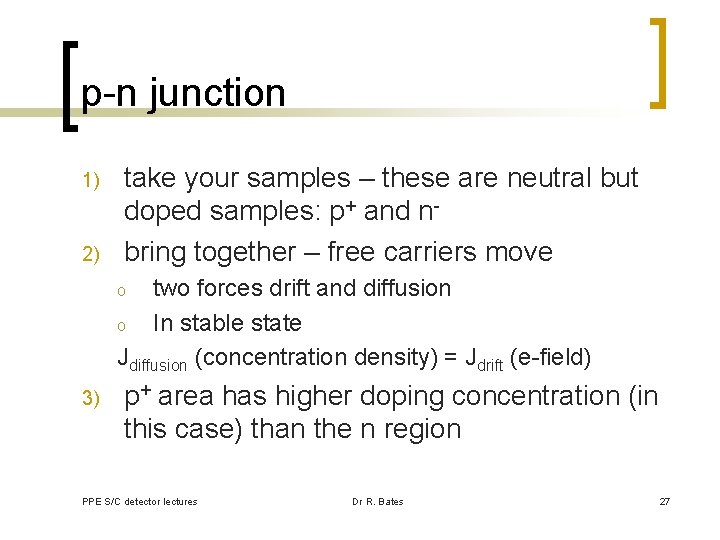
p-n junction 1) 2) take your samples – these are neutral but doped samples: p+ and nbring together – free carriers move two forces drift and diffusion o In stable state Jdiffusion (concentration density) = Jdrift (e-field) o 3) p+ area has higher doping concentration (in this case) than the n region PPE S/C detector lectures Dr R. Bates 27
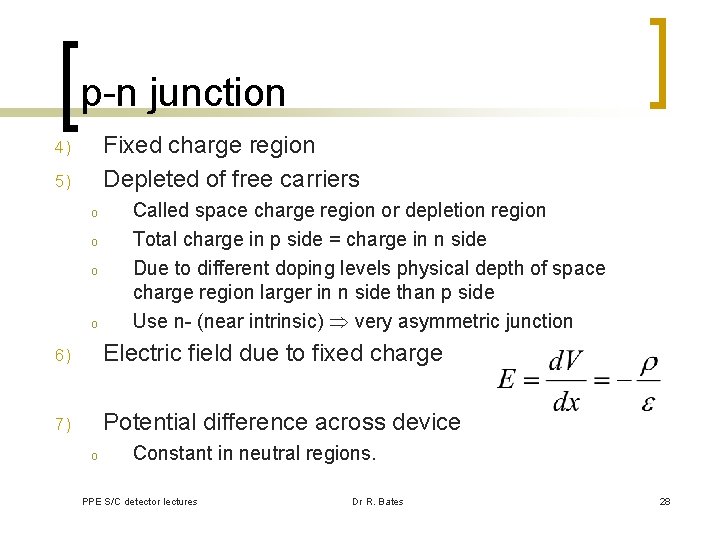
p-n junction Fixed charge region Depleted of free carriers 4) 5) o o Called space charge region or depletion region Total charge in p side = charge in n side Due to different doping levels physical depth of space charge region larger in n side than p side Use n- (near intrinsic) very asymmetric junction 6) Electric field due to fixed charge 7) Potential difference across device o Constant in neutral regions. PPE S/C detector lectures Dr R. Bates 28
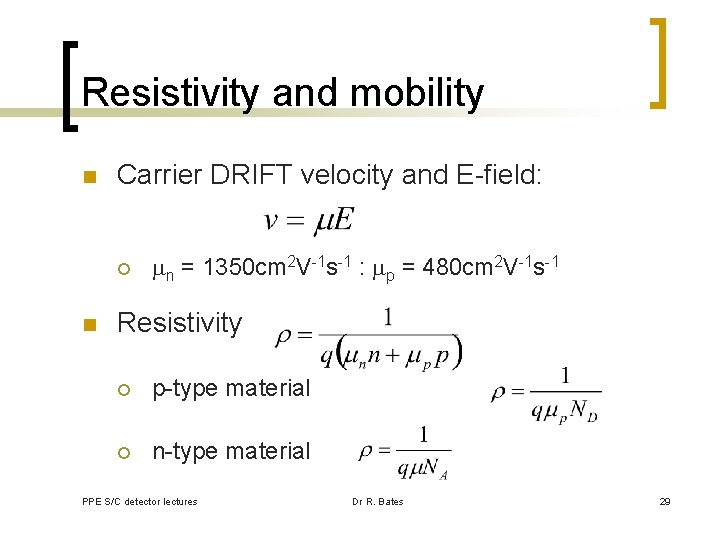
Resistivity and mobility n Carrier DRIFT velocity and E-field: ¡ n n = 1350 cm 2 V-1 s-1 : p = 480 cm 2 V-1 s-1 Resistivity ¡ p-type material ¡ n-type material PPE S/C detector lectures Dr R. Bates 29
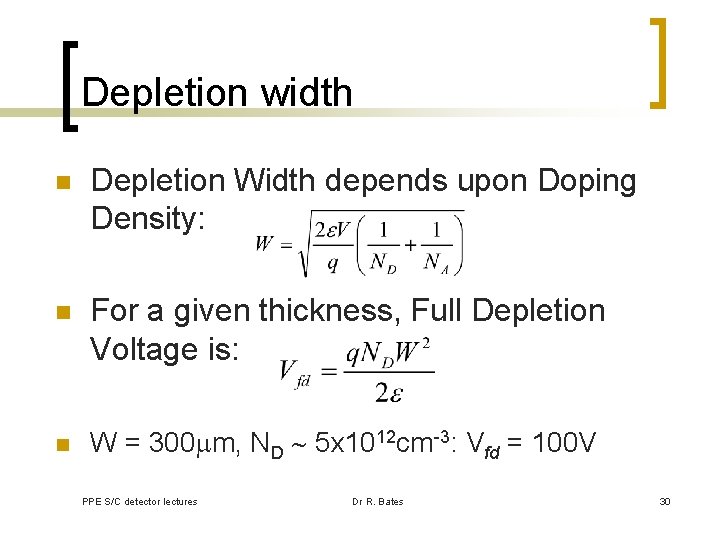
Depletion width n Depletion Width depends upon Doping Density: n For a given thickness, Full Depletion Voltage is: n W = 300 m, ND 5 x 1012 cm-3: Vfd = 100 V PPE S/C detector lectures Dr R. Bates 30
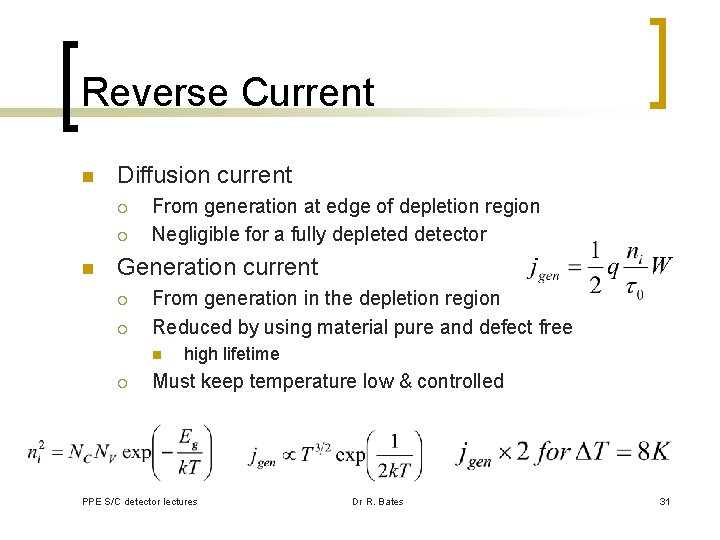
Reverse Current n Diffusion current ¡ ¡ n From generation at edge of depletion region Negligible for a fully depleted detector Generation current ¡ ¡ From generation in the depletion region Reduced by using material pure and defect free n ¡ high lifetime Must keep temperature low & controlled PPE S/C detector lectures Dr R. Bates 31
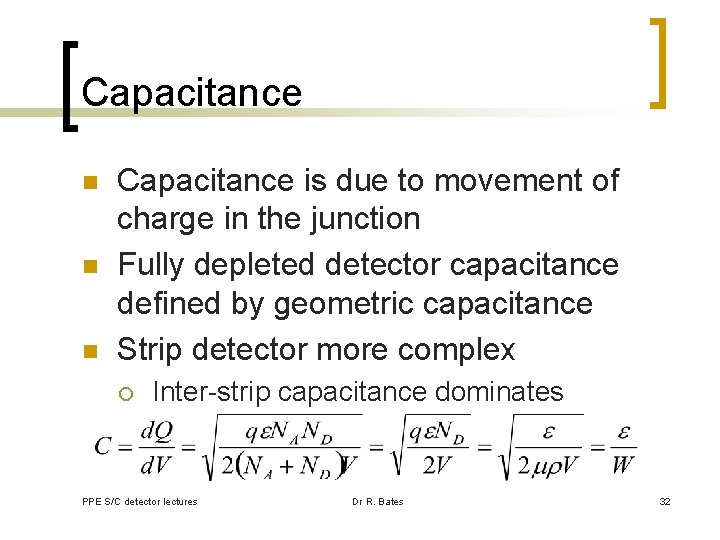
Capacitance n n n Capacitance is due to movement of charge in the junction Fully depleted detector capacitance defined by geometric capacitance Strip detector more complex ¡ Inter-strip capacitance dominates PPE S/C detector lectures Dr R. Bates 32
Noise n n n Depends upon detector capacitance and reverse current Depends upon electronics design Function of signal shaping time Lower capacitance lower noise Faster electronics noise contribution from reverse current less significant PPE S/C detector lectures Dr R. Bates 33
Fabrication n Use very pure material ¡ High resistivity n Low bias to deplete device ¡ ¡ Low defect concentration n Easy of operation, away from breakdown, charge spreading for better position resolution No extra current sources No trapping of charge carriers Planar fabrication techniques ¡ Make p-i-n diode ¡ pattern of implants define type of detector (pixel/strip) extra guard rings used to control surface leakage currents metallisation structure effects E-field mag limits max bias ¡ ¡ PPE S/C detector lectures Dr R. Bates 34
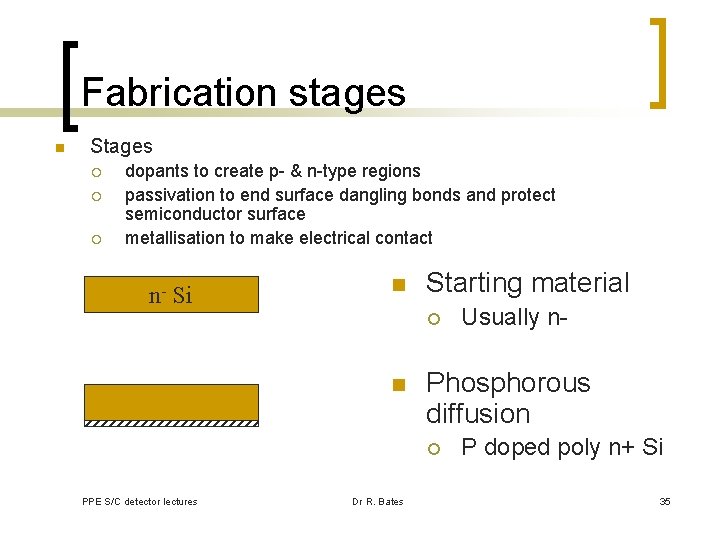
Fabrication stages n Stages ¡ ¡ ¡ dopants to create p- & n-type regions passivation to end surface dangling bonds and protect semiconductor surface metallisation to make electrical contact n- Si n Starting material ¡ n Phosphorous diffusion ¡ PPE S/C detector lectures Dr R. Bates Usually n- P doped poly n+ Si 35
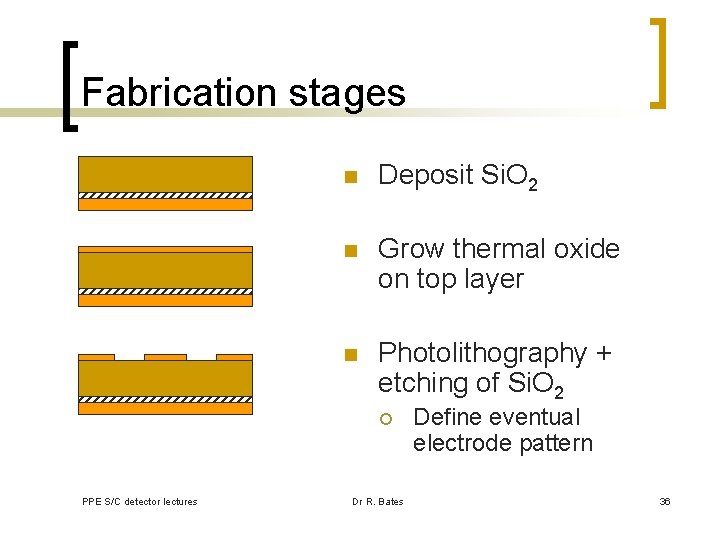
Fabrication stages n Deposit Si. O 2 n Grow thermal oxide on top layer n Photolithography + etching of Si. O 2 ¡ PPE S/C detector lectures Dr R. Bates Define eventual electrode pattern 36
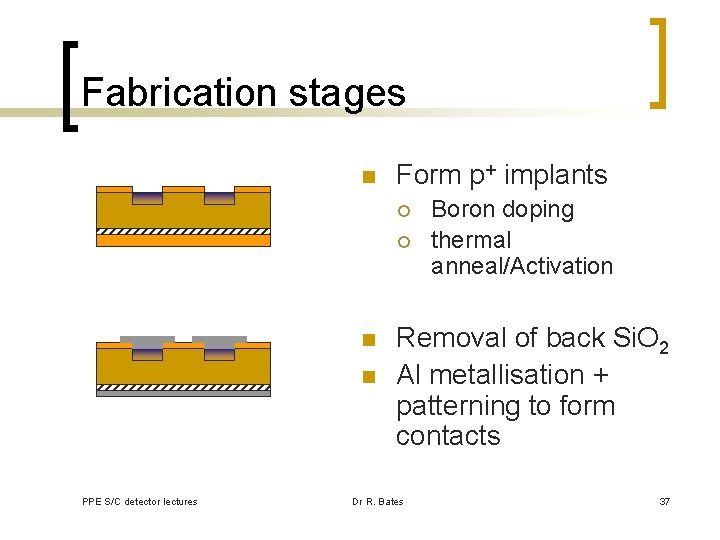
Fabrication stages n Form p+ implants ¡ ¡ n n PPE S/C detector lectures Boron doping thermal anneal/Activation Removal of back Si. O 2 Al metallisation + patterning to form contacts Dr R. Bates 37
Fabrication n Tricks for low leakage currents ¡ low temperature processing n n ¡ simple, cheap marginal activation of implants, can’t use IC tech gettering n n very effective at removal of contaminants complex PPE S/C detector lectures Dr R. Bates 38
Energy Deposition n Charge particles Bethe-Bloch ¡ Bragg Peak ¡ n Not covered Neutrons ¡ Gamma Rays ¡ n Rayleigh scattering, Photo-electric effect, Compton scattering, Pair production PPE S/C detector lectures Dr R. Bates 39
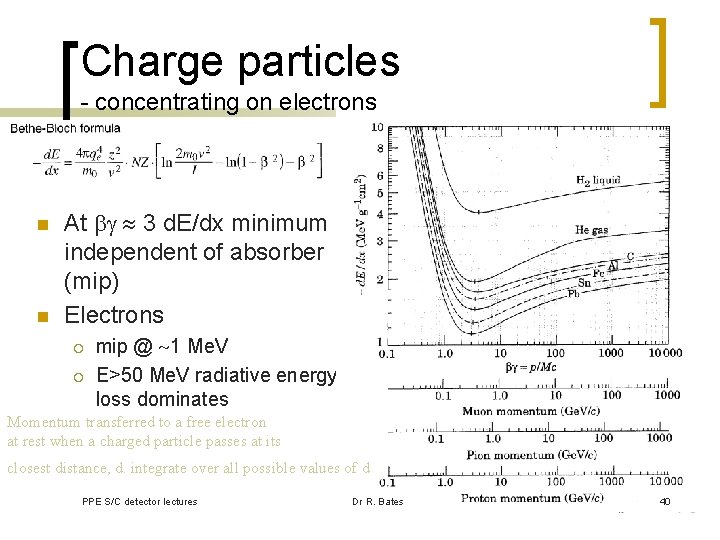
Charge particles - concentrating on electrons n n At 3 d. E/dx minimum independent of absorber (mip) Electrons ¡ ¡ mip @ 1 Me. V E>50 Me. V radiative energy loss dominates Momentum transferred to a free electron at rest when a charged particle passes at its closest distance, d. integrate over all possible values of d PPE S/C detector lectures Dr R. Bates 40
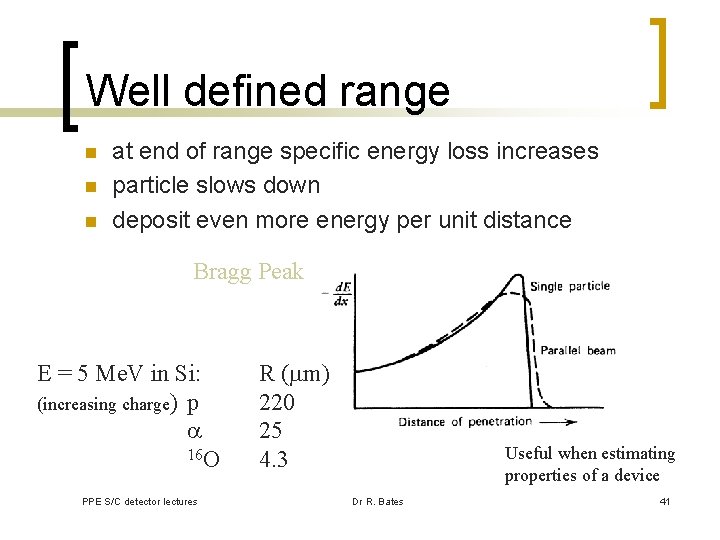
Well defined range n n n at end of range specific energy loss increases particle slows down deposit even more energy per unit distance Bragg Peak E = 5 Me. V in Si: (increasing charge) p 16 O PPE S/C detector lectures R ( m) 220 25 4. 3 Useful when estimating properties of a device Dr R. Bates 41
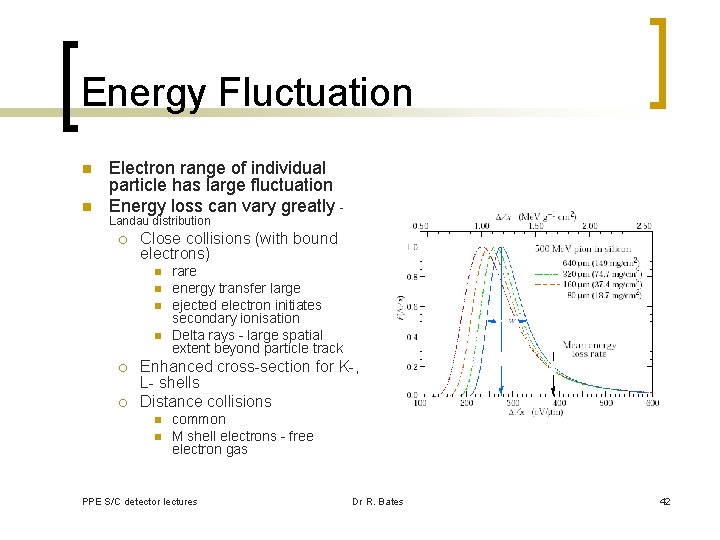
Energy Fluctuation n n Electron range of individual particle has large fluctuation Energy loss can vary greatly Landau distribution ¡ Close collisions (with bound electrons) n n ¡ ¡ rare energy transfer large ejected electron initiates secondary ionisation Delta rays - large spatial extent beyond particle track Enhanced cross-section for K-, L- shells Distance collisions n n common M shell electrons - free electron gas PPE S/C detector lectures Dr R. Bates 42
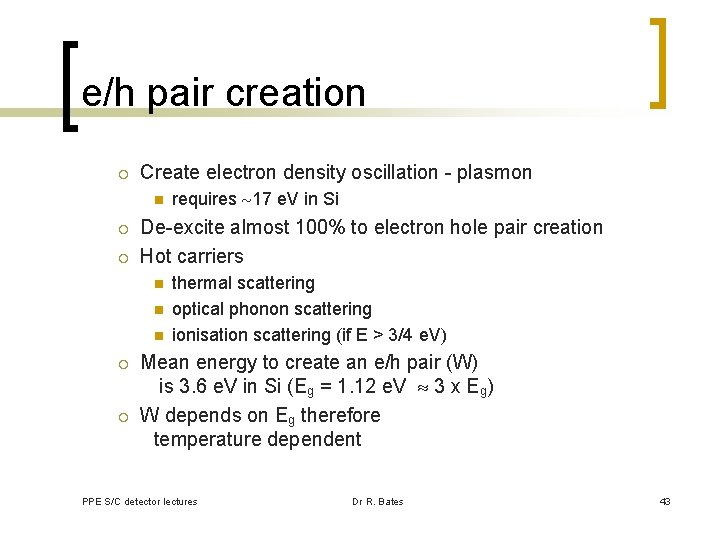
e/h pair creation ¡ Create electron density oscillation - plasmon n ¡ ¡ De-excite almost 100% to electron hole pair creation Hot carriers n n n ¡ ¡ requires 17 e. V in Si thermal scattering optical phonon scattering ionisation scattering (if E > 3/4 e. V) Mean energy to create an e/h pair (W) is 3. 6 e. V in Si (Eg = 1. 12 e. V 3 x Eg) W depends on Eg therefore temperature dependent PPE S/C detector lectures Dr R. Bates 43
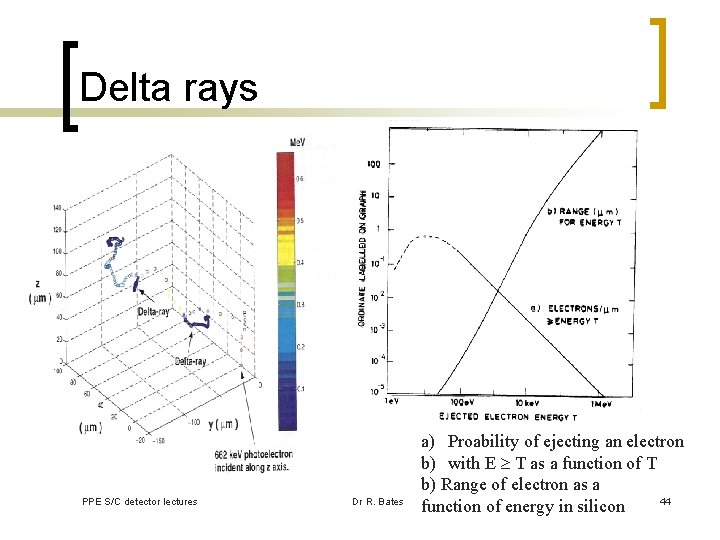
Delta rays PPE S/C detector lectures Dr R. Bates a) Proability of ejecting an electron b) with E T as a function of T b) Range of electron as a 44 function of energy in silicon
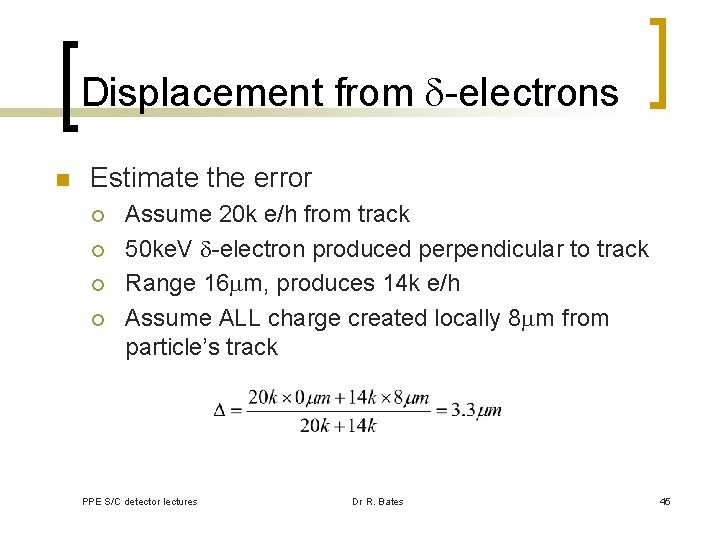
Displacement from -electrons n Estimate the error ¡ ¡ Assume 20 k e/h from track 50 ke. V -electron produced perpendicular to track Range 16 m, produces 14 k e/h Assume ALL charge created locally 8 m from particle’s track PPE S/C detector lectures Dr R. Bates 45
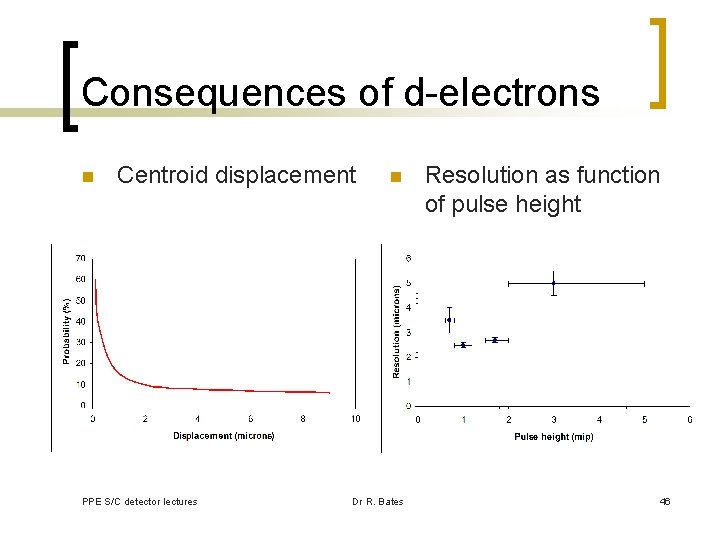
Consequences of d-electrons n Centroid displacement PPE S/C detector lectures n Dr R. Bates Resolution as function of pulse height 46
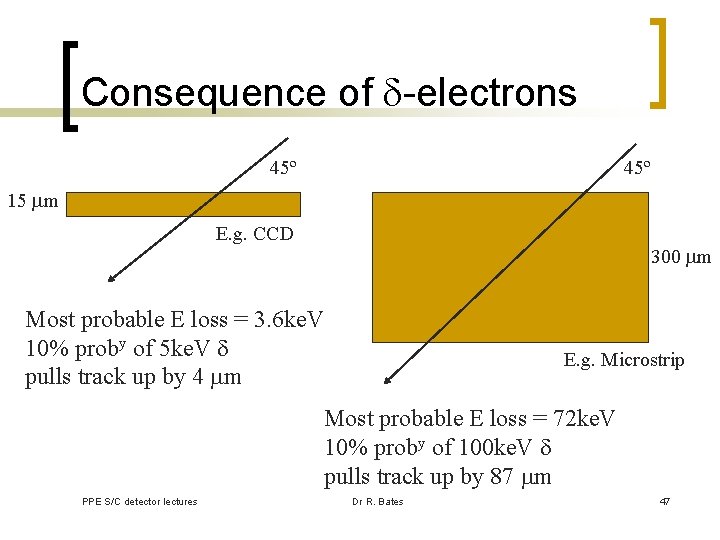
Consequence of -electrons 45º 15 m E. g. CCD 300 m Most probable E loss = 3. 6 ke. V 10% proby of 5 ke. V pulls track up by 4 m E. g. Microstrip Most probable E loss = 72 ke. V 10% proby of 100 ke. V pulls track up by 87 m PPE S/C detector lectures Dr R. Bates 47
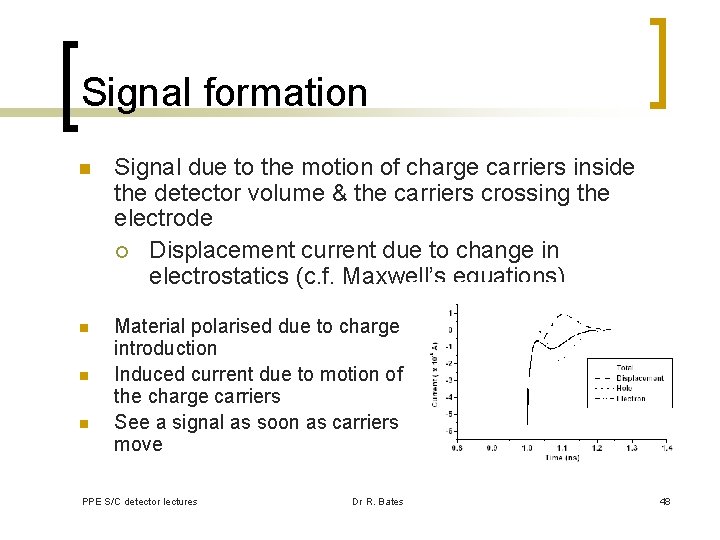
Signal formation n Signal due to the motion of charge carriers inside the detector volume & the carriers crossing the electrode ¡ Displacement current due to change in electrostatics (c. f. Maxwell’s equations) n Material polarised due to charge introduction Induced current due to motion of the charge carriers See a signal as soon as carriers move n n PPE S/C detector lectures Dr R. Bates 48
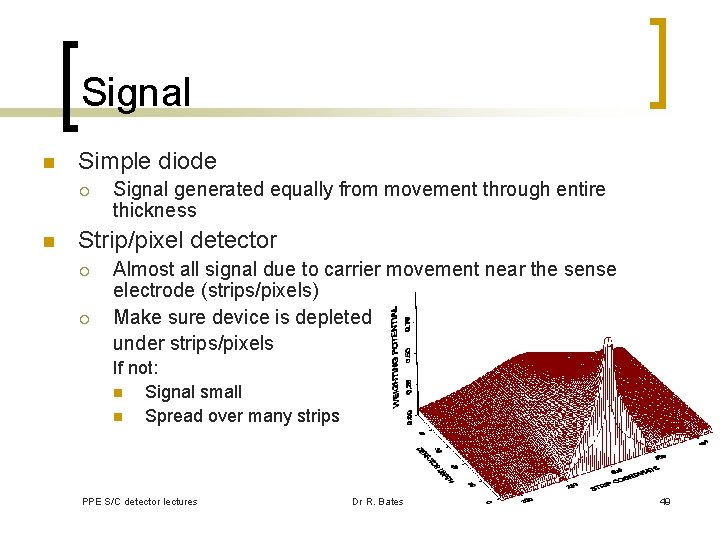
Signal n Simple diode ¡ n Signal generated equally from movement through entire thickness Strip/pixel detector ¡ ¡ Almost all signal due to carrier movement near the sense electrode (strips/pixels) Make sure device is depleted under strips/pixels If not: n Signal small n Spread over many strips PPE S/C detector lectures Dr R. Bates 49
Lecture 3 – Microstrip detector n n Description of device Carrier diffusion ¡ n Charge sharing ¡ ¡ n n n Why is it (sometimes) good Cap coupling Floating strips Off line analysis Performance in magnetic field Details ¡ ¡ ¡ AC coupling Bias resistors Double sides devices PPE S/C detector lectures Dr R. Bates 50
What is a microstrip detector? n n p-i-n diode Patterned implants as strips ¡ n n n One or both sides Connect readout electronics to strips Radiation induced signal on a strip due to passage under/close to strip Determine position from strip hit info PPE S/C detector lectures Dr R. Bates 51
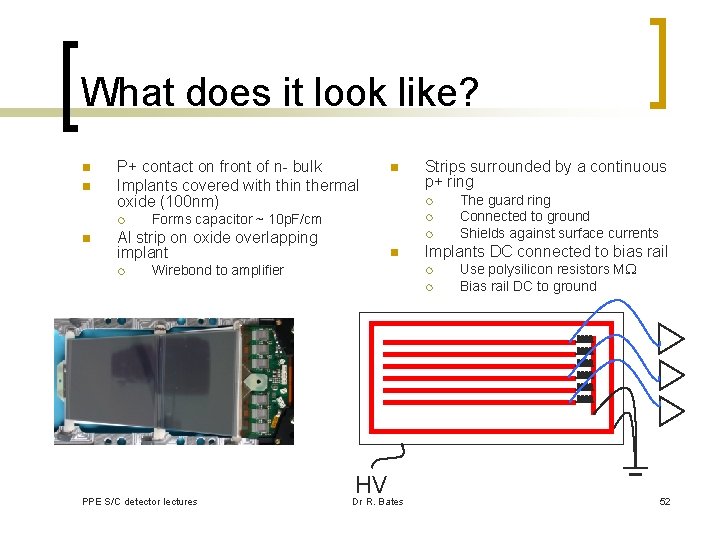
What does it look like? n n P+ contact on front of n- bulk Implants covered with thin thermal oxide (100 nm) ¡ n Strips surrounded by a continuous p+ ring ¡ Forms capacitor ~ 10 p. F/cm ¡ Al strip on oxide overlapping implant ¡ n Wirebond to amplifier Implants DC connected to bias rail ¡ ¡ PPE S/C detector lectures HV Dr R. Bates The guard ring Connected to ground Shields against surface currents Use polysilicon resistors MW Bias rail DC to ground 52
Resolution n Delta electrons ¡ n n See lecture 2 Diffusion Strip pitch ¡ ¡ ¡ Capacitive coupling Read all strips Floating strips PPE S/C detector lectures Dr R. Bates 53
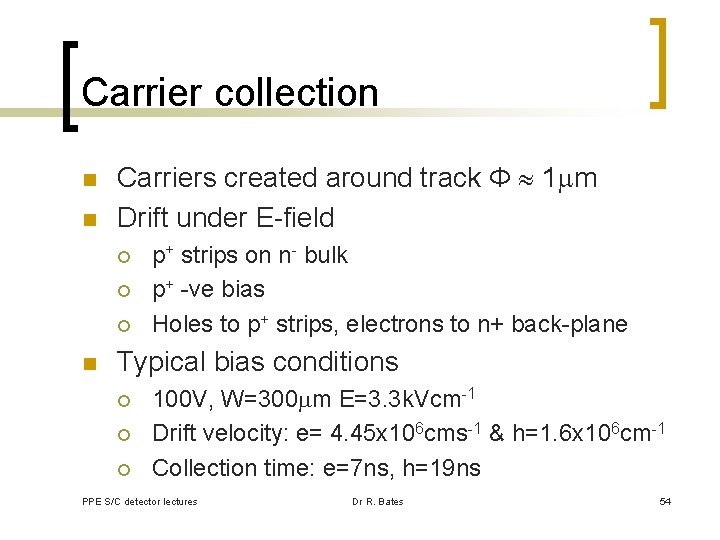
Carrier collection n n Carriers created around track Φ 1 m Drift under E-field ¡ ¡ ¡ n p+ strips on n- bulk p+ -ve bias Holes to p+ strips, electrons to n+ back-plane Typical bias conditions ¡ ¡ ¡ 100 V, W=300 m E=3. 3 k. Vcm-1 Drift velocity: e= 4. 45 x 106 cms-1 & h=1. 6 x 106 cm-1 Collection time: e=7 ns, h=19 ns PPE S/C detector lectures Dr R. Bates 54
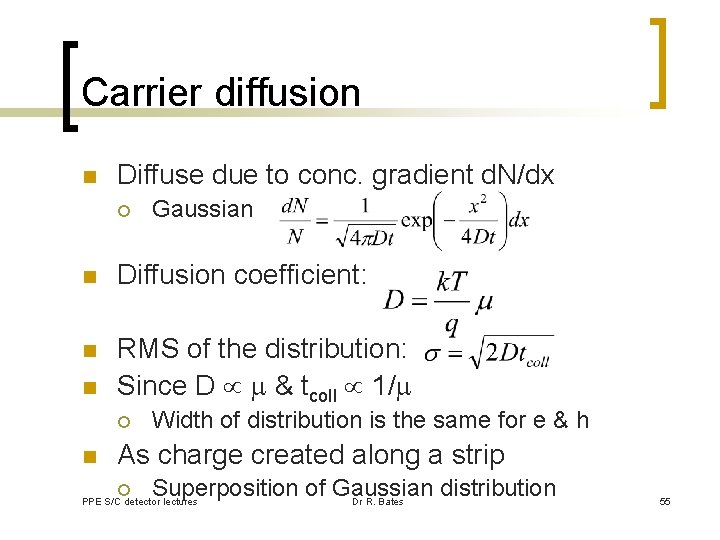
Carrier diffusion n Diffuse due to conc. gradient d. N/dx ¡ Gaussian n Diffusion coefficient: n RMS of the distribution: Since D & tcoll 1/ n ¡ n Width of distribution is the same for e & h As charge created along a strip ¡ Superposition of Gaussian distribution Dr R. Bates PPE S/C detector lectures 55
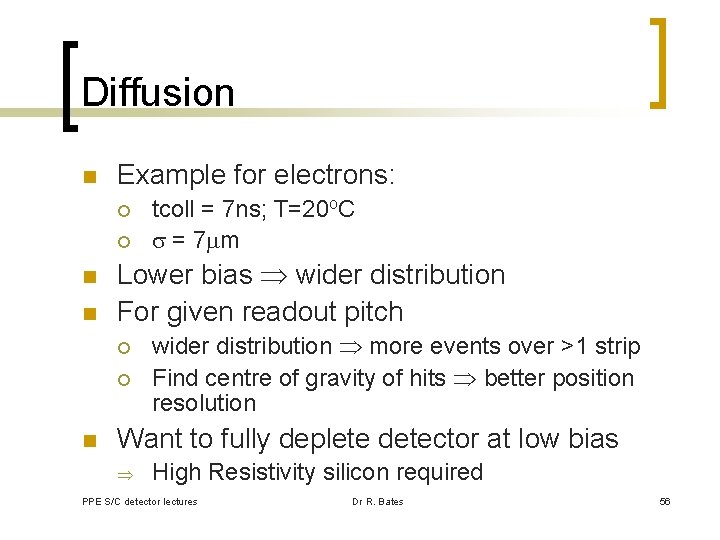
Diffusion n Example for electrons: ¡ ¡ n n Lower bias wider distribution For given readout pitch ¡ ¡ n tcoll = 7 ns; T=20 o. C s = 7 m wider distribution more events over >1 strip Find centre of gravity of hits better position resolution Want to fully deplete detector at low bias High Resistivity silicon required PPE S/C detector lectures Dr R. Bates 56
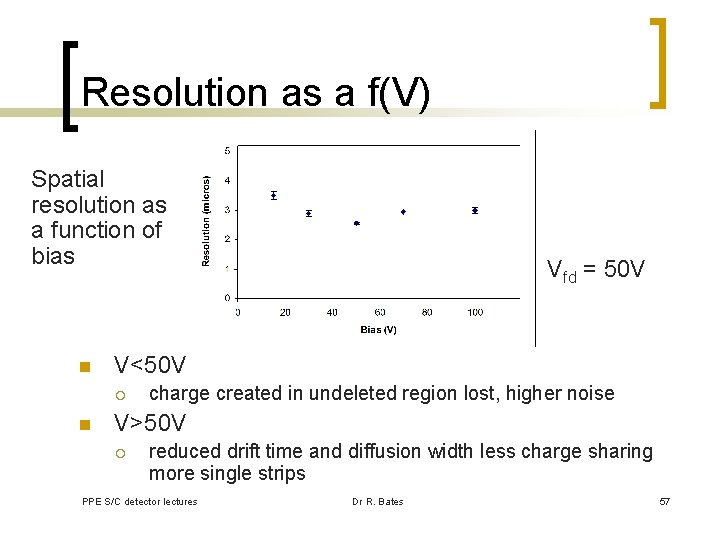
Resolution as a f(V) Spatial resolution as a function of bias n V<50 V ¡ n Vfd = 50 V charge created in undeleted region lost, higher noise V>50 V ¡ reduced drift time and diffusion width less charge sharing more single strips PPE S/C detector lectures Dr R. Bates 57
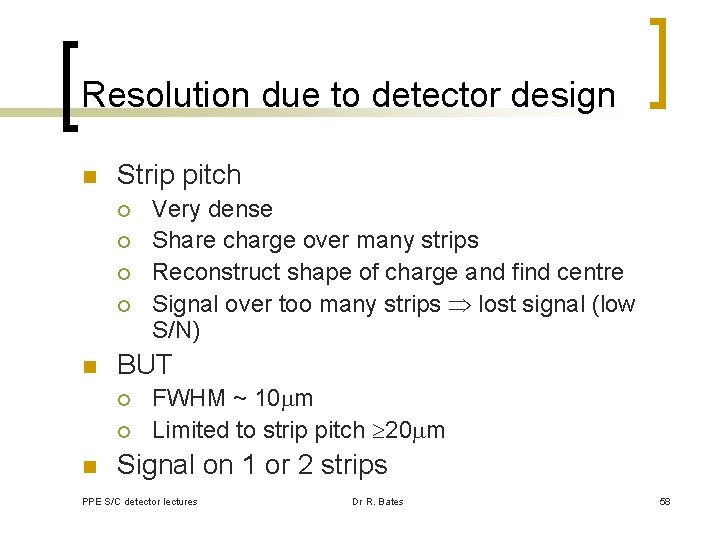
Resolution due to detector design n Strip pitch ¡ ¡ n BUT ¡ ¡ n Very dense Share charge over many strips Reconstruct shape of charge and find centre Signal over too many strips lost signal (low S/N) FWHM ~ 10 m Limited to strip pitch 20 m Signal on 1 or 2 strips PPE S/C detector lectures Dr R. Bates 58
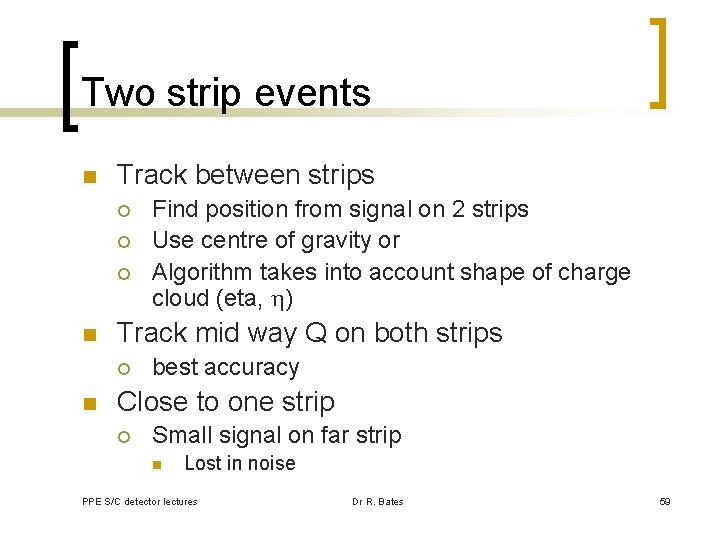
Two strip events n Track between strips ¡ ¡ ¡ n Track mid way Q on both strips ¡ n Find position from signal on 2 strips Use centre of gravity or Algorithm takes into account shape of charge cloud (eta, ) best accuracy Close to one strip ¡ Small signal on far strip n Lost in noise PPE S/C detector lectures Dr R. Bates 59
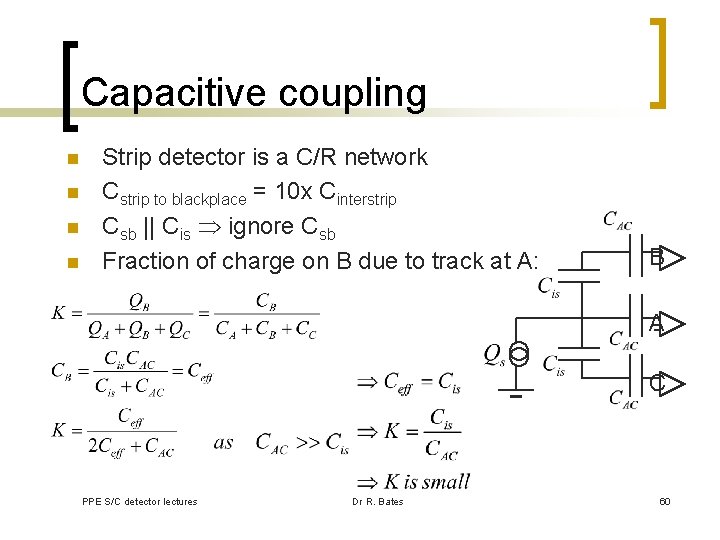
Capacitive coupling n n Strip detector is a C/R network Cstrip to blackplace = 10 x Cinterstrip Csb || Cis ignore Csb Fraction of charge on B due to track at A: B A C PPE S/C detector lectures Dr R. Bates 60
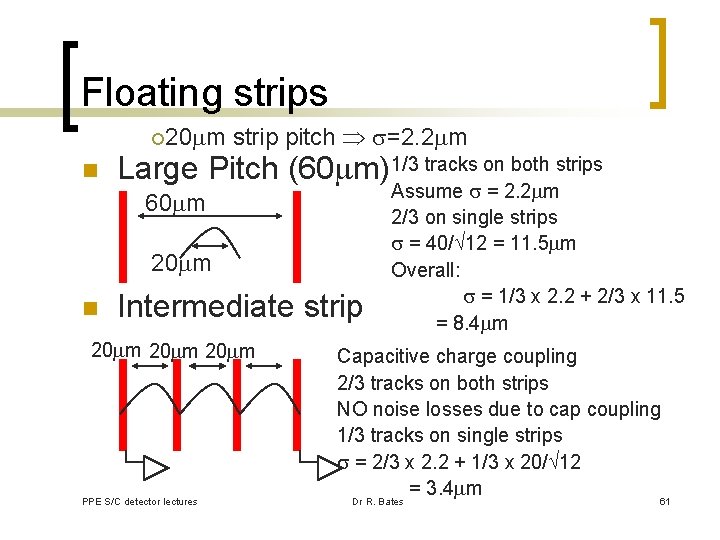
Floating strips ¡ 20 m n strip pitch s=2. 2 m Large Pitch (60 m) 1/3 tracks on both strips 60 m 20 m n Intermediate strip 20 m PPE S/C detector lectures Assume s = 2. 2 m 2/3 on single strips s = 40/ 12 = 11. 5 m Overall: s = 1/3 x 2. 2 + 2/3 x 11. 5 = 8. 4 m Capacitive charge coupling 2/3 tracks on both strips NO noise losses due to cap coupling 1/3 tracks on single strips s = 2/3 x 2. 2 + 1/3 x 20/ 12 = 3. 4 m Dr R. Bates 61
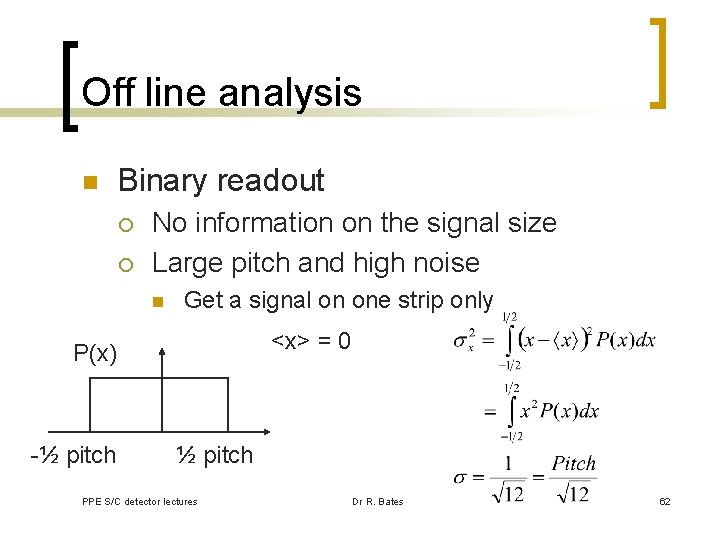
Off line analysis n Binary readout ¡ ¡ No information on the signal size Large pitch and high noise n Get a signal on one strip only <x> = 0 P(x) -½ pitch PPE S/C detector lectures Dr R. Bates 62
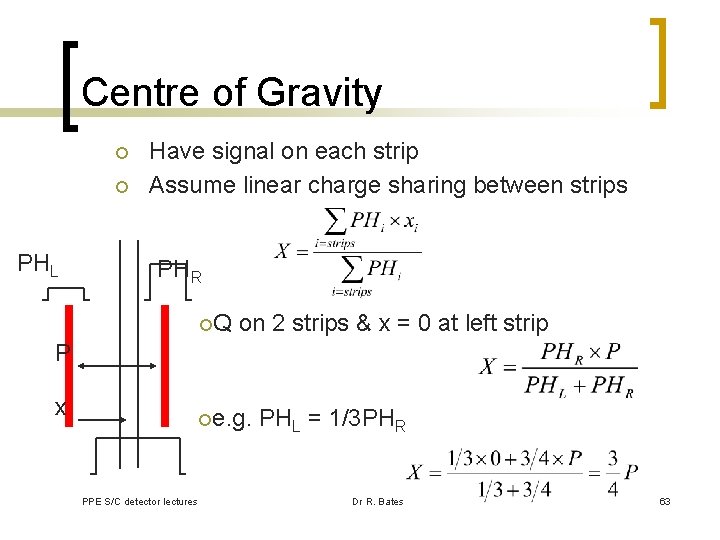
Centre of Gravity ¡ ¡ PHL Have signal on each strip Assume linear charge sharing between strips PHR ¡Q on 2 strips & x = 0 at left strip P x ¡e. g. PPE S/C detector lectures PHL = 1/3 PHR Dr R. Bates 63
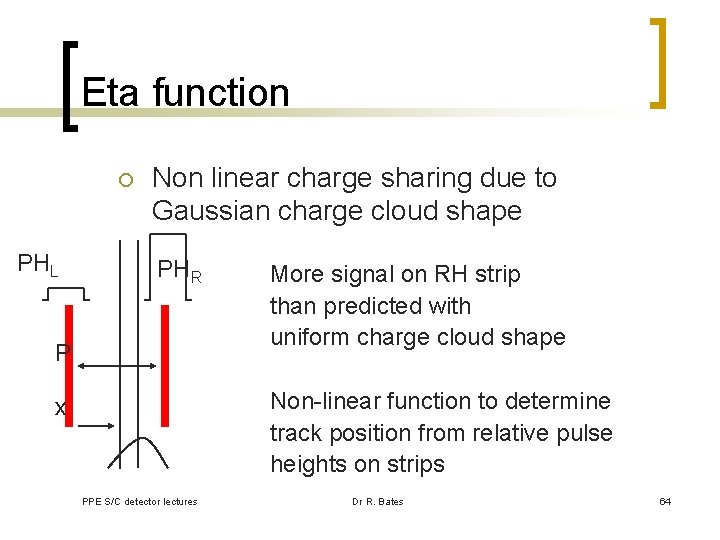
Eta function ¡ PHL Non linear charge sharing due to Gaussian charge cloud shape PHR P More signal on RH strip than predicted with uniform charge cloud shape Non-linear function to determine track position from relative pulse heights on strips x PPE S/C detector lectures Dr R. Bates 64
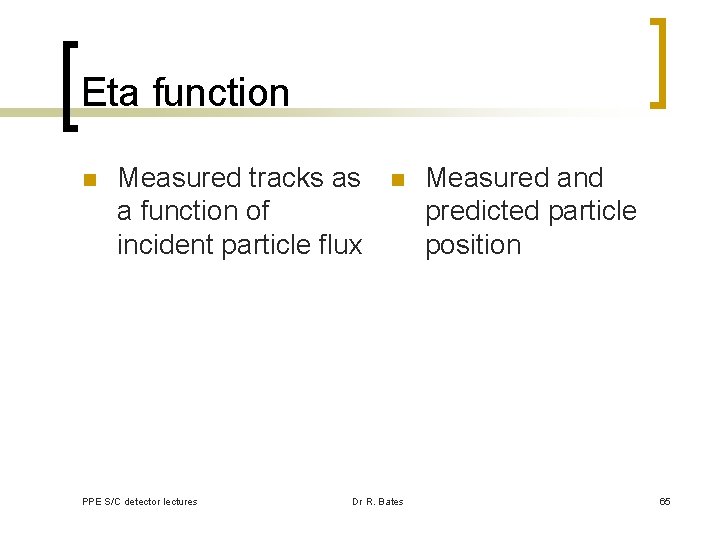
Eta function n Measured tracks as a function of incident particle flux PPE S/C detector lectures n Dr R. Bates Measured and predicted particle position 65
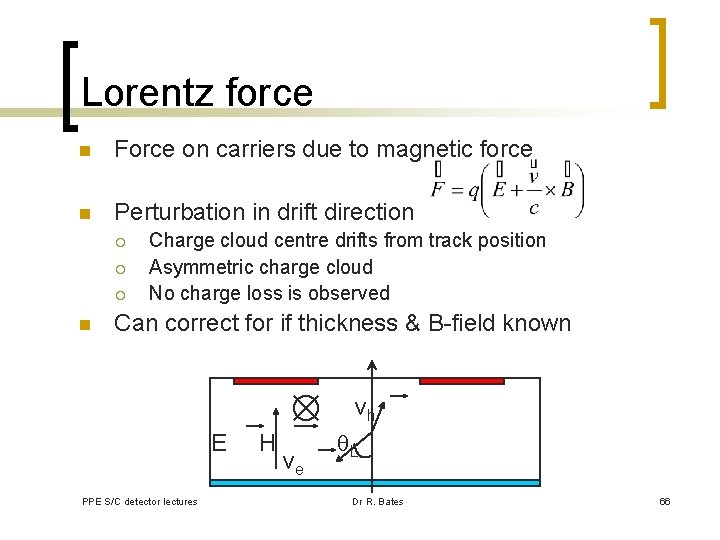
Lorentz force n Force on carriers due to magnetic force n Perturbation in drift direction ¡ ¡ ¡ n Charge cloud centre drifts from track position Asymmetric charge cloud No charge loss is observed Can correct for if thickness & B-field known vh E PPE S/C detector lectures H ve q. L Dr R. Bates 66
Details n Modern detectors have integrated capacitors ¡ ¡ ¡ n Thin 100 nm oxide on top of implant Metallise over this Readout via second layer Integrated resistors ¡ Realise via polysilicon n ¡ Complex Punch through biasing n n Not radiation hard Back to back diodes – depleted region has high R PPE S/C detector lectures Dr R. Bates 67
Details n Double sided detectors ¡ n Both p- and n-side pattern Surface charge build up on n-side ¡ ¡ Trapped +ve charge in Si. O Attracts electrons in silicon near surface Shorts strips together p+ spray to increase inter-strip resistance PPE S/C detector lectures Dr R. Bates 68
Lecture 4 – Radiation Damage n Effects of radiation ¡ ¡ ¡ n Microscopic Macroscopic Annealing What can we do? ¡ ¡ Detector Design Material Engineering Cold Operation Thin detectors/Electrode Structure – 3 -D device PPE S/C detector lectures Dr R. Bates 69
Effects of Radiation n Long Term Ionisation Effects ¡ ¡ ¡ n Trapped charge (holes) in Si. O 2 interface states at Si. O 2 - Si interface Can’t use CCD’s in high radiation environment Displacement Damage in the Si bulk ¡ ¡ ¡ 4 stage process Displacement of Silicon atoms from lattice Formation of long lived point defects & clusters PPE S/C detector lectures Dr R. Bates 70
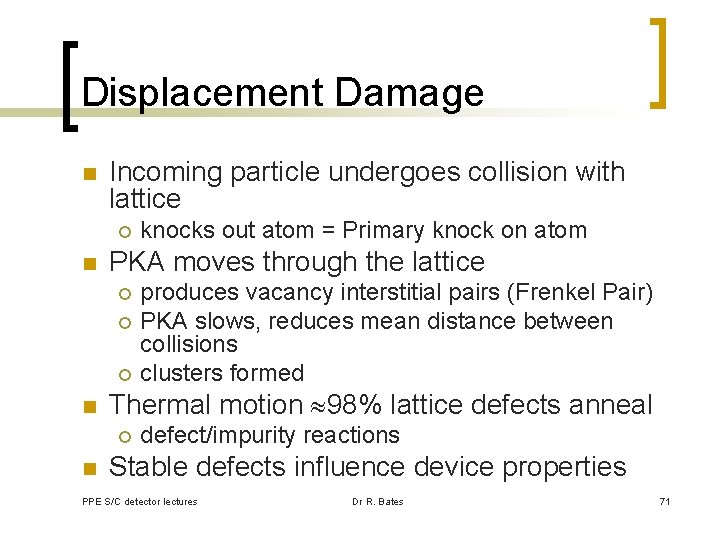
Displacement Damage n Incoming particle undergoes collision with lattice ¡ n PKA moves through the lattice ¡ ¡ ¡ n produces vacancy interstitial pairs (Frenkel Pair) PKA slows, reduces mean distance between collisions clusters formed Thermal motion 98% lattice defects anneal ¡ n knocks out atom = Primary knock on atom defect/impurity reactions Stable defects influence device properties PPE S/C detector lectures Dr R. Bates 71
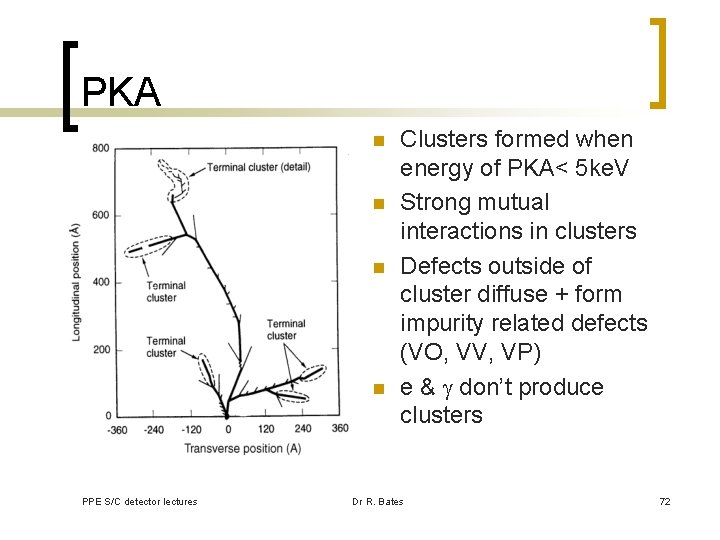
PKA n n PPE S/C detector lectures Clusters formed when energy of PKA< 5 ke. V Strong mutual interactions in clusters Defects outside of cluster diffuse + form impurity related defects (VO, VV, VP) e & don’t produce clusters Dr R. Bates 72
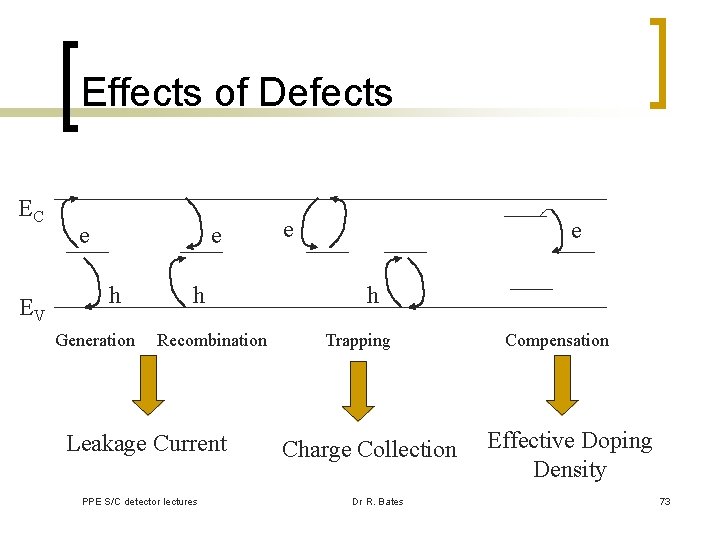
Effects of Defects EC EV e e h Generation h Recombination Leakage Current PPE S/C detector lectures e e h Trapping Charge Collection Dr R. Bates Compensation Effective Doping Density 73
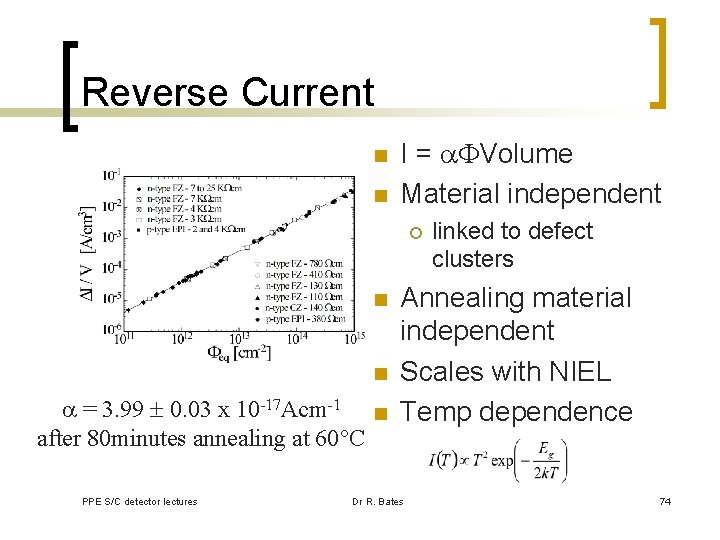
Reverse Current n n I = Volume Material independent ¡ n n = 3. 99 0. 03 x 10 -17 Acm-1 n after 80 minutes annealing at 60 C PPE S/C detector lectures linked to defect clusters Annealing material independent Scales with NIEL Temp dependence Dr R. Bates 74
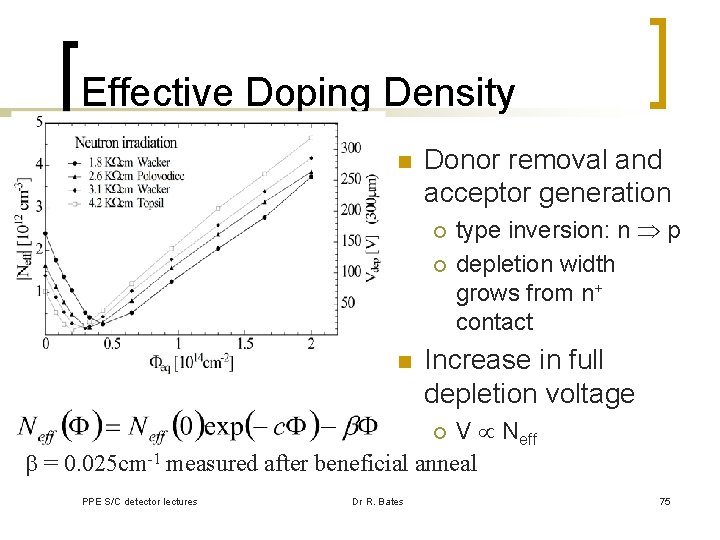
Effective Doping Density n Donor removal and acceptor generation ¡ ¡ n type inversion: n p depletion width grows from n+ contact Increase in full depletion voltage V Neff = 0. 025 cm-1 measured after beneficial anneal ¡ PPE S/C detector lectures Dr R. Bates 75
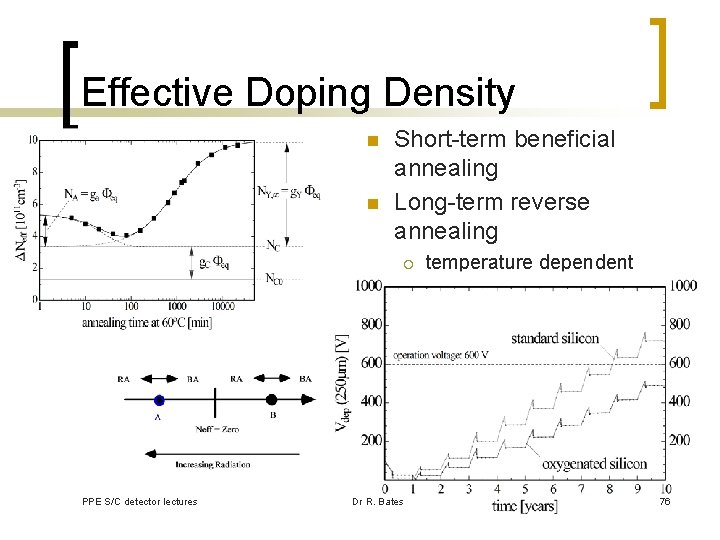
Effective Doping Density n n Short-term beneficial annealing Long-term reverse annealing ¡ ¡ PPE S/C detector lectures Dr R. Bates temperature dependent stops below -10 C 76
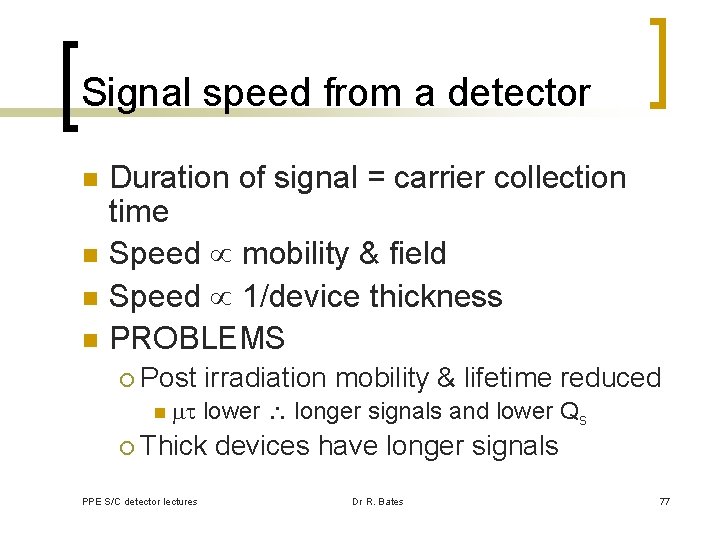
Signal speed from a detector n n Duration of signal = carrier collection time Speed mobility & field Speed 1/device thickness PROBLEMS ¡ Post irradiation mobility & lifetime reduced n ¡ lower longer signals and lower Qs Thick devices have longer signals PPE S/C detector lectures Dr R. Bates 77
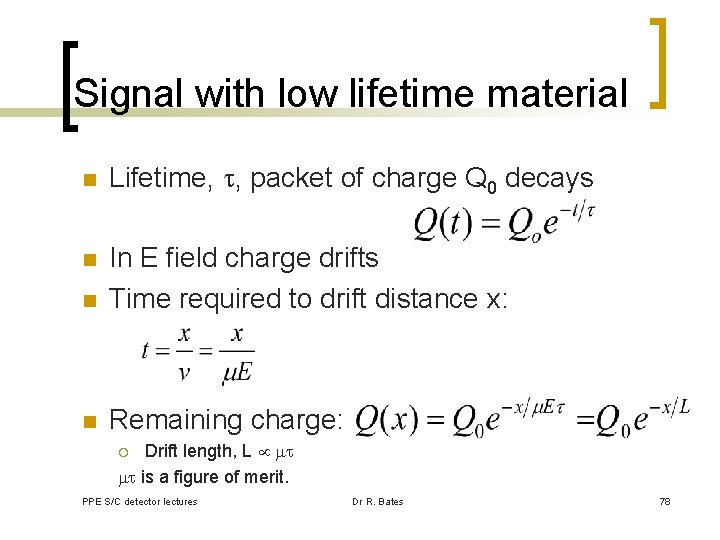
Signal with low lifetime material n Lifetime, , packet of charge Q 0 decays n In E field charge drifts Time required to drift distance x: n Remaining charge: n Drift length, L is a figure of merit. ¡ PPE S/C detector lectures Dr R. Bates 78
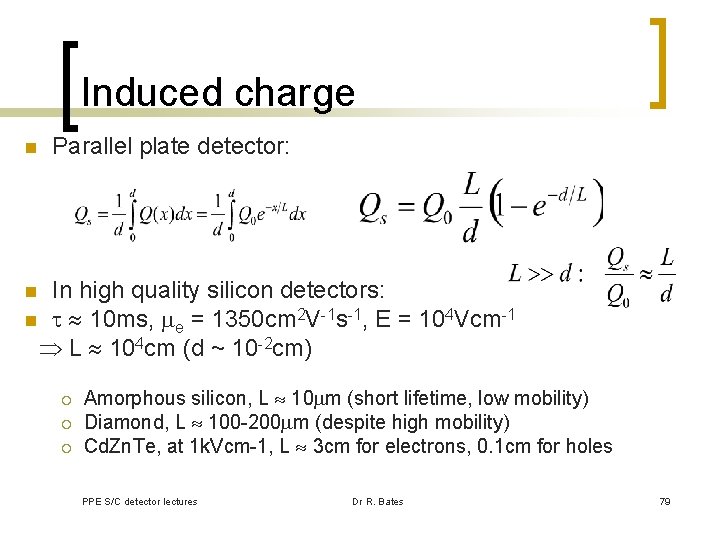
Induced charge n Parallel plate detector: In high quality silicon detectors: n 10 ms, e = 1350 cm 2 V-1 s-1, E = 104 Vcm-1 L 104 cm (d ~ 10 -2 cm) n ¡ ¡ ¡ Amorphous silicon, L 10 m (short lifetime, low mobility) Diamond, L 100 -200 m (despite high mobility) Cd. Zn. Te, at 1 k. Vcm-1, L 3 cm for electrons, 0. 1 cm for holes PPE S/C detector lectures Dr R. Bates 79
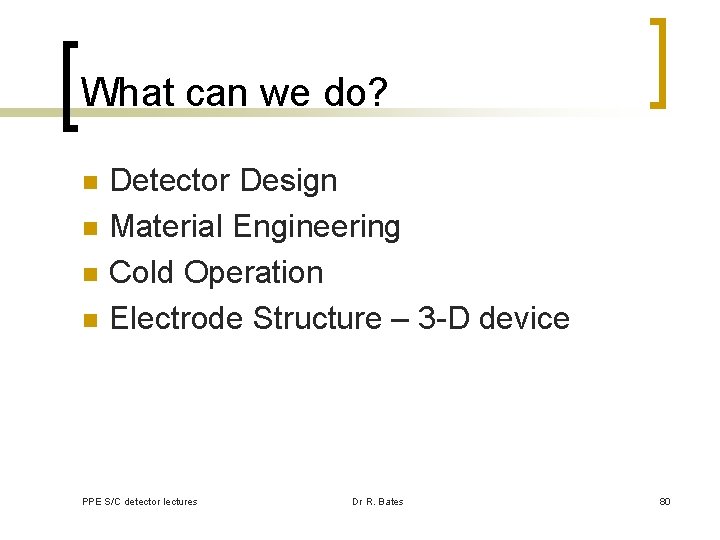
What can we do? n n Detector Design Material Engineering Cold Operation Electrode Structure – 3 -D device PPE S/C detector lectures Dr R. Bates 80
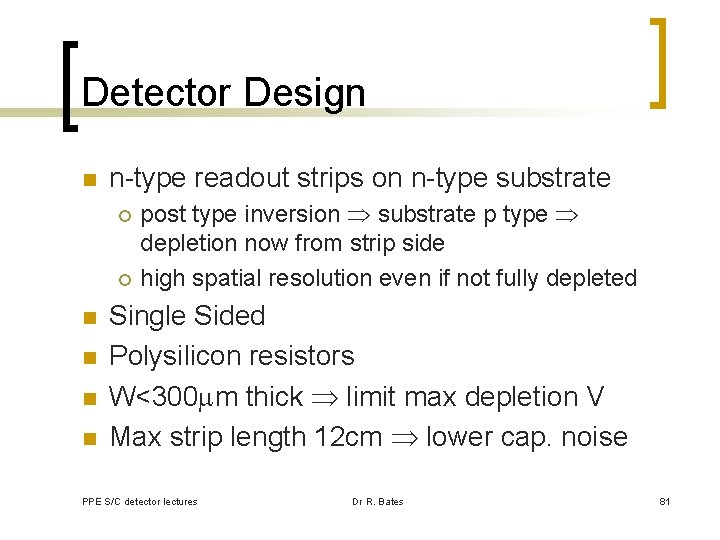
Detector Design n n-type readout strips on n-type substrate ¡ ¡ n n post type inversion substrate p type depletion now from strip side high spatial resolution even if not fully depleted Single Sided Polysilicon resistors W<300 m thick limit max depletion V Max strip length 12 cm lower cap. noise PPE S/C detector lectures Dr R. Bates 81
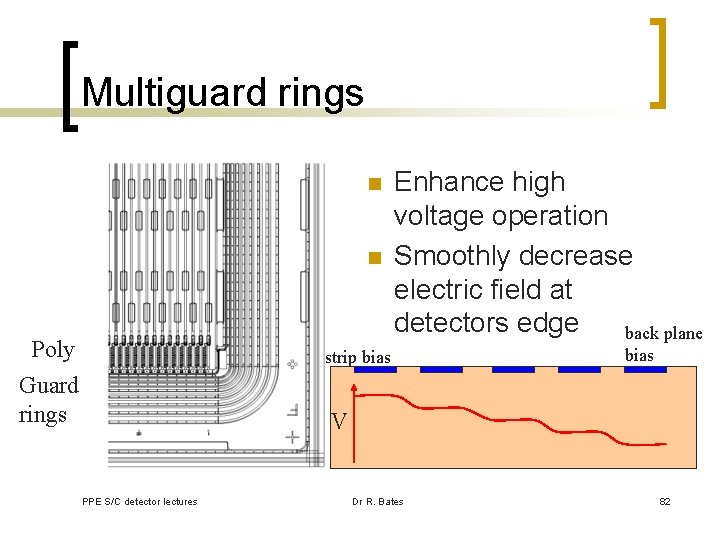
Multiguard rings n n Poly Guard rings Enhance high voltage operation Smoothly decrease electric field at detectors edge back plane strip bias V PPE S/C detector lectures Dr R. Bates 82
Substrate Choice n n Minimise interface states Substrate orientation <100> not <111> Lower capacitive load ¡ Independent of ionising radiation ¡ n <100> has less dangling surface bonds PPE S/C detector lectures Dr R. Bates 83
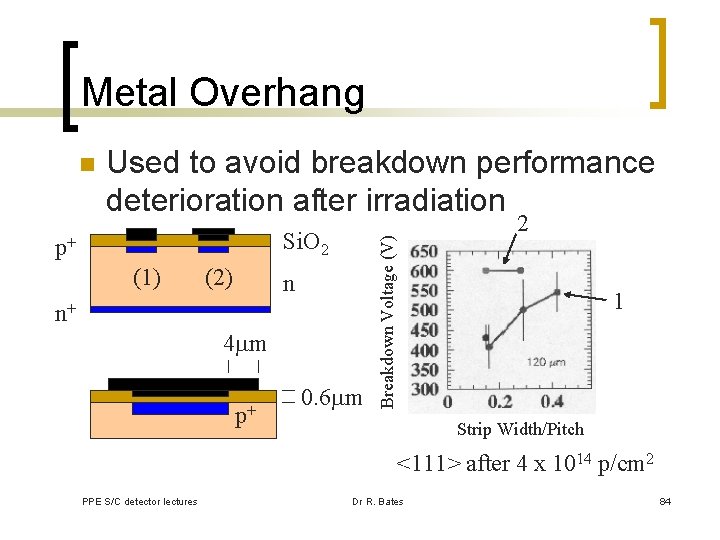
Metal Overhang Used to avoid breakdown performance deterioration after irradiation Si. O 2 p+ (1) (2) n n+ 4 m p+ 0. 6 m 2 Breakdown Voltage (V) n 1 Strip Width/Pitch <111> after 4 x 10¹⁴ p/cm 2 PPE S/C detector lectures Dr R. Bates 84
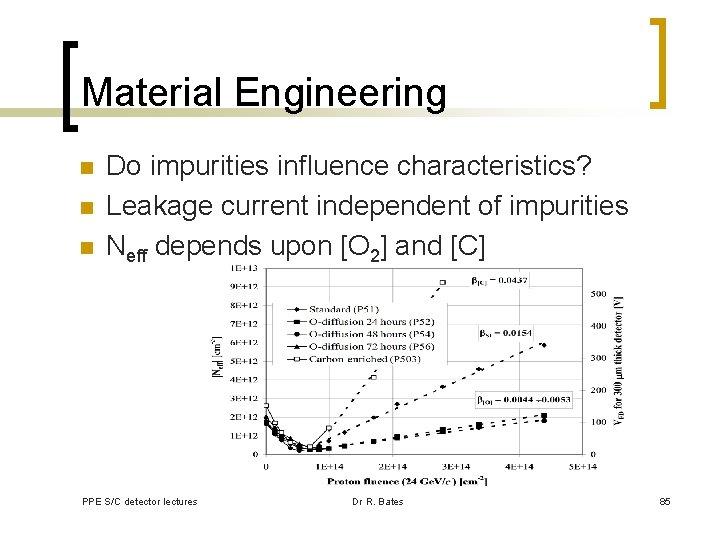
Material Engineering n n n Do impurities influence characteristics? Leakage current independent of impurities Neff depends upon [O 2] and [C] PPE S/C detector lectures Dr R. Bates 85
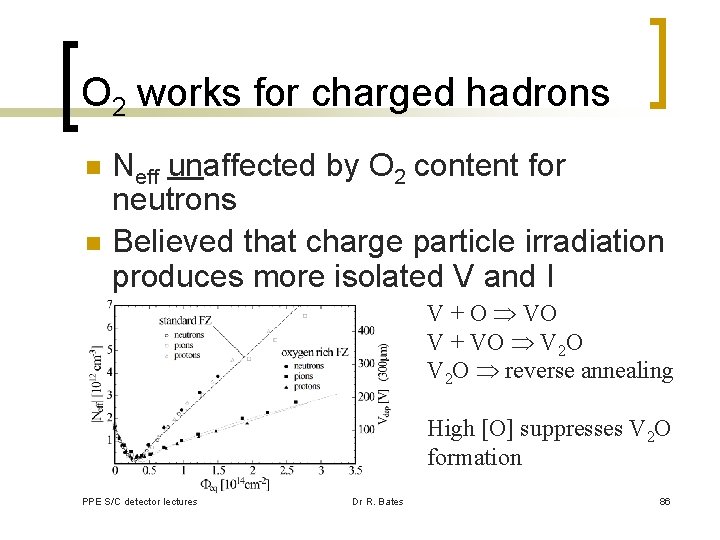
O 2 works for charged hadrons n n Neff unaffected by O 2 content for neutrons Believed that charge particle irradiation produces more isolated V and I V + O VO V + VO V 2 O reverse annealing High [O] suppresses V 2 O formation PPE S/C detector lectures Dr R. Bates 86
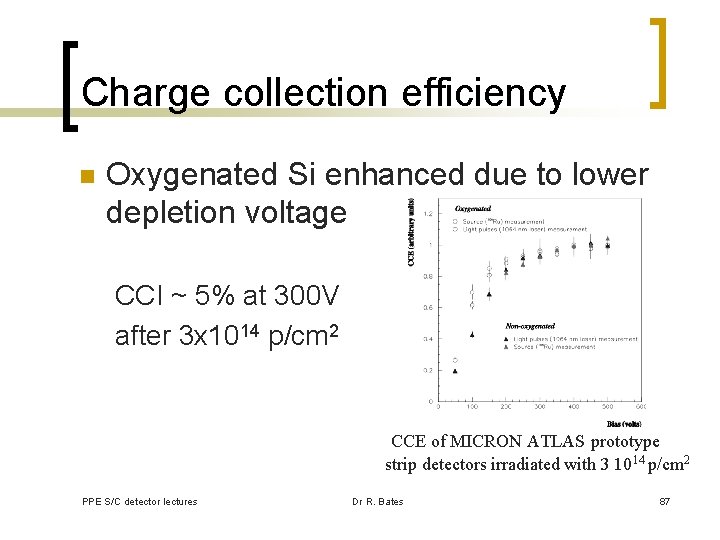
Charge collection efficiency n Oxygenated Si enhanced due to lower depletion voltage CCI ~ 5% at 300 V after 3 x 10¹⁴ p/cm 2 CCE of MICRON ATLAS prototype strip detectors irradiated with 3 1014 p/cm 2 PPE S/C detector lectures Dr R. Bates 87
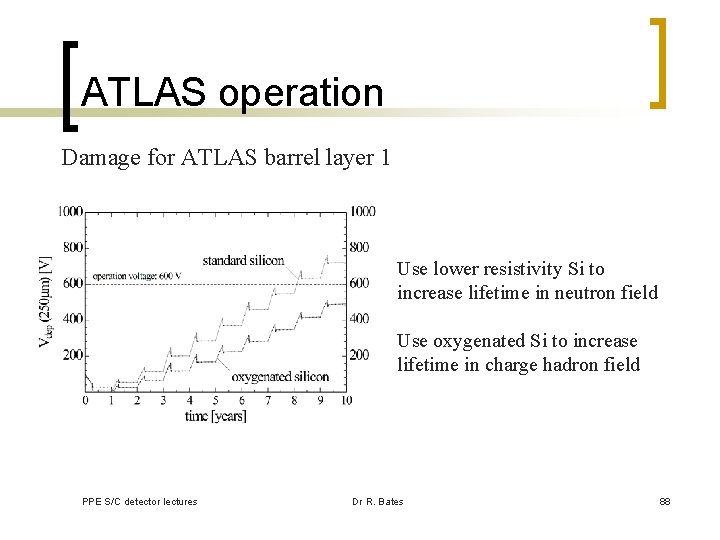
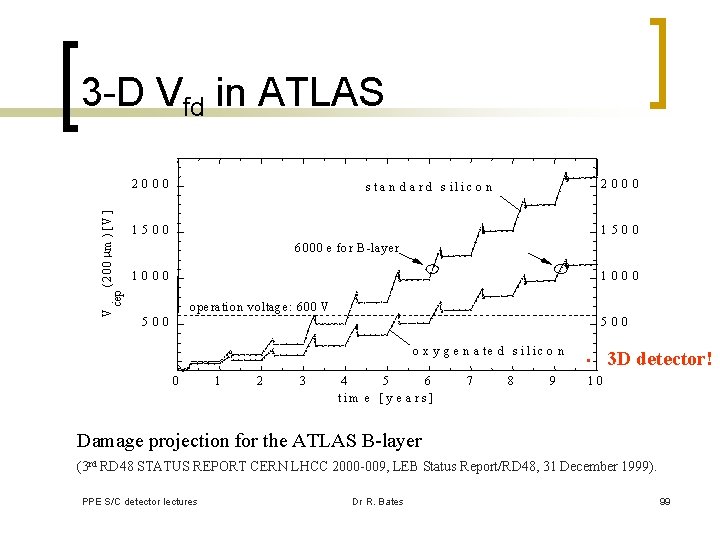
ATLAS operation Damage for ATLAS barrel layer 1 Use lower resistivity Si to increase lifetime in neutron field Use oxygenated Si to increase lifetime in charge hadron field PPE S/C detector lectures Dr R. Bates 88
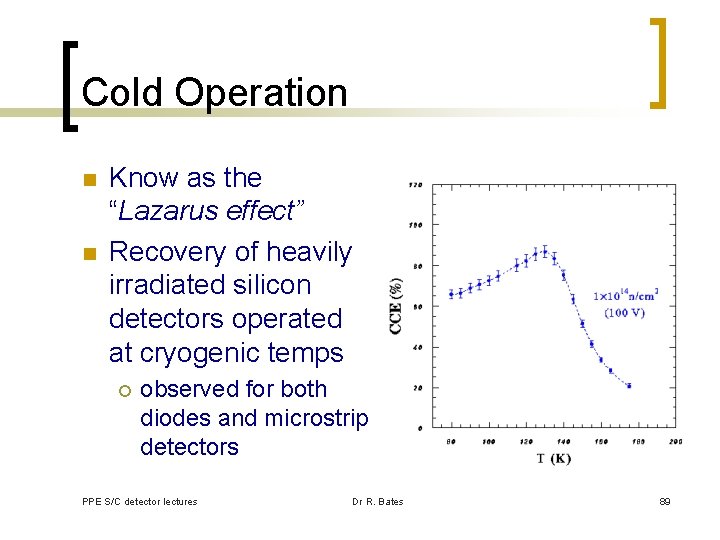
Cold Operation n n Know as the “Lazarus effect” Recovery of heavily irradiated silicon detectors operated at cryogenic temps ¡ observed for both diodes and microstrip detectors PPE S/C detector lectures Dr R. Bates 89
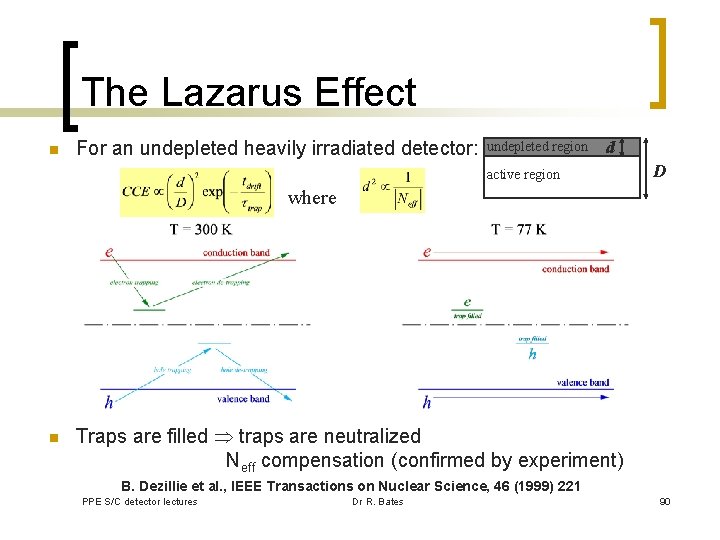
The Lazarus Effect n For an undepleted heavily irradiated detector: undepleted region d active region D where n Traps are filled traps are neutralized Neff compensation (confirmed by experiment) B. Dezillie et al. , IEEE Transactions on Nuclear Science, 46 (1999) 221 PPE S/C detector lectures Dr R. Bates 90
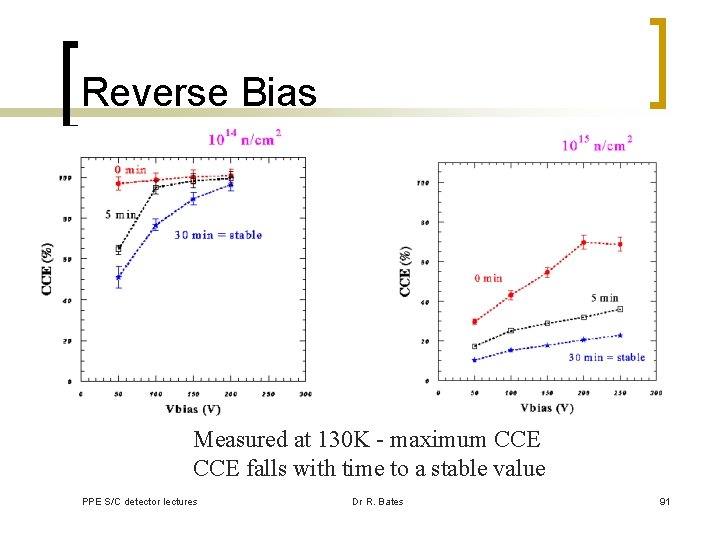
Reverse Bias Measured at 130 K - maximum CCE falls with time to a stable value PPE S/C detector lectures Dr R. Bates 91
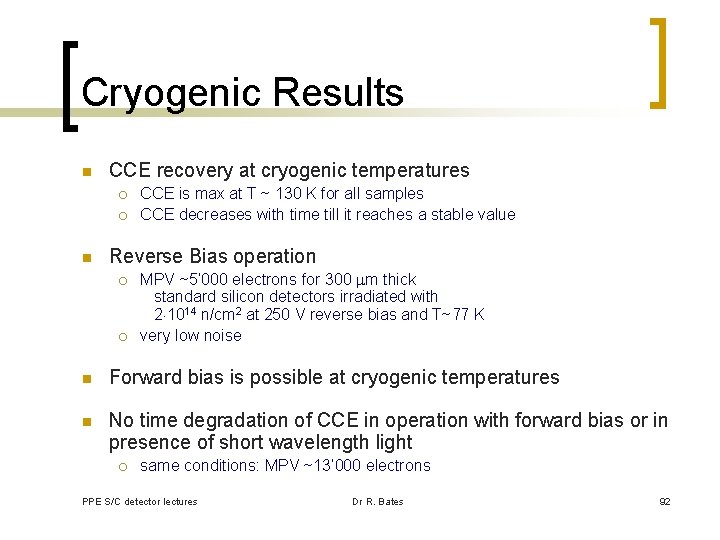
Cryogenic Results n CCE recovery at cryogenic temperatures ¡ ¡ n CCE is max at T ~ 130 K for all samples CCE decreases with time till it reaches a stable value Reverse Bias operation ¡ ¡ MPV ~5’ 000 electrons for 300 m thick standard silicon detectors irradiated with 2 1014 n/cm 2 at 250 V reverse bias and T~77 K very low noise n Forward bias is possible at cryogenic temperatures n No time degradation of CCE in operation with forward bias or in presence of short wavelength light ¡ same conditions: MPV ~13’ 000 electrons PPE S/C detector lectures Dr R. Bates 92
Electrode Structure n Increasing fluence ¡ ¡ Reducing carrier lifetime Increasing Neff n n n Higher bias voltage Operation with detector under-depleted Reduce electrode separation ¡ ¡ Thinner detector Reduced signal/noise ratio Close packed electrodes through wafer PPE S/C detector lectures Dr R. Bates 93
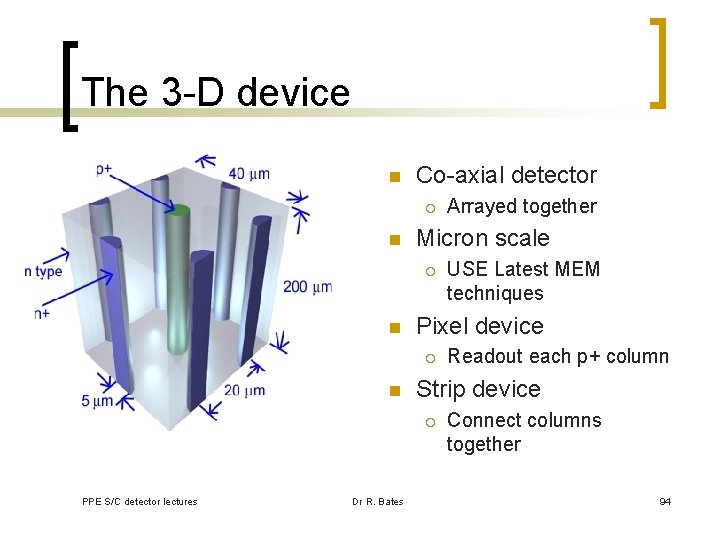
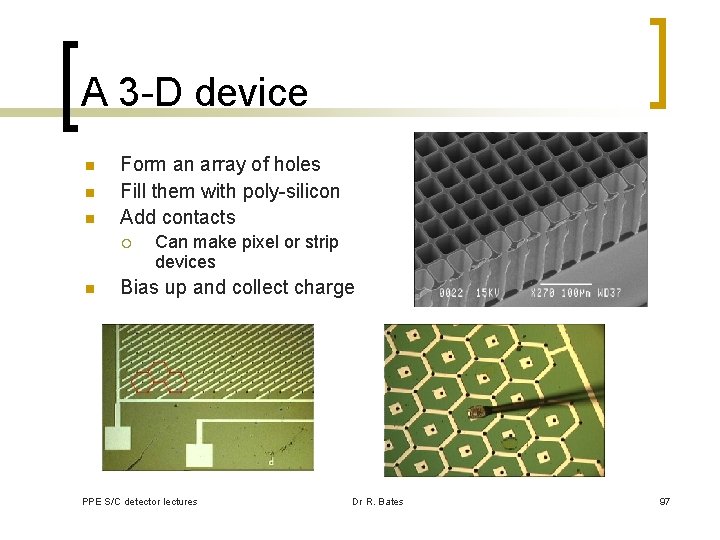
The 3 -D device n Co-axial detector ¡ n Micron scale ¡ n Dr R. Bates Readout each p+ column Strip device ¡ PPE S/C detector lectures USE Latest MEM techniques Pixel device ¡ n Arrayed together Connect columns together 94
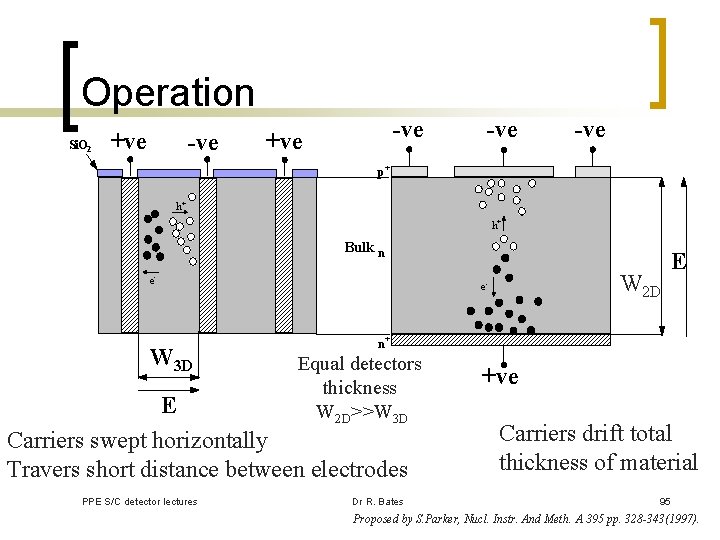
Operation Si. O 2 +ve -ve -ve p+ h+ h+ Bulk n e- W 3 D n+ Equal detectors thickness W 2 D>>W 3 D E Carriers swept horizontally Travers short distance between electrodes PPE S/C detector lectures W 2 D e- E Dr R. Bates +ve Carriers drift total thickness of material 95 Proposed by S. Parker, Nucl. Instr. And Meth. A 395 pp. 328 -343(1997).
Advantages n If electrodes are close Low full depletion bias ¡ Low collection distances ¡ Thickness NOT related to collection distance ¡ No charge spreading ¡ Fast charge sweep out ¡ PPE S/C detector lectures Dr R. Bates 96
A 3 -D device n n n Form an array of holes Fill them with poly-silicon Add contacts ¡ n Can make pixel or strip devices Bias up and collect charge PPE S/C detector lectures Dr R. Bates 97
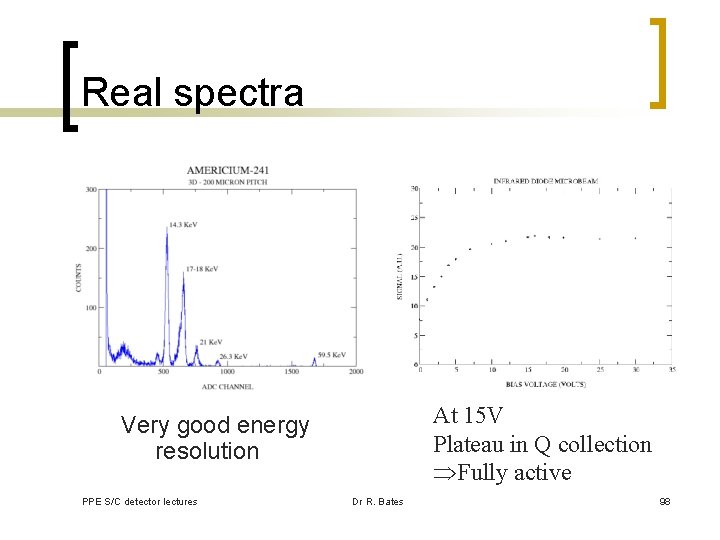
Real spectra At 15 V Plateau in Q collection Fully active Very good energy resolution PPE S/C detector lectures Dr R. Bates 98
3 -D Vfd in ATLAS V 2000 s ta n d a rd s ilic o n 1500 6 000 e fo r B -lay er 1000 dep (2 00 m ) [V ] 2000 opera tio n voltag e: 60 0 V 500 o x y g e n a te d s ilic o n 0 1 2 3 4 5 6 tim e [y e a rs ] 7 8 9 • 3 D detector! 10 Damage projection for the ATLAS B-layer (3 rd RD 48 STATUS REPORT CERN LHCC 2000 -009, LEB Status Report/RD 48, 31 December 1999). PPE S/C detector lectures Dr R. Bates 99
Summary n n Tackle reverse current ¡ Cold operation, -20 C ¡ Substrate orientation ¡ Multiguard rings Overcome limited carrier lifetime and increasing effective doping density ¡ Change material ¡ Increase carrier lifetime ¡ Reduce electrode spacing PPE S/C detector lectures Dr R. Bates 100
Final Slide n n n Why? Where? How? A major type A major worry PPE S/C detector lectures Dr R. Bates 101