
SEMESTER II B COM HONS NAME OF SUBJECT

SEMESTER II B. COM HONS NAME OF SUBJECT: PRINCIPLES OF ECONOMICS PAPER CODE : CH CGE 2 KALIYAGANJ COLLEGE 2020
THEORY OF COSTS DR. CHANDAN ROY (9932395130) chandanroy 70@gmail. com ASSOCIATE PROFESSOR KALIYAGANJ COLLEGE
COST ANALYSIS �A firm employs various factors of production in producing a commodity. �A firm makes some contract with those factors of production according to which it pays to those factors. �Viz. : With labourers firm makes contracts and pays Wage Bill and with Cpital owners it signs contracts for Intersest payment etc. �The firm/ organizer also keeps certain part for his own initiative of taking risk of undergoing this production activity, which is non-contactual cost, known as profit. �Cost of Production = Factor Income of Inputs
Different Concepts of Costs �ACCOUNTING COSTS �ECONOMIC COSTS �OPPORTUNITY COSTS �PRIVATE COSTS �SOCIAL COSTS �SHORT RUN & LONG RUN COSTS
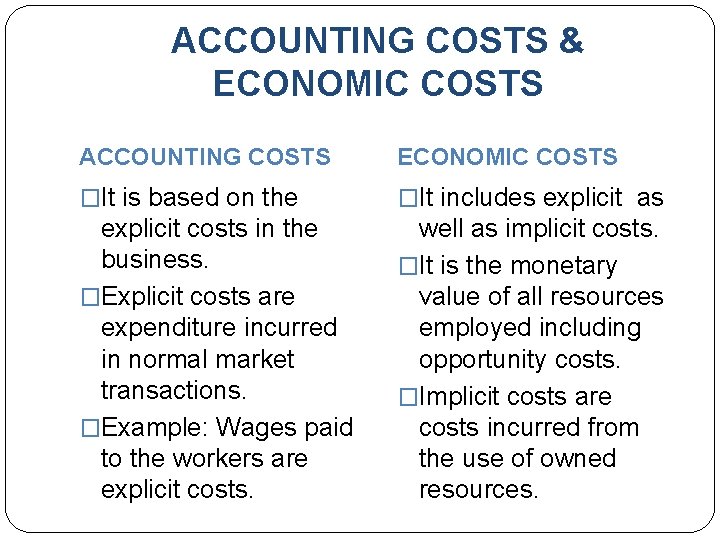
ACCOUNTING COSTS & ECONOMIC COSTS ACCOUNTING COSTS ECONOMIC COSTS �It is based on the �It includes explicit as explicit costs in the business. �Explicit costs are expenditure incurred in normal market transactions. �Example: Wages paid to the workers are explicit costs. well as implicit costs. �It is the monetary value of all resources employed including opportunity costs. �Implicit costs are costs incurred from the use of owned resources.
OPPORTUNITY COSTS � The cocept of Opportunity Costs is based on scarcity and alternative applicability characteristics of productive resources. � The opportunity cost means the next highest value of alternative use of that resource. � Opportunity cost is the PROFIT lost when one alternative is selected over another. � For example, you have $1, 000 and choose to invest it in a product line that will generate a return of 5%. If you could have spent the money on a different investment that would have generated a return of 7%, then the 2% difference between the two alternatives is the foregone opportunity cost of this decision.
PRIVATE & SOCIAL COSTS �Private Costs are paid bt firm or consumers and must be included in production and consumption decision. �Social Costs include both the private costs and any other external costs to society arising from the production or consumption of a good or service. �The private costs are usually less than the social costs, which include external costs that private costs do not. �External costs could include any costs associated with pollution that could occur as a result of establishment of a factory by an entrepreneur.
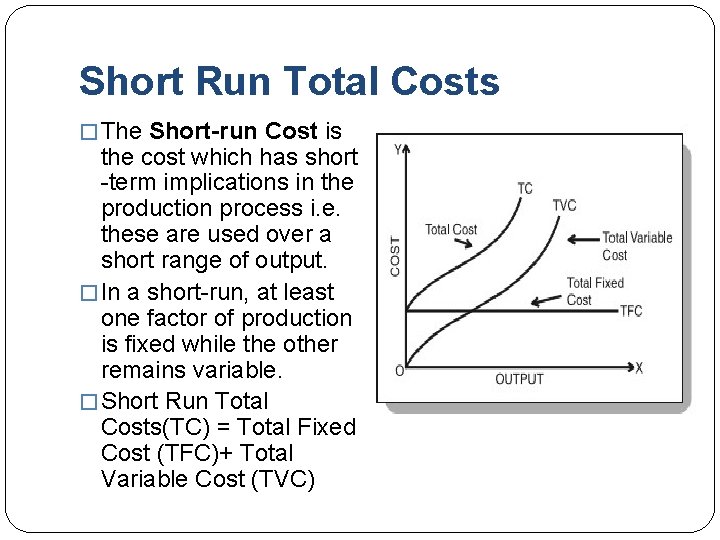
Short Run Total Costs � The Short-run Cost is the cost which has short -term implications in the production process i. e. these are used over a short range of output. � In a short-run, at least one factor of production is fixed while the other remains variable. � Short Run Total Costs(TC) = Total Fixed Cost (TFC)+ Total Variable Cost (TVC)
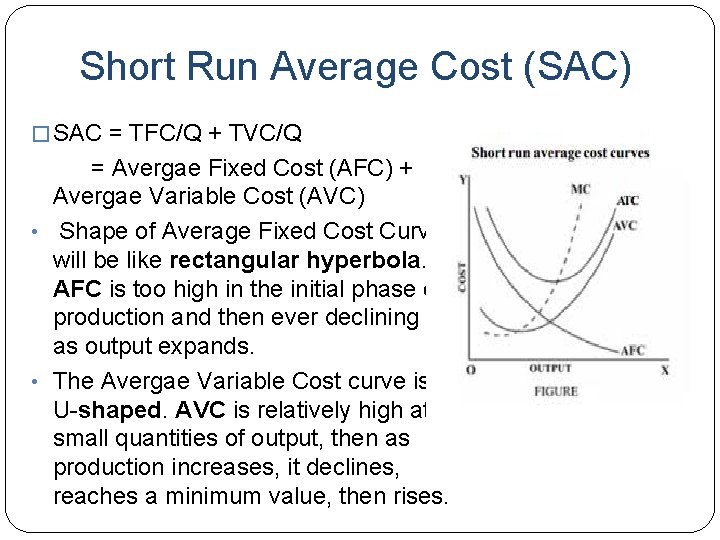
Short Run Average Cost (SAC) � SAC = TFC/Q + TVC/Q = Avergae Fixed Cost (AFC) + Avergae Variable Cost (AVC) • Shape of Average Fixed Cost Curve will be like rectangular hyperbola. AFC is too high in the initial phase of production and then ever declining as output expands. • The Avergae Variable Cost curve is U-shaped. AVC is relatively high at small quantities of output, then as production increases, it declines, reaches a minimum value, then rises.
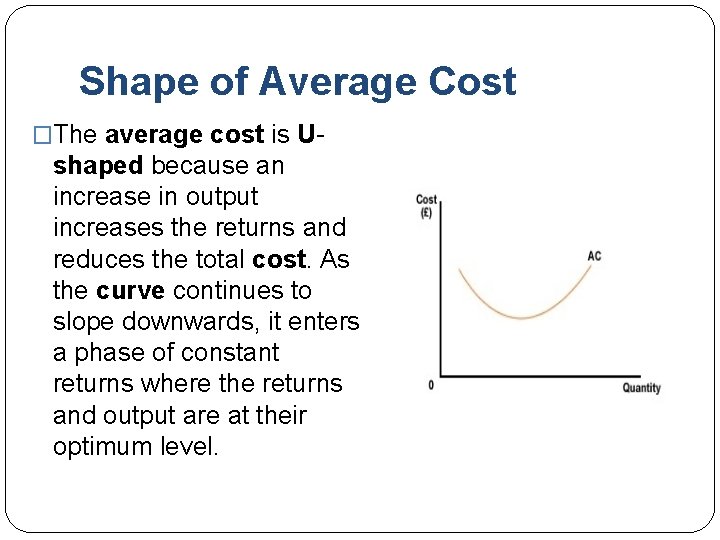
Shape of Average Cost �The average cost is U- shaped because an increase in output increases the returns and reduces the total cost. As the curve continues to slope downwards, it enters a phase of constant returns where the returns and output are at their optimum level.
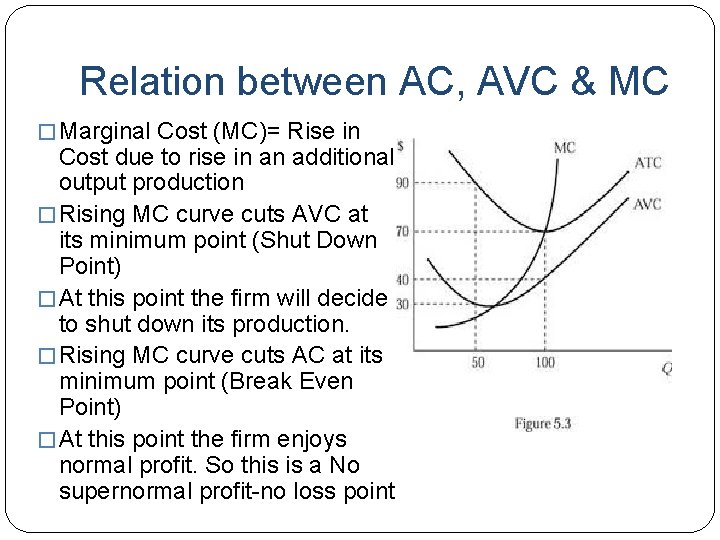
Relation between AC, AVC & MC � Marginal Cost (MC)= Rise in Cost due to rise in an additional output production � Rising MC curve cuts AVC at its minimum point (Shut Down Point) � At this point the firm will decide to shut down its production. � Rising MC curve cuts AC at its minimum point (Break Even Point) � At this point the firm enjoys normal profit. So this is a No supernormal profit-no loss point
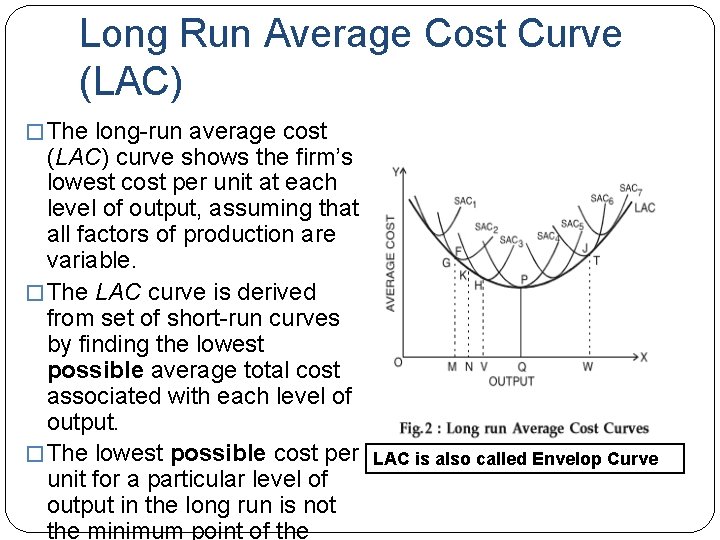
Long Run Average Cost Curve (LAC) � The long-run average cost (LAC) curve shows the firm’s lowest cost per unit at each level of output, assuming that all factors of production are variable. � The LAC curve is derived from set of short-run curves by finding the lowest possible average total cost associated with each level of output. � The lowest possible cost per unit for a particular level of output in the long run is not the minimum point of the LAC is also called Envelop Curve
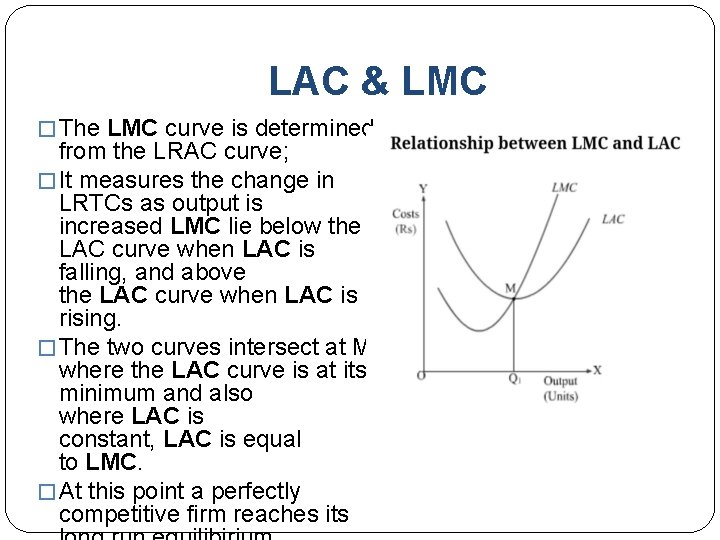
LAC & LMC � The LMC curve is determined from the LRAC curve; � It measures the change in LRTCs as output is increased LMC lie below the LAC curve when LAC is falling, and above the LAC curve when LAC is rising. � The two curves intersect at M, where the LAC curve is at its minimum and also where LAC is constant, LAC is equal to LMC. � At this point a perfectly competitive firm reaches its

Chapter taught by: DR. CHANDAN ROY (9932395130) chandanroy 70@gmail. com ASSOCIATE PROFESSOR KALIYAGANJ COLLEGE
- Slides: 14