
Semaphores CSCI 201 Principles of Software Development Jeffrey

- Slides: 6
Semaphores CSCI 201 Principles of Software Development Jeffrey Miller, Ph. D. jeffrey. miller@usc. edu
Outline • Semaphores USC CSCI 201 L
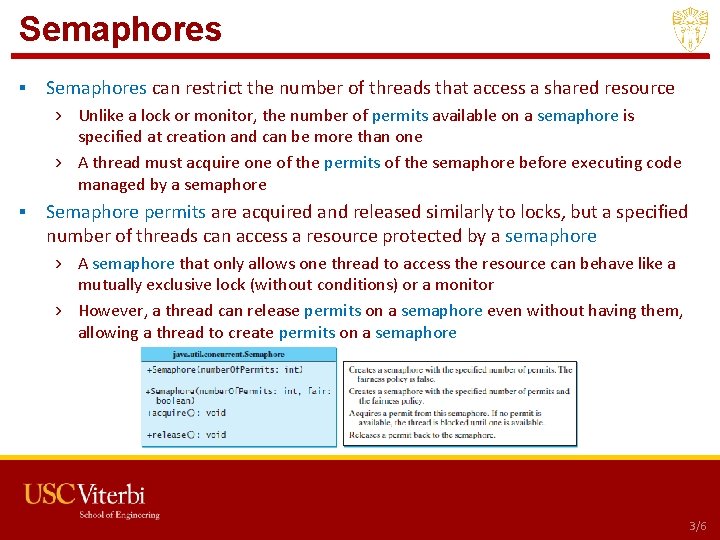
Semaphores ▪ Semaphores can restrict the number of threads that access a shared resource › Unlike a lock or monitor, the number of permits available on a semaphore is specified at creation and can be more than one › A thread must acquire one of the permits of the semaphore before executing code managed by a semaphore ▪ Semaphore permits are acquired and released similarly to locks, but a specified number of threads can access a resource protected by a semaphore › A semaphore that only allows one thread to access the resource can behave like a mutually exclusive lock (without conditions) or a monitor › However, a thread can release permits on a semaphore even without having them, allowing a thread to create permits on a semaphore USC CSCI 201 L 3/6
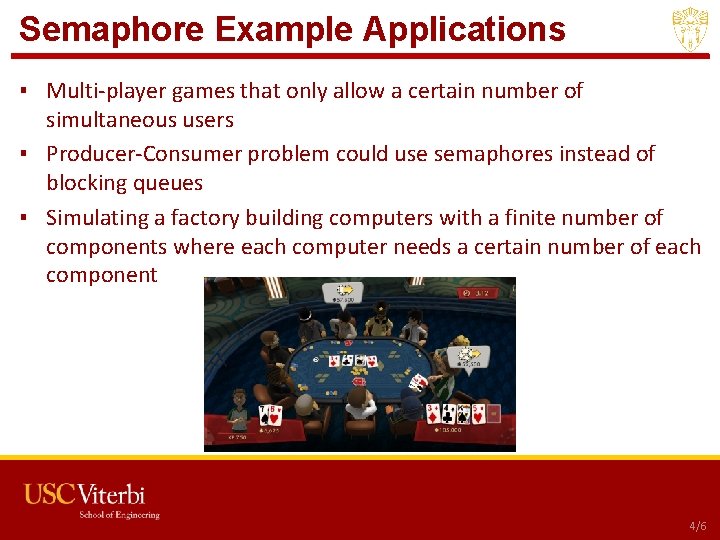
Semaphore Example Applications ▪ Multi-player games that only allow a certain number of simultaneous users ▪ Producer-Consumer problem could use semaphores instead of blocking queues ▪ Simulating a factory building computers with a finite number of components where each computer needs a certain number of each component USC CSCI 201 L 4/6
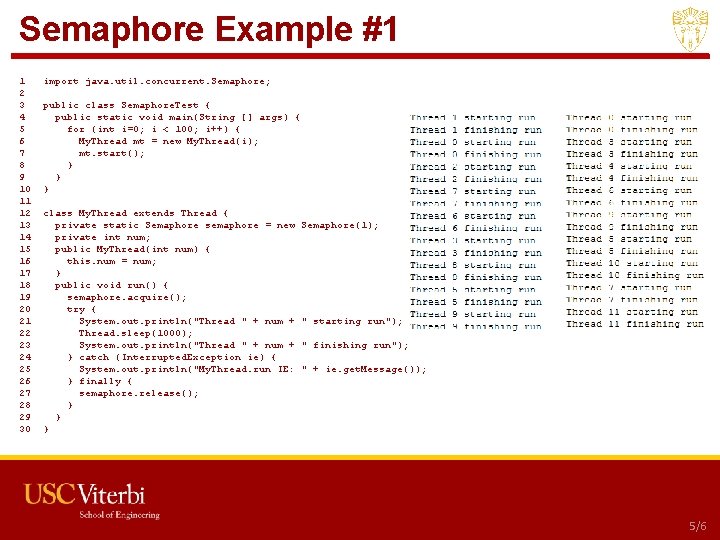
Semaphore Example #1 1 2 3 4 5 6 7 8 9 10 11 12 13 14 15 16 17 18 19 20 21 22 23 24 25 26 27 28 29 30 import java. util. concurrent. Semaphore; public class Semaphore. Test { public static void main(String [] args) { for (int i=0; i < 100; i++) { My. Thread mt = new My. Thread(i); mt. start(); } } } class My. Thread extends Thread { private static Semaphore semaphore = new private int num; public My. Thread(int num) { this. num = num; } public void run() { semaphore. acquire(); try { System. out. println("Thread " + num + Thread. sleep(1000); System. out. println("Thread " + num + } catch (Interrupted. Exception ie) { System. out. println("My. Thread. run IE: } finally { semaphore. release(); } } } Semaphore(1); " starting run"); " finishing run"); " + ie. get. Message()); USC CSCI 201 L 5/6
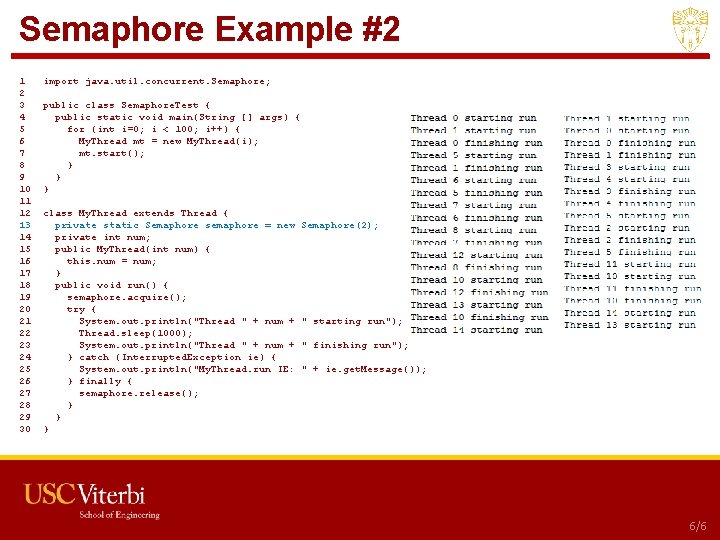
Semaphore Example #2 1 2 3 4 5 6 7 8 9 10 11 12 13 14 15 16 17 18 19 20 21 22 23 24 25 26 27 28 29 30 import java. util. concurrent. Semaphore; public class Semaphore. Test { public static void main(String [] args) { for (int i=0; i < 100; i++) { My. Thread mt = new My. Thread(i); mt. start(); } } } class My. Thread extends Thread { private static Semaphore semaphore = new private int num; public My. Thread(int num) { this. num = num; } public void run() { semaphore. acquire(); try { System. out. println("Thread " + num + Thread. sleep(1000); System. out. println("Thread " + num + } catch (Interrupted. Exception ie) { System. out. println("My. Thread. run IE: } finally { semaphore. release(); } } } Semaphore(2); " starting run"); " finishing run"); " + ie. get. Message()); USC CSCI 201 L 6/6