
Semantic Web Services Karl Aberer EPFL Syntax Semantics
"Semantic" Web Services Karl Aberer - EPFL
Syntax - Semantics • Separation of concerns for documents: XML – RDF • XML = exchange format • RDF = data model • Relationship XML – RDF • How can we carry on this separation for web services ? – purpose: communication – purpose: conceptualization – 1: RDF -> n: XML (different serializations, formal translation) – 1: XML -> n: RDF (different annotations, interpretation – non-formal)
Stateless Web Services • functions addressable and accessible through Web standards • f(I): O (syntactic representation given e. g. in WSDL) • Semantic description (annotation) – URI's, message interfaces – f is a resource, thus may belong to some RDF class • problem: binding semantic to syntactic description – I, O are resources, thus may belong to some RDF class • problem: as before – f implements a relationship I-O • problem: characterize its nature, current possibilities in RDF/OIL probably insufficient
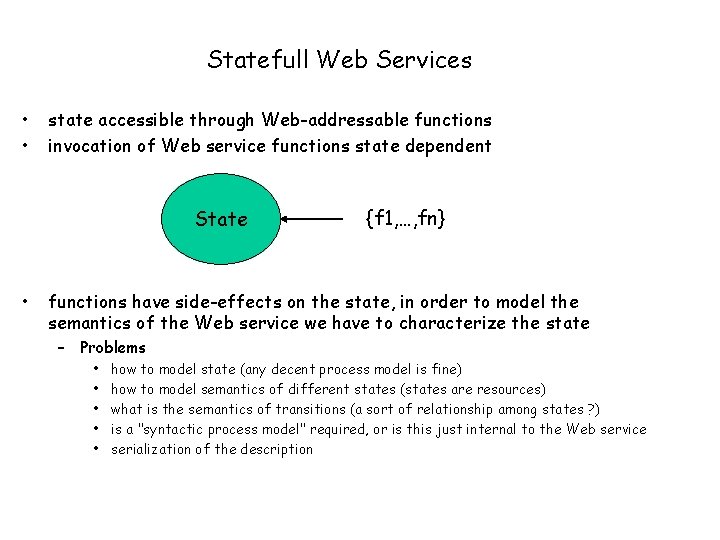
Statefull Web Services • • state accessible through Web-addressable functions invocation of Web service functions state dependent State • {f 1, …, fn} functions have side-effects on the state, in order to model the semantics of the Web service we have to characterize the state – Problems • • • how to model state (any decent process model is fine) how to model semantics of different states (states are resources) what is the semantics of transitions (a sort of relationship among states ? ) is a "syntactic process model" required, or is this just internal to the Web service serialization of the description
- Slides: 4