
Semantic Web in Depth Schema org RDFa JSONLD

Semantic Web in Depth Schema. org RDFa, JSON-LD, Microdata Professor Steffen Staab s. r. staab@ecs. soton. ac. uk 2019, Many slides courtesy by Dr. Nick Gibbins
Embedding Semantic Web Data http: //www. flickr. com/photos/40472757@N 07/4508416502/
Embedded Data • Publishing patterns for linked data that we’ve already considered make the assumption that we’re publishing directly in RDF/OWL • What if the data already exists in a web resource, in some form?
Embedded Data • Republishing the data separately introduces redundancy, and the possibility of inconsistency - embed our SW data in the web resource • Existing approaches: – JSON-LD – RDFa – Microdata Supported by schema. org – Microformats(2) – GRDDL (W 3 C recommendation 2007)

Schema. org
Metadata for Search Engine Optimization • Meta tag already available in early versions of HTML • Objective: Indication of relevance • Search. Monkey (2008) • Metadata to make Yahoo! search results visually more appealing • Spammed! Highly unsuccessful • Turned into schema. org (2011) • Initiative by Google, Bing, Yahoo, later: Yandex
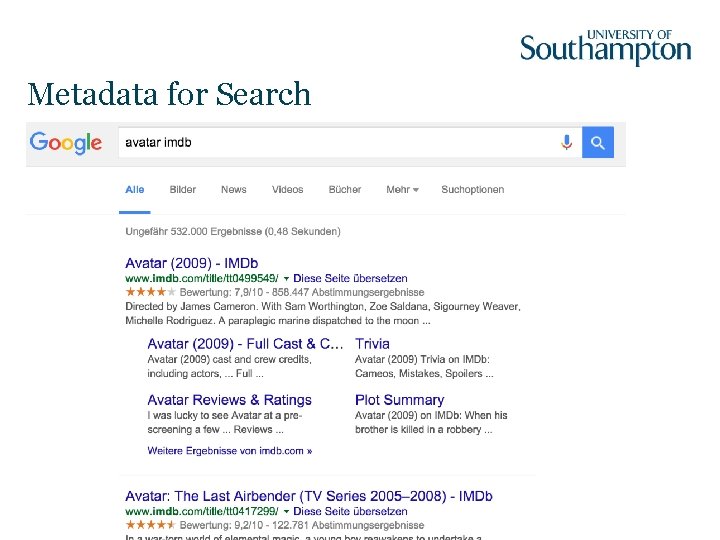
Metadata for Search
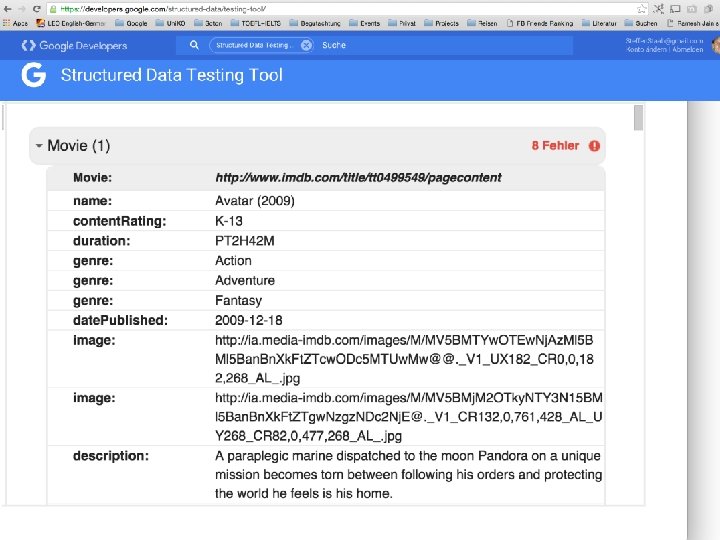
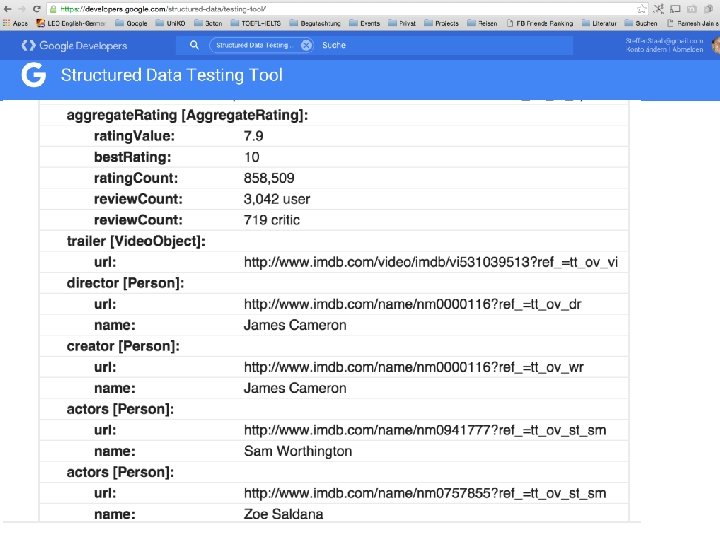
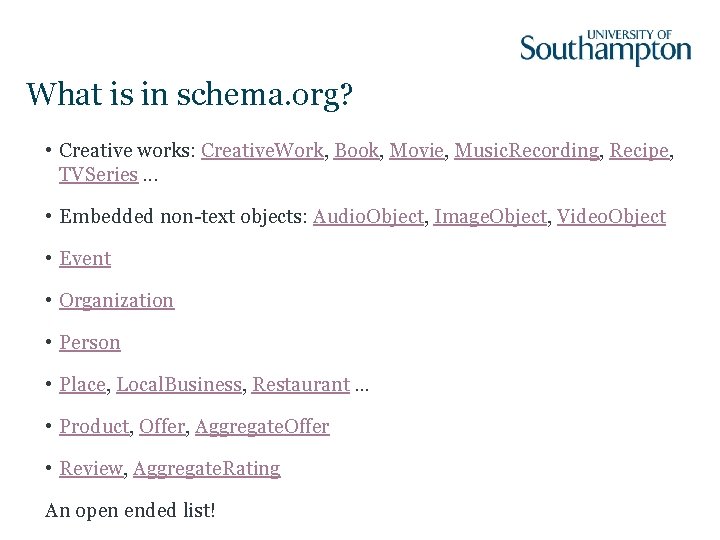
What is in schema. org? • Creative works: Creative. Work, Book, Movie, Music. Recording, Recipe, TVSeries. . . • Embedded non-text objects: Audio. Object, Image. Object, Video. Object • Event • Organization • Person • Place, Local. Business, Restaurant. . . • Product, Offer, Aggregate. Offer • Review, Aggregate. Rating An open ended list!

Return on Investment • Best. Buy early adopter - Launched Semantic Product Web, augmented with Good. Relations and RDFa, - 30% increase in traffic to their pages. - (not a scientifically precise experiment!) • Nick Cox@Yahoo! - search results augmented with structured data get 15% higher click-through rate Cf http: //www. chiefmartec. com/2009/12/best-buy-jump-starts-dataweb-marketing. html

Microdata
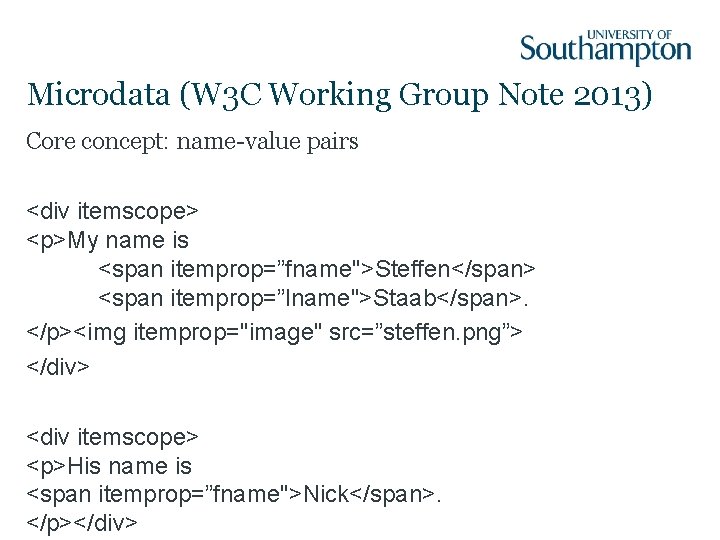
Microdata (W 3 C Working Group Note 2013) Core concept: name-value pairs <div itemscope> <p>My name is <span itemprop=”fname">Steffen</span> <span itemprop=”lname">Staab</span>. </p><img itemprop="image" src=”steffen. png”> </div> <div itemscope> <p>His name is <span itemprop=”fname">Nick</span>. </p></div>
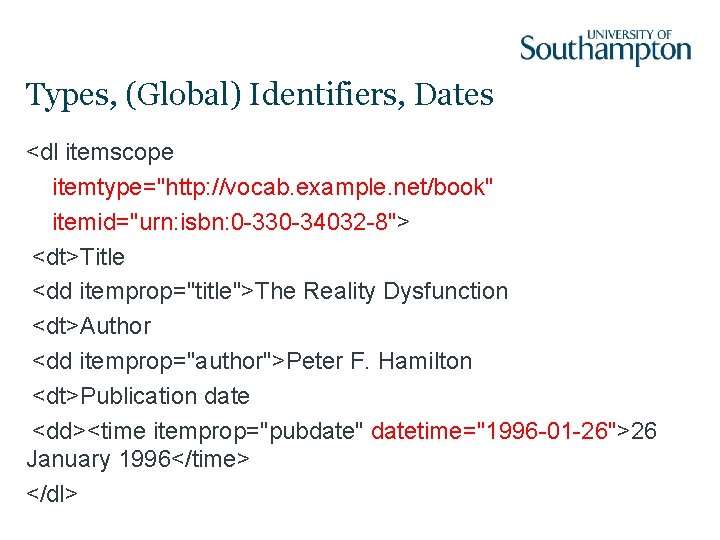
Types, (Global) Identifiers, Dates <dl itemscope itemtype="http: //vocab. example. net/book" itemid="urn: isbn: 0 -330 -34032 -8"> <dt>Title <dd itemprop="title">The Reality Dysfunction <dt>Author <dd itemprop="author">Peter F. Hamilton <dt>Publication date <dd><time itemprop="pubdate" datetime="1996 -01 -26">26 January 1996</time> </dl>
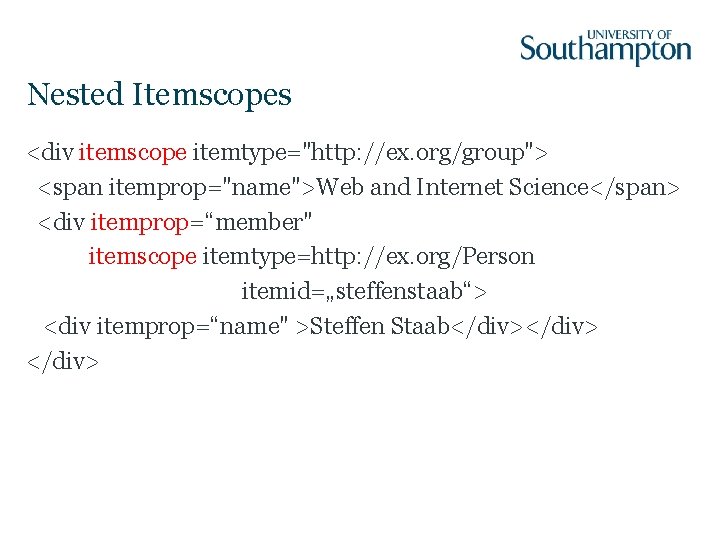
Nested Itemscopes <div itemscope itemtype="http: //ex. org/group"> <span itemprop="name">Web and Internet Science</span> <div itemprop=“member" itemscope itemtype=http: //ex. org/Person itemid=„steffenstaab“> <div itemprop=“name" >Steffen Staab</div>
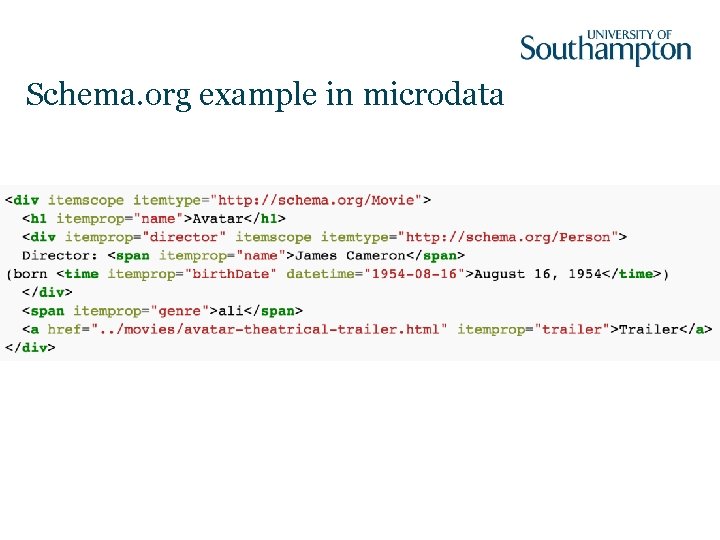
Schema. org example in microdata

RDFa
RDFa Yet another syntax for RDF… – Designed for embedding structured data in web pages – Stored structure in attributes (the ‘a’ in ‘RDFa’)
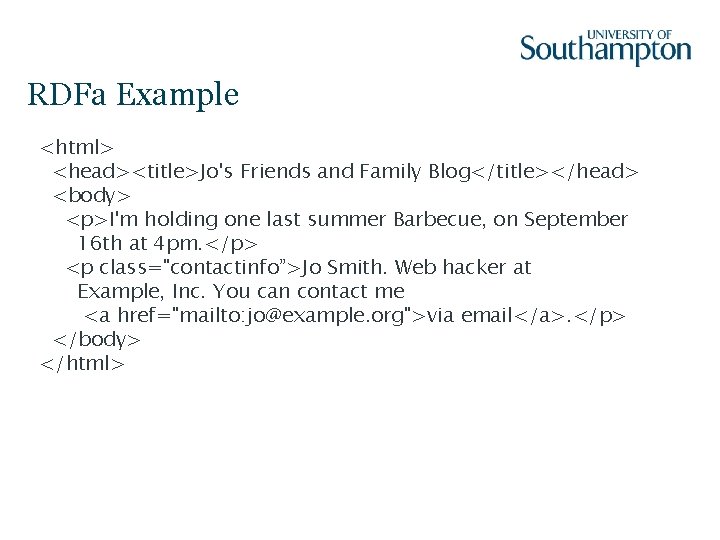
RDFa Example <html> <head><title>Jo's Friends and Family Blog</title></head> <body> <p>I'm holding one last summer Barbecue, on September 16 th at 4 pm. </p> <p class="contactinfo”>Jo Smith. Web hacker at Example, Inc. You can contact me <a href="mailto: jo@example. org">via email</a>. </p> </body> </html>
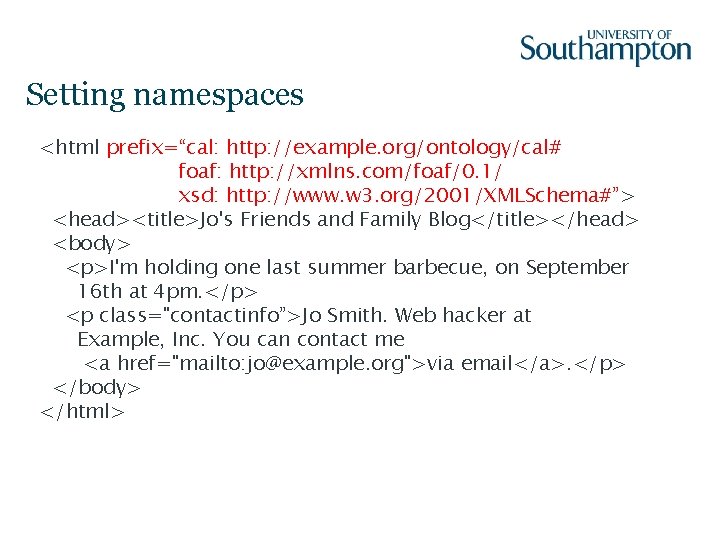
Setting namespaces <html prefix=“cal: http: //example. org/ontology/cal# foaf: http: //xmlns. com/foaf/0. 1/ xsd: http: //www. w 3. org/2001/XMLSchema#”> <head><title>Jo's Friends and Family Blog</title></head> <body> <p>I'm holding one last summer barbecue, on September 16 th at 4 pm. </p> <p class="contactinfo”>Jo Smith. Web hacker at Example, Inc. You can contact me <a href="mailto: jo@example. org">via email</a>. </p> </body> </html>
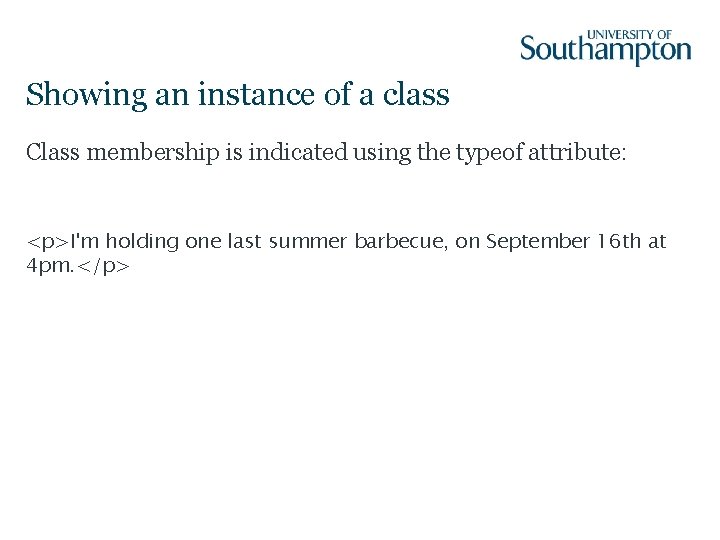
Showing an instance of a class Class membership is indicated using the typeof attribute: <p>I'm holding one last summer barbecue, on September 16 th at 4 pm. </p>
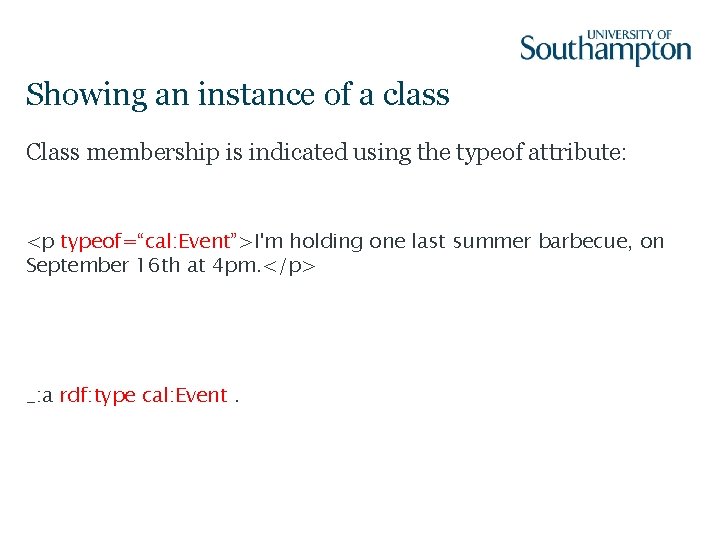
Showing an instance of a class Class membership is indicated using the typeof attribute: <p typeof=“cal: Event”>I'm holding one last summer barbecue, on September 16 th at 4 pm. </p> _: a rdf: type cal: Event.
Using properties: predicates The predicate of a triple is indicated using the property attribute: <p>I'm holding one last summer barbecue, on September 16 th at 4 pm. </p>
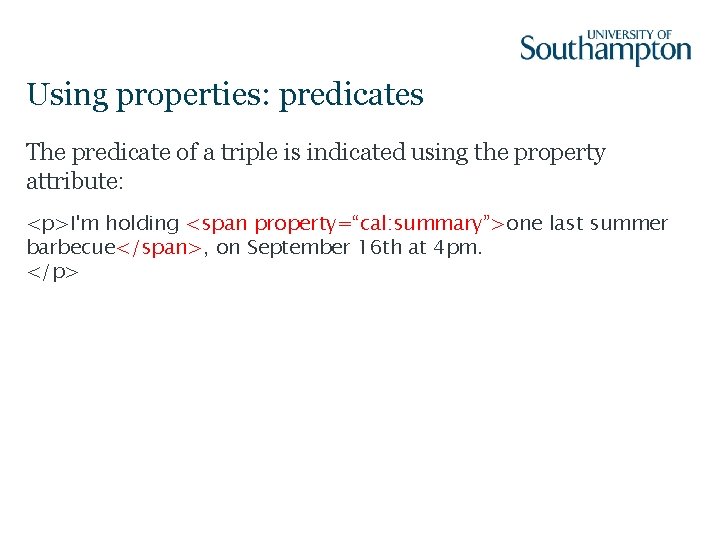
Using properties: predicates The predicate of a triple is indicated using the property attribute: <p>I'm holding <span property=“cal: summary”>one last summer barbecue</span>, on September 16 th at 4 pm. </p>
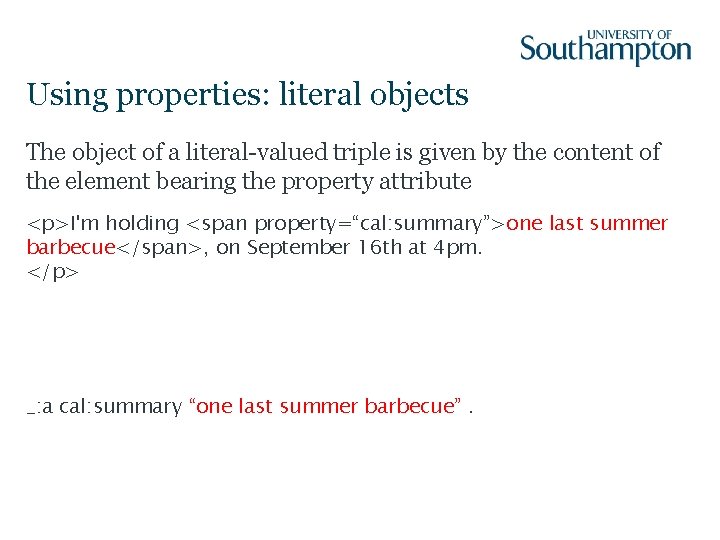
Using properties: literal objects The object of a literal-valued triple is given by the content of the element bearing the property attribute <p>I'm holding <span property=“cal: summary”>one last summer barbecue</span>, on September 16 th at 4 pm. </p> _: a cal: summary “one last summer barbecue”.
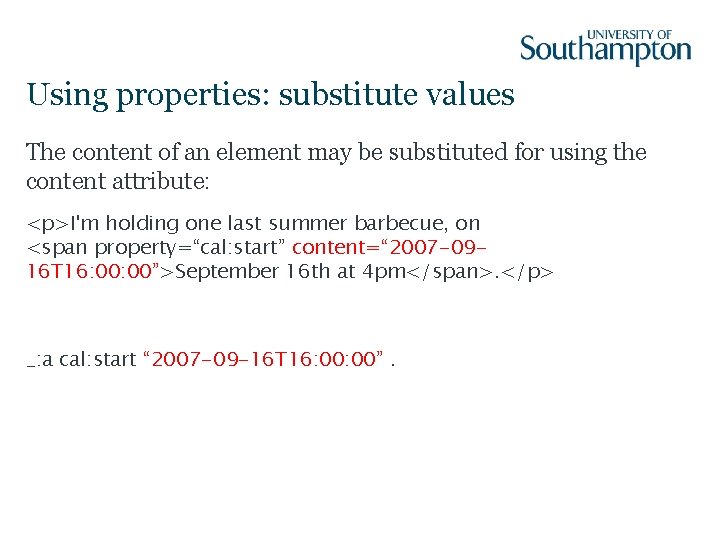
Using properties: substitute values The content of an element may be substituted for using the content attribute: <p>I'm holding one last summer barbecue, on <span property=“cal: start” content=“ 2007 -0916 T 16: 00”>September 16 th at 4 pm</span>. </p> _: a cal: start “ 2007 -09 -16 T 16: 00”.
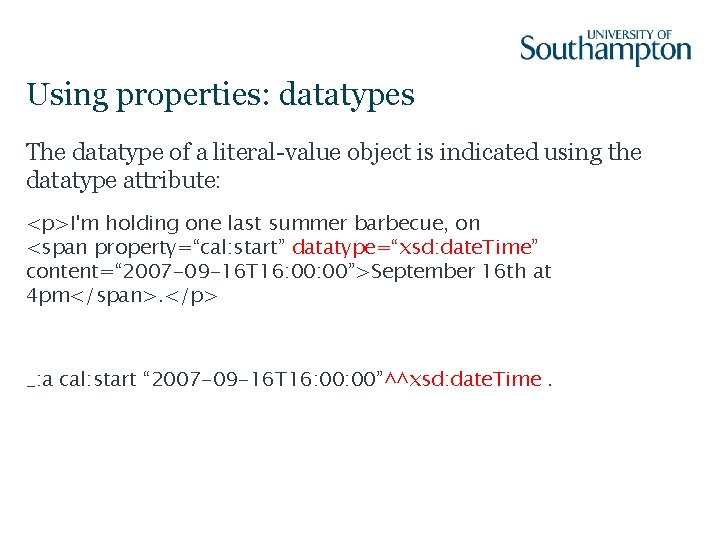
Using properties: datatypes The datatype of a literal-value object is indicated using the datatype attribute: <p>I'm holding one last summer barbecue, on <span property=“cal: start” datatype=“xsd: date. Time” content=“ 2007 -09 -16 T 16: 00”>September 16 th at 4 pm</span>. </p> _: a cal: start “ 2007 -09 -16 T 16: 00”^^xsd: date. Time.
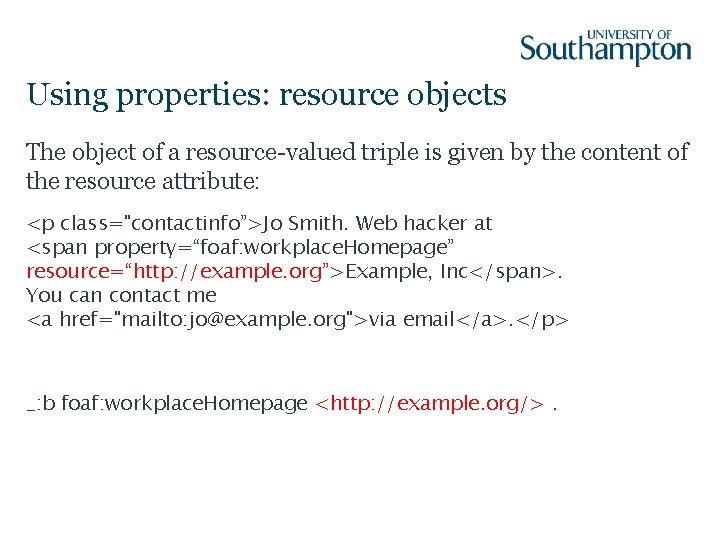
Using properties: resource objects The object of a resource-valued triple is given by the content of the resource attribute: <p class="contactinfo”>Jo Smith. Web hacker at <span property=“foaf: workplace. Homepage” resource=“http: //example. org”>Example, Inc</span>. You can contact me <a href="mailto: jo@example. org">via email</a>. </p> _: b foaf: workplace. Homepage <http: //example. org/>.
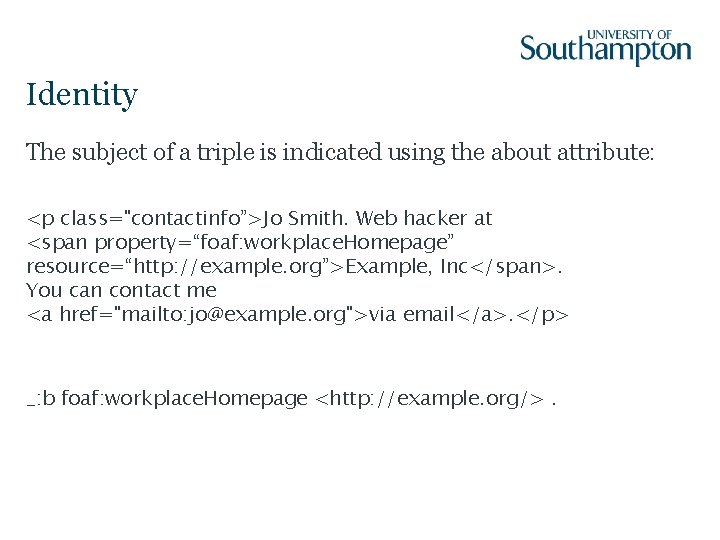
Identity The subject of a triple is indicated using the about attribute: <p class="contactinfo”>Jo Smith. Web hacker at <span property=“foaf: workplace. Homepage” resource=“http: //example. org”>Example, Inc</span>. You can contact me <a href="mailto: jo@example. org">via email</a>. </p> _: b foaf: workplace. Homepage <http: //example. org/>.
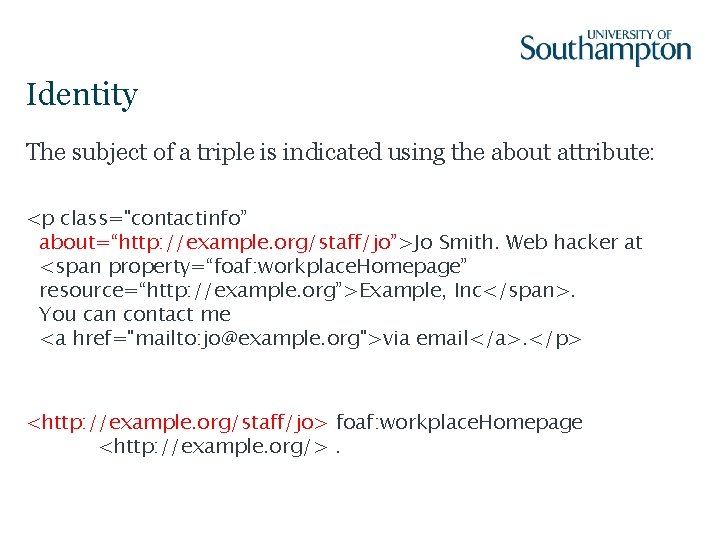
Identity The subject of a triple is indicated using the about attribute: <p class="contactinfo” about=“http: //example. org/staff/jo”>Jo Smith. Web hacker at <span property=“foaf: workplace. Homepage” resource=“http: //example. org”>Example, Inc</span>. You can contact me <a href="mailto: jo@example. org">via email</a>. </p> <http: //example. org/staff/jo> foaf: workplace. Homepage <http: //example. org/>.
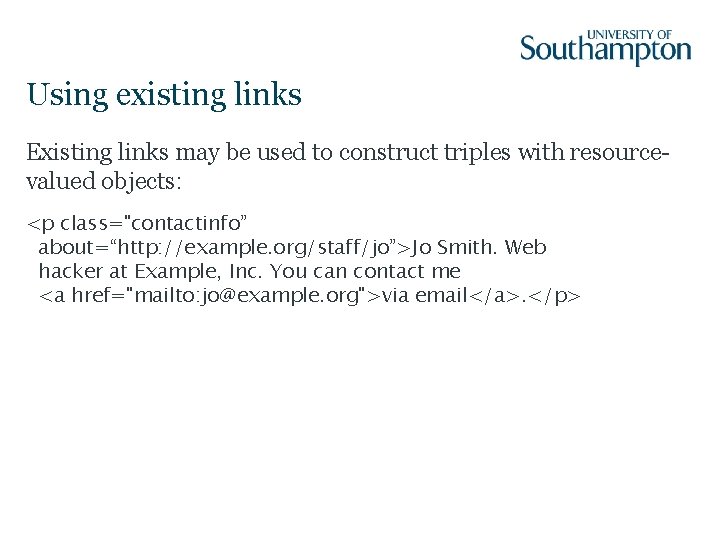
Using existing links Existing links may be used to construct triples with resourcevalued objects: <p class="contactinfo” about=“http: //example. org/staff/jo”>Jo Smith. Web hacker at Example, Inc. You can contact me <a href="mailto: jo@example. org">via email</a>. </p>
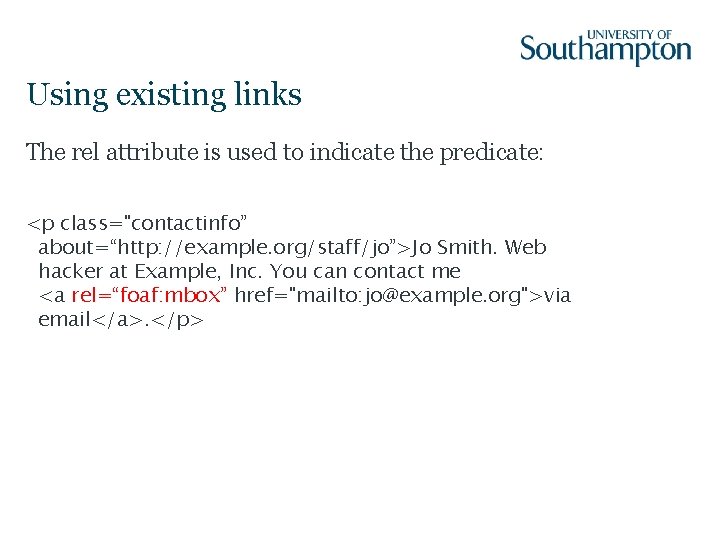
Using existing links The rel attribute is used to indicate the predicate: <p class="contactinfo” about=“http: //example. org/staff/jo”>Jo Smith. Web hacker at Example, Inc. You can contact me <a rel=“foaf: mbox” href="mailto: jo@example. org">via email</a>. </p>
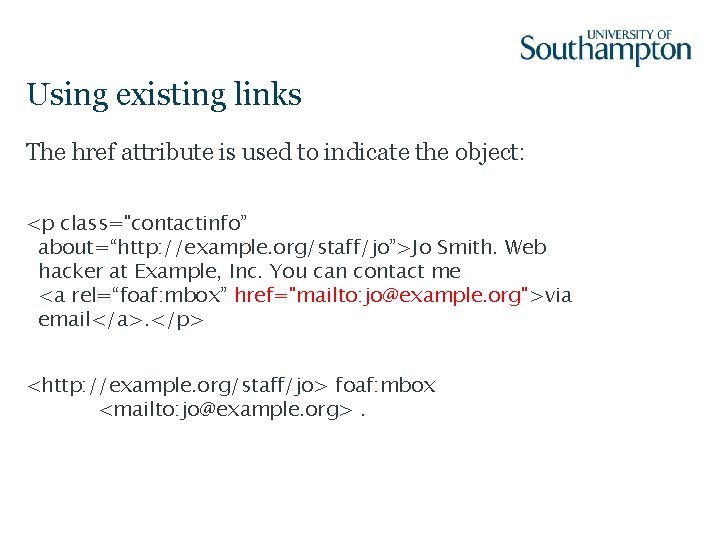
Using existing links The href attribute is used to indicate the object: <p class="contactinfo” about=“http: //example. org/staff/jo”>Jo Smith. Web hacker at Example, Inc. You can contact me <a rel=“foaf: mbox” href="mailto: jo@example. org">via email</a>. </p> <http: //example. org/staff/jo> foaf: mbox <mailto: jo@example. org>.
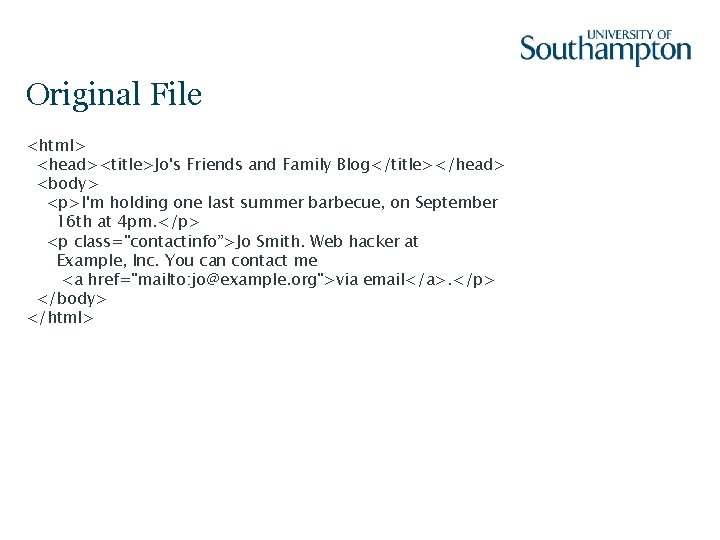
Original File <html> <head><title>Jo's Friends and Family Blog</title></head> <body> <p>I'm holding one last summer barbecue, on September 16 th at 4 pm. </p> <p class="contactinfo”>Jo Smith. Web hacker at Example, Inc. You can contact me <a href="mailto: jo@example. org">via email</a>. </p> </body> </html>
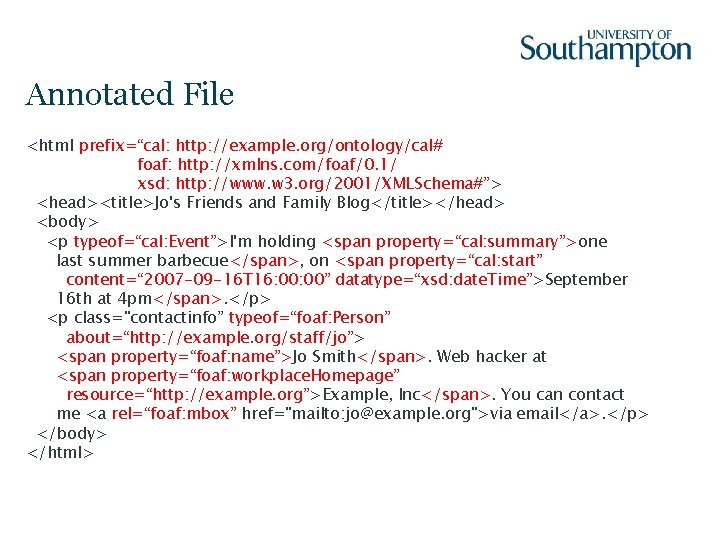
Annotated File <html prefix=“cal: http: //example. org/ontology/cal# foaf: http: //xmlns. com/foaf/0. 1/ xsd: http: //www. w 3. org/2001/XMLSchema#”> <head><title>Jo's Friends and Family Blog</title></head> <body> <p typeof=“cal: Event”>I'm holding <span property=“cal: summary”>one last summer barbecue</span>, on <span property=“cal: start” content=“ 2007 -09 -16 T 16: 00” datatype=“xsd: date. Time”>September 16 th at 4 pm</span>. </p> <p class="contactinfo” typeof=“foaf: Person” about=“http: //example. org/staff/jo”> <span property=“foaf: name”>Jo Smith</span>. Web hacker at <span property=“foaf: workplace. Homepage” resource=“http: //example. org”>Example, Inc</span>. You can contact me <a rel=“foaf: mbox” href="mailto: jo@example. org">via email</a>. </p> </body> </html>
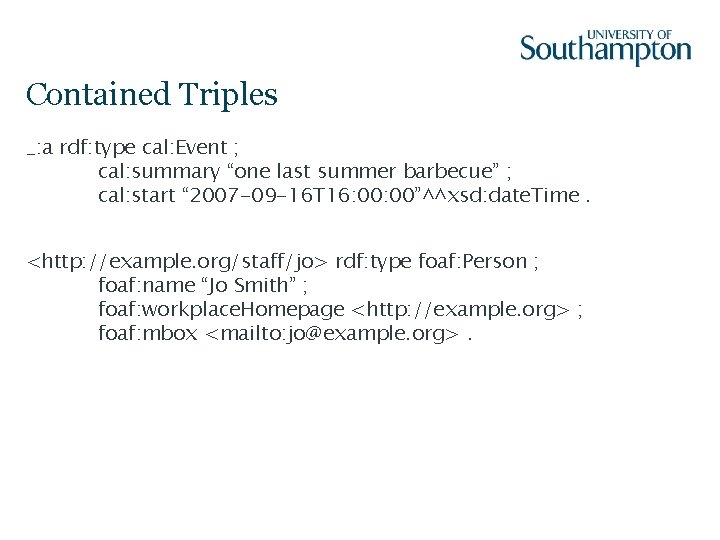
Contained Triples _: a rdf: type cal: Event ; cal: summary “one last summer barbecue” ; cal: start “ 2007 -09 -16 T 16: 00”^^xsd: date. Time. <http: //example. org/staff/jo> rdf: type foaf: Person ; foaf: name “Jo Smith” ; foaf: workplace. Homepage <http: //example. org> ; foaf: mbox <mailto: jo@example. org>.
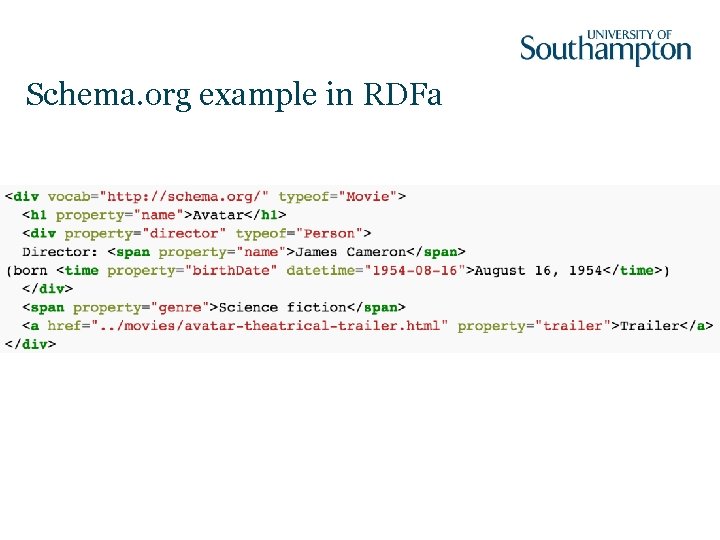
Schema. org example in RDFa
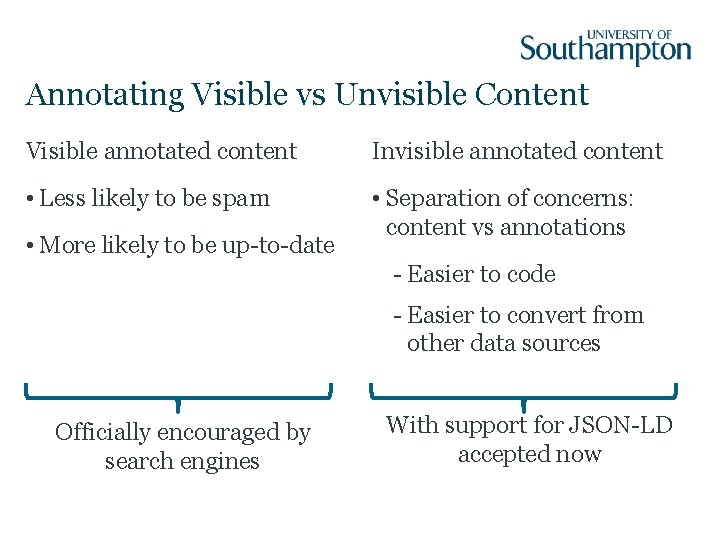
Annotating Visible vs Unvisible Content Visible annotated content Invisible annotated content • Less likely to be spam • Separation of concerns: content vs annotations • More likely to be up-to-date - Easier to code - Easier to convert from other data sources Officially encouraged by search engines With support for JSON-LD accepted now

JSON-LD
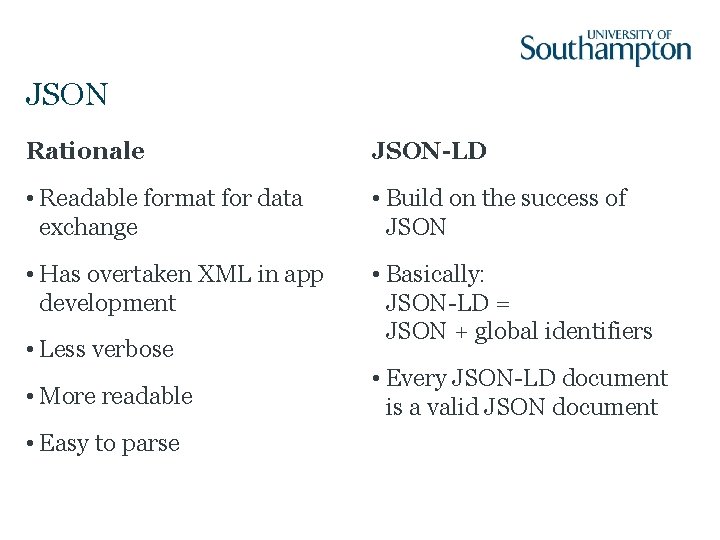
JSON Rationale JSON-LD • Readable format for data exchange • Build on the success of JSON • Has overtaken XML in app development • Basically: JSON-LD = JSON + global identifiers • Less verbose • More readable • Easy to parse • Every JSON-LD document is a valid JSON document
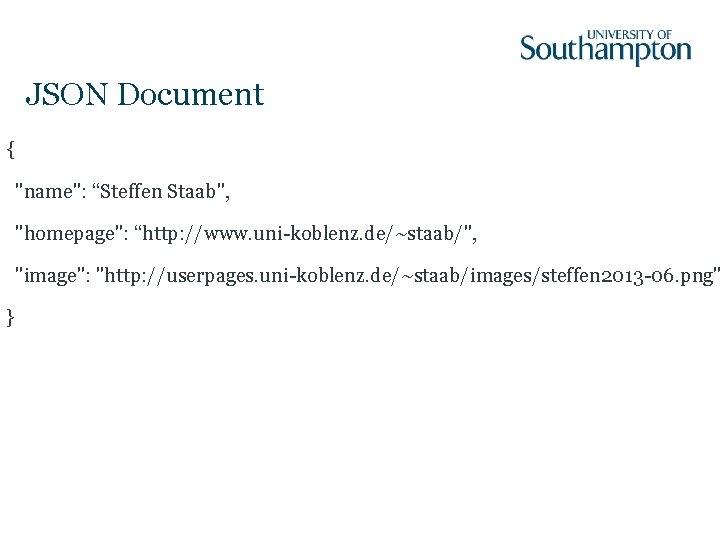
JSON Document { "name": “Steffen Staab", "homepage": “http: //www. uni-koblenz. de/~staab/", "image": "http: //userpages. uni-koblenz. de/~staab/images/steffen 2013 -06. png" }
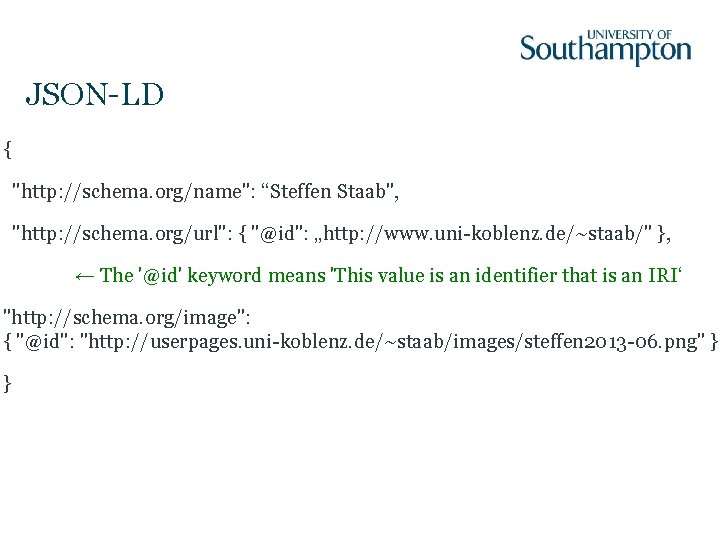
JSON-LD { "http: //schema. org/name": “Steffen Staab", "http: //schema. org/url": { "@id": „http: //www. uni-koblenz. de/~staab/" }, ← The '@id' keyword means 'This value is an identifier that is an IRI‘ "http: //schema. org/image": { "@id": "http: //userpages. uni-koblenz. de/~staab/images/steffen 2013 -06. png" } }
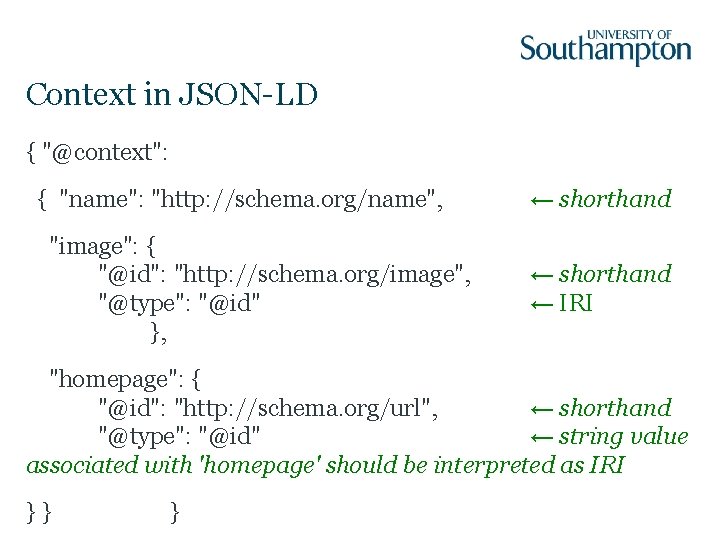
Context in JSON-LD { "@context": { "name": "http: //schema. org/name", "image": { "@id": "http: //schema. org/image", "@type": "@id" }, ← shorthand ← IRI "homepage": { "@id": "http: //schema. org/url", ← shorthand "@type": "@id" ← string value associated with 'homepage' should be interpreted as IRI }} }
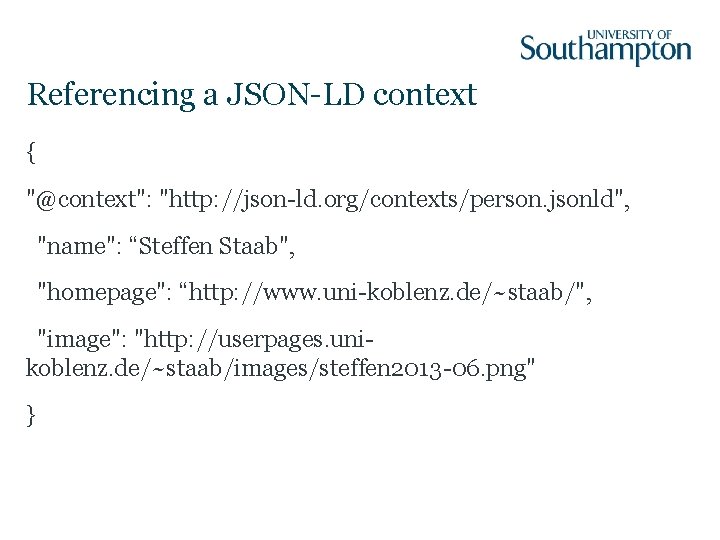
Referencing a JSON-LD context { "@context": "http: //json-ld. org/contexts/person. jsonld", "name": “Steffen Staab", "homepage": “http: //www. uni-koblenz. de/~staab/", "image": "http: //userpages. unikoblenz. de/~staab/images/steffen 2013 -06. png" }
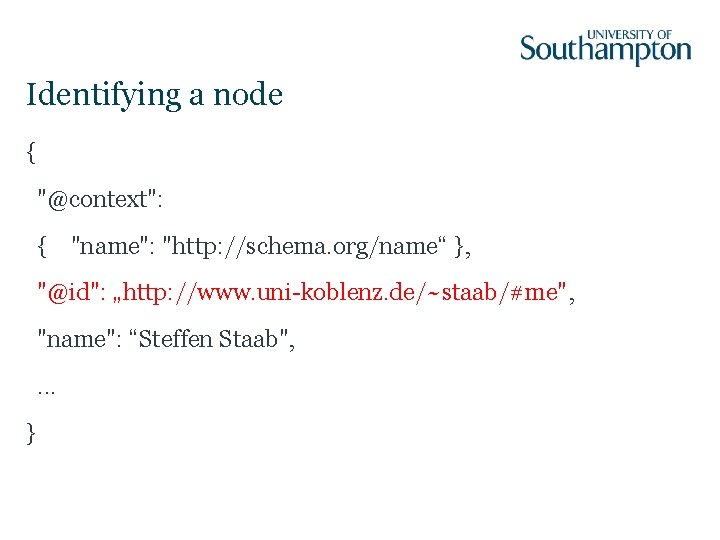
Identifying a node { "@context": { "name": "http: //schema. org/name“ }, "@id": „http: //www. uni-koblenz. de/~staab/#me", "name": “Steffen Staab", . . . }
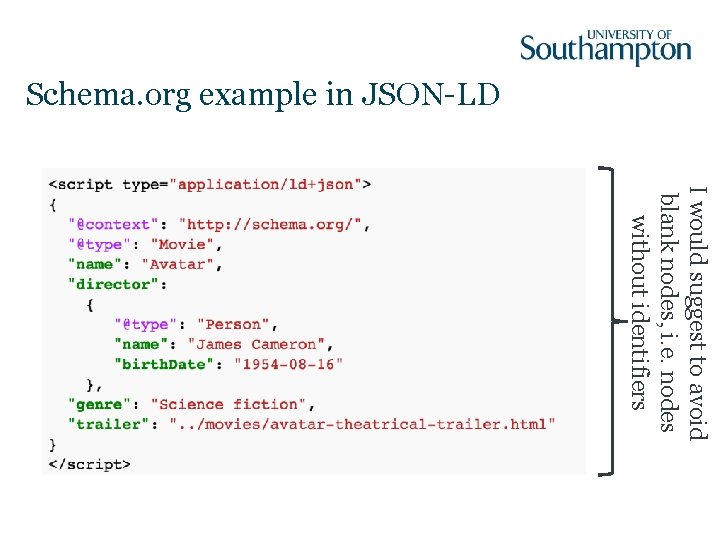
Schema. org example in JSON-LD I would suggest to avoid blank nodes, i. e. nodes without identifiers

Microformats
Microformats • Predefines syntax Vocabularies • Predefines and freezes vocabulary h-adr h-card h-entry h-event h-geo h-item h-product • Not officially supported by schema. org, but understood quite a bit by search engines h-recipe h-resume h-review-aggregate

GRDDL
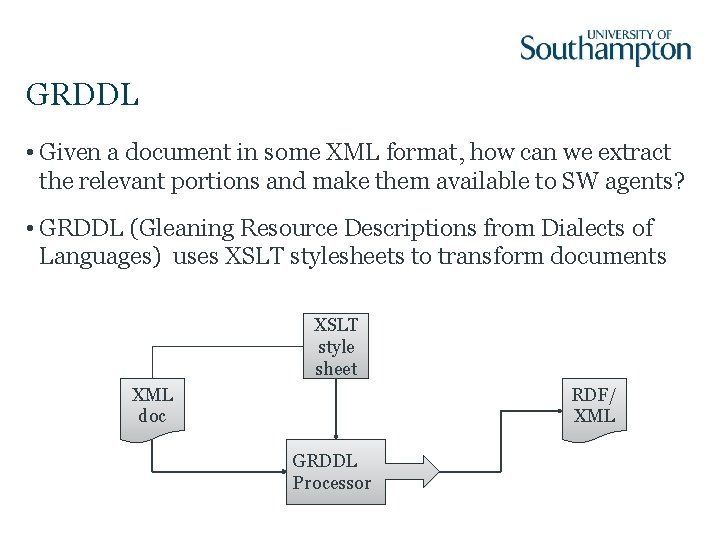
GRDDL • Given a document in some XML format, how can we extract the relevant portions and make them available to SW agents? • GRDDL (Gleaning Resource Descriptions from Dialects of Languages) uses XSLT stylesheets to transform documents XSLT style sheet XML doc RDF/ XML GRDDL Processor

Further Reading RDFa Core 1. 1 W 3 C Recommendation 22 August 2013 http: //www. w 3. org/TR/rdfa-syntax/ RDFa 1. 1 Primer (essential reading!) W 3 C Working Group Note 22 August 2013 http: //www. w 3. org/TR/xhtml-rdfa-primer/
- Slides: 51