
Semantic Web Development in Traditional Chinese Medicine Huajun
Semantic Web Development in Traditional Chinese Medicine Huajun Chen Zhejiang Unviersity
Semantic Web Development for Traditional Chinese Medicine What’s TCM? TCM Semantic Web TCM Ontology Engineering TCM Semantic Search Engine (Dart. Grid System) Semantic Graph Mining for biomedical network analysis
What’s TCM
What’s TCM? Traditional Chinese Medicine (TCM) is an ancient medical system that accounts for around 40% of all health cares delivered in China. Preventive Medicine Take medicine as like a daily nutrition supplement or part of food to maintain the balance of the whole body system. Personalized Medicine Treatment can be completely different for people with respect to their gender, age, health condition although they have very similar symptoms. Empirical Medicine The effect of many TCM drugs are based on more one thousand years of practices, whereas they do not know the specific underlying mechanism.
TCM Knowledge TCM theories derive from many knowledge sources including theories of Yin-Yang, Chinese five elements, the human body channel system, Zang Fu organ theory, holistic connections, mind-body intervention, and many others. TCM practice includes diagnosis and treatments theories such as herbal medicine and , massage and cupping, acupuncture and meridians.
TCM Semantic Web Project A project in collaboration with China Academy of Traditional Chinese Medicine.
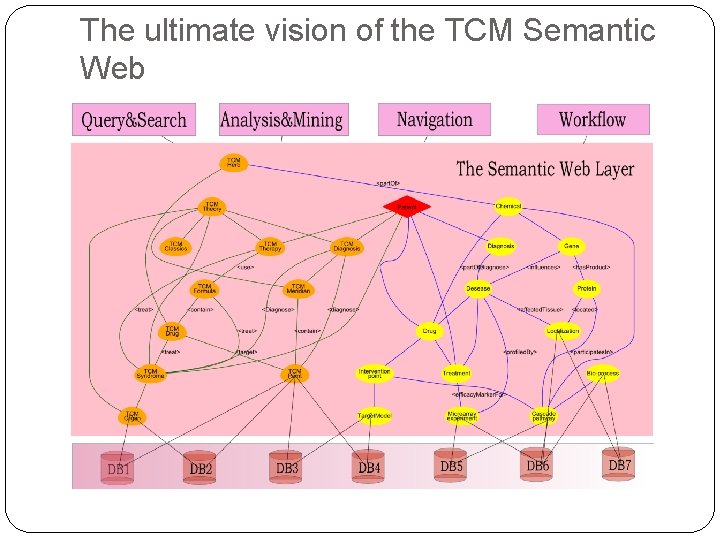
The ultimate vision of the TCM Semantic Web
The Subprojects TCM Ontology Engineering (2001 -current). The Dart. Grid Data Integration System (first started in 2002) Integrating legacy relational database into Semantic Web Dart. Mapper: Visulized relational-2 -RDF Mapper (2003 -2005) Dart. Query: SPARQL 2 SQL Query Rewriter and a Form-based SPARQL query builder (2003 -2006) Dart. Search: Semantic Search. (2005 -current) Semantic Data Analysis and Data Mining for Semantic Web Dart. Spora: semantic data analysis engine (2007 -current) Semantic Graph Mining for biomedical network analysis. (2007 - current)
TCM Ontology Engineering
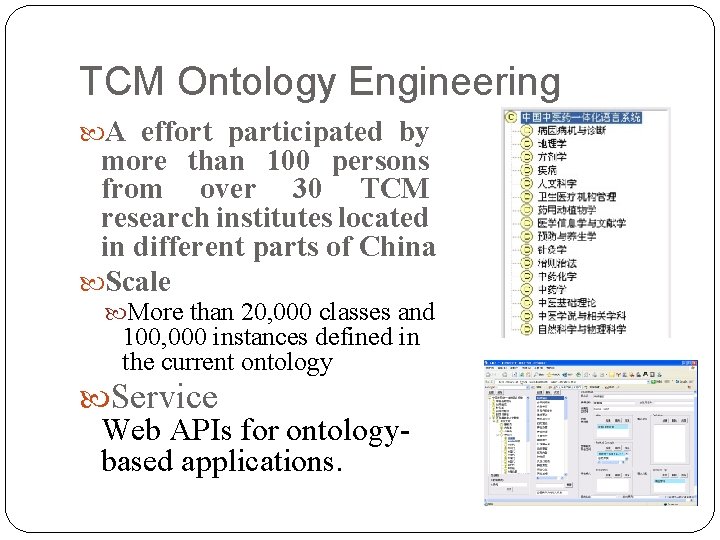
TCM Ontology Engineering A effort participated by more than 100 persons from over 30 TCM research institutes located in different parts of China Scale More than 20, 000 classes and 100, 000 instances defined in the current ontology Service Web APIs for ontologybased applications.
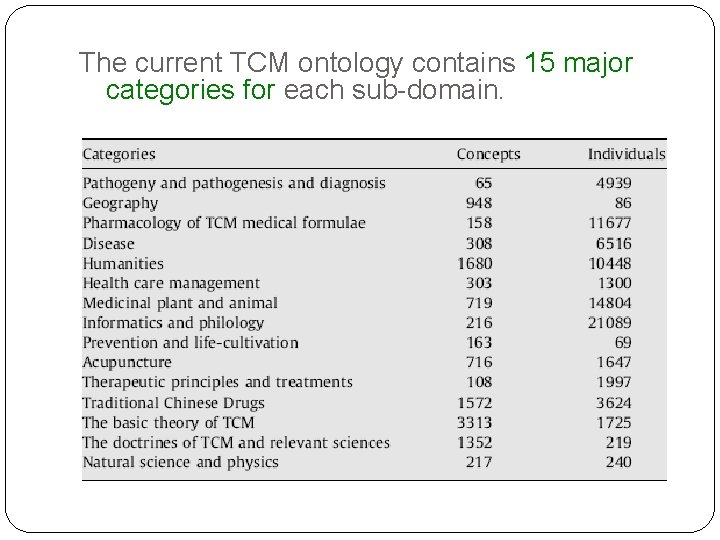
The current TCM ontology contains 15 major categories for each sub-domain.
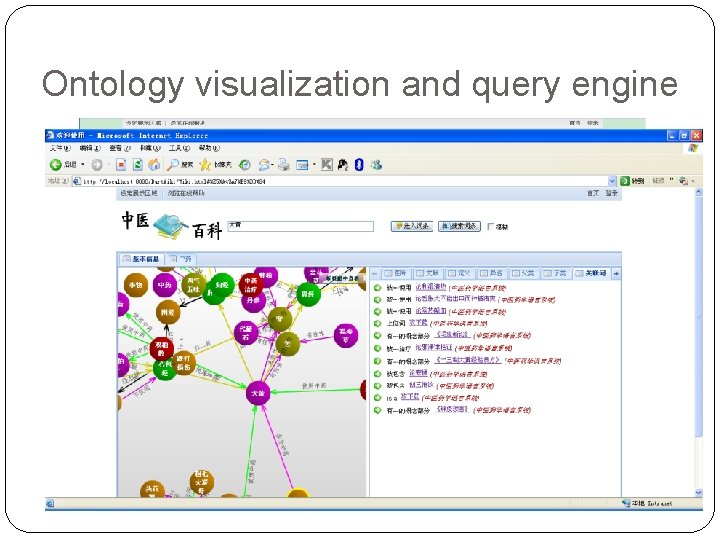
Ontology visualization and query engine
TCM Semantic Search Engine A semantic search engine build upon a lot of relational databases.
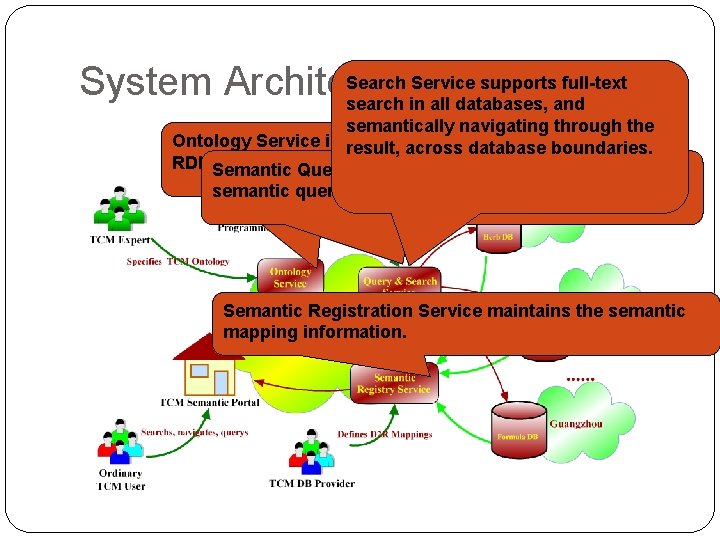
Search Service supports full-text System Architecture search in all databases, and semantically navigating through the Ontology Service is used exposedatabase the result, toacross boundaries. RDF/OWL ontologies. Semantic Query Service is used to process SPARQL semantic queries. Semantic Registration Service maintains the semantic mapping information.
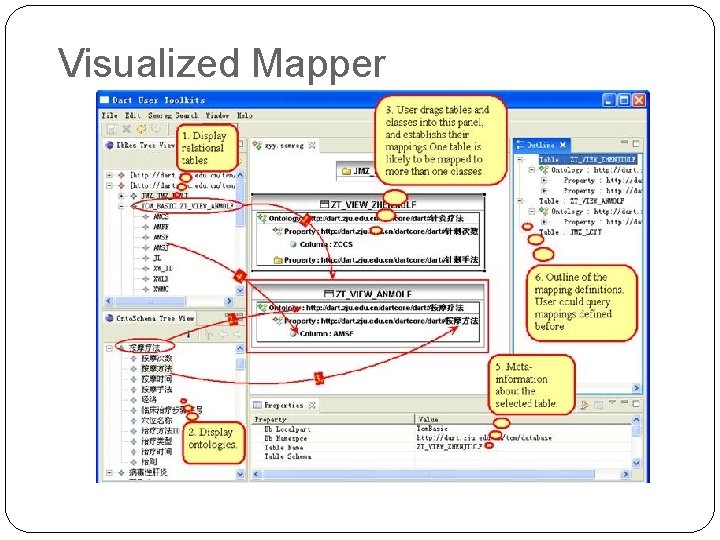
Visualized Mapper
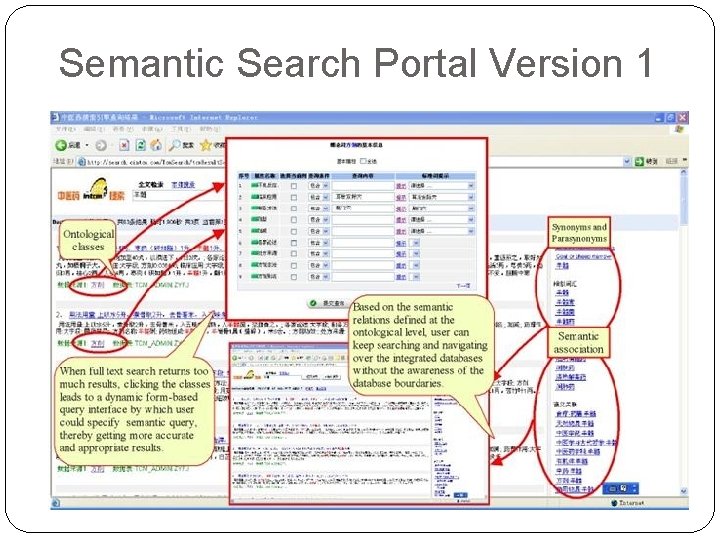
Semantic Search Portal Version 1
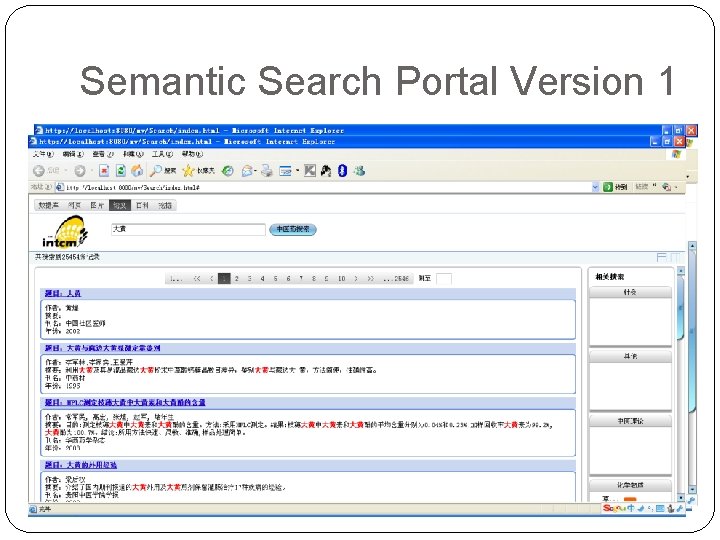
Semantic Search Portal Version 1
Semantic Data Analysis for TCM What kinds of new connections can be discovered or mined from this huge web of data?
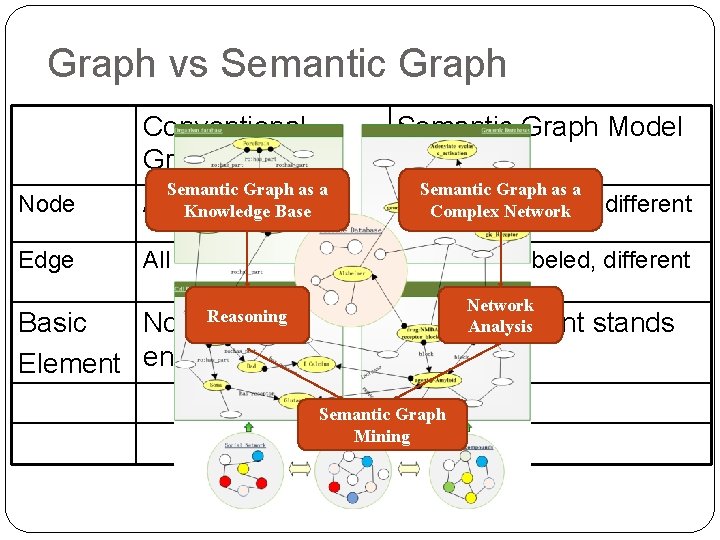
Graph vs Semantic Graph Conventional Graph Model Semantic Graph Model Node Semantic Graph as a All nodes are. Base identical Knowledge Semantic Graph as a Nodes are. Network labeled, Complex Edge All edges are identical Edges are labeled, different Reasoning Basic Nodes stand for Element entities Network statement Analysis RDF for facts. Semantic Graph Mining different stands
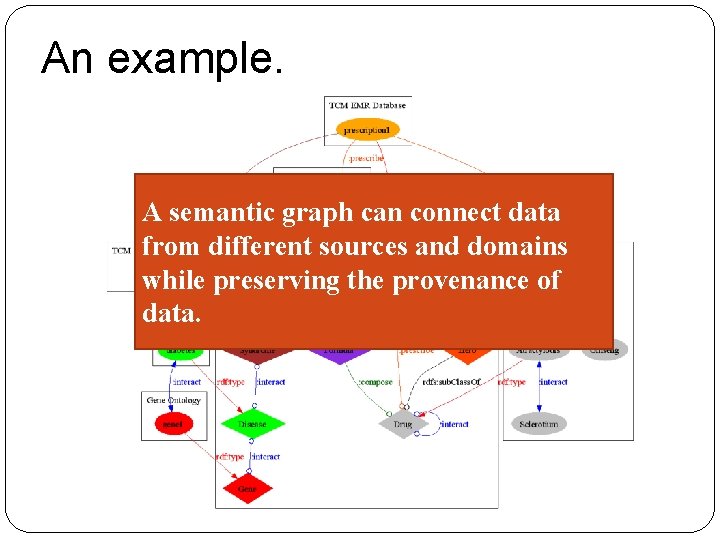
An example. A semantic graph can connect data from different sources and domains while preserving the provenance of data.
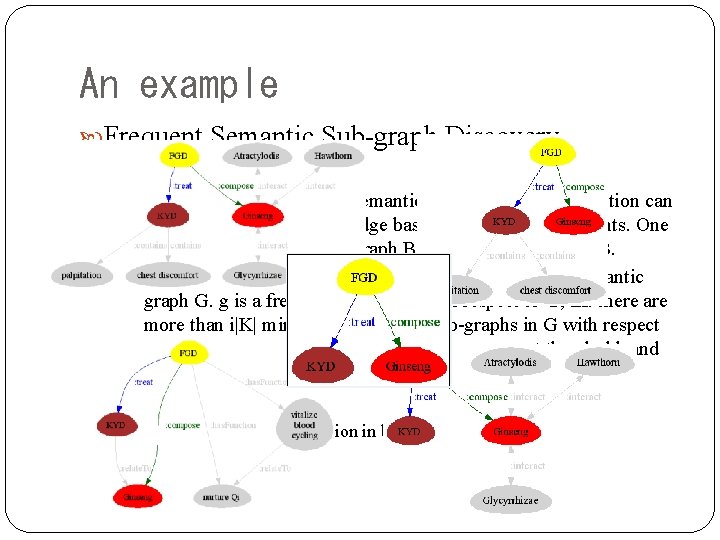
An example Frequent Semantic Sub-graph Discovery Problem Descriptions: Semantic Sub-graph. In a semantic graph G, every transaction can be represented as a knowledge base consisting of statements. One graph A is a sub-graph of graph B iff. A is subsumed by B. Frequent Semantic Sub-Graph. Give a graph g, and a semantic graph G. g is a frequent sub-graph with respect to G, iff. there are more than i|K| minimum subsumed sub-graphs in G with respect to g, where i is a user-specified minimum support threshold, and |K| is the total number of graphs in K. Applicatisions: Network motifs identification in biological networks Drug Efficacy Analysis
Semantic data analysis Semantic graph contains richer information than normal graph. It is based upon the integration capability of semantic web. Much more meaningful mining results: Discover the facts directly. Find more meaningful associations among entities. Calculate the network parameters in a more accurate way. Ontological reasoning can be leveraged to further facilitate the mining process. We need good tools to help do so.
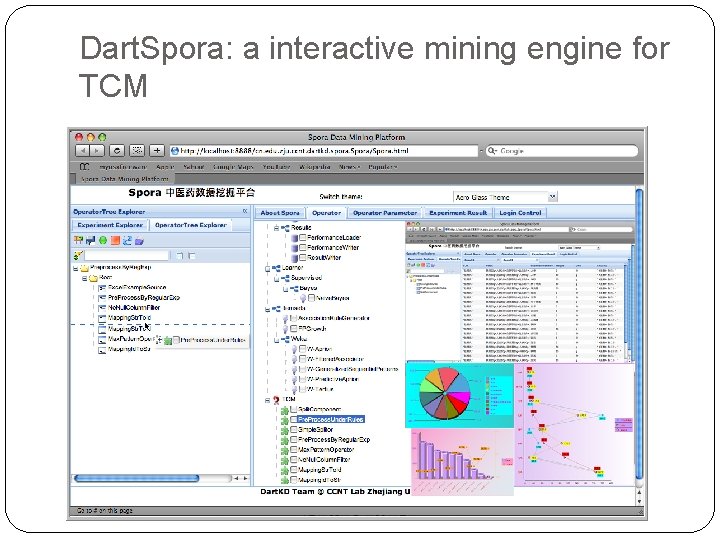
Dart. Spora: a interactive mining engine for TCM
Summary A Web of Data means a lot to us. It can enable fancy ways of searching and browsing the daunting online information space. It can also finally unleash the potential underlying disparate data sources to greatly facilitate and advance the data mining and knowledge discovery technology. But we need powerful tools to help us to achieve the goal.
Summary: Key Benefits of Semantic Web for TCM Fusion of data across many scientific discipline Easier recombination of data Querying of data at different levels of granularity Capture provenance of data through annotation Data can be assessed for inconsistencies Integrative knowledge discovery from largescale semantic graph formed by integrating cross-institutional, cross-dispinaries data
Thanks for your time!
- Slides: 26