
Semantic Web Core Concepts and Mechanisms MMI ORR
Semantic Web: Core Concepts and Mechanisms MMI ORR – Ontology Registry and Repository
What’s all this about?
• It’s all about formally capturing knowledge about the world so computers can be more useful so we can tackle pressing problems more effectively and efficiently
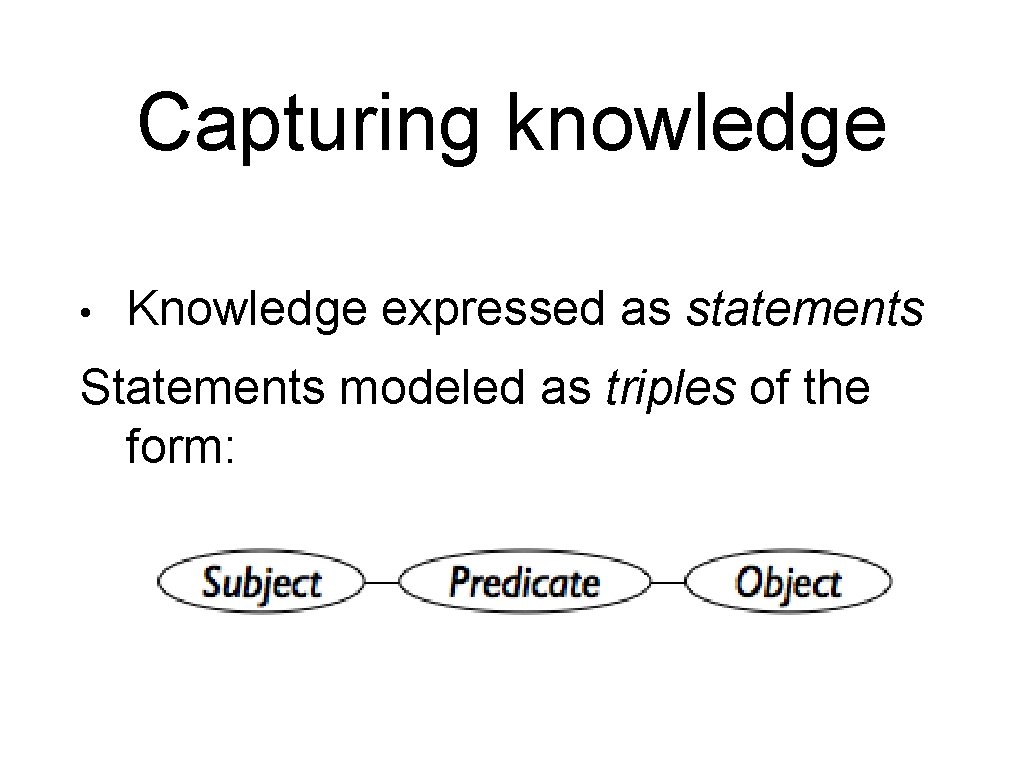
Capturing knowledge • Knowledge expressed as statements Statements modeled as triples of the form:
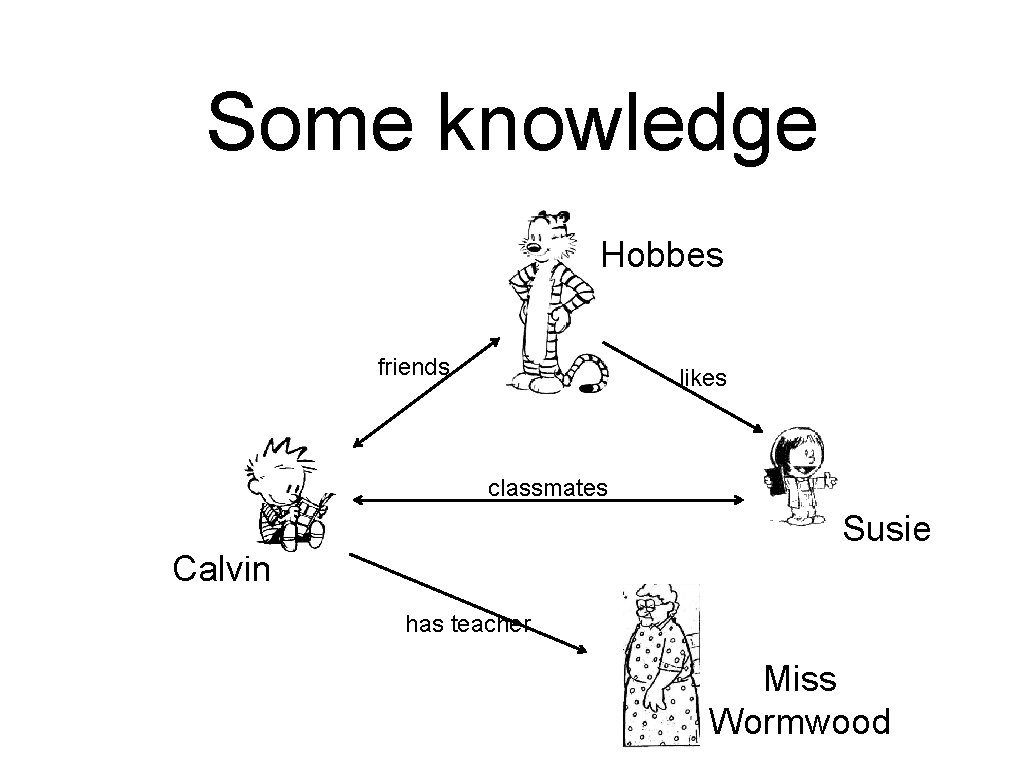
Some knowledge Hobbes friends likes classmates Susie Calvin has teacher Miss Wormwood
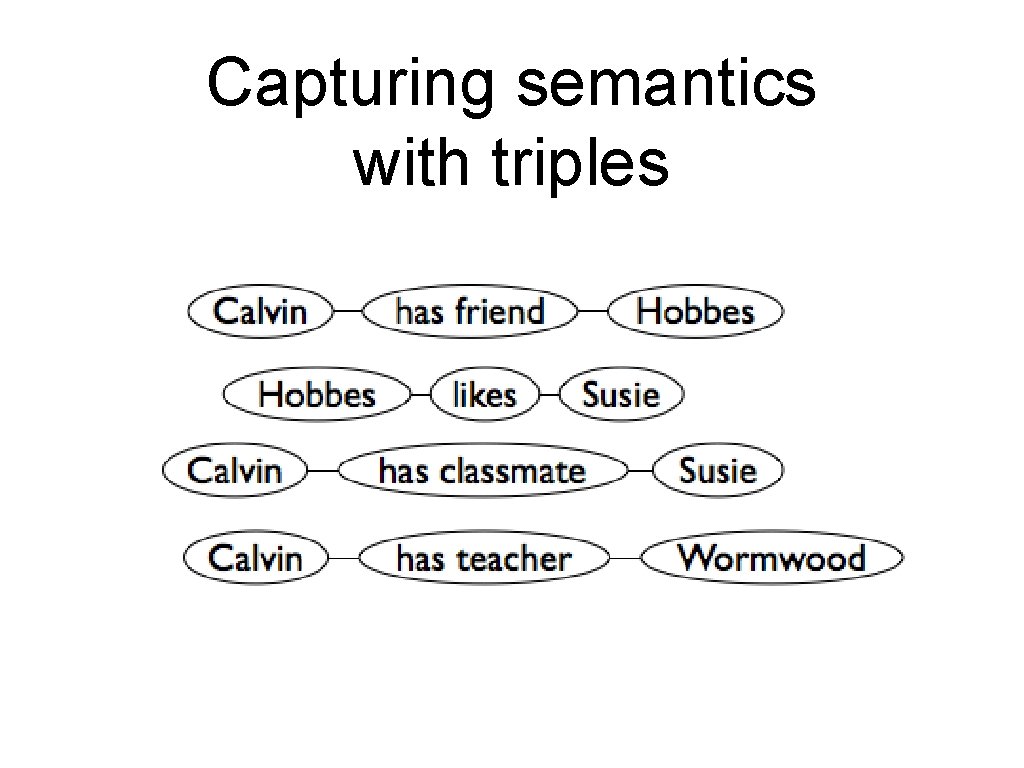
Capturing semantics with triples
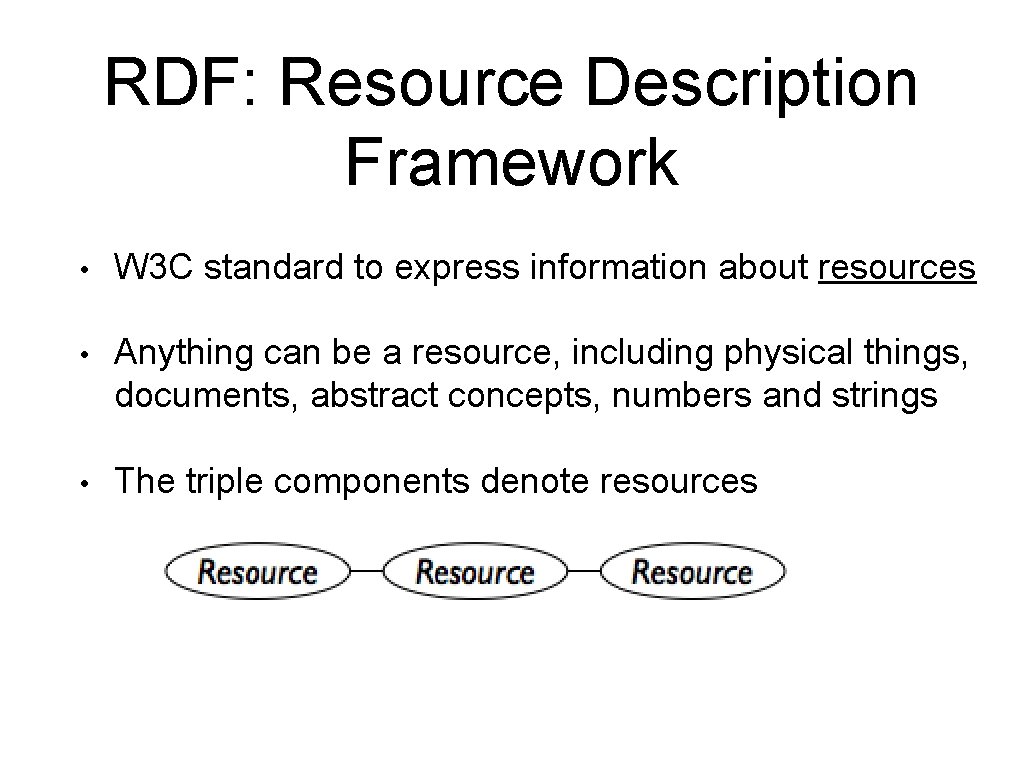
RDF: Resource Description Framework • W 3 C standard to express information about resources • Anything can be a resource, including physical things, documents, abstract concepts, numbers and strings • The triple components denote resources
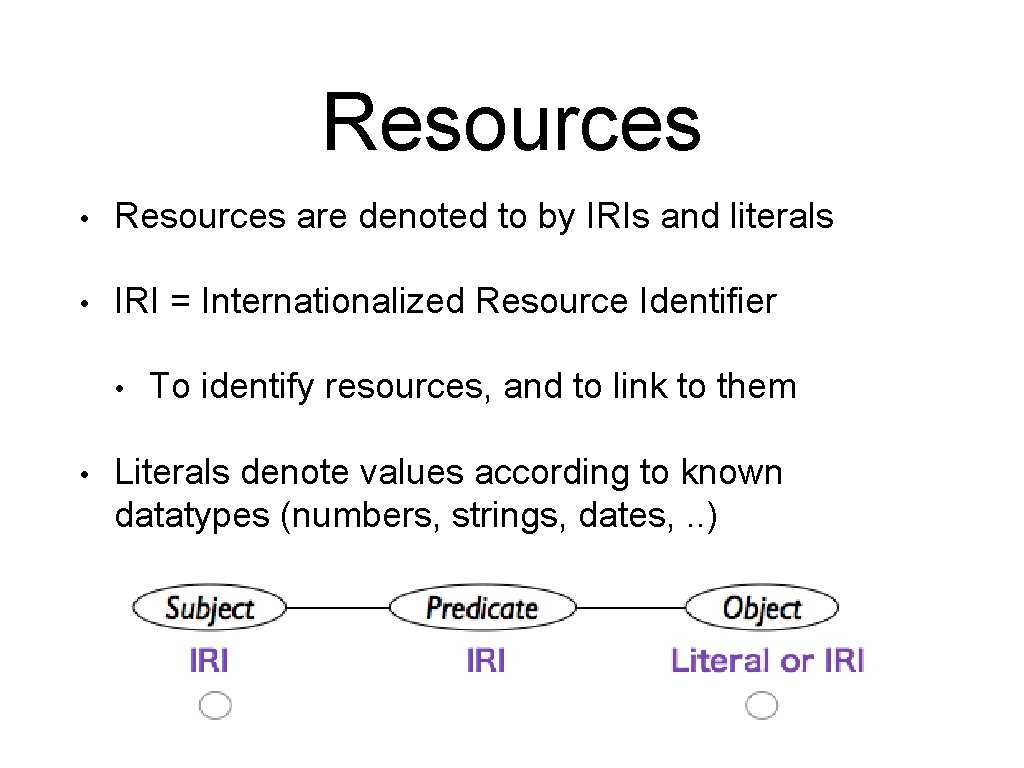
Resources • Resources are denoted to by IRIs and literals • IRI = Internationalized Resource Identifier • • To identify resources, and to link to them Literals denote values according to known datatypes (numbers, strings, dates, . . )
IRIs or URIs? • URIs used in RDF 1. 0 • IRIs now used in RDF 1. 1 IRI: Generalization of URI allowing non-ASCII characters to be used in the IRI character string • Every URI is an IRI • URIs still prevalent, with mapping needed from IRIs to URIs when retrieval over the HTTP protocol
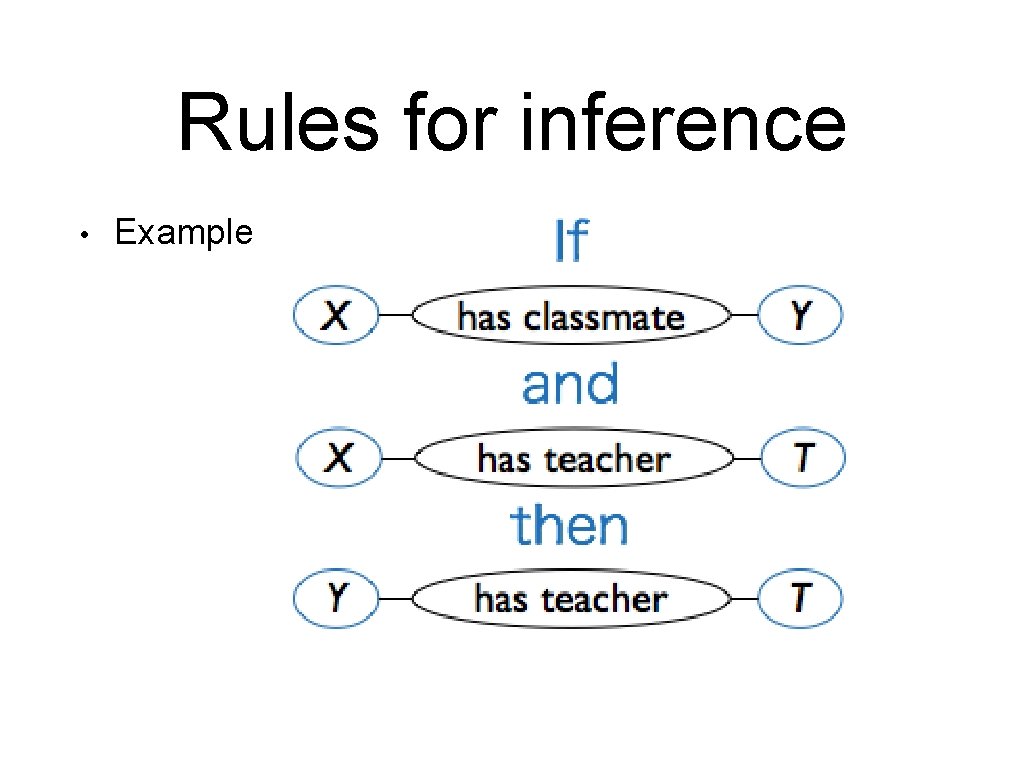
Rules for inference • Example
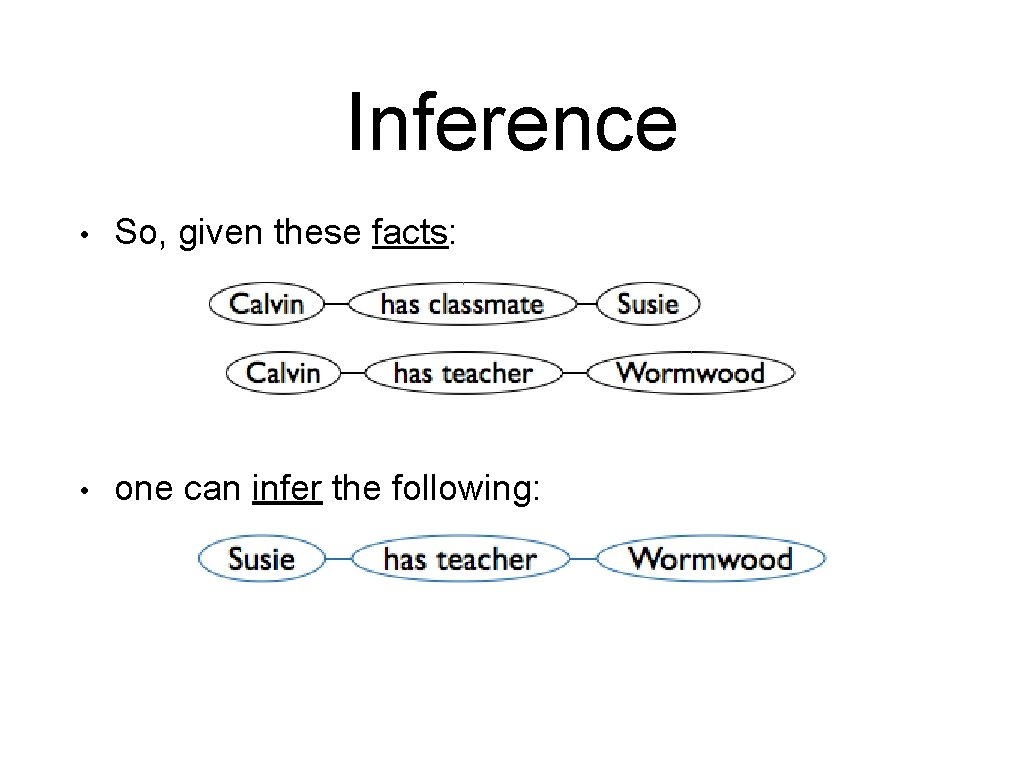
Inference • So, given these facts: • one can infer the following:

Graph-based data model

Reification
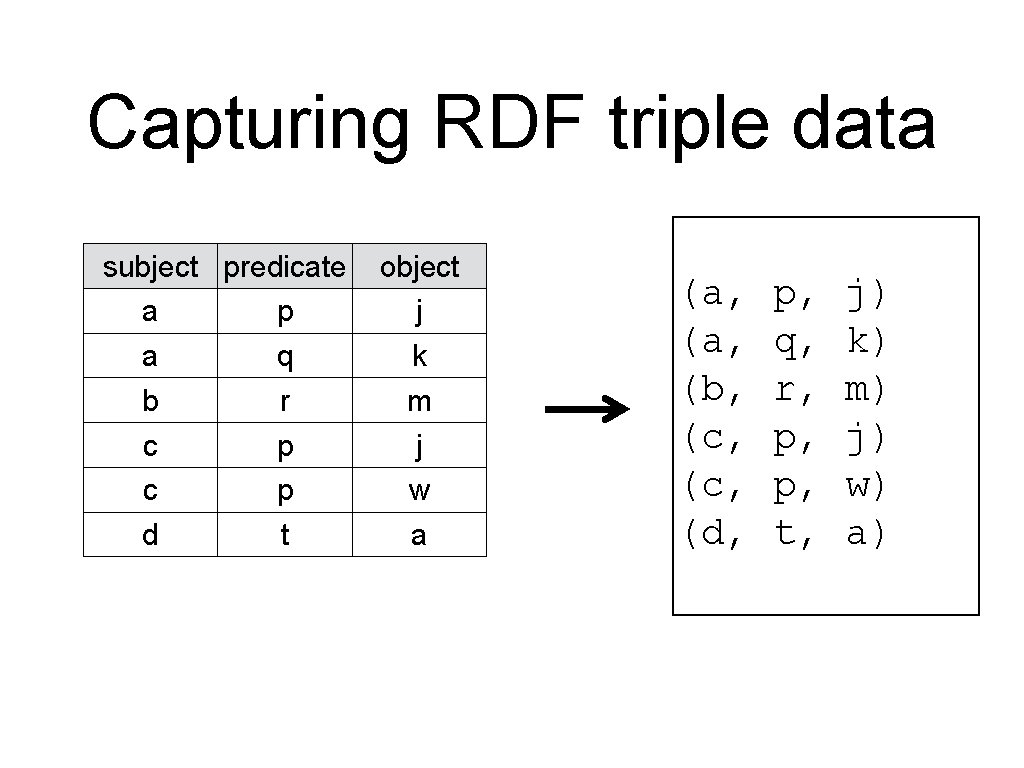
Capturing RDF triple data subject predicate a p a q b r c p d t object j k m j w a (a, (b, (c, (d, p, q, r, p, p, t, j) k) m) j) w) a)
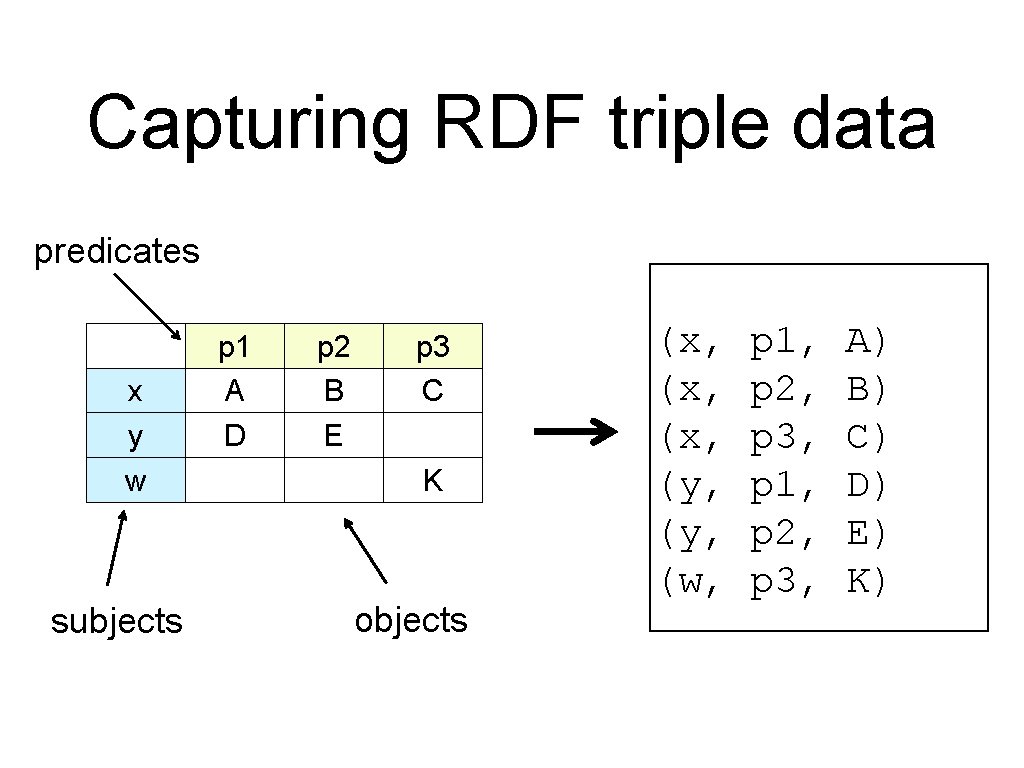
Capturing RDF triple data predicates x y w subjects p 1 A D p 2 B E p 3 C K objects (x, (x, (y, (w, p 1, p 2, p 3, A) B) C) D) E) K)
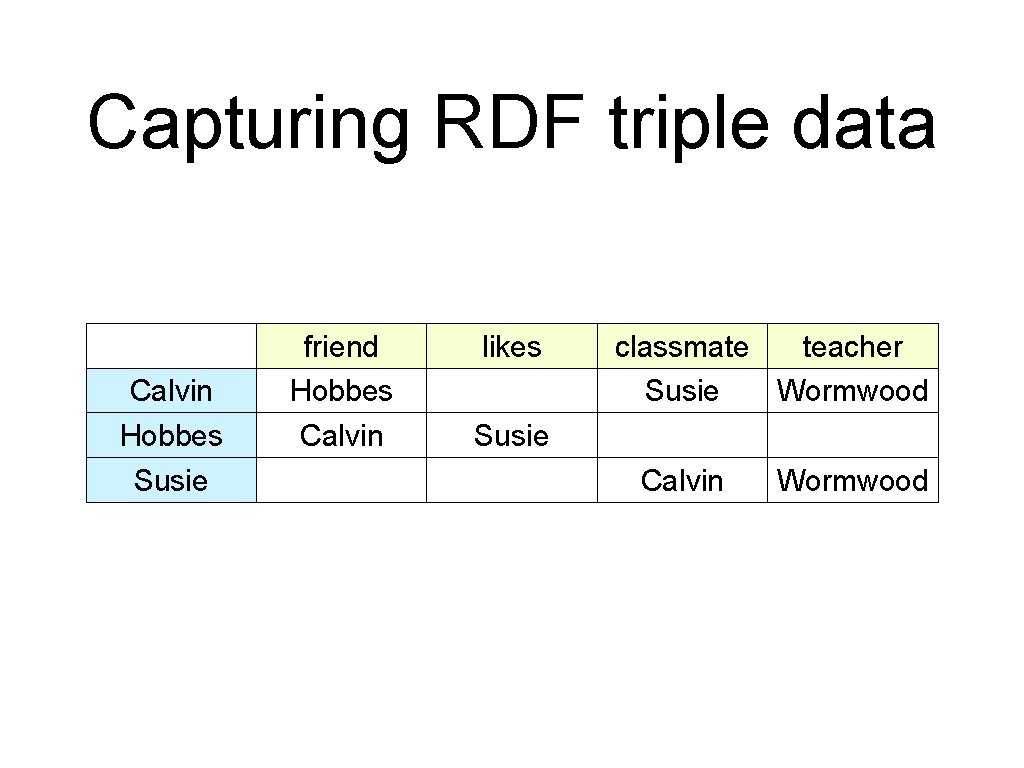
Capturing RDF triple data Calvin Hobbes Susie friend Hobbes Calvin likes classmate teacher Susie Wormwood Susie Calvin Wormwood
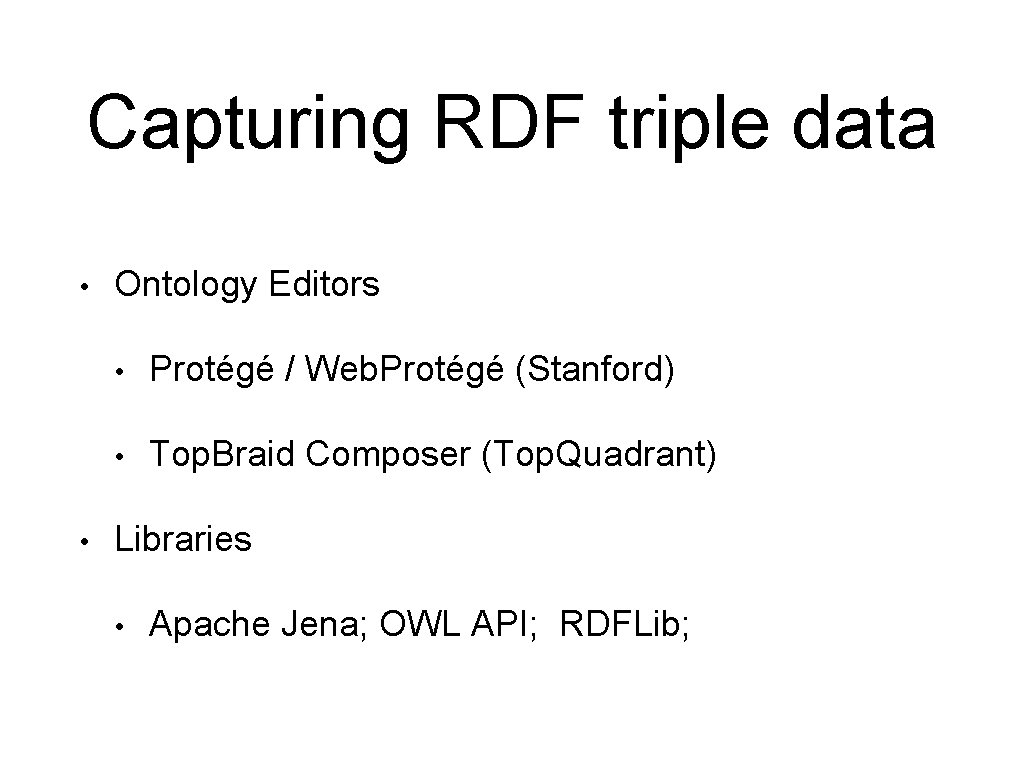
Capturing RDF triple data • • Ontology Editors • Protégé / Web. Protégé (Stanford) • Top. Braid Composer (Top. Quadrant) Libraries • Apache Jena; OWL API; RDFLib;
Vocabularies • Referring to particular subjects, properties and objects in triples means we are dealing with vocabularies • That is, naming things and using names introduced by others • “This ‘SST’ dataset was produced by organization ‘Acme’”
What about ontologies? • Vocabularies are ontologies • A way to think of a possible (loose) differentiation: • • Tend to use “ontology” when the resources in your triples and the relationships among those resources are increasingly more elaborate in terms of intended semantics Let’s use “vocabulary” and “ontology” interchangeably here
Vocabularies • Should be controlled vocabularies: • with names (and associated definitions/attributes) agreed by the community • to reduce discrepancies • to facilitate data discovery, reuse, and integration • to enable crosswalks/mappings • is short, to promote and facilitate interoperability
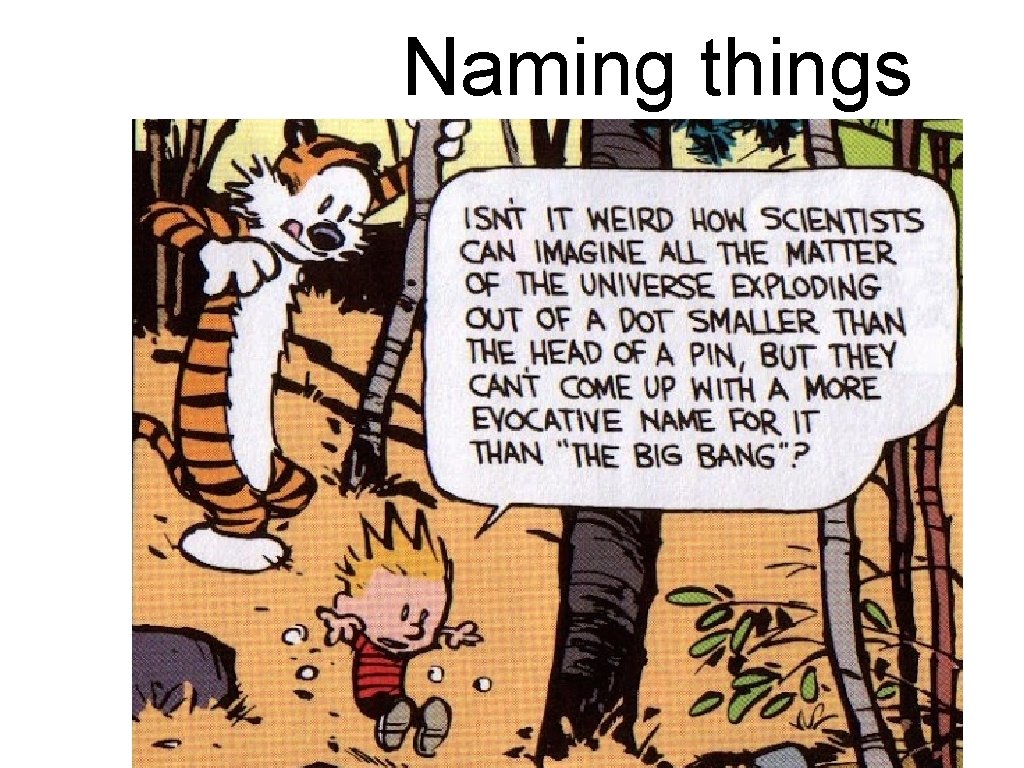
Naming things
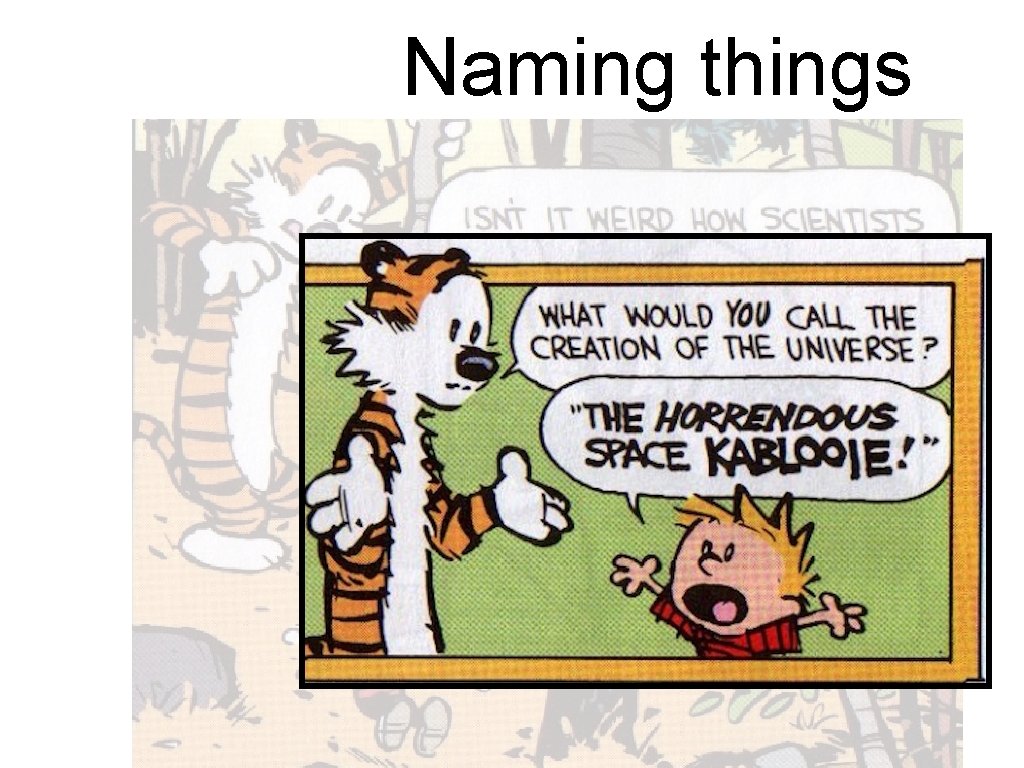
Naming things
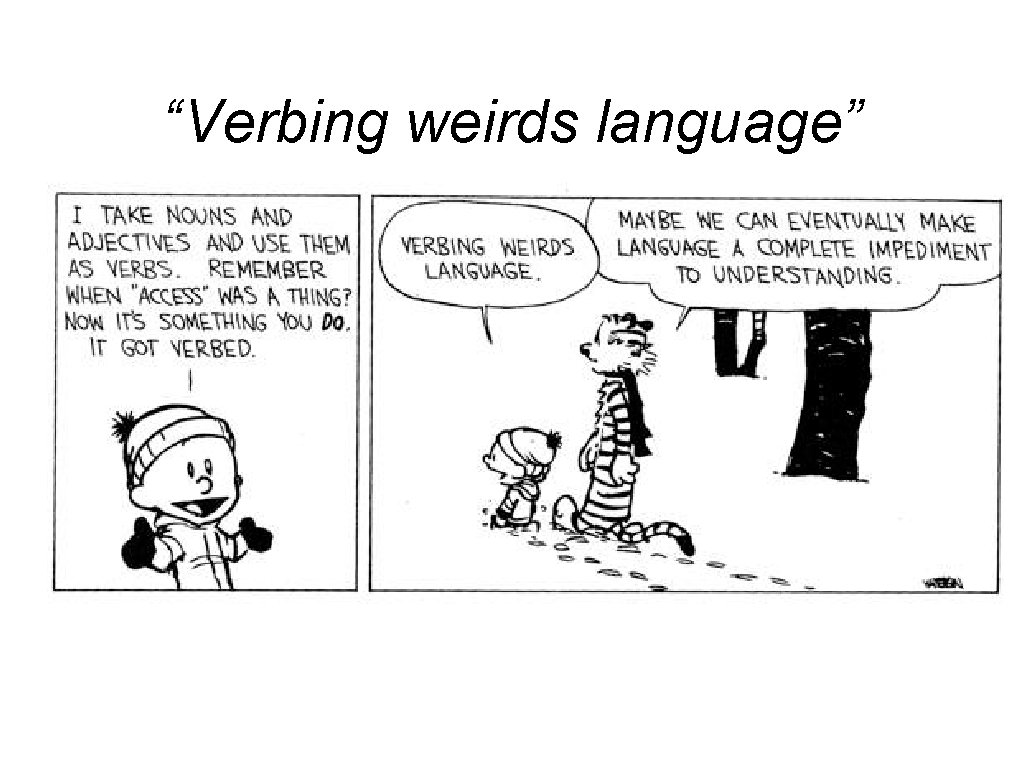
“Verbing weirds language”
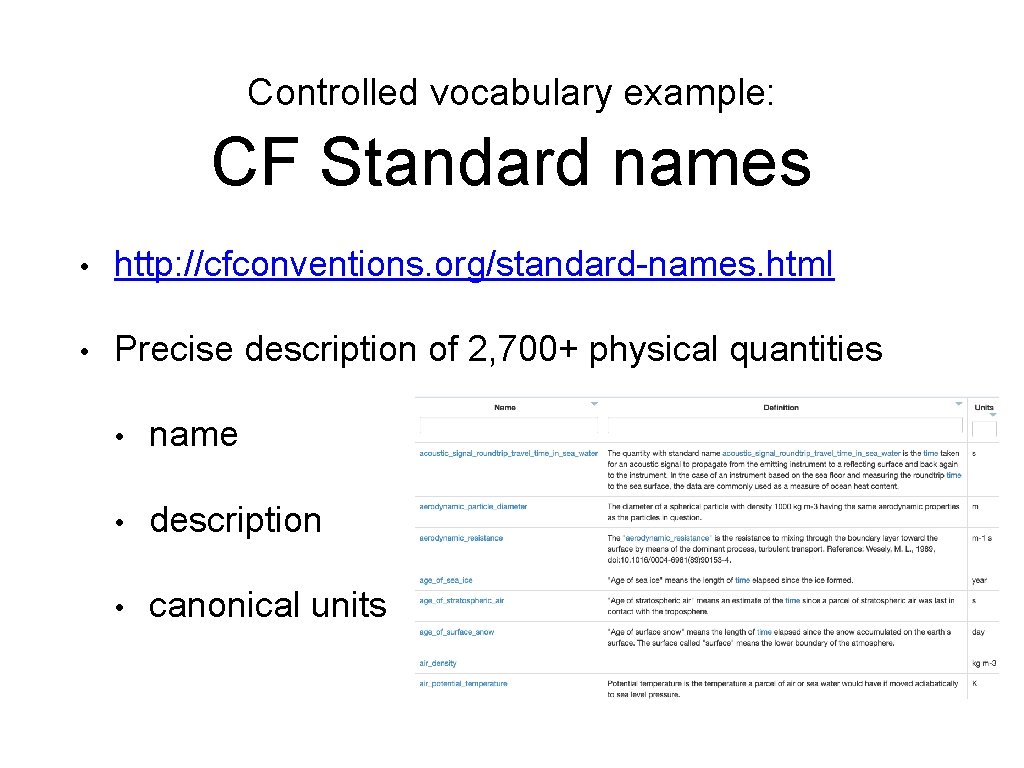
Controlled vocabulary example: CF Standard names • http: //cfconventions. org/standard-names. html • Precise description of 2, 700+ physical quantities • name • description • canonical units
Vocabularies to use in your vocabularies • • RDF: (Resource Description Framework) • type, Property, Statement, … • subject, predicate, object, … RDFS: (RDF Schema) • Resource, Class, sub. Class. Of, sub. Property. Of, … • comment, label, see. Also, is. Defined. By, …
Vocabularies to use in your vocabularies • • SKOS: (Simple Knowledge Organization System) • definition, note, … • exact. Match, close. Match, related. Match, … OWL: (Web Ontology Language) • Ontology, inverse. Of, Reflexive. Property , … • same. As, version. Info, …
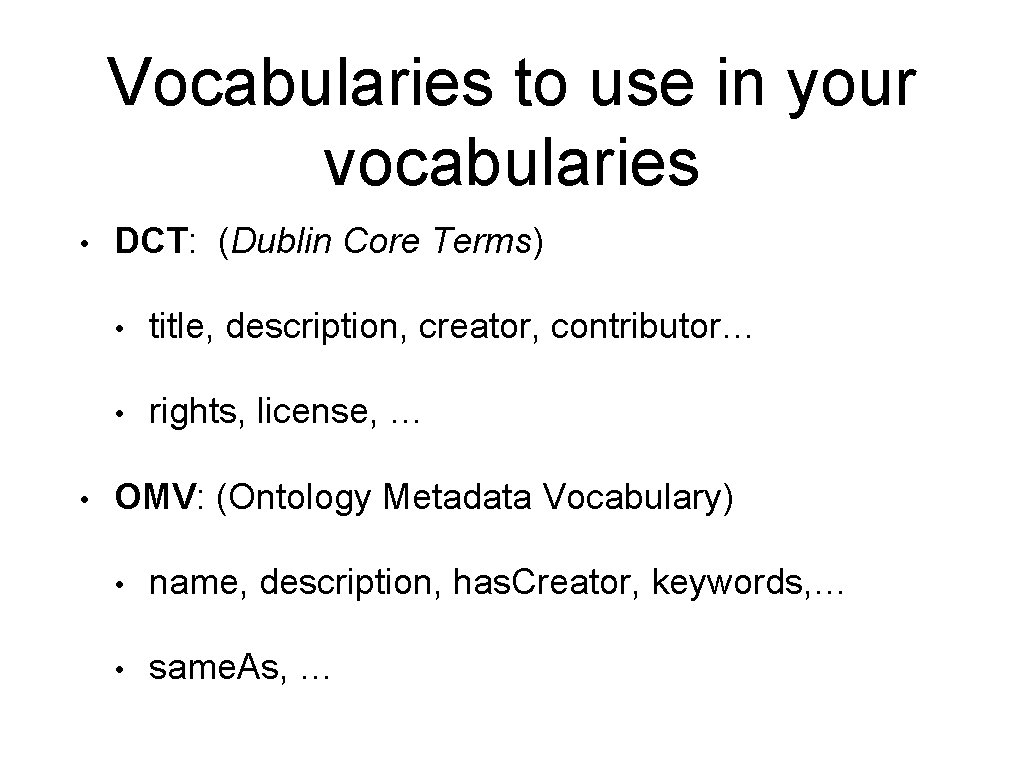
Vocabularies to use in your vocabularies • • DCT: (Dublin Core Terms) • title, description, creator, contributor… • rights, license, … OMV: (Ontology Metadata Vocabulary) • name, description, has. Creator, keywords, … • same. As, …
Does semantic interoperability need an overarching vocabulary? • No! … and such a goal is overly unrealistic in general • But it’s fine to • Define what makes sense to your case • Map your names to names is other vocabularies as convenient/needed for interoperability • Propose additions to common vocabularies
Vocabularies: Summary • • Use standard vocabularies • in your data/metadata • in your own vocabularies, too! Participate in community vocabulary development activities
All of the above in practice: ORR – Ontology Registry and Repository
ORR Origins • MMI – Marine Metadata Interoperability project • • https: //marinemetadata. org/ ORR born as part of MMI’s vision for a Semantic Framework
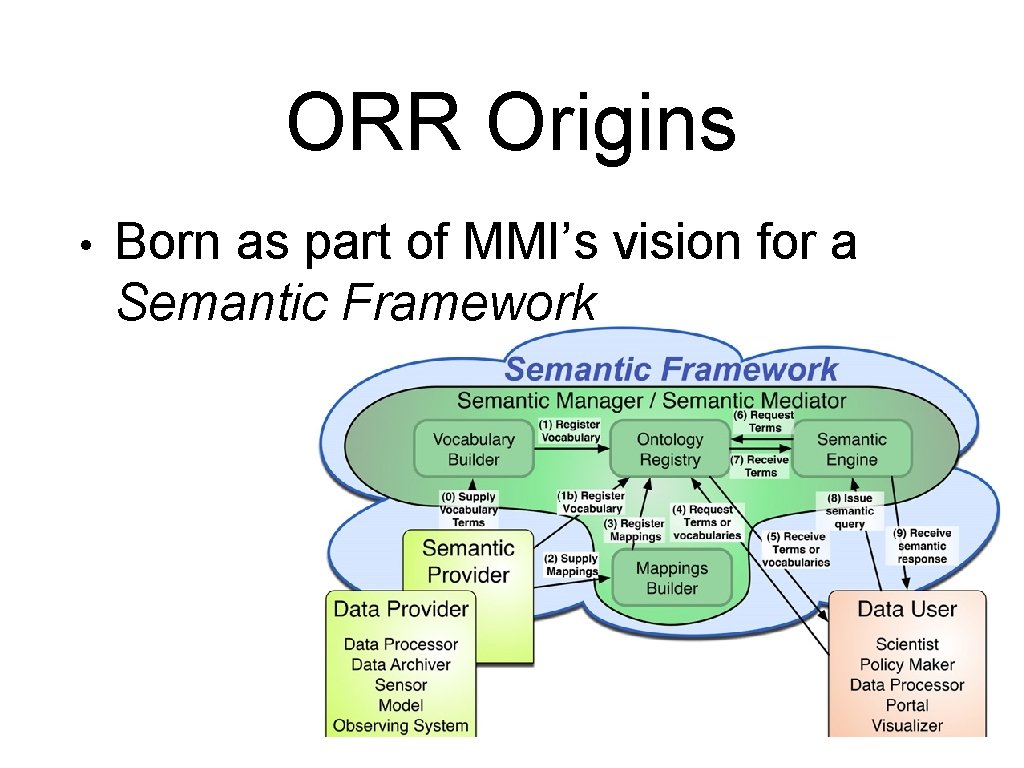
ORR Origins • Born as part of MMI’s vision for a Semantic Framework
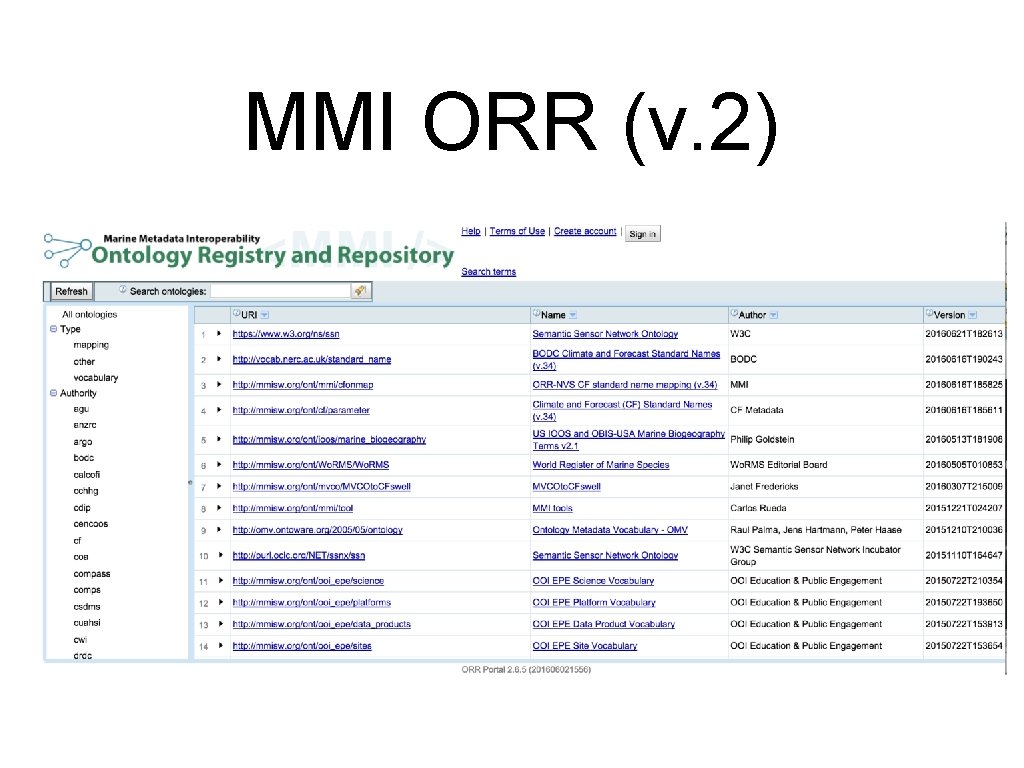
MMI ORR (v. 2)
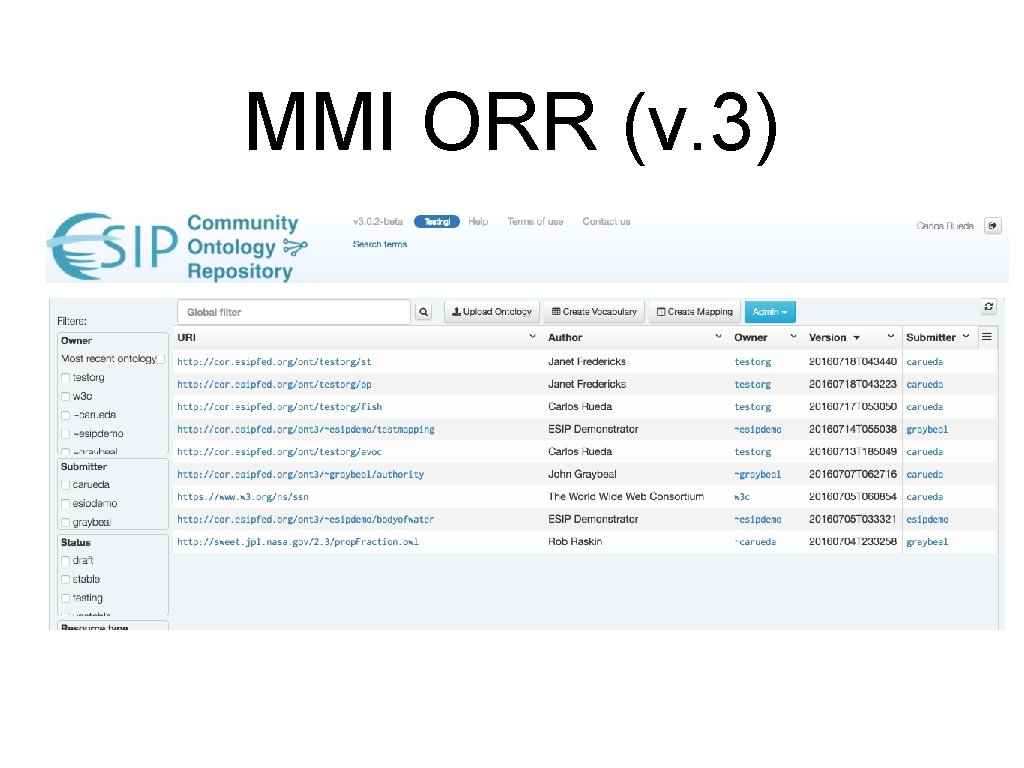
MMI ORR (v. 3)
MMI ORR (v. 3) • Enhanced user/organization/permission model • Overhauled authentication mechanism • Enhanced performance • RESTful backend endpoint • Mongo. DB; Allegro. Graph • Backend: Scala; comprehensive tests; Travis CI; good coverage • Front-end: Angular. JS • Docker images for streamlined installation of integrated system https: //hub. docker. com/r/mmisw/orr-ont/tags/
MMI ORR (v. 3) • Status • Recently transitioned to beta …mostly according to internal testing • So, please help us as we make progress toward a stable version. Your feedback is most welcome!
ORR • Registry • • ORR is a catalog of pointers to ontologies and associated metadata Repository • ORR hosts the registered ontologies
ORR Capabilities • Repository of controlled vocabularies and term mappings • Web resolvable identifiers for ontologies and terms • Enable added-value applications with semantic and inference • Ontology metadata • Versioning
Key requirements • Community driven, collaborative creation • Easy-to-use tools
Client applications–ORR interactions • Data Portals create/use ontologies that capture categories to be exposed • Data providers create/use ontologies: • • For the terms (concepts) used in their data products and services • With mappings between Data Provider’s terms and Data Portal categories Data Portal and client applications • Access; Resolve; Query; Aggregate; Archive; . . .
ORR instances • mmisw. org – MMI ORR • cor. esipfed. org – ESIP COR • sensorml. com – Sensor. ML ORR
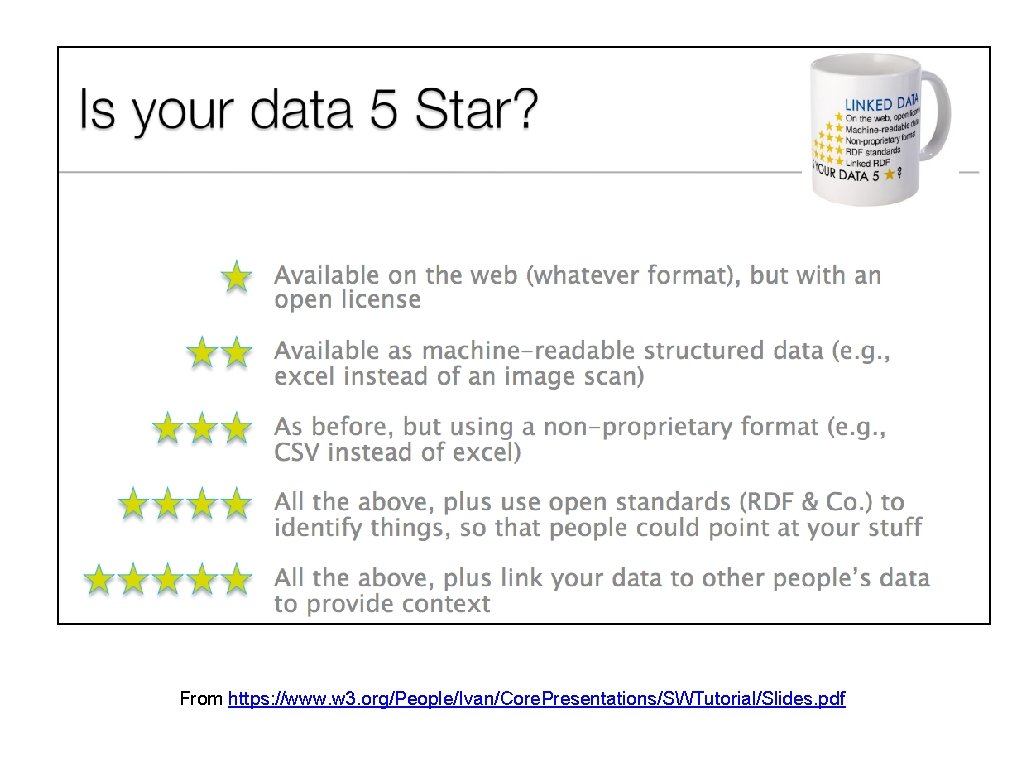
From https: //www. w 3. org/People/Ivan/Core. Presentations/SWTutorial/Slides. pdf

- Slides: 44