
Semantic segmentation Semantic segmentation using convolutional networks w








- Slides: 43
Semantic segmentation
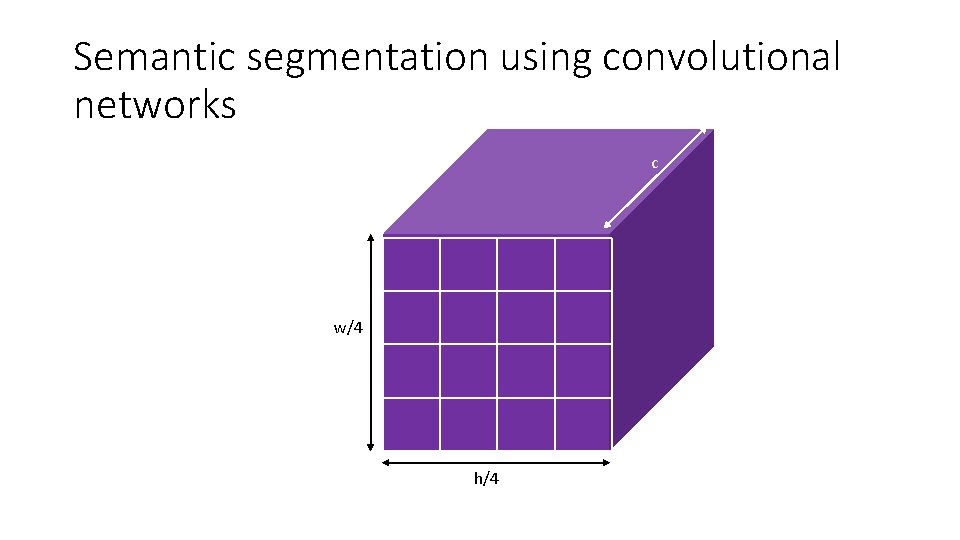
Semantic segmentation using convolutional networks w 3 h
Semantic segmentation using convolutional networks c w/4 h/4
Semantic segmentation using convolutional networks c w/4 h/4
Semantic segmentation using convolutional networks c w/4 h/4
Semantic segmentation using convolutional networks #classes c Convolve with #classes 1 x 1 filters w/4 h/4
Semantic segmentation using convolutional networks • Pass image through convolution and subsampling layers • Final convolution with #classes outputs • Get scores for subsampled image • Upsample back to original size
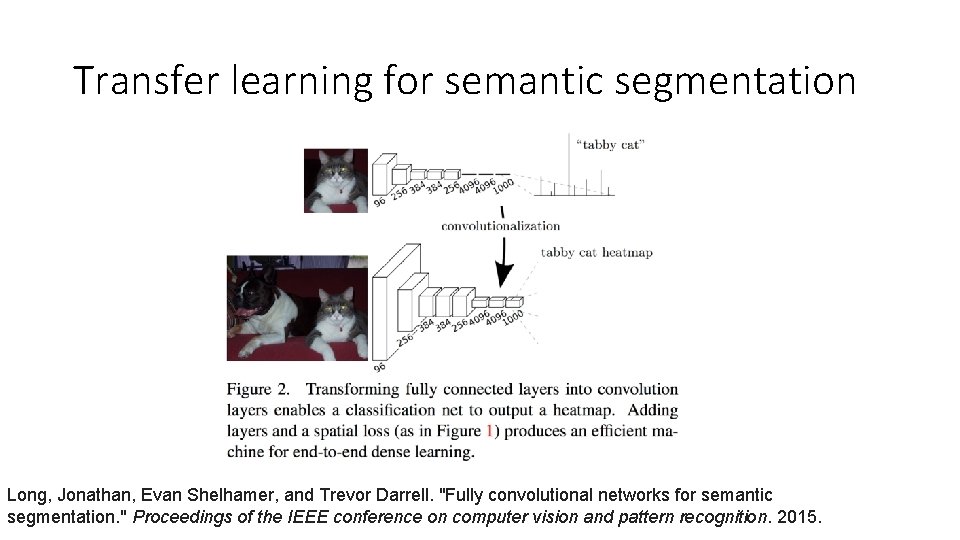
Transfer learning for semantic segmentation Long, Jonathan, Evan Shelhamer, and Trevor Darrell. "Fully convolutional networks for semantic segmentation. " Proceedings of the IEEE conference on computer vision and pattern recognition. 2015.
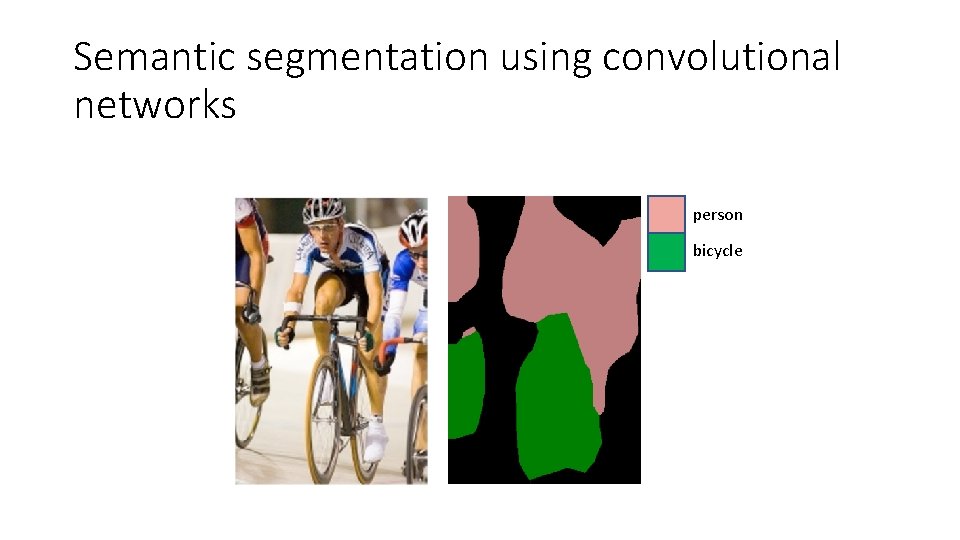
Semantic segmentation using convolutional networks person bicycle
The resolution issue • Problem: Need fine details! • Shallower network / earlier layers? • Not very semantic! • Remove subsampling? • Looks at only a small window!
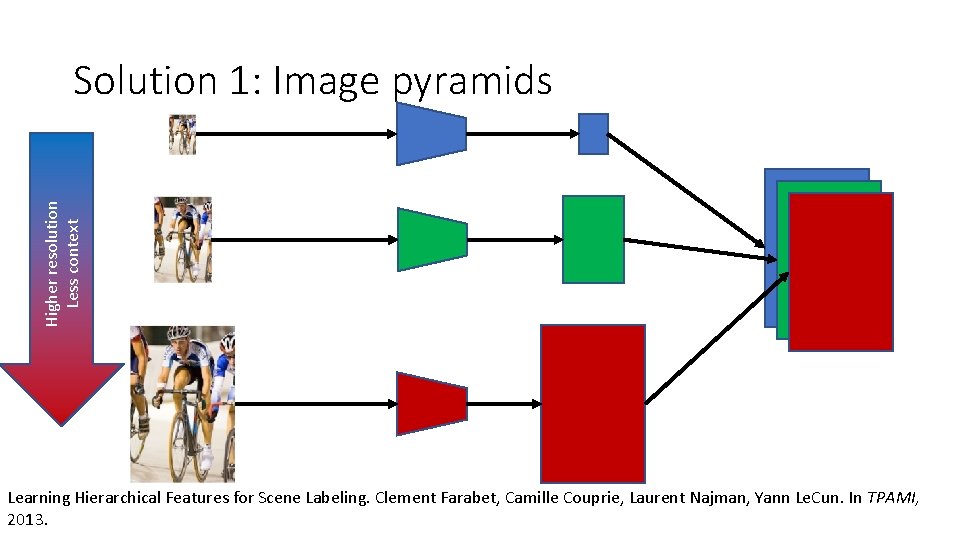
Higher resolution Less context Solution 1: Image pyramids Learning Hierarchical Features for Scene Labeling. Clement Farabet, Camille Couprie, Laurent Najman, Yann Le. Cun. In TPAMI, 2013.
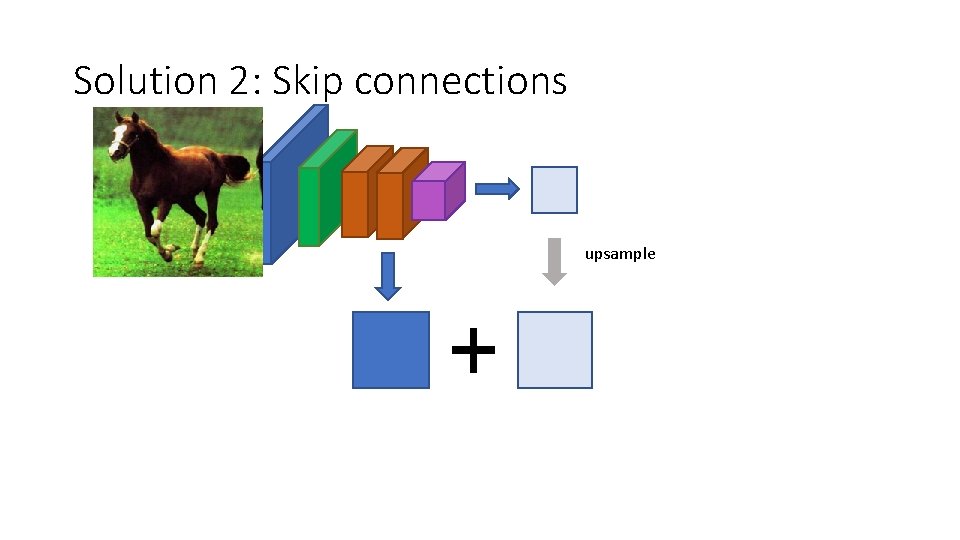
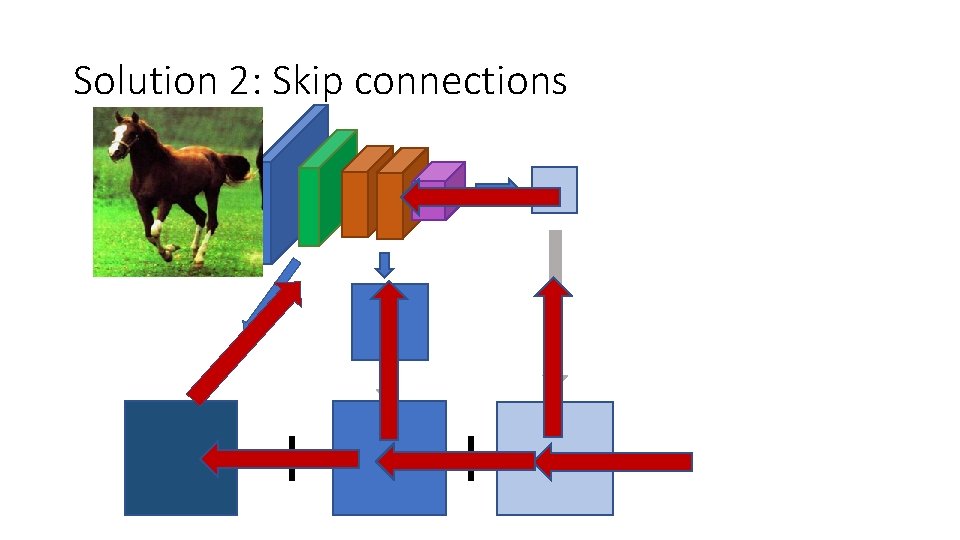
Solution 2: Skip connections upsample
Solution 2: Skip connections
Skip connections Fully convolutional networks for semantic segmentation. Evan Shelhamer, Jon Long, Trevor Darrell. In CVPR 2015
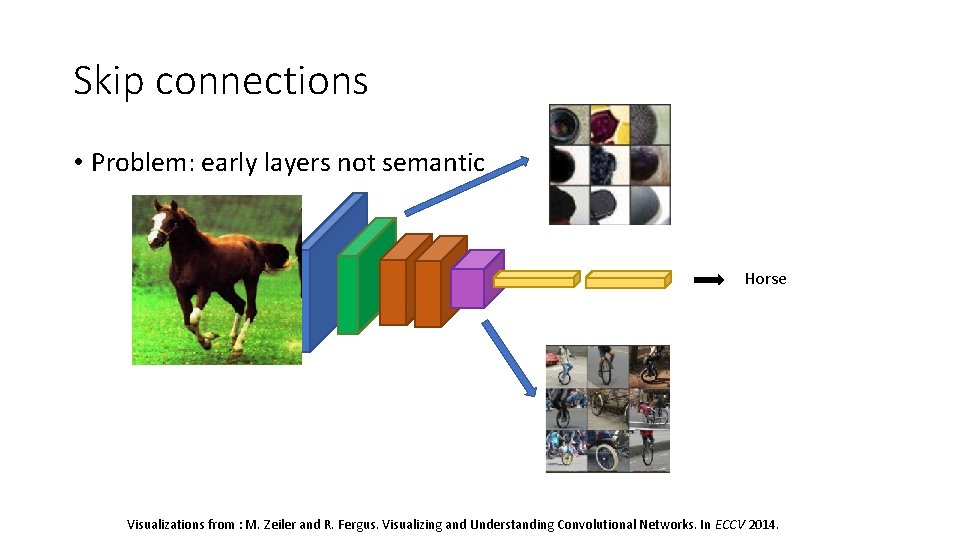
Skip connections • Problem: early layers not semantic Horse Visualizations from : M. Zeiler and R. Fergus. Visualizing and Understanding Convolutional Networks. In ECCV 2014.
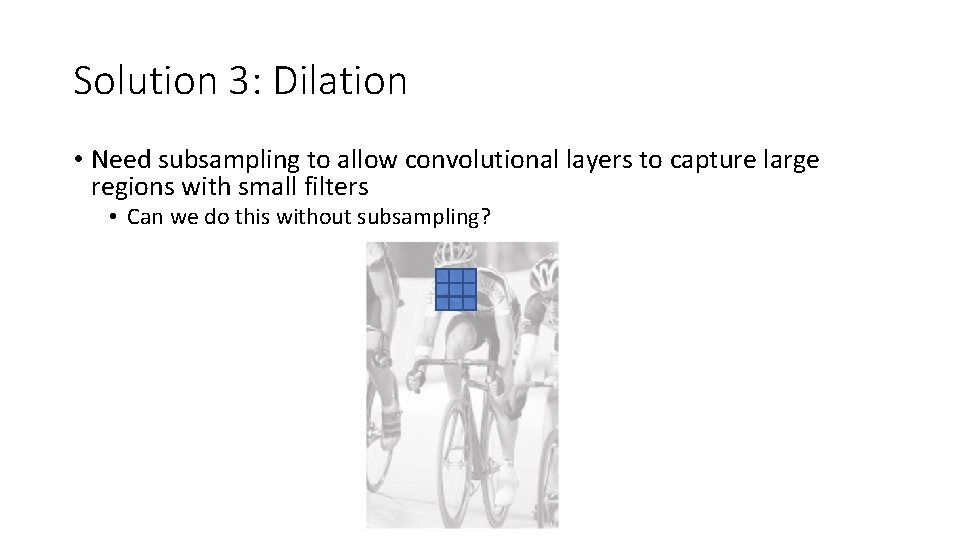
Solution 3: Dilation • Need subsampling to allow convolutional layers to capture large regions with small filters • Can we do this without subsampling?
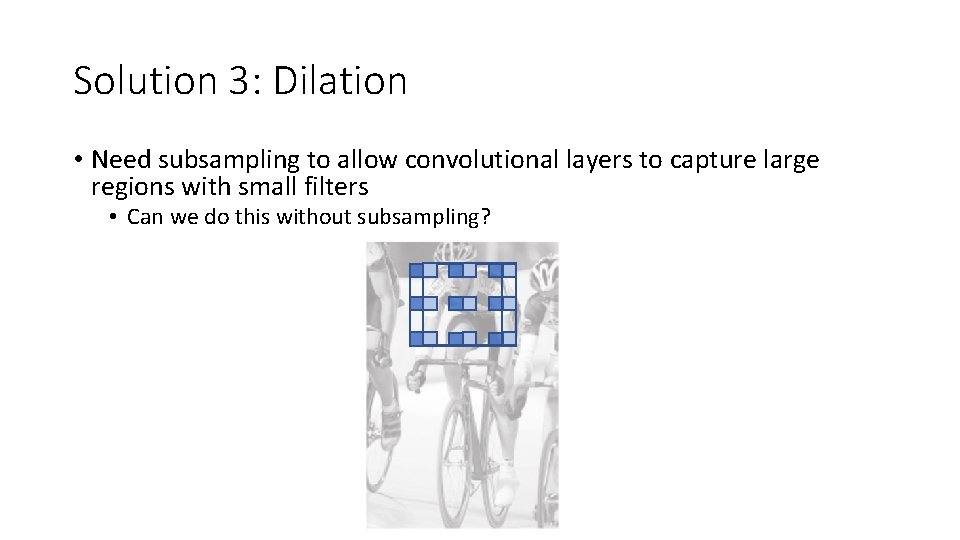
Solution 3: Dilation • Need subsampling to allow convolutional layers to capture large regions with small filters • Can we do this without subsampling?
Solution 3: Dilation • Need subsampling to allow convolutional layers to capture large regions with small filters • Can we do this without subsampling?
Solution 3: Dilation • Instead of subsampling by factor of 2: dilate by factor of 2 • Dilation can be seen as: • Using a much larger filter, but with most entries set to 0 • Taking a small filter and “exploding”/ “dilating” it • Not panacea: without subsampling, feature maps are much larger: memory issues
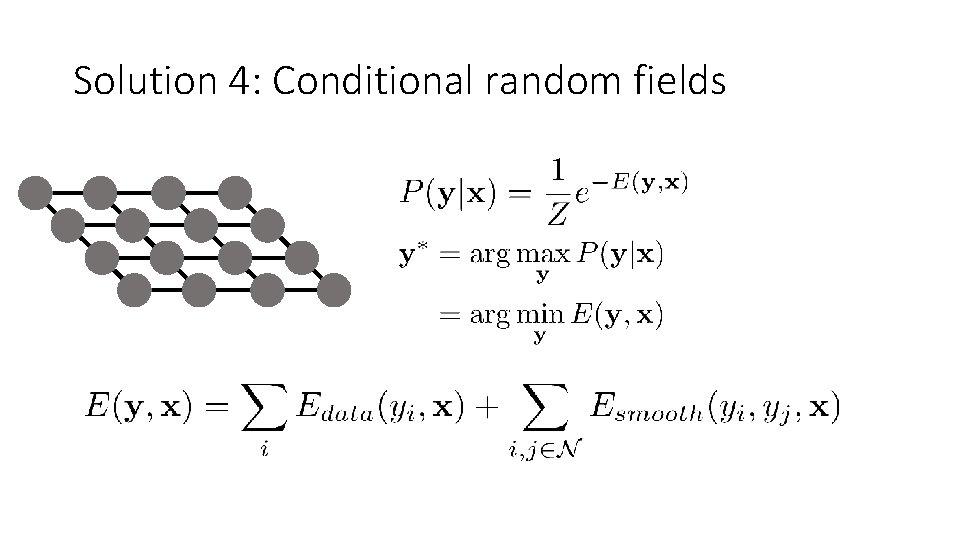
Solution 4: Conditional random fields
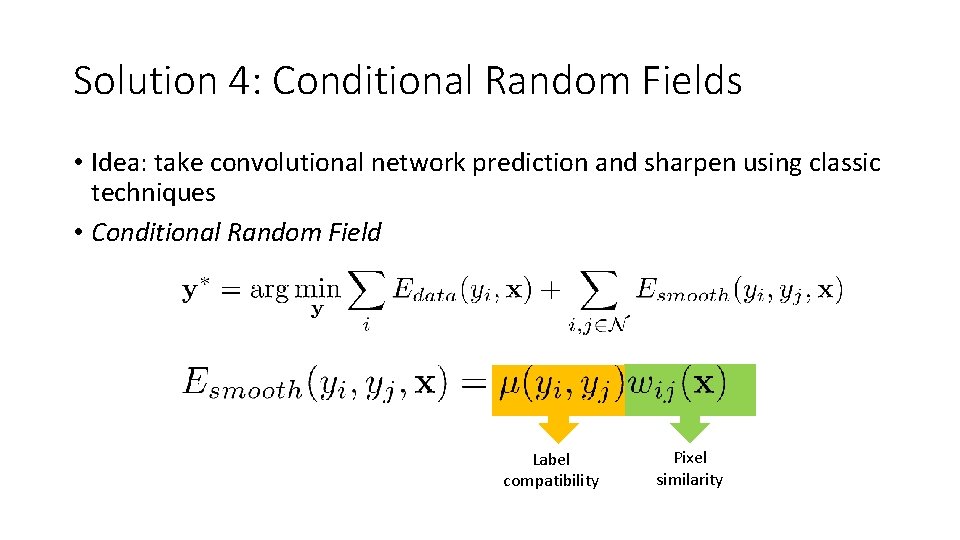
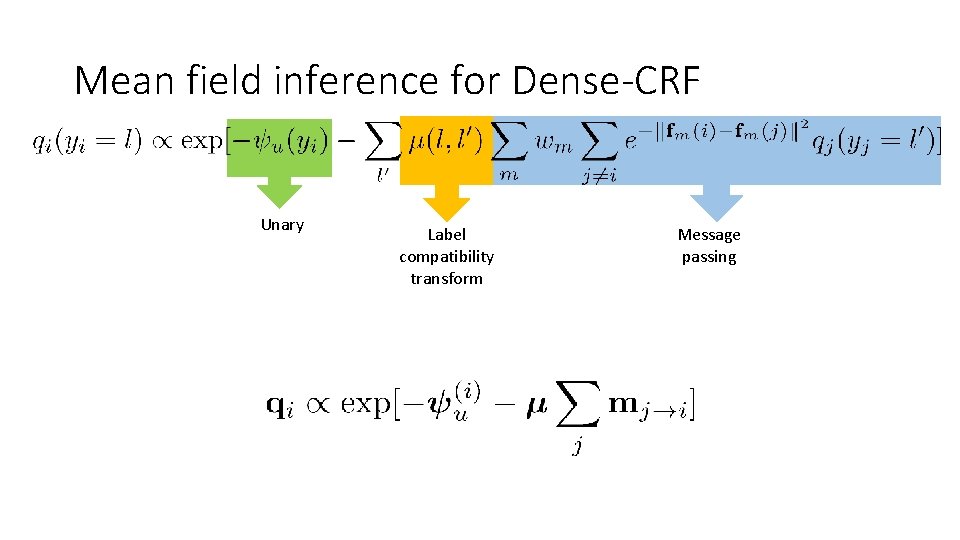
Solution 4: Conditional Random Fields • Idea: take convolutional network prediction and sharpen using classic techniques • Conditional Random Field Label compatibility Pixel similarity
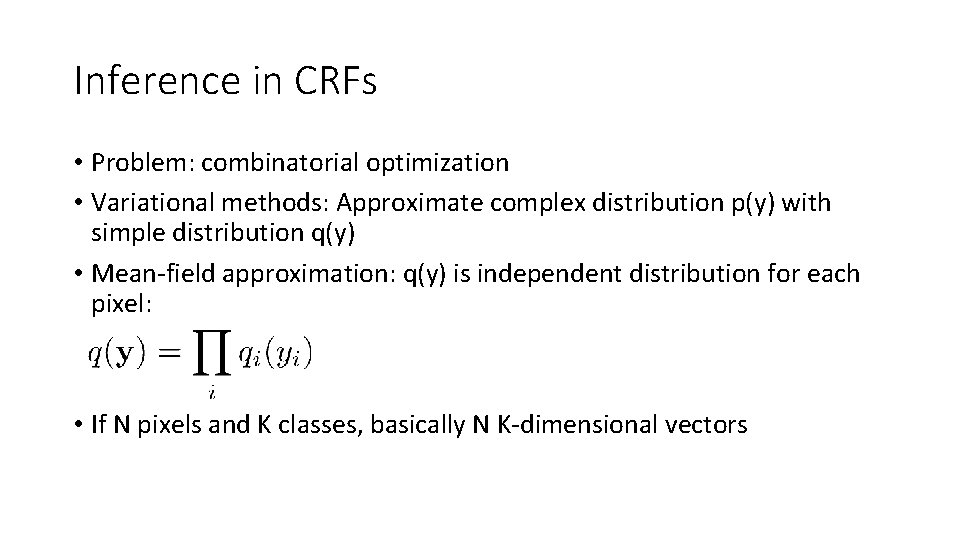
Inference in CRFs • Problem: combinatorial optimization • Variational methods: Approximate complex distribution p(y) with simple distribution q(y) • Mean-field approximation: q(y) is independent distribution for each pixel: • If N pixels and K classes, basically N K-dimensional vectors
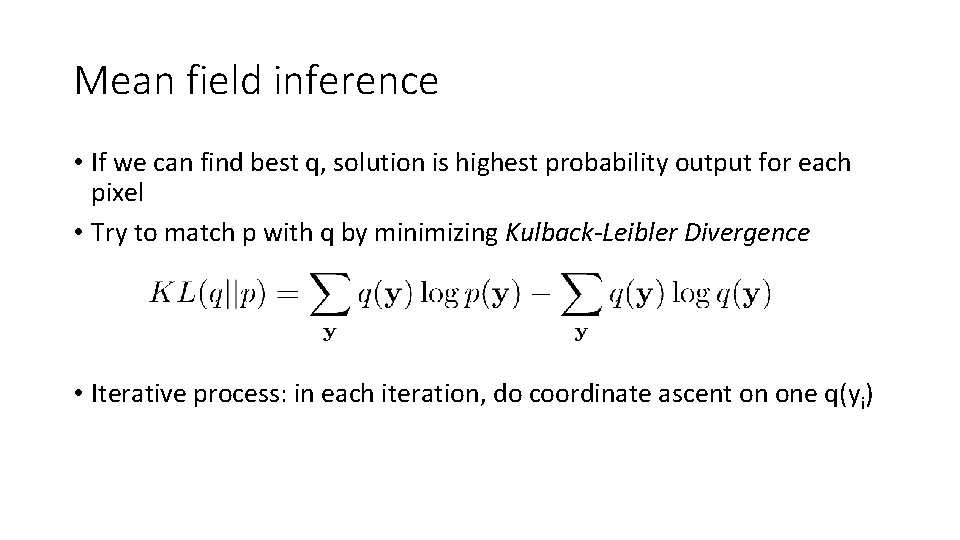
Mean field inference • If we can find best q, solution is highest probability output for each pixel • Try to match p with q by minimizing Kulback-Leibler Divergence • Iterative process: in each iteration, do coordinate ascent on one q(yi)
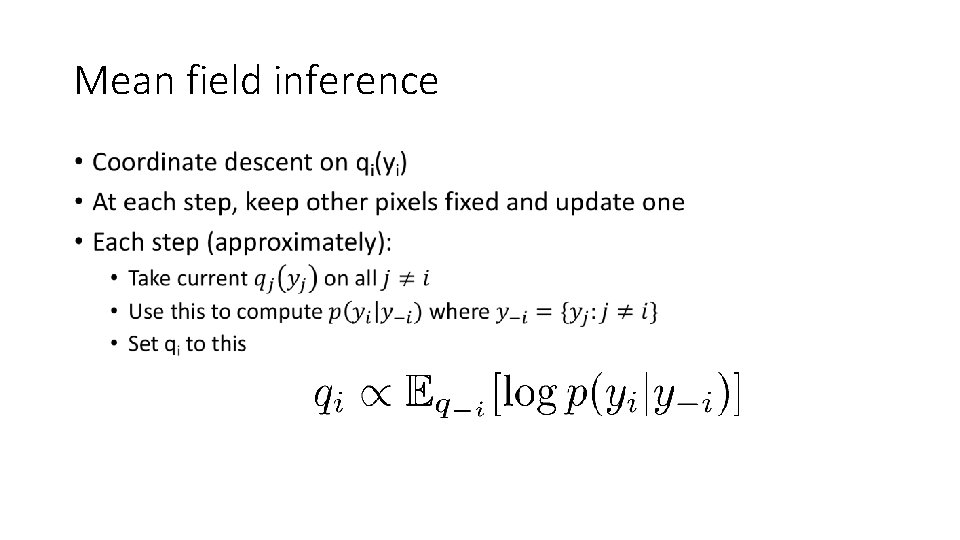
Mean field inference •
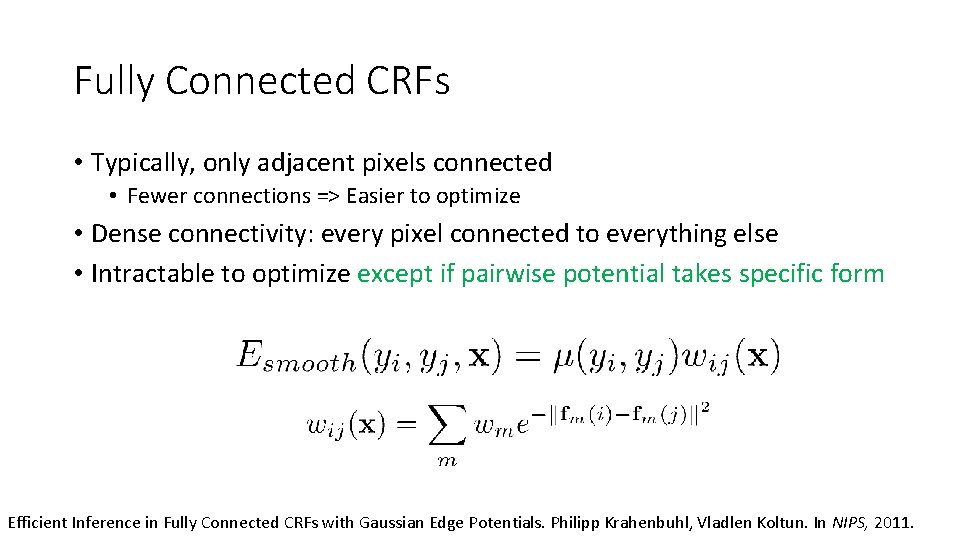
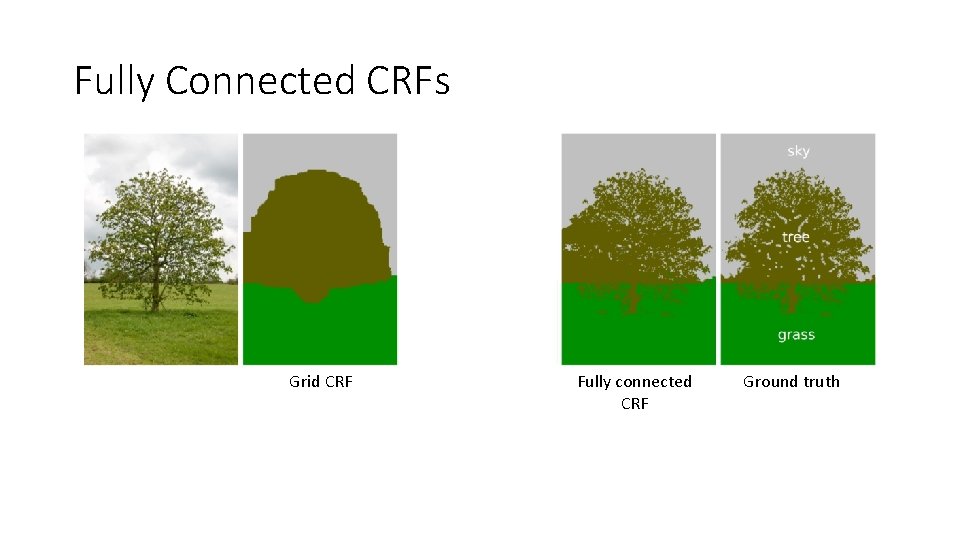
Fully Connected CRFs • Typically, only adjacent pixels connected • Fewer connections => Easier to optimize • Dense connectivity: every pixel connected to everything else • Intractable to optimize except if pairwise potential takes specific form Efficient Inference in Fully Connected CRFs with Gaussian Edge Potentials. Philipp Krahenbuhl, Vladlen Koltun. In NIPS, 2011.
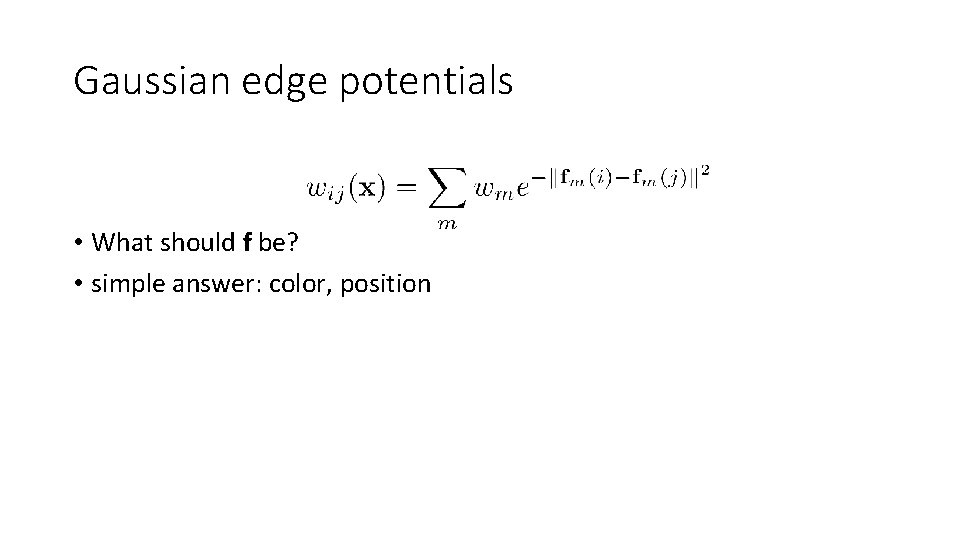
Gaussian edge potentials • What should f be? • simple answer: color, position
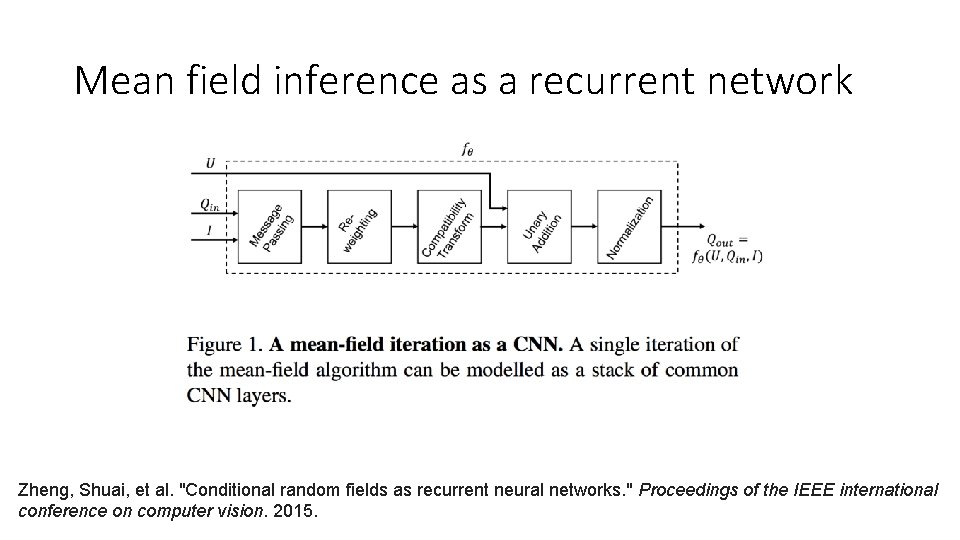
Mean field inference for Dense-CRF Unary Label compatibility transform Message passing
Fully Connected CRFs Grid CRF Fully connected CRF Ground truth
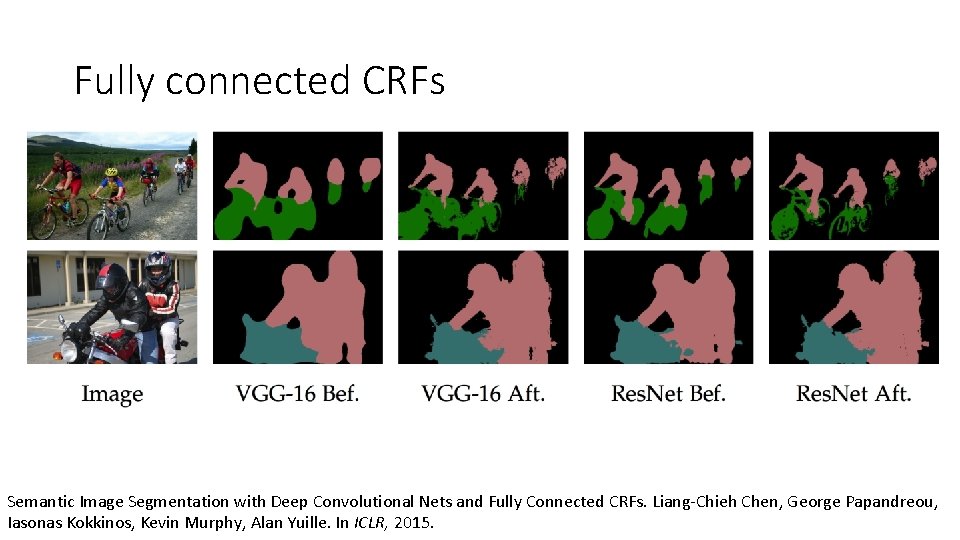
Fully connected CRFs Semantic Image Segmentation with Deep Convolutional Nets and Fully Connected CRFs. Liang-Chieh Chen, George Papandreou, Iasonas Kokkinos, Kevin Murphy, Alan Yuille. In ICLR, 2015.
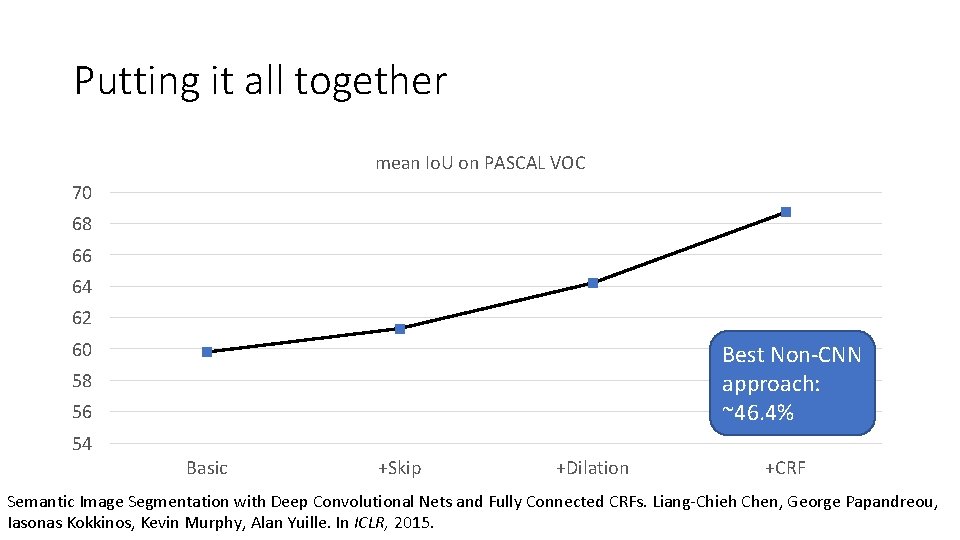
Putting it all together mean Io. U on PASCAL VOC 70 68 66 64 62 60 Best Non-CNN approach: ~46. 4% 58 56 54 Basic +Skip +Dilation +CRF Semantic Image Segmentation with Deep Convolutional Nets and Fully Connected CRFs. Liang-Chieh Chen, George Papandreou, Iasonas Kokkinos, Kevin Murphy, Alan Yuille. In ICLR, 2015.
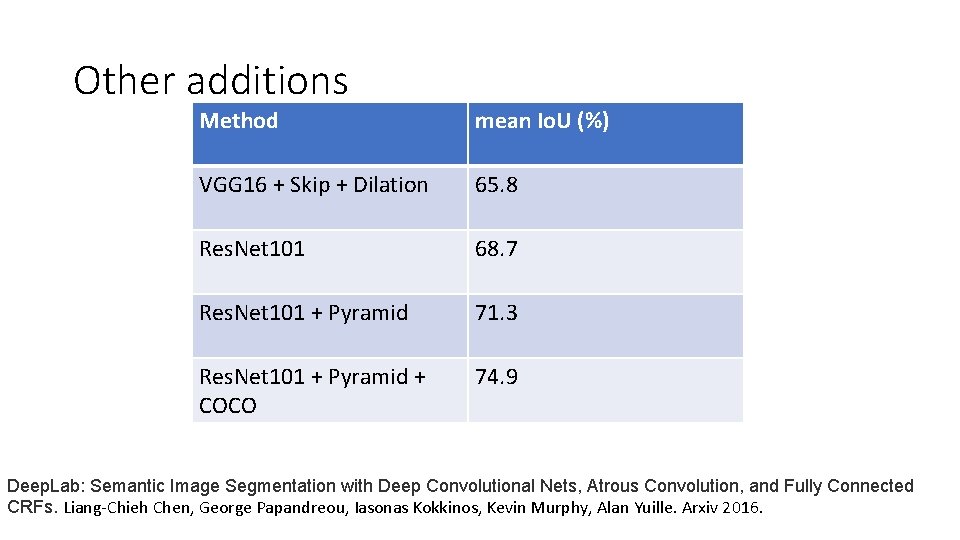
Other additions Method mean Io. U (%) VGG 16 + Skip + Dilation 65. 8 Res. Net 101 68. 7 Res. Net 101 + Pyramid 71. 3 Res. Net 101 + Pyramid + COCO 74. 9 Deep. Lab: Semantic Image Segmentation with Deep Convolutional Nets, Atrous Convolution, and Fully Connected CRFs. Liang-Chieh Chen, George Papandreou, Iasonas Kokkinos, Kevin Murphy, Alan Yuille. Arxiv 2016.
Mean field inference as a recurrent network Zheng, Shuai, et al. "Conditional random fields as recurrent neural networks. " Proceedings of the IEEE international conference on computer vision. 2015.
Skip connections Long, Jonathan, Evan Shelhamer, and Trevor Darrell. "Fully convolutional networks for semantic segmentation. " Proceedings of the IEEE conference on computer vision and pattern recognition. 2015.
Alternative: coarse-to-fine prediction • Inspiration 1: we are making independent predictions from each layer • Inspiration 2: CRF-like approaches require iterated inference • Inspiration 3: Coarse-to-fine refinement works because: coarse scales capture large scale structure coarsely, fine scales capture fine-scale structures
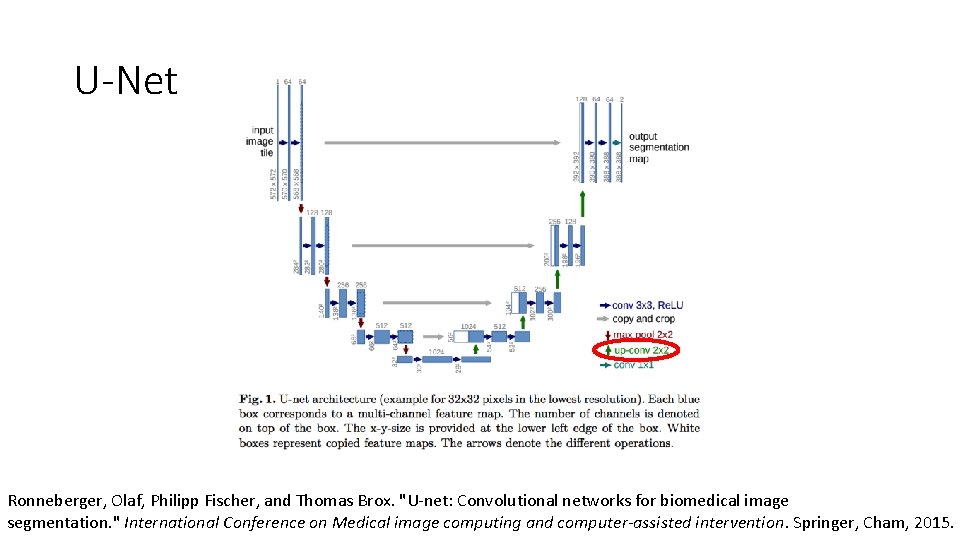
U-Net Ronneberger, Olaf, Philipp Fischer, and Thomas Brox. "U-net: Convolutional networks for biomedical image segmentation. " International Conference on Medical image computing and computer-assisted intervention. Springer, Cham, 2015.
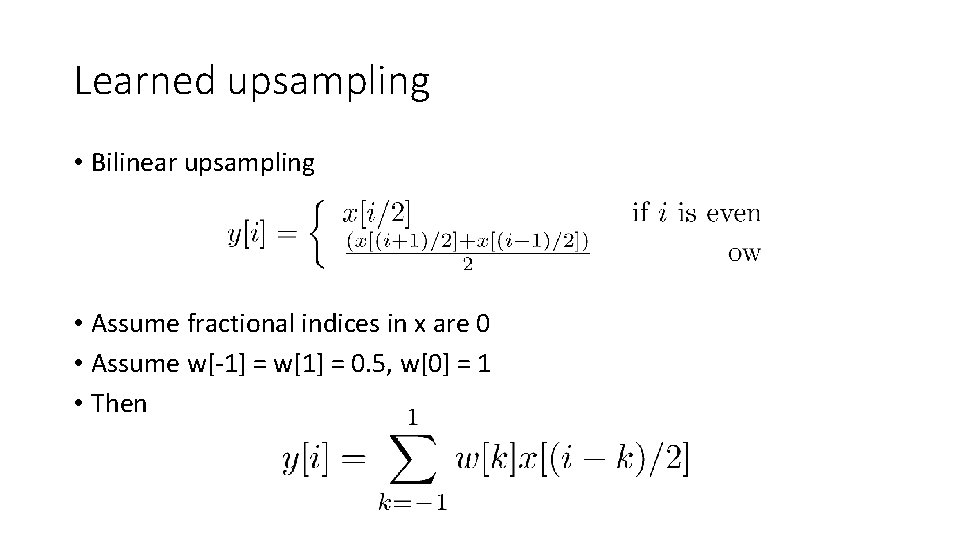
Learned upsampling • Bilinear upsampling • Assume fractional indices in x are 0 • Assume w[-1] = w[1] = 0. 5, w[0] = 1 • Then
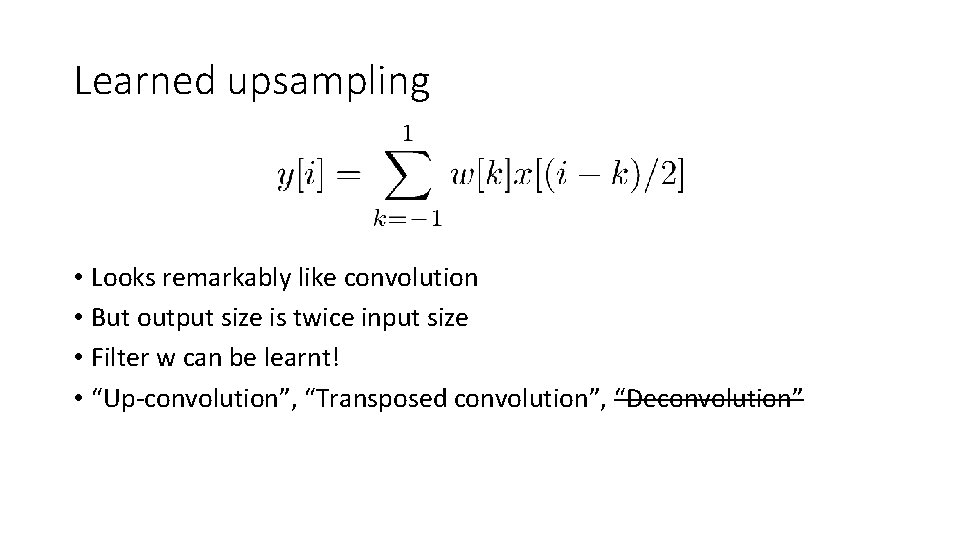
Learned upsampling • Looks remarkably like convolution • But output size is twice input size • Filter w can be learnt! • “Up-convolution”, “Transposed convolution”, “Deconvolution”
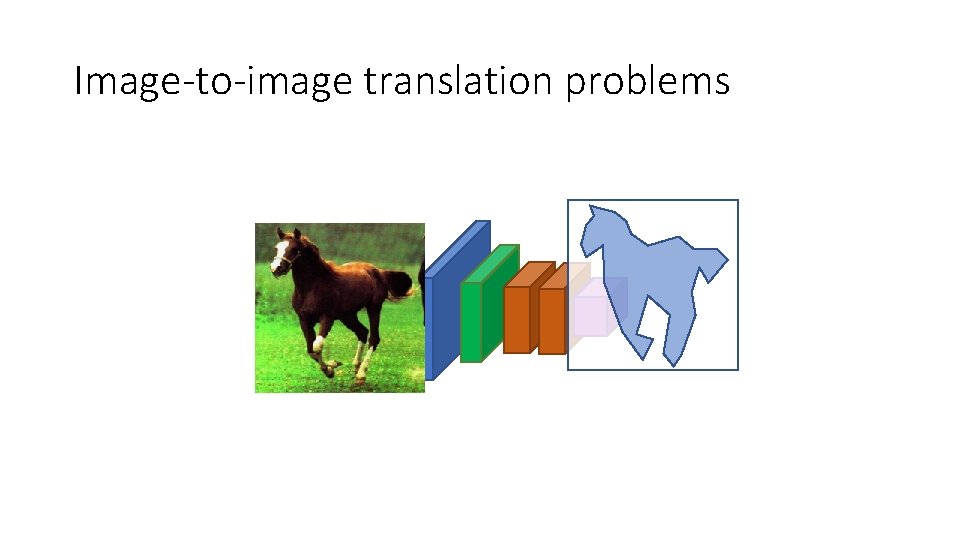
Image-to-image translation problems
Image-to-image translation problems • Segmentation • Optical flow estimation • Depth estimation • Normal estimation • Boundary detection • …
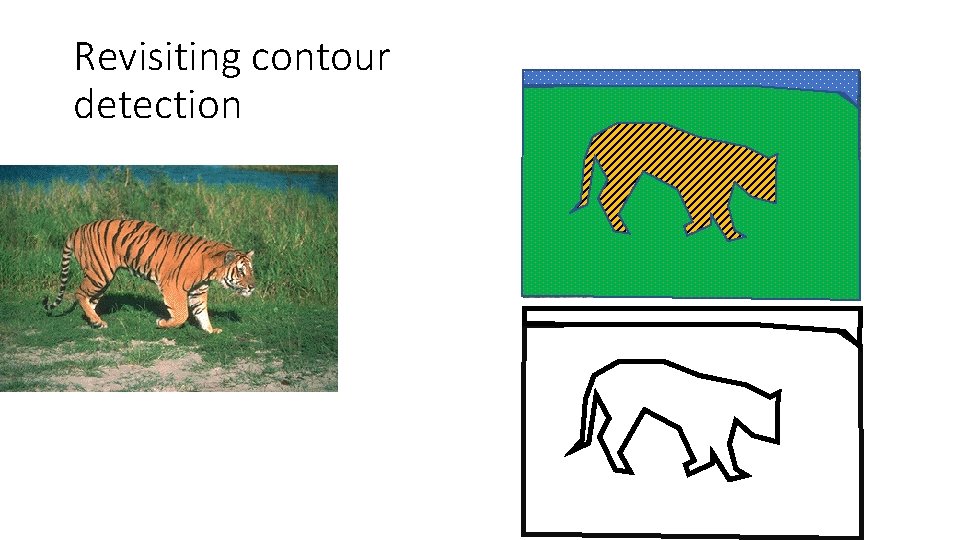
Revisiting contour detection
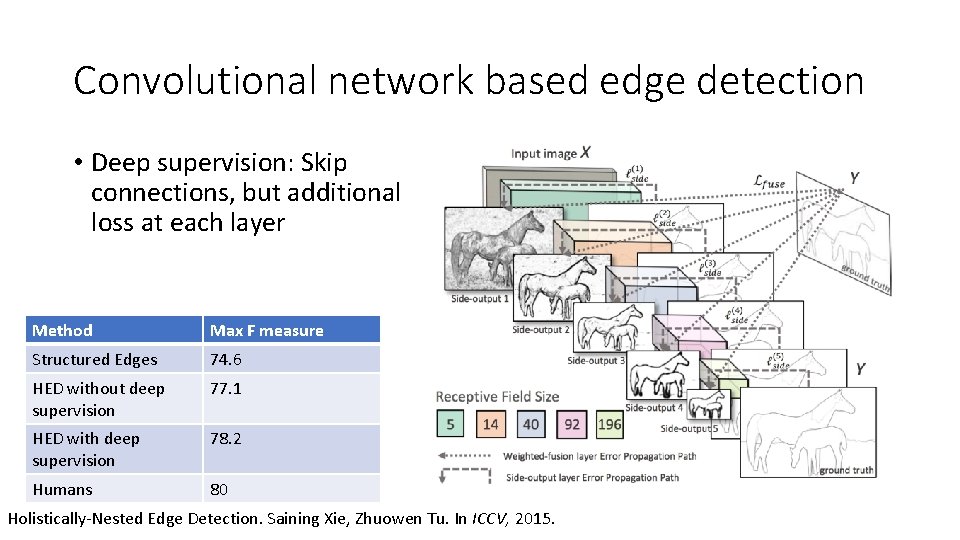
Convolutional network based edge detection • Deep supervision: Skip connections, but additional loss at each layer Method Max F measure Structured Edges 74. 6 HED without deep supervision 77. 1 HED with deep supervision 78. 2 Humans 80 Holistically-Nested Edge Detection. Saining Xie, Zhuowen Tu. In ICCV, 2015.
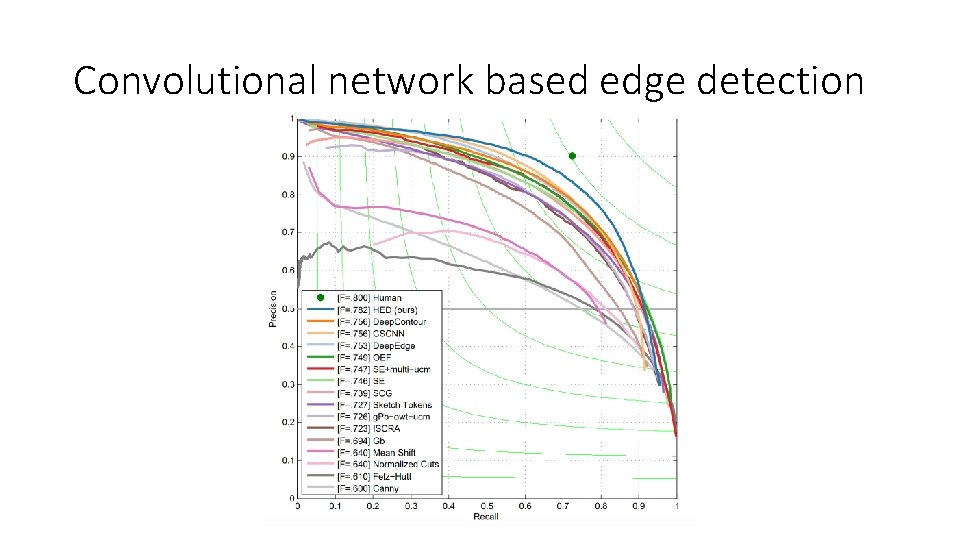
Convolutional network based edge detection