
Semantic Role Labeling Chapter 20 Semantic Role Labeling
Semantic Role Labeling Chapter 20
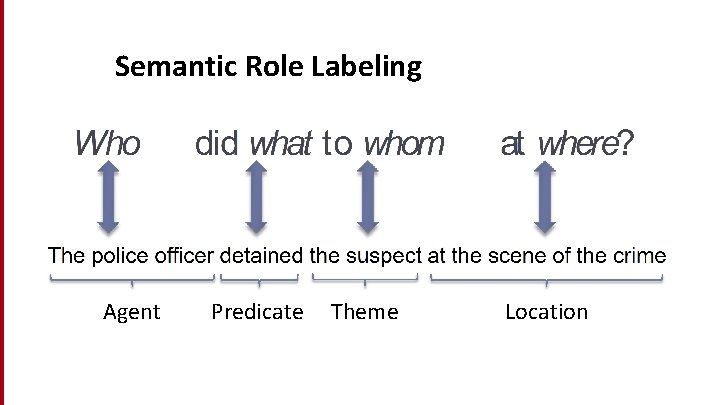
Semantic Role Labeling Agent Predicate Theme Location
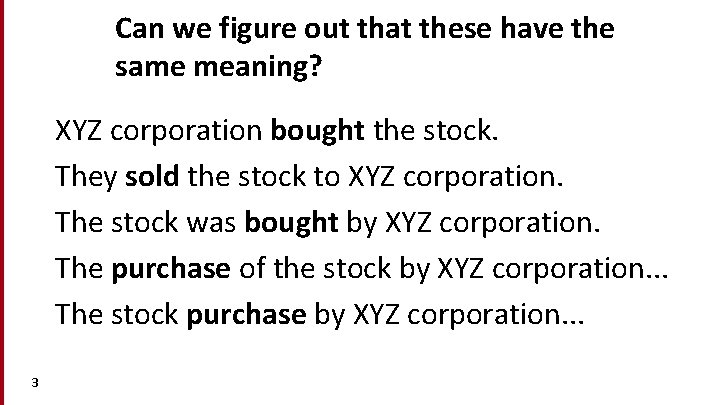
Can we figure out that these have the same meaning? XYZ corporation bought the stock. They sold the stock to XYZ corporation. The stock was bought by XYZ corporation. The purchase of the stock by XYZ corporation. . . The stock purchase by XYZ corporation. . . 3
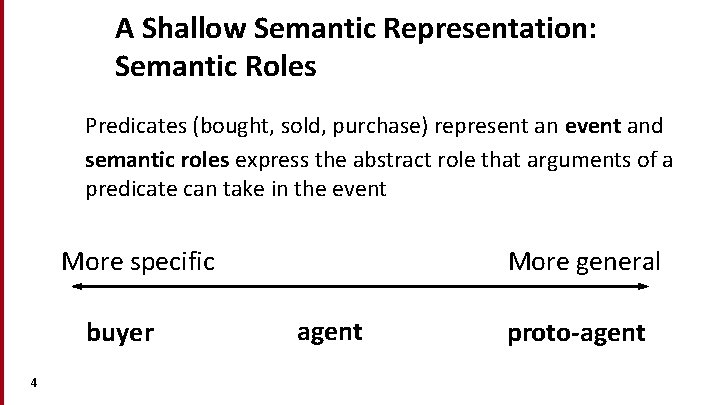
A Shallow Semantic Representation: Semantic Roles Predicates (bought, sold, purchase) represent an event and semantic roles express the abstract role that arguments of a predicate can take in the event More specific buyer 4 More general agent proto-agent
Getting to semantic roles What roles are involved in a breaking event? First order logic event representation for Sasha broke the window: 5
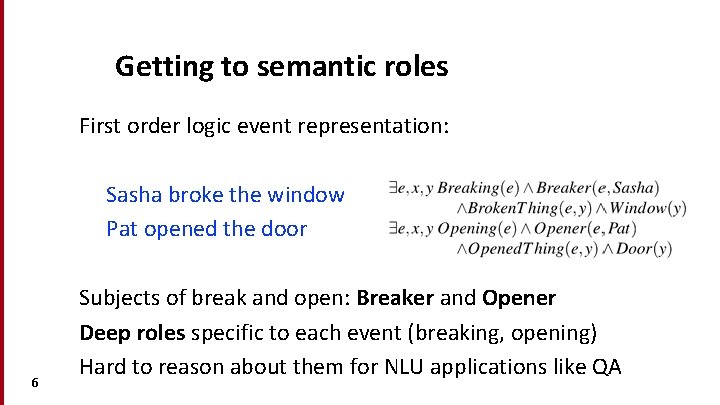
Getting to semantic roles First order logic event representation: Sasha broke the window Pat opened the door 6 Subjects of break and open: Breaker and Opener Deep roles specific to each event (breaking, opening) Hard to reason about them for NLU applications like QA
Thematic roles • Breaker and Opener have something in common! • Volitional actors • Often animate • Direct causal responsibility for their events • Thematic roles are a way to capture this semantic commonality between Breakers and Openers. • They are both AGENTS. • The Broken. Thing and Opened. Thing, are THEMES. 7 • prototypically inanimate objects affected in some way by the action
Thematic roles • One of the oldest linguistic models • Indian grammarian Panini between the 7 th and 4 th centuries BCE • Modern formulation from Fillmore (1966, 1968), Gruber (1965) • Fillmore influenced by Lucien Tesnière’s (1959) E léments de Syntaxe Structurale, the book that introduced dependency grammar • Fillmore first referred to roles as actants (Fillmore, 1966) but switched to the term case 8
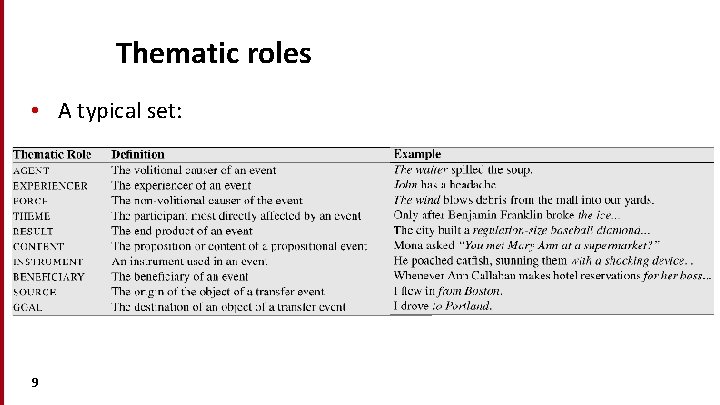
Thematic roles • A typical set: 9
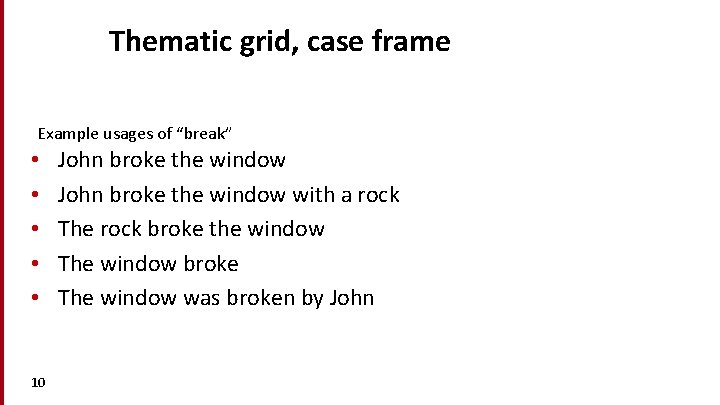
Thematic grid, case frame Example usages of “break” • • • 10 John broke the window with a rock The rock broke the window The window broke The window was broken by John
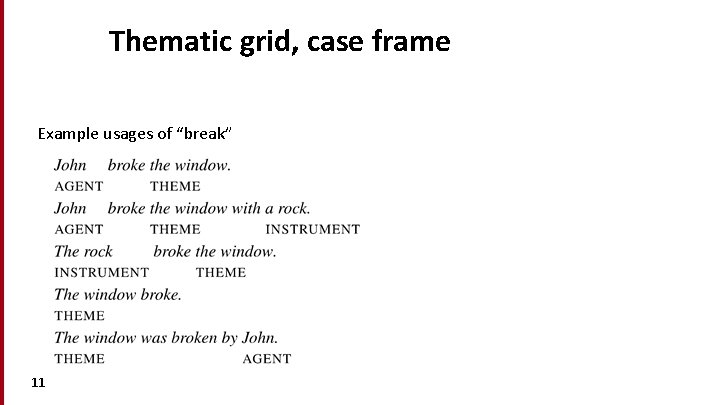
Thematic grid, case frame Example usages of “break” 11
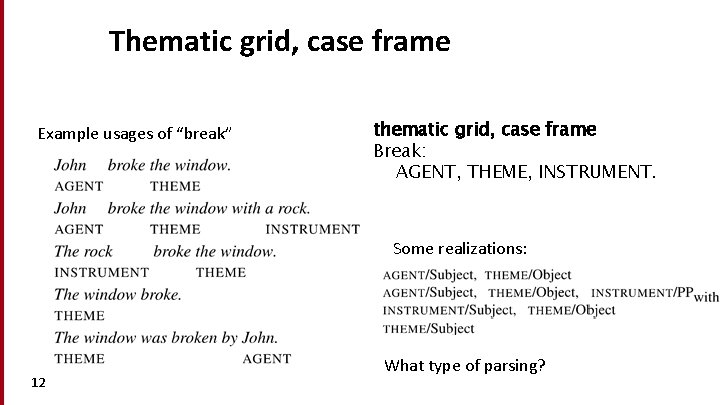
Thematic grid, case frame Example usages of “break” thematic grid, case frame Break: AGENT, THEME, INSTRUMENT. Some realizations: 12 What type of parsing?
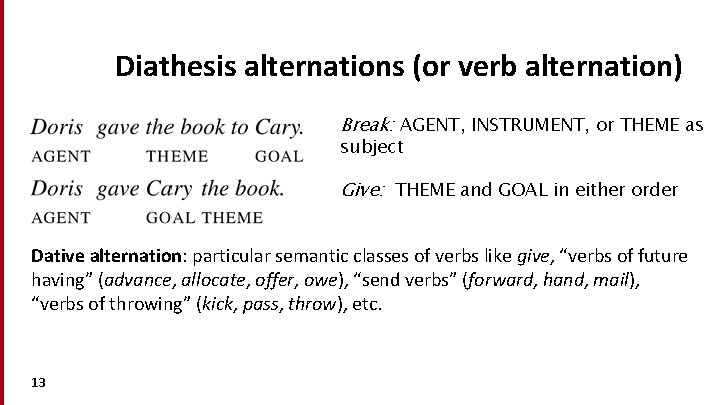
Diathesis alternations (or verb alternation) Break: AGENT, INSTRUMENT, or THEME as subject Give: THEME and GOAL in either order Dative alternation: particular semantic classes of verbs like give, “verbs of future having” (advance, allocate, offer, owe), “send verbs” (forward, hand, mail), “verbs of throwing” (kick, pass, throw), etc. 13
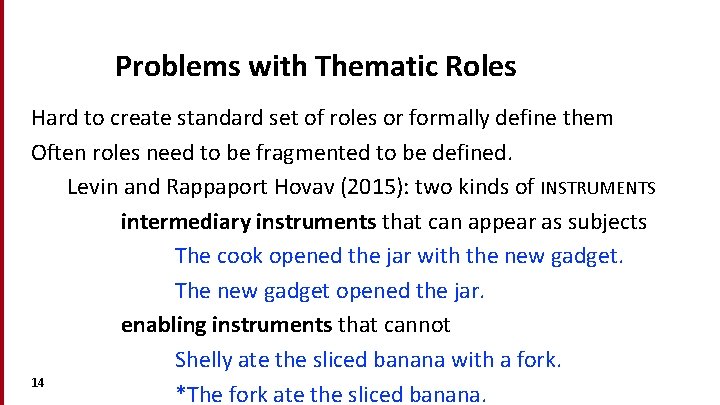
Problems with Thematic Roles Hard to create standard set of roles or formally define them Often roles need to be fragmented to be defined. Levin and Rappaport Hovav (2015): two kinds of INSTRUMENTS intermediary instruments that can appear as subjects The cook opened the jar with the new gadget. The new gadget opened the jar. enabling instruments that cannot Shelly ate the sliced banana with a fork. 14 *The fork ate the sliced banana.
Alternatives to thematic roles 1. Fewer roles: generalized semantic roles, defined as prototypes (Dowty 1991) PROTO-AGENT PROTO-PATIENT Prop. Bank 2. More roles: Define roles specific to a group of predicates Frame. Net 15
Prop. Bank • Palmer, Martha, Daniel Gildea, and Paul Kingsbury. 2005. The Proposition Bank: An Annotated Corpus of Semantic Roles. Computational Linguistics, 31(1): 71– 106 • http: //verbs. colorado. edu/~mpalmer/projects/ace. html 16
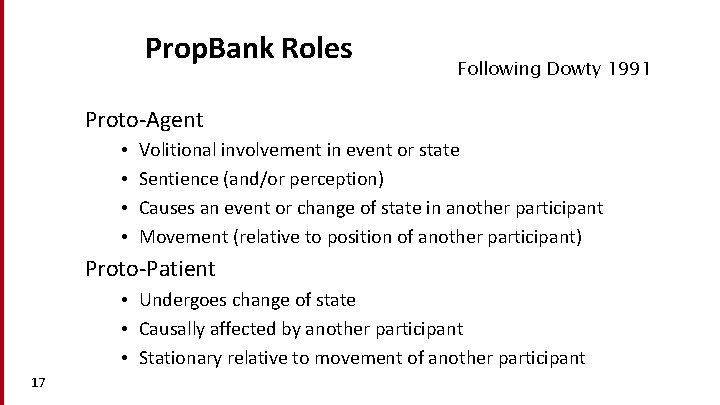
Prop. Bank Roles Following Dowty 1991 Proto-Agent • • Volitional involvement in event or state Sentience (and/or perception) Causes an event or change of state in another participant Movement (relative to position of another participant) Proto-Patient • Undergoes change of state • Causally affected by another participant • Stationary relative to movement of another participant 17
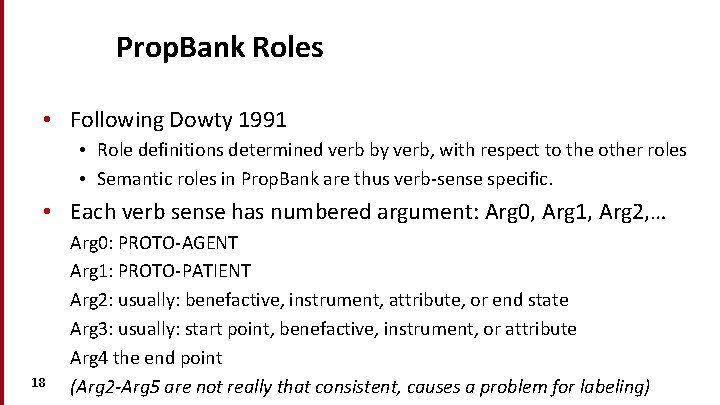
Prop. Bank Roles • Following Dowty 1991 • Role definitions determined verb by verb, with respect to the other roles • Semantic roles in Prop. Bank are thus verb-sense specific. • Each verb sense has numbered argument: Arg 0, Arg 1, Arg 2, … 18 Arg 0: PROTO-AGENT Arg 1: PROTO-PATIENT Arg 2: usually: benefactive, instrument, attribute, or end state Arg 3: usually: start point, benefactive, instrument, or attribute Arg 4 the end point (Arg 2 -Arg 5 are not really that consistent, causes a problem for labeling)
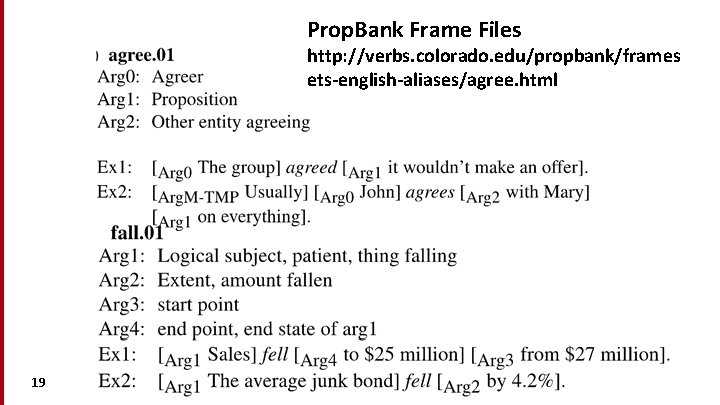
Prop. Bank Frame Files http: //verbs. colorado. edu/propbank/frames ets-english-aliases/agree. html 19
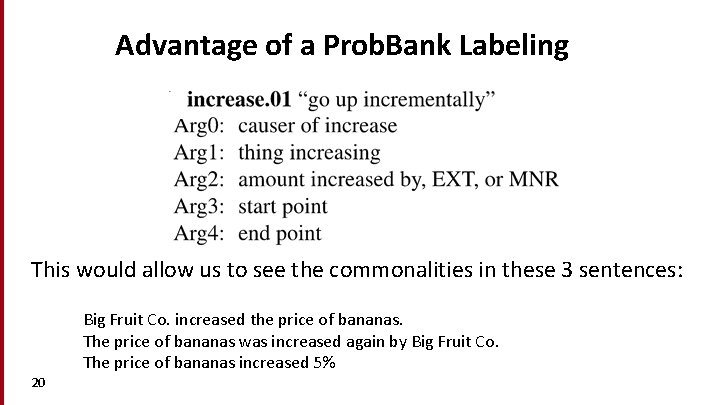
Advantage of a Prob. Bank Labeling This would allow us to see the commonalities in these 3 sentences: Big Fruit Co. increased the price of bananas. The price of bananas was increased again by Big Fruit Co. The price of bananas increased 5% 20
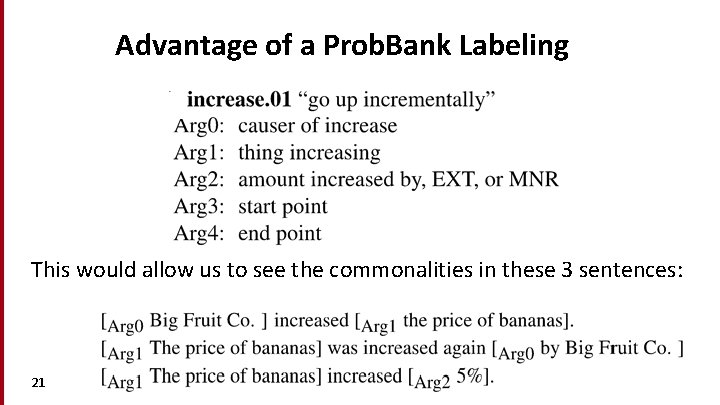
Advantage of a Prob. Bank Labeling This would allow us to see the commonalities in these 3 sentences: 21
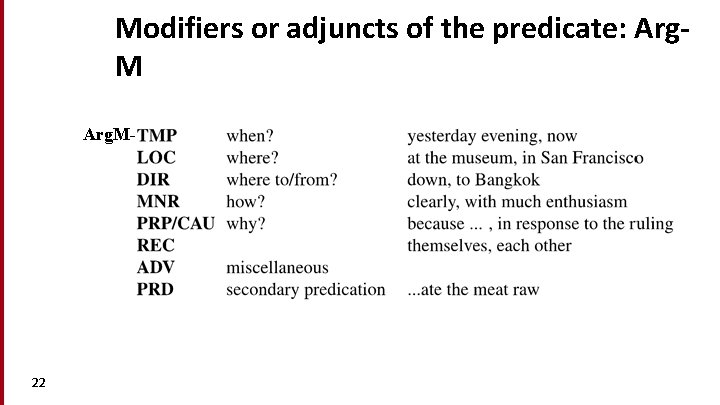
Modifiers or adjuncts of the predicate: Arg. M- 22
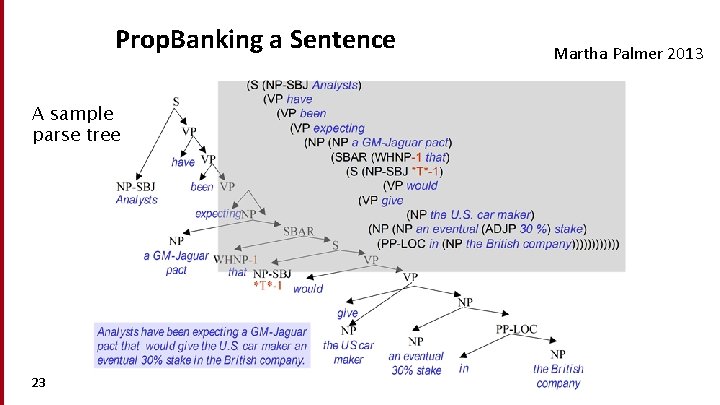
Prop. Banking a Sentence A sample parse tree 23 Martha Palmer 2013
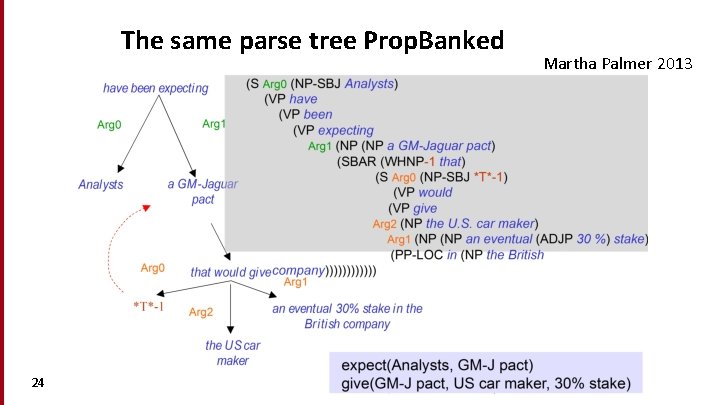
The same parse tree Prop. Banked 24 Martha Palmer 2013
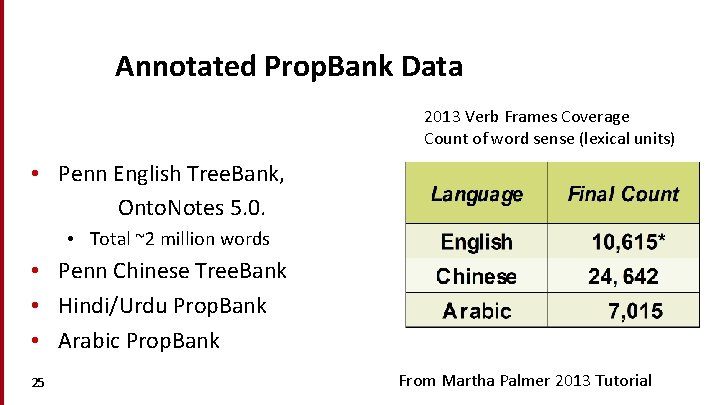
Annotated Prop. Bank Data 2013 Verb Frames Coverage Count of word sense (lexical units) • Penn English Tree. Bank, Onto. Notes 5. 0. • Total ~2 million words • Penn Chinese Tree. Bank • Hindi/Urdu Prop. Bank • Arabic Prop. Bank 25 From Martha Palmer 2013 Tutorial
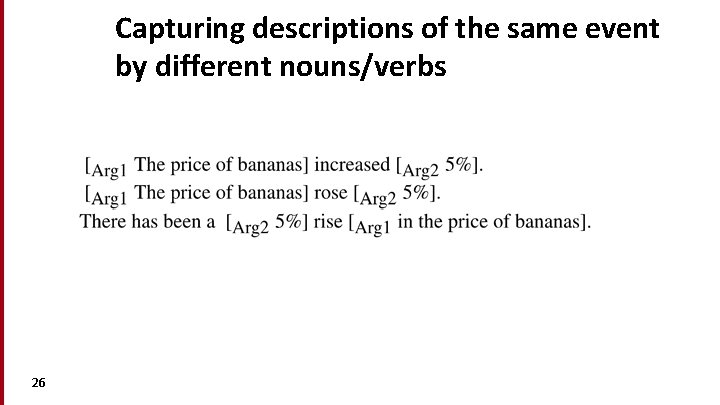
Capturing descriptions of the same event by different nouns/verbs 26
Frame. Net • Baker et al. 1998, Fillmore et al. 2003, Fillmore and Baker 2009, Ruppenhofer et al. 2006 • Roles in Prop. Bank are specific to a verb • Role in Frame. Net are specific to a frame: a background knowledge structure that defines a set of frame-specific semantic roles, called frame elements, • includes a set of predicates that use these roles • each word evokes a frame and profiles some aspect of the frame • https: //framenet. icsi. berkeley. edu/fndrupal/ 27
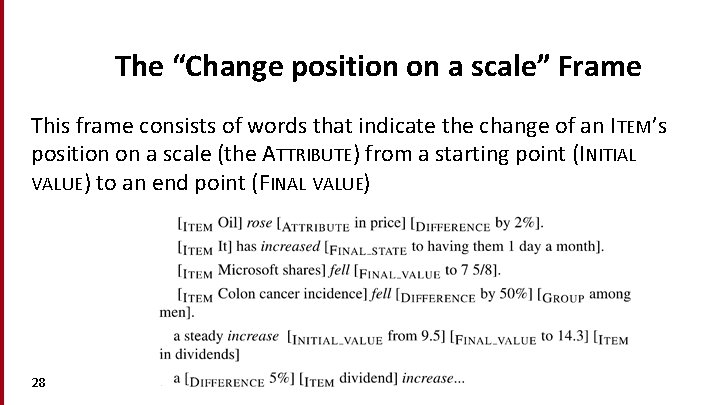
The “Change position on a scale” Frame This frame consists of words that indicate the change of an ITEM’s position on a scale (the ATTRIBUTE) from a starting point (INITIAL VALUE) to an end point (FINAL VALUE) 28
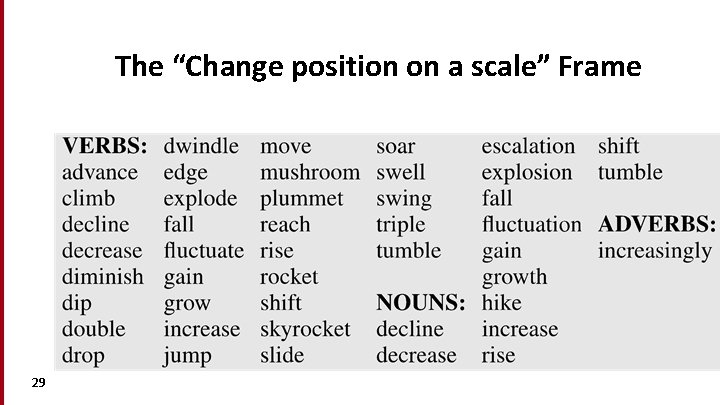
The “Change position on a scale” Frame 29
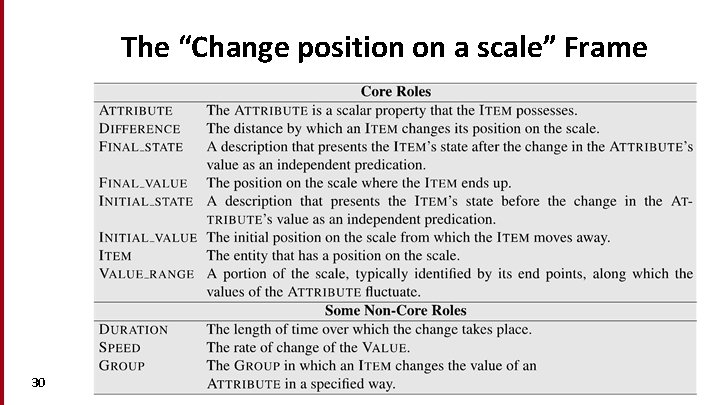
The “Change position on a scale” Frame 30
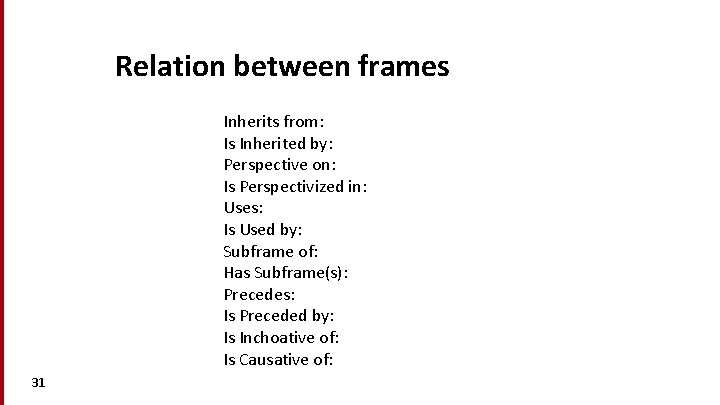
Relation between frames Inherits from: Is Inherited by: Perspective on: Is Perspectivized in: Uses: Is Used by: Subframe of: Has Subframe(s): Precedes: Is Preceded by: Is Inchoative of: Is Causative of: 31
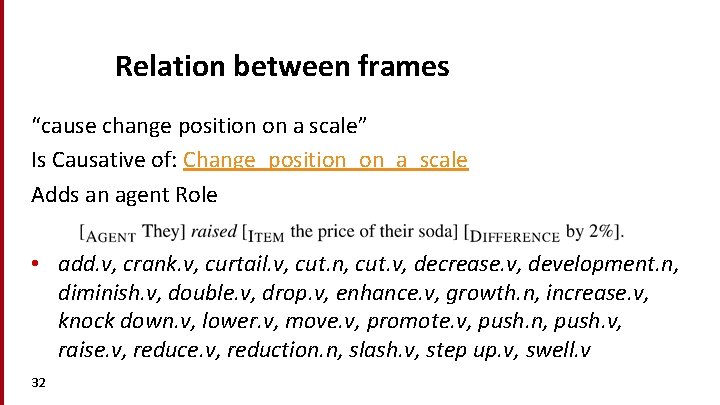
Relation between frames “cause change position on a scale” Is Causative of: Change_position_on_a_scale Adds an agent Role • add. v, crank. v, curtail. v, cut. n, cut. v, decrease. v, development. n, diminish. v, double. v, drop. v, enhance. v, growth. n, increase. v, knock down. v, lower. v, move. v, promote. v, push. n, push. v, raise. v, reduction. n, slash. v, step up. v, swell. v 32
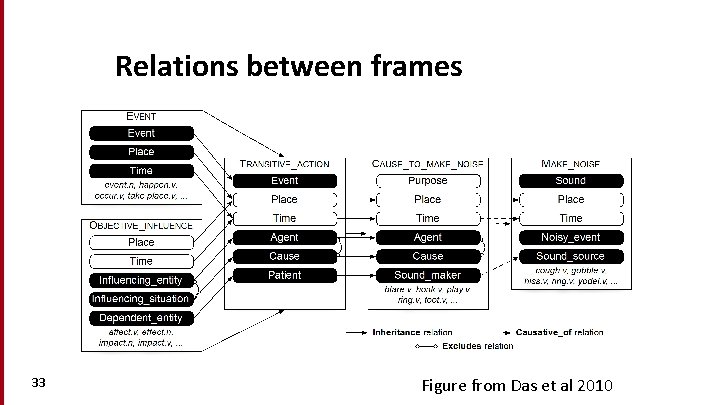
Relations between frames 33 Figure from Das et al 2010
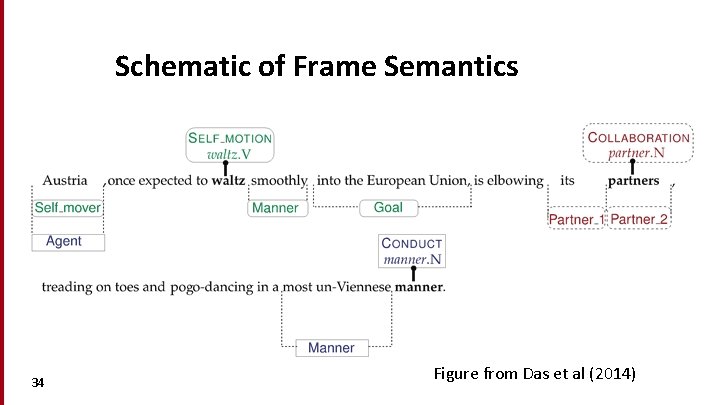
Schematic of Frame Semantics 34 Figure from Das et al (2014)
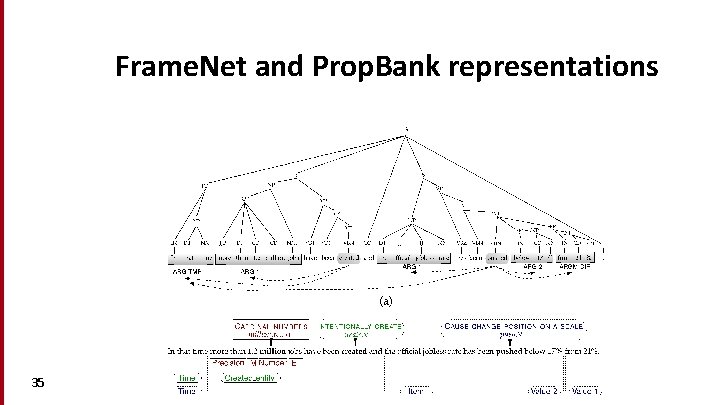
Frame. Net and Prop. Bank representations 35
- Slides: 35