
Semantic Properties of Verbs Situation and its Types
Semantic Properties of Verbs Situation and its Types
Overview Semantic Properties and Lexicon
Semantic Class Learn these English verbs: hit, kiss, and touch Yes, they share a semantic property [CONTACT] They are in a semantic class
Consider! make, create, imagine, and build girl, filly, pullet, and ewe little, small, tiny, and short
Semantic Relationship Learn these English verbs: hit, punch, Hit a computer keyboard to enter data. Punch a computer keyboard to enter data. hit and punch have semantic properties [CONTACT] and [PRESS DOWN] ‘typewriter’ ‘computer keyboard’ pushing typewriter to enter data, pressing typewriter down to enter data pushing, pressing, enter, data are related to typewriter; semantic relations
Consider! pour, drink, leak, droplet, swim, splash, goop, water, and liquid fish swims [in a liquid, water] a liquid is splashed pouring goops, drinking goops, plugging a hole where goops is leaking out and forming doplets

Grammatical Semantics
A verb in a clause Compositionality and Situation
Rhetorical Focus A verb, like punch, hit, push, and press simply make a clause, Hit a computer keyboard to enter data “do something” hit interrelates to entity computer keyboard and enter to entity data computer keyboard and data refer to aspect of the world – real or imagined that language users talk and write about. hit and enter denote an action.
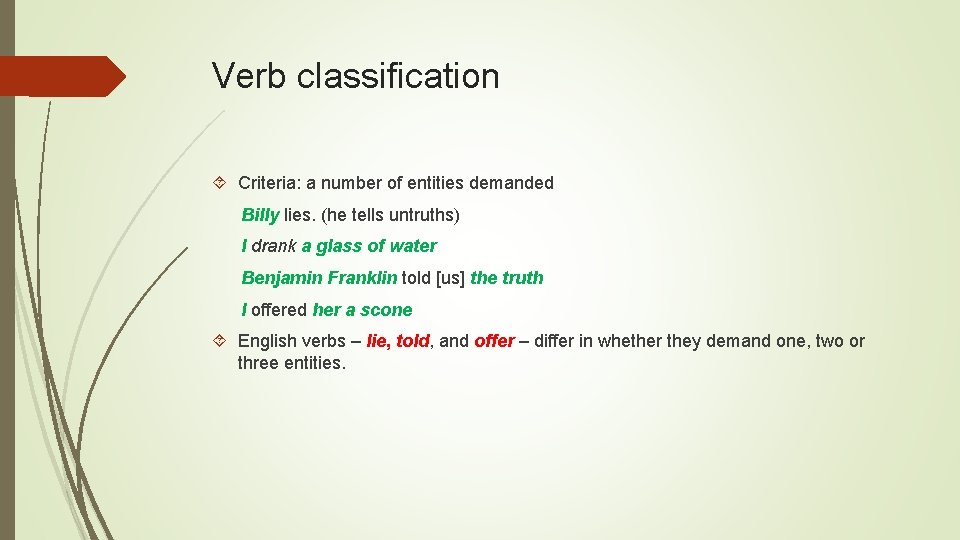
Verb classification Criteria: a number of entities demanded Billy lies. (he tells untruths) I drank a glass of water Benjamin Franklin told [us] the truth I offered her a scone English verbs – lie, told, and offer – differ in whether they demand one, two or three entities.
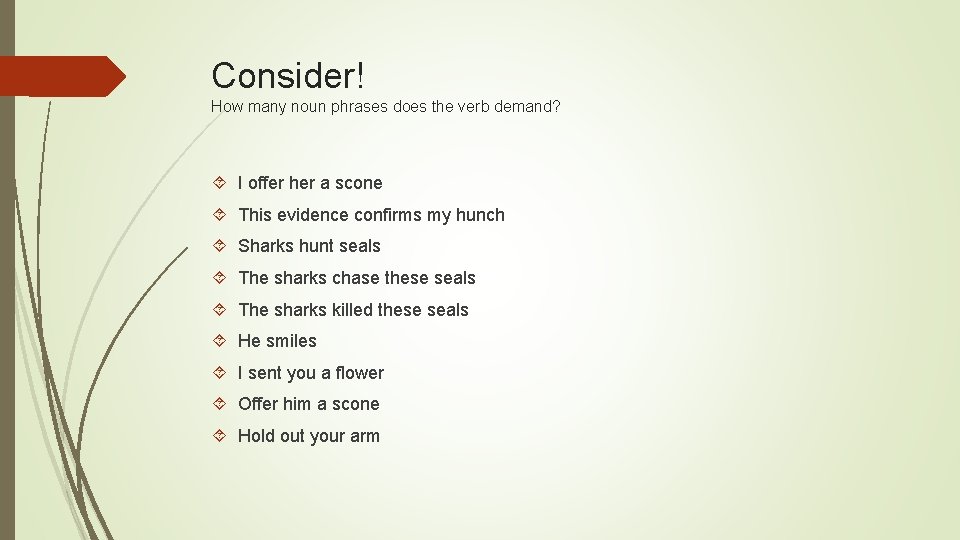
Consider! How many noun phrases does the verb demand? I offer her a scone This evidence confirms my hunch Sharks hunt seals The sharks chase these seals The sharks killed these seals He smiles I sent you a flower Offer him a scone Hold out your arm
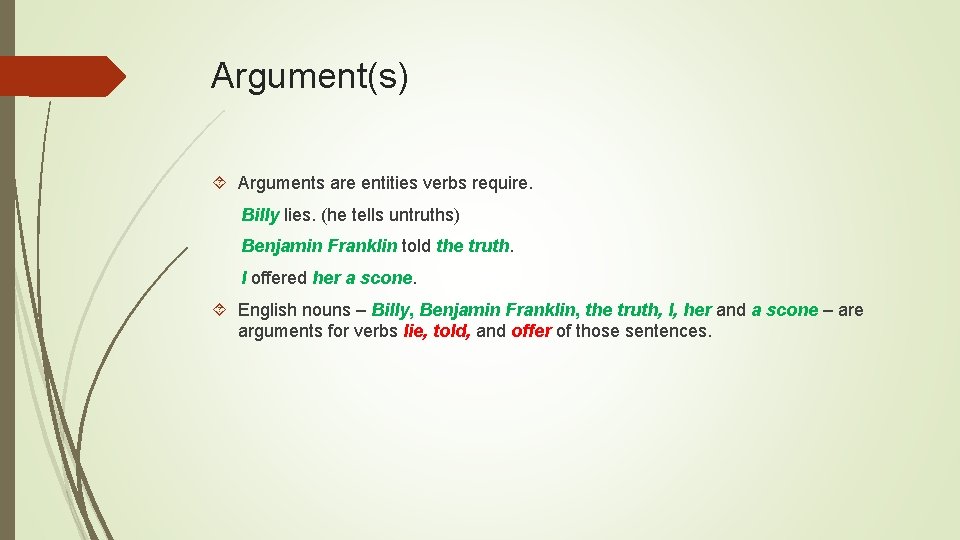
Argument(s) Arguments are entities verbs require. Billy lies. (he tells untruths) Benjamin Franklin told the truth. I offered her a scone. English nouns – Billy, Benjamin Franklin, the truth, I, her and a scone – are arguments for verbs lie, told, and offer of those sentences.
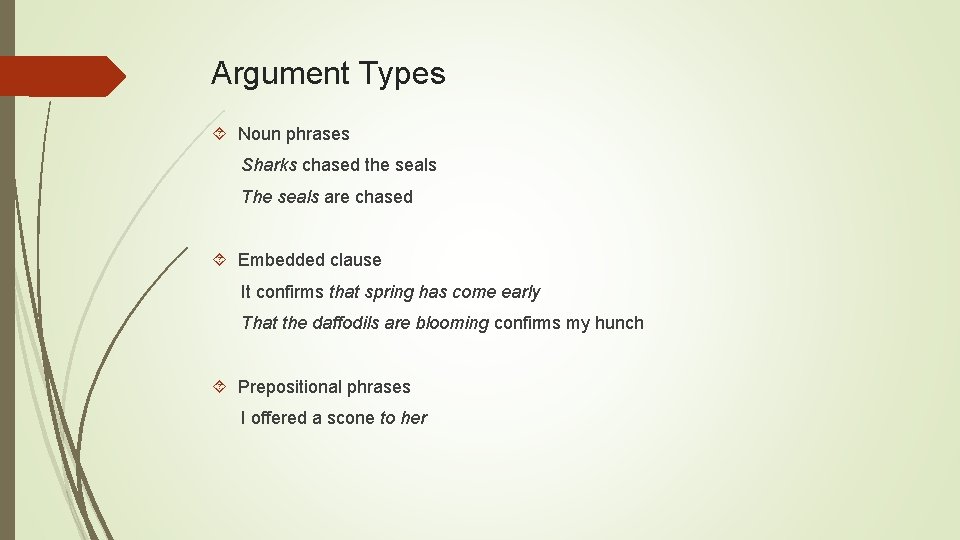
Argument Types Noun phrases Sharks chased the seals The seals are chased Embedded clause It confirms that spring has come early That the daffodils are blooming confirms my hunch Prepositional phrases I offered a scone to her
Consider! How many arguments does the verb require? What type of arguments are there? Tourist walk through the eco park The bank’s interest rate dropped One of his teeth chipped Jo cooked dinner He slept in five minutes Axel owned a pair of jeans for a weak
Proposition (1) Hold out your arm (2) Spring has come early (3) Tourist walk through the eco park (1), (2) and (3) denotes a situation (1) denotes a situation that the speaker wants (2) denotes a situation, that is, the start of a season [3) denotes a situation happens In semantics, the speaker wants for (1), the start of a season (2), and situation happens carry proposition.
Proposition A proposition consists of one verb, and one or more noun phrase. (4) I love the way you are Proposition terms: predication, participants, circumstances (5) I love you in every way
Exercises 1. Mommy massed the banana 2. The baby ate some banana 3. We drove to Jakarta today 4. The teacher held the first tutorial next week
- Slides: 17