
Semantic Lexical Typology Verbs of Falling and Beyond
Semantic / Lexical Typology: Verbs of Falling and Beyond Katia Rakhilina (NRU HSE, Moscow) “Verbs, verb phrases and verbal categories” 23 -25 March Hebrew University of Jerusalem
BEYOND: Lexical Typology. Main objectives • A relatively new area of linguistic typology • Until recently, linguistic typology grammatical or phonological typology • Lexical typology deals with cross-linguistic universals and variation in lexical categorization of conceptual domains 2

Main approaches to lexical typology q Natural Semantic Metalanguage (Anna Wierzbicka and Cliff Goddard) primarily determined via introspection q Denotation-based approach: MPI Nijmegen (Stephen Levinson, Asifa Majid et al. ) < Berlin&Kay 1969 experimental approach to LT: pictures or videoclips as stimuli and lexical reactions of native speakers 3
(1) NSM: Limitations v Which one is to choose a primitive among several near-synonyms xotet’ /zhelat’ in Russian or want / wish in English v How to deal with changes in meanings? 4
(2) Denotation-based approach: limitations + clear tertium comparationis (= extralinguistic stimuli) non applicable for domains of subjective experience & metaphorical extensions 5
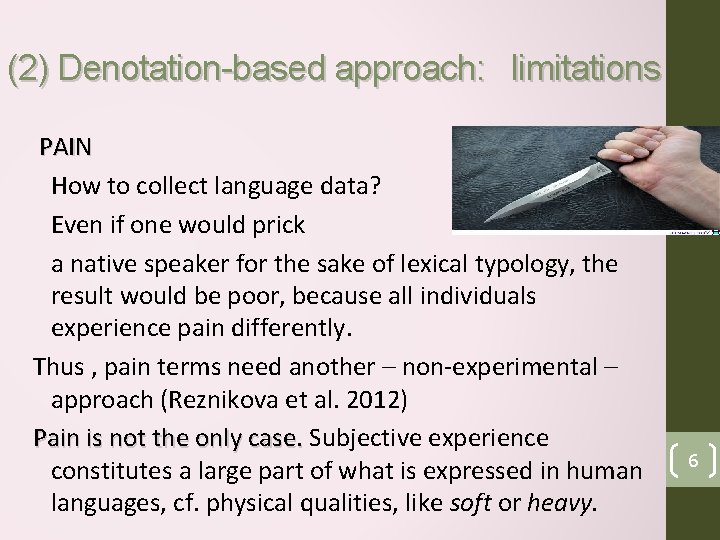
(2) Denotation-based approach: limitations PAIN How to collect language data? Even if one would prick a native speaker for the sake of lexical typology, the result would be poor, because all individuals experience pain differently. Thus , pain terms need another – non-experimental – approach (Reznikova et al. 2012) Pain is not the only case. Subjective experience constitutes a large part of what is expressed in human languages, cf. physical qualities, like soft or heavy. 6
MLex. T Methodology • The general idea is to combine: • the Moscow Semantic school tradition (deep semantic analysis of the lexicon with a special focus on synonymy) • Tradition of grammatical typology = Lexical typology So, basically we take into account the “linguistic behavior” of lexical items, i. e. combinability restrictions (dictionaries, corpora, field work with specially developed questionnaires)
Moscow Lexical Typology Group projects: Typology of activities & states: ØVerbs of aquamotion ØPain metaphors ØSound metaphors ØVerbs of rotation ØVerbs of oscillation ØCutting & breaking ØSitting & standing ØPhysical qualities (‘sharp’, ‘wet’, ‘soft’…) ØFALLING
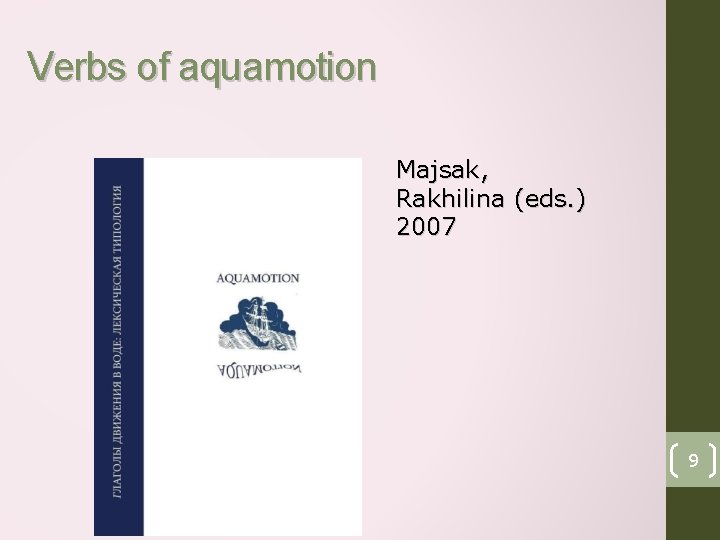
Verbs of aquamotion Majsak, Rakhilina (eds. ) 2007 9
Pain metaphors Britsyn, Rakhilina, Reznikova, Yavorska (eds. ) 2010 10

Sound metaphors 11
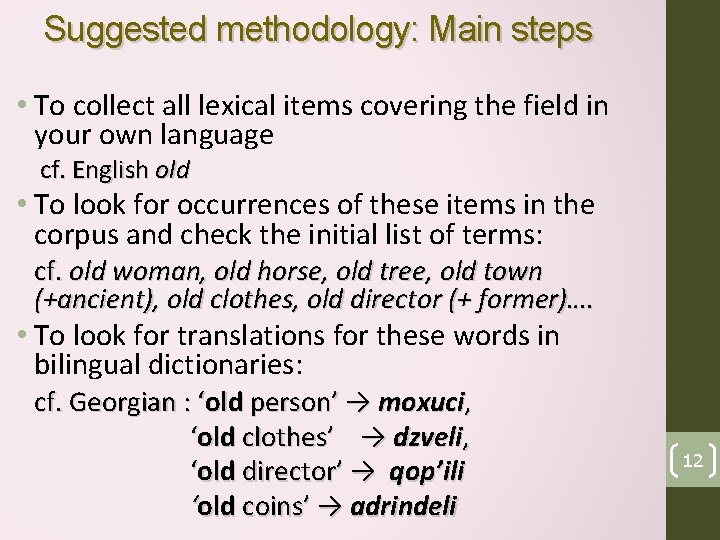
Suggested methodology: Main steps • To collect all lexical items covering the field in your own language cf. English old • To look for occurrences of these items in the corpus and check the initial list of terms: cf. old woman, old horse, old tree, old town (+ancient), old clothes, old director (+ former)…. • To look for translations for these words in bilingual dictionaries: cf. Georgian : ‘old person’ → moxuci, ‘old clothes’ → dzveli, ‘old director’ → qop’ili ‘old coins’ → adrindeli 12

Questionnaire • Obtaining a semantic classification of nouns based on dictionary data and corpus examples. • This classification provides the basis for a questionnaire to be completed by native speakers of different languages. • We have an ___oak close to our house; my great-grand father planted it many years ago. • His ___ wife was kind-hearted and the new one is beautiful but bad-tempered. 13
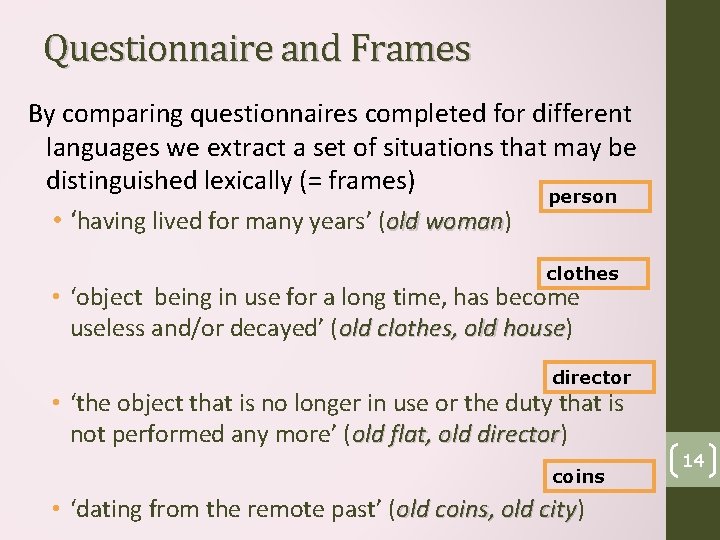
Questionnaire and Frames By comparing questionnaires completed for different languages we extract a set of situations that may be distinguished lexically (= frames) person • ‘having lived for many years’ (old woman) woman clothes • ‘object being in use for a long time, has become useless and/or decayed’ (old clothes, old house) house director • ‘the object that is no longer in use or the duty that is not performed any more’ (old flat, old director) director coins • ‘dating from the remote past’ (old coins, old city) city 14
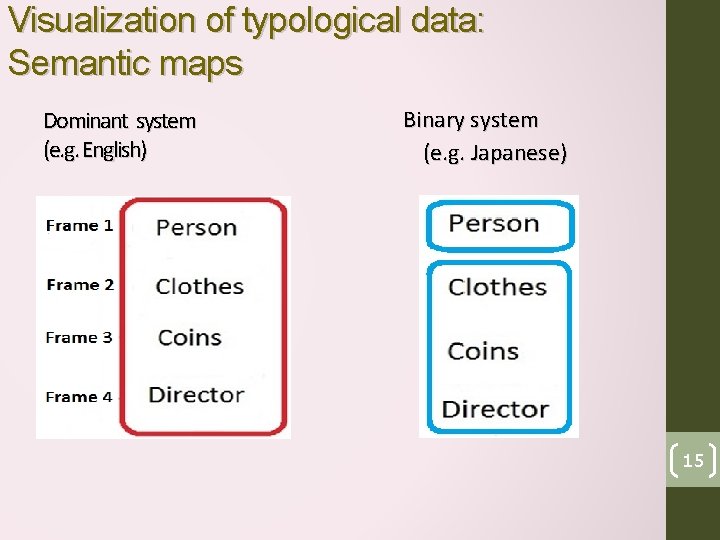
Visualization of typological data: Semantic maps Dominant system (e. g. English) Binary system (e. g. Japanese) 15
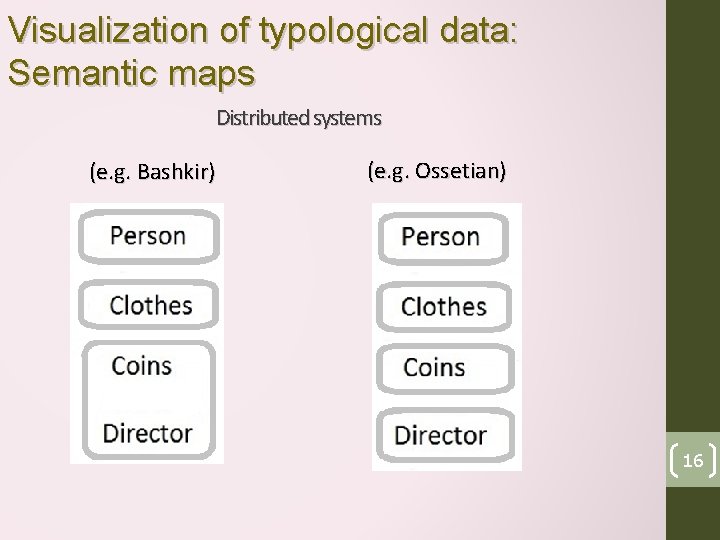
Visualization of typological data: Semantic maps Distributed systems (e. g. Bashkir) (e. g. Ossetian) 16
SHARP domain: Collocating nouns ‘knife’ ‘arrow’ ‘nose’ ‘scissors’ ‘(rose) thorns’ ‘(woolen) blanket’ ‘boots’ ‘needle’ ‘bristle’ 17
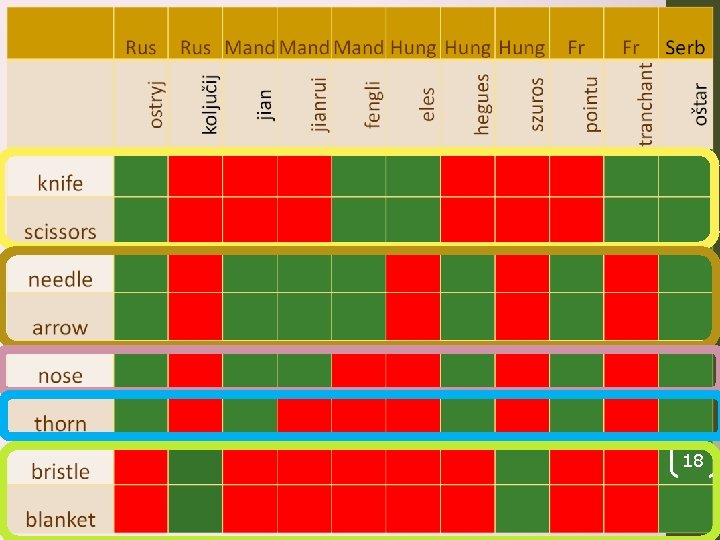
18
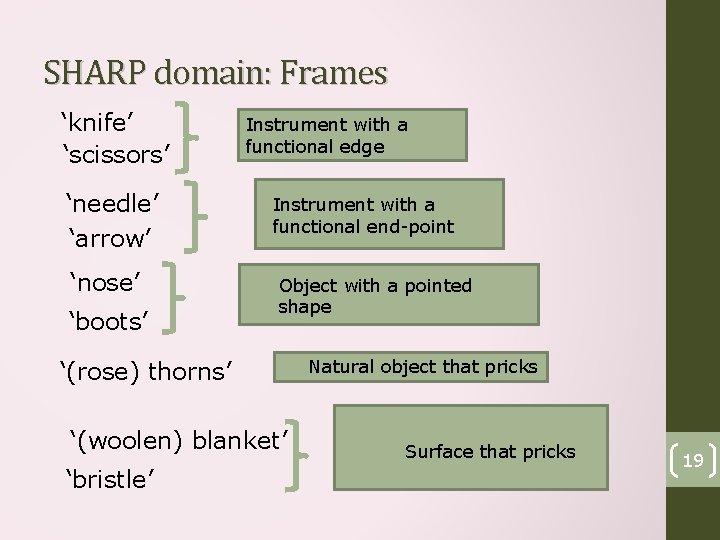
SHARP domain: Frames ‘knife’ ‘scissors’ ‘needle’ ‘arrow’ ‘nose’ ‘boots’ Instrument with a functional edge Instrument with a functional end-point Object with a pointed shape ‘(rose) thorns’ ‘(woolen) blanket’ ‘bristle’ Natural object that pricks Surface that pricks 19
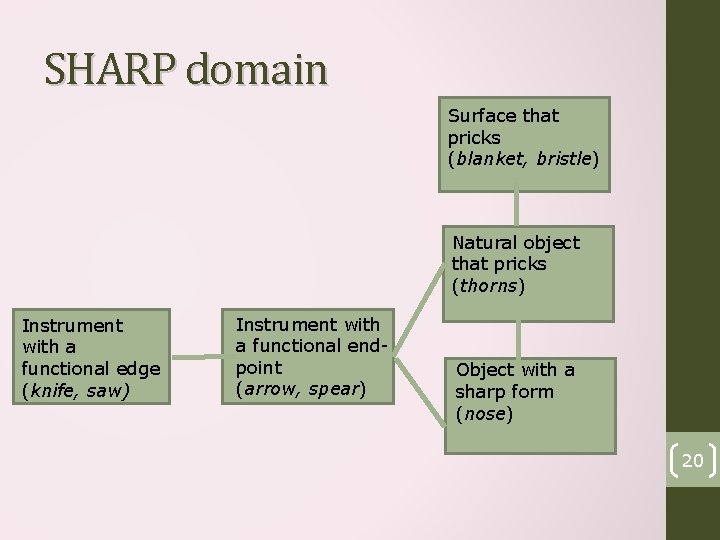
SHARP domain Surface that pricks (blanket, bristle) Natural object that pricks (thorns) Instrument with a functional edge (knife, saw) Instrument with a functional endpoint (arrow, spear) Object with a sharp form (nose) 20
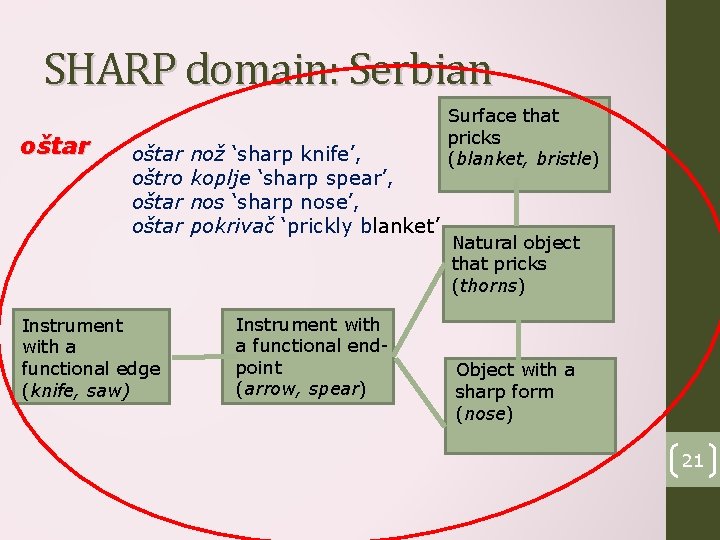
SHARP domain: Serbian oštar oštro oštar Instrument with a functional edge (knife, saw) nož ‘sharp knife’, koplje ‘sharp spear’, nos ‘sharp nose’, pokrivač ‘prickly blanket’ Instrument with a functional endpoint (arrow, spear) Surface that pricks (blanket, bristle) Natural object that pricks (thorns) Object with a sharp form (nose) 21
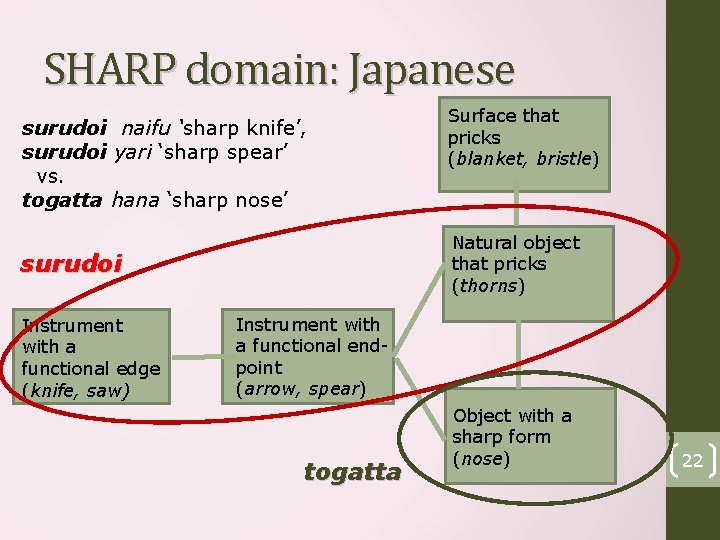
SHARP domain: Japanese surudoi naifu ‘sharp knife’, surudoi yari ‘sharp spear’ vs. togatta hana ‘sharp nose’ Natural object that pricks (thorns) surudoi Instrument with a functional edge (knife, saw) Surface that pricks (blanket, bristle) Instrument with a functional endpoint (arrow, spear) togatta Object with a sharp form (nose) 22
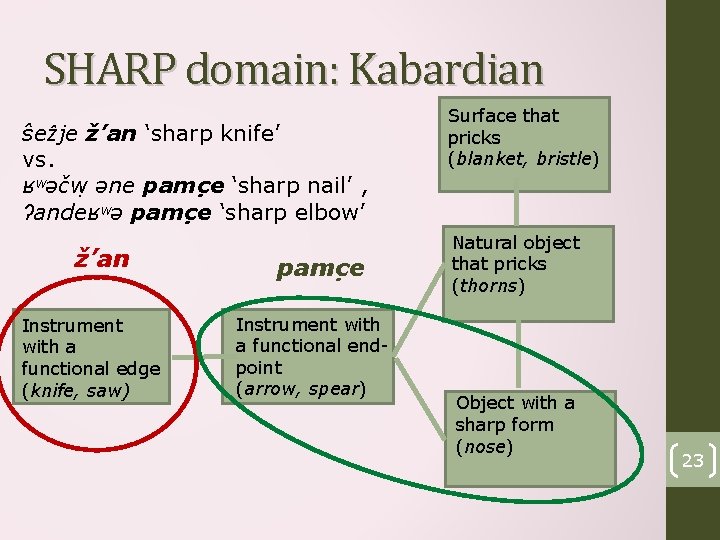
SHARP domain: Kabardian ŝeẑje ž’an ‘sharp knife’ vs. ʁʷəčw əne pamc e ‘sharp nail’ , ʔandeʁʷə pamc e ‘sharp elbow’ ž’an Instrument with a functional edge (knife, saw) pamc e Instrument with a functional endpoint (arrow, spear) Surface that pricks (blanket, bristle) Natural object that pricks (thorns) Object with a sharp form (nose) 23
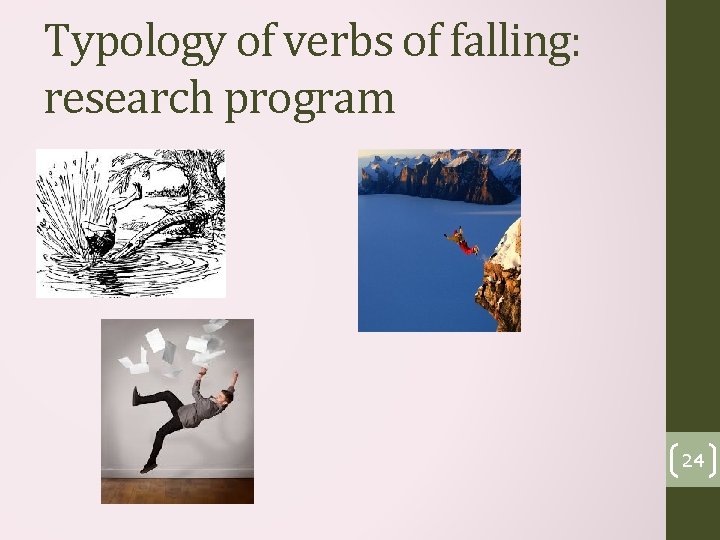
Typology of verbs of falling: research program 24
Falling: vertical motion due to gravity Description of falling has two dimensions: A. Substructure of the field and oppositions between its main frames B. Other semantic fields related to falling either directly (1) or through metaphorization procedure (2) 25
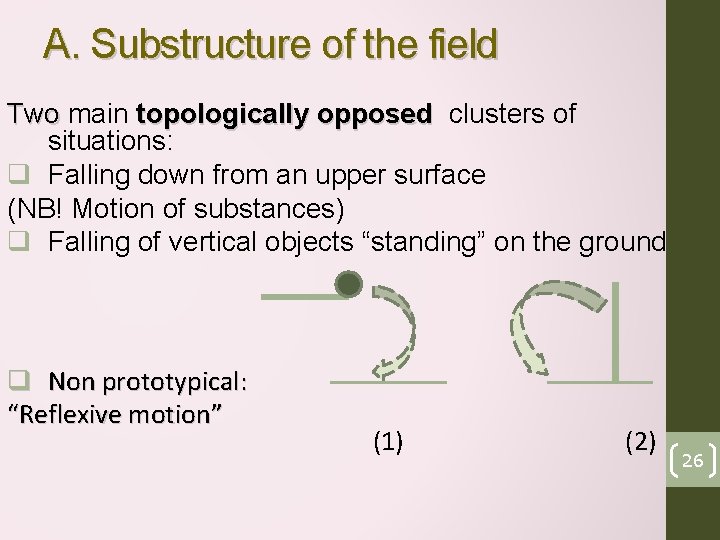
A. Substructure of the field Two main topologically opposed clusters of situations: q Falling down from an upper surface (NB! Motion of substances) q Falling of vertical objects “standing” on the ground q Non prototypical: “Reflexive motion” (1) (2) 26
q Falling down from an upper surface • Locations: Locations • Source (initial location) and Goal (final location) • Source is normally not marked (except for containers: falling out of smth)
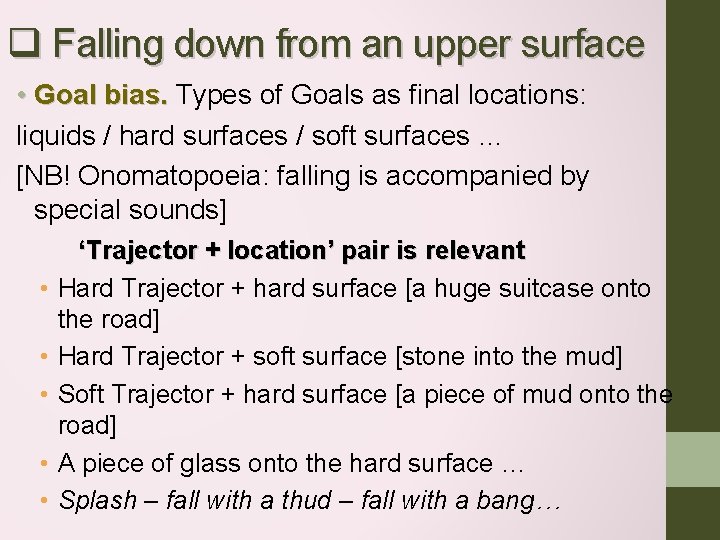
q Falling down from an upper surface • Goal bias. Types of Goals as final locations: liquids / hard surfaces / soft surfaces … [NB! Onomatopoeia: falling is accompanied by special sounds] • • • ‘Trajector + location’ pair is relevant Hard Trajector + hard surface [a huge suitcase onto the road] Hard Trajector + soft surface [stone into the mud] Soft Trajector + hard surface [a piece of mud onto the road] A piece of glass onto the hard surface … Splash – fall with a thud – fall with a bang…
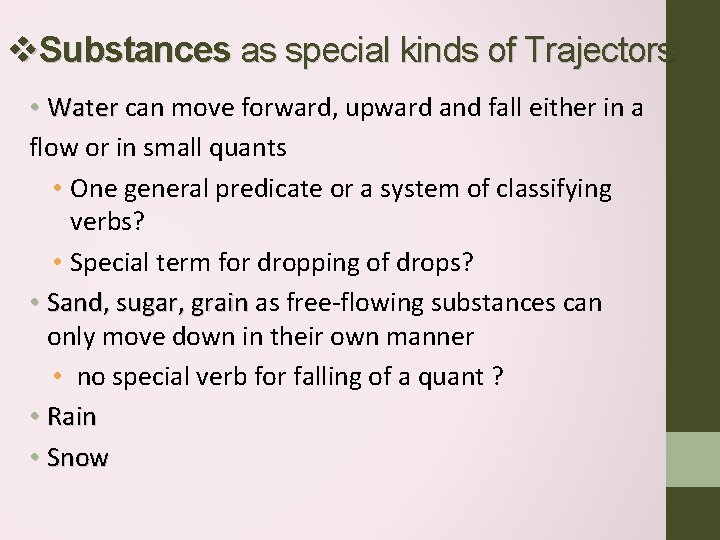
v. Substances as special kinds of Trajectors • Water can move forward, upward and fall either in a flow or in small quants • One general predicate or a system of classifying verbs? • Special term for dropping of drops? • Sand, sugar, grain as free-flowing substances can only move down in their own manner • no special verb for falling of a quant ? • Rain • Snow
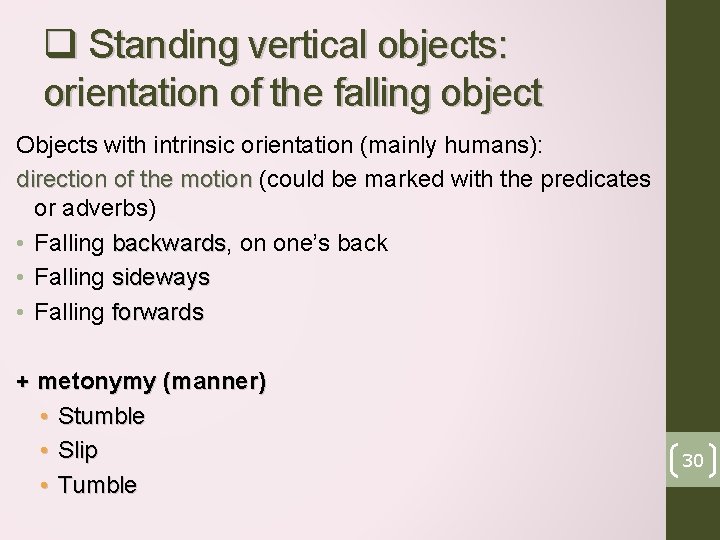
q Standing vertical objects: orientation of the falling object Objects with intrinsic orientation (mainly humans): direction of the motion (could be marked with the predicates or adverbs) • Falling backwards, backwards on one’s back • Falling sideways • Falling forwards + metonymy (manner) • Stumble • Slip • Tumble 30
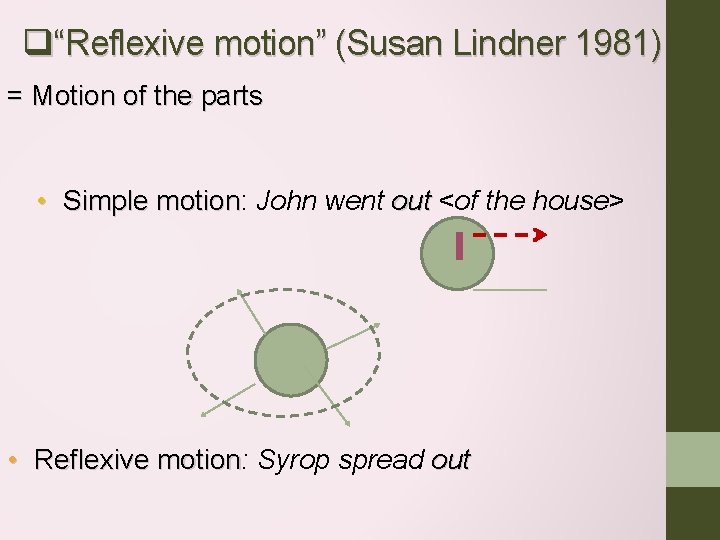
q“Reflexive motion” (Susan Lindner 1981) = Motion of the parts • Simple motion: motion John went out <of the house> • Reflexive motion: motion Syrop spread out
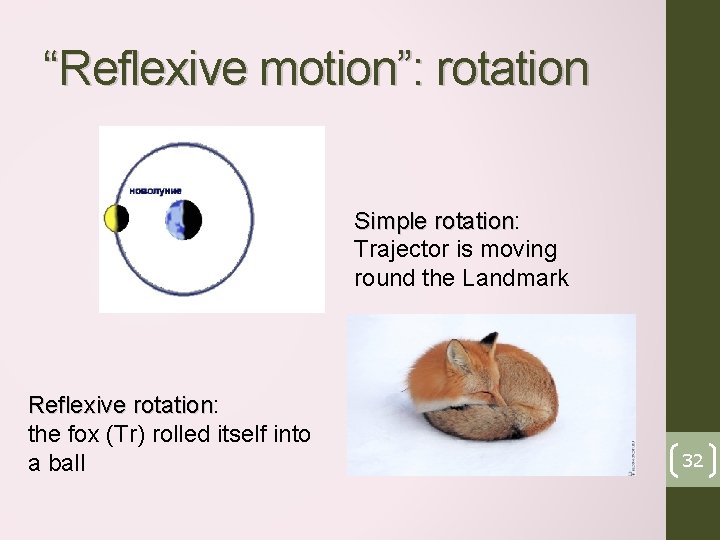
“Reflexive motion”: rotation Simple rotation: rotation Trajector is moving round the Landmark Reflexive rotation: rotation the fox (Tr) rolled itself into a ball 32
“Reflexive motion” & related frames • Crash down, collapse: about a building the house fell down • To fall down: about a surface itself e. g. due to the heavy object on it the ice crashed + meton. smb. fell trough the ice
“Reflexive motion”: related frames • Body parts (no motion) • Teeth / Hair: come out [+ Tail of a lizard] [+ Tongue (a running dog)] • • Parts of artifacts (the motion is not vertical) May be separated due to the movement High speed, type of initial connection is relevant Break off, come off, be torn off …
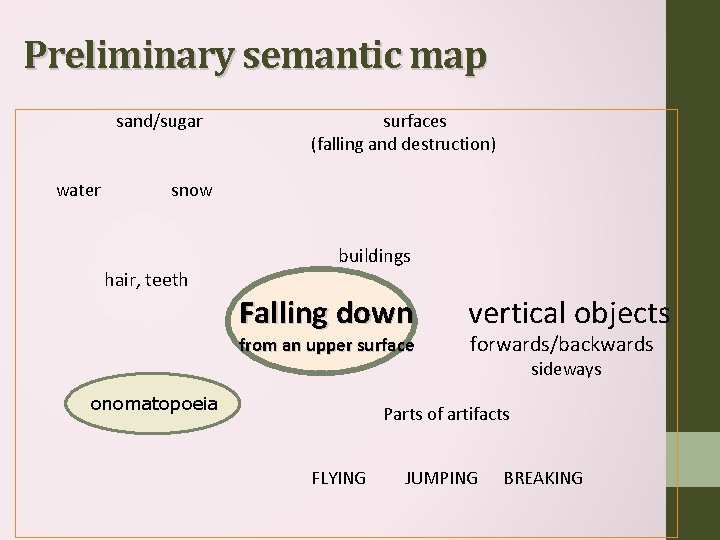
Preliminary semantic map sand/sugar water surfaces (falling and destruction) snow hair, teeth buildings Falling down from an upper surface onomatopoeia vertical objects forwards/backwards sideways Parts of artifacts FLYING JUMPING BREAKING
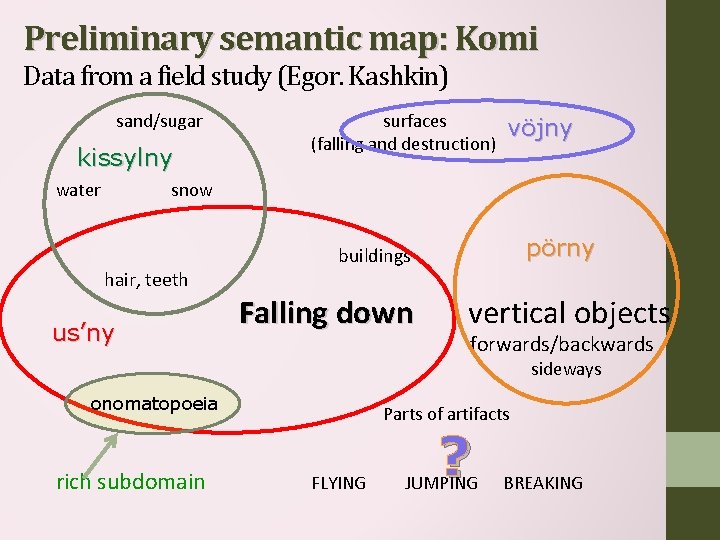
Preliminary semantic map: Komi Data from a field study (Egor. Kashkin) sand/sugar kissylny water surfaces (falling and destruction) vöjny snow hair, teeth us’ny pörny buildings Falling down vertical objects forwards/backwards sideways onomatopoeia rich subdomain Parts of artifacts FLYING ? JUMPING BREAKING
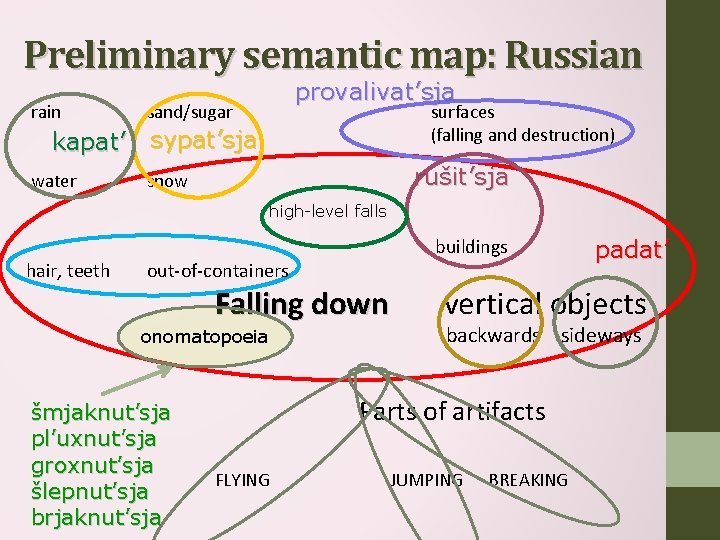
Preliminary semantic map: Russian rain provalivat’sja sand/sugar surfaces (falling and destruction) kapat’ sypat’sja water rušit’sja snow high-level falls hair, teeth buildings out-of-containers Falling down onomatopoeia šmjaknut’sja pl’uxnut’sja groxnut’sja šlepnut’sja brjaknut’sja vertical objects backwards sideways Parts of artifacts FLYING padat’ JUMPING BREAKING
B 1. Related semantic fields: flying (Plungian, Rakhilina 2007) • The lexical domain of ‘flying’ (‘moving through the air’) proves not to be elementary. • In the languages of the world it often splits into two zones, or sub-domains. • Active sub-domain covers staying in the air of a living creature who abruptly moves its limbs. • Passive sub-domain describes an inanimate object’s movement through the air caused by an external force applied to it. • Cognitive distinction between them is manifested in different strategies of conceptual assimilation applied in the two cases:
B 1. Related semantic fields: flying • Flying may be conceptualized either as jumping (active flying) flying or falling (passive flying). flying • This explains why in various languages the meanings ‘fall’ and ‘fly’ are interchangeable in some contexts, cf. English fall off ~ fly off. • There also cases when the meanings ‘fly’ and ‘fall’ are combined within one predicate (similarly to what happens to ‘fly’ and ‘jump’); native speakers then perceive the two meanings as closely related to each other. • The most known case is Sanskrit pat- which had two meanings ‘fall’ and ‘fly’; ‘fly’ this polysemy is preserved in many modern Indo-Arian languages. 39
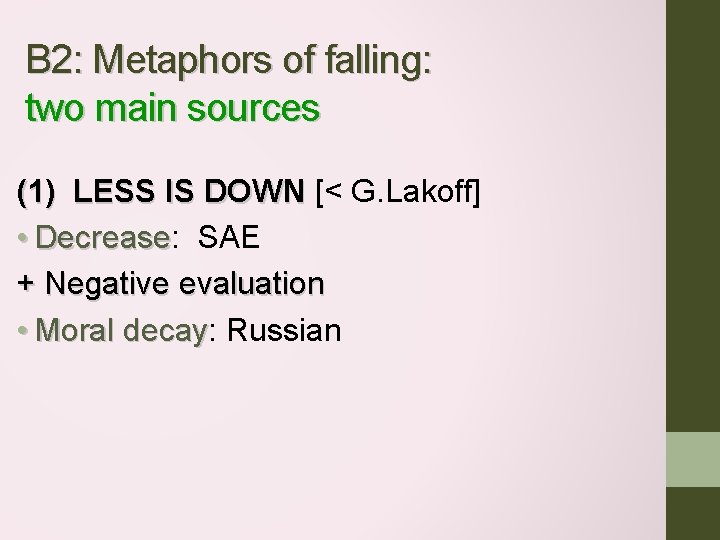
B 2: Metaphors of falling: two main sources (1) LESS IS DOWN [< G. Lakoff] • Decrease: Decrease SAE + Negative evaluation • Moral decay: decay Russian
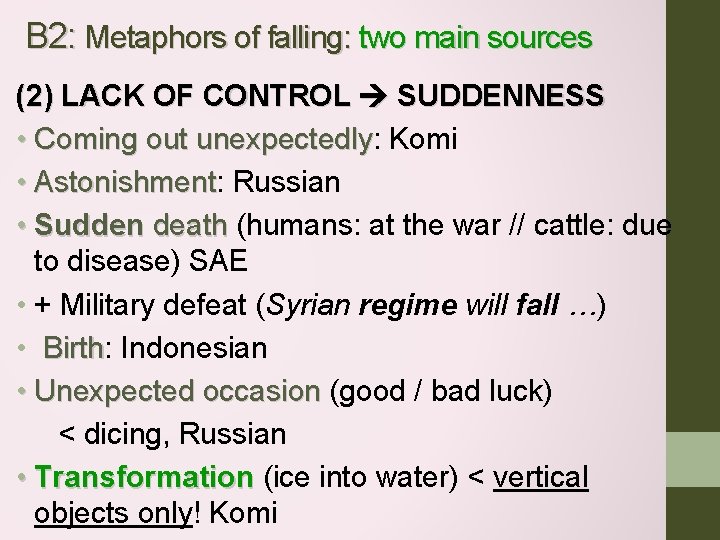
B 2: Metaphors of falling: two main sources (2) LACK OF CONTROL SUDDENNESS • Coming out unexpectedly: unexpectedly Komi • Astonishment: Astonishment Russian • Sudden death (humans: at the war // cattle: due to disease) SAE • + Military defeat (Syrian regime will fall …) • Birth: Birth Indonesian • Unexpected occasion (good / bad luck) < dicing, Russian • Transformation (ice into water) < vertical objects only! Komi
Dreams and Plans • 20 -30 languages, including Russian gesture language • Direct meanings & semantic maps • Types of systems • Metaphorical extensions • Cases of intersection with other semantic fields • Statistical experiments 42
And grammaticalization paths -? Heine, Kuteva 2002: 133 • Some African Languages: Fall > down (adverb) • Korean, Tamil Fall > passive suffix 43
- Slides: 43