
SEMANTIC INTEGRITY CONTROL CENTRALIZED DISTRIBUTED PERTEMUAN 7 IR
SEMANTIC INTEGRITY CONTROL CENTRALIZED & DISTRIBUTED PERTEMUAN 7 IR. NIZIRWAN ANWAR, MT PROGRAM STUDI TEKNIK INFORMATIKA FAKULTAS ILMU KOMPUTER
Semantic Data Control Involves Semantic Data Control ; v View management v Security control v Integrity control
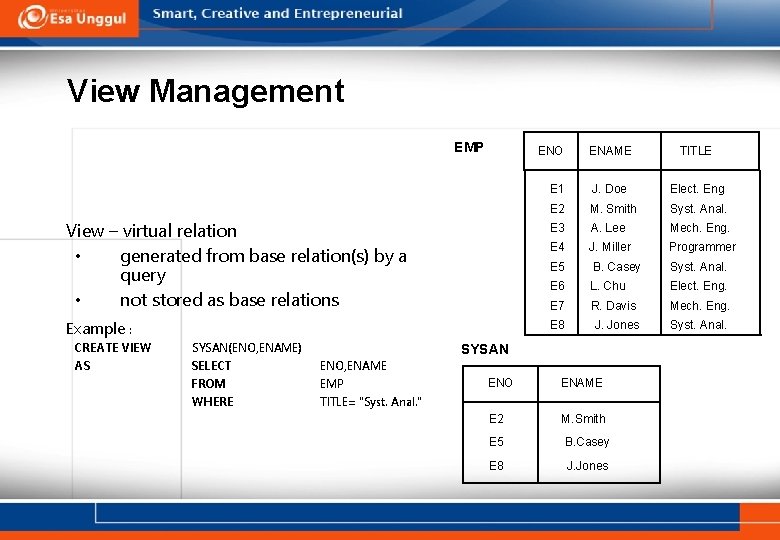
View Management EMP ENAME TITLE E 1 J. Doe Elect. Eng E 2 M. Smith Syst. Anal. View – virtual relation • generated from base relation(s) by a query • not stored as base relations E 3 A. Lee Mech. Eng. E 4 J. Miller Programmer E 5 B. Casey Syst. Anal. E 6 L. Chu Elect. Eng. E 7 R. Davis Mech. Eng. Example : E 8 J. Jones Syst. Anal. CREATE VIEW AS SYSAN(ENO, ENAME) SELECT FROM WHERE ENO SYSAN ENO, ENAME EMP TITLE= "Syst. Anal. " ENO ENAME E 2 M. Smith E 5 B. Casey E 8 J. Jones
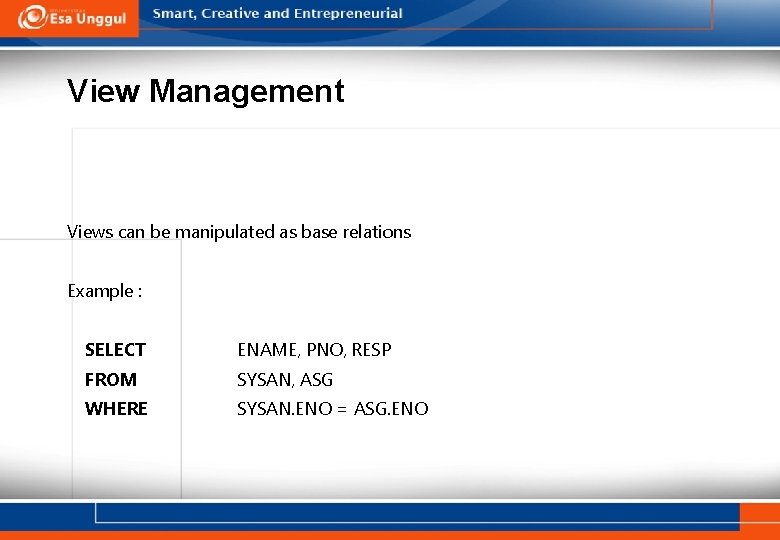
View Management Views can be manipulated as base relations Example : SELECT ENAME, PNO, RESP FROM SYSAN, ASG WHERE SYSAN. ENO = ASG. ENO
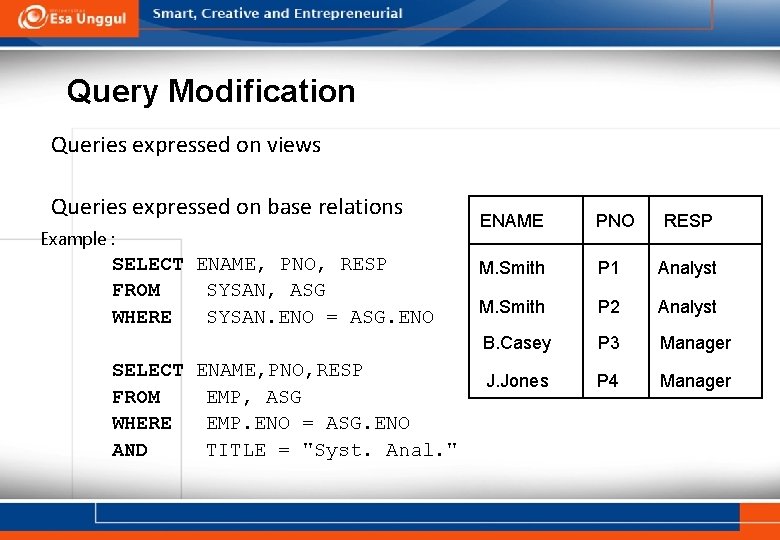
Query Modification Queries expressed on views Queries expressed on base relations Example : SELECT ENAME, PNO, RESP FROM SYSAN, ASG WHERE SYSAN. ENO = ASG. ENO SELECT ENAME, PNO, RESP FROM EMP, ASG WHERE EMP. ENO = ASG. ENO AND TITLE = "Syst. Anal. " ENAME PNO RESP M. Smith P 1 Analyst M. Smith P 2 Analyst B. Casey P 3 Manager J. Jones P 4 Manager
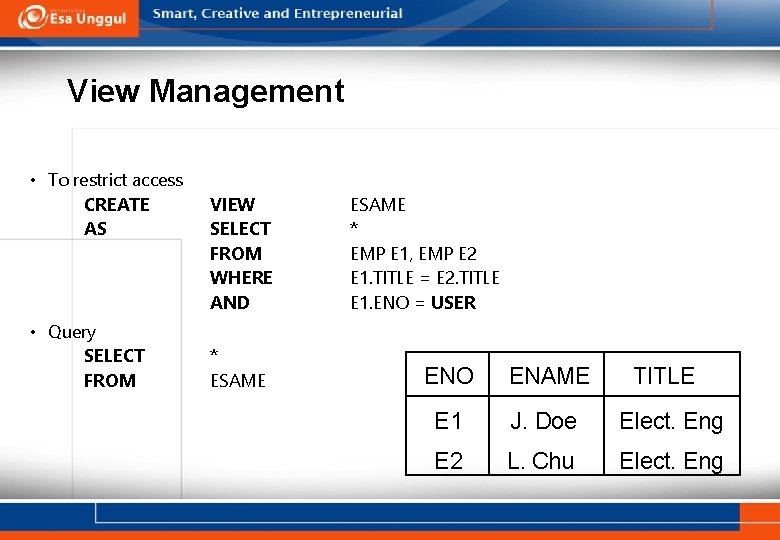
View Management • To restrict access CREATE AS • Query SELECT FROM VIEW SELECT FROM WHERE AND * ESAME * EMP E 1, EMP E 2 E 1. TITLE = E 2. TITLE E 1. ENO = USER ENO ENAME TITLE E 1 J. Doe Elect. Eng E 2 L. Chu Elect. Eng
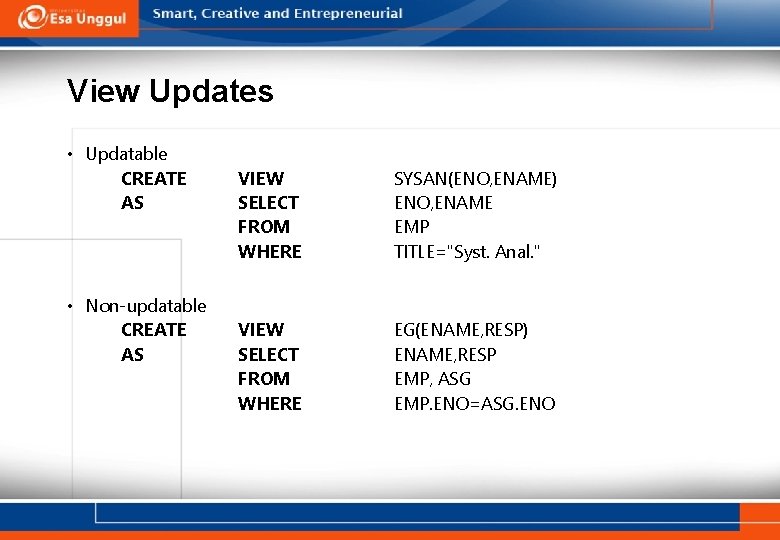
View Updates • Updatable CREATE AS • Non-updatable CREATE AS VIEW SELECT FROM WHERE SYSAN(ENO, ENAME) ENO, ENAME EMP TITLE="Syst. Anal. " VIEW SELECT FROM WHERE EG(ENAME, RESP) ENAME, RESP EMP, ASG EMP. ENO=ASG. ENO
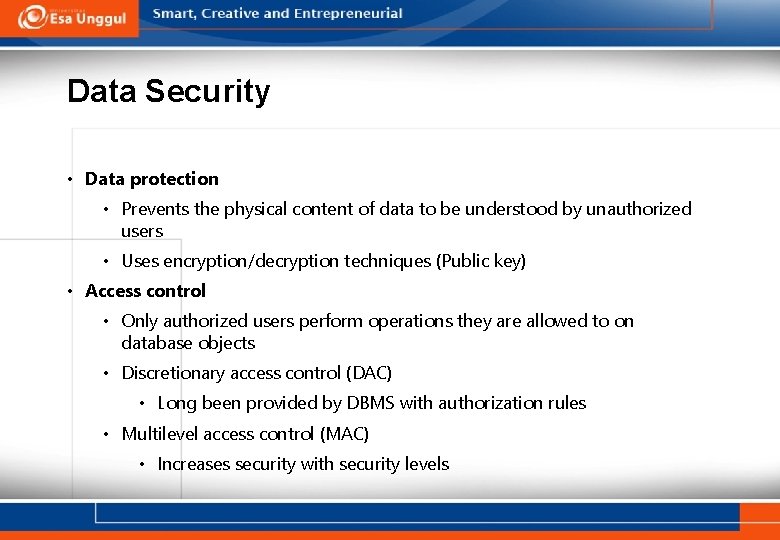
Data Security • Data protection • Prevents the physical content of data to be understood by unauthorized users • Uses encryption/decryption techniques (Public key) • Access control • Only authorized users perform operations they are allowed to on database objects • Discretionary access control (DAC) • Long been provided by DBMS with authorization rules • Multilevel access control (MAC) • Increases security with security levels
Discretionary Access Control • Main actors • Subjects (users, groups of users) who execute operations • Operations (in queries or application programs) • Objects, on which operations are performed • Checking whether a subject may perform an op. on an object • Authorization= (subject, op. type, object def. ) • Defined using GRANT OR REVOKE • Centralized: one single user class (admin. ) may grant or revoke • Decentralized, with op. type GRANT • More flexible but recursive revoking process which needs the hierarchy of grants
Multilevel Access Control • Different security levels (clearances) • Top Secret > Confidential > Unclassified • Access controlled by 2 rules: • No read up • subject S is allowed to read an object of level L only if level(S) ≥L • Protect data from unauthorized disclosure, e. g. a subject with secret clearance cannot read top secret data • No write down: • subject S is allowed to write an object of level L only if level(S) ≤L • Protect data from unauthorized change, e. g. a subject with top secret clearance can only write top secret data but not secret data (which could then contain top secret data)
Distributed Access Control • Additional problems in a distributed environment • Remote user authentication • Typically using a directory service • Should be replicated at some sites for availability • Management of DAC rules • Problem if users’ group can span multiple sites • Rules stored at some directory based on user groups location • Accessing rules may incur remote queries • Covert channels in MAC
Semantic Integrity Control Maintain database consistency by enforcing a set of constraints defined on the database. • Structural constraints • basic semantic properties inherent to a data model e. g. , unique key constraint in relational model • Behavioral constraints • regulate application behavior, e. g. , dependencies in the relational model • Two components • Integrity constraint specification • Integrity constraint enforcement
Semantic Integrity Control • Procedural control embedded in each application program • Declarative assertions in predicate calculus • easy to define constraints • definition of database consistency clear • inefficient to check assertions for each update • limit the search space • decrease the number of data accesses/assertion • preventive strategies • checking at compile time
- Slides: 13