
Semantic Decomposition for Question Answering Introduction Decomposable questions
Semantic Decomposition for Question Answering 于佳婕
Introduction • Decomposable questions & Atomic questions • Decomposition form:sequences of two questions, later questions are built on top of the answers to earlier questions. • 6 decomposition classes, linked to different decomposition methods. • Decomposition methods are mostly based on the semantic representation of questions(Multi. Net formalism )
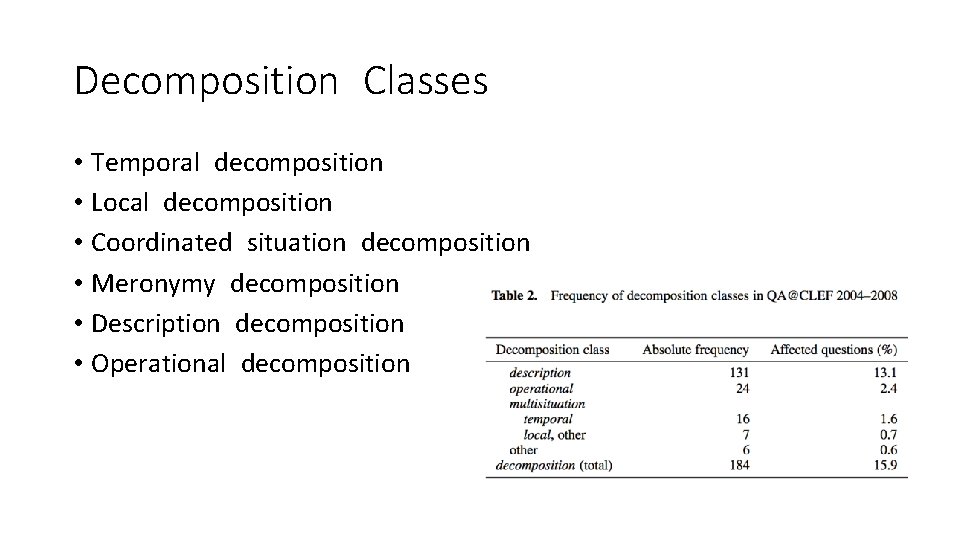
Decomposition Classes • Temporal decomposition • Local decomposition • Coordinated situation decomposition • Meronymy decomposition • Description decomposition • Operational decomposition
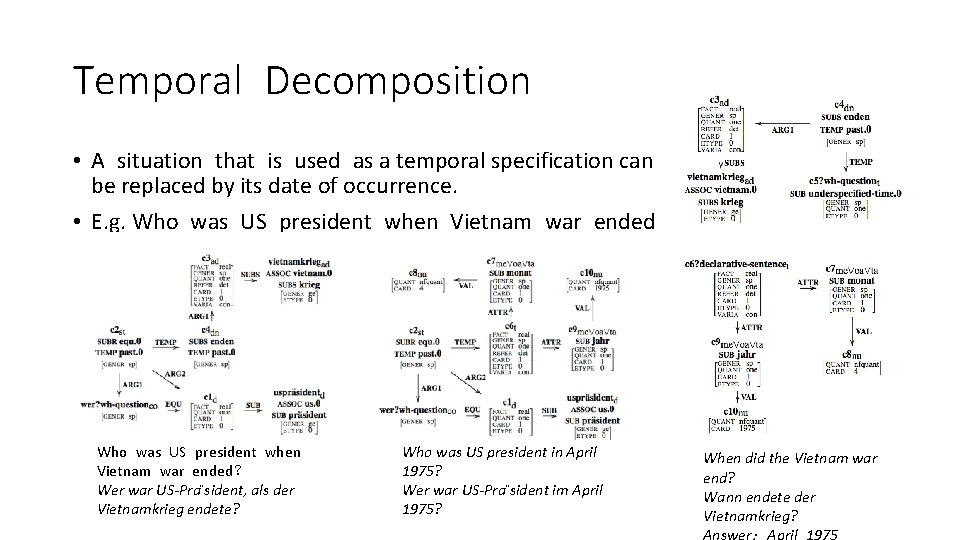
Temporal Decomposition • A situation that is used as a temporal specification can be replaced by its date of occurrence. • E. g. Who was US president when Vietnam war ended ? Who was US president when Vietnam war ended? Wer war US-Pra sident, als der Vietnamkrieg endete? Who was US president in April 1975? Wer war US-Pra sident im April 1975? When did the Vietnam war end? Wann endete der Vietnamkrieg?
Local Decomposition • a local (or spatial) restriction can be replaced by the answer(s) to a subquestion about the exact location(s) fulfilling the restriction. • E. g. Which parties reign in countries that are in Northern Europe? =》(subquestion)Which countries are located in Northern Europe? =》(revised question with a list-valued answer)Which parties reign in Sweden, Norway, and Finland?
Coordinated Situation Decomposition • A question can contain several propositions also in the form of a conjunction of situations, often involving ellipsis. • E. g. Which football players played for Borussia Dortmund and Real Madrid? =》(subquestion)Which football players played for Borussia Dortmund? =》(revised question with a list-valued answer)Do …… played for Real Madrid?
Multisituation Decomposition • Involve 2 situations that are linked by a relation in the semantic network for the question. • Includes: • Temporal Decomposition • Local Decomposition • Coordinated situation Decomposition
Meronymy Decomposition • Meronymy decomposition tries to generate and exploit geographical knowledge on the fly (here: meronymy knowledge for geographical objects). • E. g. When did a hurricane hit Northern Germany? =》 (subquestion) Which regions/cities are in Northern Germany? =》(revised question with a list-valued answer)When did a hurricane hit Niedersachsen/Hamburg……?
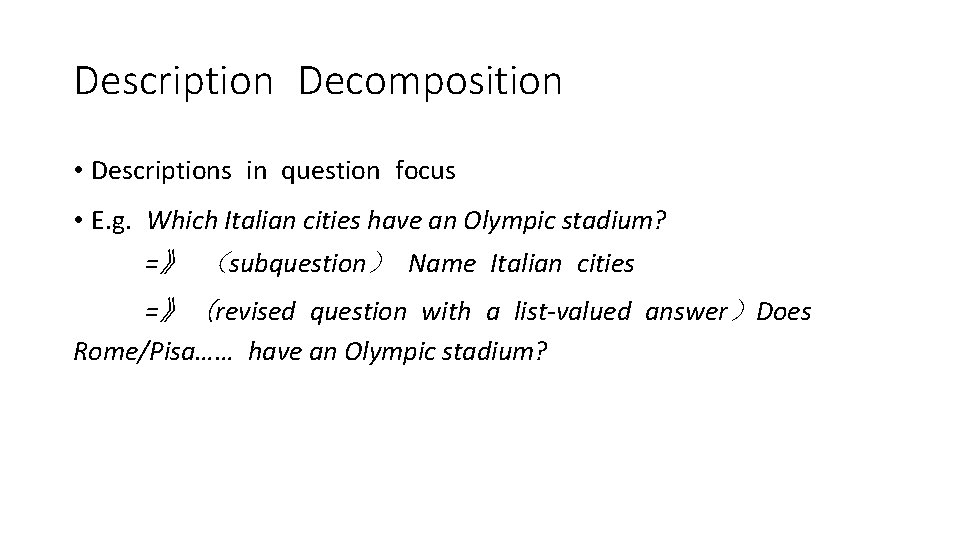
Description Decomposition • Descriptions in question focus • E. g. Which Italian cities have an Olympic stadium? =》 (subquestion) Name Italian cities =》(revised question with a list-valued answer)Does Rome/Pisa…… have an Olympic stadium?
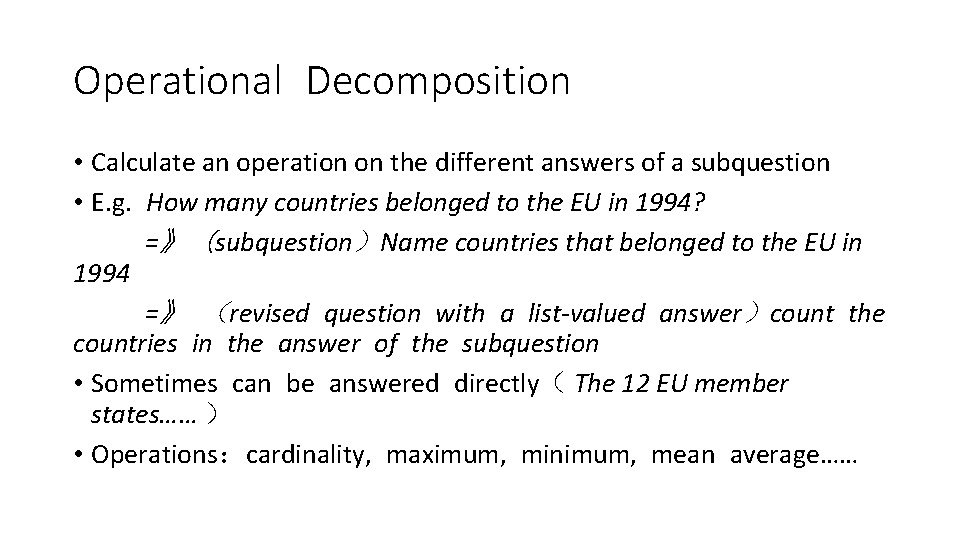
Operational Decomposition • Calculate an operation on the different answers of a subquestion • E. g. How many countries belonged to the EU in 1994? =》(subquestion)Name countries that belonged to the EU in 1994 =》 (revised question with a list-valued answer)count the countries in the answer of the subquestion • Sometimes can be answered directly( The 12 EU member states…… ) • Operations:cardinality, maximum, minimum, mean average……
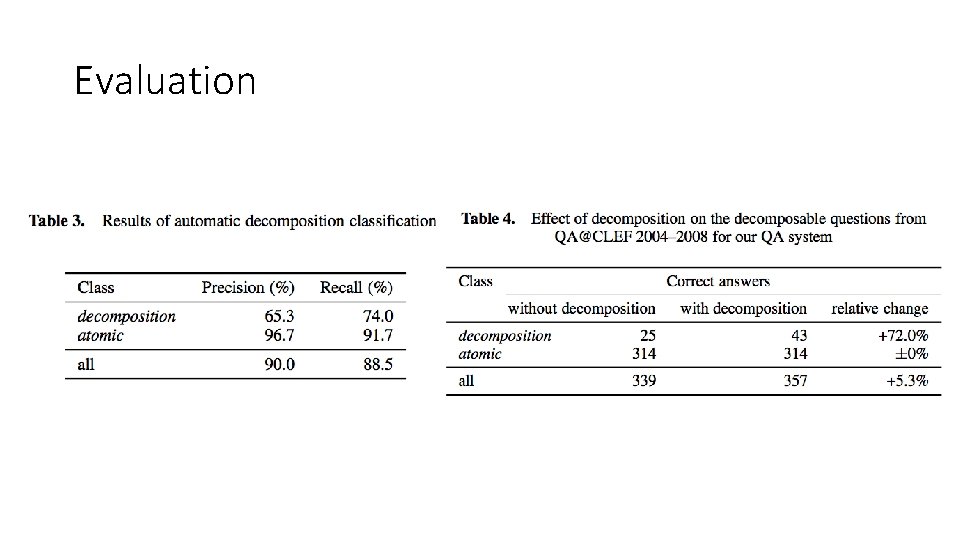
Evaluation
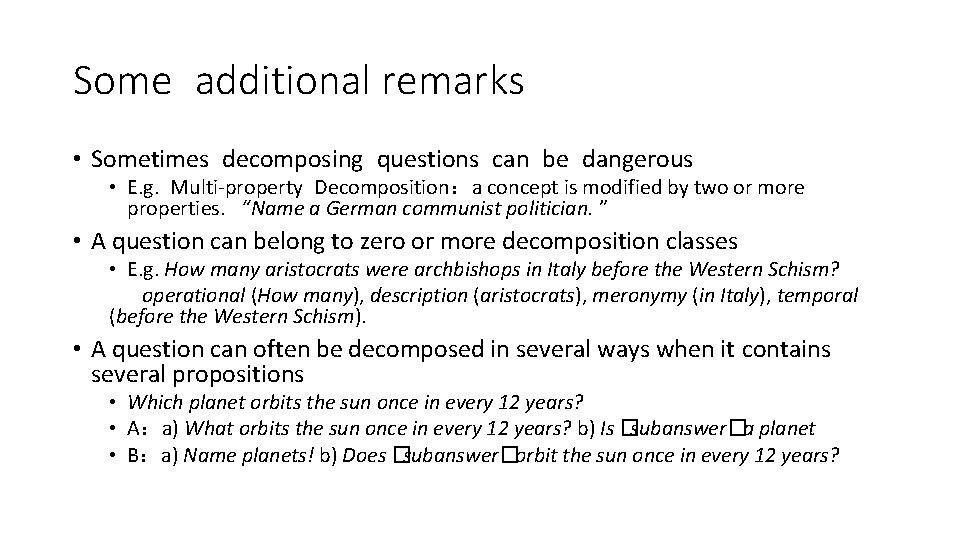
Some additional remarks • Sometimes decomposing questions can be dangerous • E. g. Multi-property Decomposition:a concept is modified by two or more properties. “Name a German communist politician. ” • A question can belong to zero or more decomposition classes • E. g. How many aristocrats were archbishops in Italy before the Western Schism? operational (How many), description (aristocrats), meronymy (in Italy), temporal (before the Western Schism). • A question can often be decomposed in several ways when it contains several propositions • Which planet orbits the sun once in every 12 years? • A:a) What orbits the sun once in every 12 years? b) Is �subanswer�a planet • B:a) Name planets! b) Does �subanswer�orbit the sun once in every 12 years?
A decomposition task • Which class does the question belong to • Where to split • How to adjust question type • How to integrate the subanswer(s) into the original question to form the revised question(s)
- Slides: 13